In the hyper-competitive tech landscape, your brand is more than just a logo; it’s the foundation of your company’s identity and reputation. A well-defined brand guideline acts as the North Star, ensuring consistency across all touchpoints, from investor presentations to social media interactions.
Without it, you risk diluting your message and confusing your audience. This guide provides actionable strategies to build and maintain a robust brand identity, helping your tech startup stand out and build lasting trust and authority. Let’s see what actually works, cutting through the theoretical fluff.
Quick Answer: What Are Brand Guidelines for Tech Startups?
Brand guidelines are comprehensive documents that define how your tech startup should look, sound, and behave across all touchpoints. They include visual identity standards (logos, colors, fonts), messaging frameworks, and implementation rules that ensure consistency as you scale. For tech startups, they’re essential for building trust, standing out in competitive markets, and maintaining professional credibility with investors and customers.
Key Takeaways
- Brand guidelines are strategic tools that help tech startups compete with established companies
- Consistency across touchpoints builds trust and recognition faster than perfect design
- Implementation matters more than perfection – create guidelines your team will actually use
- Scale gradually – start with essentials and expand based on growth needs
- Regular audits and updates keep guidelines relevant and effective
What is brand guideline and why tech startups need comprehensive branding
What Are Brand Guidelines?
Brand guidelines are your startup’s core visual and verbal identity. A detailed document that dictates how your company should look, sound, and behave across every interaction. Consider it your brand’s instruction manual, ensuring consistency whether you’re presenting to investors, launching a new feature, or engaging on social media.
For tech startups navigating crowded markets, brand guidelines are essential. They’re strategic tools that help you stand out and build trust quickly. When you’re up against established competitors, a strong brand can level the playing field, making your startup appear more polished and reliable.
What sets successful tech startup branding apart is specificity. Your brand guideline document should offer clear instructions for logo usage, color codes (specifying “Hex #2563EB” instead of just “blue”), font choices, and voice guidelines that your entire team can easily follow.
Essential Brand Guideline Components
- Brand story and mission – Your why and unique value
- Visual identity – Logo, colors, fonts, imagery
- Logo usage rules – Sizes, spacing, variations
- Color palette – Hex codes, RGB, CMYK values
- Font standards – Primary, secondary, hierarchy
- Image guidelines – Style, composition, treatment
- Voice and tone – Communication personality
- Messaging framework – Key messages, positioning
- Real-world examples – Do’s and don’ts
Tech companies that prioritize comprehensive branding early on often see tangible results: quicker customer recognition, higher perceived value, easier recruitment, and more successful funding rounds. Your brand guidelines become the bedrock for scaling your digital marketing efforts without sacrificing consistency as your team expands.
How to create a brand guideline: Essential foundation elements
Step-by-Step Brand Guideline Creation Process
- Audit existing materials – Collect all current brand touchpoints
- Define brand strategy – Target audience, value proposition, positioning
- Develop brand story – Why you exist, problem you solve, differentiation
- Create brand personality – Specific adjectives that guide decisions
- Design visual identity – Logo, colors, fonts, imagery
- Document standards – Clear rules and examples
- Create templates – Make compliance easy
- Test and refine – Gather feedback and iterate
Creating brand guidelines begins with strategic thinking, not just design. Before opening design software or hiring a designer, you need to solidify your brand strategy. This involves defining your target audience precisely, articulating your unique value, and identifying your competitive position.
Begin by auditing your existing materials. Collect everything: your website, pitch decks, social media, email signatures, and any marketing materials. You’ll likely find inconsistencies that weaken your brand. Document these issues; your new guidelines will address them.
The foundation of creating a brand guideline starts with your brand story. Write a concise narrative that explains why your startup exists, the problem you solve, and how you differ from competitors. This story guides all creative decisions. Every color, font, and message should support it.
Then, define your brand personality using specific adjectives. Instead of vague terms like “innovative,” choose distinctive descriptors like “analytically bold,” “refreshingly straightforward,” or “confidently understated.” These traits will inform your visual and verbal identity.
Brand Guideline Document Structure
- Brand strategy overview – Mission, vision, values
- Visual identity – Logo system, colors, fonts
- Logo standards – Usage rules and restrictions
- Color palette – Primary and secondary colors with codes
- Typography – Font hierarchy and specifications
- Image guidelines – Style, composition, treatment rules
- Voice and tone – Communication personality and examples
- Messaging framework – Key messages and positioning
- Application examples – Real-world usage scenarios
Use tools like Notion, Figma, or brand management platforms such as Frontify to create your guidelines. The goal is to make them accessible and searchable for your team. Include downloadable assets, code snippets for developers, and approval workflows to maintain quality as you grow.
Remember that creating brand guidelines is ongoing. Start with a basic guide covering the essentials, then expand it based on usage and feedback. The aim is to create a living document that evolves with your startup while maintaining core consistency.
Now that you’ve laid the groundwork for your brand guidelines, let’s move on to the specifics of visual identity and design standards. This is where your brand strategy translates into tangible elements that your audience will see and interact with.
Brand identity guidelines: Visual elements and design standards
Your visual identity is where brand strategy meets customer perception. Every detail matters because you have limited time to make an impression. Brand identity guidelines translate abstract brand concepts into clear visual standards for your team. For an example of a successful branding and launch campaign, consider the work done for Bucharest Gaming Week.
Visual Identity Checklist
Logo System Development:
- Primary logo (full version)
- Secondary logo (simplified)
- Horizontal and stacked versions
- Monochrome versions (black, white)
- Minimum size specifications
- Clear space requirements
- “What not to do” examples
Color Palette Specifications:
- 3-5 primary colors with exact codes
- 3-5 secondary/accent colors
- Digital codes (Hex, RGB)
- Print codes (CMYK, Pantone)
- Accessibility compliance checks
- Color combination rules
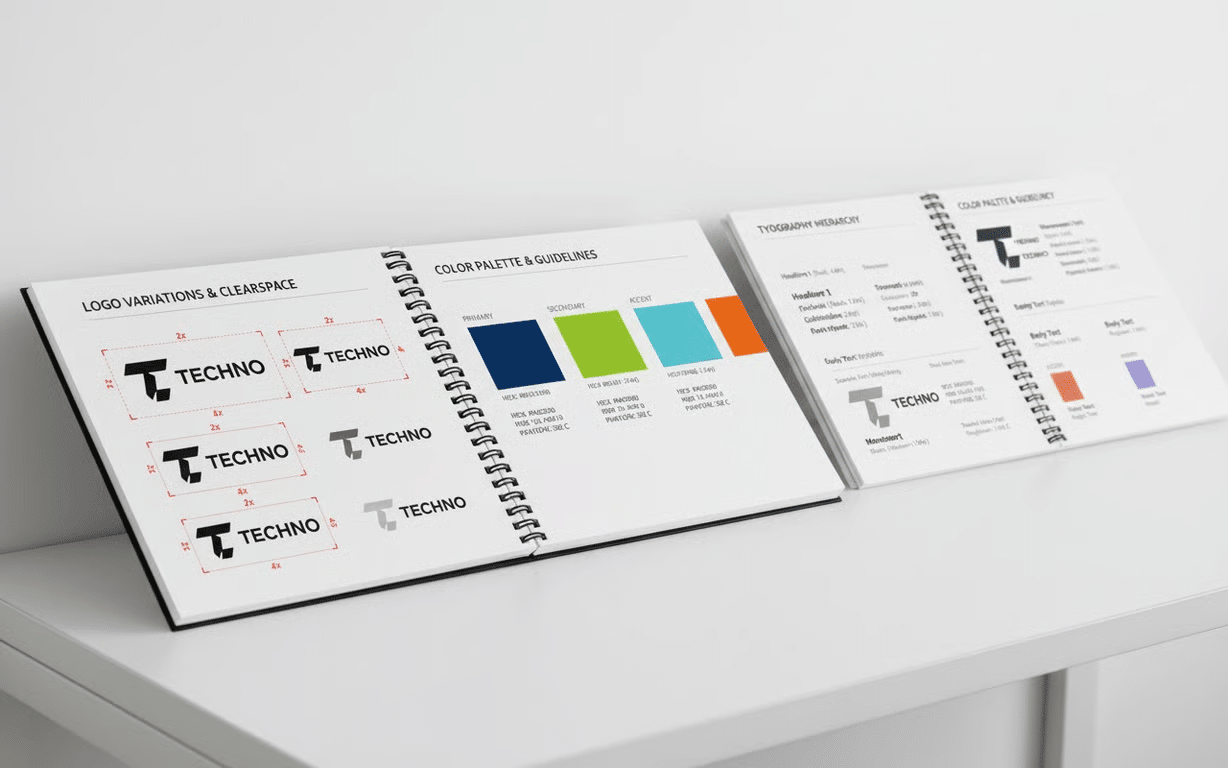
Begin with your logo system, not just a single logo. Develop primary and secondary logo options, including horizontal and stacked versions, monochrome versions, and simplified versions for small spaces. Define minimum size limits, clear space requirements, and a “what not to do” section showing incorrect examples.
Your color palette requires precision. Choose 3-5 primary colors and 3-5 secondary colors, providing codes for digital (Hex, RGB) and print (CMYK, Pantone). Include accessibility guidelines ensuring sufficient contrast for web compliance. Create rules showing which colors work well together and which to avoid.
Font hierarchy establishes information structure across all communications. Select primary and secondary fonts that reflect your brand while ensuring readability. Define font weights, sizes, and spacing for headers, body text, and interface elements. Include web font specifications and backup options for developers.
Image guidelines prevent the use of random stock photos. Define your visual style through mood boards, color treatments, composition rules, and subject preferences. Specify whether you use photography, illustrations, or both, and provide examples of appropriate versus inappropriate images.
Create a brand style guide that includes grid systems, spacing standards, and layout principles. These specifications ensure consistency across digital and print. Include templates for presentations, social media posts, and email signatures to streamline content creation while maintaining brand standards.
With your visual identity defined, it’s time to articulate your brand’s unique position in the market. This involves crafting a compelling messaging framework that resonates with your target audience and sets you apart from the competition.
Tech brand positioning and messaging framework
How to Position Your Tech Startup
Effective tech brand positioning uses this framework: “For [target audience] who [need/problem], [your company] is the [category] that [unique benefit] because [reasons to believe].” This forces clarity and prevents vague positioning that hinders many tech startups.
Tech brand positioning goes beyond features to communicate why customers should care about your solution. Your positioning strategy determines how you occupy space in your target market’s minds, setting you apart from competitors with similar features.
Develop your positioning statement using this framework: “For [target audience] who [need/problem], [your company] is the [category] that [unique benefit] because [reasons to believe].” This forces clarity and prevents the vague positioning that hinders many tech startups. Your positioning should be unique enough that competitors couldn’t use it.

Three-Tier Messaging Framework
Tier 1: Primary Value
The main benefit your solution provides – this should be memorable and differentiated
Tier 2: Supporting Messages
Proof points and key features that validate your primary value proposition
Tier 3: Tactical Messages
Specific use cases, technical capabilities, and detailed benefits for different audiences
Implementation Steps:
- Define your core positioning statement
- Create audience-specific message variations
- Develop competitive differentiation points
- Test messages through customer interviews
- Refine based on feedback and results
Your messaging framework builds on positioning to create consistent communication. Develop three tiers of messaging: primary value (the main benefit), supporting messages (proof points and features), and tactical messages (specific uses). Each tier should reinforce your core positioning, ultimately supporting your B2B lead generation goals.
Create audience-specific messaging because different stakeholders care about different benefits. Your messaging for technical users should emphasize capabilities, while executive messaging focuses on business outcomes. Document these variations in your brand guidelines to align sales and marketing.
Develop a competitive messaging matrix that positions your startup against competitors. Identify your differentiators and create messaging that highlights these advantages without attacking competitors. Focus on your strengths to maintain credibility.
Test your messaging through customer interviews, A/B testing, and sales feedback. Track which messages resonate most and refine your framework. Your messaging should evolve as you gather feedback while staying consistent with your core positioning.
Now that you understand the theory behind brand guidelines, let’s examine some real-world examples and best practices for implementation. This will give you a clearer picture of what works and how to apply these principles to your own tech startup.
Brand style guide examples and best practices for implementation
Examining successful brand style guides reveals patterns that distinguish effective guidelines. Companies like Slack and Mailchimp have created guides that are actually used because they prioritize clarity over design awards.
Effective Brand Style Guide Structure
- Brand Overview – Mission and values (1 page)
- Visual Identity Standards – Logo, colors, fonts
- Specific Applications – Web, social media, print
- Templates and Resources – Downloadable assets
- Contact Information – Brand team contacts
Effective brand style guides follow a modular structure that allows team members to find information quickly. Start with a brand overview that explains your mission and values on one page. Follow with visual identity standards, then specific applications like web and social media. End with resources like asset downloads and contact information.
Implementation depends on making your guidelines accessible. Create a central hub where team members can access assets and guidelines. Use tools like Figma for design assets, Notion for documentation, or brand management platforms like Frontify for comprehensive management.

Implementation Best Practices
Make Guidelines Accessible:
- Create a central digital hub for all brand assets
- Use cloud-based tools for real-time access
- Organize assets by category and use case
- Include search functionality for quick finding
Develop Supporting Materials:
- Video walkthroughs of brand application
- Template libraries for common materials
- Quick reference cards for key standards
- Training materials for new team members
Establish Governance:
- Designate brand champions in each department
- Create approval workflows for important materials
- Set up regular brand compliance audits
- Provide feedback mechanisms for improvements
Develop brand training materials that go beyond the written guidelines. Create video walkthroughs showing how to apply brand standards. Build template libraries for materials like pitch decks and social media posts. The easier it is to follow standards, the more likely your team will maintain consistency.
Establish brand governance processes that maintain quality without slowing execution. Designate brand champions who can answer questions and review materials. Create approval workflows for important materials while allowing flexibility for internal communications.
Monitor brand compliance through regular audits. Check your website and social media quarterly to identify inconsistencies. Use tools like Google Alerts to monitor how your brand appears externally and ensure third parties represent your brand correctly.
Update your guidelines regularly based on usage and feedback. Track which sections are referenced most and which cause confusion. Evolve your standards based on new platforms while maintaining core consistency.
With your brand guidelines in place, the next challenge is ensuring they’re consistently applied across all digital platforms and touchpoints. This requires a proactive approach and the right tools to maintain a cohesive brand experience.
Maintaining brand consistency across digital platforms and touchpoints
How to Maintain Brand Consistency
Systematic brand consistency requires three key elements: comprehensive auditing of all touchpoints, platform-specific adaptation guidelines, and automated monitoring tools. The goal is creating a seamless brand experience across all customer interactions.
Maintaining brand consistency requires systematic thinking and tools. With the average tech startup managing many digital touchpoints, consistency becomes a challenge that impacts customer perception.
Brand Consistency Action Plan
Step 1: Comprehensive Audit
- Website and mobile app interfaces
- Social media profiles and content
- Email signatures and templates
- Digital advertising materials
- SaaS product interface
- Customer support materials
- Sales presentations and collateral
Step 2: Platform-Specific Standards
- Social media image specifications
- Email template guidelines
- Web style guide for developers
- Mobile app design standards
- Presentation template rules
Step 3: Implementation Tools
- Digital asset management system
- Brand monitoring tools
- Template libraries
- Approval workflow systems
Audit every place your brand appears online. Include your website, mobile app, social media, email signatures, digital advertising, SaaS interface, and customer support. Document current brand application and identify inconsistencies.
Develop platform-specific standards that adapt your guidelines to each channel. Social media platforms have different image sizes and audience expectations. Your guide should include specifications for LinkedIn headers and Instagram story templates.
Implement brand management tools that centralize assets. Use digital asset management systems like Brandfolder to ensure team members access current files. Set up automated brand monitoring using tools like Mention to track how your brand appears online.
Create templates for common digital materials. Develop PowerPoint templates with locked brand elements, social media templates, email signature generators, and web style guides for developers.
Establish quality control processes that catch inconsistencies. Implement approval workflows, conduct monthly audits, and create feedback loops that help team members learn from mistakes.
Your brand should feel seamless across all digital touchpoints, creating a cohesive experience. Consistency often matters more than perfection because customers interact with your brand across multiple platforms.
Finally, as your tech startup grows, your brand guidelines must evolve to meet new challenges and opportunities. This requires a flexible and scalable approach to brand management that can adapt to changing market conditions and organizational structures.
Scaling your brand guidelines as your tech startup grows
Brand Scaling Strategy
Organizational Planning:
- Define brand decision-making authority
- Identify brand stewards for each department
- Create brand training programs for new hires
- Establish escalation processes for brand decisions
Guideline Expansion:
- Add standards for new products and features
- Create international market adaptations
- Develop customer success brand materials
- Include partner and vendor brand requirements
Technology Solutions:
- Invest in scalable brand management platforms
- Implement design systems for development
- Use automated brand compliance tools
- Create self-service brand resource portals
Scaling brand guidelines requires anticipating growth challenges. As your startup grows, your brand management must evolve from informal oversight to systematic processes.
Plan for organizational changes that affect brand management. Early-stage startups can rely on founder oversight, but scaling companies need brand stewards and training programs. Document decision-making authority to prevent inconsistencies.
Expand your guidelines to cover new products and markets. Your initial guidelines might focus on core product marketing, but scaling requires standards for customer success and international markets. Create guidelines that can accommodate new applications.
Develop brand training programs that onboard new team members. Create materials that explain why choices were made and how they support business objectives. Include exercises that help new hires apply brand standards.
Implement technology solutions that support consistency. Invest in brand management platforms that provide asset libraries and approval workflows. Use design systems that allow developers to build on-brand interfaces.
Create feedback mechanisms that help your guidelines evolve. Conduct quarterly reviews to identify pain points. Track brand compliance and adjust guidelines based on common mistakes. Your process should be iterative, responding to growth while maintaining consistency.
Frequently Asked Questions
1. What is the difference between brand guidelines and a brand style guide?
Answer: Brand guidelines are comprehensive, covering strategy, visual identity, and messaging. A brand style guide focuses on visual elements like logos and colors. Guidelines are broader and include the style guide as a component.
2. How long should it take to create brand guidelines for a tech startup?
Answer: Creating guidelines typically takes 4-8 weeks, including strategy (1-2 weeks), visual identity (2-3 weeks), documentation (1-2 weeks), and review (1 week). Rushing can lead to incomplete guidelines.
3. Should tech startups hire an agency or create brand guidelines internally?
Answer: This depends on budget and capabilities. Agencies offer expertise but cost $15,000-$50,000+. Internal development costs less but requires time. Many startups use a hybrid approach.
4. How often should brand guidelines be updated?
Answer: Review guidelines quarterly for minor updates and conduct comprehensive reviews annually. Major updates should occur when launching new products or rebranding. Maintain consistency while allowing evolution.
5. What’s the biggest mistake tech startups make with brand guidelines?
Answer: Creating guidelines that are too complex to implement. Focus on creating practical guidelines that your team will actually use.
6. How do you ensure team compliance with brand guidelines?
Answer: Make compliance easy through templates and training. Establish approval processes and conduct regular audits. Positive reinforcement works better than policing.
7. What tools are essential for managing brand guidelines?
Answer: Essential tools include a digital asset management system (Brandfolder), design platform (Figma), documentation hub (Notion), and brand monitoring tools (Mention).
8. How detailed should logo usage guidelines be?
Answer: Logo guidelines should cover sizes, clear space, color variations, placement, and examples of misuse. Detailed guidelines prevent mistakes.
9. Should brand guidelines include competitor analysis?
Answer: Include competitive context in your strategy section but avoid detailed analysis in operational guidelines. Focus on how your brand differentiates.
10. How do you measure the success of brand guidelines?
Answer: Track consistency, team compliance, time saved on production, and brand recognition. Conduct audits and monitor customer feedback. Success means consistent application that supports business objectives.
Take Action
Your Next Steps to Implement Brand Guidelines:
- Audit your current brand presence – Document all touchpoints and identify inconsistencies
- Prioritize essential brand assets – Start with logo, colors, and key messaging
- Create templates and resources – Make it easy for your team to stay on-brand
- Establish governance processes – Set up approval workflows and regular audits
- Train your team – Ensure everyone understands and can apply the guidelines
- Monitor and iterate – Regularly review and update based on feedback and growth
Implementing these brand guidelines isn’t a one-time task; it’s an ongoing commitment. Start by auditing your current brand presence and identifying areas for improvement. Then, prioritize the creation of essential brand assets and templates. Finally, establish a clear process for brand governance and training. By taking these steps, you’ll build a strong, consistent brand that drives growth and builds trust with your audience. For a real-world example of how strategic branding and messaging can drive results, consider this lead generation strategy for mReady Apps.