TL;DR: 9 Key Takeaways from Wenture’s Marketing and Sales Strategy
🎀 This section gives you the main insights without all the details. It’s the stuff you need to remember, whether you’re reading this now or in 6 months. We made this for people who want to get the core message fast.
Wenture is an Estonian B2B SaaS company founded in 2021 by Kaur Tull, focused on digitalizing the construction and manufacturing sector. Their main product, Materia Suite, bundles CPQ (Configure, Price, Quote), PIM (Product Information Management), a B2B Partner Portal, and an AI Sales Assistant in one environment, all aimed at manufacturers and construction companies still stuck with Excel spreadsheets and manual quoting.
Wenture is unfunded, bootstrapped, and operating with a lean team of a few people. Despite that, they’ve built real traction: ISO 27001 certification, a government contract as the development partner for Estonia’s national E-construction platform (under the Ministry of Climate), an award for Innovation Project of the Year from the Digital Construction Cluster in 2024, and a growing list of construction industry clients across Estonia and the Nordics.
Here are the 9 things worth remembering from their approach:
- Winning a niche industry award builds credibility faster and cheaper than any paid campaign at the early stage.
- A CEO who publishes substantive thought leadership and takes every first discovery call personally is your strongest distribution and trust-building asset. According to a 2025 ThoughtCred analysis, founder-authored posts reach up to 10x more people than company page content.
- A free utility tool gets bookmarked, shared, and used. A gated PDF gets downloaded once and ignored. According to Demand Gen Report research, interactive tools generate 2x more conversions than static content from engaged buyers.
- Transparent, modular pricing with a free trial lets buyers self-qualify before they ever talk to sales.
- Specific outcome metrics from named clients sell better than any feature list.
- A dual business model, custom development alongside a SaaS product, buys time and stability while the product matures.
- An ISO 27001 certification is not just a badge. In regulated industries like construction and public sector, it’s a procurement requirement.
- A multilingual website signals geographic intent. Finnish means the Nordics are a real target, not a future aspiration.
- A government development contract is the strongest possible trust signal in a conservative buying market. Use it prominently.
📝 A quick note before you start reading: The data and analysis in this article are valid as of the time we wrote it. We don’t know when you’ll be reading this, maybe next week, maybe six months from now, and things might have changed since we looked at this company’s marketing and sales approach. Still, the insights and lessons here stay useful, even if the numbers or tactics have evolved a bit.
Picture this: you’re a sales engineer at a construction materials company. A client called, asking for a custom quote on 400 ventilation units with specific dimensions, special finishes, and a partner discount applied. You open Excel, search for 3 different product catalogs, calculate the BOM (bill of materials) by hand, pull prices from a shared drive that was last updated eight months ago, and finally, after 48 hours, send a PDF that might already be wrong. That’s Monday.
Here at Milk and Cookies Studio, we believe the most interesting B2B products are not the ones with the biggest marketing budgets or the flashiest pitch decks. They’re the ones built by people who genuinely understand the chaos inside a specific industry and decide to do something about it. And in construction and manufacturing, that chaos is very, very real.
So we put Wenture under the spotlight. No funding rounds, no flashy launches. A focused Estonian team quietly building software that turns days of quoting into minutes. Let’s look at how they’re going to market.
Understanding Wenture
Wenture is a software development company focused exclusively on the construction and manufacturing sector. Founded in March 2021 by Kaur Tull, they are headquartered in Tallinn, Estonia.
They’ve built a team that combines construction engineers and software developers on purpose. You can’t build good software for construction if you don’t understand how construction works.
According to Tracxn, as of September 2024, Wenture had approximately 8 employees, with headcount growing 33% year-over-year. Total turnover for 2025 is reported at €1,218,889, with a balance sheet of €956,081. Meaningful numbers for a bootstrapped company at this stage.
Wenture is unfunded. No VC backing, no angels on record. They’ve received EU-funded grants (via EAS, Estonia’s Enterprise and Innovation Foundation) to develop specific features of their product, including IFC/DXF CAD export and AR/VR visualization capabilities for their configurator.
Their work has been recognized beyond their client base. In 2024, they won the Innovation Project of the Year award from the Digital Construction Cluster for their PIM system. They were nominated again in 2025, this time for an AI customer support agent developed with AVEO for Estonia’s Building Registry (EHR), under the jurisdiction of the Ministry of Climate.
Wenture is a development partner to the Estonian government for the national E-construction platform. In a conservative industry where trust is everything, that’s a serious credibility signal. They operate in Estonian, English, and Finnish, which tells you exactly where their expansion ambitions are pointed: Estonia first, Nordics next.
Wenture’s market focus is narrow by design, and that’s their biggest strategic asset. A bootstrapped team of a few people targeting a specific geography and a specific industry vertical is the exact setup where ABM (Account-Based Marketing) outperforms every other approach. You need precision, not reach.
According to the ITSMA and ABM Leadership Alliance’s 2023 Benchmark Study, 87% of marketers who measured ABM ROI said it outperformed other marketing investments. For a company whose top 100 target accounts fit on a single spreadsheet, that number should mean something.
Wenture’s Brand Promise Analysis
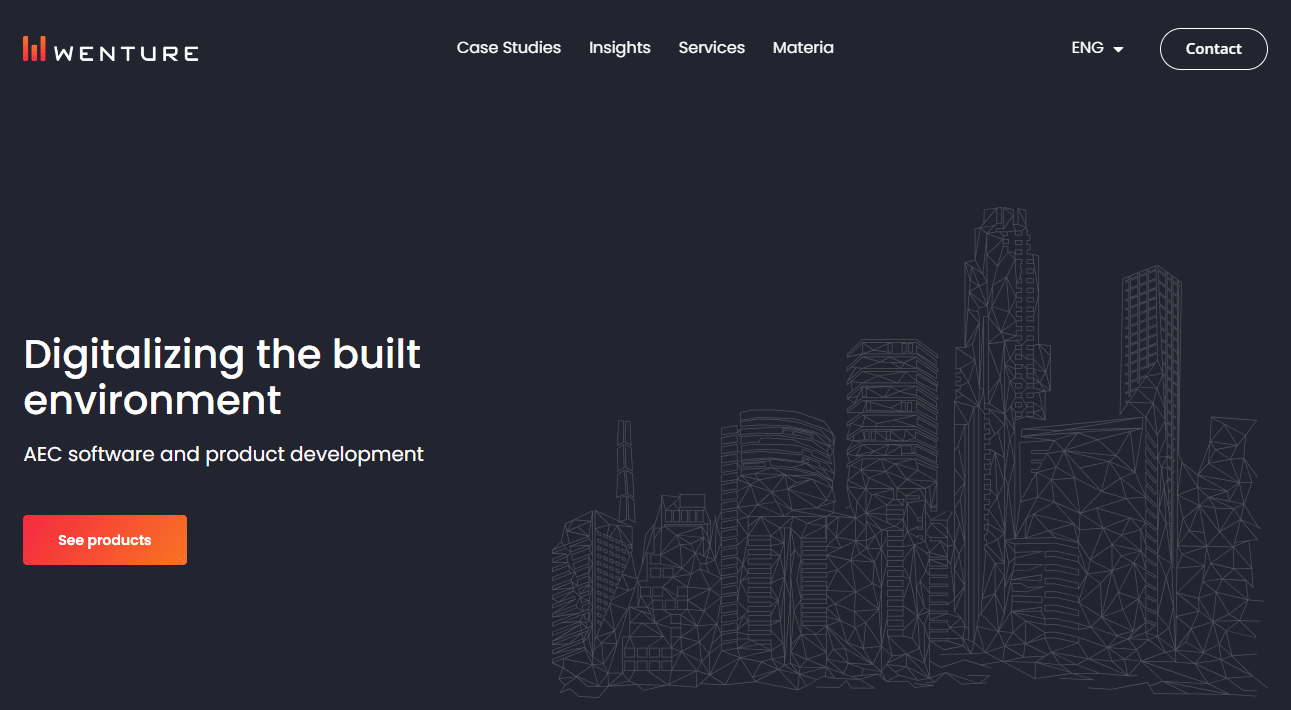
The homepage hero opens with: “Digitalizing the built environment – AEC software and product development”.
That’s their overarching brand statement. AEC stands for Architecture, Engineering, and Construction (the industry they’re targeting). It’s clear, specific, and speaks directly to the people who need to hear it.
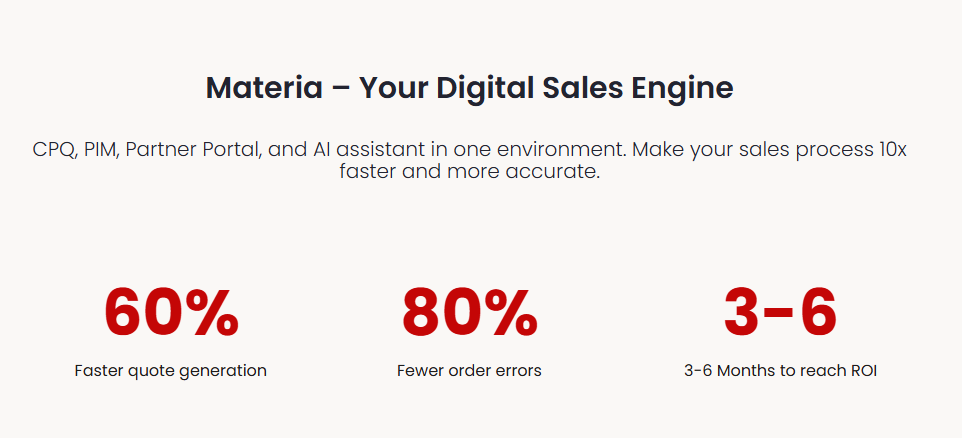
The supporting metrics they lead with are outcome numbers: 60% faster quote generation, 80% fewer order errors, and 3-6 months to reach ROI (return on investment). Buyers in manufacturing don’t care that you have a 3D configurator. They care that their sales team stops spending two days on every quote.
Materia is your Digital Sales Engine, incorporating CPQ (Configure, Price, Quote), PIM (Product Management), Partner Portal, and AI assistant, that will make your sales process 10x faster and more accurate. Materia automates the entire sales process, from quotes to technical drawings.
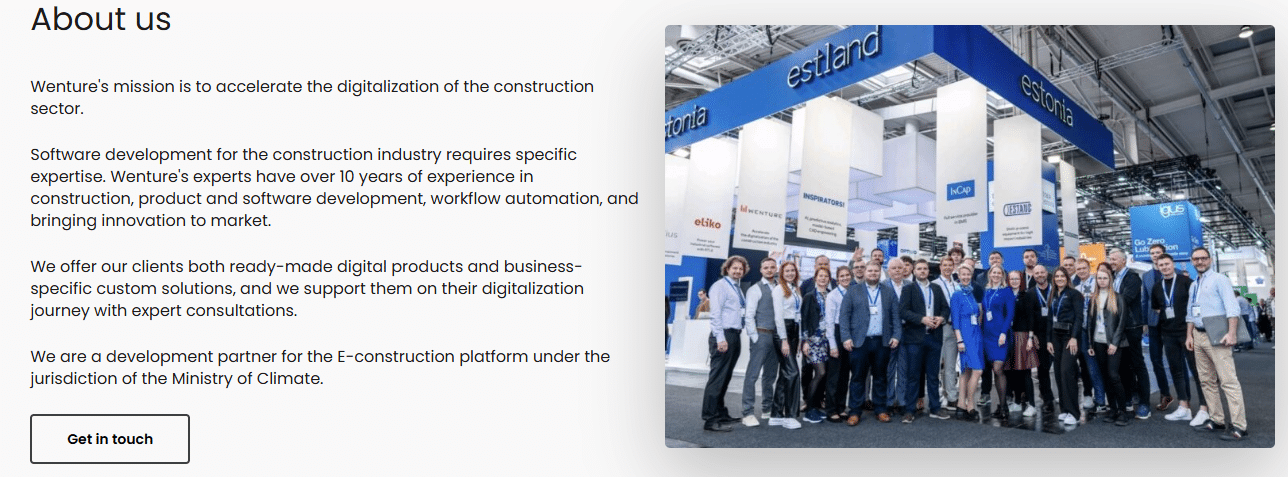
Their mission statement, from the About section is: “…to accelerate the digitalization of the construction sector.” Simple. No corporate fluff.
The overall brand promise is: Wenture makes complex product sales simpler, faster, and more accurate, with a team that understands construction from the inside. That “we understand your world” positioning is well executed throughout the site.
Wenture’s Service and Product Breakdown
Wenture runs two parallel business models.
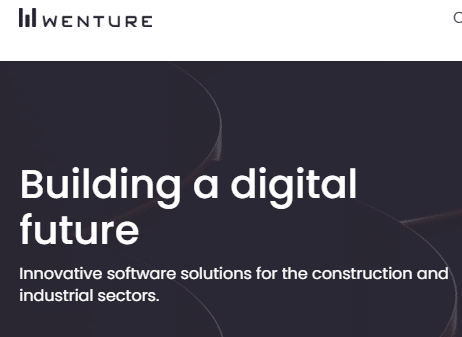
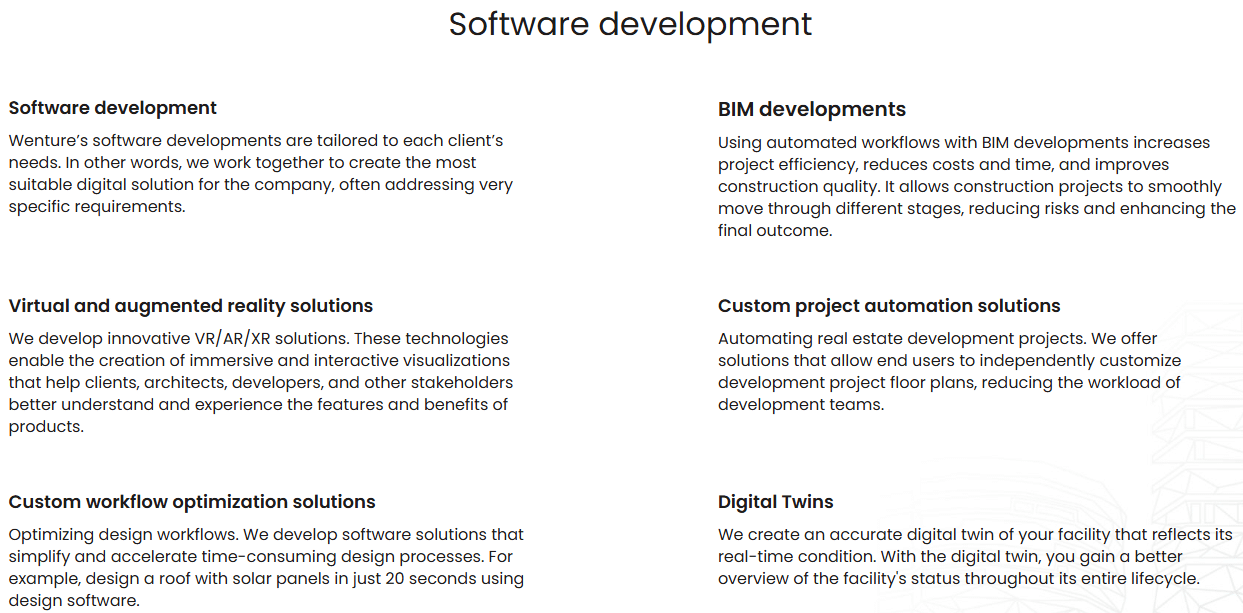
This is where Wenture started. They build bespoke digital solutions for construction and manufacturing clients: digital twins, AR/VR/XR experiences, BIM (Building Information Modeling) models, custom configurators, GIS mapping tools, and product information systems tailored to a specific company’s workflow.
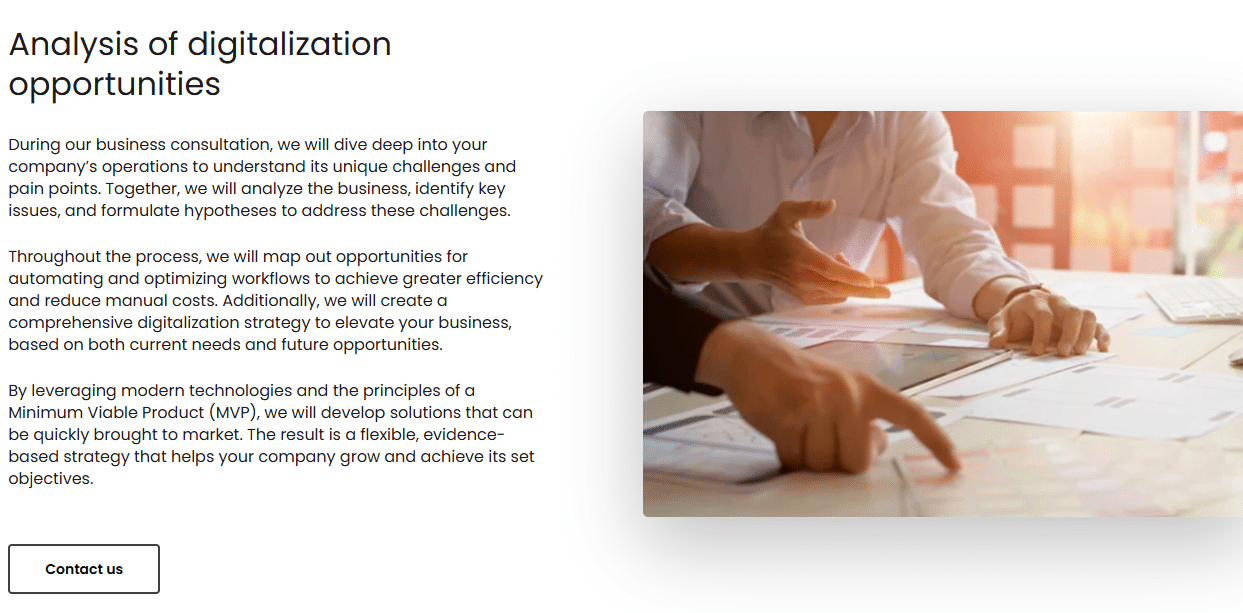
They also offer a Digitalization Roadmap service: a consulting engagement that maps out your company’s digital development needs, identifies bottlenecks, and comes with a timeline and cost-effectiveness analysis. This service is noteworthy because, in some cases, it’s eligible for government funding support (EAS grants), which lowers the financial barrier for SMBs (small and medium businesses) to work with Wenture.
Materia Suite, the SaaS product
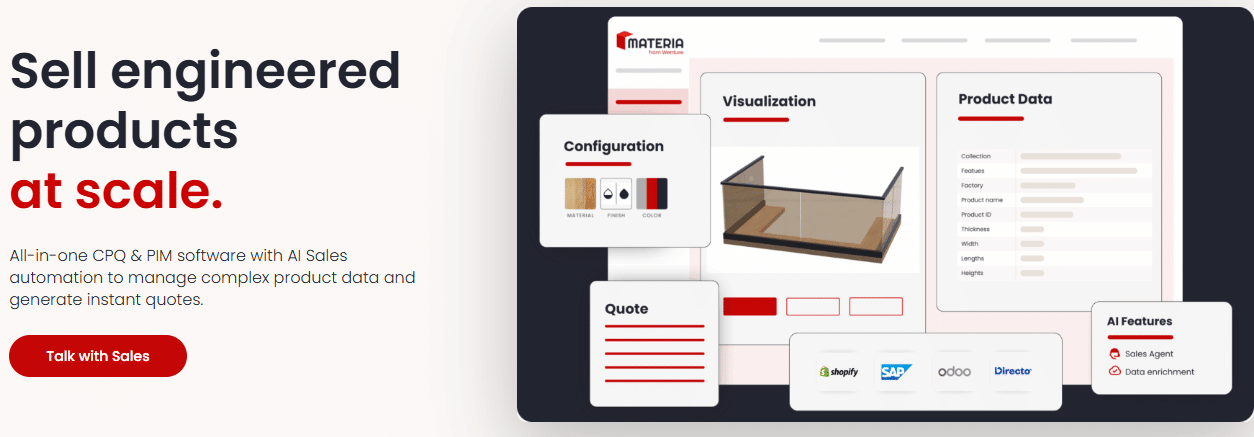
This is clearly the growth bet. Materia is a modular platform with 4 products:
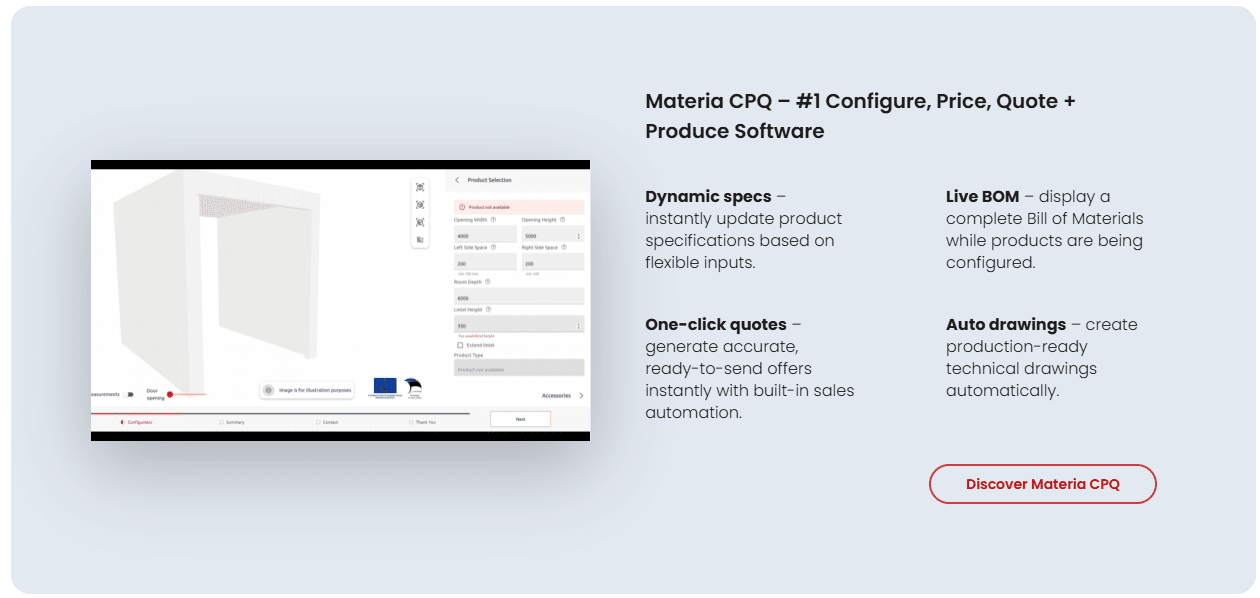
- Materia CPQ (Configure, Price, Quote): Generates accurate quotes instantly with one click. Handles dynamic product specifications, real-time BOM (bill of materials) generation, auto-produced technical drawings, and integration with ERP (Enterprise Resource Planning) and MES (Manufacturing Execution System) systems. Designed for manufacturers with complex, configurable products.
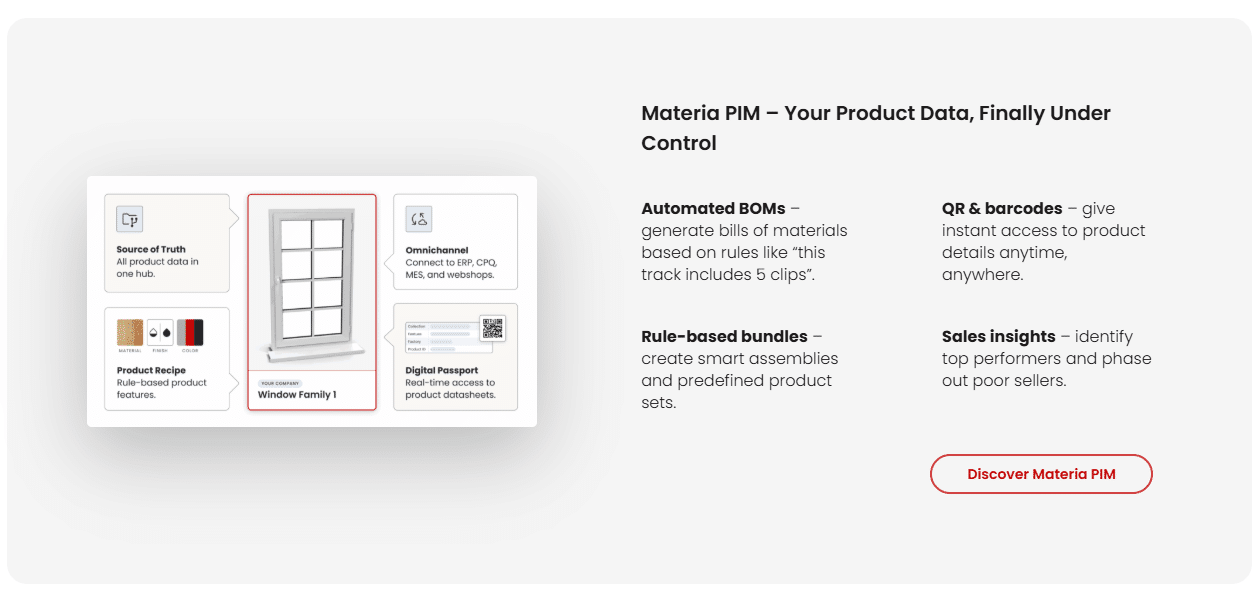
- Materia PIM (Product Information Management): A single source of truth for all product data. QR codes, rule-based bundles, automated BOMs, branded data sheets, and sales analytics to identify top performers. Won the Digital Construction Cluster Innovation Project of the Year in 2024.
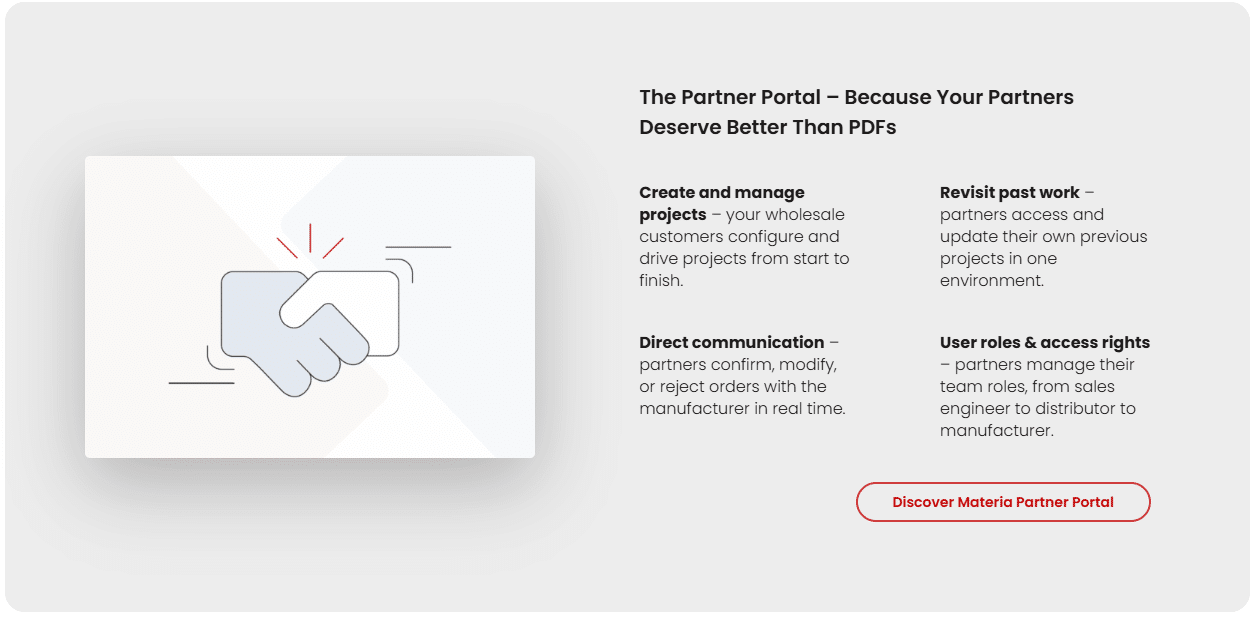
- B2B Partner Portal: Wholesale customers and distributors configure, track, and manage projects directly inside the platform. Real-time communication, role-based permissions, and order tracking integrated with ERP. The headline on this module is perfectly on-brand: “Because Your Partners Deserve Better Than PDFs.”
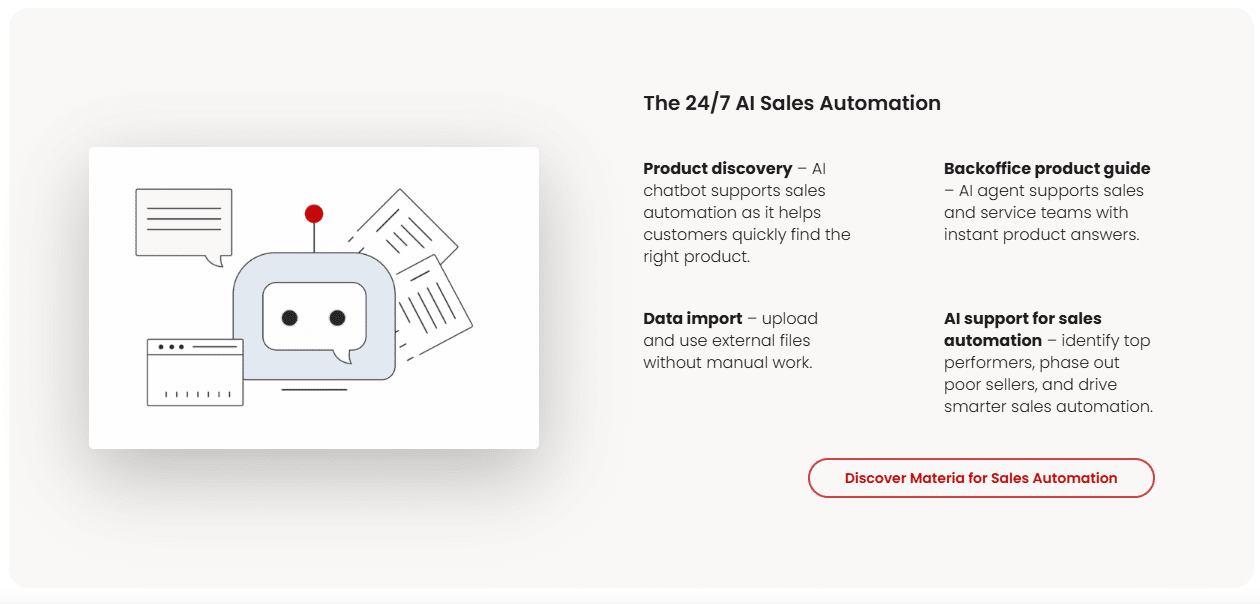
- AI Sales Agent: A 24/7 chatbot for product discovery on the website, a back-office product guide for internal sales teams, and smart data import from external files (architect drawings, manufacturer Excel sheets).
Pricing:
| Plan | Price/month | Best for |
|---|---|---|
| Starter | €390 | B2C, early-stage, basic PIM + configurator |
| Scale | €690 | B2B, growing teams, adds Partner Portal + AI Chatbot |
| Pro | €990 | Full B2B2C, CPQ with CAD/BIM exports, full AI agent |
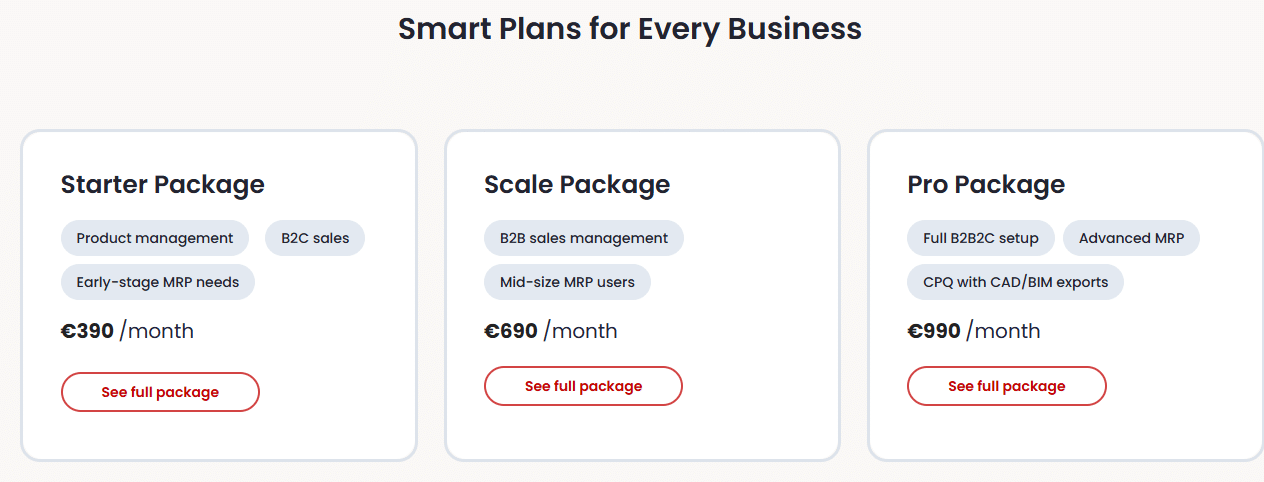
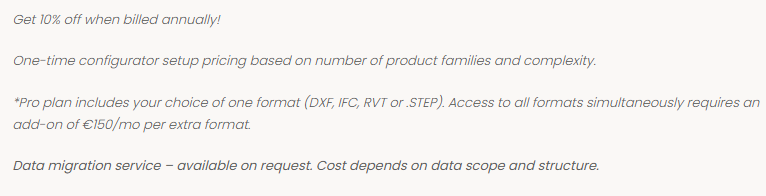
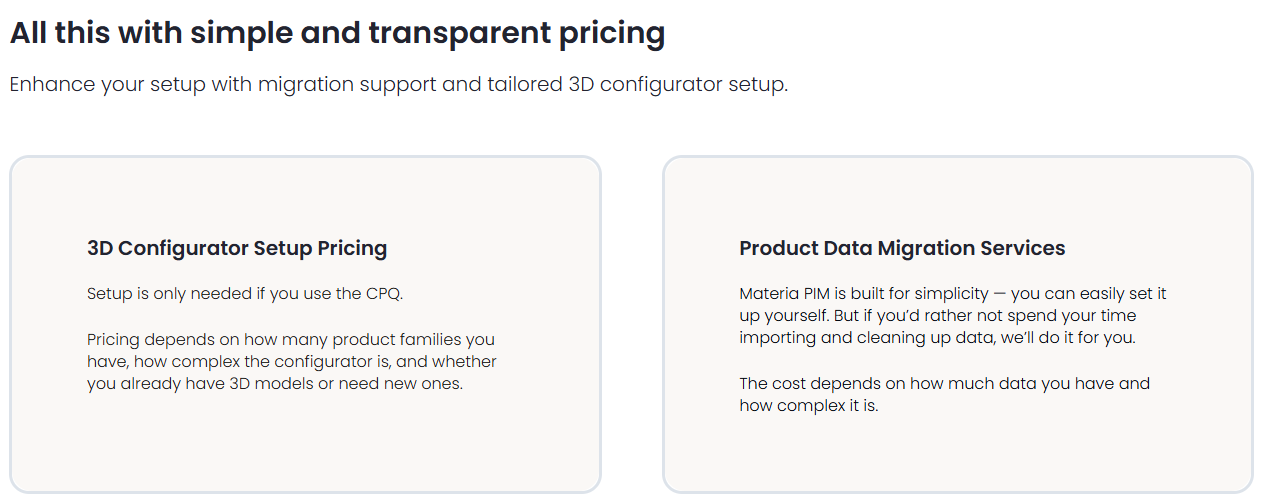
Annual billing gets a 10% discount. CAD/BIM exports (DXF, IFC, Revit, STEP) are included in Pro but limited to one format. Any additional formats cost €150/month each. There’s also a one-time 3D Configurator setup fee, priced based on product family complexity.
The ICP (ideal customer profile) is clear: manufacturers and construction material companies with complex, configurable product portfolios who are currently quoting by hand, managing product data across multiple systems, and trying to give distributors and architects access to accurate, up-to-date information. Think: window manufacturers, ventilation companies, flooring producers, solar roof panel companies.
Showing your pricing upfront filters the right buyers in and the wrong ones out before a single demo slot gets booked. According to ProfitWell research, B2B SaaS companies with transparent pricing pages see 30% higher conversion rates from pricing page to trial initiation compared to those that gate pricing. The Starter/Scale/Pro structure at Wenture does something more specific: it separates B2C from B2B use cases at the pricing level itself. Buyers self-select into the right tier before they ever speak to anyone.
💡 Steal This: If you sell to both B2C and B2B segments but with fundamentally different needs, price them separately. It sets expectations, reduces support friction, and lets buyers self-qualify before they ever talk to sales. Gate only the enterprise or fully custom tier behind a sales conversation. Let the pricing page do the qualification work for you.
Differentiators and Unique Assets
ISO 27001 Certification
Wenture is ISO 27001 certified, meaning its information security management meets international standards. This is a sales asset in construction and public sector procurement, where data security is a contractual requirement. For a small team, that’s a notable investment in credibility.
Dual Business Model
The custom development side generates stable revenue that funds Materia’s development. This is a common pattern in B2B SaaS coming out of consulting shops, and it works, as long as the SaaS product eventually pulls ahead in margin and scalability. Wenture hasn’t crossed that line yet, but the direction is clear.
CAD/BIM Export Integration
The ability to export configured product models directly to Autodesk Revit, IFC, DXF, and STEP formats is a genuine technical differentiator. Architects and engineers need to work in these formats. If Wenture’s CPQ generates files that land directly in their design software, the product becomes part of the architect’s workflow.
Michael Porter’s competitive strategy framework identifies switching costs as one of the five forces that determine sustainable competitive advantage. When a customer’s daily workflow depends on a specific integration output, replacing the source tool means rebuilding the entire process. In AEC software, that bar is high.
💡 Steal This: Map every touchpoint in your product where a customer’s data connects to another tool they use hourly. Those connection points are your stickiness. Prioritize building one integration that goes so deep it becomes part of the customer’s daily output, over five shallow integrations they use occasionally. Depth beats breadth for retention.
Multilingual Platform
The website and product operate in Estonian, English, and Finnish. Finnish is the tell. It means they’re actively targeting the Finnish market, not translating for optics.
Design Time Estimation Calculator
Wenture published a free Design Time Estimation Calculator tool for construction companies, available through their Insights section. This is a lead generation mechanism dressed as a utility tool. Someone searching “how long does design take for a construction project” lands here, gets value, and meets Wenture for the first time without a sales pitch in sight.
The difference is where trust starts. A gated PDF requires commitment before value is delivered. A free tool earns attention by being useful first. According to Demand Gen Report research, interactive tools generate 2x more conversions than static content from buyers who are already engaged. Someone who spends 5 minutes on a design estimation calculator is telling you exactly what they’re working on, without filling out a form.
💡 Steal This: Identify the single most common calculation your customers do manually before they meet you. Build a simple web calculator that does it in 30 seconds. Publish it ungated. Use it as a paid search landing page and have your CEO share it from their personal profile. The leads it attracts are warmer than anything sitting behind a form.
Wenture does not have a formal learning academy, community forum, or Discord/Slack group. Given the complexity of CPQ and PIM implementations, this is a missed opportunity for user activation and retention. Companies like Katana (which built Katana Academy) have shown that education platforms reduce churn by shortening time-to-value. According to research in Customer Success, the first 90 days of a SaaS subscription determine long-term retention more than any other factor. An educational layer would help Wenture’s customers get to value faster.
Leadership Presence Analysis
Founder-led growth and executive visibility build brand trust and thought leadership. In B2B especially, buyers research leadership before making purchase decisions. A visible, credible executive team shortens sales cycles and strengthens brand positioning.
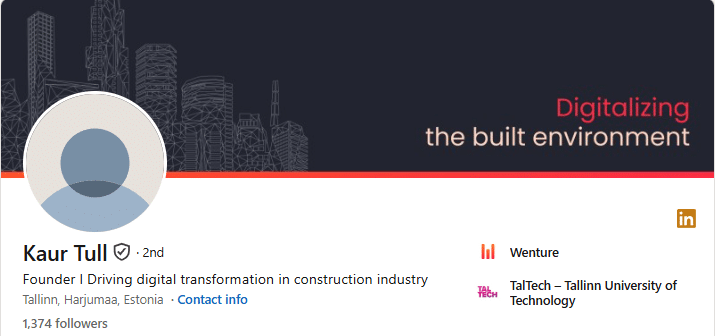
Kaur Tull is the public face of Wenture. He writes most of the blog articles, shows up in press releases, gives commentary to Estonian industry media, and was quoted in Äripäev (Estonia’s leading business newspaper) on construction digitalization. He describes himself as the person who “always finds solutions”, and his activity backs that up.
He has 1.3k followers on his LinkedIn page. He hasn’t posted in the last 4 weeks, but before that, he posted 5-7x per month. He mostly reposts with his thoughts, with a few original posts. He posts both in English and Estonian.
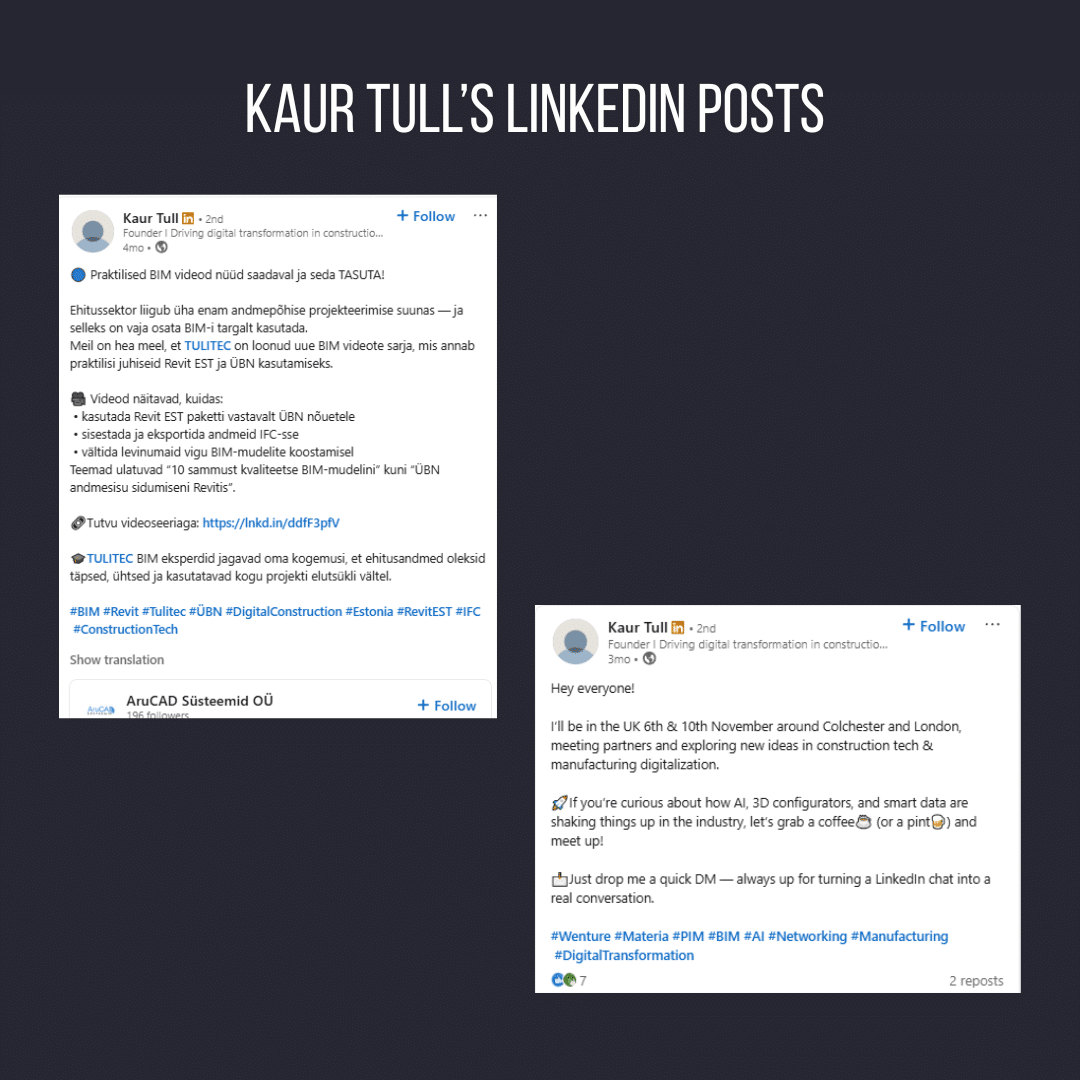
According to a 2025 analysis, LinkedIn company pages reach only 1.6% of their followers on average, while founder-authored posts get up to 10x more reach. B2B Thought Leadership Impact Report found that 60% of decision-makers say thought leadership directly influences their purchase decisions. In construction, a conservative industry where buyers are purchasing a relationship as much as a product, a CEO who shows up in the press and writes honest, substantive content is answering the biggest procurement objection before it’s even asked: “Are these people real and will they still be here in 3 years?”.
The gap is consistency. Kaur posted 5-7 times per month before going quiet for four weeks. In B2B thought leadership, going dark costs more attention than it saves time.
💡 Steal This: Take your last 3 blog articles published under your company brand and republish them under your CEO’s name with a personal byline. Measure the reach difference over 30 days. Then build a simple editorial system: CEO drafts rough ideas, content team polishes, CEO publishes under their name. Frequency matters less than consistency. Show up every month, without exception.
Social Media Strategy
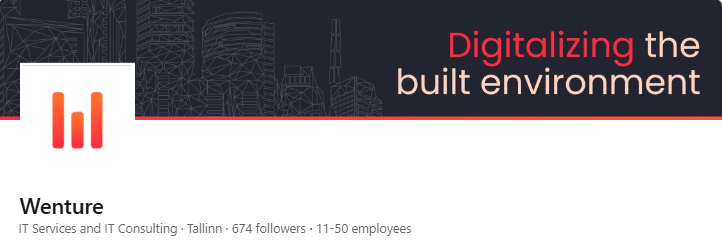
Wenture’s LinkedIn company page has 674 followers. Posting frequency appears to be roughly 2–3 times per month. Their posts gain a couple of likes and reposts.
Content pillars include:
- product updates and partnerships
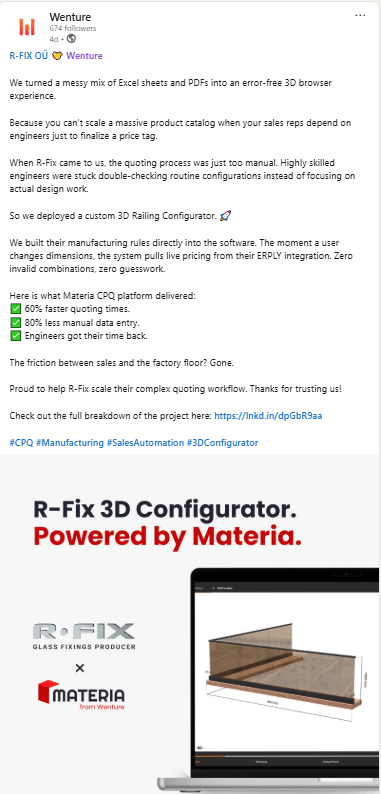
- industry events
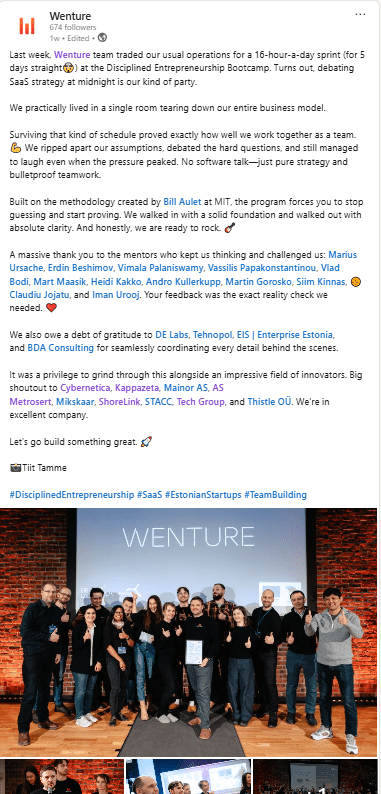
- educational content, focused on webinars
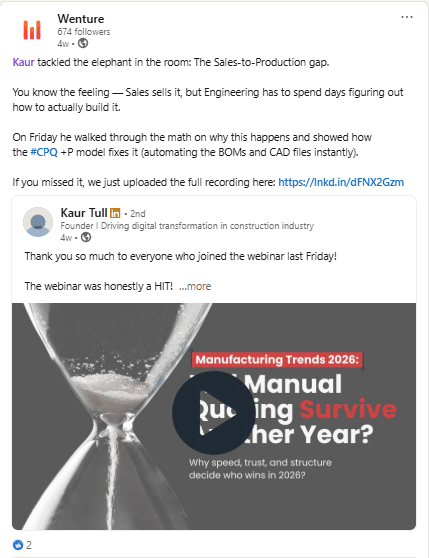
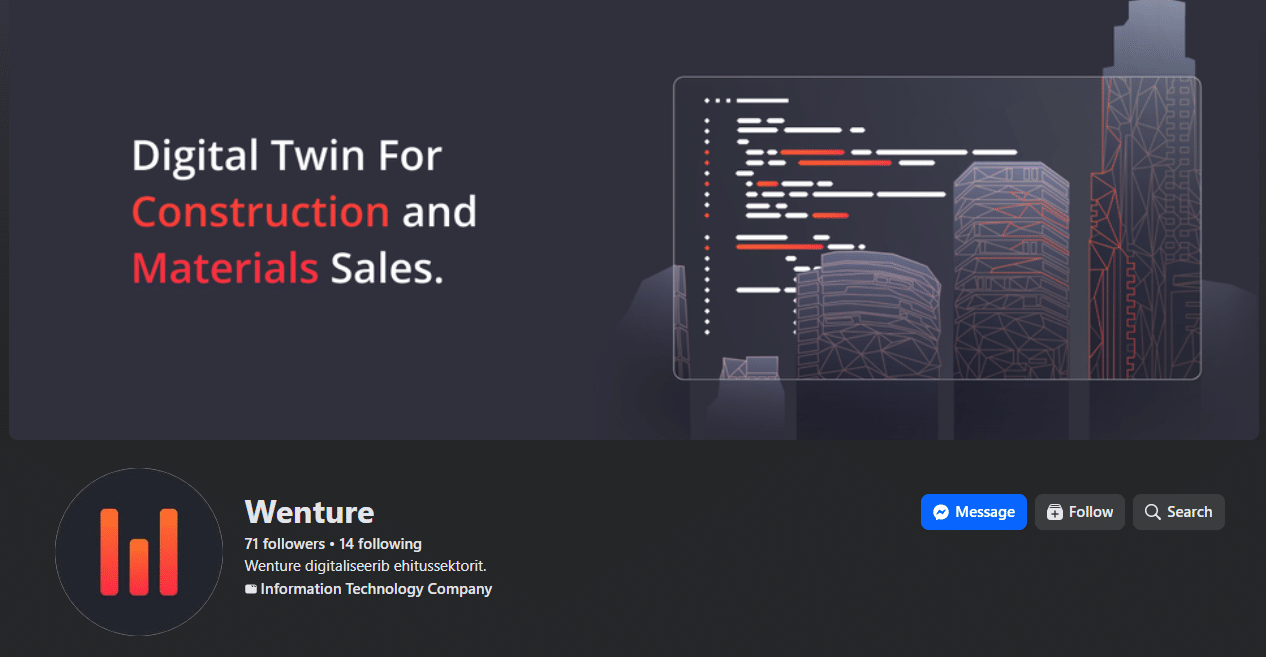
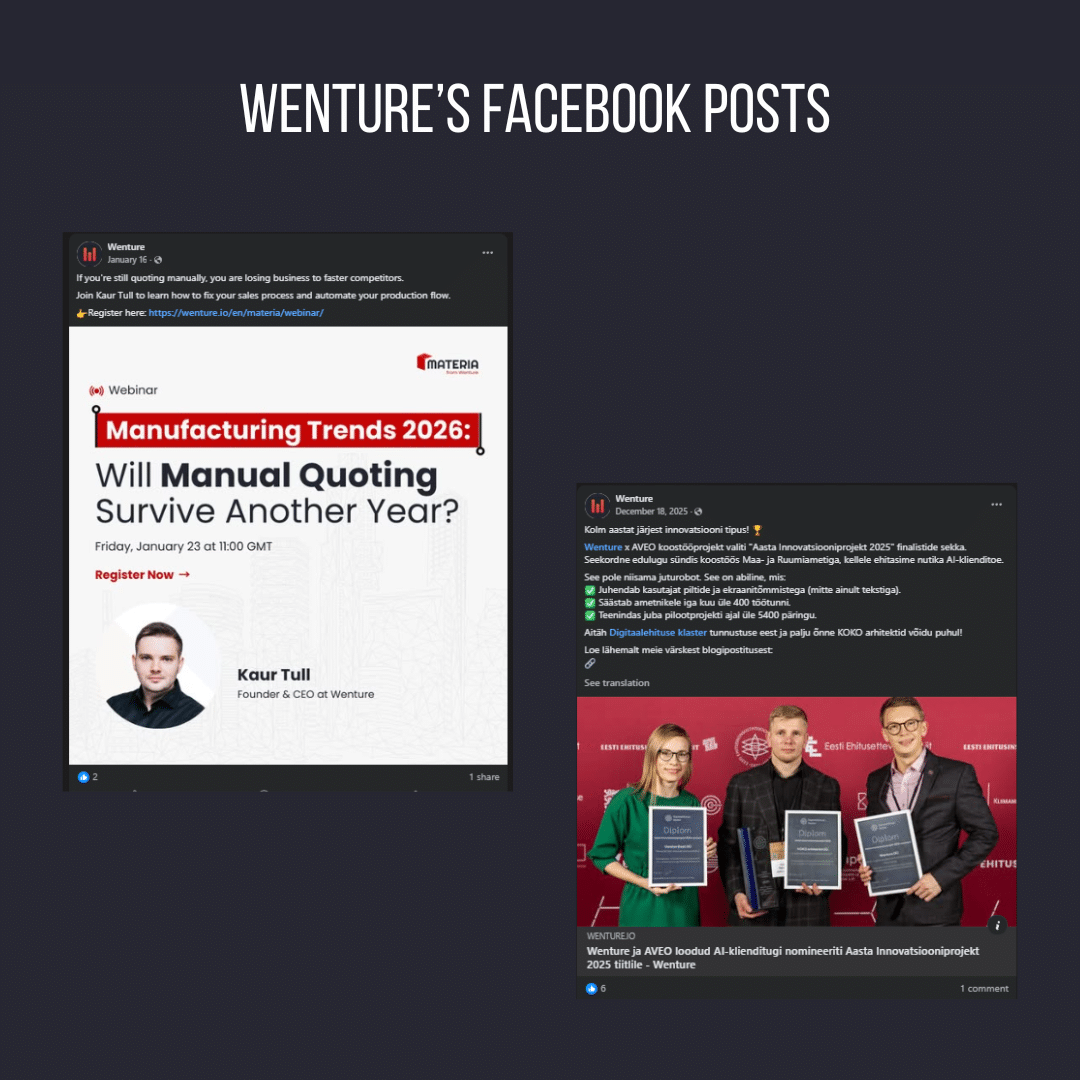
Wenture has 71 followers on Facebook. Their posting is inconsistent, sometimes one post per month, sometimes multiple, sometimes none. They haven’t posted in some months at all. They mostly reshare articles that mention Wenture. Promoting webinars is clearly a priority, visible both in their posts and in the pop-up on their website.
Engagement is close to zero across posts, but this is a common pattern for B2B construction tech. Facebook reaches consumers, not procurement managers. The channel is more about being present than building an audience.
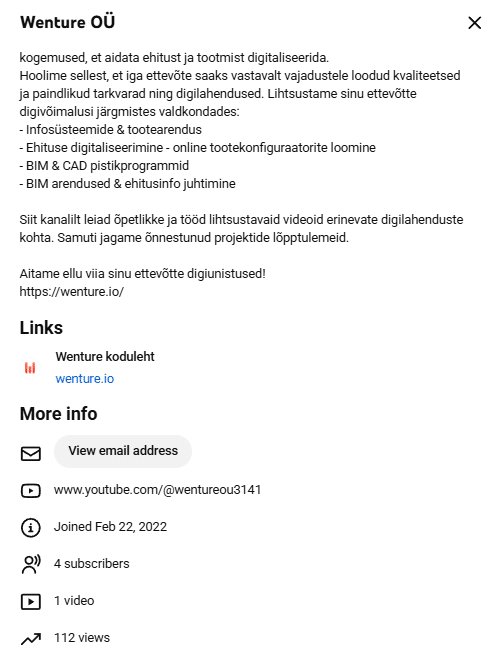
Wenture has 4 subscribers and only 1 video posted, with 112 views. Their channel description is in Estonian. The video, about their roof visualizer and solar panel profitability calculator, has 1 like and no comments. It was posted in February 2022 and never promoted.
This is a missed opportunity worth flagging. Wenture constantly promotes webinars. Past webinar sessions stored on YouTube become evergreen, searchable content.
YouTube SEO (search engine optimization) for niche B2B products is significantly underexploited in the AEC software space. A manufacturer searching “how does CPQ work for windows” or “what is product configurator for construction” is a bottom-of-funnel buyer. That search, right now, leads nowhere near Wenture.
No TikTok, No Instagram, No X. Appropriate. Resources are limited, and B2B construction tech buyers are not scrolling TikTok to evaluate software vendors.
Top-Performing Content
These are the top 3 posts in the last 3 months from Wenture’s LinkedIn page:
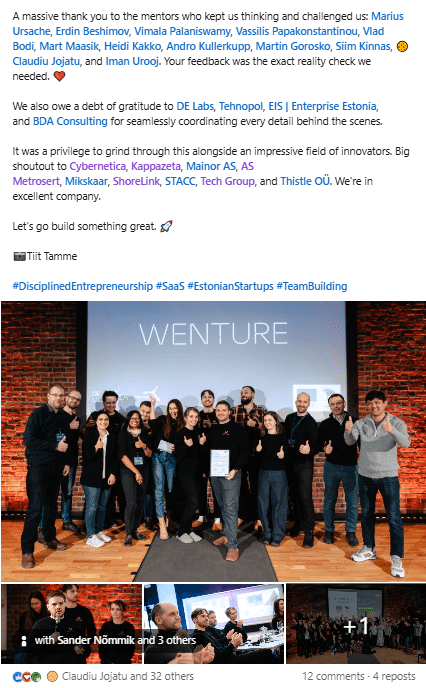
- The multiple-image post about the Disciplined Entrepreneurship Bootcamp, with 33 reactions, 12 comments, and 4 reposts.
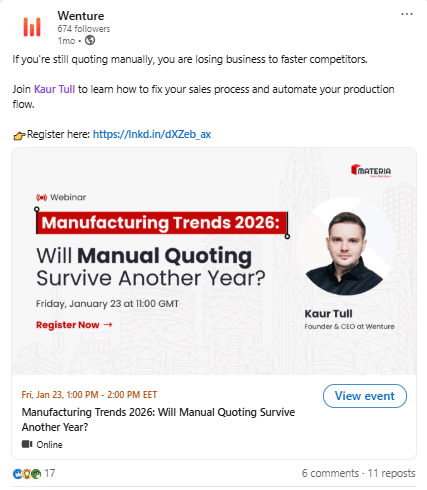
2. The post about Manufacturing Trends 2026: Will Manual Quoting Survive Another Year? webinar registration, that has 17 reactions, 6 comments, and 11 reposts.
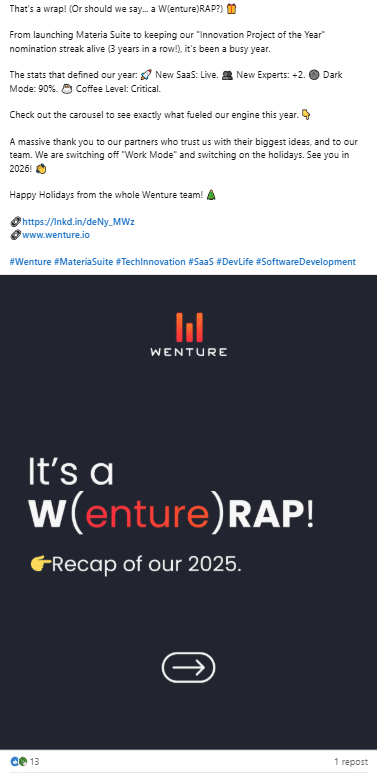
3. The recap of the 2025 carousel, where they gained 13 likes and 1 repost.
The pattern is clear: carousel and multiple-image posts outperform single-image posts on LinkedIn. The webinar post earned the most reposts, showing that the audience found it worth sharing to their own networks, which is the highest-value signal on LinkedIn. When someone reposts your content, they’re endorsing it to their professional connections. For Wenture, that’s free distribution into networks they don’t have direct access to.
Wenture’s Facebook page had no posts worth measuring in the last 3 months by engagement. Most posts received zero reactions. The channel is active but not performing, and there is no top content to report here. Facebook is not a working content channel for Wenture, and the effort spent maintaining it would be better redirected to LinkedIn or YouTube.
There are no posts from the last 3 months on Wenture’s YouTube channel. The only video on the channel was published in February 2022 and has 112 views. There is nothing to rank here. Again, that absence is worth noting: a company that actively promotes webinars has no archive of past sessions, no product walkthroughs, and no recorded content for buyers who prefer video over text.
Paid Advertising Strategy
We checked LinkedIn, Meta, and Google Ads Library for Wenture. We found no active paid advertising campaigns on either platform as of February 2026.
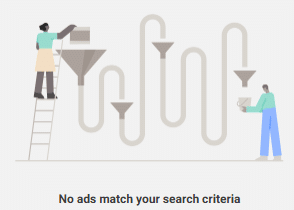
This happens all the time with bootstrapped companies at this stage. Paid acquisition is expensive and requires a functioning funnel to be efficient. Without a proper lead nurturing system in place, paid ads would generate demo requests that the team may struggle to service at scale.
According to Dreamdata’s 2025 LinkedIn Ads Benchmarks Report, LinkedIn’s share of total B2B ad budgets grew from 31% to 39% in 2024 alone. B2B buyers are increasingly discoverable and reachable on the platform. For a product like Materia, targeting LinkedIn audiences by job title (Sales Engineer, Head of Product, CPO) and industry (construction materials, manufacturing) would be a high-precision play.
The absence of paid advertising means all current growth is organic and referral-driven. That’s a decent signal about product-market fit. You don’t need to buy attention if the product solves a real problem. But to scale beyond the Estonian and Nordic market, some form of paid amplification will be necessary.
💡 Steal This: If you’re not running any paid advertising yet because you’re early-stage, at minimum run LinkedIn Lead Gen Form ads targeting your top 3 job titles in your target geographies. The CPQ audience is very specific and very reachable on LinkedIn. Even a €500/month test budget gives you signal on which message resonates before you scale spend.
Sales Funnel from Social Media
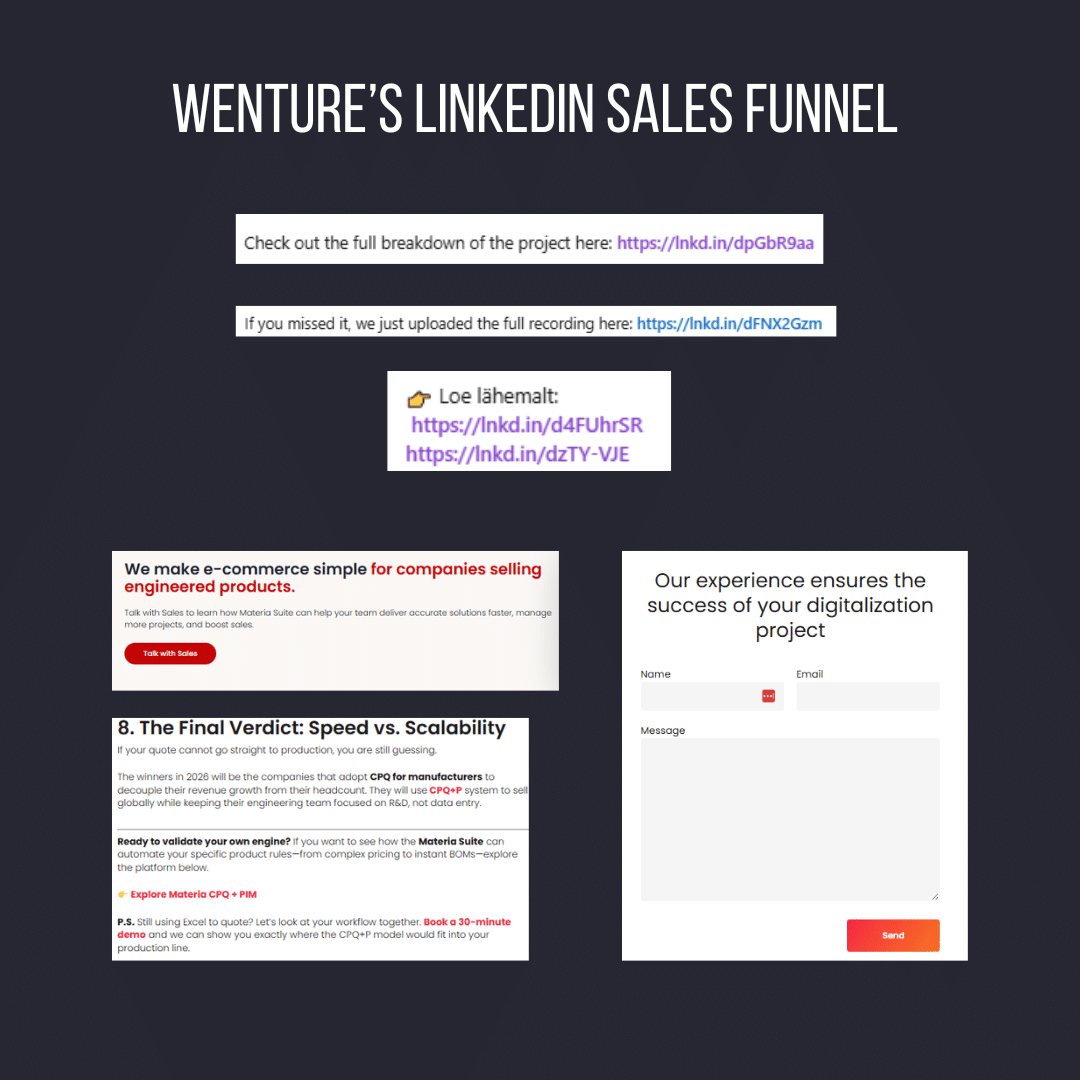
Wenture will insert links in their caption that will send you directly to their website. You can read the full breakdown of a project, check their latest webinar, or read a use case. On each page, you’ll find a form or a CTA button to contact sales.
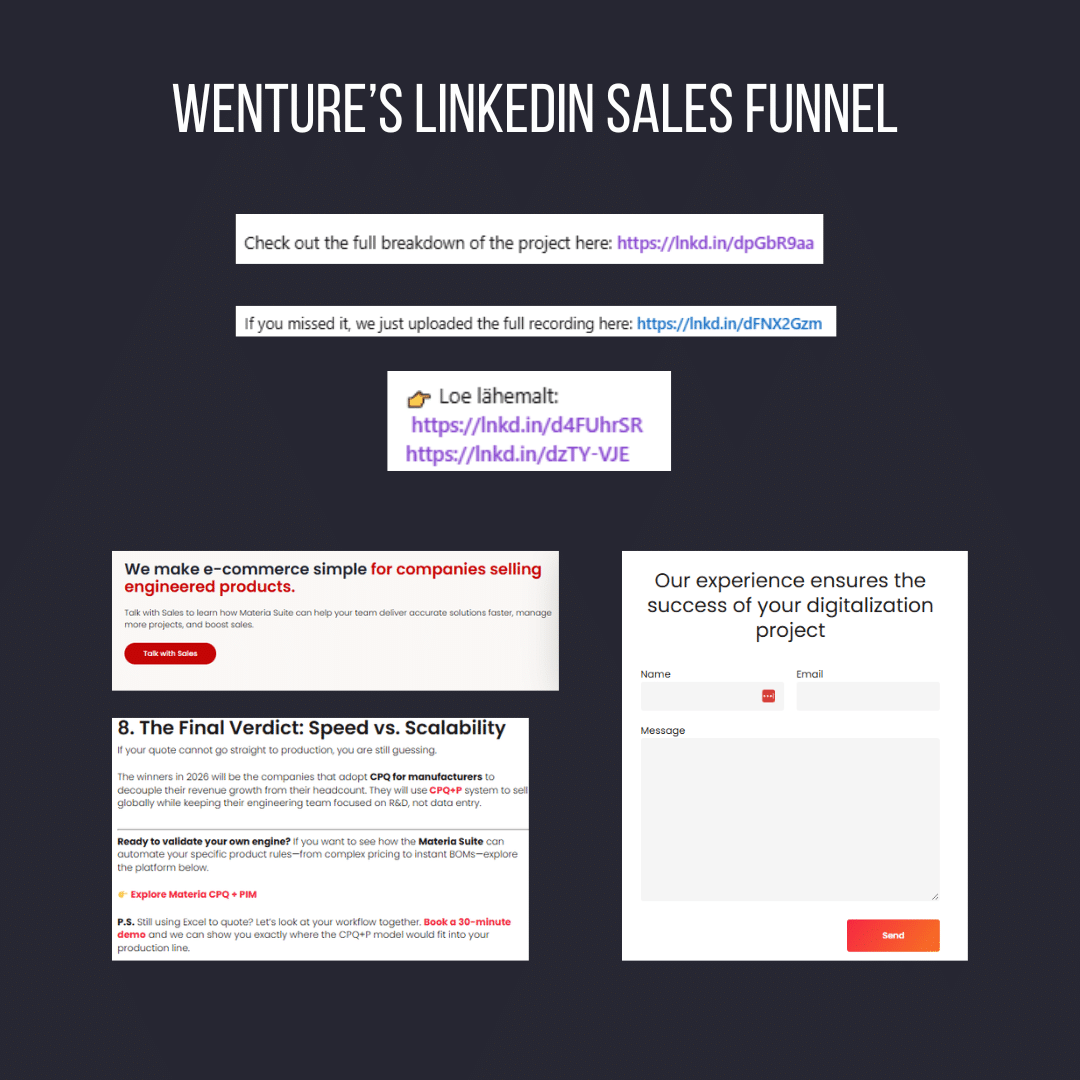
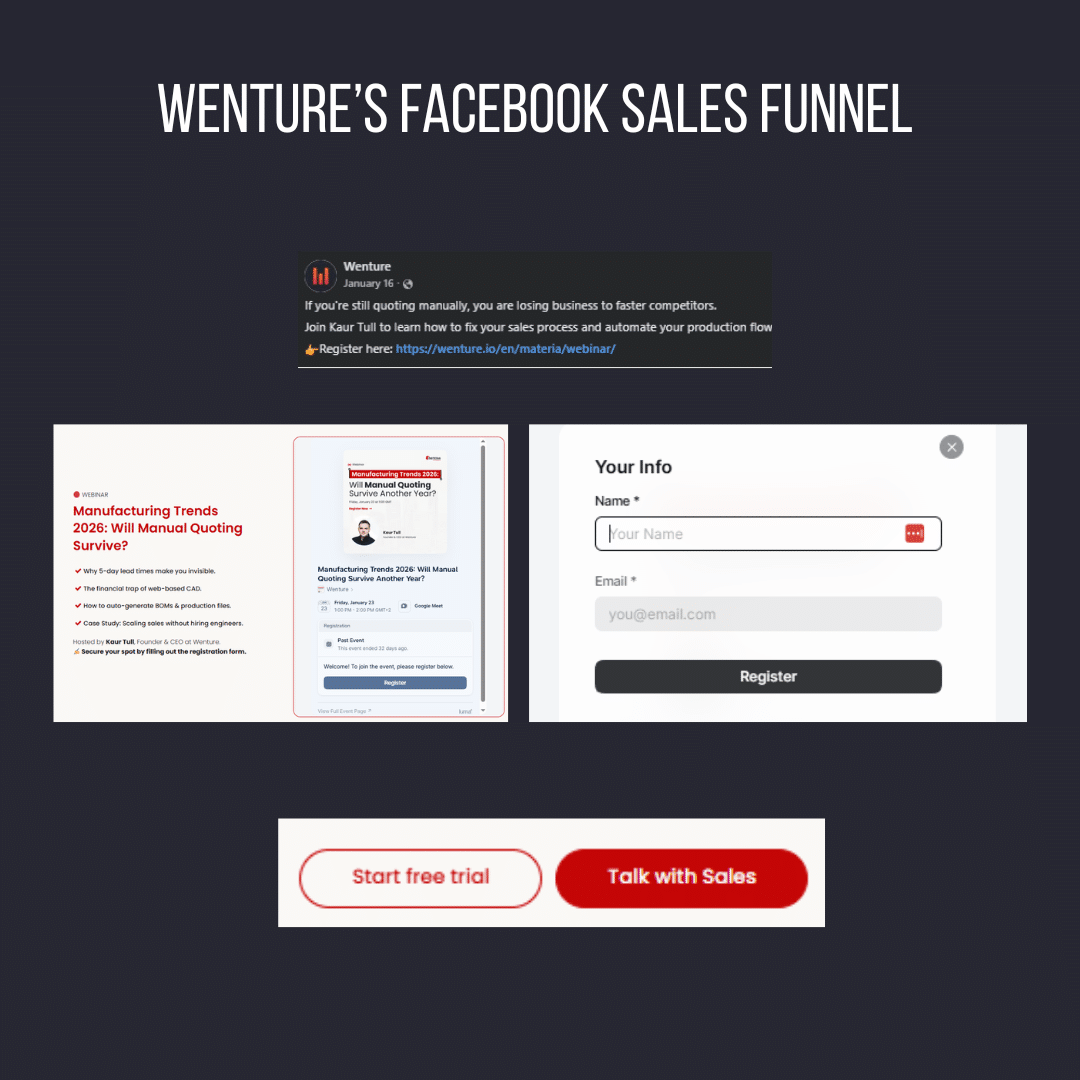
The links in Facebook post descriptions point primarily to webinar registration pages, not the Materia product page. To register, you complete a form providing your name and email. On the top right of the site, you find the Start free trial and Talk with Sales buttons. The free trial form requires name, company, and email. The Talk with Sales form adds phone number, company size, and message.
Wenture’s sales funnel from social media is simple and direct. The interesting detail is the Calendly link on the contact page. It goes directly to Kaur Tull’s calendar. That’s the CEO personally taking first discovery calls. This shows that they’re in an early, relationship-driven sales phase where every new client relationship starts at the top.
Wenture is running a manual ABM (Account-Based Marketing) motion without calling it that. Named testimonials from specific clients, direct outreach through industry relationships, a CEO who takes every first call personally. These are all high-touch, account-specific tactics that define treating individual accounts as markets of one. The instinct is right. The system behind it hasn’t been built yet.
There is no visible automated nurturing sequence, no downloadable lead magnet behind a form (beyond the newsletter subscription), and no webinar series visible on the English-language site. There is a webinar announced on the site for March 19, 2026: “How to automate complex manufacturing quotes?”, hosted in Estonian. This is worth noting as the beginning of a demand generation infrastructure.
Reviews and Social Proof
Wenture doesn’t have any reviews on G2, Capterra, Trustpilot, or even Glassdoor, as of February 2026.
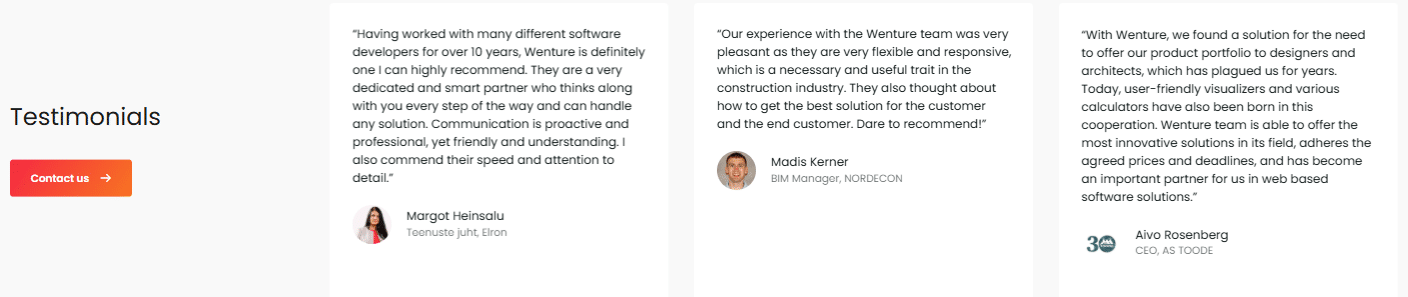
What they do have is strong, named testimonials on their own website. They’re attributed to people with real titles at real companies. Testimonials like “80% of our leads now come from CPQ” are operational metrics. That kind of specificity matters more than 50 anonymous star ratings.
But you can’t rely on owned testimonials forever. They are invisible to buyers who start their research on review platforms, not your homepage.
According to the State of Software Buyer Behavior Report, 92% of B2B buyers consult peer review sites before purchasing software. If you’re not there, you’re invisible to a significant portion of your market at the moment they’re actively evaluating options. Third-party reviews, even 5-10 of them, add discoverability and credibility that on-site testimonials simply can’t replicate.
💡 Steal This: Go to 5 clients personally and ask them to leave a G2 review. Not a bulk email blast. A personal ask from the CEO or account manager. Ask them one question before they write it: “What is the single most measurable result you’ve seen in the first 90 days?” That answer, as a G2 review, is more valuable than a paragraph of adjectives. The review also becomes a sales asset you can screenshot and use in outreach.
Content Marketing and Demand Generation
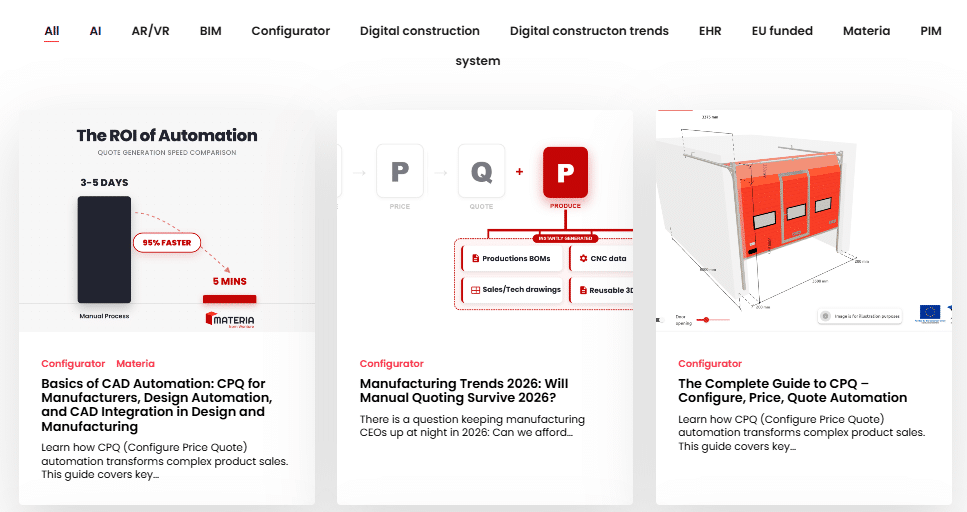
Wenture’s Insights blog has a clear focus. Each article addresses real questions their buyers have, written by people who understand the industry they’re writing about. These are some of their used titles:
- Manufacturing Trends 2026: Will Manual Quoting Survive 2026?
- The Complete Guide to CPQ – Configure, Price, Quote Automation
- Basics of CAD Automation: CPQ for Manufacturers
- BIM Adoption in Europe: Key Insights from BAU 2025
- AI Customer Support Innovation” (about their AVEO project)
Posting frequency is approximately 1-2 articles per month. That’s light by content marketing standards, but each article is substantive. Articles are SEO-targeted at keywords like “CPQ software”, “PIM software for manufacturers”, “product configurator e-commerce”.
The blog also covers news-driven content, like their visit to BAU 2025 (the world’s leading trade fair for architecture and building materials, held in Munich), which shows active market participation and earns them topical relevance in industry conversations.
There is a newsletter subscription available in the footer. No visible subscriber count, no promoted newsletter content series.

💡 Steal This: If you have a comprehensive guide on your blog already, gate a more detailed version of it. Take your guide and turn the last third into a downloadable PDF checklist. Put it behind a form. One asset, one form, one email address captured from a buyer who just spent 10 minutes reading your best content. That’s a warmer lead than anything you’d get from a cold ad.
Marketing and Sales Funnel Stages
Top of Funnel: Awareness
Wenture builds awareness primarily through: CEO thought leadership articles in the Insights blog and Estonian industry press, participation in industry trade fairs, free tools, LinkedIn company posts and employee advocacy, industry award announcements, and government partnership visibility.
This is a credibility-first TOFU strategy. They’re earning attention by showing up in the conversations their buyers are already having about construction digitalization. Not by interrupting them.
Middle of Funnel: Consideration
At the consideration stage, Wenture has: in-depth blog guides (Complete Guide to CPQ, Complete Guide to PIM), case studies on the Materia site with named client outcomes, transparent pricing page with a feature comparison table, free 30-day trial (no credit card) for Materia PIM, and the Materia Customer Stories portfolio section.
There is no visible downloadable lead magnet. This is the clearest gap in their funnel. Someone who reads the Complete Guide to CPQ is in research mode, not yet ready to book a demo. A gated resource at that point captures an email and starts a nurture sequence. Without it, that visitor reads, leaves, and is never heard from again.
Bottom of Funnel: Decision
At the decision stage we have: “Book a Demo” CTA everywhere, pointing to Calendly (CEO’s calendar), “Talk with Sales” CTA on the Materia site, pointing to a contact form, free trial as a self-service option for lower-friction entry.
The BOFU is clean and direct. There’s no pricing obfuscation. You can see what the plans cost and start a trial without talking to anyone. That transparency removes a major objection for smaller buyers who don’t want a sales-heavy process.
According to OpenView Partners’ 2024 Product Benchmarks report, companies using PLG (Product-Led Growth) as their primary acquisition motion grow at 2x the rate of sales-led companies and achieve 30% lower customer acquisition costs. For a bootstrapped team that cannot scale a high-touch sales process indefinitely, a trial that proves value independently is how you grow without proportionally growing headcount.
💡 Steal This: For every product feature you’d normally show in a demo, ask: “Could this be experienced in a self-serve trial instead?” If yes, build the onboarding so that feature is reachable in under 15 minutes of setup. Reserve demos for complex integrations, enterprise configurations, and situations where a human conversation genuinely accelerates the decision. Let the product prove value everywhere it can without you in the room.
Retention
There is no visible onboarding email sequence, in-product tutorials, or customer success content beyond what’s in the product itself. The absence of a formal academy or help center is a real gap. For a product with technical complexity (CPQ configuration, BIM exports, ERP integration), retention support will become critical as the client base grows beyond the founders’ direct relationship capacity.
Future Plans and Growth Indicators
From the Career page, you are sent to Wenture’s LinkedIn to check open roles. They have no jobs listed at the moment.
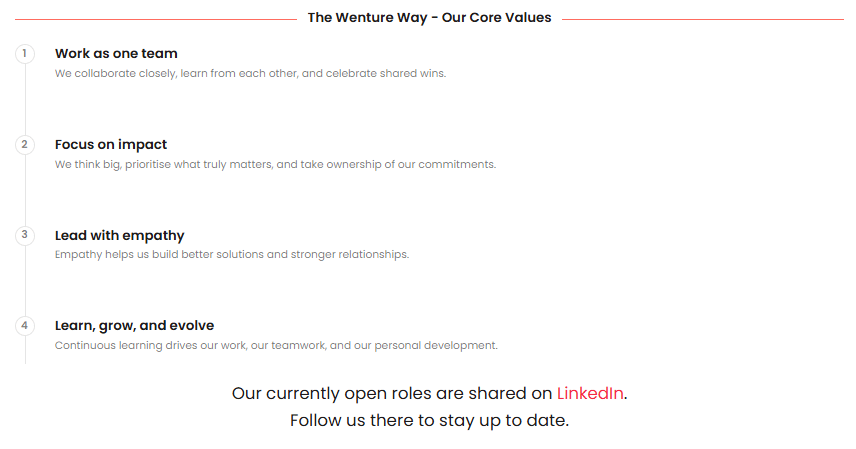
Since there is no recent funding, we can take a hint from what they’re doing.
The March 2026 webinar on manufacturing quote automation shows the beginning of a demand generation infrastructure. Webinars that are recorded well become evergreen content. They’re also a low-cost way to qualify leads: if someone registers for a 45-minute session on CPQ automation, they’re seriously interested.
The website is already live in Finnish. Combined with their participation in BAU 2025 (a European trade fair), we can already talk about a Nordic expansion.
The addition of an AI Sales Agent as a core Materia product line shows that they’re betting on AI-powered sales assistance as a category. This aligns with where manufacturing sales tech is heading. Wenture has received multiple EAS grants for specific product feature development: IFC/DXF export, AR/VR visualization, and the Partner Portal module. This gives them a non-dilutive funding path to build product capabilities without VC overhead.
If Nordic expansion is the next real move, ABM (Account-Based Marketing) is the most logical go-to-market motion to build for it. Instead of running broad awareness campaigns in a market where nobody knows Wenture yet, the play is to identify 50 to 100 Finnish manufacturers that match the profile of their best Estonian clients (window companies, ventilation producers, flooring manufacturers) and run a coordinated sequence: LinkedIn content from Kaur Tull, targeted outreach, webinar invitations in Finnish, and the Design Time Estimation Calculator as the first touchpoint. That’s a pipeline you can build without a media budget.
Inspiration Points
1. Win a niche industry award to replace marketing spend
In the construction and public sector, trust precedes everything. A third-party award from an industry body is a credibility signal that no ad campaign can manufacture. According to Edelman’s 2024 B2B Thought Leadership Impact Report, 60% of C-suite executives say credibility markers directly influence their purchase decisions. An industry award is exactly that kind of marker. It costs a nomination form, not a media budget.
The competition is also thinner than most companies expect. Early-stage companies don’t bother nominating themselves. If you operate in a niche B2B vertical, you’re almost certainly competing in an awards category where the bar is reachable.
Map every trade association, cluster organization, and industry body in your vertical. Most run annual awards. Nominate your best specific work. Not “best company” (too vague), but “best product innovation in [specific category].” The nomination itself creates content. The win creates a trust signal you use for years.
2. Use the CEO’s byline as a content distribution asset
His name and photo appear almost everywhere. He posts on LinkedIn in both English and Estonian. He was quoted in Äripäev on construction digitalization. His Calendly is on the contact page, meaning the CEO personally takes every first discovery call. That’s founder hustle doing double duty as a marketing channel. Most companies leave this completely idle.
According to a 2025 ThoughtCred analysis, LinkedIn company pages reach only 1.6% of their followers on average, while founder-authored posts reach up to 10x more people. Edelman’s 2024 B2B Thought Leadership Impact Report found that 60% of decision-makers say thought leadership directly influences their purchase decisions. In construction, a conservative industry where buyers are purchasing a relationship as much as a product, a CEO who writes honest, substantive content is answering the biggest objection before it’s even asked.
💡 Steal This: Take your last 3 blog articles published under your company brand and republish them under your CEO’s name with a personal byline. Measure the reach difference over 30 days. Then build a simple editorial system: CEO drafts rough ideas, content team polishes, CEO publishes under their name. Frequency matters less than consistency.
3. Build a free utility tool, not a lead magnet
Wenture published a free Design Time Estimation Calculator for construction companies, available ungated through their Insights section. Someone searching “how long does design take for a construction project” lands there, gets real value, and meets Wenture for the first time with zero sales pressure.
A gated eBook sits in a downloads folder. A free calculator gets bookmarked, shared in team Slack channels, and forwarded by engineers to their managers. According to Demand Gen Report research, interactive tools generate 2x more conversions than static content from buyers who are already engaged. This is a compound asset. Someone who spends 5 minutes on a design estimation calculator is telling you exactly what problem they’re working on, without filling out a form.
4. Quote specific outcomes, not features, in testimonials
Wenture’s on-site testimonials include lines like: “80% of our leads now come from CPQ”. They’re attributed to named executives at real companies. Vague testimonials don’t move B2B buyers. They’re too easy to fabricate and too easy to skip.
A named executive at a real company stating a specific operational metric is a compressed case study in one sentence. According to G2’s 2024 State of Software Buyer Behavior Report, 92% of B2B buyers consult peer review sites before purchasing, precisely because they’re looking for verifiable, specific social proof. Named outcome testimonials on your own site are the highest-trust format that doesn’t require a third-party platform to publish.
5. Transparent modular pricing that does your lead qualification for you
Wenture publishes all three Materia tiers: Starter at €390/month, Scale at €690/month, Pro at €990/month. Annual billing, format add-ons at €150/month each, and a one-time setup fee for the 3D Configurator. All visible without a conversation.
According to ProfitWell research, B2B SaaS companies with transparent pricing pages see 30% higher conversion rates from pricing page to trial initiation compared to those that gate pricing. The three-tier structure at Wenture does something more specific: it separates B2C from B2B use cases at the pricing level itself. A prospect who arrives at the Scale tier at €690/month and doesn’t flinch is already pre-qualified. One who leaves is filtered out before wasting a demo slot.
Transparent pricing is also a trust signal in conservative markets. When your costs are visible, buyers feel respected rather than maneuvered into a sales conversation.
💡 Steal This: If you’re hiding pricing because you’re afraid of competitor intelligence, reconsider. Your competitors already know what you charge. The only people who don’t are your prospects. Publish your tiers. Gate only the enterprise or fully custom tier behind a sales conversation. Let the pricing page do the qualification work for you.
6. Turn your government contract into your most powerful trust signal
Wenture is the development partner for Estonia’s national E-construction platform, under the Ministry of Climate. Their 2025 award nomination was for an AI customer support agent built for Estonia’s Building Registry (EHR). The ISO 27001 certification sits alongside it. Although these are PR wins, they double as direct answers to the biggest procurement objection in construction: “Can we trust this vendor with our data and our business?”
In regulated industries, institutional validation is the highest-trust signal available. It is also the hardest to fake. According to Edelman’s 2023 Trust Barometer, government and regulatory endorsement consistently scores as the most credible institutional signal in B2B purchasing contexts, outranking analyst reports, media coverage, and even peer recommendations among enterprise buyers.
💡 Steal This: If you have a government client, an institutional partner, or a security certification, move it to the hero section of your homepage. If you don’t have one yet, find the fastest path: a pilot project, a discounted first engagement with a public institution, or a funded research partnership. One credible institutional logo outperforms 10 feature bullets.
7. Make your deepest integration the stickiest part of your product
Wenture’s CPQ generates files that export directly to Autodesk Revit, IFC, DXF, and STEP formats. These are the formats architects and engineers work in every single day. When a configured product quote auto-generates a file that lands inside their design software, the product stops being optional tooling and becomes embedded infrastructure.
Michael Porter’s competitive strategy framework identifies switching costs as one of the five forces that determine sustainable competitive advantage. When a customer’s daily workflow depends on a specific integration output, replacing the source tool means rebuilding the entire workflow. In AEC software, that bar is high. The architect who has been generating Revit files from Wenture’s CPQ for six months would need to rebuild that process entirely to move to a competitor. That friction is retention, built into the product architecture rather than into a loyalty programme.
8. Make the free trial your primary CTA, not the demo
Wenture offers a 30-day, no-credit-card-required, full-feature trial of Materia PIM. The “Start free trial” button sits alongside “Talk with Sales” across the site. This is a PLG (Product-Led Growth) motion deployed in an industry where most vendors still default to demo-first.
The difference between a demo and a trial is the difference between being told something is good and experiencing it yourself. In a product like Materia, where the value only becomes visible once you’ve loaded your actual product catalog and watched a quote generate in one click instead of 48 hours, no slide deck will be as convincing as the product running on your own data.
Every trial signup is also a diagnostic signal. If someone starts a trial and never configures a product, that is your onboarding data. It tells you exactly where the experience breaks before it reaches value.
💡 Steal This: For every product feature you’d normally show in a demo, ask: “Could this be experienced in a self-serve trial instead?” If yes, build the onboarding so that feature is reachable in under 15 minutes of setup. Reserve demos for complex integrations, enterprise configurations, and situations where a human conversation genuinely accelerates the decision. Let the product prove value everywhere it can without you in the room.
Wenture’s marketing strategy reveals something specific about how to grow a niche B2B SaaS product without a venture capital runway: you don’t win by being everywhere. You win by being exactly right for a very specific buyer, at the moment they realize they have a problem.
The ingredients are all here. A technically strong, genuinely differentiated product. A CEO who shows up in the press and takes every first call personally. Government contract credibility. Transparent pricing. Named client outcomes. A free trial that removes friction at the bottom of the funnel.
The distribution is the gap. With 674 LinkedIn followers, no paid advertising, no lead nurturing infrastructure beyond a newsletter, and no presence on third-party review platforms, the audience reach is very limited for a company with Nordic expansion ambitions. The content quality is good. The funnel mechanics are clean. The next chapter is building the engine to get both in front of more of the right people.
At Milk and Cookies Studio, we build marketing and sales systems for B2B SaaS companies exactly like this one. If you’re growing a product with a clear ICP and a real use case but need help building the distribution it deserves, let’s talk.
Frequently Asked Questions
- What is Wenture? Wenture is an Estonian B2B software company founded in 2021 by Kaur Tull. They specialize in digitalizing the construction and manufacturing sector through two parallel offerings: custom software development for industry-specific needs, and Materia Suite, a SaaS (Software as a Service) product combining CPQ, PIM, a B2B Partner Portal, and an AI Sales Agent.
2. Who is Wenture’s ideal customer? Manufacturers and construction material companies with complex, configurable product portfolios: companies that are currently generating quotes manually, managing product data across spreadsheets and email, and dealing with errors in orders and proposals. Think: window makers, ventilation system producers, flooring companies, solar panel manufacturers.
3. What is Materia Suite? Materia is Wenture’s core SaaS product, available in three plans (Starter at €390/month, Scale at €690/month, Pro at €990/month). It includes CPQ software for instant quote generation, PIM for centralized product data management, a B2B Partner Portal for distributor management, and an AI Sales Agent for 24/7 product support.
4. What makes Wenture different from other CPQ/PIM software vendors? Three things: their team combines construction engineers and software developers (domain expertise as a product moat), their product integrates CPQ + PIM + Partner Portal in one platform rather than requiring separate tools, and they offer CAD/BIM export capabilities that embed the product directly in architects’ and engineers’ design workflows.
5. What social media channels does Wenture use? LinkedIn is the primary channel (674 followers on the company page). They also maintain Facebook and YouTube pages, with limited activity. No TikTok or Instagram presence.
6. Does Wenture have product reviews on G2 or Capterra? Not as of February 2026. They have testimonials on their own website from clients, but no third-party review platform presence yet.