Marketing Spotlight: Mapping Starship Technologies’ Marketing and Sales Tactics
In this article, we put Starship Technologies in the “Marketing Spotlight” as we take a closer look at how their sales and marketing strategies are working and what sets them apart (in February 2026).
Article summary
Share
TL;DR: Conclusions and Key Takeaways
🎀 This section gives you the main insights without all the details. It’s the stuff you need to remember, whether you’re reading this now or in 6 months. We made this for people who want to get the core message fast.
Starship Technologies is doing some things really well when it comes to marketing their autonomous delivery robots. They know how to repurpose content across platforms without making it feel stale, and they understand that different audiences hang out in different places.
Their partnership announcements consistently get the most engagement, which tells you something important: people care more about where these robots are going than the technical specs of how they work. They also deserve credit for taking accessibility seriously and actually building it into their product and marketing, not just talking about it in a press release.
But here’s where things get messy. Starships’ social media strategy feels scattered. They’ll post consistently for a while, then go radio silent for months. TikTok hasn’t seen a new video in 2026 yet, and its blog stopped updating last August. It seems like they don’t have a clear content calendar.
The bigger problem is customer service. Reviews across platforms mention the same issues: slow responses, order problems, and pricing confusion. You can have the coolest robots on the planet, but if people can’t get help when something goes wrong, you might be in trouble.
The takeaway here is straightforward. Starship has built something genuinely innovative, and they’re marketing it to the right people in mostly the right ways. Partnership announcements work. Accessibility messaging works. Carousels on LinkedIn work.
What has room for improvement? The inconsistent posting, ignoring negative reviews, and letting customer service problems pile up while you focus on the next big launch. If you’re building a company that depends on daily customer interactions, your support infrastructure needs to be as reliable as your product. Otherwise, all that marketing effort just drives people to a frustrating experience they’ll tell everyone about.
📝 A quick note before you start reading: The data and analysis in this article are valid as of the time we wrote it. We don’t know when you’ll be reading this, maybe next week, maybe six months from now, and things might have changed since we looked at this company’s marketing and sales approach. Still, the insights and lessons here stay useful, even if the numbers or tactics have evolved a bit.
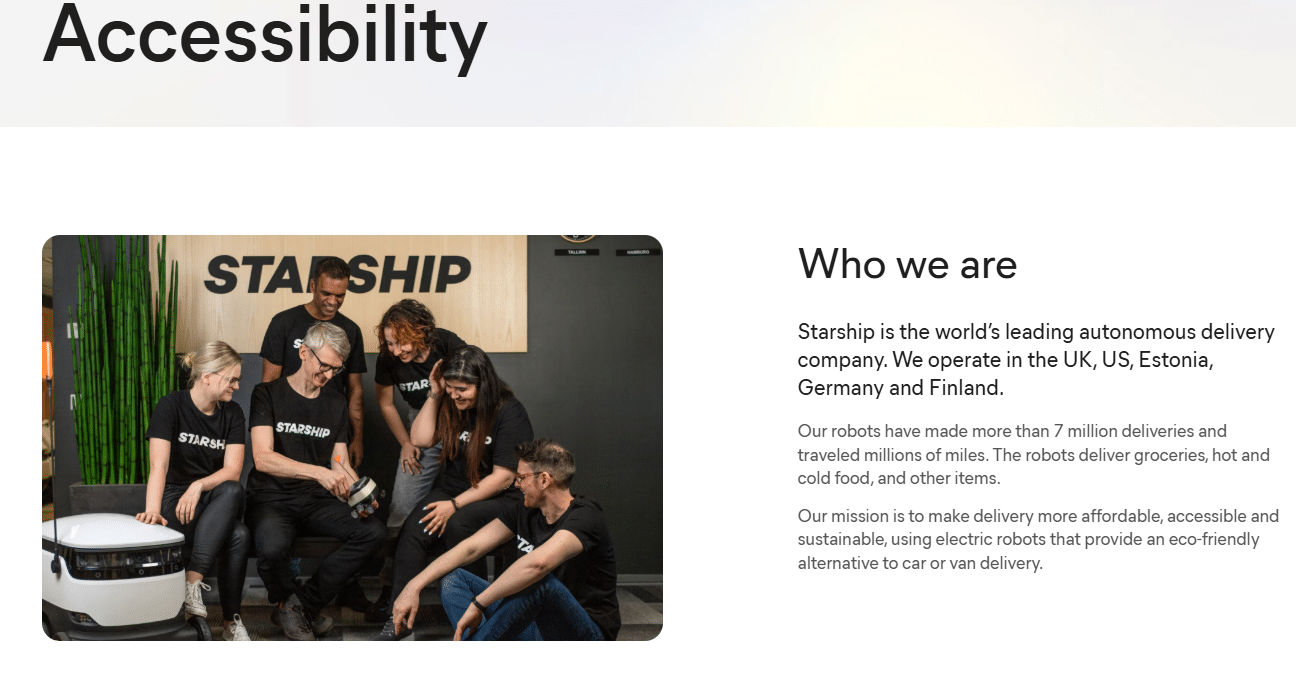
Autonomous delivery robots rolling down sidewalks used to be science fiction. Now they’re delivering burritos to college students and groceries to suburban families. Starship Technologies made that happen. They’ve completed 9 million deliveries across 270 global locations, from university campuses to industrial sites. Their little six-wheeled robots navigate traffic, weather, and sidewalk obstacles to get hot food and cold groceries to your door.
But building a cool product is one thing. Getting people to trust a robot with their lunch is another. That’s where marketing comes in. Starship has to convince universities that robots can reduce staffing pressure, persuade grocery chains that autonomous delivery cuts costs, and show regular customers that yes, your food will actually arrive and no, the robot won’t get stuck in a pothole.
So how does Starship do it? We looked at their entire marketing operation: website messaging, social media presence, content strategy, paid advertising, leadership visibility, and customer reviews. We wanted to see what’s working, what’s not, and what lessons you can take from their approach.
This breakdown shows you exactly how Starship Technologies markets autonomous delivery to a world that’s still getting used to the idea.
Understanding Starship Technologies
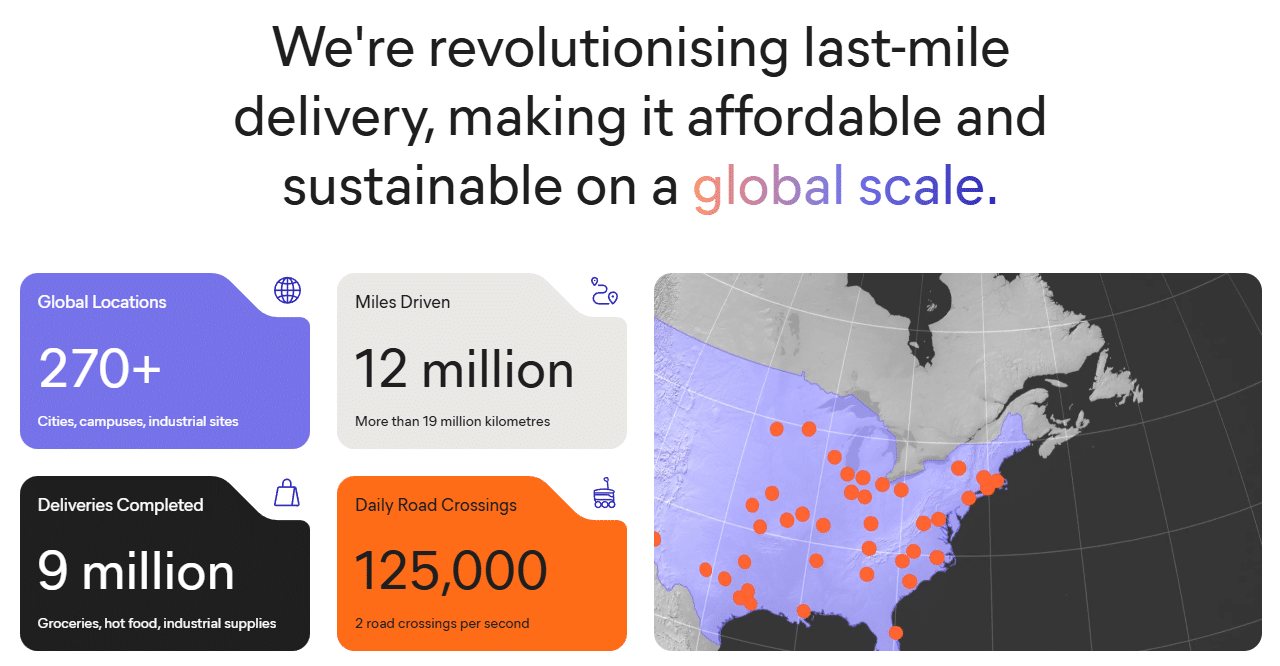
Starship Technologies makes autonomous delivery robots. Small, six-wheeled machines that drive on sidewalks and carry food, groceries, and supplies to people. They operate in over 270 locations worldwide, from college campuses in the US to city streets in Europe. These robots have driven 12 million miles, completed 9 million deliveries, and crossed roads 125,000 times every day.
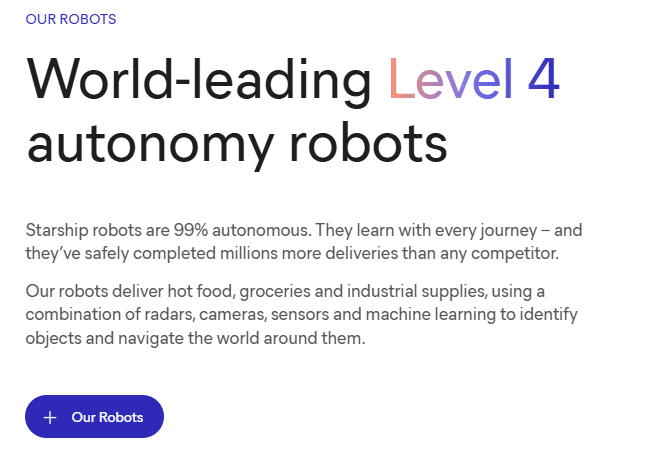
The robots are Level 4 autonomous, which means they’re 99% self-driving. They use cameras, sensors, radars, and machine learning to navigate around obstacles, recognize traffic signals, and avoid pedestrians. They can carry up to 3 grocery bags, keep hot food hot and cold food cold, and operate in rain, snow, and darkness.
Starship sells to 5 main customer types. University campuses use the robots to deliver food across sprawling grounds without hiring more staff. Grocery retailers use them for local deliveries that cost less than human couriers. Food delivery apps like Uber Eats and Grubhub integrate the robots into their platforms for short-distance orders. Industrial sites use them to move supplies between buildings, cutting down on employee walking time and emissions. Brands use the robots as moving billboards, wrapping them in custom designs and using them for product sampling campaigns.
The company was co-founded by Ahti Heinla, who also co-founded Skype. They’ve raised funding from investors, including Plural, which led their $50M Series C round in October 2025. They partner with major brands: Bolt, Sodexo, Aramark, REWE Germany, and others. They emphasize accessibility in their design, working with the American Foundation for the Blind to make their app usable for blind customers and ensuring wheelchair users can retrieve orders from the robots.
Starship’s pitch is simple: autonomous delivery that’s cheaper, greener, and more convenient than human couriers. They’ve proven it works at scale. Now they just have to keep convincing new markets to adopt it.
Starship Technologies’ Brand Promise Analysis
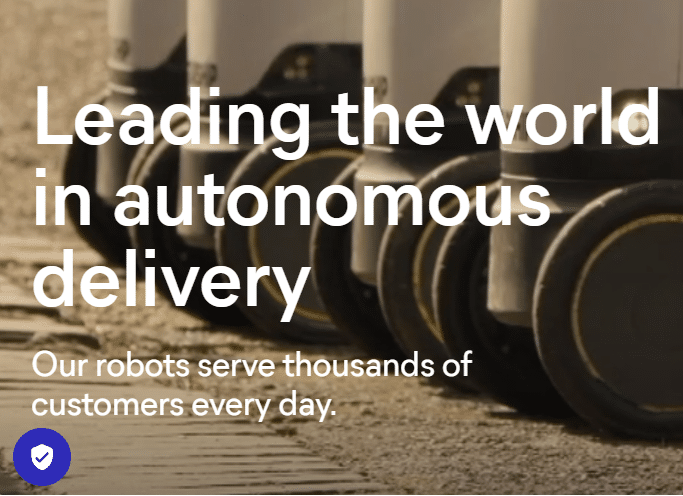
The hero section starts with a video montage and the first promise: “Leading the world in autonomous delivery. Our robots serve thousands of customers every day.”.
Starship are revolutionizing last-mile delivery, making it affordable and sustainable on a global scale. Their robots are available in over 270 global locations, such as cities, campuses, and industrial sites. 12 million miles driven, 9 million deliveries completed, and 125k daily road crossings.
Their level 4 autonomy robots are all over the world. These robots are 99% autonomous, and they can deliver hot food, groceries, or industrial supplies, using a combination of radars, cameras, sensors, and machine learning to identify objects and navigate the world around them.
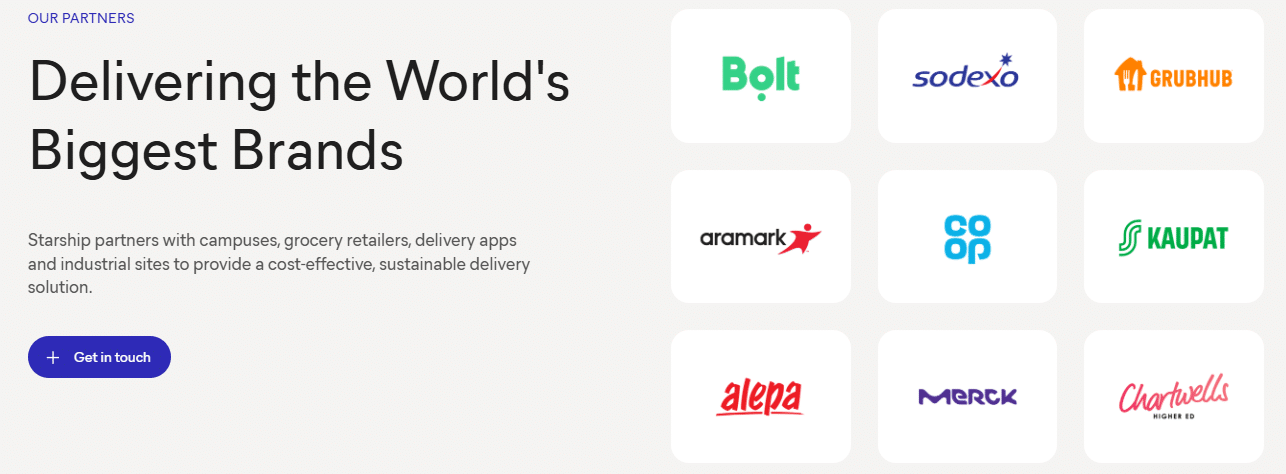
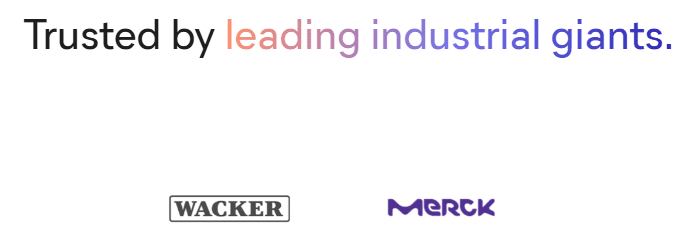
To reinforce trust, they drop the partners’ names: Bolt, Sodexo, GrubHub, Aramark, and others, in a dedicated section on their homepage.
Starship robots are making life easier and more accessible for students and staff at over 60 leading universities across the US. They partner with major chains to make hyper-local grocery delivery more efficient and sustainable by bringing cost-effective convenience to customers. Starship’s battery-powered robots provide a smart, cost-saving solution to industrial sites. And of course, they love to integrate with food delivery apps and even promote products with their little helpers.
Starship leads with social proof and scale. The numbers plastered across their homepage aren’t there by accident. Nearly half of consumers say poor support directly impacts whether they remain loyal, which makes building trust upfront through credible metrics even more critical.
They’re solving for the biggest B2B objection before you even think to ask it: does this actually work? Partnership logos reinforce this. When you see Bolt, Sodexo, and Grubhub, you’re seeing risk mitigation.
That reduces the cognitive load on new prospects trying to decide if autonomous delivery is real or just hype. The approach works because B2B buyers don’t make decisions in isolation. 92% of B2B buyers begin their journey with at least one vendor in mind, and 41% already have a preferred vendor before evaluation begins. Starship’s homepage is designed to become the preferred vendor through sheer credibility density.
Starship Technologies’ Service and Product Breakdown
Starship’s robots can be used by university campuses, grocery retailers, delivery apps, industrial sites, and advertising. The pricing is hidden because every case is unique, with different needs.
Starship’s benefits for university campuses:
elevates campus dining for busy college students and faculty
alleviates staffing pressure, without the need for additional retail locations or front-of-house staff
unlocks new revenue streams, without straining your current resources (university clients report an average 12% revenue increase)
incorporating their robots helps position your university as an innovative and forward-thinking institution, helping to attract prospective students
their robots make last-mile delivery cleaner, greener, and more sustainable
Starship’s benefits for grocery retailers:
reduced delivery costs
lower cost of acquisition
the robots are sustainable because they are electric, ready to reduce your carbon footprint and hit CSR goals.
innovative technology that can set your brand apart, helping you stand out in a competitive market
boost customer satisfaction and brand loyalty
they are reliable and safe, operating in all weather conditions
they can carry up to 3 grocery bags with an insulated compartment to ensure hot, cold, and frozen items remain at their correct temperature
What is the benefit for delivery apps, besides the ones mentioned for grocery retailers? Scalability. You can scale your delivery operations easily by deploying robots, without managing additional couriers. They can handle short-distance deliveries during peak hours, allowing humans to satisfy wider demand.
They’ve completed over 78k deliveries on industrial sites, saving over 650 tonnes of CO2. With Starship, you can reduce costs, save time, reduce emissions, and reduce the need for person-to-person contact, minimising any risk of contamination of goods and mitigating the transfer of colds and flu between employees.
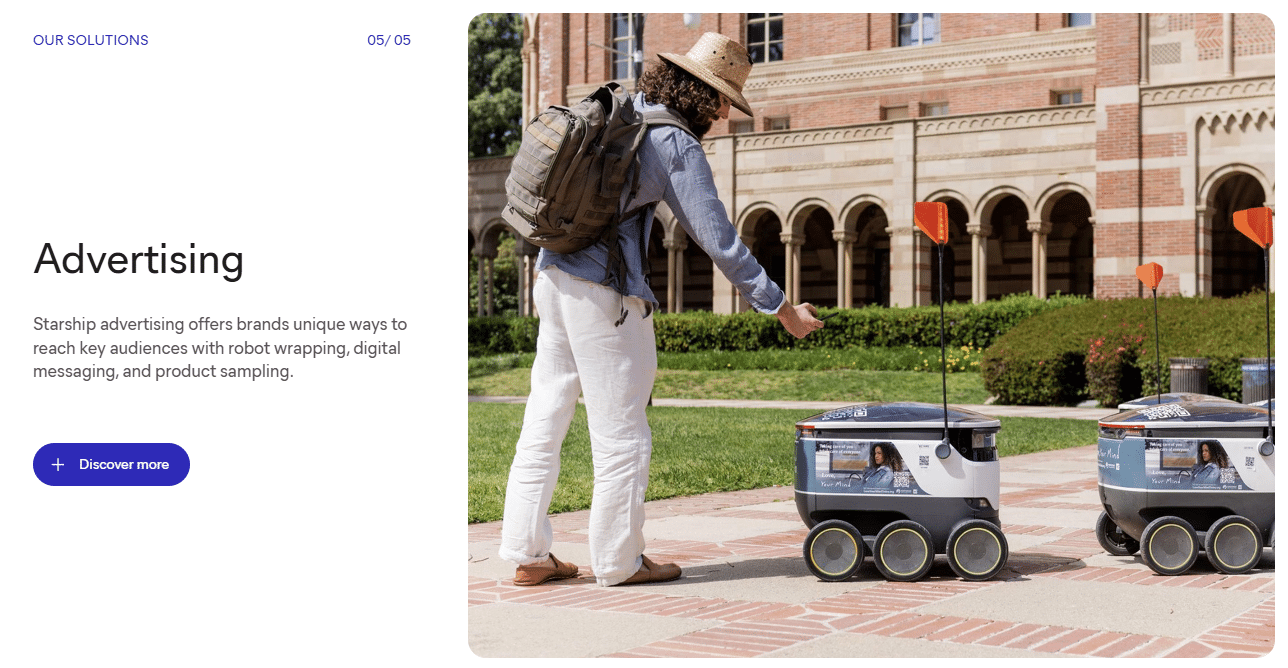
Starship advertising offers brands unique ways to reach key audiences with robot wrapping, digital messaging, and product sampling.
The benefits?
hyperlocal & global reach
you can monitor the impact of your campaign with mobile geolocation tracking and capture 1.7k average impressions per mile driven.
you can combine robot advertising, digital messaging, and product sampling for an immersive brand experience
you have expert implementation for a customized campaign that fits your brand, target audience, KPIs, and budget.
💡Steal This: Turn your physical product into an ad placement while it works.
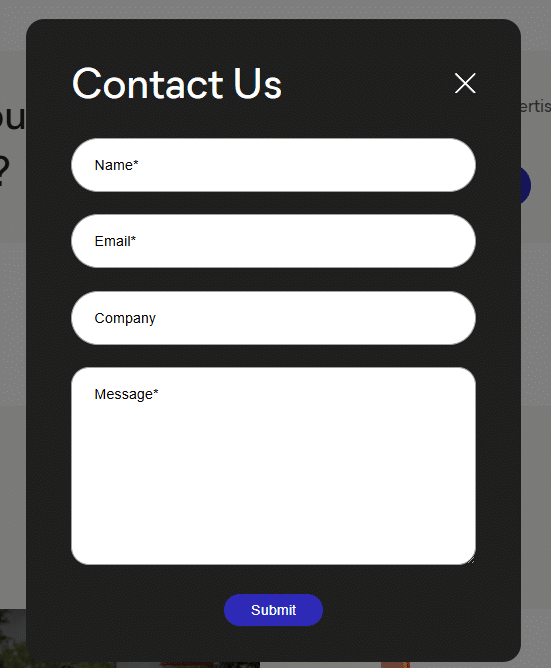
For each solution offered, you can contact Starship through a form that requests your name, email, company, and your message. Plain and simple.
Starship Technologies’ Differentiators and Unique Assets
Starship takes accessibility and inclusion seriously. They want to provide reassurance for disabled people and those with accessibility needs. Their goal is to enhance people’s lives whilst decongesting towns and cities of traffic. In the UK alone, between 17%-25% of their customers have a disability or live with someone who does.
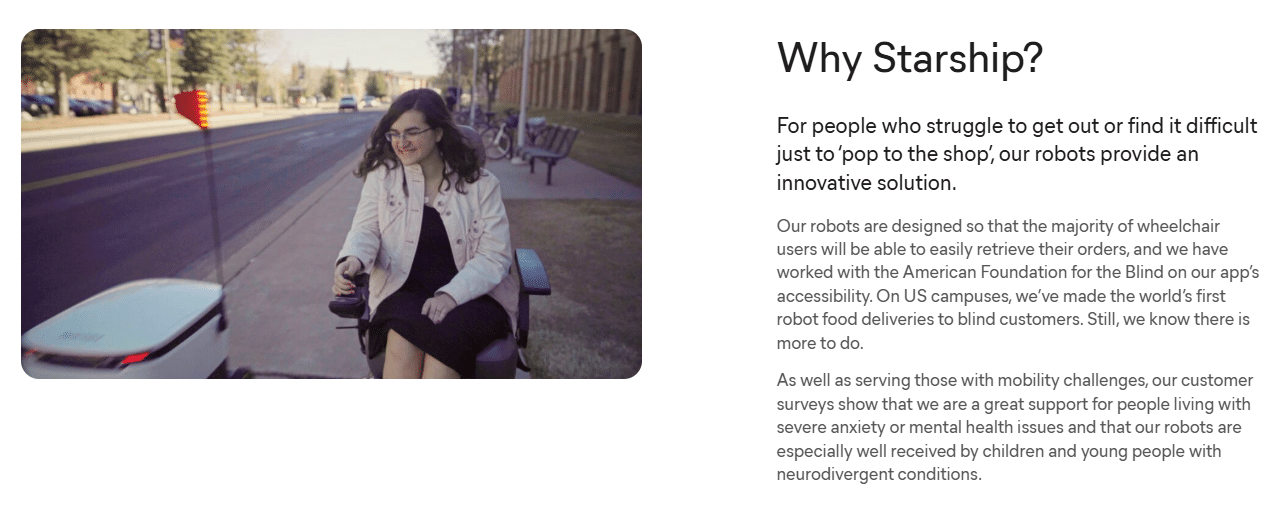
Starship robots are designed so that the majority of wheelchair users will be able to easily retrieve their orders. They also worked with the American Foundation for the Blind on their app’s accessibility. On US campuses, they’ve made the world’s first robot food deliveries to blind customers.
As well as serving those with mobility challenges, Starship’s customer surveys show that they are a great support for people living with severe anxiety or mental health issues and that the robots are especially well received by children and young people with neurodivergent conditions.
💡Steal This: Build accessibility into your product first, then let your marketing talk about it.
Founder-led growth and executive visibility build brand trust and thought leadership. Buyers research leadership before making purchase decisions. A visible, credible executive team can shorten sales cycles and strengthen brand positioning.
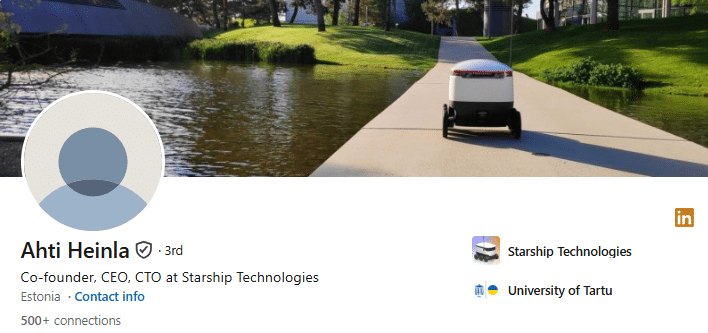
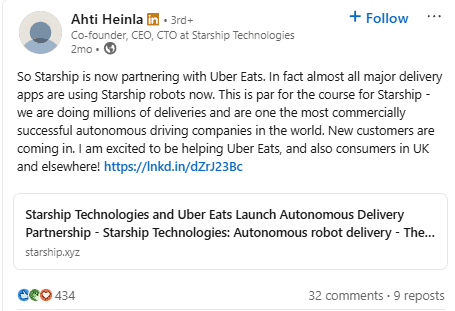
The co-founder, CEO, and CTO of Starship Technologies has 5.3k followers on LinkedIn. In the last 3 months, he posted only 1 time, announcing the partnership with Uber Eats. His post gained 434 reactions, 32 comments, and 9 reposts.
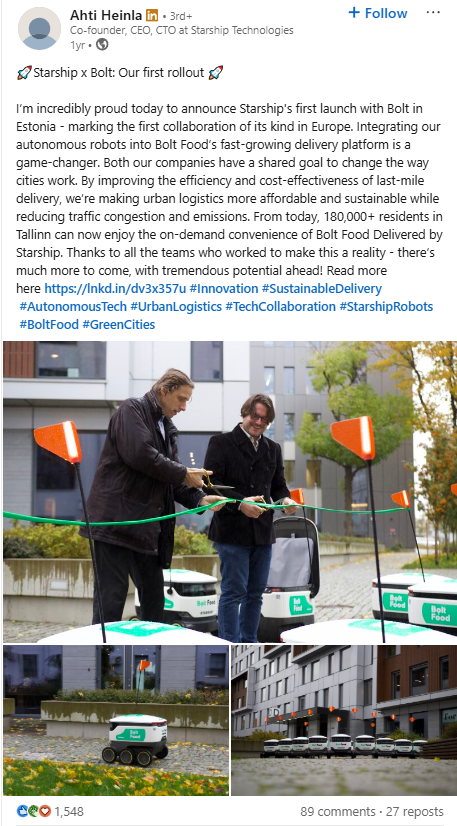
When he posts, it’s about Starship. News, updates, partnerships. Most of them gain almost 200 reactions, 10 comments, and a few reposts, but others have much more engagement. A year ago, when he posted about the Bolt Food partnership, the post gained 1.5k reactions, 89 comments, and 27 reposts.
He actually has big potential. If he posted company updates more often, the Starship page would gain traction just from that. Sporadic posting from a credible founder still outperforms most corporate accounts. The opportunity cost is massive.
LinkedIn is 277% more effective at lead generation for B2B than Facebook and Twitter, and founder-led content consistently drives higher engagement than branded posts. Heinla co-founded Skype. That’s instant credibility in tech and logistics circles. Every post he makes carries weight that a corporate account can’t replicate.
The “why” behind not posting more is probably resource constraints or lack of prioritization. Founders are busy. But the data is clear: engagement per post is up 12% on LinkedIn while organic views are down 50% compared to the previous year.
The platform is rewarding quality over quantity, which means even a few strategic posts per month from Heinla would amplify Starship’s reach significantly. You don’t need to become the next influencer. But leveraging existing trust to shorten sales cycles is something you could have in mind.
Starship Technologies’ Social Media Strategy
Social media reveals where your ICP actually spends time and what content resonates with them. Channel selection, posting frequency, and engagement rates tell you if marketing efforts match audience behavior.
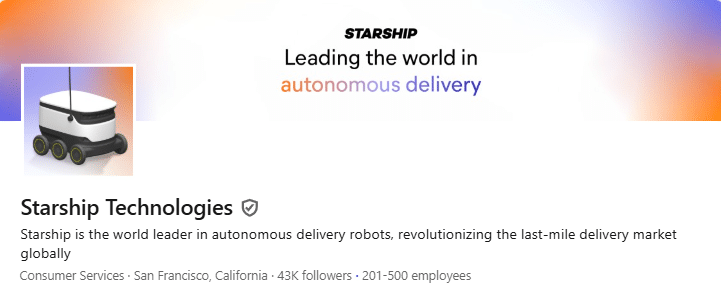
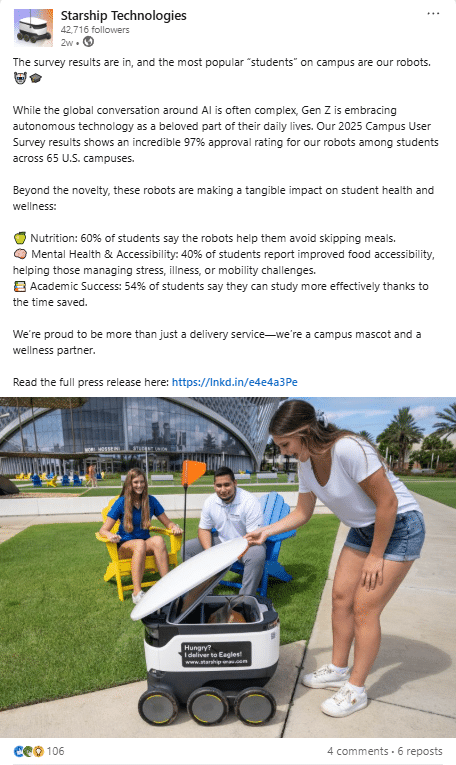
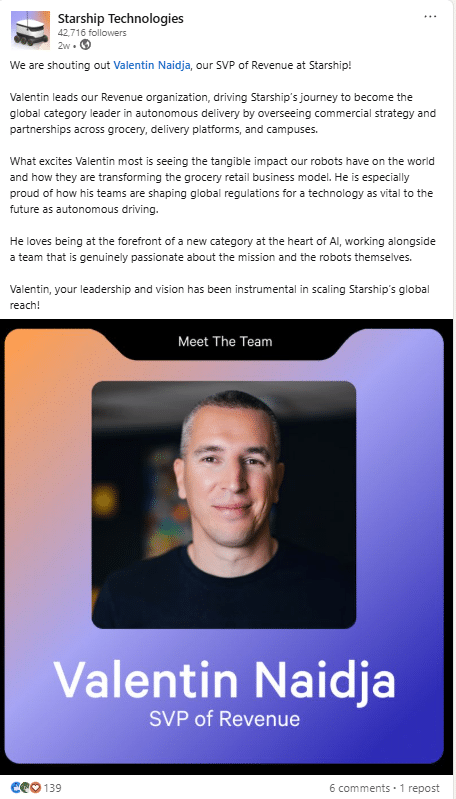
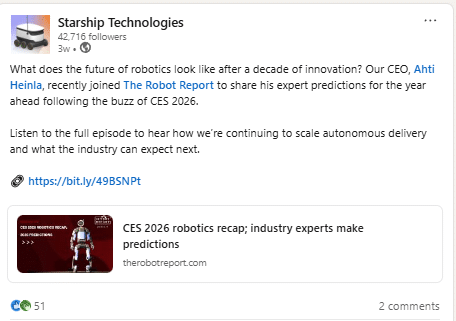
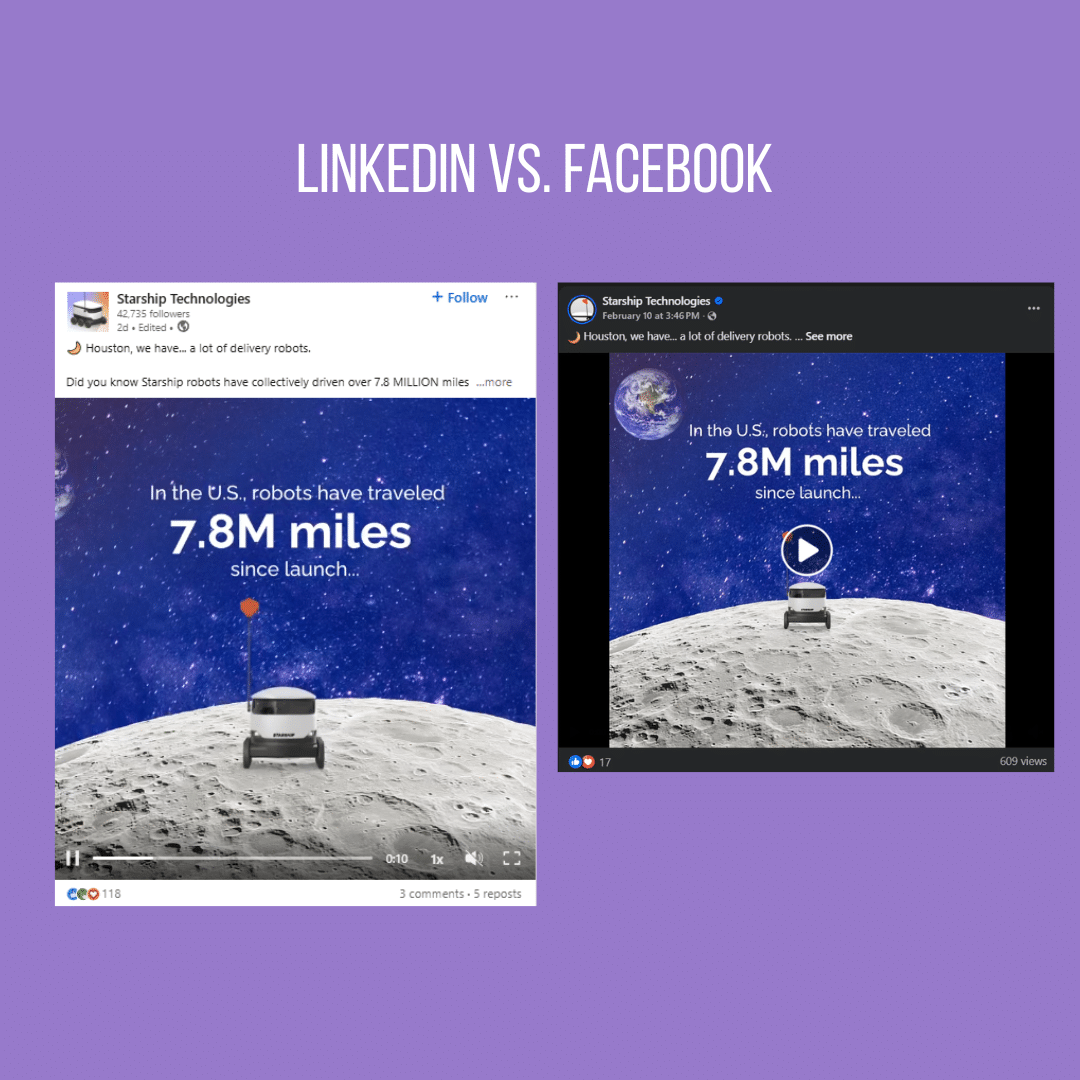
Starship Technologies has 43k followers on LinkedIn. They post twice a week, with engagement ranging from 50 to 250 reactions per post. Their feed includes a mix of original posts and reposts. They are posting images heavily, either single images or carousels.
Their content pillars are:
Product information
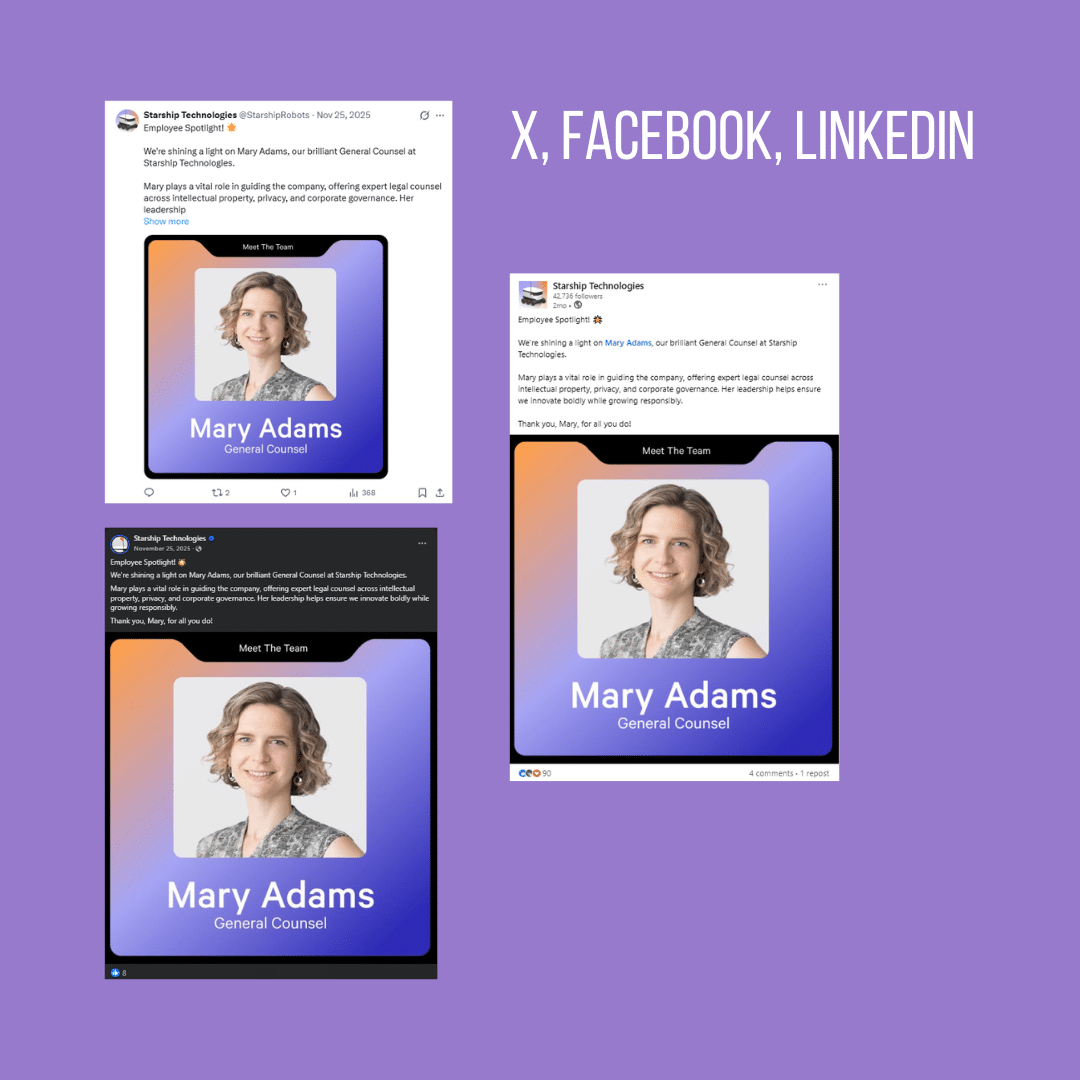
Employees and company culture
Educational content
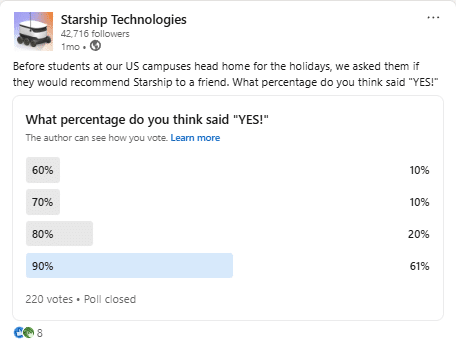
Starship will sometimes post polls, like this one below, where they ask students at US campuses if they would recommend Starship to a friend.
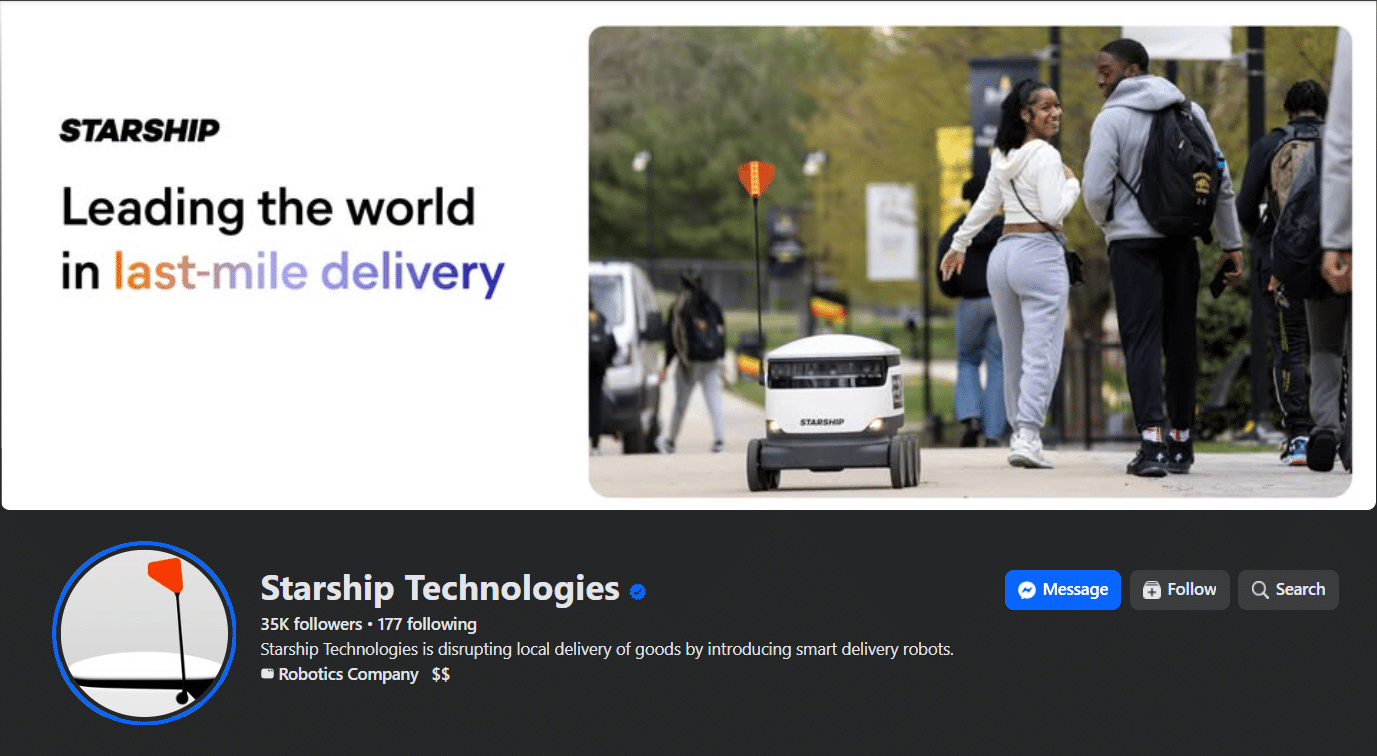
Starship Technologies has 35k followers on Facebook. The posts are the same from their LinkedIn page, which means they have the same content pillars (product updates, company culture, and educational content). Their engagement ranges from 4 reactions to 45 per post, with few comments and shares.
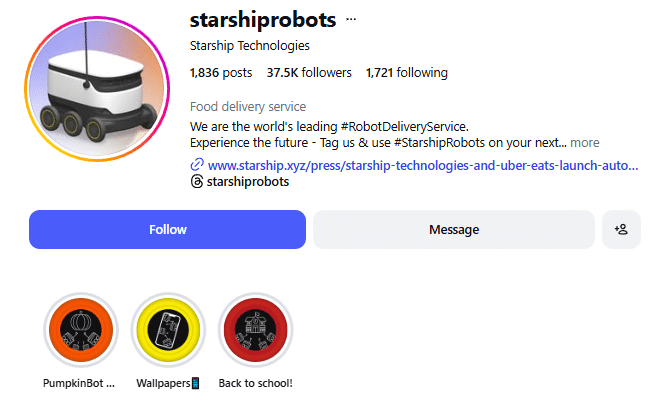
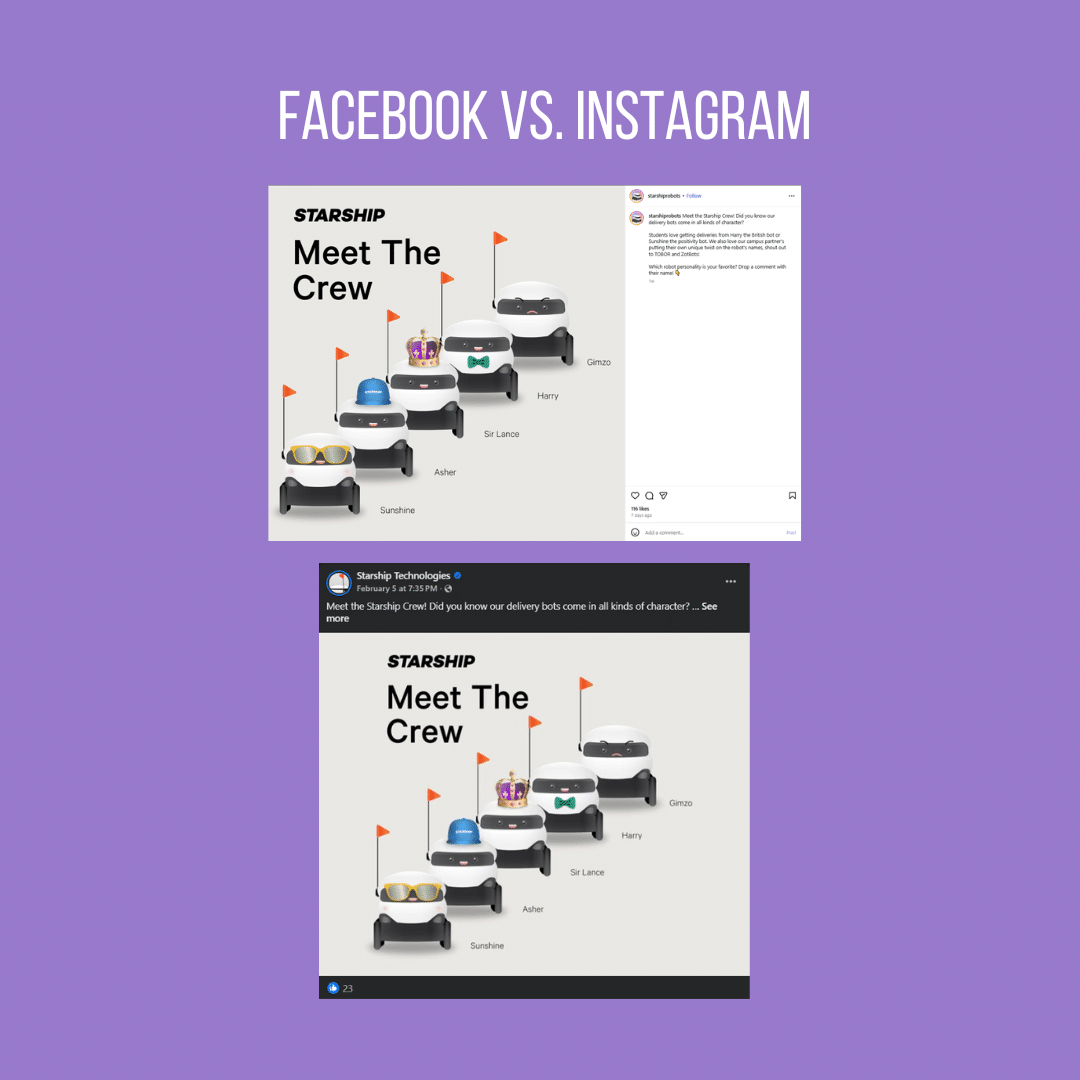
On Instagram, Starship Technologies has 37.5k followers. Content repurposing happens here, too, but not for all posts. They usually post a few times per week, with a noticeable break from December 2025 to February 2026. Here, they mostly post about the product to raise awareness. They post images, carousels, and videos. Engagement varies from 150 likes to over 350k.
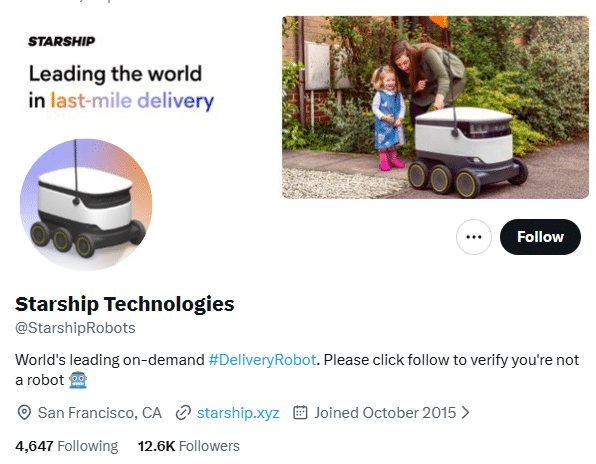
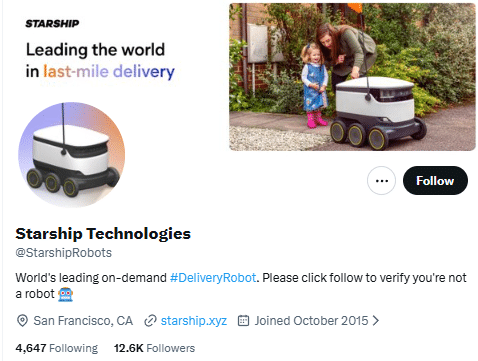
Starship Technologies has 12.6k followers on X. Here, you will see the same posts from every platform. Product awareness from Instagram, updates and events from LinkedIn, and company culture from Facebook and LinkedIn. Their posts have around 300 views, but only a few likes, comments, or reposts.
There are some original posts scattered throughout all of these, like this post below about Valentine’s Day and how their “love bots” will help you with your last-minute shopping.
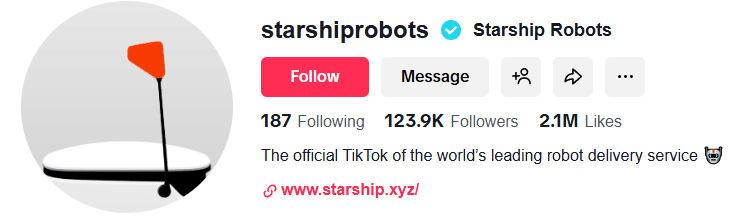
On TikTok, Starship has 123.9k followers and a total of 2.1 million likes. They have 3 featured playlists: Robo talks, Women of Starship, and Humans of Starship.
On Robo talks, a robot is walking around campuses with a question for students, like “Tell me a secret” and “What makes you happy?”.
On Women of Starship, women employees answer questions like: “What are you most proud of when it comes to your work at Starship?” and “What advice would you give to a young woman entering your career field?”.
The Humans of Starship playlist has 1 video showing an employee’s normal workday, along with the caption “Want to work with us? [link to their career page].
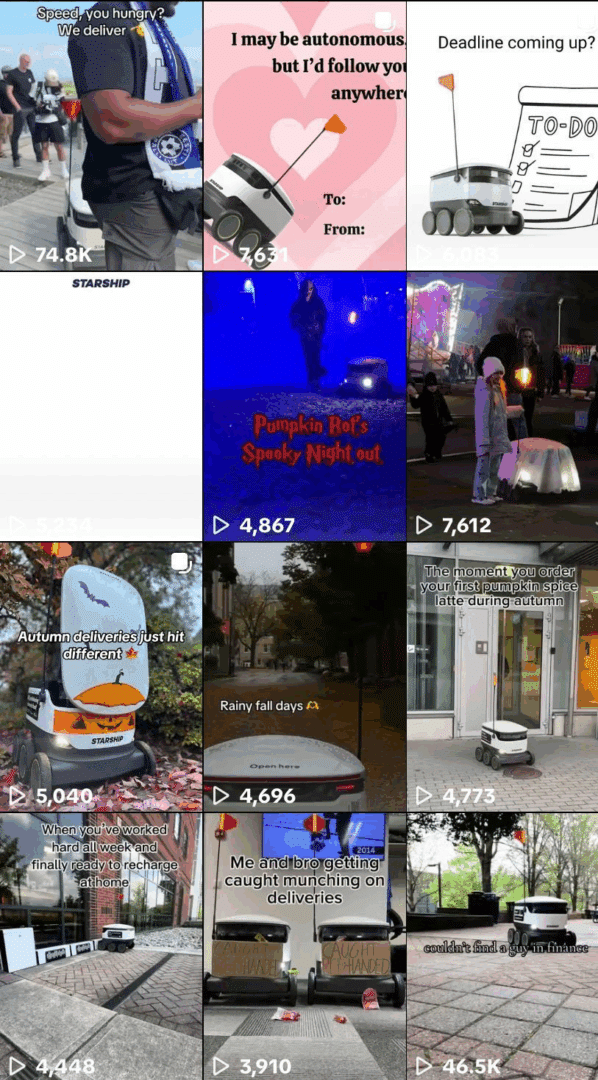
In 2025, Starship posted only 2 videos, and the feed continues with the 2024 ones. As of February 2026, they don’t have any posts this year. They had around 2.5k views, with spikes of over 50k views. They post videos and carousels. Carousels are not great performers on TikTok, especially for a brand. They had constantly few comments, shares, and saves on each post.
These videos are mostly original, created specially for this platform. They are a little bit funny, fresh, and short. Just what the algorithm liked in 2024.
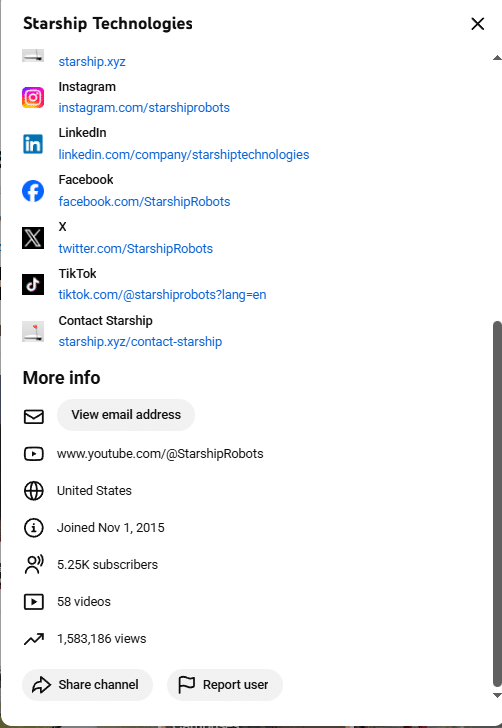
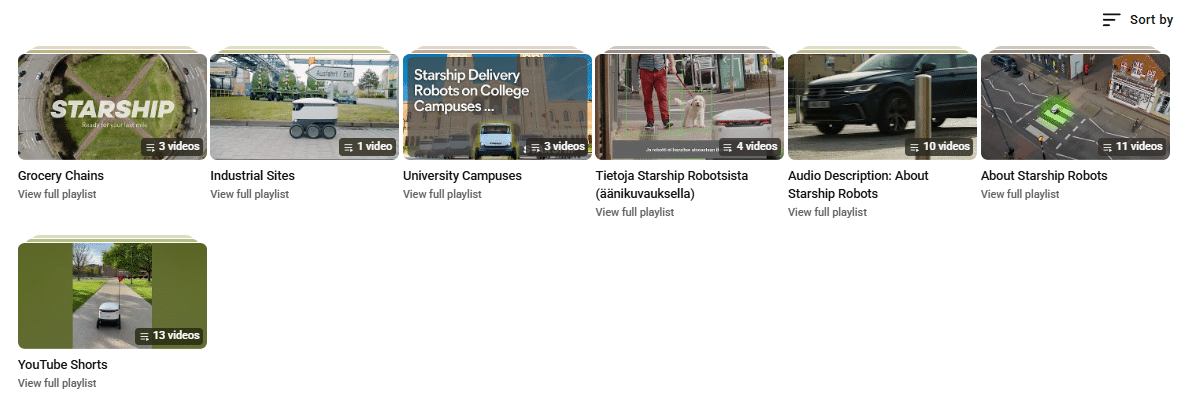
On their YouTube channel, Starship has 5.25k subscribers, 58 videos posted, and 1.5 million views in total. They have 7 playlists:
Grocery Chains
Industrial Sites
University Campuses
Tähtialusrobotit ja muut jalkakäytävän käyttäjät (äänikuvauksella) [which, by Google Translate courtesy, we found out it means Star Robot and other sidewalk users (audio display)]
Audio Description: About Starship Robots
About Starship Robots
YouTube Shorts
On the Shorts tab, Starship has 15 videos. They have more than 1.6k views per video, hundreds of likes, and few comments. They are reposting the same videos from TikTok. How do we know this, except for visual memory? The TikTok video watermark. Again, this is not a great strategy, because each platform wants to be first. Or at least, to feel like it. That means no watermarks from other platforms, no external links, or you will be penalized, in most cases.
They are posting a few times a year, which is not so great for the YouTube algorithm. What are they posting? Panels, use cases, and how the robots are walking on the street with different obstacles or in different weather conditions.
The audio description videos are made for visually impaired people. They are describing exactly how their robots look and how to use them. They also have some videos with ASL overlay.
Their videos usually get some comments, but not always. They are clearly using this platform to show and explain in detail what their robots are and what they can do.
Starship posts across 6 platforms with wildly inconsistent frequency. LinkedIn gets twice-weekly updates. TikTok went silent for months. This scattered approach suggests either a small team stretched thin or no centralized content strategy.
TikTok dominates engagement, growing 49% year over year to a 3.70% rate in 2025, the highest of all social media platforms. Going dark on TikTok in 2026 means abandoning one of the highest-engagement platforms available.
The content repurposing strategy they’re using (same posts across LinkedIn, Facebook, Instagram, X) is smart in theory but poorly executed in practice. Marketers who repurpose content see a 40% increase in overall content output without proportionally increasing their creation time, but the key word is “repurpose”, not “copy-paste”. Each platform has different audience expectations and algorithm preferences.
TikTok watermarks on YouTube Shorts get penalized. External links in Instagram captions get buried. Average comments per post fell on TikTok and Instagram, suggesting a shift toward more passive engagement. When you disappear for months, you train your audience to disengage. Algorithms reward consistency. Starship’s social strategy would work better with half the platforms and double the consistency.
Starship Technologies’ Top-Performing Content
Top-performing content reveals what actually resonates with your audience, not what you think should resonate. These insights inform content strategy, ad creative, and messaging across all channels.
LinkedIn
In the last 3 months, Starship Technologies’ top-performing posts on LinkedIn are:
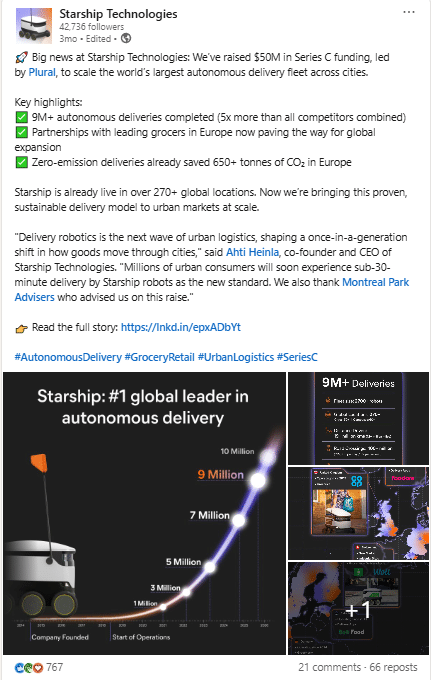
A carousel announcing funding news ($50M in Series C, led by Plural), with 767 reactions, 21 comments, and 66 reposts.
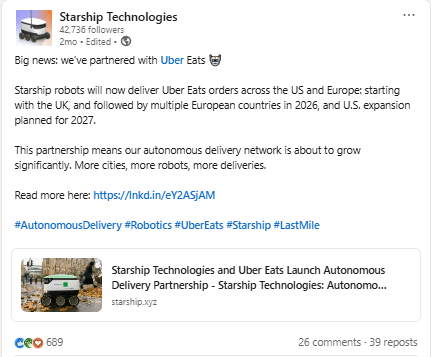
2. Partnership with Uber Eats announcement, with 689 reactions, 26 comments, and 39 reposts. This is linked to an article from their site.
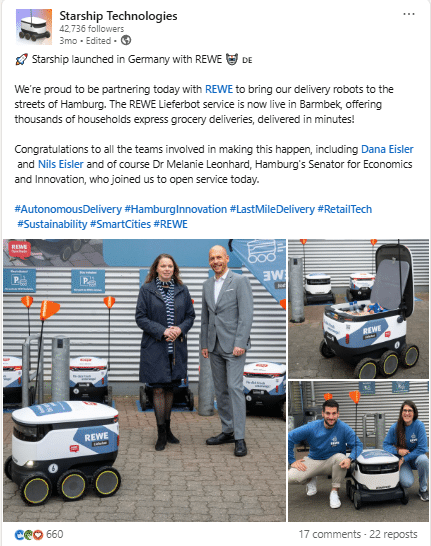
3. A carousel announcing the partnership with REWE Germany, with 660 reactions, 17 comments, and 22 reposts.
As we can see, carousels are the preferred format for their LinkedIn page. Partnership announcements and funding news have the most traction. They are also using hashtags in these posts, like: #AutonomousDelivery, #RetailTech, #UberEats, or #Starship.
💡Steal This: Announce partnerships like milestones, not press releases.
Facebook
In the last 3 months, these are best perfoming posts from their page.
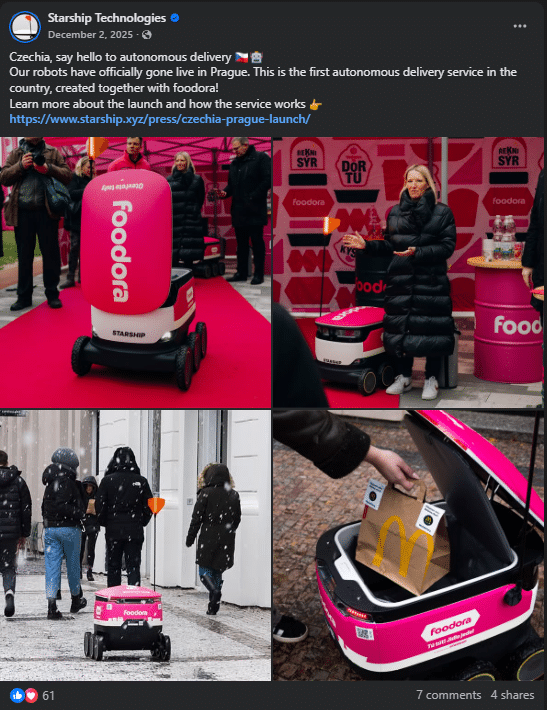
A collection of pictures announcing the Czechia, Prague launch of their robots, with 61 reactions, 7 comments, and 4 shares.
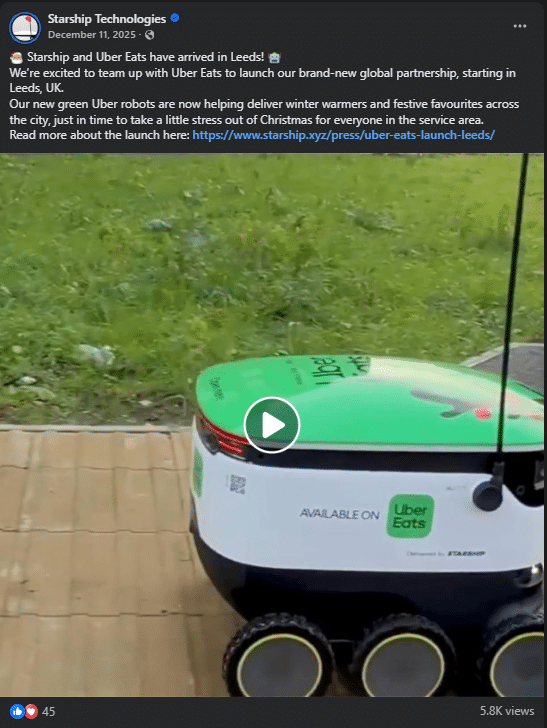
2. A video announcing Uber Eats partnership, starting in Leeds, UK, with 45 reactions and 5.8k views.
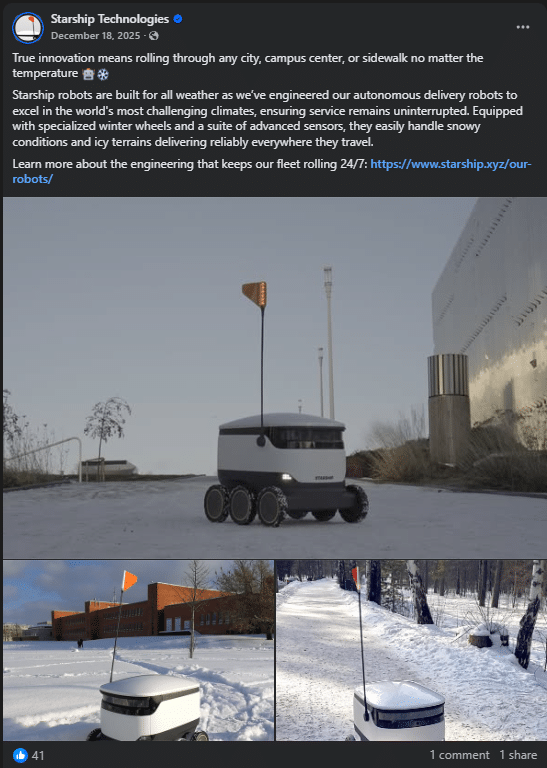
3. Pictures with robots in the snow, describing how their robots can walk on any city, campus center, or sidewalk, no matter the temperature. This post has 41 reactions, 1 comment, and 1 share.
On Facebook, posts with multiple images are doing well, along with videos. Here, partnership announcements are the most exciting for their followers.
Instagram
The last 3 months’ top-performing Starship posts are:
2025 wrapped up, a carousel with 188 likes, 4 comments, and 3 shares.
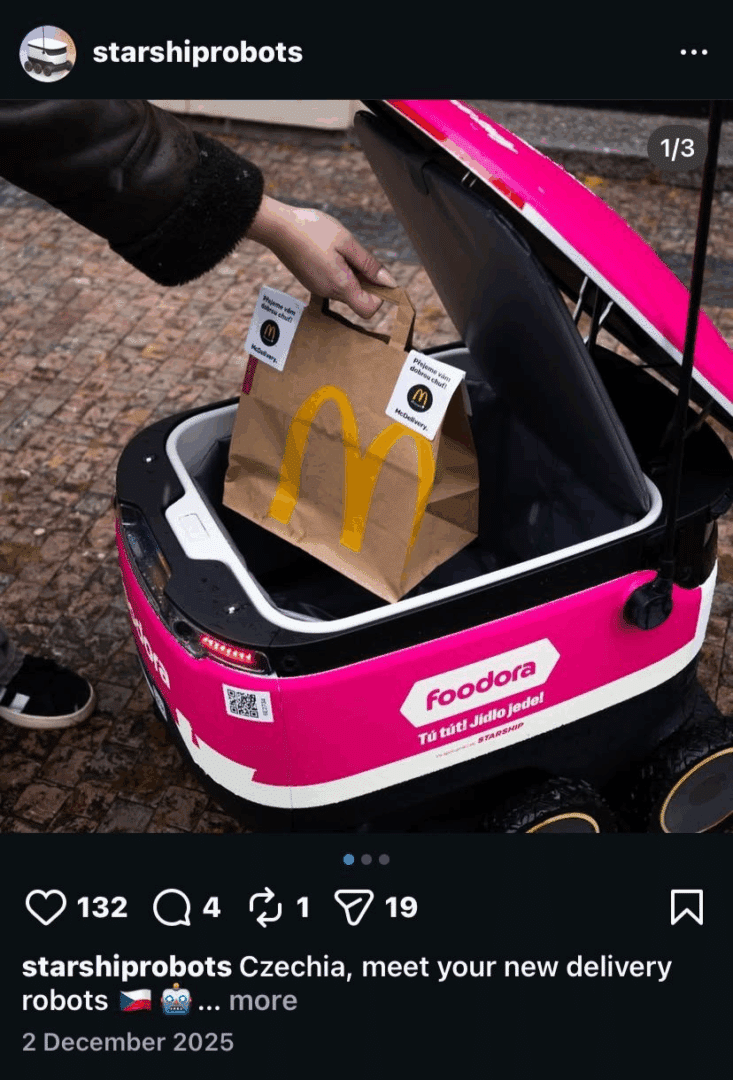
2. The Prague announcements carousel, with 132 likes, 4 comments, 1 repost, and 19 shares.
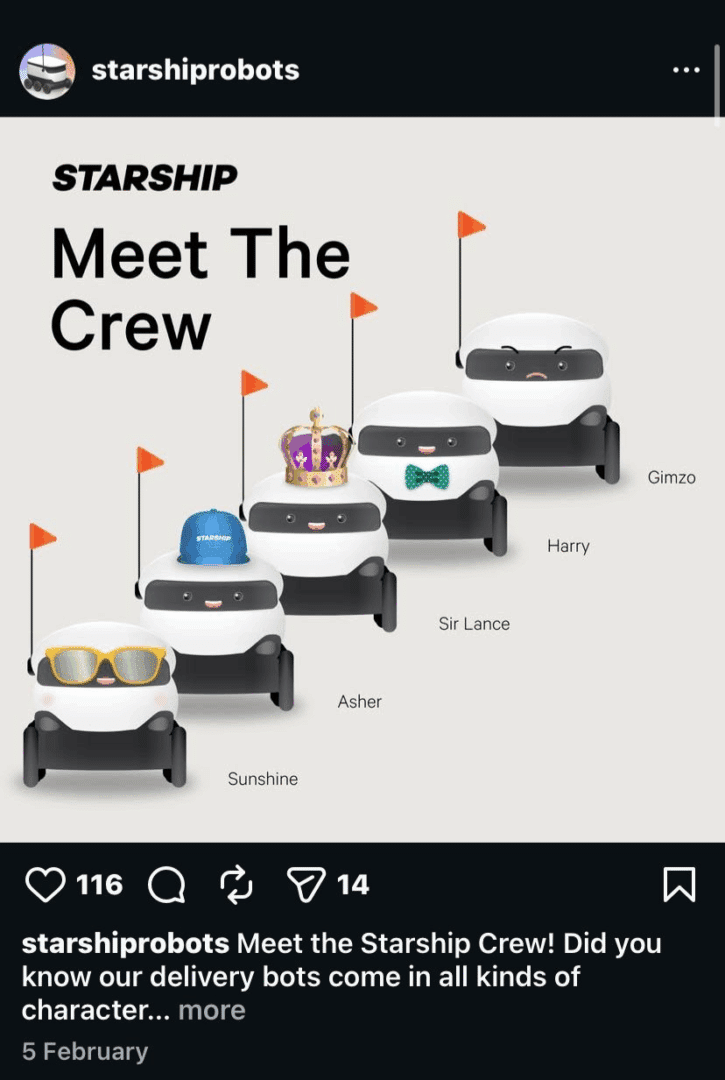
3. Meet the (robo) crew image, with 116 likes and 14 shares.
As seen before, carousels are doing well on Instagram, too. In fact, even in 2026, carousels come in second place after videos.
X (formerly Twitter)
Top posts on X in the last 3 months are:
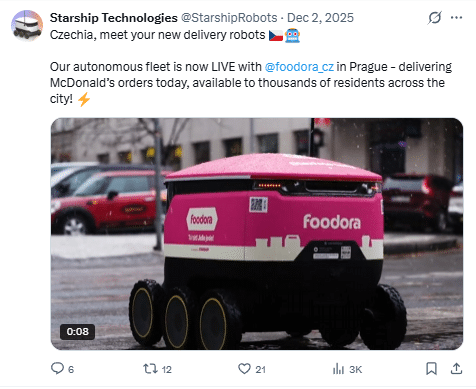
An 8-second video announcing Czechia’s new entry. As you can see, people were VERY excited about this. The post has 3k views, 21 likes, 6 comments, and 12 reposts.
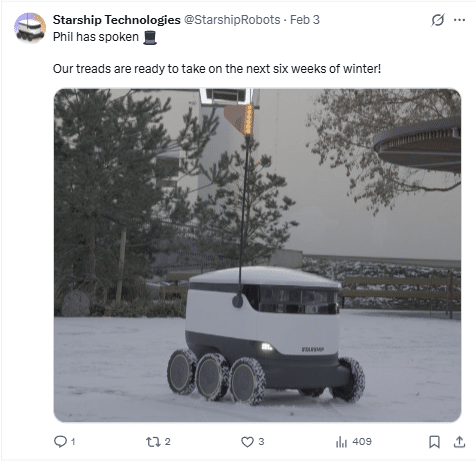
2. An image with a robot ready for the winter, with 409 views, 3 likes, 1 comment, and 2 reposts.
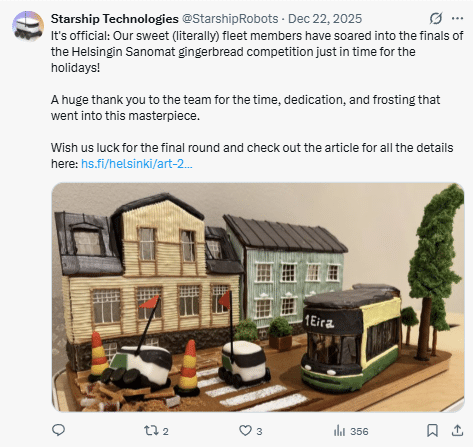
3. A post about a (sweet) gingerbread competition, with 356 views, 3 likes, and 2 reposts.
It seems here that videos are gaining more views, but funny, single-image posts are worth more likes and views than product updates.
YouTube
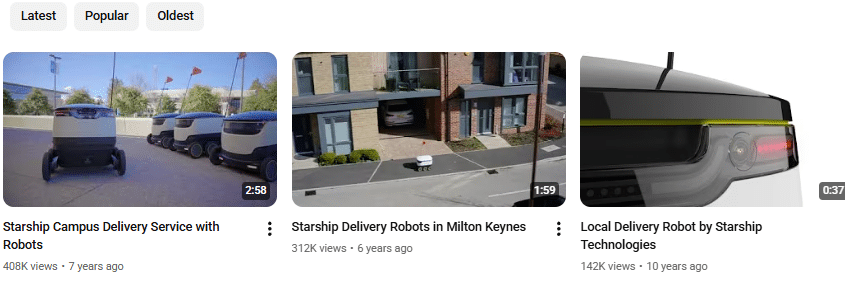
Starship’s most popular videos are:
Starship Campus Delivery Service with Robots, with 408k views, 3.2k likes, and 260 comments
Starship Delivery Robots in Milton Keynes, with 312k views, 1.1k likes, and 272 comments
Local Delivery Robot by Starship Technologies, with 142k views, 286 likes, and 22 comments
These videos are 2 minutes long, explaining how their robots work. They are from 6 to 10 years ago, which means that the engagement is organic, made in time.
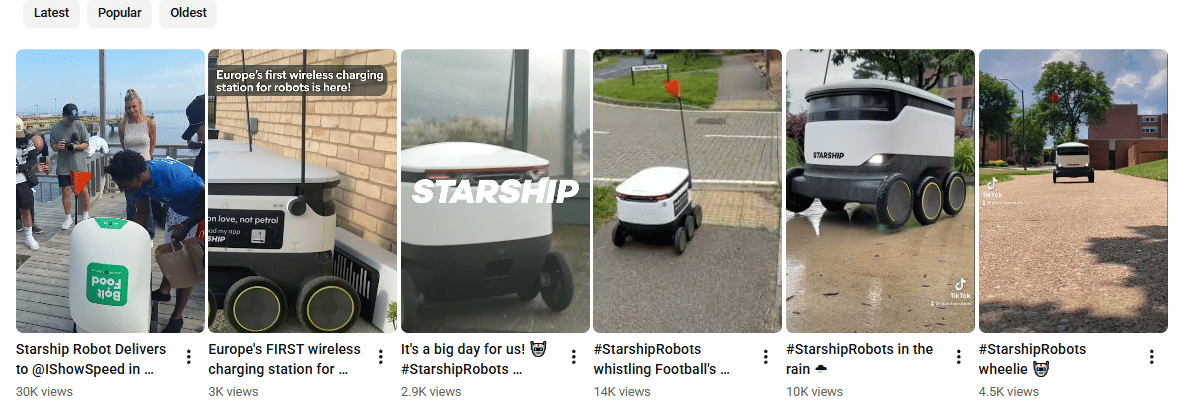
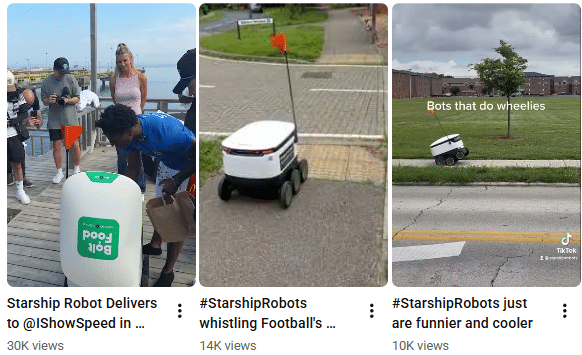
These are the top 3 Shorts:
Starship Robot Delivers to @IShowSpeed in Estonia, with 30k views, 325 likes, and 4 comments.
#StarshipRobots whistling Football’s Coming Home in Milton Keynes, with 14k views, 178 likes, and 2 comments
#StarshipRobots just are funnier and cooler, with 10k views, 216 likes, and 3 comments.
The last one is a repost from TikTok. Creators can also do this because the post performed well on the other platform, and they are dipping their toes in the water by posting it here, too. The first short is more explanatory on how the robots work, but the other 2 are just funny videos. Nothing crossing the line, in any way.
Since Starship Technologies hasn’t posted in a while on TikTok and they don’t have any pinned post, we can’t analyze their top content.
Partnership announcements crush everything else. The Uber Eats reveal got 689 LinkedIn reactions. The REWE Germany partnership got 660. The $50M Series C funding hit 767. Compare that to regular posts getting 50-250 reactions, and the pattern is obvious: people care more about where robots are going than how robots work.
Carousels consistently outperform single images and text posts on LinkedIn and Instagram. Multi-image posts lead with a 6.6% engagement rate, document posts at 6.1%, and short videos at 5.6%. Starship has figured this out.
Most of their top posts are carousels. The format lets them pack multiple data points, visuals, and narratives into one post, which keeps people swiping and increases dwell time. The algorithm rewards that.
Partnership announcements signal growth and validation. They answer the implicit question every buyer has, which is “who else is using this?”. Funding news works for similar reasons. It signals stability and momentum. When customers feel in control, personalization becomes a loyalty driver, not a red flag. Partnerships make autonomous delivery feel less experimental and more inevitable.
Starship Technologies’ Paid Advertising Strategy
Paid advertising reveals where companies invest acquisition budget and what messages they test in the market. Ad copy, creative formats, and platform selection show you what’s working at scale, not just what sounds good in theory.
LinkedIn
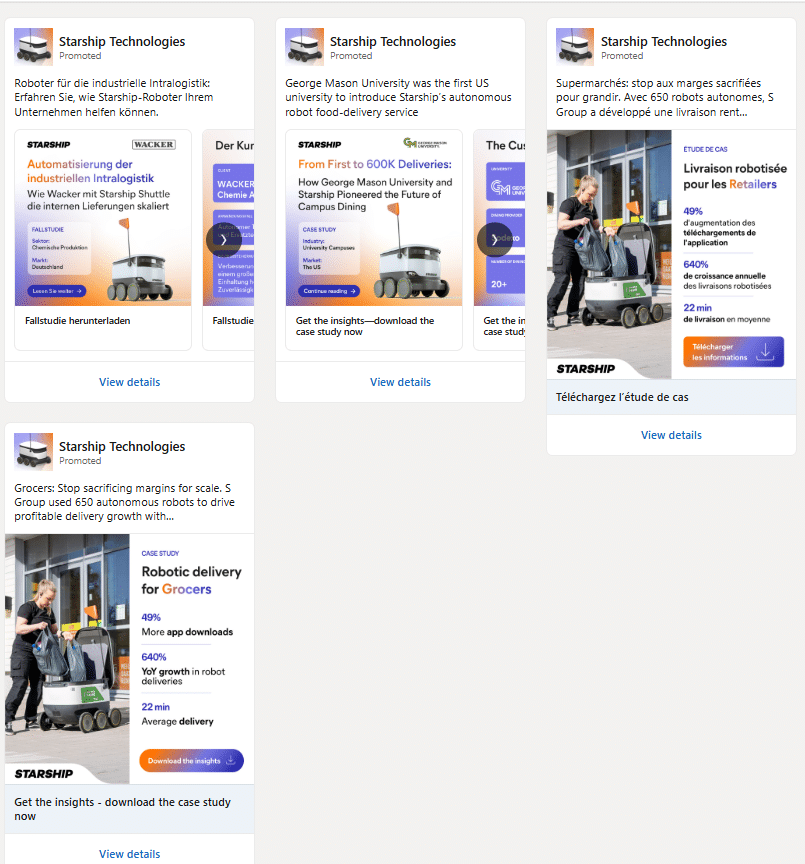
On LinkedIn, Starship Technolgies are running 4 ads: 2 in English, 1 in German (that targets Germany), and 1 in French (targets France). Two of them are carousels, and two of them are single image ad. All of their ads have a case study for their landing page.
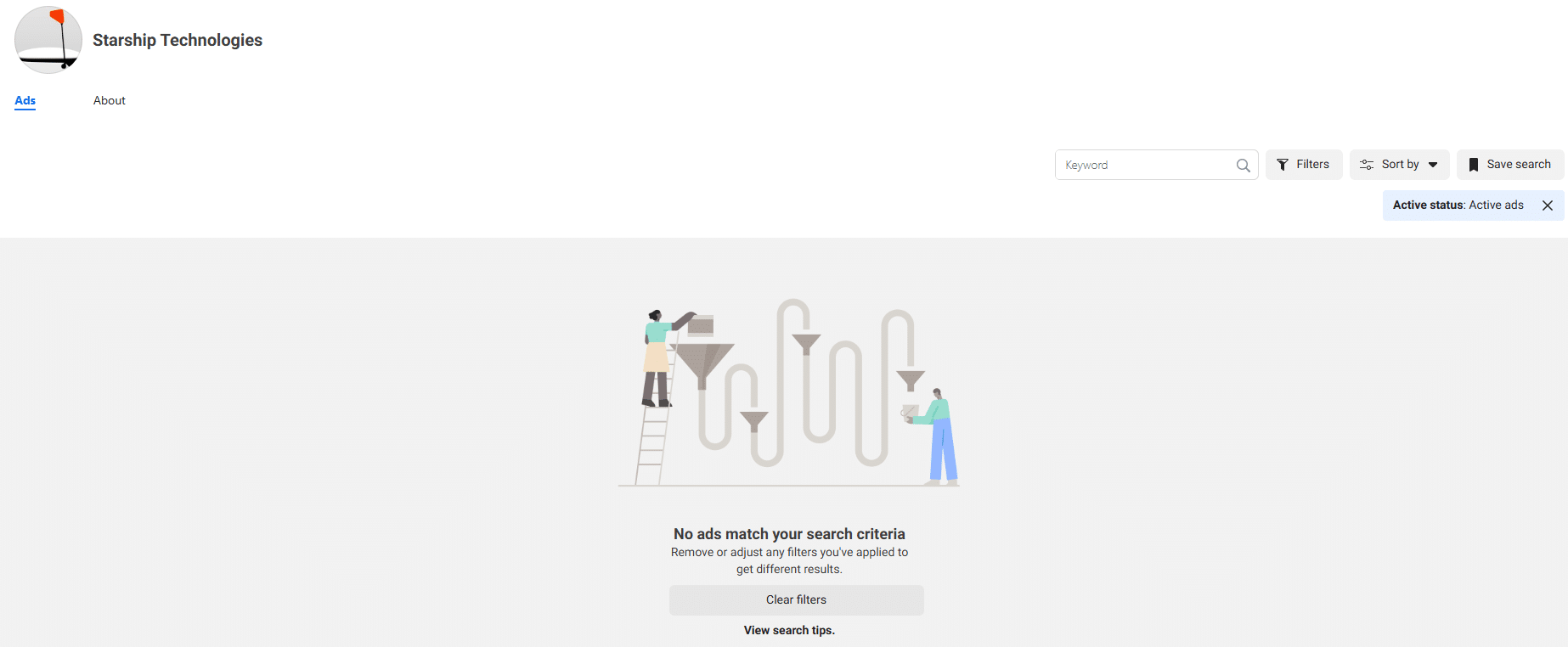
Starship Technologies isn’t currently running any ads on Meta, YouTube, or Google.
This narrow focus tells you something important about their budget and their confidence in LinkedIn as a B2B channel. LinkedIn drives nearly half of all social traffic to B2B company websites, and about 46% of social media traffic visiting B2B sites comes from LinkedIn.
If you’re going to spend a limited ad budget somewhere, LinkedIn makes sense for B2B. Case studies as landing pages is smart. They’re not asking for immediate conversions. They’re building credibility. Show prospects how the solution works for similar companies, let them self-identify with the use case, then capture their information.
B2B leads from LinkedIn are considered 277% more effective than those from Facebook, so even though LinkedIn CPCs are higher, the lead quality justifies the investment. The lack of advertising on consumer platforms like Meta and Google suggests they’re focusing exclusively on B2B decision-makers (campus administrators, grocery executives, app developers) rather than end consumers. That makes sense given their business model. Students and grocery shoppers don’t buy robots, but institutions do.
Starship Technologies’ Sales Funnel from Social Media
Understanding how each social channel contributes to the sales funnel reveals where to invest resources and what content to create. Not every channel needs to drive direct conversions. Some build awareness, some nurture consideration, some close deals. The key is knowing which does what.
LinkedIn
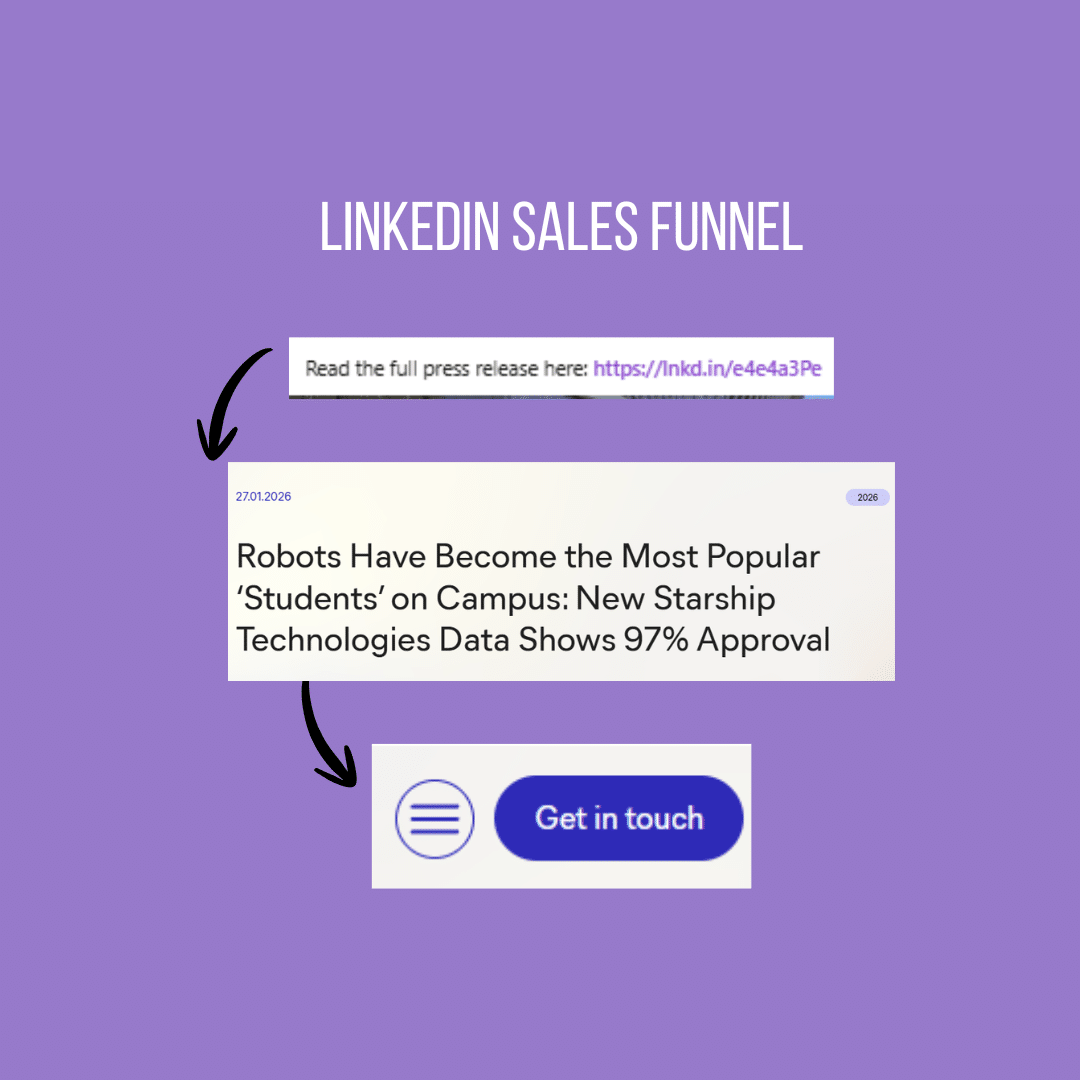
On some of their captions, you can find links to their articles. Once you’re there, the “Get in touch” button waits for you discreetly, on the top right of the page.
Facebook
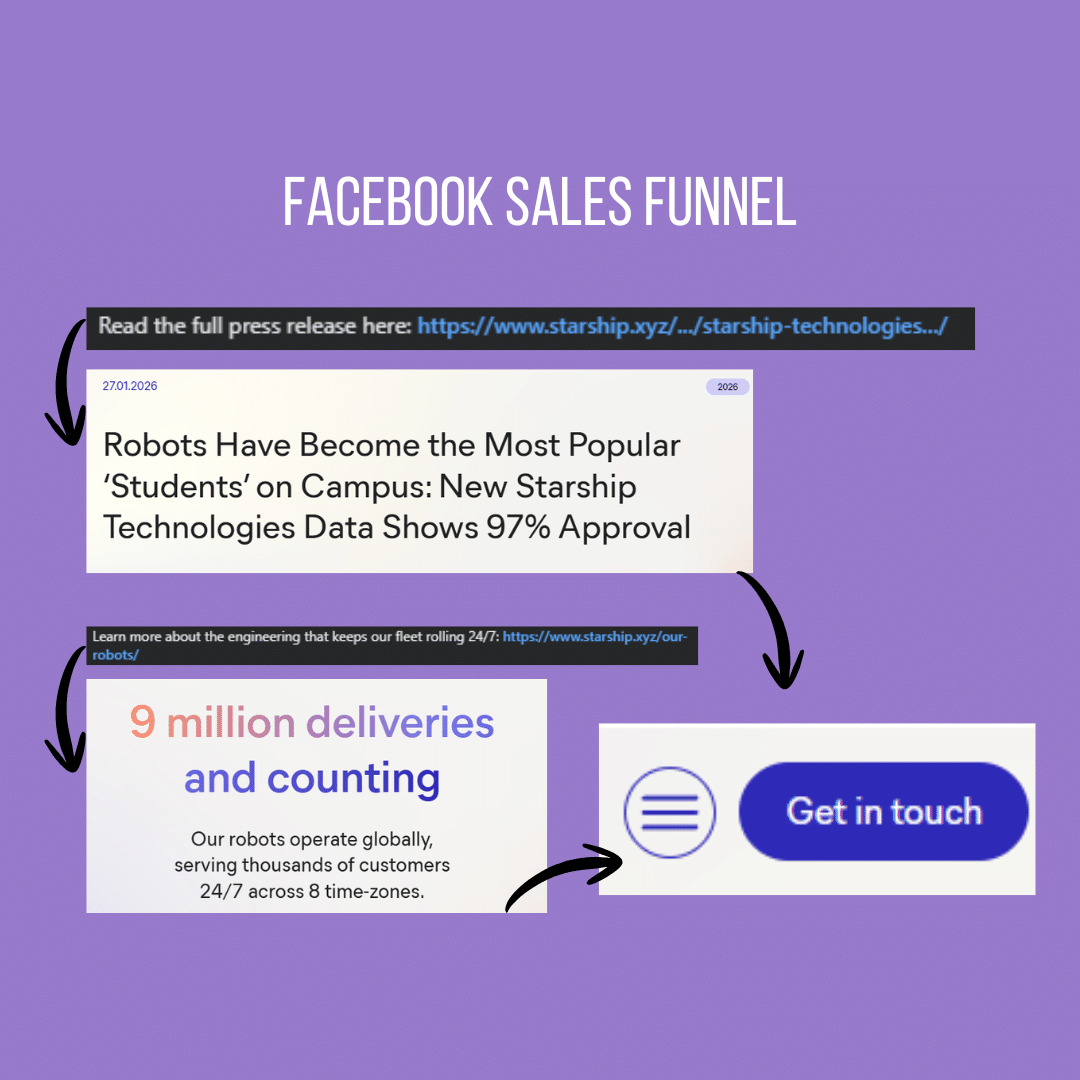
On Facebook, Starship will sometimes put a link in a post that leads to their website. The only CTA button on these articles is the “Get in touch” one, accessible next to the menu.
Instagram
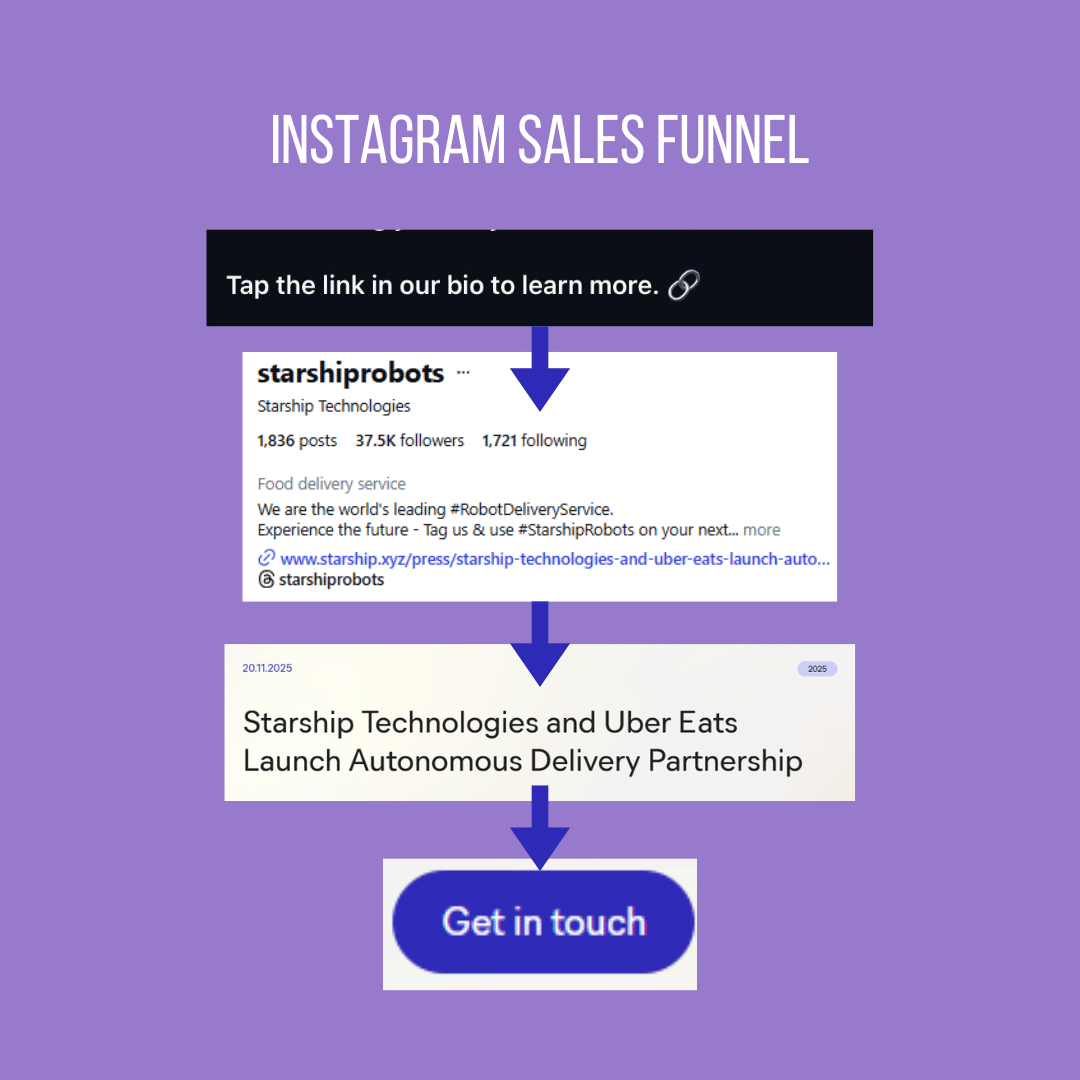
Starship just knows that links in the description are not a thing anymore on Instagram. That’s why you’ll sometimes find the phrase “Tap the link in our bio to learn more”. The current link sends you to a blog post about the Uber Eats partnership. The only CTA on this blog post is “Get in touch”, right beside the menu.
X (formerly Twitter)
Just like on other platforms, Starship keep the caption clear on X, too. No links to their website are provided, except for their bio.
TikTok
On TikTok, the only place where you can find their website is on their bio. Of course, TikTok doesn’t support links in the description, but there are ways you can hijack that if you want to.
YouTube
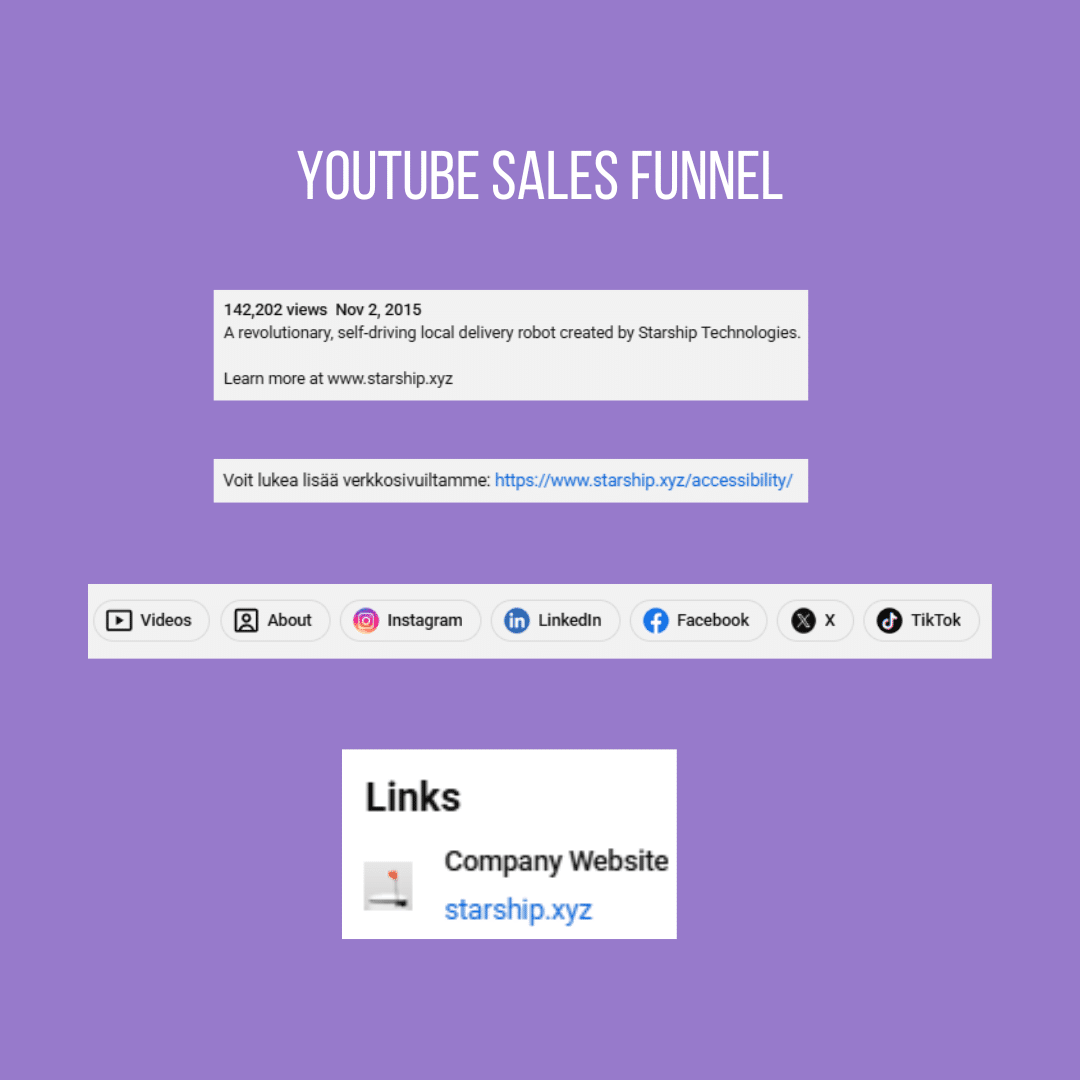
On YouTube videos description, you will mostly find their social media accounts, rather than their website. Of course, there are some videos with that link, but too few. If you’re interested in their product, you can go to their YouTube description, and there you will find their site.
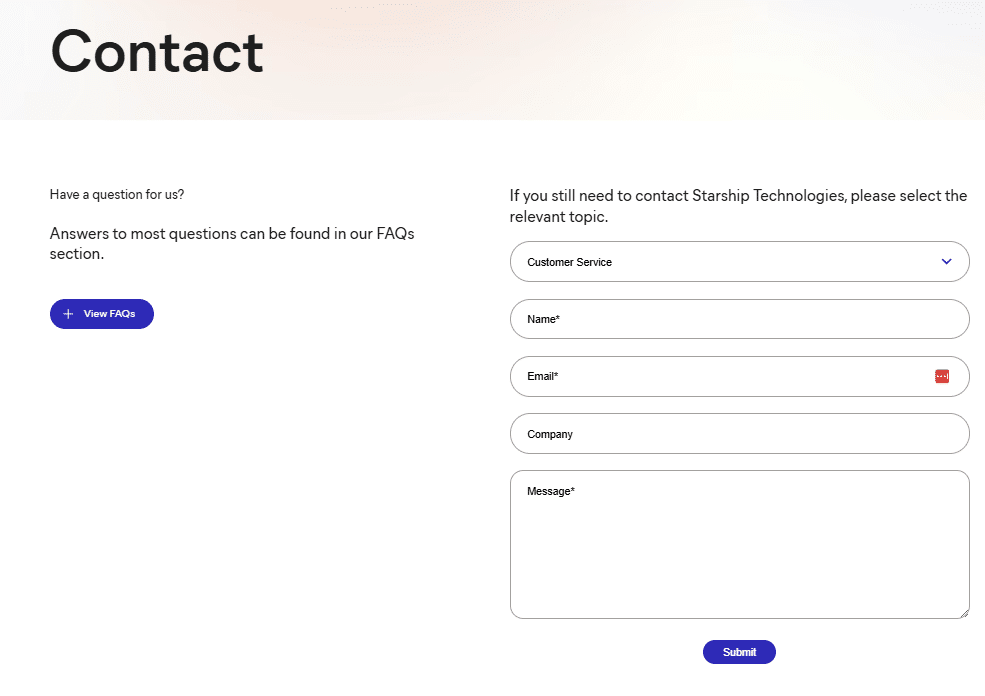
Now, you’re probably curious what’s behind that purple button. Is just a simple contact form. You can select the topic of your inquiry from: customer service, business enquiries, PR & media, events, or report an incident. Give them your name, email, and write the message. That’s all!
The conversion path is almost nonexistent. Most social posts don’t include links. Instagram uses “link in bio” occasionally. LinkedIn posts sometimes link to articles with a “Get in touch” button buried in the navigation. YouTube descriptions prioritize social links over the main website.
The contact form is simple: name, email, company, and message. That’s it. For B2B enterprise sales, this minimalist approach works. By the time buyers fill a form, the decision is already halfway made.
The social content isn’t designed to drive immediate conversions; it’s designed to build awareness and credibility so that when decision-makers are ready, Starship is the obvious choice.
The problem is they’re not tracking or optimizing this journey effectively. There are no visible UTM parameters, no platform-specific landing pages, and no lead magnets beyond case studies. They’re relying on brand recall rather than conversion optimization.
79% of businesses say implementing live chat has resulted in an improvement in sales and revenue. Adding even basic conversion infrastructure (chat widgets, gated content, email capture) would improve their funnel performance significantly.
Starship Technologies’ Reviews and Social Proof
Reviews are the reality check on marketing promises. High ratings validate messaging. Low ratings reveal product-market fit issues or operational problems. Review sentiment across platforms tells you if customers love the product but hate support, or vice versa. This intel should directly inform the product roadmap and customer success strategy.
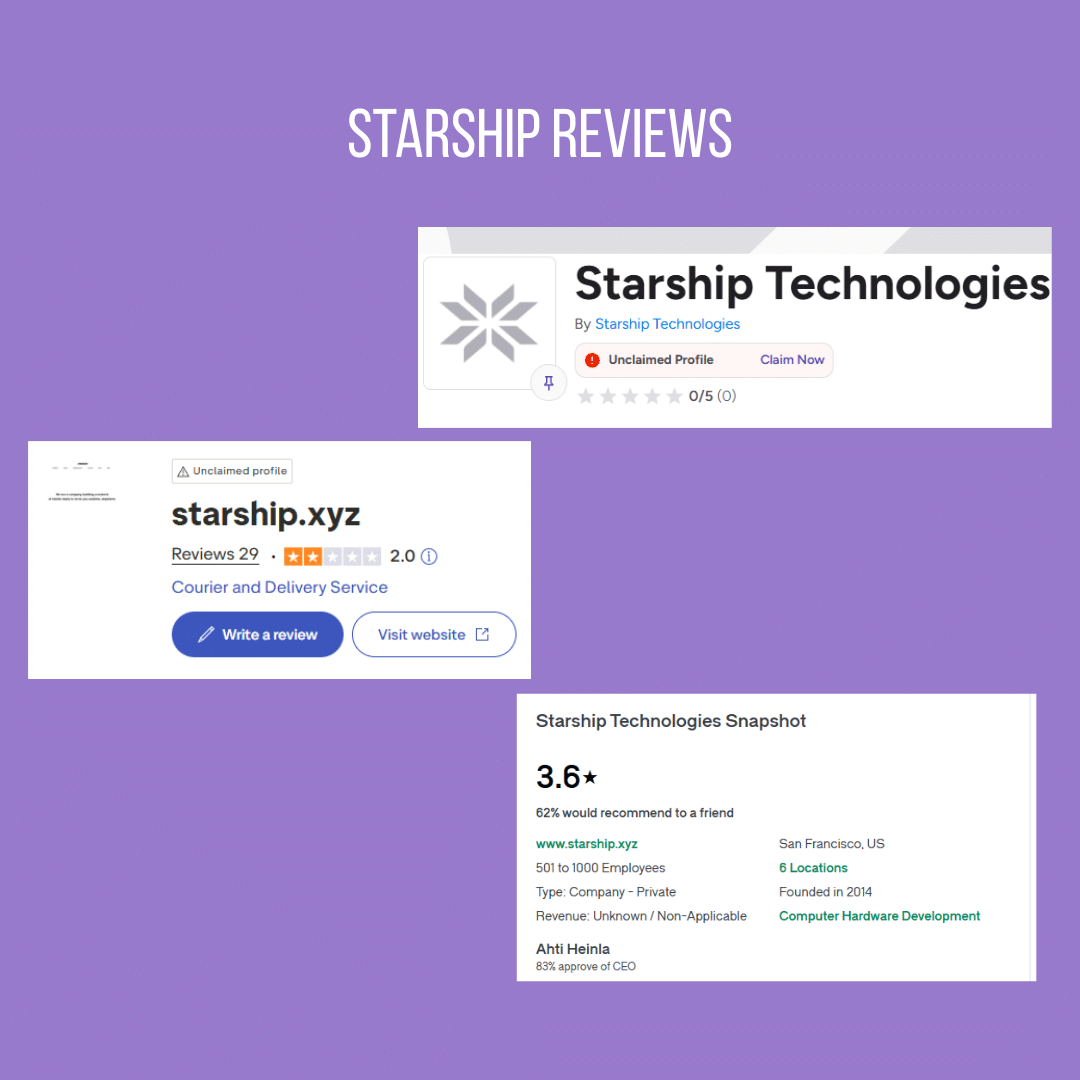
Their G2 profile is still unclaimed, with no reviews. No profile on Capterra. On Trustpilot, they have an unclaimed profile with a 2-star rating. The low score, according to reviews, comes from the delivery service, pricing errors, and terrible customer service.
On Glassdoor, Starship Technologies has a 3.6-star rating, with 62% recommending it to a friend and 83% approving of the CEO. 47% positive business outlook comes from 3 stars for compensation and benefits, 3.2 stars for career opportunities and senior management, 3.6 for culture and values, 3.8 for work/life balance, and 3.9 for diversity & inclusion.
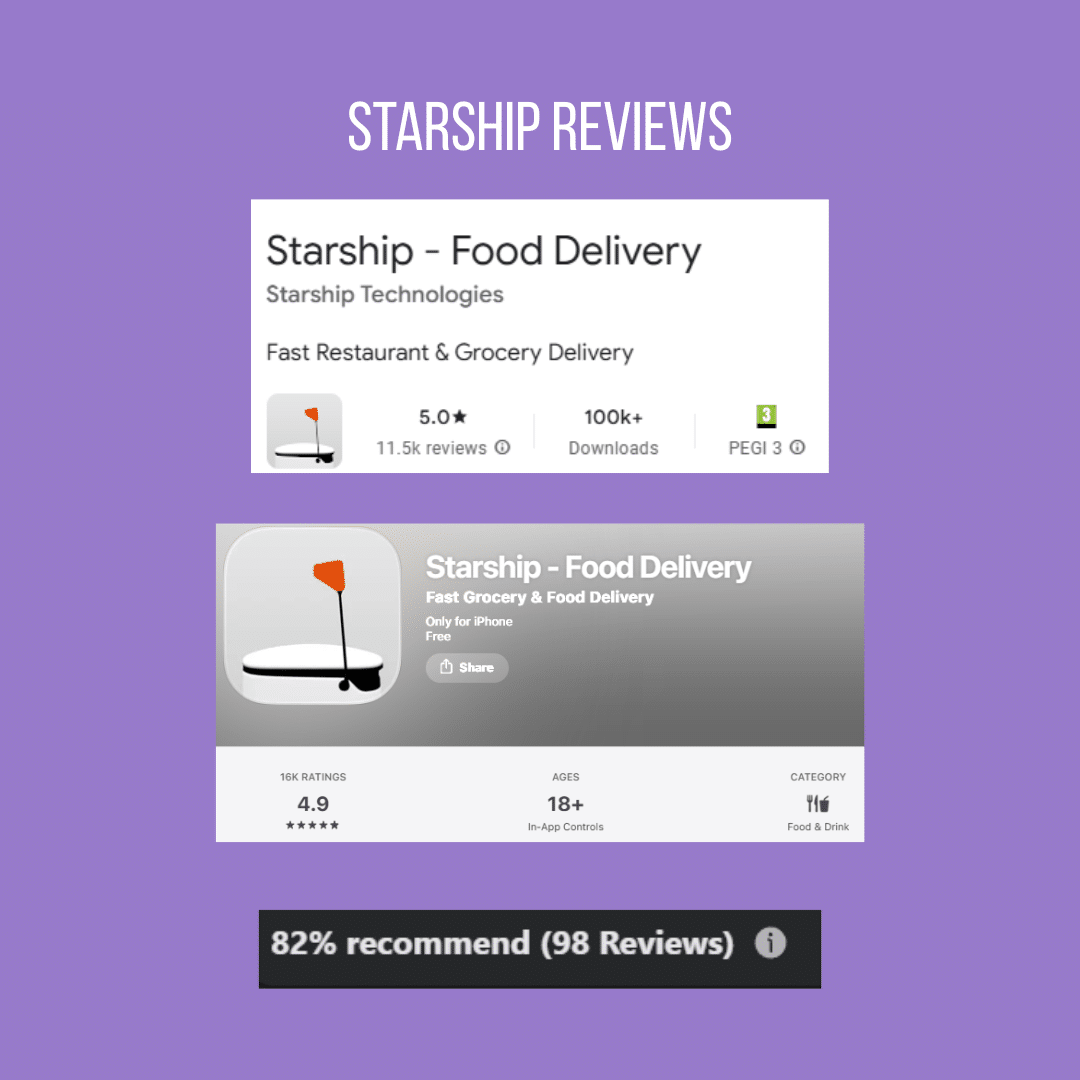
On Google Play, the app Starship – Food Delivery has 5 stars from 11.5k reviews. Among all of these good reviews, lately people are complaining about customer service, long waiting time for delivery, and messed-up orders.
On App Store (Apple), they have 4.8 stars, from 16k ratings, with the same complaints from other review platforms. On their Facebook page, they have 82% recommend from 98 reviews. People here are complaining about high prices, order problems, and customer service problems.
Even Reddit will perpetuate the same ideas. It seems like people are grateful for convenience, tracking, and ease of use, but they don’t appreciate robo-problems. Which is fair, at the end of the day. The big problem is that they don’t respond to any of that negative feedback, and they should. But the bigger problem is still customer service.
When you have a big company that relies on customer service for solving different problems, it needs to be top-notch. You can’t be caught off guard or unprepared. This thing can be a little food for thought if you run a similar company.
73% of customers have switched to competitors or changed their purchase decisions after a single bad experience. You can have the coolest technology on the planet, but if people can’t get help when their lunch doesn’t show up, your marketing becomes irrelevant.
The bigger problem is that Starship doesn’t respond to negative reviews. Not on Trustpilot, not on Facebook, not in app store comments. Around 73% of social users agree that if a brand doesn’t respond on social, they’ll buy from a competitor. Silence amplifies complaints.
When you don’t address issues publicly, you signal that customer problems don’t matter. This is fixable but requires prioritization. 82% of American consumers say excellent customer service is the most important factor in building brand loyalty. Starship needs to staff up customer support, implement response protocols for reviews, and treat customer service as a retention channel, not an afterthought.
Starship Technologies’ Content Marketing and Demand Generation
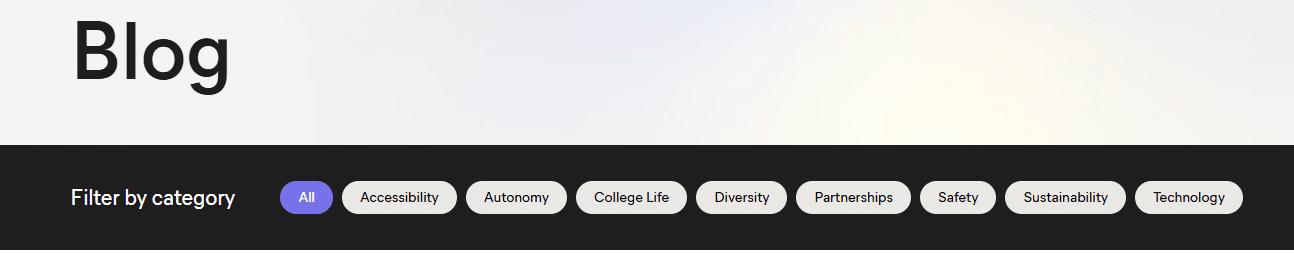
Starship’s blog has the following categories: accessibility, autonomy, college life, diversity, partnerships, safety, and technology.
They haven’t posted on their blog since last August. The cadence was around one post per month, maybe two. An article can be tagged with more than one category. There are no H2, H3, table of contents, or information about reading time or the author’s name, as you would expect.
Articles are short, with 1 or 2 images inserted. They are sharing news, accomplishments, and the life of a Starship robot. Yes, you heard it right. There are some blog posts with robo-adventures in some different “settings”, like the Song and Dance Festival in Estonia.
It seems that there’s no SEO strategy, no content calendar, and no clear purpose beyond announcing things. Most marketers (92%) plan to spend the same or more on video marketing in 2026, but Starship’s blog doesn’t incorporate video, interactive elements, or visual storytelling. It’s just text and maybe an image or two.
The inconsistency shows low prioritization. Either they don’t have dedicated content resources, or they don’t see the blog as a growth channel. A consistent blog publishing educational content about autonomous delivery, last-mile logistics, campus food service trends, sustainability in delivery, etc., could drive organic traffic, build topical authority, and generate inbound leads.
Instead, the blog sits dormant while competitors own those search terms. Content marketing works when it’s treated as infrastructure, not decoration.
Need help with authority building? We’re one click away.
Starship Technologies’ Marketing and Sales Funnel Stages
Top of The Funnel
Starship builds awareness through social media, PR partnerships, and highly visible robots literally rolling through public spaces. Every robot on a sidewalk is a billboard. Partnership announcements with Uber Eats, REWE Germany, and Bolt get amplified across LinkedIn, Instagram, Facebook, and X. These posts consistently generate the highest engagement, especially on LinkedIn, where carousels about new partnerships get 600+ reactions.
Educational content explaining how the robots work, videos of them navigating snow or crossing streets, and accessibility features all serve to familiarize people with the concept. TikTok content like “Robo talks”, where robots interview students, adds a fun, human angle. YouTube explainer videos showing robots in action have racked up hundreds of thousands of views organically. Their funding announcements also generate buzz, positioning them as a serious, well-backed player in the space.
Middle of the Funnel
Once you know Starship exists, they nurture interest through detailed use case content and social proof. The website breaks down benefits by customer type: university campuses see staffing relief and 12% revenue increases, grocery retailers get cost reduction and sustainability wins, and delivery apps get scalability during peak hours. Case studies are the primary middle-funnel asset, featured in LinkedIn ads and website conversion paths. Blog posts covering topics like accessibility, partnerships, and robot adventures humanize the brand while reinforcing practical benefits.
Employee spotlight content and company culture posts on LinkedIn and Facebook build trust. The various playlists on YouTube (Grocery Chains, Industrial Sites, University Campuses) let prospects self-select into relevant content. Reviews and ratings on app stores (4.8 stars on Apple, 5 stars on Google Play) provide third-party validation, though mixed reviews on Trustpilot and complaints about customer service create friction here.
Bottom of the Funnel
Conversion happens through simple contact forms. Every solution page (campus delivery, grocery retail, delivery apps, industrial sites, advertising) ends with a form requesting name, email, company, and message. LinkedIn ads drive to case study landing pages that also feature these contact forms. The “Get in touch” button sits in the top navigation across the site. There’s no complicated sales process visible to the user, no pricing transparency, just a low-friction way to start a conversation. The messaging emphasizes outcomes: revenue increases for universities, cost savings for retailers, and scalability for apps. Partnership logos (Bolt, Sodexo, Grubhub, Aramark) provide credibility at the decision point. The lack of public pricing makes sense given that every deployment is custom, but it also means sales cycles likely involve multiple stakeholders and custom quotes.
Retention
Retention marketing is where Starship’s strategy gets weak. Customer service complaints dominate review platforms. People mention long wait times, order mix-ups, pricing errors, and unresponsive support across Trustpilot, Facebook reviews, Reddit, and app store reviews. Starship doesn’t visibly respond to this feedback. There’s no content addressing common issues, no help center prominently featured, and no community forum for users to troubleshoot.
The blog hasn’t been updated since August, meaning existing customers aren’t getting fresh content about new features, expanded coverage areas, or service improvements. Social media could be used to celebrate loyal customers or share user-generated content, but most posts focus on new launches rather than existing relationships. For B2B clients like universities and grocery chains, retention likely happens through account management and contract renewals, but there’s no visible content strategy aimed at keeping those partners engaged or helping them maximize value from the service.
Starship Technologies’ Future Plans and Growth Indicators
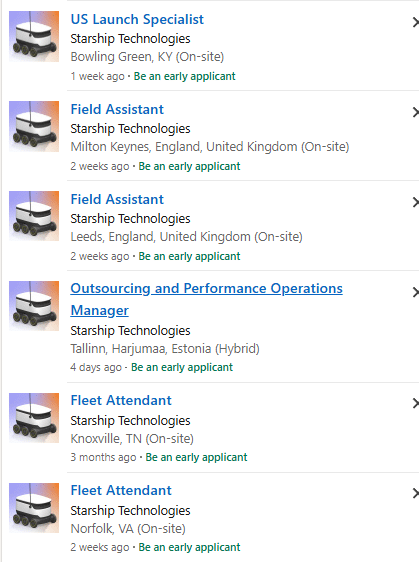
Starship’s Career page is full of opportunities. You can filter your search by team, location, and work type. They offer full and part-time jobs, all over the world: Estonia, the UK, Finland, the US, and Germany. They are hiring in the following departments: People, Operations, Launch Team, Business Development, Hardware Engineering, Navigation, Autonomous Driving, and Service.
You can apply for each of them directly from their site, by clicking any job title, or by searching their LinkedIn Jobs tab. Here you can find old listings from 4 months ago, but also from 5 days ago. That means that the hiring process is an ongoing process right now, and they plan to expand all over the world.
That signals market expansion, not just product development. Active hiring across geographies means they’re preparing to enter new markets or significantly expand existing ones. The sustained volume of openings (new listings appearing weekly) suggests growth momentum.
Companies don’t keep posting roles if they’re not closing them and needing more. This hiring pattern indicates either recent funding deployment (the $50M Series C) or strong revenue growth requiring team expansion. Either way, it’s a leading indicator of business health and future market presence.
Inspiration Points
Partnership announcements are their secret weapon
Every time Starship announces a new partnership, engagement spikes. The Uber Eats announcement got 689 reactions on LinkedIn. The REWE Germany partnership got 660. The Prague launch generated buzz across Facebook, Instagram, and X. They’ve figured out that people care more about where robots are going than how robots work. Partnerships signal growth, validation, and accessibility. They make the technology feel real and close, not distant and theoretical. Don’t just talk about your product, talk about who’s using it.
Accessibility messaging is genuine and specific
Most companies slap “accessible” in their marketing and call it a day. Starship actually built accessibility into the product and talks about it with specificity. They worked with the American Foundation for the Blind on app design. They made the first robot food deliveries to blind customers. They designed the robot height so that wheelchair users can retrieve orders. They talk about serving customers with severe anxiety and neurodivergent conditions. This differentiates them in a crowded delivery market where most competitors haven’t thought about accessibility at all.
Carousels consistently outperform on LinkedIn
Their top-performing LinkedIn content is almost always in carousel format. Carousels get 600-700+ reactions compared to 50-250 for regular posts. This tells you something useful: when you have multiple data points or a story to tell, break it into slides. LinkedIn’s algorithm favors carousels, and Starship has leaned into that.
The robots themselves are marketing assets
Every robot on a sidewalk is a walking advertisement. They offer branded wraps for advertising campaigns, turning the robots into hyperlocal billboards that capture over 1.7k impressions per mile. This is brilliant because it monetizes the delivery infrastructure while simultaneously building brand awareness for both Starship and its advertising clients. The robots are functional and promotional at the same time.
Frequently Asked Questions
What makes Starship’s robots different from other delivery options?
Starship’s robots are Level 4 autonomous (99% self-driving), operate on sidewalks rather than roads, and can navigate in all weather conditions. They use a combination of cameras, sensors, and machine learning to avoid obstacles and cross streets safely. They cost less than human couriers, produce zero direct emissions, and can operate 24/7 without breaks. The robots carry up to three grocery bags with temperature-controlled compartments to keep food at the right temperature during delivery.
2. What specific value does Starship promise to different customer types?
For university campuses, they promise to elevate dining options without adding retail locations or staff, with clients reporting an average 12% revenue increase. For grocery retailers, they offer reduced delivery costs and lower customer acquisition costs while hitting sustainability targets. For delivery apps, they provide scalability during peak hours without managing more couriers. For industrial sites, they save employee time, reduce emissions, and minimize person-to-person contact for safety. Each promise is backed by metrics or benefits.
3. Why doesn’t Starship’s leadership post more consistently on social media?
CEO and co-founder Ahti Heinla has 5.3k LinkedIn followers, but only posted once in the last three months. When he does post about partnerships or company milestones, engagement is strong (400-500 reactions). Founder-led content builds trust, shortens B2B sales cycles, and amplifies company announcements. His Skype co-founder’s credibility could be leveraged much more effectively with a consistent posting schedule, even if it’s just twice a month.
4. Why does Starship’s posting frequency vary so much across platforms?
Starship posts twice weekly on LinkedIn but went dark on TikTok from December 2025 through February 2026, with no posts yet in 2026. Their blog hasn’t updated since August. This inconsistency suggests either resource constraints or a lack of centralized content planning. Social algorithms reward consistency, and audience trust builds through regular presence. Sporadic posting trains your audience to disengage because they can’t rely on you showing up.
5. What content themes generate the most engagement for Starship?
Partnership announcements dominate across all platforms. The Uber Eats partnership, REWE Germany collaboration, and Prague launch all drove significant engagement. Funding news also performs well (the $50M Series C announcement got 767 LinkedIn reactions). Format matters too: carousels outperform single images on LinkedIn and Instagram. On YouTube, explainer videos showing robots in action have hundreds of thousands of views. People want to see where robots are going and how they work in real situations, not abstract tech specs.
6. Where is Starship spending its advertising budget?
Currently, Starship is only running ads on LinkedIn. Four active campaigns: two in English, one in German targeting Germany, and one in French targeting France. Two carousel ads, two single-image ads. All of them drive to case study landing pages. No active ads on Meta, YouTube, or Google. This narrow focus suggests either a limited ad budget, high confidence in LinkedIn as their primary B2B channel, or a testing phase before broader expansion.
7. How does Starship convert social media followers into customers?
The conversion path is minimal and consistent: most social posts don’t include direct links to conversion pages. LinkedIn posts sometimes link to blog articles, which feature a “Get in touch” button in the top navigation. Instagram uses “link in bio” occasionally. Facebook and X rarely include website links in posts. YouTube descriptions have social links but often omit the main website. The primary CTA across all touchpoints is the contact form (name, email, company, message). This simplicity works for B2B enterprise sales where the goal is starting conversations, not immediate purchases.
8. What do customer reviews reveal about Starship’s service quality?
App store ratings are strong (4.8 stars on Apple, 5 stars on Google Play), but digging into reviews reveals consistent complaints about customer service, delivery wait times, order mix-ups, and pricing errors. Trustpilot shows a 2-star rating, mostly from frustrated customers who couldn’t get support. Reddit echoes these themes: people love the convenience and technology but hate dealing with problems. The critical issue is that Starship doesn’t respond to negative reviews across any platform, missing opportunities to address concerns publicly and improve service perception.
9. What is Starship’s content strategy?
Their blog posts are posted roughly once or twice a month when active, covering accessibility, partnerships, technology, and even robot adventures at events. But nothing new since last August. Articles are short, minimally formatted (no H2s, H3s, table of contents, author names, or reading time), and mostly news-focused rather than educational or SEO-driven. This suggests the blog is a low-priority channel, possibly maintained by the PR team rather than a dedicated content marketer. The gap indicates either a resource shift, strategic deprioritization, or both.
10. What does Starship’s hiring activity indicate about its growth plans?
Their careers page is full of open positions across People, Operations, Launch Team, Business Development, Hardware Engineering, Navigation, Autonomous Driving, and Service departments. Locations span Estonia, the UK, Finland, the US, and Germany. Job listings range from 5 days old to 4 months old, indicating ongoing, active hiring rather than sporadic needs. This signals planned expansion into new markets and scaling of existing operations. The diversity of departments hiring (not just engineering) suggests they’re building a full operational infrastructure, not just developing new technology.
*Please note that if we do not get clear details and accurate info, you might not get a reply from us!
Nice to meet you, amazing human! Fill out this super short form and start your journey!
Welcome to our cozy data-driven digital marketing studio for bold B2B tech companies.
Your journey starts with you filling in our contact form. It’s a very short form. #PinkyPromise. It only takes you 45 seconds to fill it in, but it helps us a lot to understand who you are, what your challenges are and if we are the right partner to help you.
We don’t want to waste your time. So… a big thank you in advance for your effort.
Please don’t hesitate to reach out with questions or if you would like to discuss any of your challenges or ideas in depth.
You can contact us using this form on the right or you can send us an email at hello (at) milkandcookies (dot) studio.
We will reach out to you as soon as possible. Usually no more than a couple of hours.