TL;DR: Conclusions and Key Takeaways
🎀 This section gives you the main insights without all the details. It’s the stuff you need to remember, whether you’re reading this now or in 6 months. We made this for people who want to get the core message fast.
This article breaks down how KappaZeta, an Estonian Earth Observation company, approaches marketing and sales. We looked at their website, social media, content strategy, leadership presence, funnel structure, and competitive positioning to understand what they are doing and why it works for their market.
KappaZeta sells AI-driven satellite data products to governments, defence organizations, agricultural agencies, forestry operators, and Earth Observation companies. Their buyers are technical, risk-averse, and operate on long procurement cycles. That context shapes every marketing decision they make.
Here are the 8 things worth remembering from KappaZeta’s marketing and sales approach.
- Lead with outcomes, not technology. Their messaging focuses on what buyers can do differently, not on how the satellite works.
- Content qualifies buyers before they ever make contact. A well-titled blog post about procurement does more pre-sales work than any form of ad.
- Authority-building content outperforms promotional content. Their top posts signal credibility, not features.
- Third-party validation does the trust work at the bottom of the funnel. ESA funding, patents, and NATO advisory group membership reduce perceived risk better than any case study.
- The partnership program turns early customers into stakeholders. Buyers who shape the product are naturally invested in its success.
- The funnel is lean by design. One contact form is enough when the content upstream has already been qualified.
- Posting consistently in a niche field builds compounding visibility. Once or twice a week, every week, in a small industry keeps your name in the right feeds.
- Positioning as infrastructure rather than a vendor creates stickier retention than any contract clause.
The broader lesson for other B2B deep tech companies is that marketing does not have to be loud to be effective. When your buyers are sophisticated and your product is technically complex, the most powerful thing you can do is prove, consistently and in public, that you know what you are doing. KappaZeta does that well.
📝 A quick note before you start reading: The data and analysis in this article are valid as of the time we wrote it. We don’t know when you’ll be reading this, maybe next week, maybe six months from now, and things might have changed since we looked at this company’s marketing and sales approach. Still, the insights and lessons here stay useful, even if the numbers or tactics have evolved a bit.
Somewhere above your head, right now, a satellite is passing. It sees your city, your fields, your forests. It doesn’t need good weather. It doesn’t need permission. It just reads the earth, quietly, precisely, from 700 kilometers up. No boots on the ground. No inspection teams. No clipboards. Just radar pulses bouncing back with answers.
And somewhere in Tallinn, a small team of PhD-level scientists decided that all of that data was being wasted. That governments were still sending people into fields to check what a satellite could confirm in seconds. That forestry operators were still guessing about carbon stocks that orbital radar could measure to the meter.
The gap between what space technology could do and what most organizations were actually doing with it was enormous, expensive, and completely unnecessary. That is the problem KappaZeta is here to fix.
Here at Milk and Cookies Studio, we believe the best B2B products are not the ones with the biggest sales teams. They are the ones built by people who understand a specific problem so deeply that the product itself becomes the argument. KappaZeta is that kind of company.
So we put them under the spotlight and mapped everything: how they position, how they sell, what content they publish, and what the rest of us can learn from a company doing serious work in a market most marketers have never heard of.
Understanding KappaZeta
KappaZeta was founded in 2016 by Kaupo Voormansik and Tanel Tamm, both of whom remain in the company today as CEO and CTO, respectively. The company is headquartered in Tartu, Estonia, with team members based across Estonia, Sweden, and the Netherlands. They are members of the Estonian Cleantech Association, the Estonian Defence and Aerospace Industry Association, NATO Industrial Advisory Group Spacenet, and GovTech Campus Germany.
As of February 2026, KappaZeta has not disclosed a recent formal funding round. They have received project-based grants from the European Space Agency and the European Regional Development Fund to support specific R&D programs. In September 2023, KappaZeta secured a seed funding round of approximately $480K.
KappaZeta builds AI-driven satellite data products for land monitoring across agriculture, forestry, carbon projects, and defence. Their core work is change detection, land cover classification, and advanced analytics.
What sets their technology apart is the use of radar (SAR) data, which works regardless of weather conditions. Their radar interferometry processing is among the few in the world that can fully use its potential. Combined with machine learning, it means large-scale earth monitoring without physical inspections.
They are also developing a 3D-SAR satellite mission that will produce global forest height and terrain data at an accuracy level that simply does not exist today.
To understand how KappaZeta fits within the broader EU market, our analysis of 1,922 companies across the geospatial, agricultural intelligence, and earth observation space shows that KappaZeta sits squarely in the commercial core: the $1M–$10M revenue, 11-50 employee segment that makes up 47% of the market. Read the full market analysis here.
KappaZeta’s Brand Promise Analysis
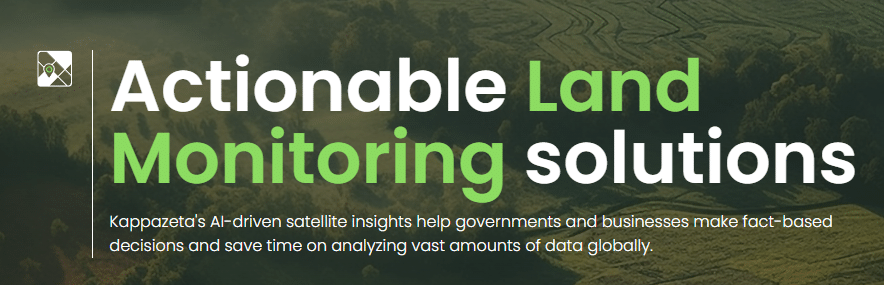
KappaZeta’s first promise on their hero section is “Actionable Land Monitoring solutions”, followed by the promise that their AI-driven satellite insights help governments and businesses make fact-based decisions and save time on analyzing vast amounts of data globally.
They promise products that you can rely on daily. You will have actionable insights at your fingertips without spending resources on physical in-situ inspections.
The promise is clear and grounded. They are not leading with the technology, but with the outcome. That’s the right move when selling to government procurement teams and enterprise buyers, who care about compliance and cost reduction, not SAR processing pipelines. The framing of “save time on analyzing vast amounts of data globally” speaks directly to resource-constrained teams, which is exactly who signs these contracts.

For Agriculture, you can verify subsidy compliance, decrease the number of field inspections, and monitor vegetation health and farming practices over time with real-time and historical data.
For Defence & Intelligence, you can collect and analyze greater amounts of intelligence data with your existing team, enhancing situational awareness critical for improving defense capabilities and effective mission planning.
For Forestry & Sustainability, you can detect forest management activities, such as deforestation, more swiftly and accurately, eliminating the need for physical on-site inspections. A streamlined approach is essential for regulatory compliance and carbon sequestration reporting.
For Earth Observation, you can enhance your information services with industry-leading cloudmask technology and advanced Analysis Ready SAR Data, ensuring you meet and exceed customer expectations.
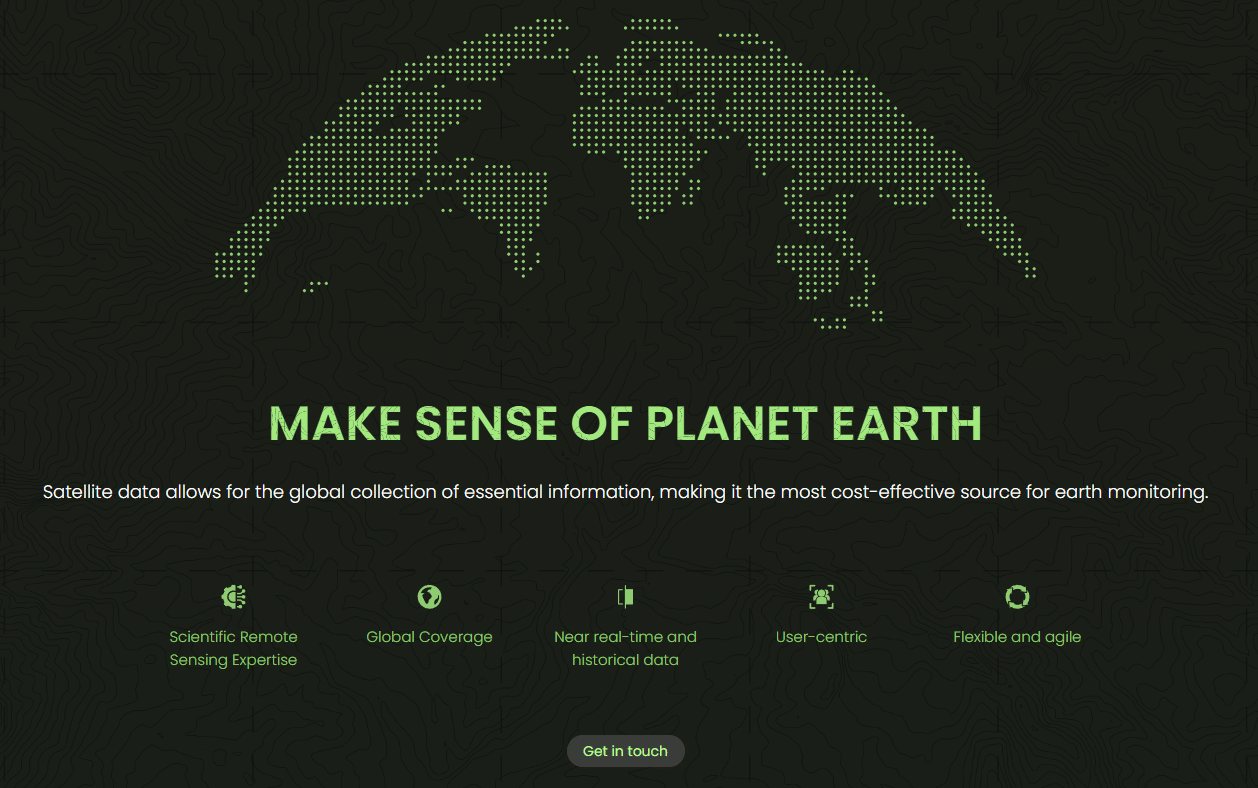
They are closing this page with the statement “Make sense of planet earth”. Why? Because satellite data allows for the global collection of essential information, making it the most cost-effective source for earth monitoring.
KappaZeta’s Service and Product Breakdown
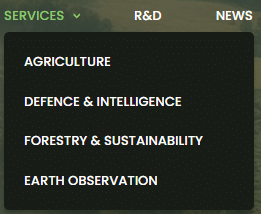
KappaZeta covers four areas: agriculture, defence and intelligence, forestry and sustainability, and earth observation.

They help governments and agricultural bodies spot farming practices, anomalies, and fraud at the field level. Their products include farming event detection (mowing, harvesting, ploughing), crop type identification, field heterogeneity detection, damaged area assessment from weather events like droughts and winterkill, and a cloudless NDVI that uses radar satellites to fill data gaps on cloudy days.
What’s worth noting here is how well the product lineup maps to actual pain points in the agricultural sector. CAP subsidy verification, insurance claims, and carbon farming compliance are all areas where governments and agri-businesses are under growing regulatory pressure. KappaZeta is not selling technology for its own sake. They are selling a faster, cheaper way to meet obligations that already exist.


Two main products here. Their Sentinel-1 Analysis Ready Data delivers high-quality parcel statistics at 5-meter resolution, covering 30-50% more parcels than standard processing and improving analytics accuracy by up to 10%. Their Sentinel-2 Cloudmask (KappaMask) is an AI-based processor that filters out clouds and shadows globally, giving cleaner imagery for applications like change detection, disaster response, and climate research. A Sentinel-1 3D-SAR product is also in the works.
This category is interesting because the buyer is not an end user, but another Earth Observation company or data provider looking to improve their own product. KappaZeta is positioning itself as infrastructure. If your analytics platform runs on their cleaned, analysis-ready data, you’re not just a customer, you’re dependent on them. That kind of positioning creates stickier, longer relationships than one-off service contracts.


KappaZeta offers three situational awareness tools: landscape trafficability monitoring for military logistics, deforestation and disturbance monitoring that can flag potential military activity in strategic areas, and flood detection for disaster response.
Defence is one of the hardest verticals to break into, and the fact that KappaZeta is already operating here says a lot about the credibility of their data. Their membership in NATO’s Industrial Advisory Group Spacenet is a signal to defence procurement teams that they have already cleared a level of vetting that most startups never reach.


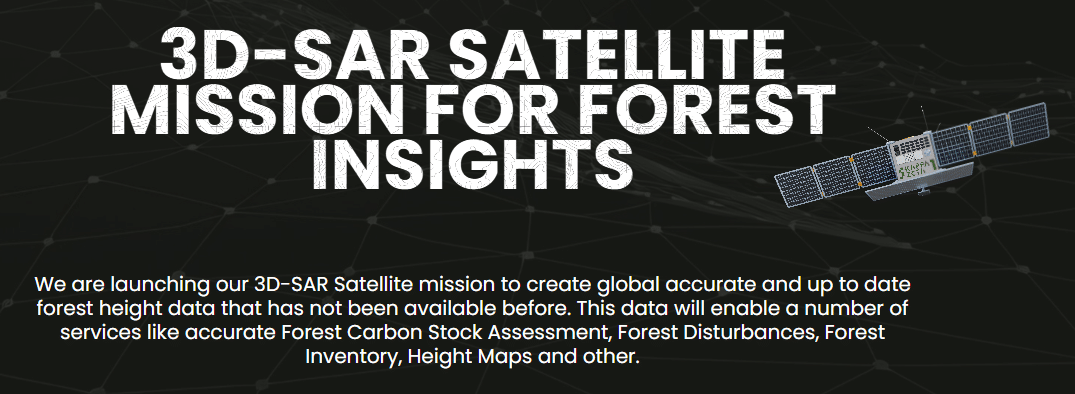
They are launching a 3D-SAR satellite mission flying in formation with Sentinel-1 to produce global forest height data with 90%+ accuracy. This feeds into carbon stock assessment, forest disturbance monitoring, timber inventory, and height maps, all at a price point and scale that hasn’t been possible before.
The timing here is deliberate. EUDR and LULUCF regulations are creating real urgency for forestry and carbon project operators who need verifiable, audit-ready data. KappaZeta is building the infrastructure before the demand fully arrives, which puts them in a rare position: by the time the market catches up to the regulation, they will already have a working product and a set of early customers.

KappaZeta’s Differentiators and Unique Assets
Partnership Program
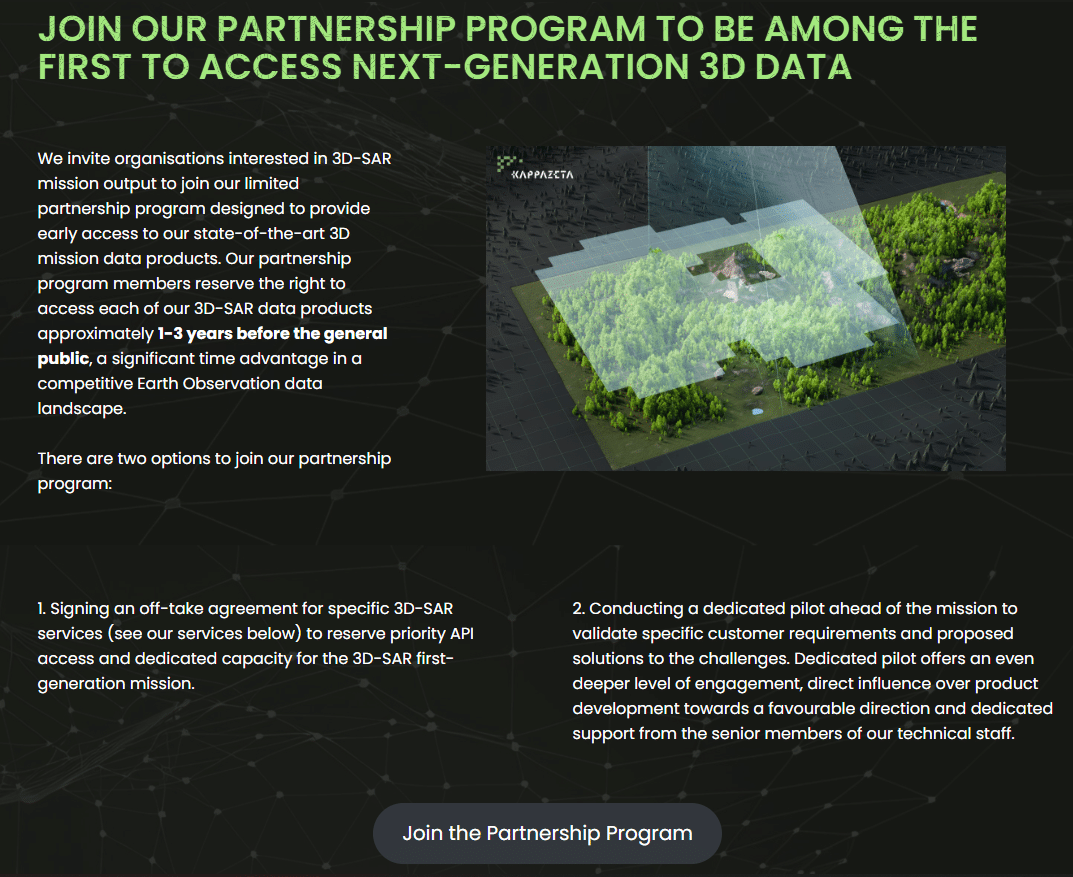
KappaZeta runs a limited partnership program for organizations that want early access to their 3D-SAR mission data, roughly 1 to 3 years ahead of general availability. That’s a meaningful head start in a competitive market.
There are two ways to get involved. The first is signing an off-take agreement for specific 3D-SAR services, which locks in priority API access and dedicated capacity. The second is a dedicated pilot ahead of the mission, where you work directly with their senior technical team to validate your requirements and actually shape product development. The pilot route is the deeper engagement of the two.
The partnership program is a smart way to generate revenue and de-risk the mission at the same time. Off-take agreements give them forward visibility on demand. Dedicated pilots give them real customer requirements to build against. For buyers, the appeal is obvious: you get early access and influence over a product that could become a market standard. It’s a model that works well in deep tech, where the sales cycle is long and buyers want to feel involved in the outcome.
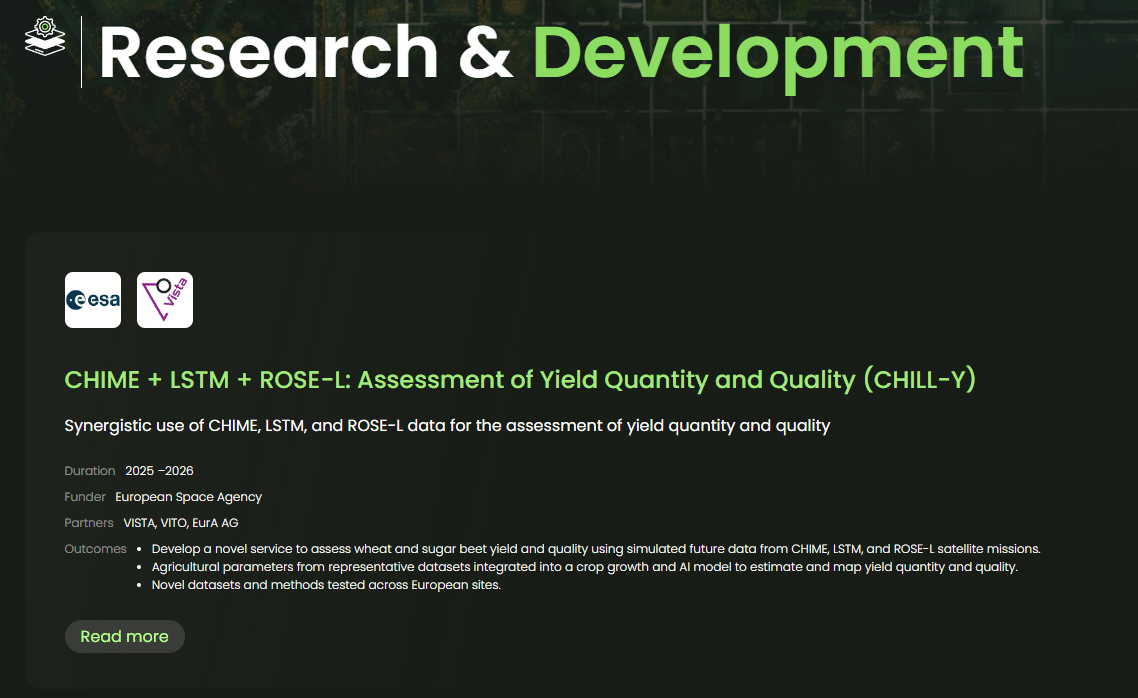
KappaZeta has an active R&D program, with projects funded by organizations like the European Space Agency and the European Regional Development Fund. Their work spans yield estimation, forest volume and carbon stock modeling, cloud-independent vegetation indices, landscape trafficability, tillage detection, crop insurance tools, and more. It gives a good sense of where their technical depth comes from and where they are headed.
Public R&D funding is underrated as a trust signal. When the ESA or the European Regional Development Fund backs your research, it means your methodology has been reviewed and validated by people who are not paying you. For enterprise and government buyers doing due diligence, that matters. It also means KappaZeta is advancing the science, not just packaging existing tools, which is a meaningful differentiator in a market that has a lot of resellers.
This is what Cialdini calls authority in Influence: The Psychology of Persuasion. When an independent, credible institution validates your methodology, it does the convincing that your own claims cannot. For enterprise and government buyers running formal due diligence, ESA-backed research is a stronger signal than any testimonial.
KappaZeta’s Leadership Presence Analysis
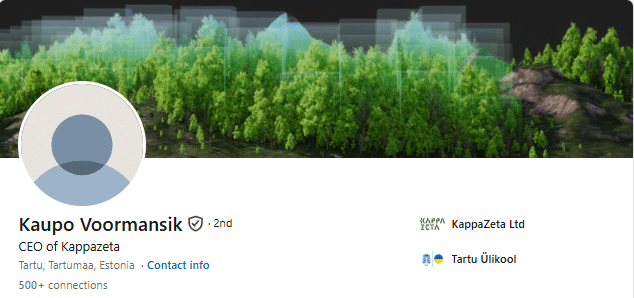
KappaZeta’s CEO has 1.4k followers on LinkedIn. He has not posted in the last two months. He usually reposts from the company’s page along with his insights.
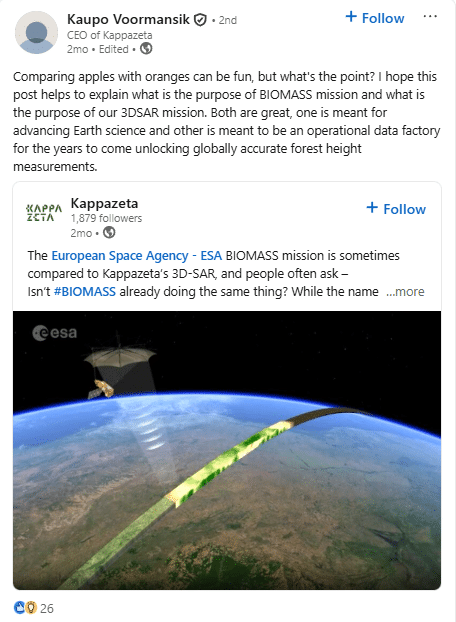
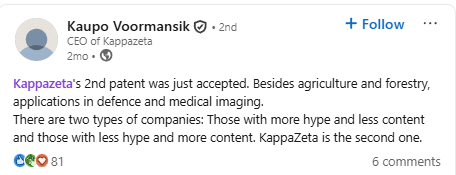
He sometimes posts original text-only content, like this one below, about Kappazeta’s second patent approval. On this original post, he has gained 81 reactions and 6 comments.
If he starts to post more, he will build credibility for the company. Not that this is necessary, but building online authority and making thought leadership content can help boost your reputation over all. More people will hear about you; therefore, you can score more sales.
CTO, Tanel Tamm, hasn’t posted in the last year, but he is actively commenting on other posts. He has only 2 reposts about hiring a software lead and a forestry domain lead at KappaZeta.
In B2B deep tech, the founder’s voice carries a lot of weight. Buyers at the government or enterprise level want to know there is a credible person behind the product. Kaupo’s occasional original posts, especially around milestones like patent approvals, do exactly that. They signal progress and expertise without being promotional. The comments activity from the CTO also matters more than it looks. Being present in industry conversations, even without publishing, keeps the company name visible in the right circles.

According to Edelman’s 2024 B2B Thought Leadership Impact Report, 60% of B2B decision-makers say thought leadership directly influences their vendor selection. A founder who publishes honest, substantive content signals that the company has genuine expertise.
KappaZeta’s Social Media Strategy
Kappazeta has 1.8k followers on LinkedIn. They post once or twice per week, get 15-60 reactions per post, and receive a few comments and reposts. They are heavy hashtag users. Every post has at least 5 of them. The most recurring are: #EarthObservation, #RemoteSensing, and #SAR. Kappazeta’s feed is full of single-image posts, with occasional multiple-image posts.
Their content pillars are:
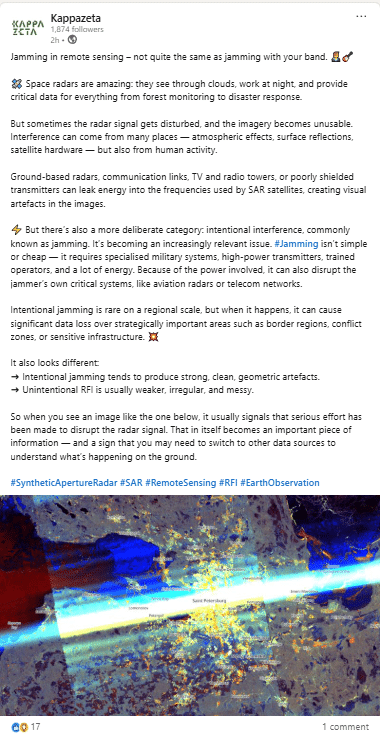
- educational content
- promoting their LinkedIn newsletter
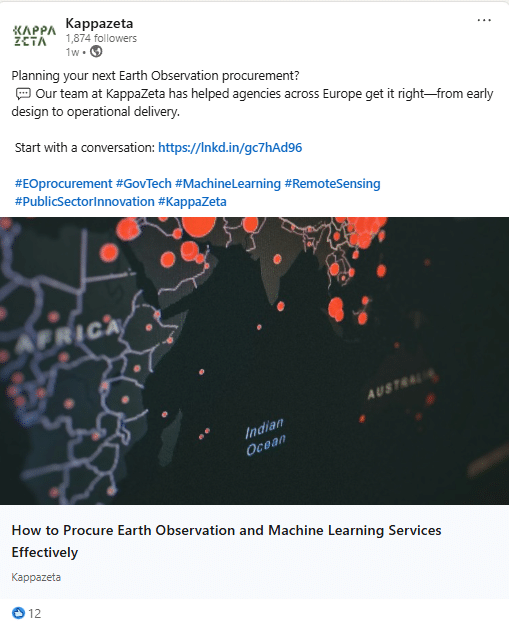
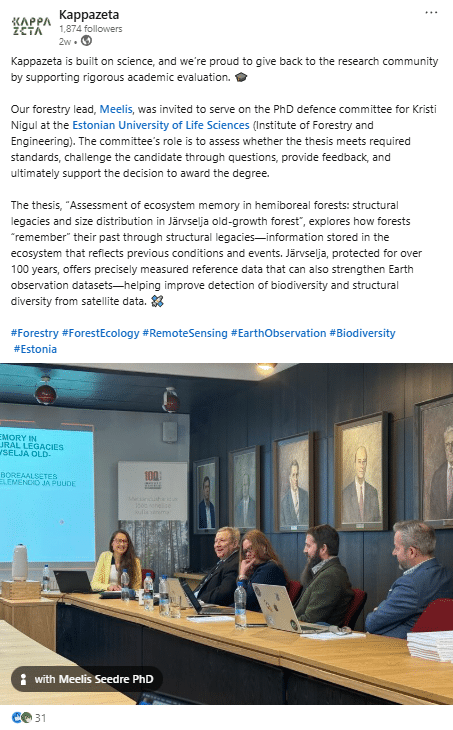
- industry events
- product insights
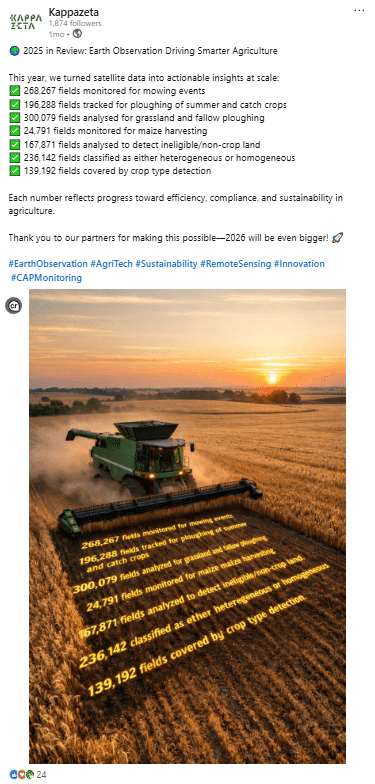
For a company selling to governments and enterprise clients, LinkedIn is the right primary channel. Their posting cadence is consistent, which matters more than volume for building an audience in a niche field. The mix of educational content and event participation is a solid foundation. Educational posts build credibility over time, and event content proves they are active players in the industry.
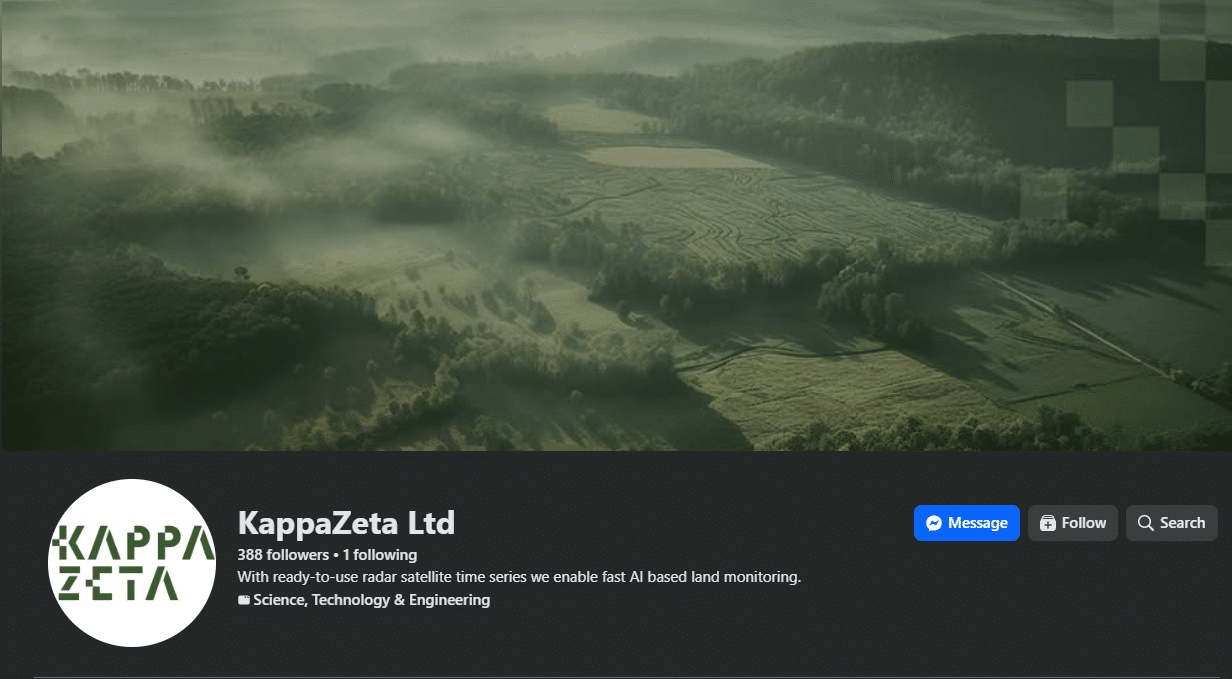
On Facebook, KappaZeta has only 388 followers. They were active last time in July 2025. Since then, it’s radio silence. On this platform, the content pillars were:
- company culture
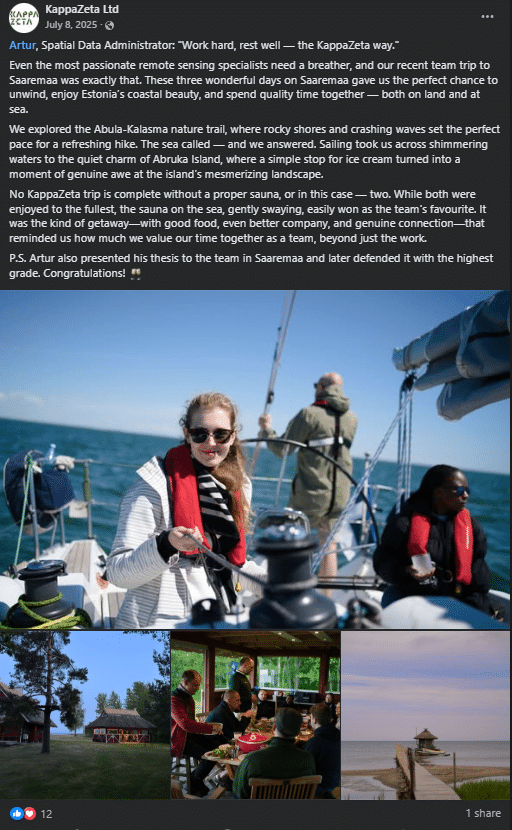
- thought leadership
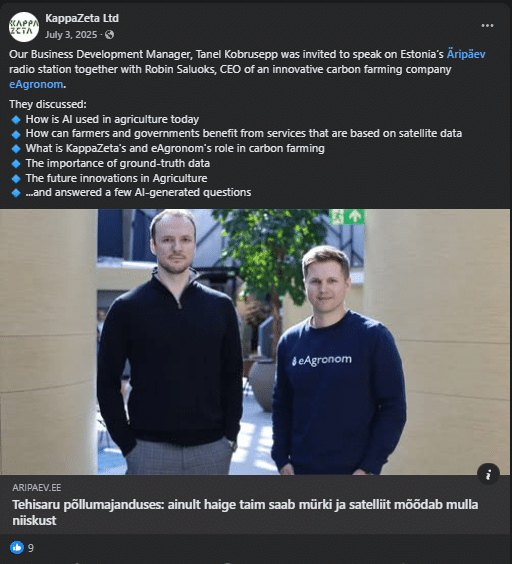
- educational content
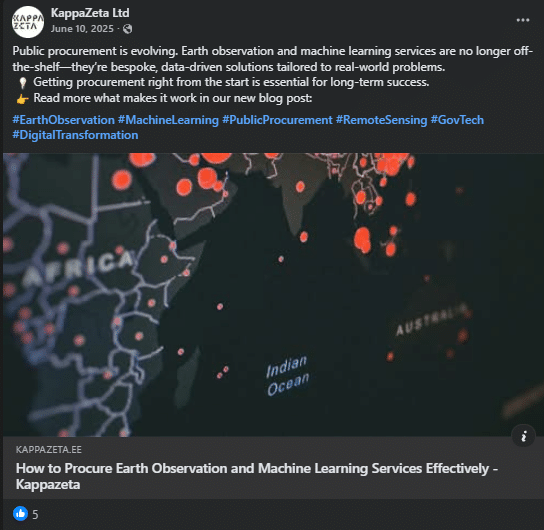
- industry events
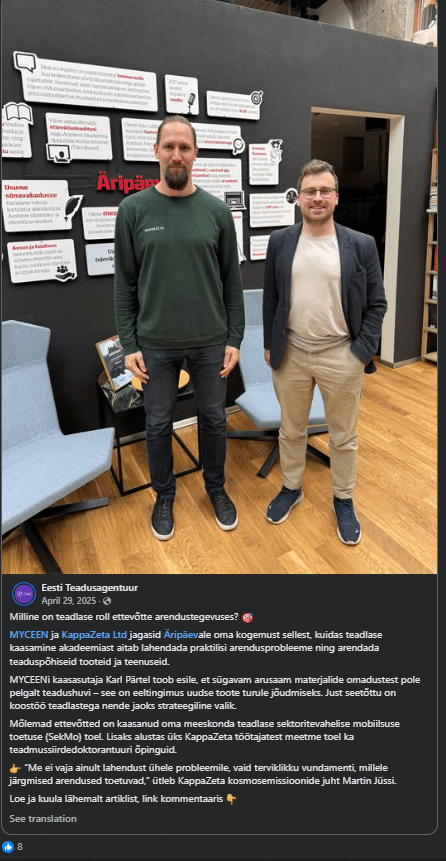
The posts received between 5 and 20 reactions, with no comments and a couple of shares. Just like on LinkedIn, they have mostly single-image and multiple-image posts.
Facebook is not the natural home for this audience, and KappaZeta seems to have figured that out. Their energy is better spent on LinkedIn, where their buyers actually are. The content they did post on Facebook showed a range, though, particularly the company culture posts, which are useful for recruitment even if they don’t drive sales.
We checked for KappaZeta presence on YouTube, TikTok, Instagram, and X. No active accounts were found on any of these platforms. This is the right call for their audience. Government procurement officers and remote sensing analysts are not discovering vendors through short-form video. The absence is a deliberate prioritization.
KappaZeta’s Top-Performing Content
In the last 3 months, these are the top 3 content from KappaZeta’s LinkedIn page:
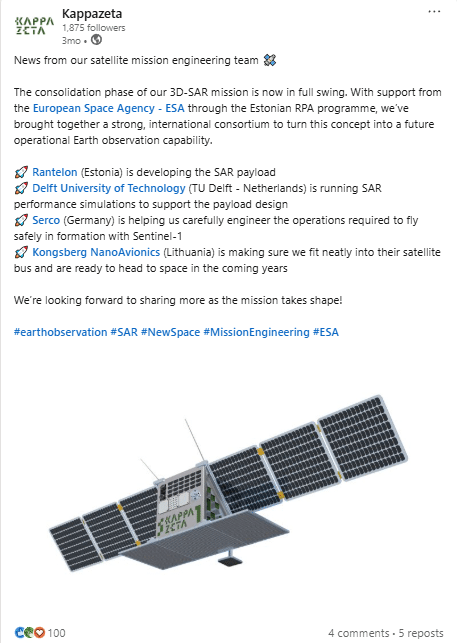
- The announcement about their satellite mission engineering team received 100 reactions, 4 comments, and 5 reposts.
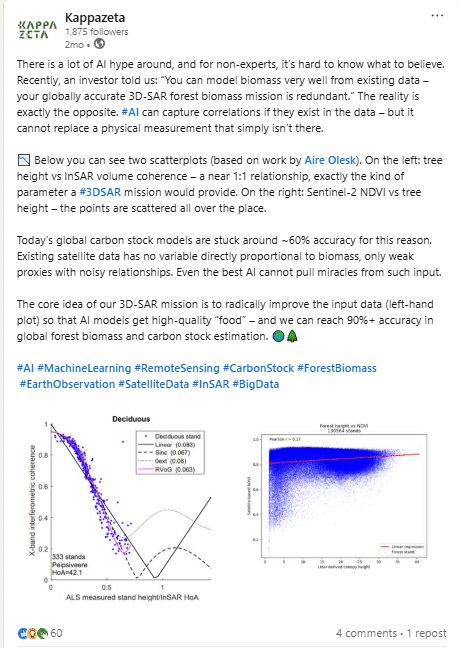
2. The post about AI estimations and their 3D-SAR mission, with 60 reactions, 4 comments, and 1 repost.
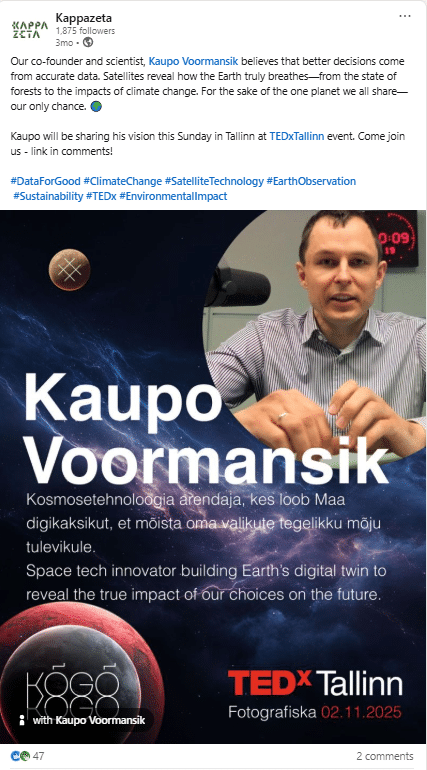
3. The post about the participation of their co-founder, Kaupo Voormansik, at TEDxTallin received 47 reactions and 2 comments.
What do their top 3 posts have in common? First off, they are single-image posts. Second, they position the company as high-expertise and future-driven. They are making authority-building posts. None of them promotes a product directly or pushes a demo. They are focusing on credibility signals through the team’s talent, scientific credibility, and public credibility.
You don’t know how to build authority? Get in touch with us and get the help you need today.
This is the clearest signal of what works for KappaZeta’s audience. People are not reacting to product features or pricing. They are reacting to proof that this company is doing something real and important.
The TEDx post is a good example: a co-founder on a public stage is a third-party credibility signal that no ad can replicate. The lesson here is that authority-building content consistently outperforms promotional content in technical B2B markets, and KappaZeta’s organic results confirm it.
This matches what CEB and Gartner found in their research on B2B buying behavior: buyers complete roughly 57% of their decision-making process before ever contacting a vendor. Content that builds credibility and educates early in that process shapes the shortlist before any sales conversation begins.
On Facebook, KappaZeta went quiet in July 2025 and has not posted since. There is no content to analyze from the last three months on that platform. Facebook was never a primary channel for them and the decision to deprioritize it is consistent with where their buyers actually spend time.
KappaZeta’s Paid Advertising Strategy
We checked the LinkedIn Ad Library and Meta Ad Library for KappaZeta. As of February 2026, no active campaigns are running on either platform.
This is not a gap for this type of company. Their buyers, government procurement teams, agricultural agencies, and defence organizations do not make decisions by clicking on sponsored posts. The buying process is long, relationship-driven, and involves multiple stakeholders who research vendors over months, not minutes. Paid social rarely moves the needle in that environment.
That said, this could be a missed opportunity for top-of-funnel brand awareness in adjacent markets. According to Dreamdata’s 2025 LinkedIn Ads Benchmarks Report, LinkedIn’s share of total B2B ad budgets grew from 31% to 39% in 2024, with conversion rates improving significantly year-over-year.
A small awareness campaign targeting job titles like Remote Sensing Analyst, Head of Agricultural Policy, or Forestry Compliance Officer could surface KappaZeta to buyers who are researching the category but have not yet encountered the brand. Even a €500 monthly test budget would generate a signal worth having.
KappaZeta’s Sales Funnel from Social Media
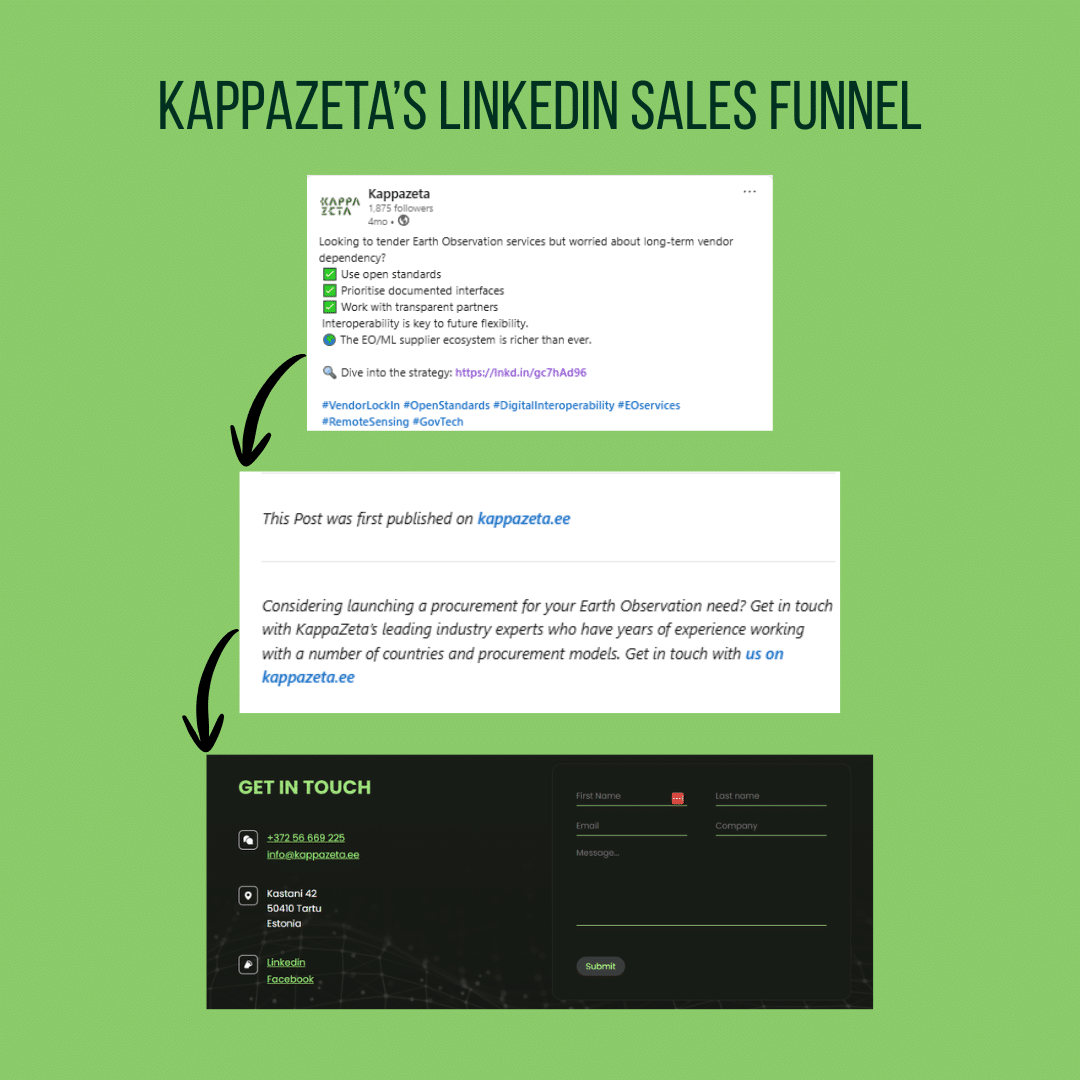
They are not currently posting links to their website or other resources. The only links are the ones to the articles on LinkedIn, which were posted on their website first.
At the bottom of these LinkedIn articles, you have a section that says: “Considering launching a procurement for your Earth Observation need? Get in touch with KappaZeta’s leading industry experts who have years of experience working with a number of countries and procurement models. Get in touch with us on kappazeta.ee”, which sends you directly to their contact page on their website.
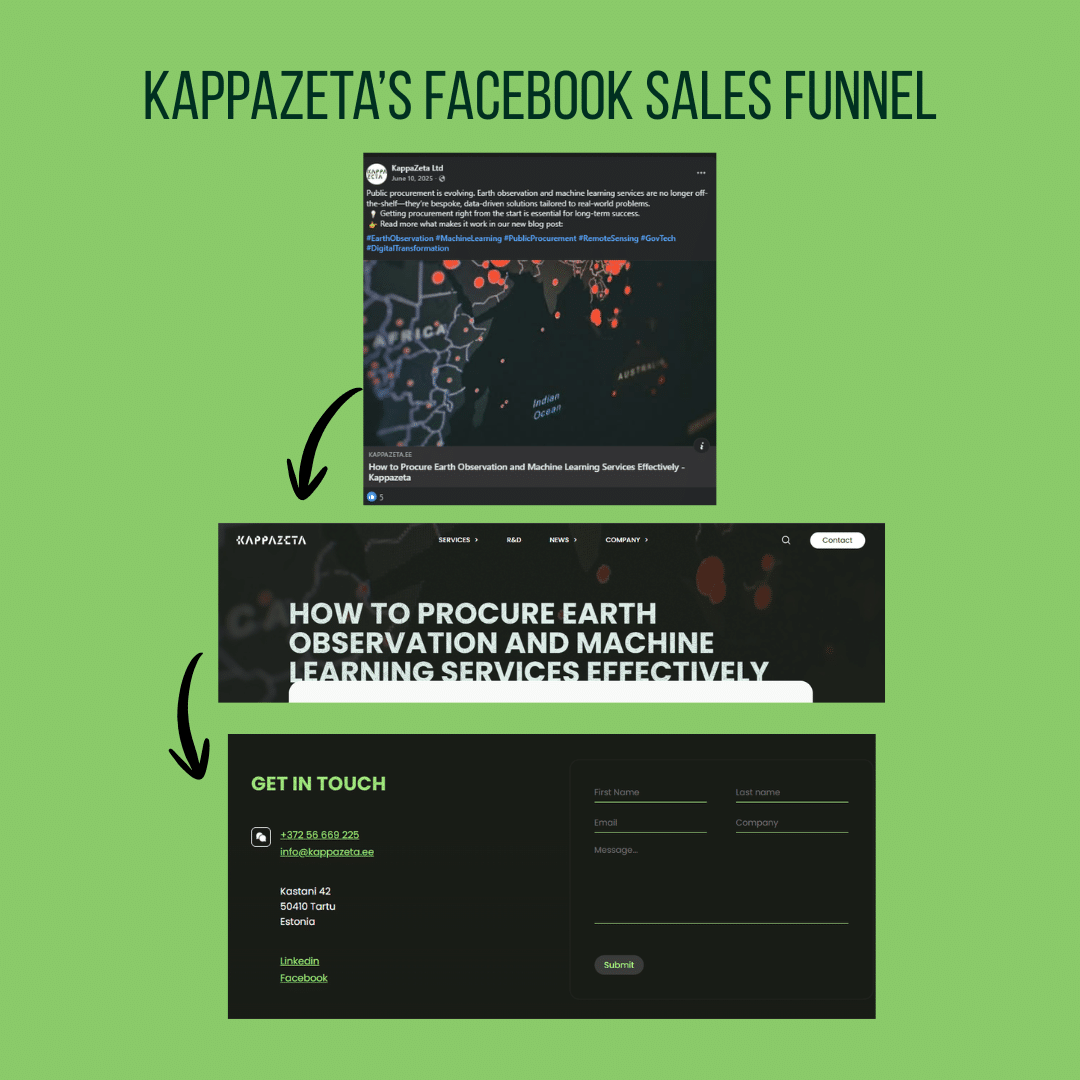
On Facebook, KappaZeta is using the same method. They will share a blog post, you will be taken to the landing page, and you will see the contact button on the right side of the menu. Click contact, and you will land on a page with the same name.
On the KappaZeta’s Contact page, you will see their phone number, email address, company address, and links to LinkedIn and Facebook pages on the left side. On the right side, you will see a normal contact form, requesting your full name, email, company, and message.
The funnel is lean but intentional. For a company with a long sales cycle and a narrow ICP, volume is not the goal. One well-qualified lead from a government procurement team is worth more than a hundred form fills from people who don’t fit. The contact-first approach works when your content is doing the qualification work upstream, which is exactly what their educational and authority-building posts are designed to do.
KappaZeta has no active presence on YouTube, TikTok, Instagram, or X, so there are no additional funnel paths to map from those channels.
KappaZeta’s Reviews and Social Proof
There is no company page on G2, Capterra, or TrustPilot. The review section on Facebook is not visible right now.
On Glassdoor, KappaZeta has a 4-star rating, with 100% would recommend to a friend, and 100% positive business outlook. The lowest rated category, with 1 star rating are Compensation & benefits and Senior Management.
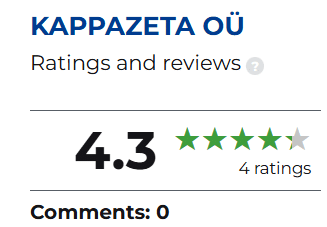
SSB.ee, an Estonian business information database and reputation management platform, gives us 4 reviews, scoring KappaZeta 4.3 stars rating.
The absence of software review platforms is not a gap for this type of company. G2 and Capterra are built for SaaS products with self-serve buying journeys. KappaZeta’s customers are governments and large organizations that do not make decisions based on review aggregators. The Glassdoor scores are more relevant here because they speak to company stability and team satisfaction, both of which matter to enterprise buyers assessing long-term vendor relationships.
KappaZeta’s Content Marketing and Demand Generation
Their articles are divided in two categories: blog and news(letter). As you enter each page, you’ll see their latest post signaled by a pulsating green point. You can see for both categories when the article was published from the preview.

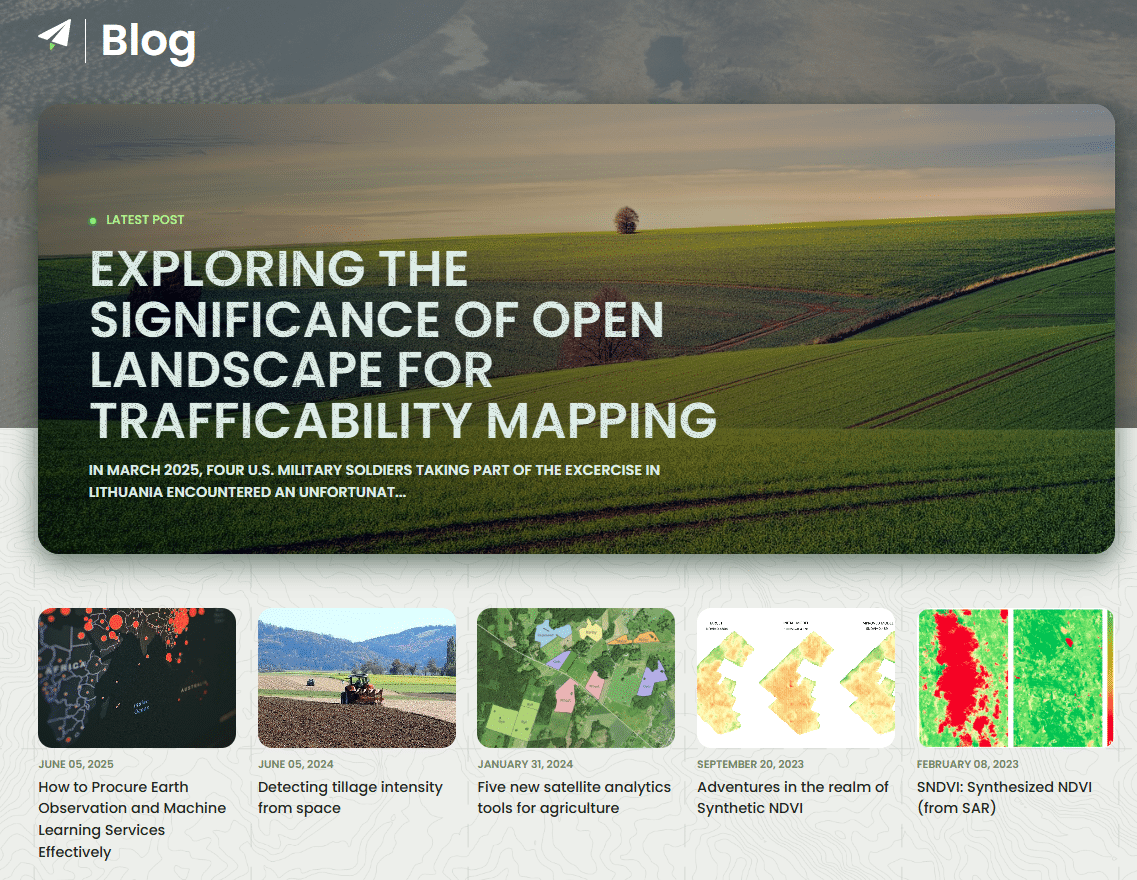
The articles have headings and subheadings, pictures, and spreadsheets. There is no table of contents present for any article. These have around 700 words, and they are using professional and technical language. They posted twice in 2025, 2024, and 2023.
Some of their titles are:
- How to Procure Earth Observation and Machine Learning Services Effectively
- Detecting tillage intensity from space
- Five new satellite analytics tools for agriculture
- Adventures in the realm of Synthetic NDVI
- SNDVI: Synthesized NDVI (from SAR)
The blog titles are worth paying attention to. A post about how to procure Earth Observation services is a guide written for the exact person who would eventually buy from KappaZeta. That kind of content attracts buyers who are already in research mode and positions KappaZeta as the expert guiding the decision, not just one of the options. At low posting frequency, every piece needs to earn its place, and these topics are well chosen for that.
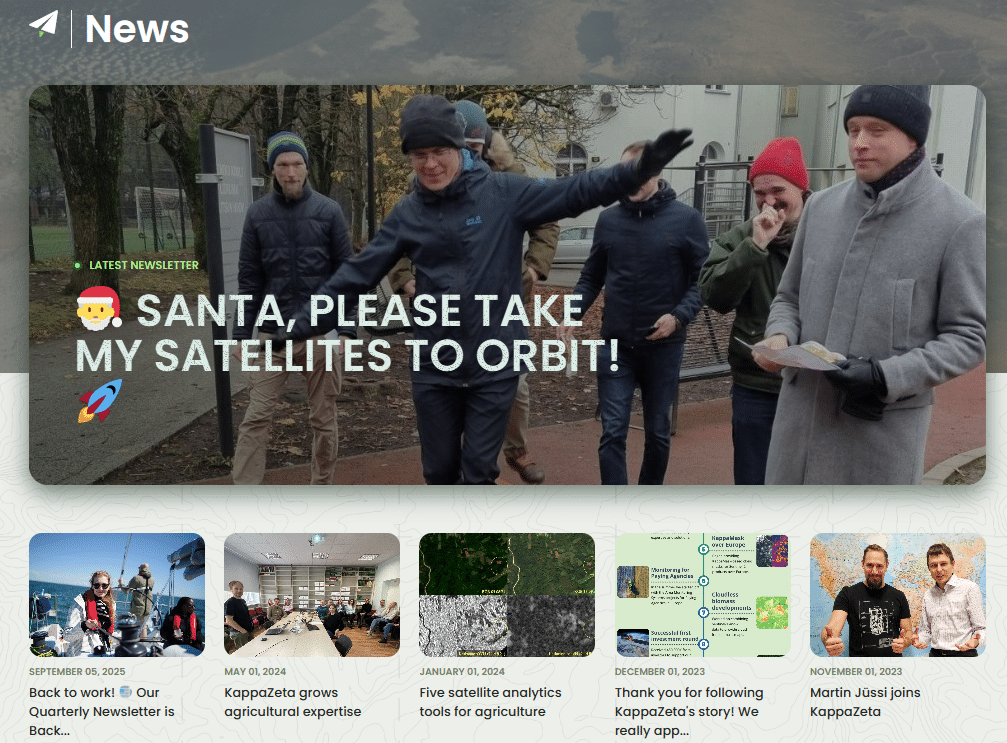
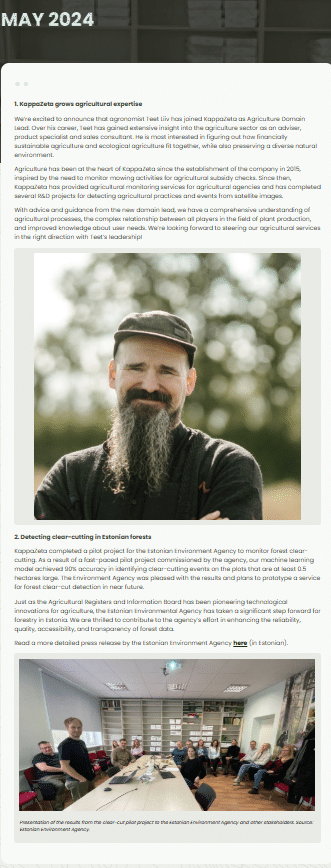
The same posting schedule is sustained on the newsletter, too. Although they are posted as articles, they keep the newsletters’ interface. In the news, you can read about their latest updates, events, and team culture.
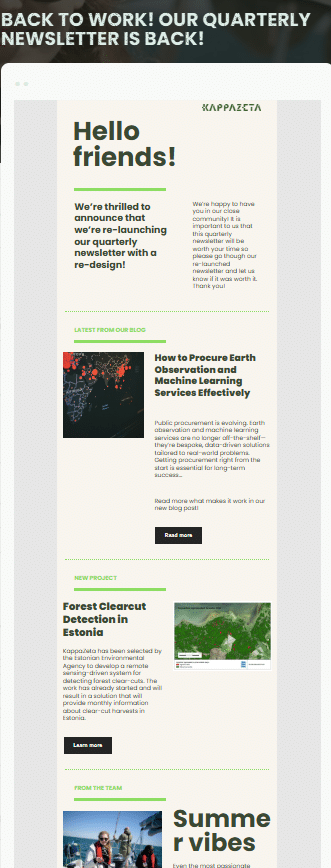
After a break, they announced the return of the quarterly newsletter, but with a new design.
Before
After
According to HubSpot’s 2024 State of Marketing Report, companies that publish educational content aligned to specific buyer roles generate 3x more qualified leads than those publishing general content. A post written for a procurement officer in an agricultural paying agency is a pre-qualification filter.
KappaZeta’s Marketing and Sales Funnel Stages
Top of the Funnel
KappaZeta builds awareness through a combination of content and industry presence. On LinkedIn, their educational posts and product insight content introduce the company to people who may not have heard of them yet.
Their blog does similar work in a more durable way: a well-titled article about how to procure Earth Observation services lives on search and keeps attracting the right readers long after it’s published.
Beyond content, their presence at industry events and membership in bodies like NATO’s Industrial Advisory Group, Spacenet and the Estonian Defence and Aerospace Industry Association puts them in rooms where their buyers already are. For a company with a narrow ICP, that kind of targeted visibility is more valuable than a broad reach.
Middle of the Funnel
Once someone is aware of KappaZeta, the newsletter and longer blog content build trust. They are written for technically sophisticated buyers who are evaluating vendors carefully and want to understand the methodology behind the product.
The LinkedIn articles with their contact prompt at the bottom are a soft but deliberate nudge toward conversation. The R&D program also plays a role here: ESA-backed research and patent approvals are the kind of third-party validation that helps a procurement team justify moving forward internally. At this stage, KappaZeta is not pushing for a sale. They are giving buyers enough evidence to feel confident.
Bottom of the Funnel
The conversion mechanism is direct and simple: a contact form, an email address, and a phone number. There are no demos, no free trials, no pricing pages. That reflects the nature of the sale. These are custom, high-value contracts with government agencies and enterprise clients, not self-serve subscriptions.
The partnership program is the most structured bottom-of-funnel tool they have. An off-take agreement or a dedicated pilot is a relationship with built-in commitment on both sides. For the right buyer, that structure is actually appealing because it comes with dedicated support and direct influence over the product roadmap.
Retention
Retention at KappaZeta is built into the product architecture. When a government agency or Earth Observation company integrates their Analysis Ready SAR Data or cloudmask into their own workflows, switching costs go up fast.
The quarterly newsletter keeps existing customers and partners informed about new developments without being promotional about it. The dedicated pilot model also creates a deeper form of retention: customers who have shaped the product are naturally more invested in its success.
As the 3D-SAR mission moves toward launch, early partners will have both contractual and reputational reasons to stay close. That’s a retention strategy that doesn’t rely on reminders or loyalty programs. It relies on making the customer part of the story.
KappaZeta’s Future Plans and Growth Indicators
There are currently no available LinkedIn Jobs or on their Career page.

A quiet hiring page in a company building a satellite mission is worth reading carefully. It could mean the core team is in place and heads-down on execution, which at this stage of a hardware-heavy deep tech project is actually a good sign.
The 3D-SAR mission is the central growth bet, and the partnership program is the mechanism for turning that into early revenue. The next signal to watch is whether they announce new partners or pilot customers, which would confirm the commercial side is moving alongside the technical one.
Inspiration Points
- Lead with outcomes, not technology.
Their messaging focuses on what buyers can do differently: verify subsidies faster, reduce field inspections, and meet compliance deadlines. None of that requires explaining how radar interferometry works. This is the right call when selling to government procurement teams who care about accountability and cost reduction. If your product solves a regulated problem, sell the compliance, not the capability.
2. Write content for the person who signs the contract.
A blog post titled “How to Procure Earth Observation and Machine Learning Services Effectively” speaks directly to the person who will eventually buy from KappaZeta. By the time the reader reaches the contact form, they already understand the category, trust the source, and know what they need. Write one piece of content aimed exactly at your buyer’s job title and their most pressing obligation. That one post will do more pipeline work than 5 generic articles.
3. Make authority-building posts, not sales posts.
Their three best-performing LinkedIn posts were about their engineering team, their 3D-SAR mission, and a co-founder at TEDxTallinn. None of them pushed a product. All of them signaled that this is a serious company doing serious work. According to Edelman’s 2024 B2B Thought Leadership Impact Report, 60% of B2B decision-makers say thought leadership directly influences their purchase decisions. In technical markets, credibility travels further than any campaign.
4. Use third-party validation as a sales asset.
ESA funding, patent approvals, and NATO advisory group membership are trust signals that reduce the perceived risk of choosing a relatively young company for a high-stakes contract. Robert Cialdini in Influence: The Psychology of Persuasion calls this social proof by authority: when a credible third party validates your work, it does the convincing that your own claims cannot. Put your biggest third-party validations in front, not buried in a footer.
5. Turn early customers into stakeholders through a partnership program.
KappaZeta gives early partners the ability to shape product development through dedicated pilots and off-take agreements. Buyers who have influenced a product are naturally more invested in its success, which means they stay longer, refer more readily, and become the kind of reference customers that close the next deal. If you are building something that does not exist yet, find three organizations willing to shape it with you. That relationship is worth more than any marketing campaign.
6. Match your funnel to your actual sales reality.
KappaZeta does not run free trials, demos, or self-serve sign-ups. Their conversion mechanism is a contact form, an email, and a phone number. That is the right structure for a long sales cycle with high-value buyers who need a conversation, not a product tour. Before you add another funnel step, ask whether it serves the buyer or just the metric. Sometimes a simple contact form is the most honest CTA you can offer.
7. Post consistently in your niche, even at low volume.
Once or twice a week, every week, in a field where most competitors post sporadically, is enough to build compounding visibility. LinkedIn’s algorithm rewards consistency. More importantly, the people you want to reach in a niche industry will start to recognize your name before they ever need you. That recognition is what makes the eventual outreach feel warm rather than cold.
8. Position your product as infrastructure, not a service.
When Earth Observation companies build their analytics on KappaZeta’s Analysis Ready SAR Data, KappaZeta stops being a vendor and becomes a dependency. That shift changes the nature of the customer relationship entirely. If your product integrates deeply into a buyer’s workflow, prioritize that depth over breadth. One integration that makes you essential is worth more than ten features that are nice to have.
Frequently Asked Questions
- What marketing channels does KappaZeta use?
KappaZeta’s primary channel is LinkedIn, where they post once or twice a week and publish longer articles aimed at technical and procurement audiences. They also maintain a blog and a quarterly newsletter on their website. They are not currently running paid ads on any platform, which is a deliberate choice for a company whose buyers make decisions through relationships and research rather than clicking on ads.
2. How does KappaZeta generate leads?
Their lead generation is content-driven and long-cycle. Educational blog posts and LinkedIn articles attract buyers who are already researching Earth Observation solutions. At the bottom of their articles, a direct prompt sends interested readers to a simple contact form. There are no demos or free trials because the product is not self-serve. The goal is to start a conversation with the right person, not to generate volume.
3. Who is KappaZeta’s target customer?
KappaZeta sells to governments, agricultural paying agencies, defence organizations, forestry operators, carbon project developers, and Earth Observation companies looking to improve their data quality. These are technically sophisticated buyers with long procurement cycles, regulatory obligations, and a low tolerance for vendors who cannot demonstrate scientific credibility.
4. How does KappaZeta build trust with enterprise and government buyers?
They combine several trust signals: ESA-funded research, patent approvals, membership in NATO’s Industrial Advisory Group Spacenet, and a founding team with PhD-level expertise in radar remote sensing. Their content strategy reinforces this by consistently positioning the company as a scientific authority rather than a software vendor. None of their top-performing content is promotional. It is all credibility-first.
5. Does KappaZeta use paid advertising?
As of February 2026, they are not running ads on LinkedIn, Meta, or Google. This is consistent with how enterprise and government procurement actually works. Buying decisions in this space are made through conferences, referrals, research, and direct outreach, not through sponsored posts. Their investment goes into industry presence and content instead.
6. What can other B2B deep tech companies learn from KappaZeta’s marketing approach?
The clearest lesson is that in technical B2B markets, authority builds a pipeline faster than promotion. KappaZeta’s best-performing content is about their mission, their team, and their science, not their pricing or features. Their funnel is lean because their content does the qualification work early. And their partnership program shows that involving buyers in product development is good marketing too, because it creates advocates before the product even launches.