Today we’re taking a look at Embeddable’s marketing and sales strategies as of December 2024.
Why do we do this series? Because we love a good challenge and want to help fellow marketers get inspired by companies that are doing things right and the right things.
(PS: If you need help, wink-wink, send us a message. We have Milk & Cookies and good strategies).
📝 A quick note before you start reading:
The data and analysis in this article are valid as of the time we wrote it. We don’t know when you’ll be reading this, maybe next week, maybe six months from now, and things might have changed since we looked at this company’s marketing and sales approach. Still, the insights and lessons here stay useful, even if the numbers or tactics have evolved a bit.
Who is Embeddable?
Embeddable is a platform that simplifies the creation of custom analytics dashboards and visualizations. The company was founded in 2023 and has it’s headquarter in London, the Great Britain. As they are a relatively new company, they have only 822 followers on LinkedIn, with 15 associated members on LinkedIn.
Brand promise
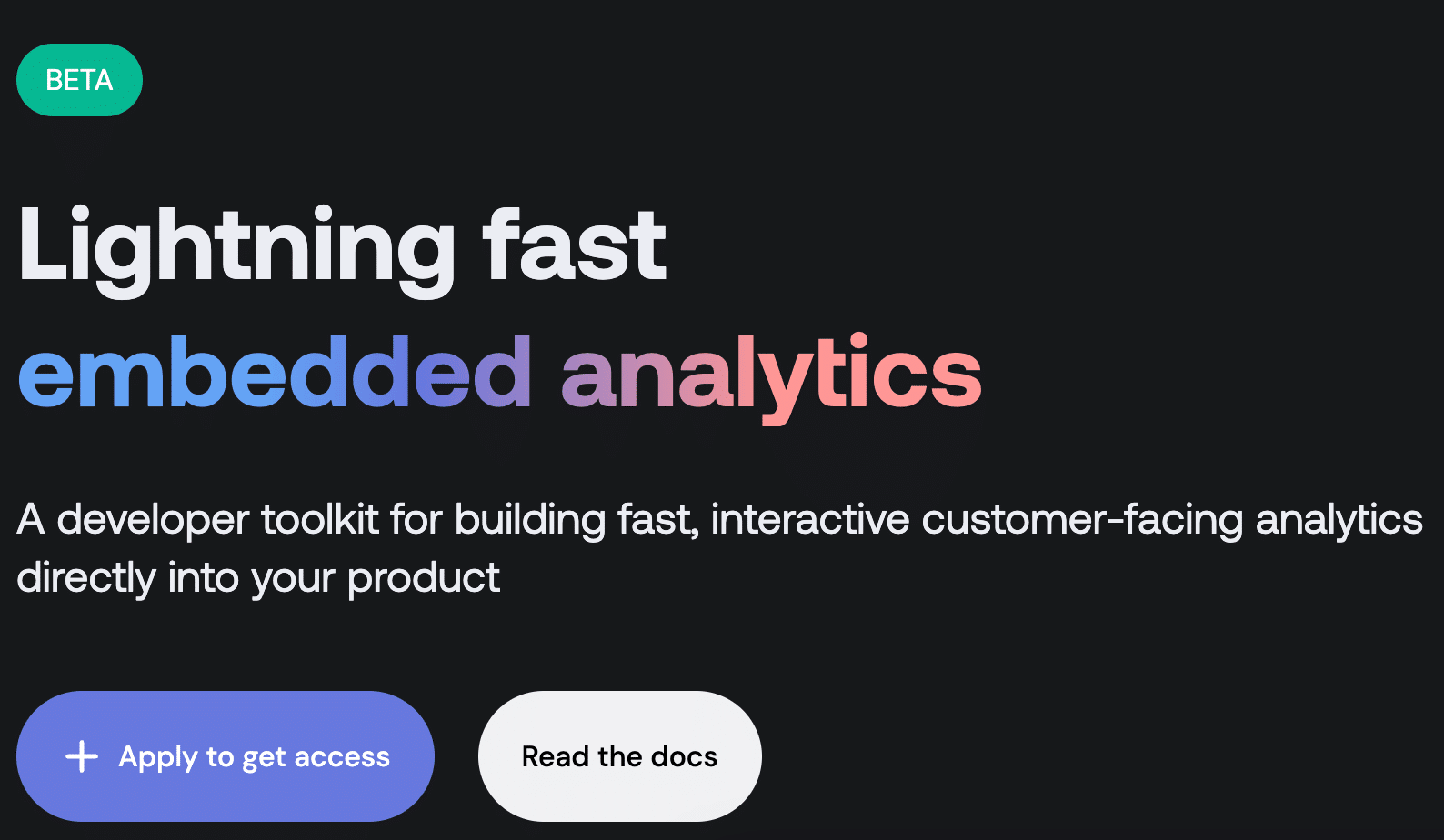
“Lightning-fast embedded analytics” is their brand promise. This statement promises to give developers the tools and capabilities to integrate data analysis features directly within their applications.
How do they differentiate themselves
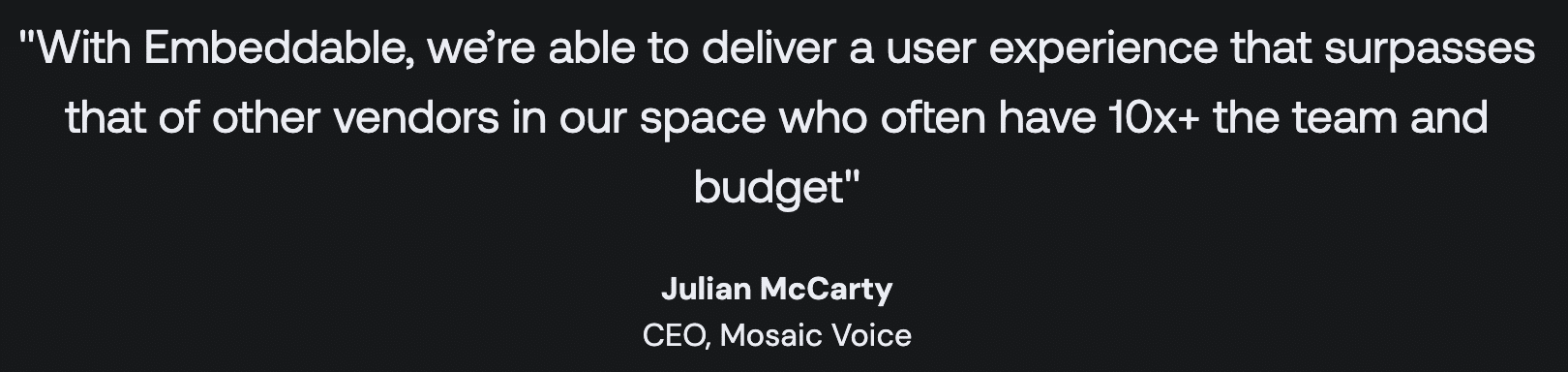
Beyond their brand promise of “lightning-fast embedded analytics,” their recent win of the “Embedded Analytics Solution of the Year 2024” at the Data Breakthrough Awards speaks volume. It’s a way of building trust with potential customers by demonstrating industry validation.

Another way they differentiate themselves is by having a dedicated section on their website, called “Why?”. Here they have a comprehensive copy explaining why their platform is an alternative to other options.
“We’re meticulously designing our platform to streamline the entire process so you can craft your perfect solution, without compromise, in just 10% of the time.”
Embeddable’s Social Media Presence
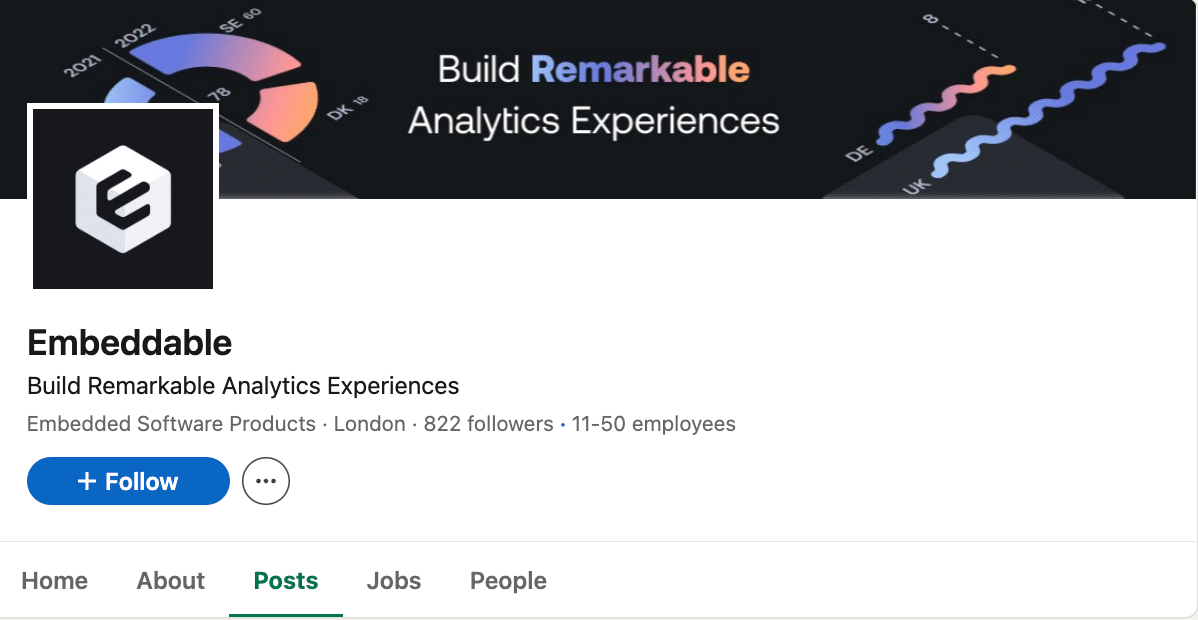
On LinkedIn they are not as active as other brands, posting only once per week. Maybe they are focusing on improving their products first, and marketing comes last. Marketing activities can be resource-intensive, it needs people, budget, and time. Sometimes, a company might choose to allocate these resources towards product development, focusing on a product that will bring customers in.
Content Pillars
It’s tough to say they have defined content pillars, because their marketing strategy doesn’t seem very robust. This could be happening because they don’t have a marketing team, as we tried to find, as of December 2024.
1. Announcing partnerships
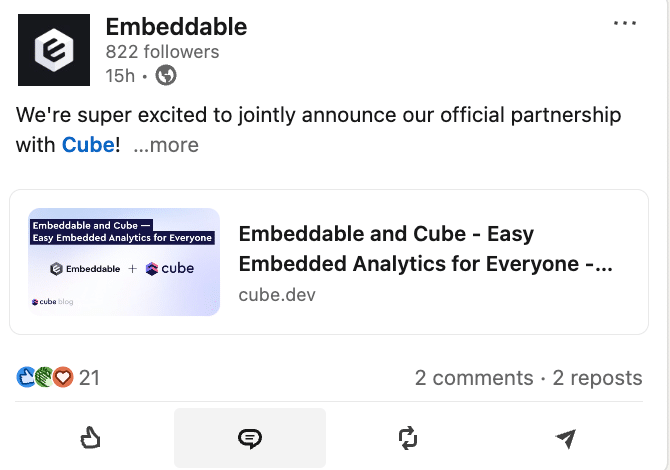
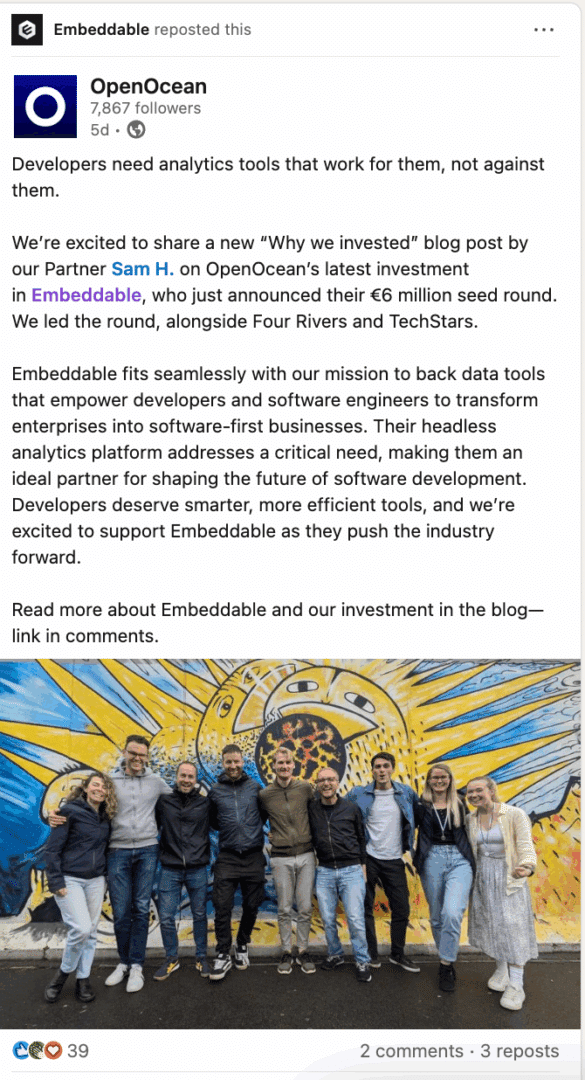
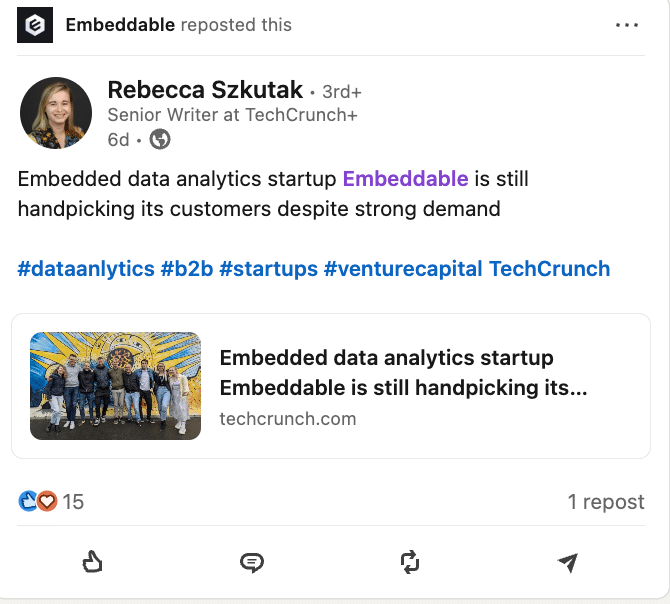
2. Resharing posts where they are mentioned
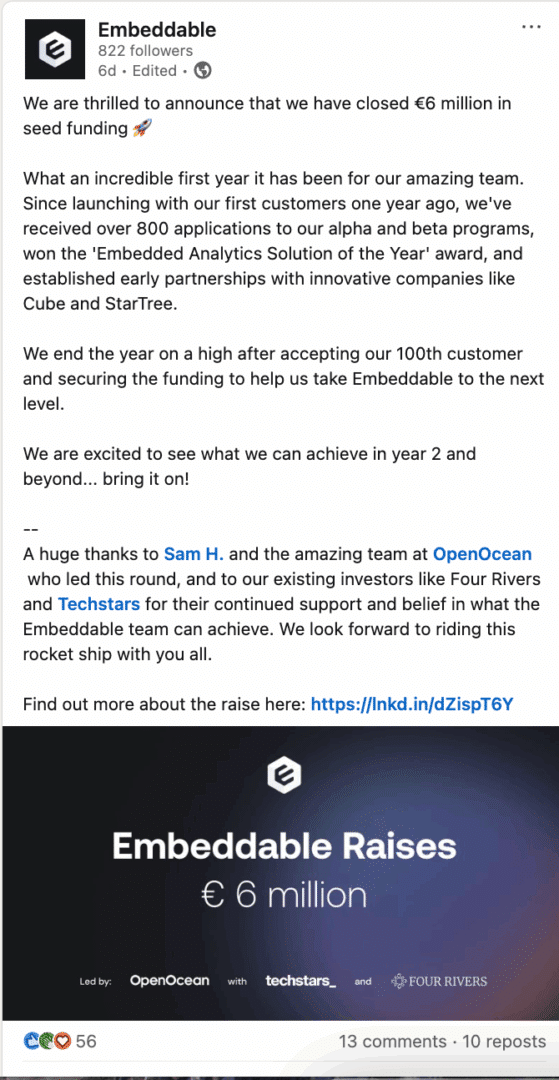
3. Company announcements
4. Educational content
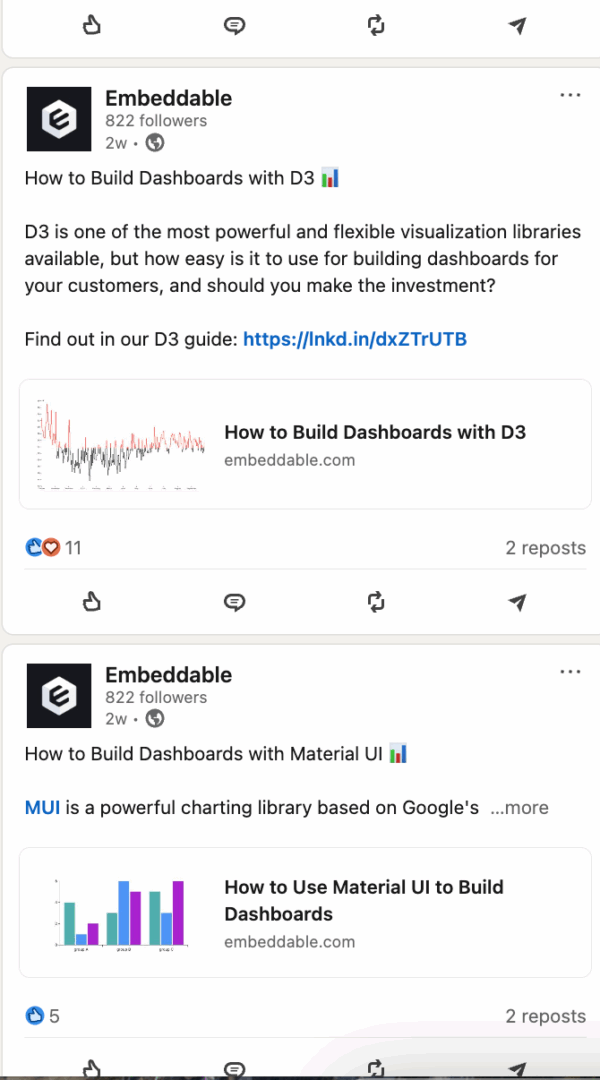
For a young company, creating educational content is a big deal. Slowly but surely, Embeddable is establishing itself as a knowledgeable and authoritative voice in its industry.
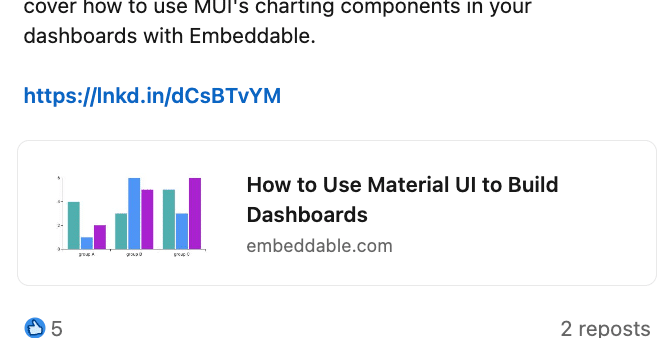
The links send readers to their Blog page. We see that these articles are written by Rogan Sage, the VP of Growth. They also sometimes end the posts with a CTA like this one: “Find out in our D3 guide” However, they do not always end with a CTA, and they just put the link there, as you can see below.
5. Customer stories
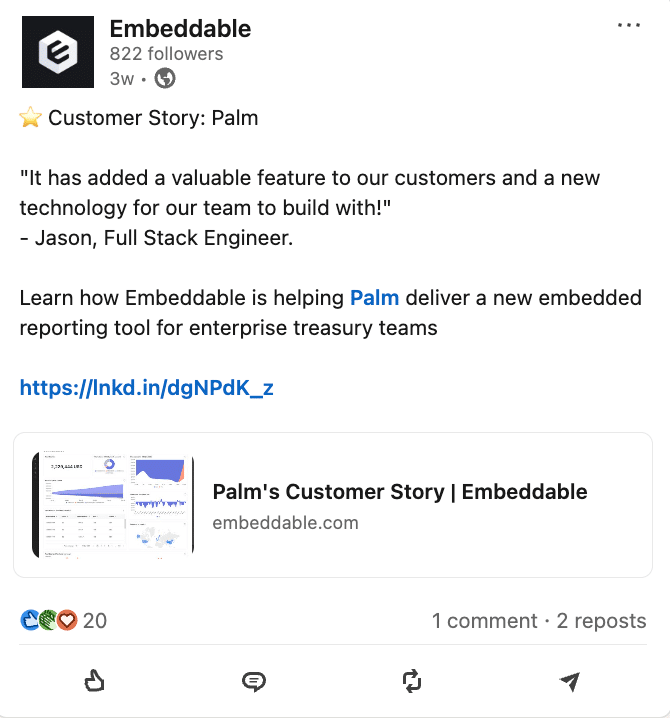
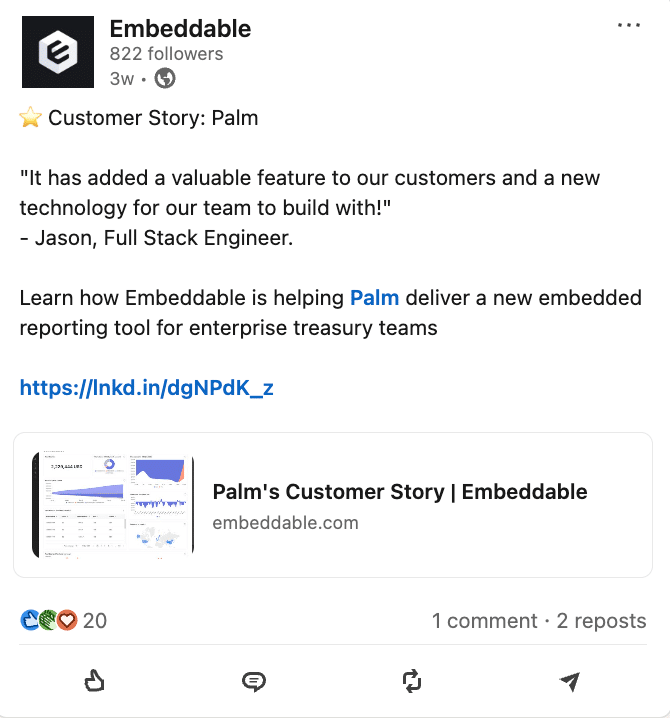
Embeddable shares customer stories from their website, together with a small testimonial.
In this example, the post directs users to a specific link (“https://lnkd.in/dgNPdK_z“), which leads to a more detailed customer story on their website, making readers curious to discover the full story and details.
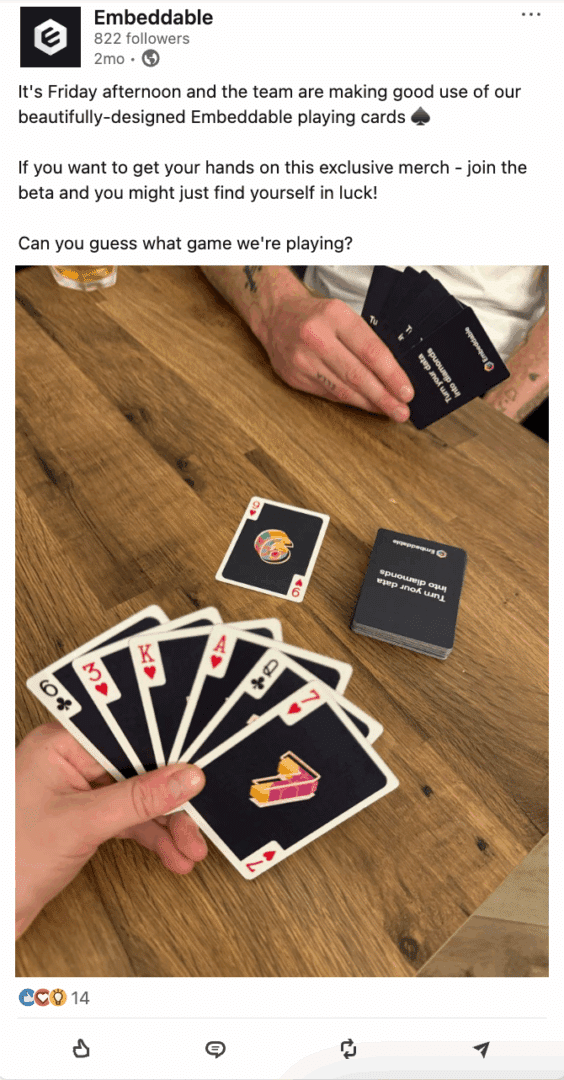
6. Company’s values and activities
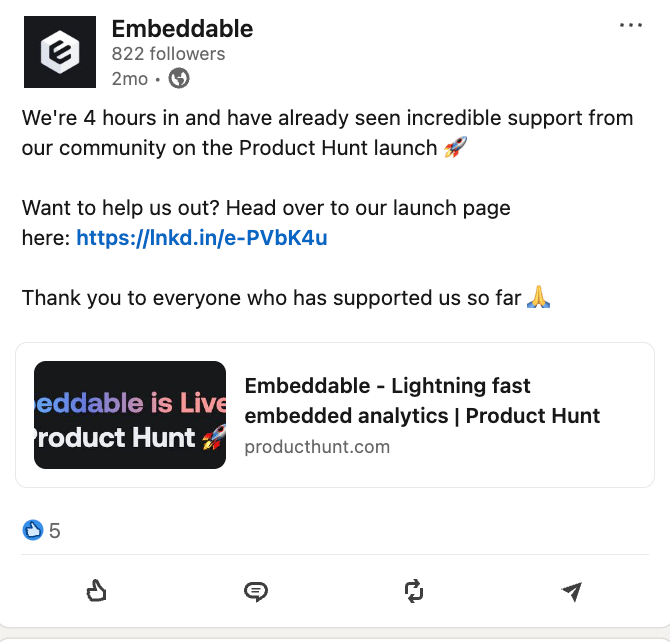
7. Product launches
8. Awards

In terms of engagement, as you can expect when having such a small number of followers, and no visible content plan, their engagement is small, with no more than 30 reactions in general, with some exceptions of course.
This is one of their best performing posts:
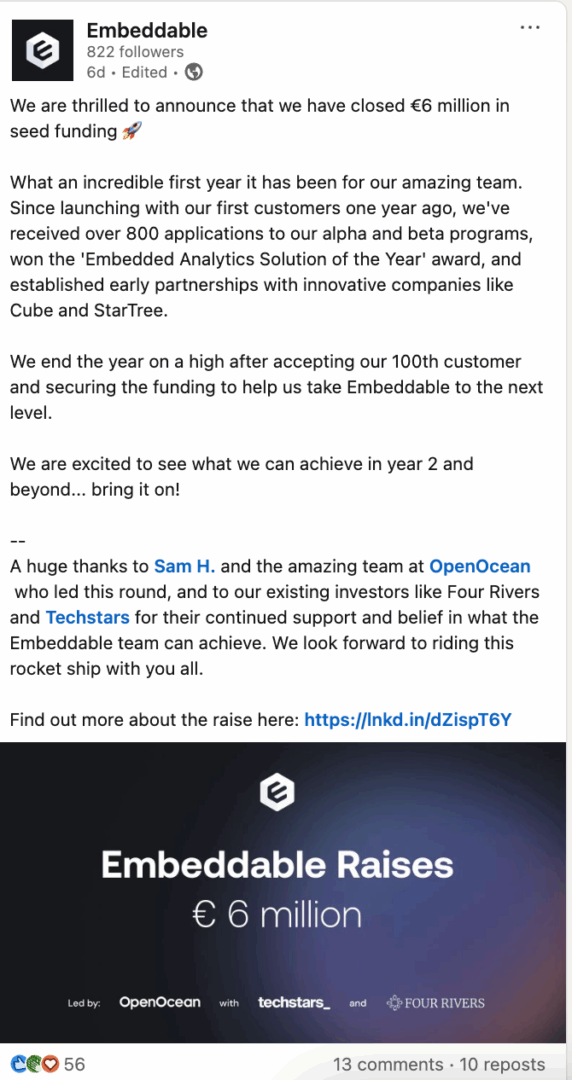
Most of the time they reply to comments on their posts. By doing so, Embeddable shows that you can start building your social media presence while still developing your product.
LinkedIn seems to be a good place for lead generation, and Embeddable is using it exactly with this purpose. Their posts end most of the time with a CTA, inviting the audience to their website.
They also promote their educational content on LinkedIn, with a preview that looks quite interesting. They have an image with data, which could be relevant for tech enthusiasts.
Social Media Strategy Analysis
Their content mix tells their story. They’re juggling promotional stuff with educational content, customer success stories, and company news. It’s cool that they’re putting out educational content, even though they’re just starting out. Their engagement is decent, especially considering how few followers they have. They’re doing a good job by responding to comments and being active as much as they can, especially since they don’t have a marketing team behind to solve all of this.
When you start building your brand on social media you need a strong base. Even with a small team, stick to a regular posting schedule. Focus on top-notch content that your audience will actually find useful, reshareable and give something to spark the conversation.
Also, from the start it’s good to understand and nail your call-to-action game. Embeddable sometimes includes CTAs, but being more consistent would probably boost conversions. Every post should tell readers exactly what to do next, whether it’s downloading a guide, checking out a case study, or visiting the website.
Another criteria to consider is to invest in visual content. Embeddable’s use of data visualizations and eye-catching preview images for educational content proves how much visuals matter. Think about creating branded templates for different post types to keep things looking sharp and save time.
Embeddable’s Digital Content Marketing Strategies
Demand generation
In this section, we will analyze Embeddable content marketing strategy, with a focus on their demand generation and lead generation strategies.
Embeddable’s Blog
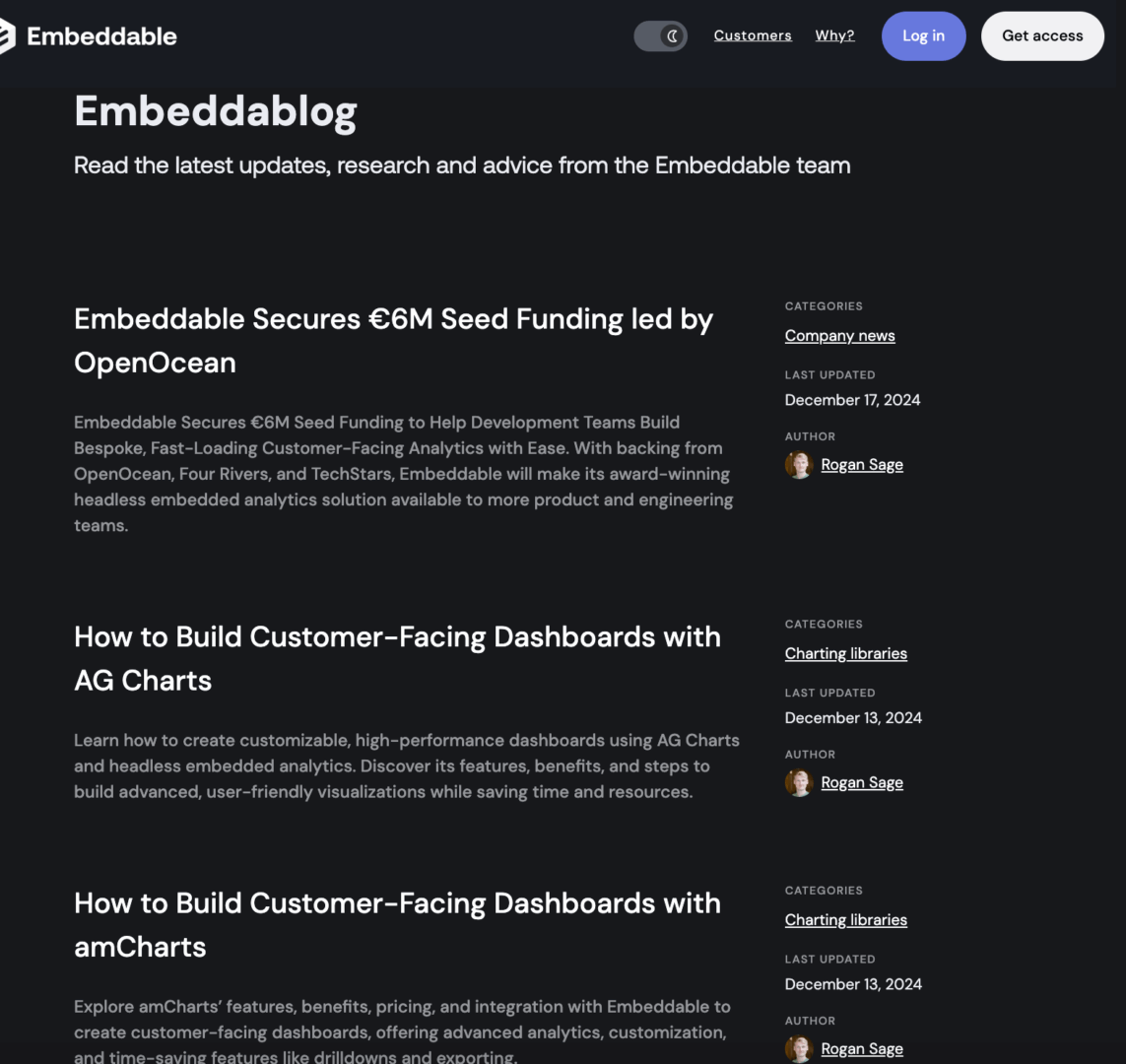
The blog posts seem to be written mostly by the VP of Growth. The content covers a range of topics, including company news, charting libraries, product updates, embedded analytics, and data stacks.
They kicked things off on December 13th 2024, with a flurry of articles. We noticed that the articles often start with a box designed to grab the reader’s attention and pique their interest in the products. Phrases like “Before you jump in…” are a great way to build anticipation and make readers feel like they’re about to learn something important.
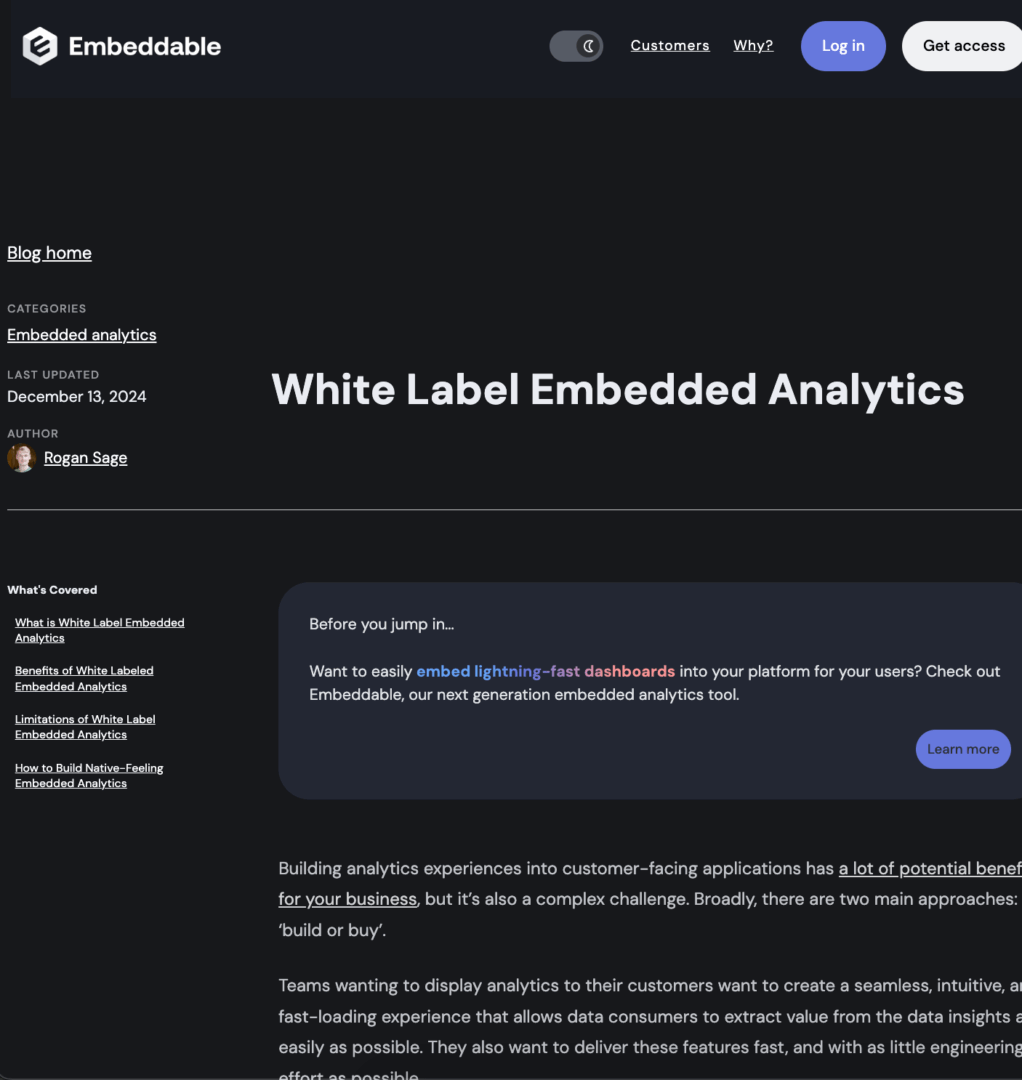
The articles have a 1,000 words sweet spot and it shows that they understand the balance between depth and readability. Their tone of voice is professional, but friendly. Moreover, they include many links to other blog posts. Sometimes they include figures and images in their posts, but written text is the main content part.
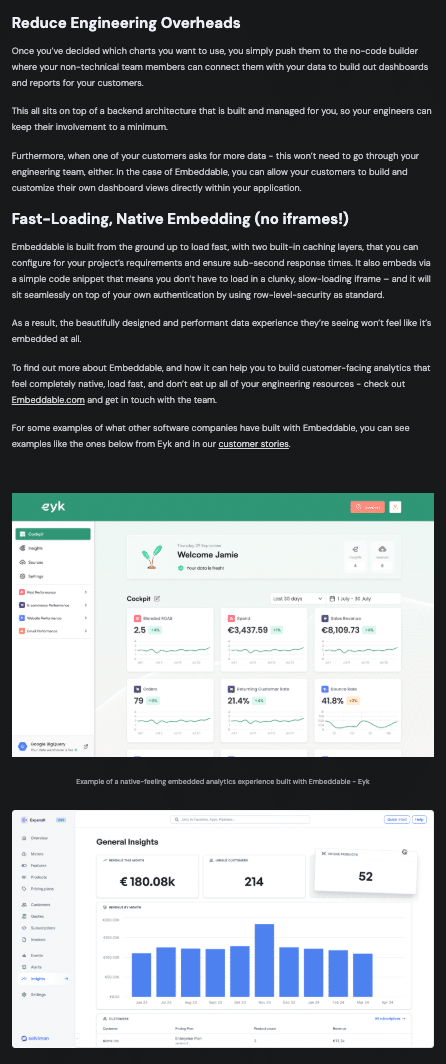
When it comes to CTAs, we see the followings:
- Primary CTA: “Learn more” (as seen in the snippet) likely directs readers to a dedicated page about “Embeddable” with more information, pricing, and a potentially free trial.
- Secondary CTAs:
- Subscribe to the blog: Encourage readers to subscribe for future updates and insights on embedded analytics.
- Contact sales: Provide a clear path for interested parties to connect with the sales team for a personalised demo or consultation.
- Follow us on LinkedIn / Join our community: Encourage readers to join their “team” and start building their online community.
Sometimes they have CTAs that look like this:

Community
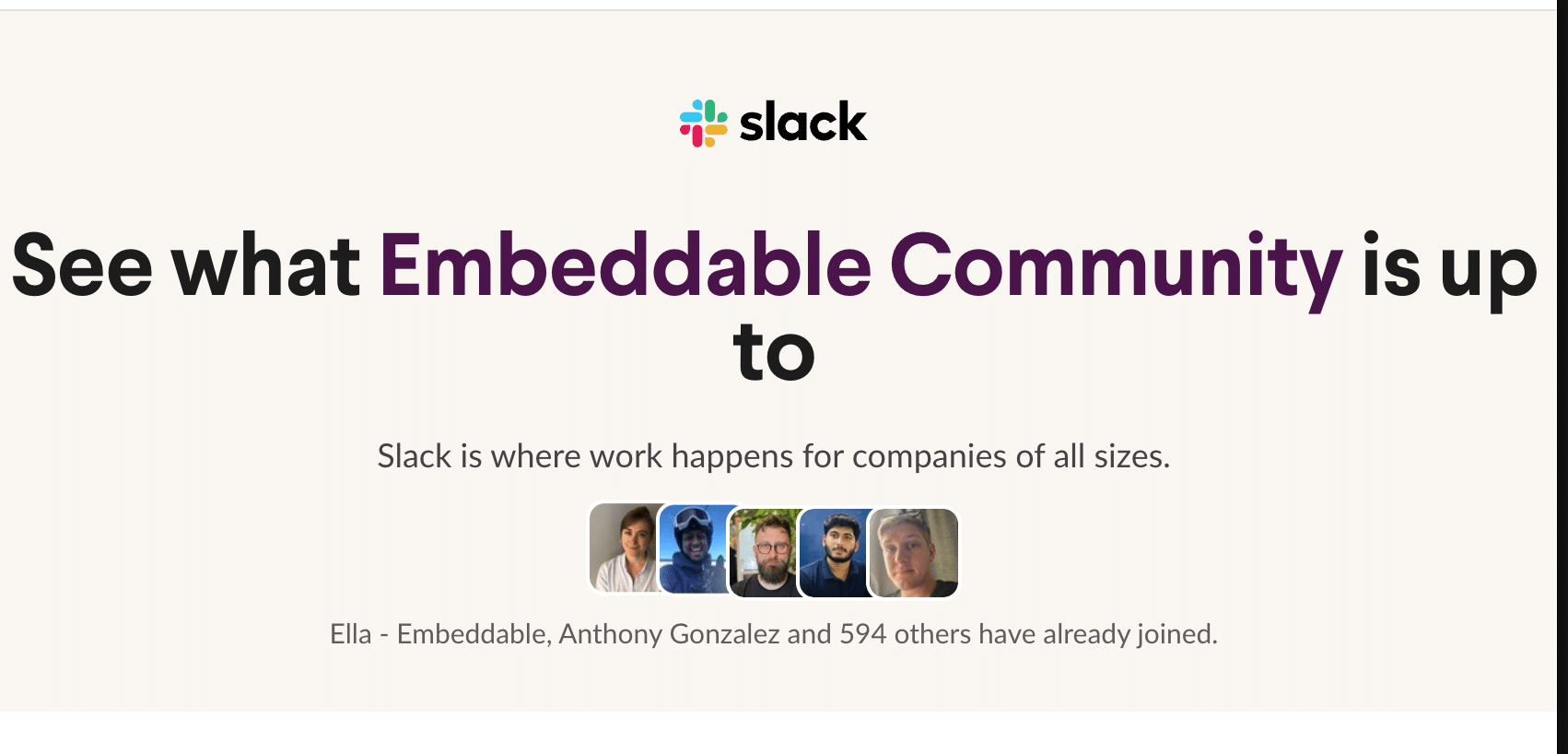
Embeddable has a Slack Community, with 594 members at the moment. Slack is widely recognized and used in many organizations, to reduce the learning curve for new members. This familiarity encourages participation and makes it easier for users to engage.
Customer Stories
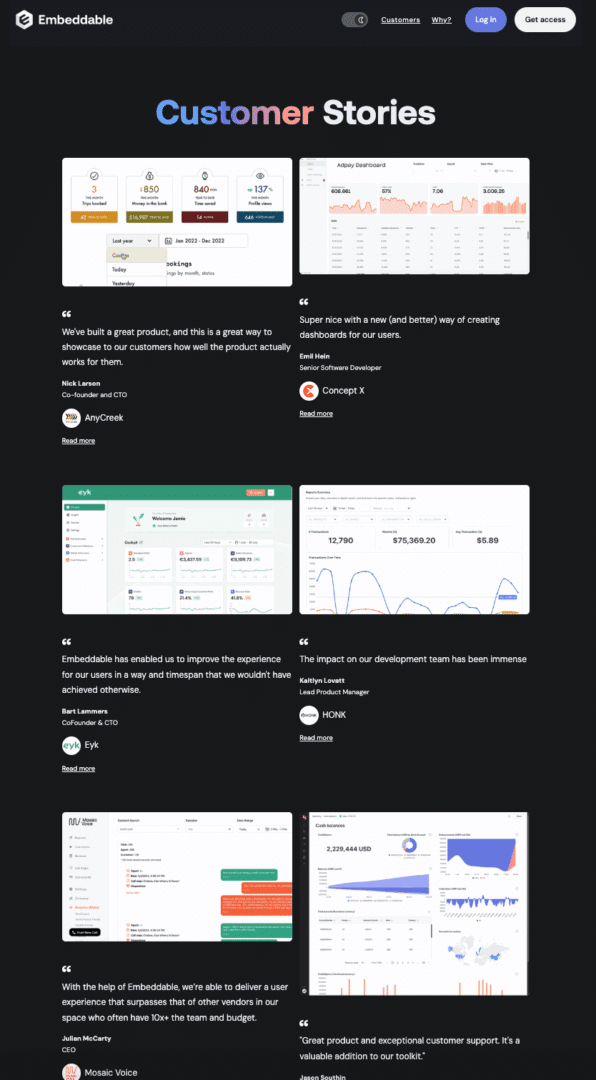
The structure of their Customers Stories:
- Project Overview
- How [The client] chose Embeddable
- Business Impact
- About [The client]
Their main page features some customer testimonials. Customers report big improvements in user engagement and satisfaction, and they especially love the easy-to-use, no-code builder.
Why are testimonials so effective? They’re a form of social proof, showing potential customers how the product works in real life and how happy existing users are. This builds trust and makes the company seem much more credible.
Newsletter
Embeddable newsletter can be found at the bottom of the page, in the “Discover” section.
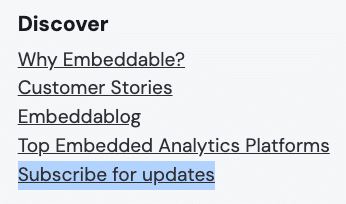
To convince readers to subscribe, they use the copy: “Get updates from Embeddable 🙋and be the first to know about opportunities to work with us 👀.” This is not promoted on their blog page or on the career section. Considering that they are searching for talent, it would be beneficial to be displayed in the careers section too.
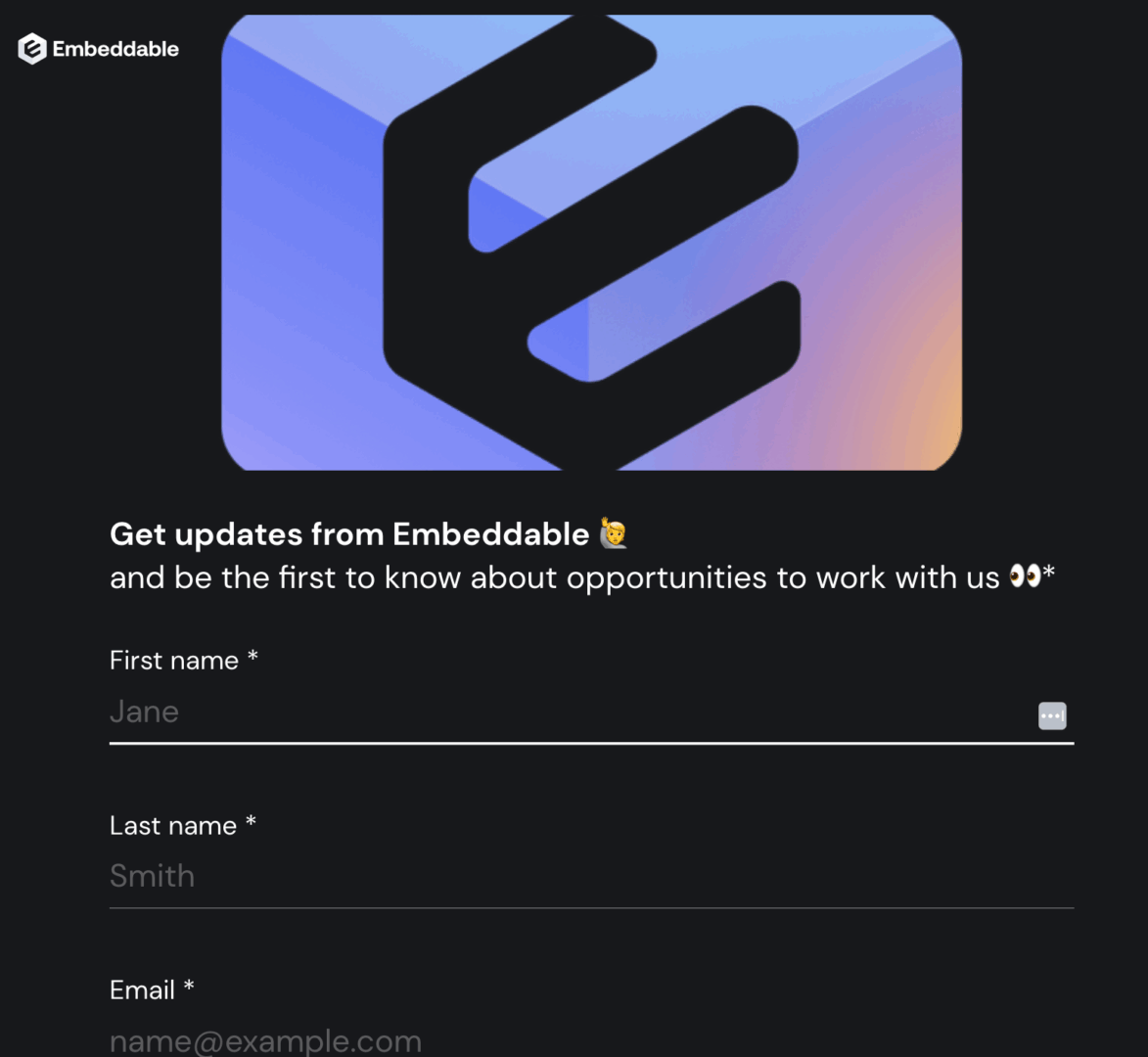
Currently, Embeddable’s newsletter signup is somewhat hidden at the bottom of the page. Making this more prominent and integrating it across multiple touchpoints, can help people see this info more and give the constant reminders to do this action. The newsletter can be a powerful tool for nurturing leads and building long-term relationships with your audience.
Embeddable GitHub
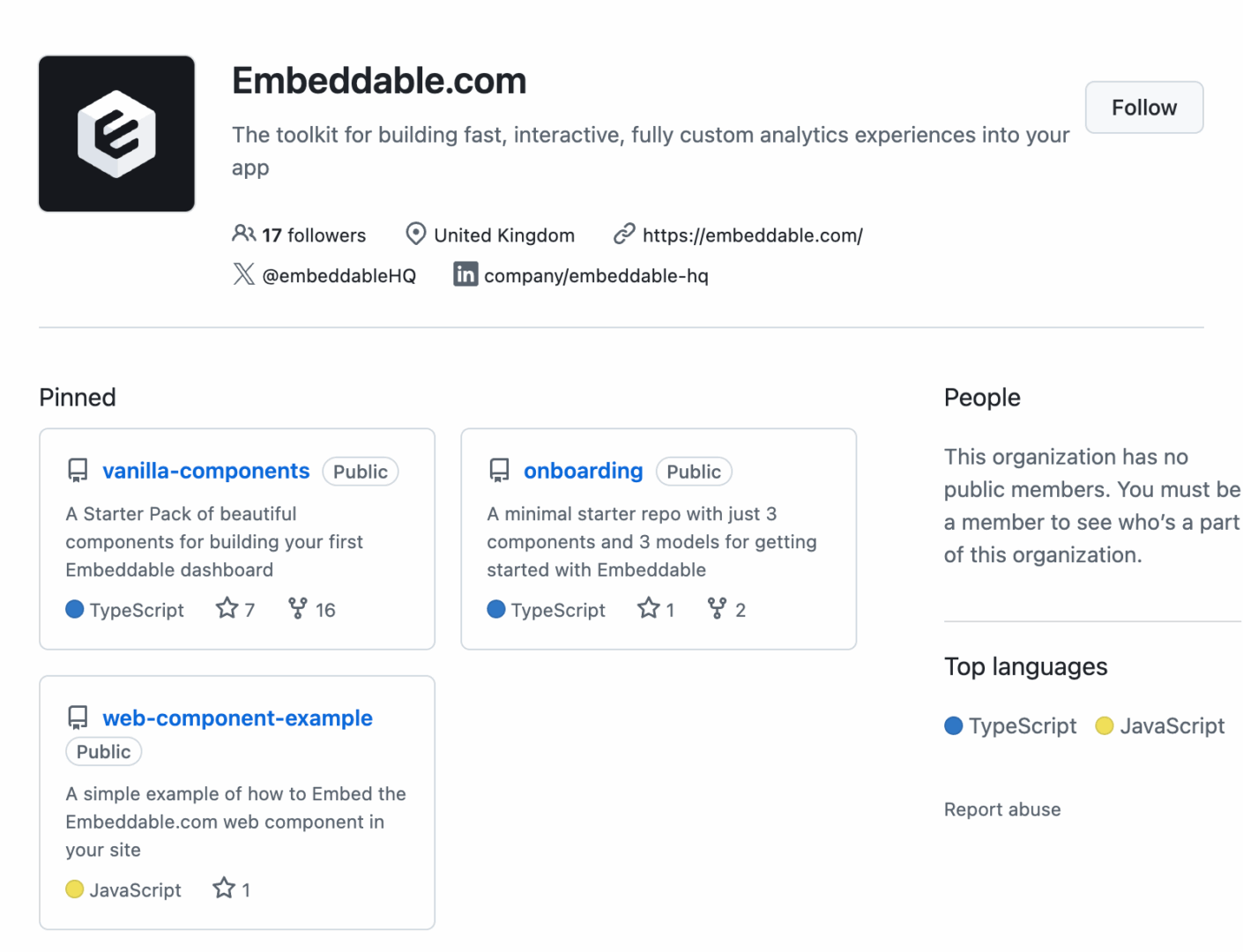
The GitHub page shows their expertise, and attracts potential clients and collaborators. At this moment, they have 17 followers.
We noticed the presence of repositories like vanilla-components, onboarding, and web-component-example These can be used as starter kits and examples to help developers integrate Embeddable into their projects.
Conclusions
Until now, we have seen that Embeddable has just started creating their content, but it already looks promising.
Their GitHub presence further reinforces their technical credibility, providing practical resources for developers, which is a quite important aspect of a tech product.
Their customer stories follow a clear, effective structure that focuses on the journey and impact, rather than just features. The fact that they’ve sprinkled testimonials throughout their website shows they get how important social proof is for winning over potential customers.
Make your blog work harder for you. Consider implementing a clear content calendar with diverse topics that speak to different segments of your audience.
Following Embeddable’s GitHub example, develop clear, practical resources that help users implement your solution.
Strengthen your social proof strategy. While Embeddable uses customer stories effectively, consider expanding this approach by creating different formats of success stories, short video testimonials, detailed case studies, and quick-win snippets that can be used across different channels.
Lead generation
When it comes to lead generation, we usually analyse a company’s webinars, events, downloadables and so on. Another thing we look at is paid advertising. Since we couldn’t find any landing pages or downloadable content, we will start with ads.
Paid Advertising Strategy
On LinkedIn we have found only 10 ads.
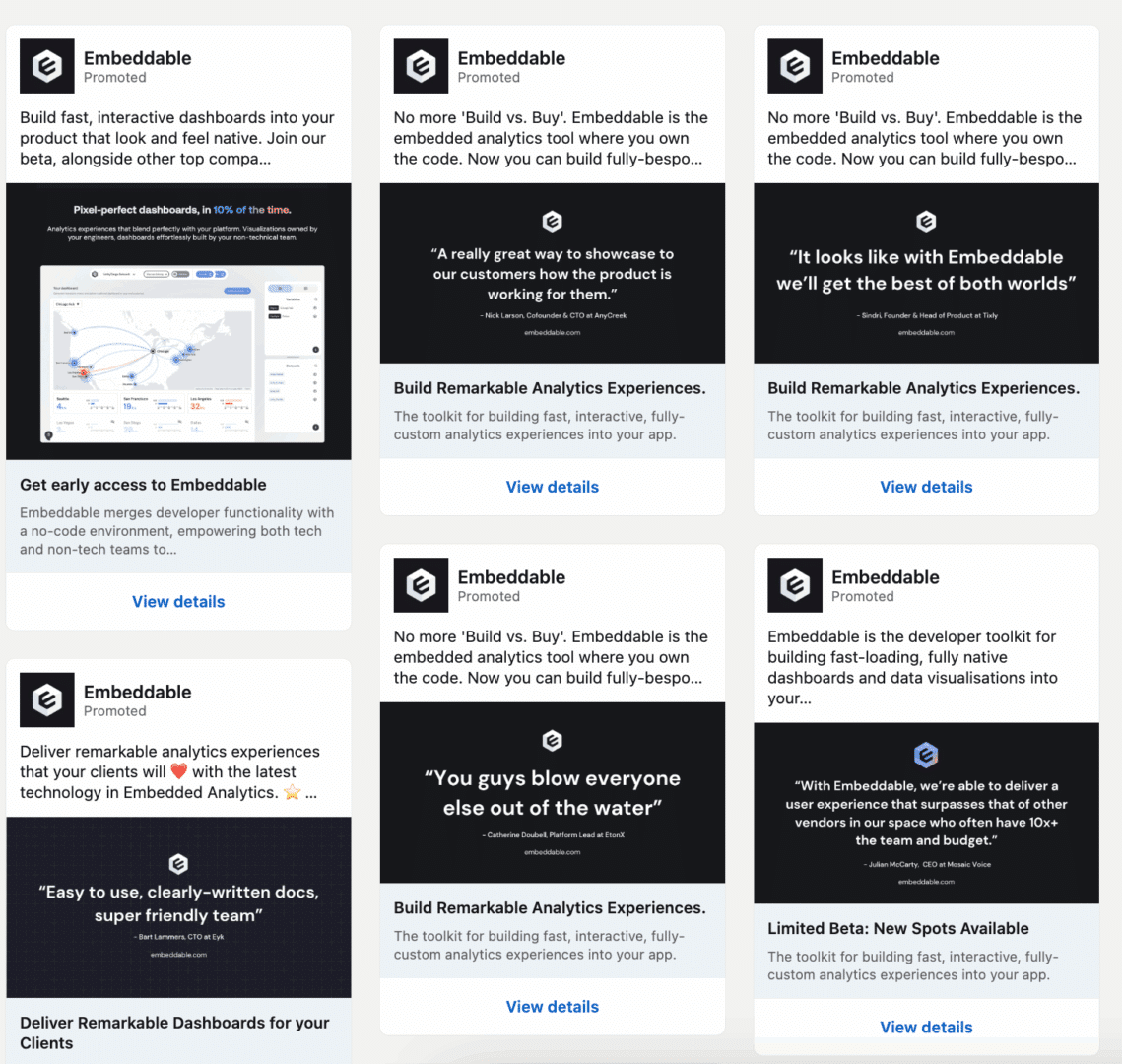
A repeating ad is the one with the title “Build remarkable Analytics Experiences”. Using a consistent tagline reinforces brand identity. Their paid advertising strategy shows that they also want to test different testimonials.
For this ad, they have the same text, but different quote or testimonial displayed. Incorporating different quotes or testimonials in various versions of the ad leverages social proof, which is a powerful marketing tactic.
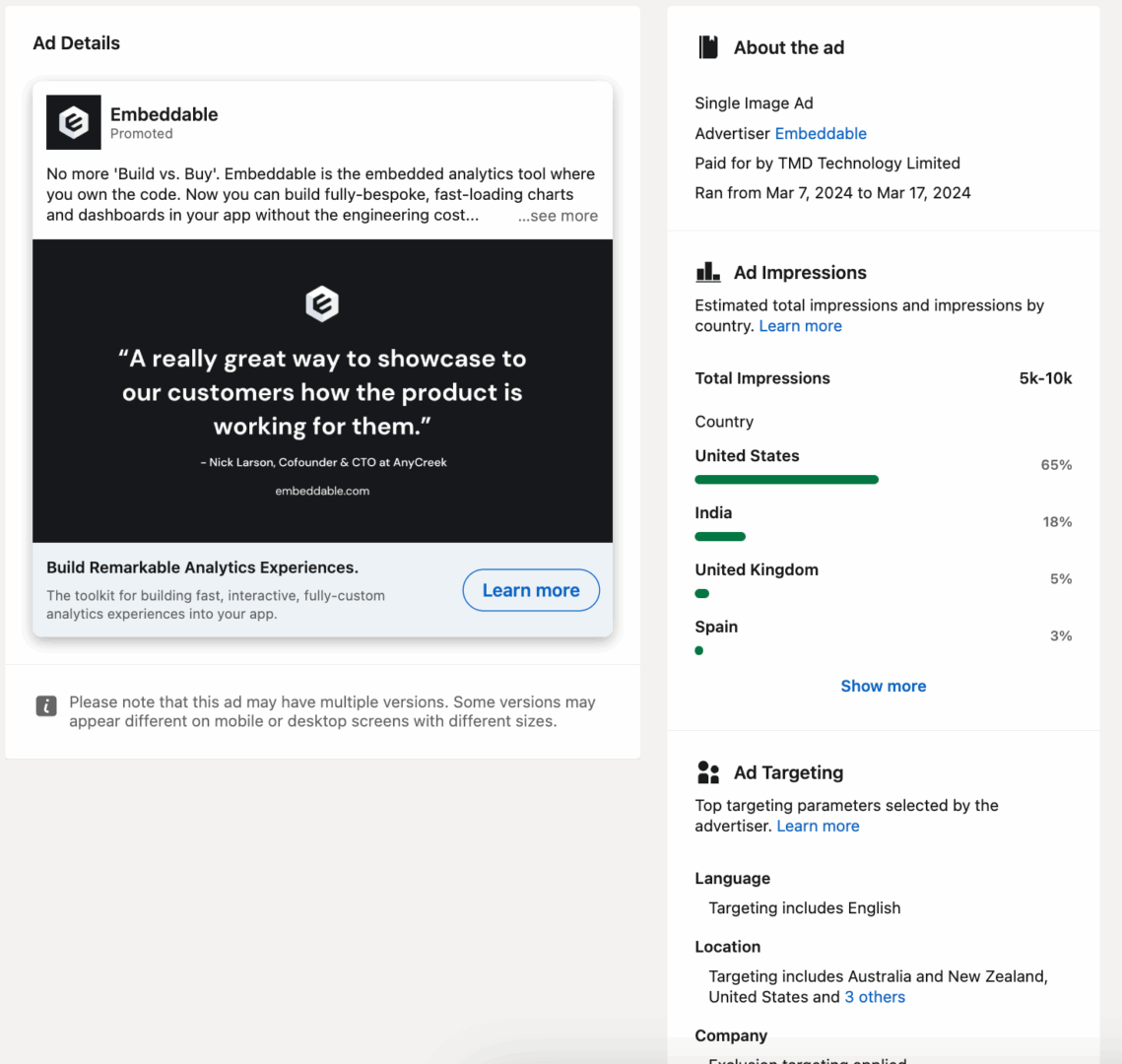
The CTA “Learn more” sends us to their main page.
The total number of impressions varies, with some ads getting 5-10k impressions, and others gather 100k-200k. The country they seem to target the most is the United States.
There is not much to analyze yet, because they are still growing. But as a first impression, they are doing a good job with the content.
Looking at Embeddable’s complete marketing ecosystem, we can see they’re taking a methodical approach to building their presence, even as a young company.
Inspiration points
- Meet the team: this section is very nice, and really, we could read it all. Here, each team member presents itself in a nice and original way, by answering different personal questions, like: “If you could be an instant pro in any sport, what would you pick?”
- Q&A: This is not the usual Q&A section you find on other websites. They have a dedicated page for that, which works like a central hub for users to find answers to their questions about their platform.
- Your success stories are powerful tools for building credibility and trust. Case studies should tell compelling narratives about real challenges you’ve helped solve. Share the journey, the overcome of the obstacles, and most importantly, the transformative results achieved. P.S. From our experience, they generate a lot of traffic. Do not neglect them, really!
- Your expertise is valuable, and sharing it through downloadable resources helps establish your authority while capturing leads. Think beyond basic whitepapers; consider creating comprehensive guides, in-depth research, or innovative tools that your audience will find genuinely useful in their work.
- Your online presence should tell a story. From your website content to social media engagement, each touchpoint should reflect your expertise and value proposition. Investment could be reached with the right audience, at the right time, with the right content.
- Focus on social selling. Your reputation in professional communities can be a powerful lead generator. Engage authentically in industry discussions, share your expertise generously, and build genuine relationships. When you focus on being helpful rather than promotional, leads often develop naturally through these connections.
- Understanding your lead generation performance doesn’t have to be complicated. Focus on meaningful metrics that tell you whether you’re building valuable relationships. Track how your audience engages with your content, which topics resonate most, and what kinds of interactions lead to the best client relationships.
You’ve seen how Embeddable is building their presence step by step, from their content strategy to community building and paid advertising. But implementing these strategies requires expertise, time, and resources. That’s where we come in. If you are ready to get to the next level, contact us today!
Frequently Asked Questions
1. What is Embeddable and what does it do?
Embeddable is a London-based software platform founded in 2023 that helps developers create custom analytics dashboards and data visualizations quickly. It enables seamless integration of data analysis features into applications, promising “lightning-fast embedded analytics.”
2. How does Embeddable differentiate itself from competitors?
Embeddable sets itself apart through speed, simplicity, and user experience. The company emphasizes its ability to help developers build analytics solutions in just 10% of the usual time. Its “Embedded Analytics Solution of the Year 2024” award from the Data Breakthrough Awards also strengthens its credibility in the analytics industry.
3. What is Embeddable’s social media and content marketing strategy?
Embeddable primarily uses LinkedIn to share company news, product launches, customer stories, and educational content. Despite being a small team, they post consistently and engage actively with comments. Their content pillars include partnerships, tutorials, customer testimonials, and company culture, helping build trust and visibility in the tech community.
4. How does Embeddable generate demand and leads?
Embeddable generates demand through educational blog content, customer success stories, and an active Slack community with over 500 members. They also use paid LinkedIn ads and call-to-actions like “Learn more” or “Subscribe to the blog” to guide prospects toward their main site and product pages.
5. What can startups learn from Embeddable’s approach to marketing?
Startups can learn the importance of building credibility early through transparency, consistent posting, and community engagement. Embeddable demonstrates that even small teams can create impact by balancing product development with educational content, leveraging social proof, and fostering authentic relationships with users.