TL;DR: Conclusions and Key Takeaways
🎀 This section gives you the main insights without all the details. It’s the stuff you need to remember, whether you’re reading this now or in 6 months. We made this for people who want to get the core message fast.
Clay is an AI-powered GTM platform that connects to 150+ data providers and lets sales, marketing, and RevOps teams build automated enrichment and outreach workflows. This article shows how they built a $5B company by inventing a job category, educating an entire market, and turning their community into their most powerful distribution channel.
Key Takeaways
- Name the category before your competitors do. They invented the “GTM Engineer” job title, built a university and community around it, and made their product the default tool for that role. Now the title appears in job postings at Cursor, Webflow, and Notion.
- Use education as a retention tool. Clay University offers structured beginner and intermediate courses, live cohorts with daily exercises, and use case templates. Users who complete courses understand the full product, build better workflows, and are far less likely to churn when they hit a rough patch. Research from Forrester shows companies with formalized education programs retain 7.4% more customers.
- Gate your community so its quality stays high enough to keep members coming back. Access to Clay’s Slack requires an active Clay account. That single requirement keeps the community full of users instead of lurkers, which keeps the signal-to-noise ratio high enough that senior GTM professionals show up. Research shows that communities increase customer retention by 40% and that 73% of users who engage weekly stay active for at least 12 months.
- Turn your Experts marketplace into a secondary sales force that never appears on your payroll. Clay runs a certified consultant directory (Clay Experts) and a talent marketplace (Talent Hub). Every agency or freelancer who builds a client’s workflow is installing the product into an account that the internal sales team never had to touch. That expert ecosystem spans 108 agencies worldwide and generates hundreds of millions in collective revenue.
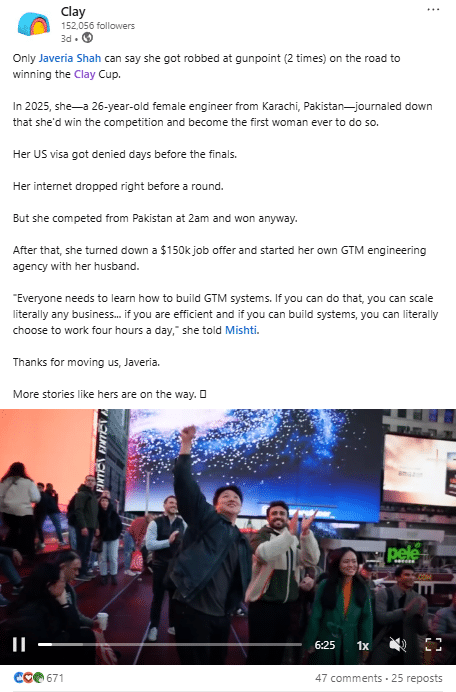
- Make your community members the stars of your content. Clay’s highest-performing LinkedIn post last month was the story of Javeria Shah, a Clay Cup winner, with 671 reactions and 47 comments. It outperformed every product update and category post in the same period. Featuring real people from your community, specifically users who’ve achieved something through your product, consistently drives more engagement than announcing what the product does.
- Run event-based paid ads instead of always-on awareness campaigns. Clay’s LinkedIn ads say “compete for $50k at Clay Cup 2026” and “join us Tuesday for a live workshop on [specific topic].” Each ad has a reason to exist and a clear next step. Event-based ads give warm audiences something to act on. Always-on awareness ads give warm audiences something to scroll past.
- Build your ecosystem before your pipeline needs it. Clay’s job board, talent hub, media property (thegtme.com), and in-person clubs across 60 cities in 30 countries were all built before the full enterprise sales motion was in place. By the time a large company’s buying committee evaluates Clay, most of those “hidden buyers” in finance, legal, and procurement have already encountered the GTM Engineer brand, attended a Clay event, or read Clay University content. The Edelman-LinkedIn B2B Thought Leadership report found that 95% of hidden buyers are more receptive to sales outreach when they’ve already engaged with a vendor’s thought leadership. Clay builds that touchpoint before the sales cycle even starts.
📝 A quick note before you start reading: The data and analysis in this article are valid as of the time we wrote it. We don’t know when you’ll be reading this, maybe next week, maybe six months from now, and things might have changed since we looked at this company’s marketing and sales approach. Still, the insights and lessons here stay useful, even if the numbers or tactics have evolved a bit.
If you’ve spent any time in B2B sales or marketing over the past couple of years, you’ve heard someone say “just use Clay for that”. It’s become the default answer to questions nobody knew how to phrase 5 years ago. **Clay** is the spreadsheet that grew up, got an AI education, and started doing things that used to require a team of five and three different SaaS subscriptions.
Here at Milk & Cookies Studio, we spend most of our time reverse-engineering how the best GTM companies grow, to understand the reasoning behind it, so the companies we work with build strategies grounded in evidence, not trend-chasing. Clay is one of the most interesting cases we’ve looked at in a while. Not primarily because of the product, but because of the world they’ve built around it.
The data and analysis here reflect what we found as of April 2026. Clay moves fast. Between the time we wrote this and the time you’re reading it, they’ve almost certainly launched something new, hired another hundred people, or added another few thousand members to their Slack. The principles underneath the tactics, though, hold regardless of when you’re reading this.
Understanding Clay
Clay was founded in 2017 by Kareem Amin and Nicolae Rusan, two McGill University graduates who had previously worked together at Microsoft and sold an earlier startup, Frame (an e-commerce tablet experience tool), to the marketing automation company Sailthru in 2012.
After the acquisition, both moved to Dow Jones. Amin served as VP of Product at The Wall Street Journal. They left in 2015 to brainstorm what would become Clay. The company launched in 2017.
Rusan stepped away from day-to-day operations in 2022 and remains on the board. Varun Anand joined as co-founder and Head of Operations in 2021, and the company found its current product-market fit shortly after, pivoting from a general workflow tool to what it is today: a GTM data and automation platform.
Clay is headquartered in New York, with offices in Chelsea and a registered address originally in Brooklyn. As of early 2026, the company has around 1.2k employees across New York, San Francisco, and London.
The funding story moves fast. Clay raised a $100M Series C in August 2025, led by CapitalG, Alphabet’s independent growth fund, at a $3.1B post-money valuation. That round brought total external funding to $204M. Participating investors included Sequoia Capital, Meritech Capital, First Round Capital, BoxGroup, Boldstart, and new investor Sapphire Ventures.
Then, in January 2026, Clay ran a second employee tender offer that valued the company at $5B. That’s a 60% jump in implied valuation in under 6 months, with no new external round involved. Revenue hit $100M in December 2025, roughly tripling year-over-year. The company had around 5k customers in January 2025. By August 2025, they had 10k.
The product-market fit that unlocked that growth came from a single decision: stop building a horizontal tool and go deep on one use case that people actually needed. Everything after that, the funding, the valuation, the community, the ecosystem, was a consequence of that choice.
Steal This: When your company crosses a meaningful revenue milestone, announce it with context. Share the founding story, the pivot, the moment product-market fit clicked. Milestones with narrative generate press, signal growth to enterprise buyers, and create recruiting content that costs you nothing to distribute.
Brand Promise Analysis
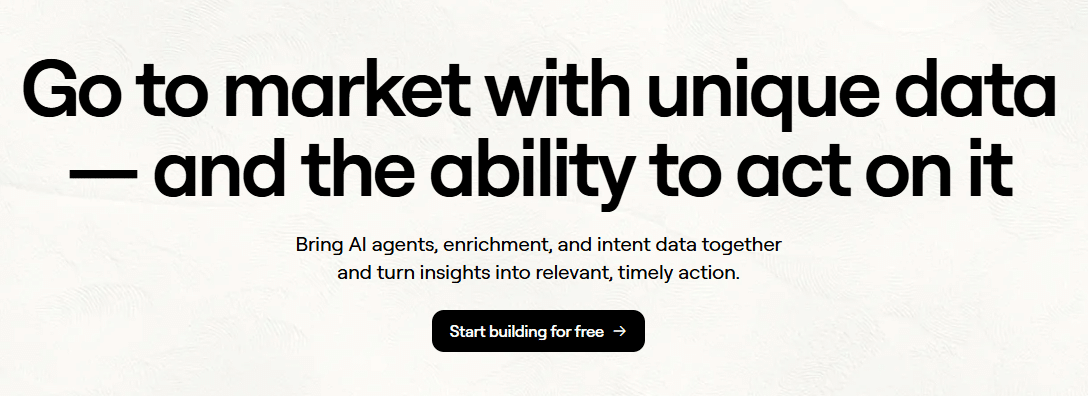
Clay’s homepage opens with: “Go to market with unique data, and the ability to act on it. Bring AI agents, enrichment, and intent data together and turn insights into relevant, timely action”.
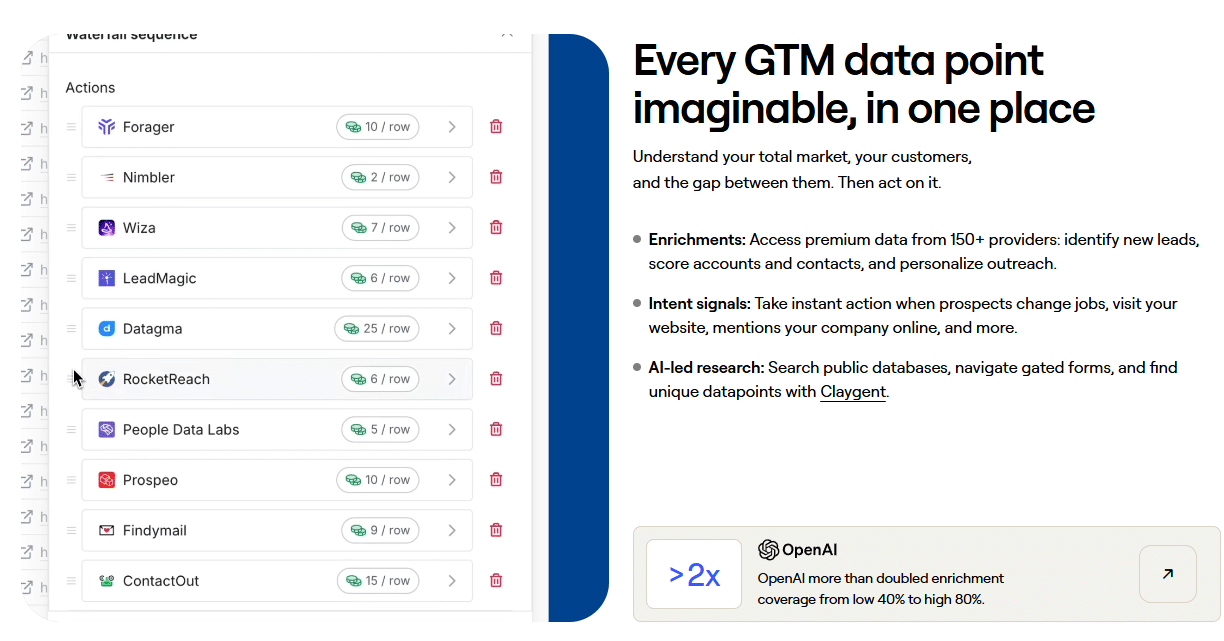
Two parts, deliberately constructed. “Unique data” addresses the problem that most GTM teams are fishing from the same ponds. Apollo, ZoomInfo, and Lusha pull from overlapping sources. Clay’s pitch is that their waterfall model across 150+ providers gives you coverage no single-source tool can match.
“The ability to act on it” addresses the second frustration: even when you have good data, moving it from insight to action is still a duct-tape process involving multiple tools, spreadsheets, and a lot of manual work.
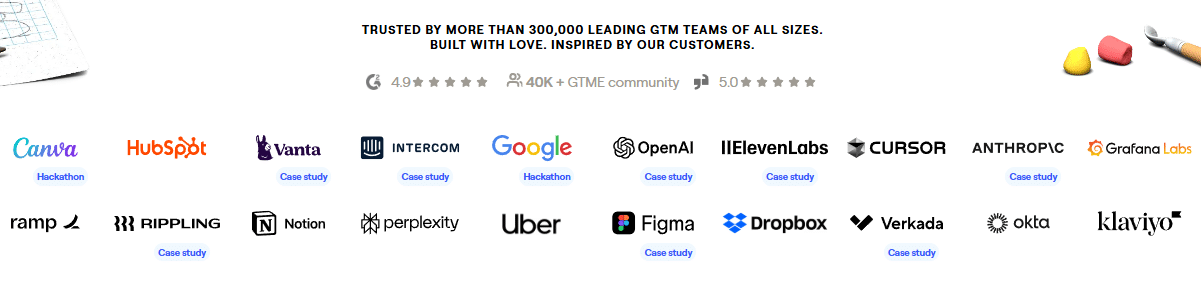
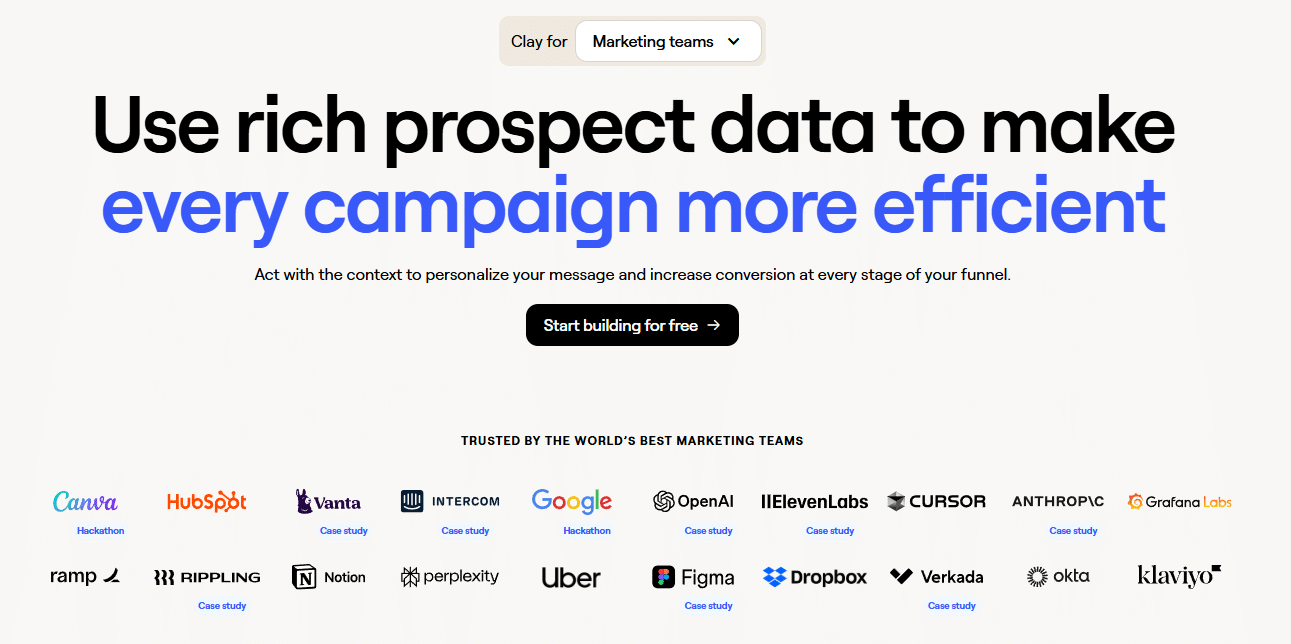
The homepage then backs that promise with named client logos: Canva, HubSpot, Google, Notion, Perplexity, Uber, and Figma. Several of them link directly to case studies or hackathon writeups. This upgrades the standard logo wall from a passive credibility signal into an active conversion tool. A buyer who clicks an Intercom logo and reads a detailed outcome story is significantly more convinced than one who saw the logo and moved on.
The named client logos with clickable case studies are a subtle ABM move on the homepage. Enterprise buyers recognize peer company names and respond to evidence from organizations they respect. Seeing that OpenAI, Anthropic, and Intercom all use Clay tells a procurement manager more than any feature comparison table.
The stats below the logos do the same work with more precision. OpenAI doubled enrichment coverage from the low 40% to the high 80%. Anthropic tripled data coverage on contact information and firmographics. Coverflex automated monitoring of buying signals from 3M+ companies to prioritize outreach. These are specific, named, and attributed claims to real people at real companies with real titles.
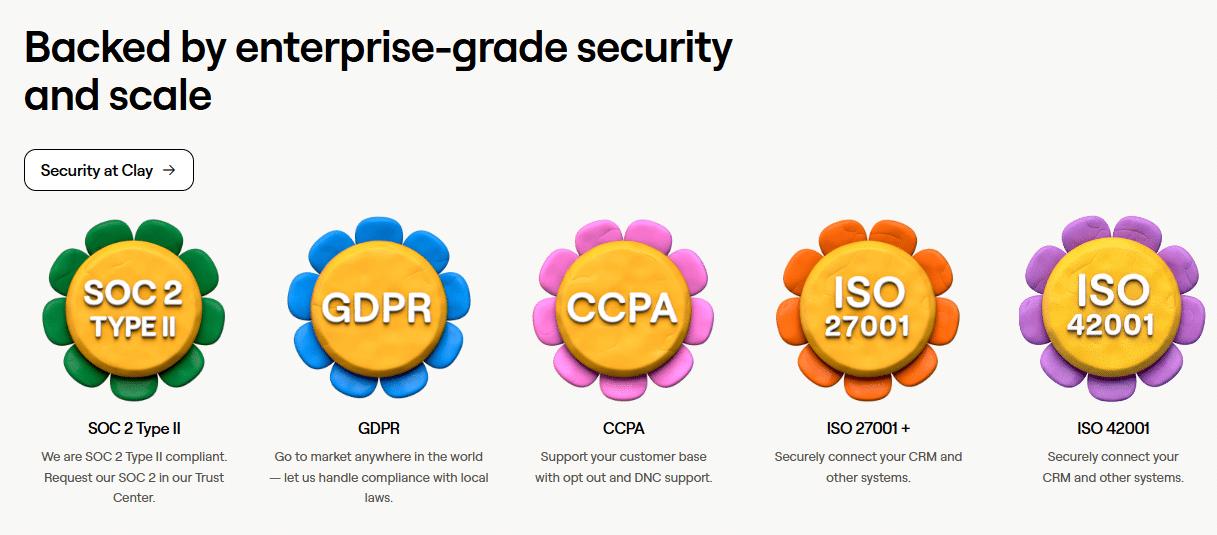
The security section at the bottom of the homepage (SOC 2 Type II, GDPR, CCPA, ISO 27001+, and ISO 42001) rounds out the enterprise trust signal. Compliance certifications are a buying requirement in enterprise deals. But their clean, confident presentation says “we’ve handled this” in a way that removes a blocker rather than selling a feature.
In positioning terms, Clay is running what April Dunford describes in “Obviously Awesome” as enemy-based positioning. The enemy is not Apollo or ZoomInfo by name, but the fragmented data and disconnected workflows. This framing lets Clay argue against a problem rather than a competitor, which is both more defensible and more scalable as a message.
Steal This: Lead your homepage with a two-part promise that addresses both the data problem and the action problem your product solves. “Here’s what you’ll know” plus “here’s what you’ll do with it” converts better than a feature list or a tagline built around outcomes alone. Then back every claim with a named company and a specific metric.
Service and Product Breakdown
Clay’s product surface area is wide. The core platform sits at the center, but the features around it now cover the full GTM workflow from data sourcing to email delivery.
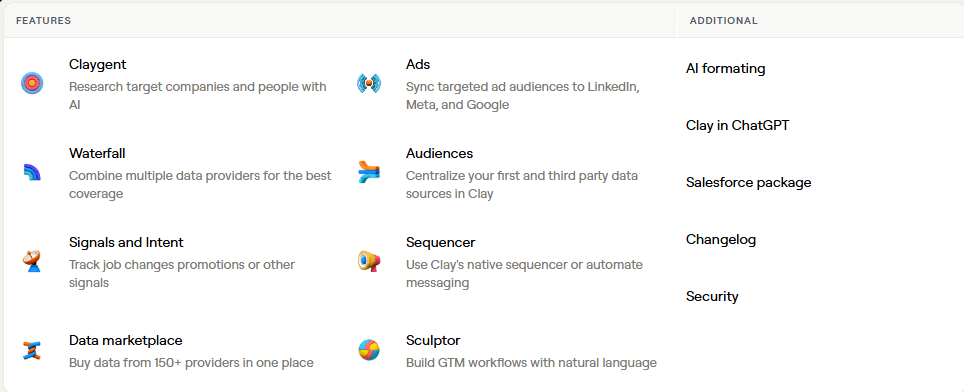
The main products are:
- Claygent (AI research agent), Sculptor (natural language workflow builder)
- Signals (intent data tracking for job changes, news, social mentions, website visits)
- Audiences (segment building that combines CRM data, enrichment, and signals)
- Sequencer (native email outreach), and the foundational data marketplace with 150+ provider integrations.
Additional features include Clay in ChatGPT (a native integration that lets users run Clay workflows directly inside ChatGPT), an AI formula generator, and a Salesforce package for enterprise CRM users. Each of these would have been a standalone product at a smaller company, but Clay has bundled them into a single platform.
For sales teams, Clay also lists Exportly, a Chrome extension partner that lets reps enrich contacts with Clay and sync prospects to their CRM from anywhere on the web. It’s a lightweight way to bring Clay’s data layer into a rep’s daily workflow without requiring a full platform context switch.
Solutions are organized by team (GTM Ops and RevOps, Marketing, and Sales) and by company type (Enterprise and Startups). The Enterprise page emphasizes multi-source enrichment, data pipelines without engineering overhead, and the elimination of months-long procurement cycles. The Startups page emphasizes speed and flexibility, the ability to test ICP hypotheses and iterate without adding headcount.
Pricing runs four tiers: Free, Launch at $167/mo, Growth at $446/mo, and Custom for enterprise. Annual plans save 10%, and you get a 14-day Pro trial that requires no credit card.
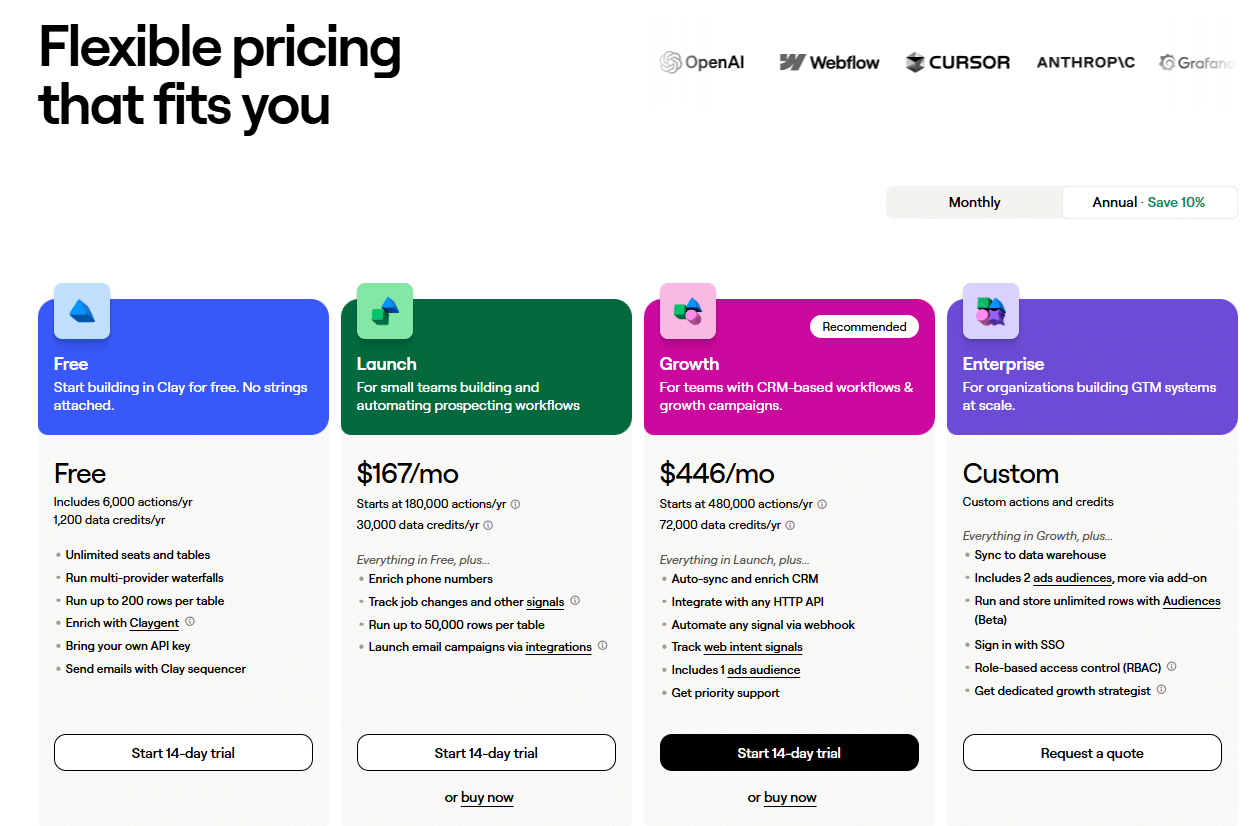
This is a textbook product-led growth structure as Wes Bush describes in “Product-Led Growth”: use the product itself as the primary acquisition and conversion channel, then layer a sales motion on top for larger accounts. The free tier and trial create a self-serve entry ramp. The custom enterprise plan creates an upmarket path with no friction point to discover before a buyer has already seen value inside the product.
One thing worth noting: social proof is not evenly distributed across the product surface. The homepage carries detailed, named testimonials from senior leaders at Vanta, Intercom, Anthropic, Rippling, and Ramp. Some individual product feature pages don’t carry the same weight of named client evidence. A buyer who lands on the Sequencer page without first visiting the homepage will have a different trust experience than one who follows the intended journey.
Who is Clay actually built for? The clearest answer from the product surface is B2B companies with a dedicated sales, marketing, or RevOps function that are running outbound or enrichment at scale, typically Series A and beyond.
The free tier and startup page exist, but the weight of the product, the waterfall enrichment, the enterprise data pipelines, the Salesforce package, and the multi-provider coverage points toward teams that already know they have a data problem and are ready to solve it systematically. A solo founder doing 50 cold emails a week will find Clay interesting. A RevOps team managing 10k contacts across five tools will find it essential.
Steal This: If you’re running a PLG motion and also targeting enterprise, build two distinct trust journeys. The self-serve buyer needs to feel that the first value moment is close and setup is fast. The enterprise buyer needs to feel that compliance is handled and the vendor is stable. One product, two different sets of signals, and two different conversion paths on the same site.
Differentiators and Unique Assets
Before going through each differentiator individually, it’s worth naming what connects all of them. Clay didn’t build a product and then add marketing around it. They built a profession, and the product is what you use to practice it.
The GTM Engineer role, the University that trains it, the community that connects its practitioners, the job board that employs them, and the expert marketplace that deploys them commercially, they’re a single ecosystem built around a job title Clay invented. That’s the most defensible moat in the list. Features get copied. Professions don’t.
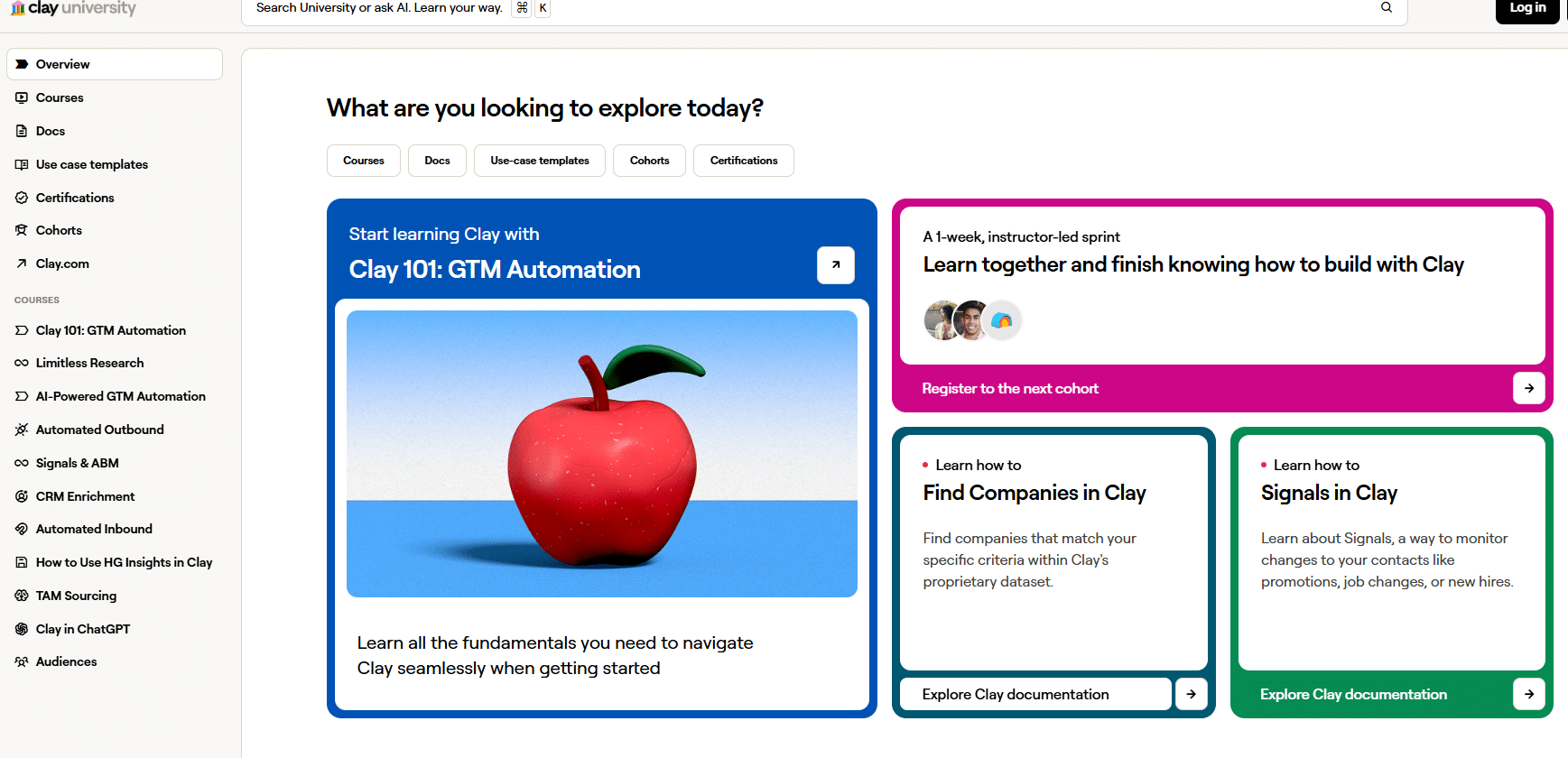
Clay University is a full learning platform with courses organized by skill level, cohorts, Claybooks (use case templates), and documentation.
Beginner courses cover Clay 101, Automated Outbound, Clay in ChatGPT, and Audiences. Intermediate courses cover Limitless Research, AI-powered GTM Automation, Signals and ABM, CRM Enrichment, Automated Inbound, How to Use HG Insights in Clay, and TAM Sourcing.
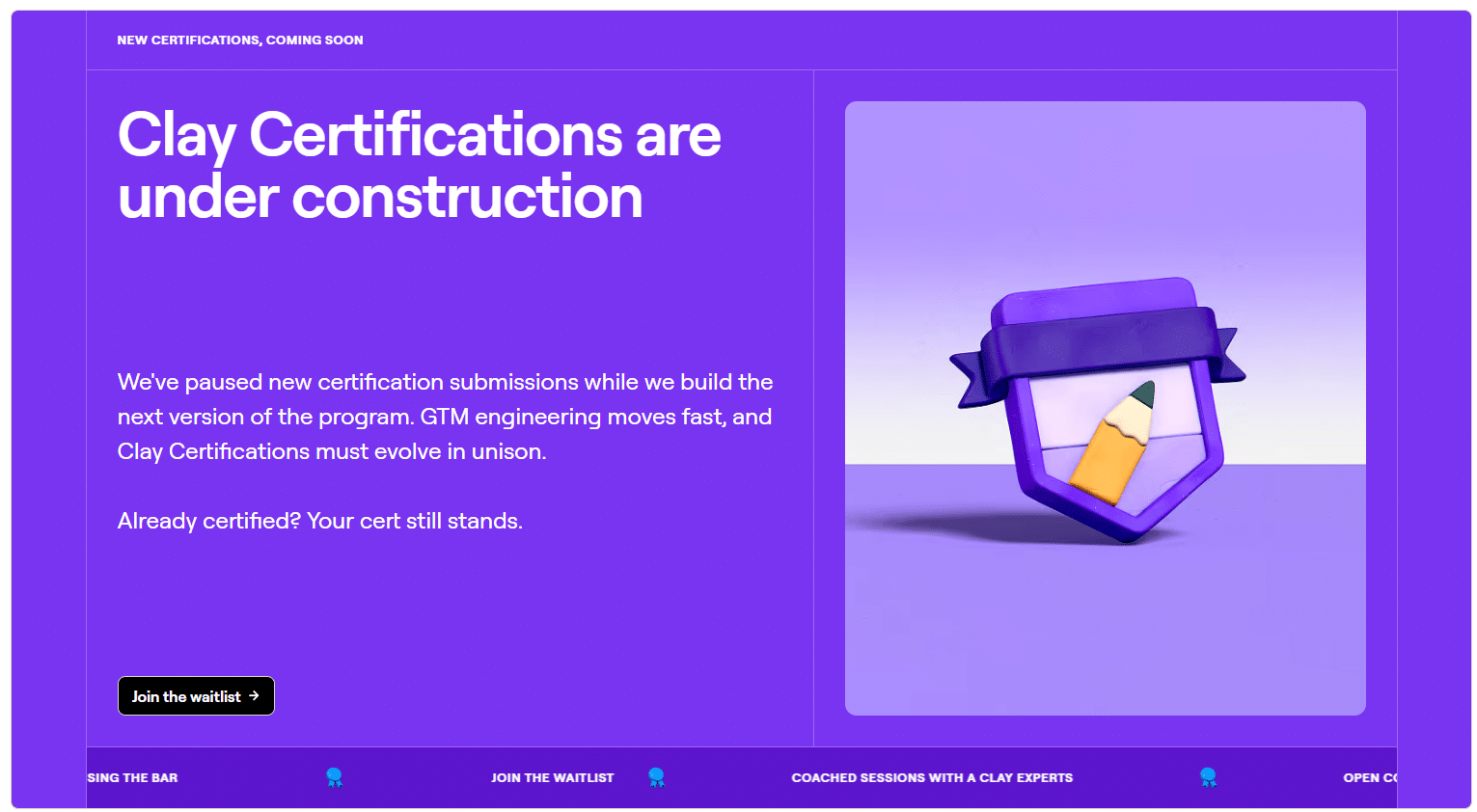
Certifications are currently paused, with new ones expected soon. Cohorts are live training programs with daily hands-on exercises and direct Clay team support through a private Slack channel.
The distinction between a help center and a curriculum matters a lot for retention. A help center solves problems after they occur. A curriculum shapes how users think about the tool before they run into problems. Users who work through structured courses understand the full value surface of the product, build better workflows, and get results faster.
They’re less likely to churn when they hit a friction point, because they know what’s on the other side of the learning curve. Clay University is probably worth more in net revenue retention than any loyalty program Clay could run.
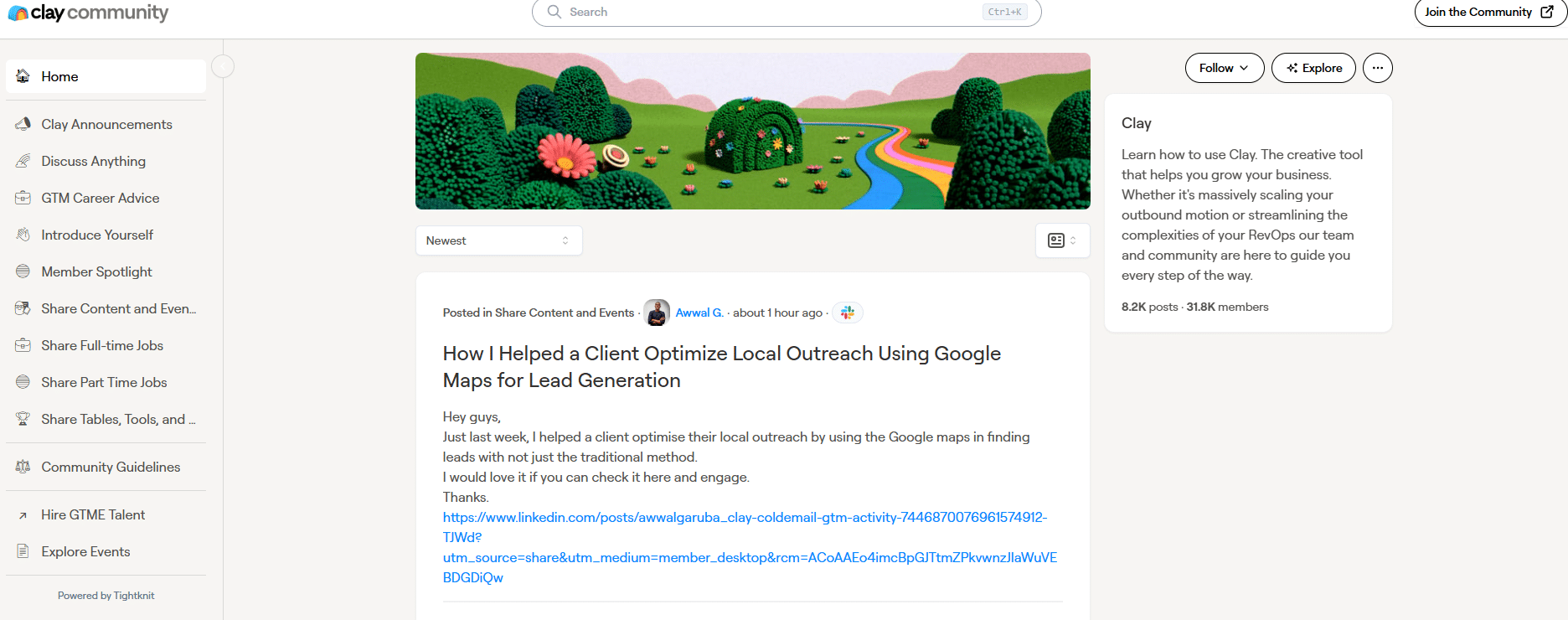
Clay Community is a forum with discussions, GTM career advice, member spotlights, job listings, and general conversation. To join the Slack channel, members need a valid Clay account.
What you need to understand is that free, open communities dilute quickly. The signal-to-noise ratio drops, valuable members disengage, and the community stops being a reason to stay subscribed.
Jono Bacon’s work on community architecture in “The Art of Community” argues that the value of a professional community is inversely related to the ease of entry. By tying Slack access to an active Clay account, the community becomes a retention feature and a quality filter simultaneously.
The exact member count is not publicly confirmed, but third-party observers reported close to 22k members in mid-2025, and the community has continued to grow since. Whatever the current number, it’s a professional network built entirely around a single product category, and the gating mechanism (active Clay account required) keeps it that way.
Claygent is Clay’s AI research agent. It visits domains, finds information, interacts with websites (applying filters, filling forms, clicking buttons), and returns structured data. You build, version, and test Claygents in a builder without spending credits, then connect them to MCP servers from tools like Salesforce, Gong, or Google Docs for deeper business context. The “iterate without spending credits” detail is a smart friction-removal feature. It lowers the cost of experimentation for new users and encourages building before committing.
Sculptor is the natural language workflow builder. You describe what you want, and Sculptor translates it into a Clay workflow. Before Sculptor, Clay was a tool for RevOps specialists. Sculptor expands the ICP without requiring a product rebuild, which is one of the cleaner product decisions in the GTM software space in recent memory.
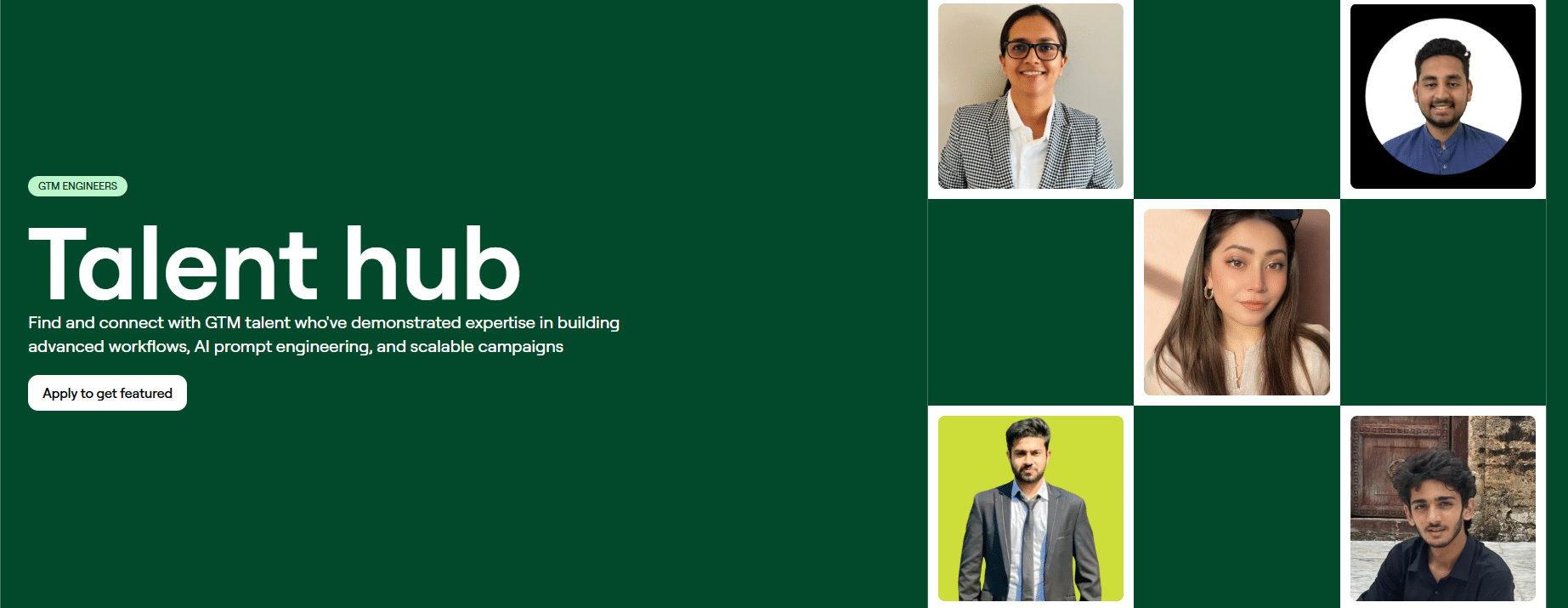
The Talent Hub is a marketplace where you find and hire GTM professionals with demonstrated Clay expertise, filterable by skills, work preferences, and location. The Job Board lists open roles at companies seeking Clay skills across sales, marketing, RevOps, and growth. These two assets together turn skilled Clay users into a distribution network. Every expert placed at a new company is a new Clay installation that their own sales team never had to close.
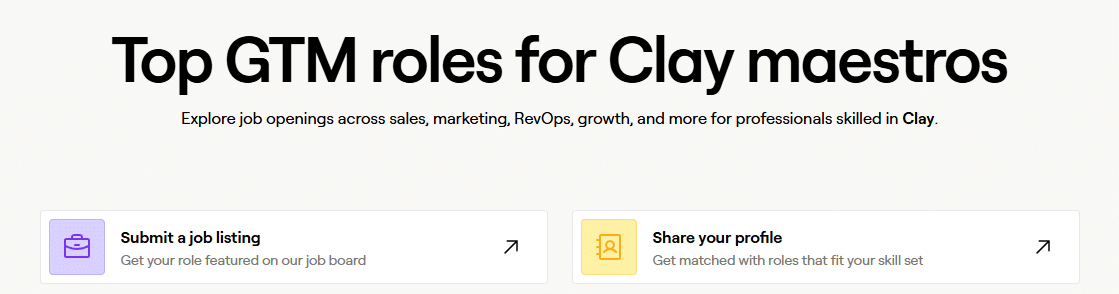
The GTM Engineer brand is the most ambitious differentiator here. Clay runs thegtme.com as a separate media property, maintains a dedicated GTME job board, a talent marketplace, and in-person Clay Clubs across 60 cities in 30 countries, , with new cities added as the community grows.
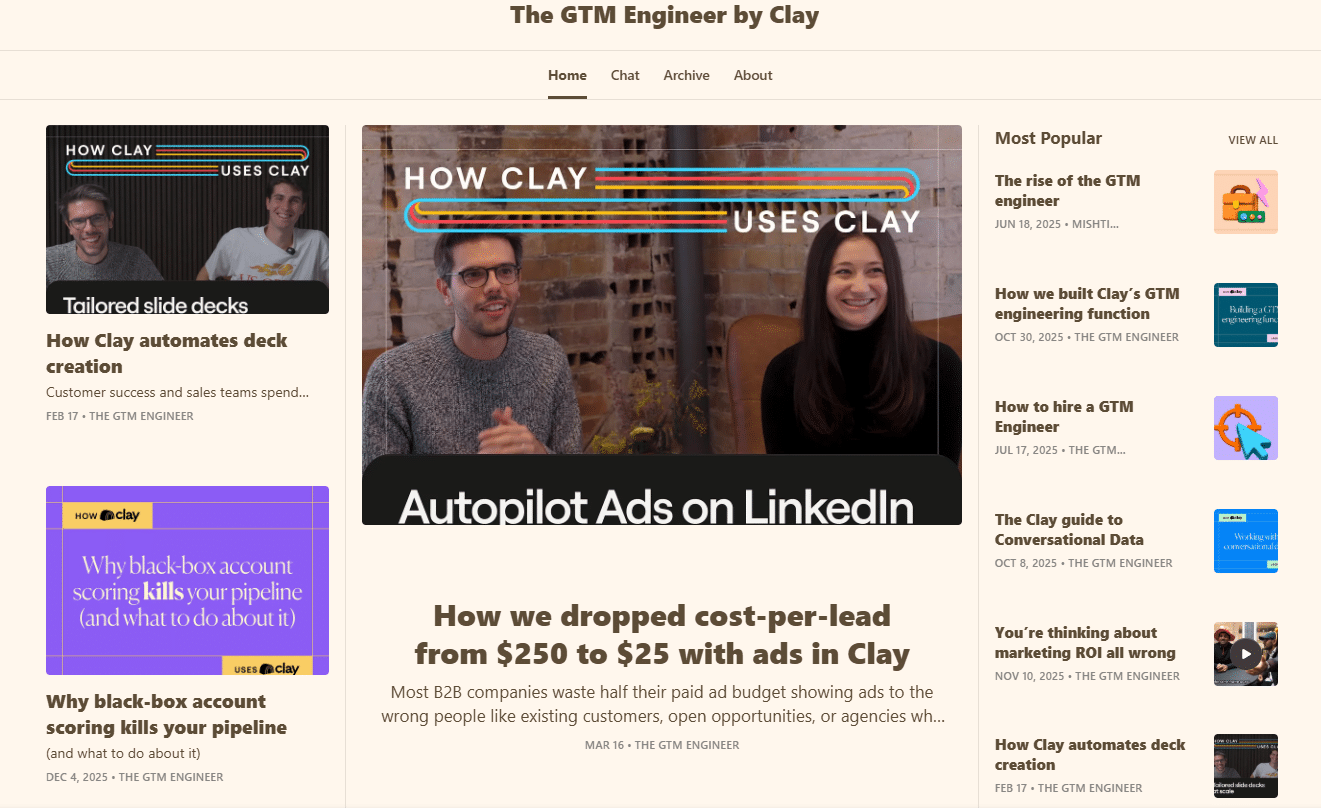
They have, in effect, invented and named a new job category. Christopher Lochhead’s “Play Bigger” makes the case that category creators, not product leaders, capture the majority of the economics in any market.
Clay named the GTM Engineer role, built the community and curriculum for it, and now the job title appears in hiring posts at Cursor, Webflow, Notion, and Lovable. That’s category ownership at a scale most companies never achieve.
Free tools on their website create SEO-driven top-of-funnel traffic and give people a reason to visit the domain without a commercial intent. Each tool is a product experience before a user signs up.
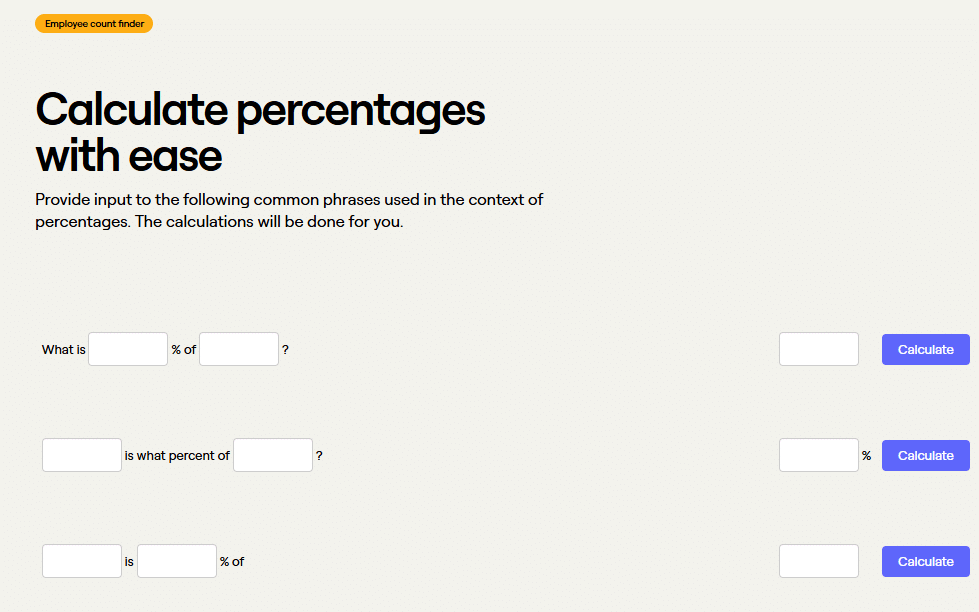
Here is the list of Clay’s free tools:
- Headcount Finder: Look up how many employees any company has. Useful for qualifying prospects before outreach, filtering your TAM by company size, or checking whether an account has grown since you last touched it.
- Percentage Calculator: Calculate any percentage instantly. Handy for quick GTM math like conversion rate changes, list size ratios, or engagement rate comparisons without opening a spreadsheet.
- Growth Rate Calculator: Calculate the growth rate between any two values over any time period. Useful for tracking revenue growth, headcount expansion, or any metric where you need to show momentum clearly.
- Conversion Rate Calculator: Calculate the conversion rate between any two stages of your funnel. Useful for benchmarking campaign performance, measuring trial-to-paid rates, or building a case for where your funnel is leaking.
- Margin Calculator: Calculate gross margin, markup, and profit from any combination of cost and revenue inputs. Useful for pricing decisions, partnership proposals, or quickly checking unit economics without a financial model.
- CPM Calculator: Calculate the cost per thousand impressions for any paid campaign. Useful for comparing ad spend efficiency across platforms or quickly estimating what a given budget will buy in terms of reach.
- WHOIS Domain Lookup: Look up the registration information for any domain, including owner details, registrar, and creation date. Useful for prospecting, verifying a company’s web presence, or researching a domain before reaching out.
The Experts marketplace is a platform ecosystem move with ABM implications. By building a certified consultant network, Clay creates a secondary sales force that operates inside accounts that Clay’s own team would never reach through direct outreach. Every consulting engagement is a warm installation into a new company. This is ABM at the ecosystem level: let trusted third parties carry the message into target accounts.
Steal This: Build the job description before you finalize the feature set. If your product enables a genuinely new way of working, name it, write about it, create a community around it, and build a job board for it. By the time a competitor copies your features, you own the category in the minds of hiring managers, candidates, and the companies looking to staff up on this new way of working.
Leadership Presence Analysis
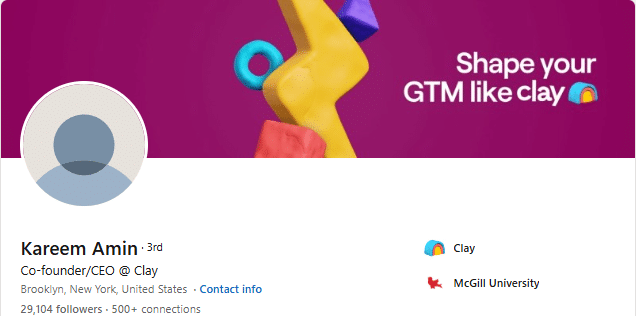
Kareem Amin, CEO and Co-founder of Clay, has 29k LinkedIn followers and posts roughly once a week. Every post tags Clay. Engagement ranges from around 300 reactions on quieter posts to over 2.5k reactions, 200 comments, and 100 reposts at the top end. That ceiling is strong for a B2B founder account of this size.
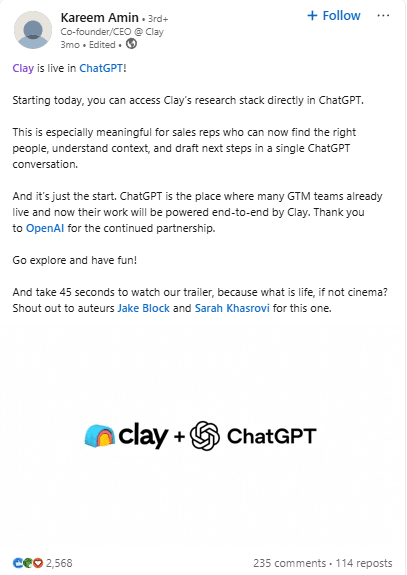
The consistency of the Clay tag is building his personal credibility in direct service of the brand. This creates a compounding effect: his audience growth translates into brand awareness among people who trust a founder’s voice more than a company page. The personal account and the company account reinforce each other rather than compete.
Bruno Estrella, Head of Marketing
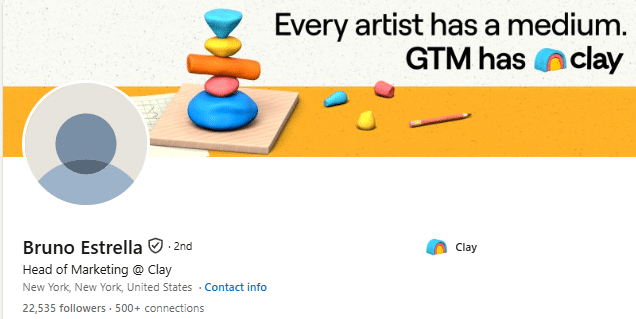
Bruno Estrella, Head of Marketing at Clay, has 22.5k LinkedIn followers. He reposts frequently and creates original content selectively. His original posts generate around 600 reactions, 75 comments, and 6 reposts. All content, original and reposts, stays in the Clay orbit. His LinkedIn functions as an extension of the company’s content strategy rather than a separate thought leadership channel.
The combined leadership presence is lean but tightly aligned. Every post from every leader points toward the same product, community, and category.
Steal This: Align your executive LinkedIn content pillars with your company content pillars before you optimize for individual reach. A founder with 20k followers posting consistently on-brand outperforms a founder with 200k followers posting randomly. Audience size matters less than message coherence when you’re building a brand in a specific professional market.
Social Media Strategy
Clay has a lean social presence with very different levels of investment across platforms.
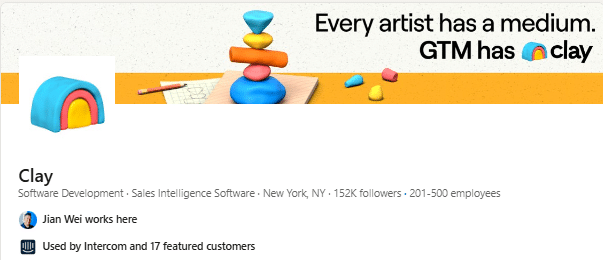
On LinkedIn, Clay has 152k followers, and it’s their primary channel. They post multiple times per week with a mix of images and video. Average engagement runs between 80 and 135 reactions per post for content published in the last week.
Content pillars include:
- event participation
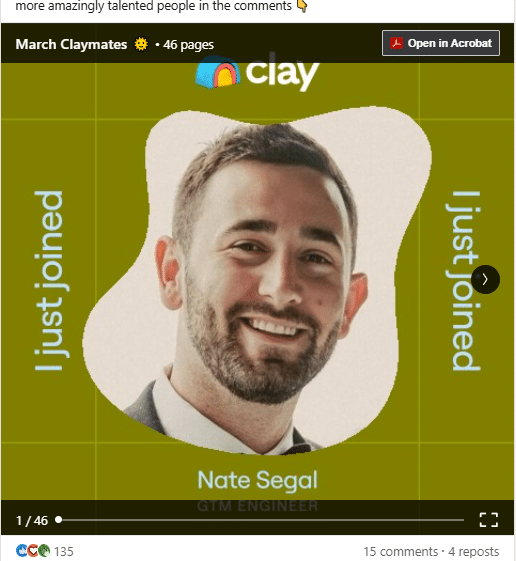
- new employee welcome posts
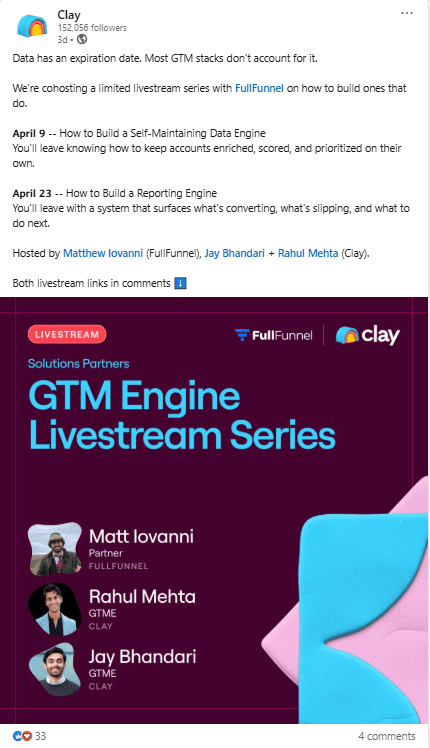
- Livestream series announcements
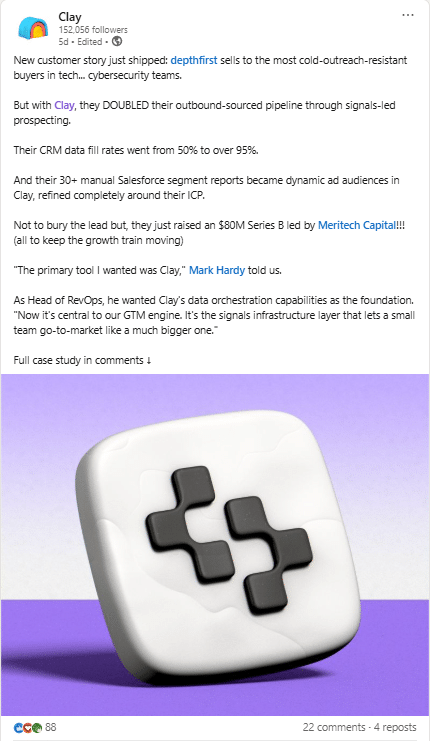
- customer stories
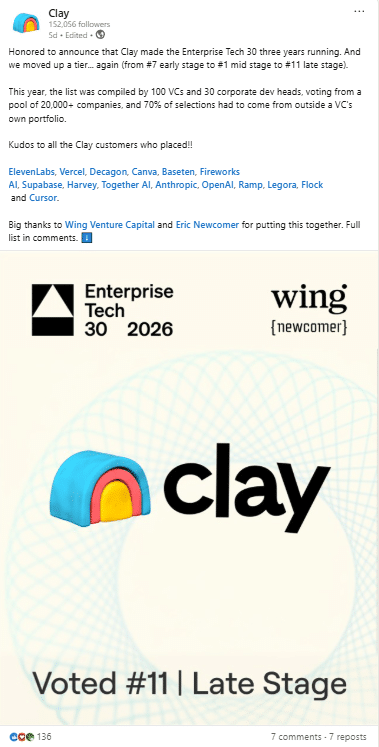
- award announcements
- product updates
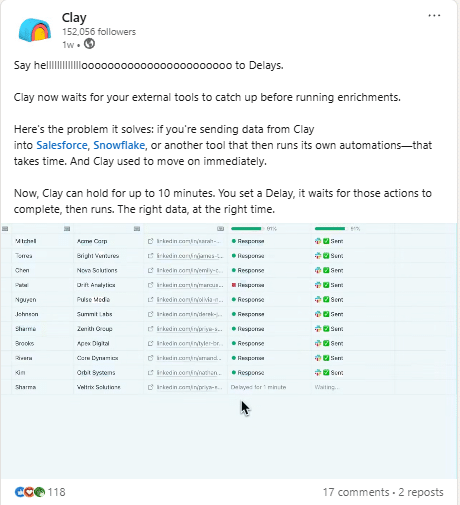
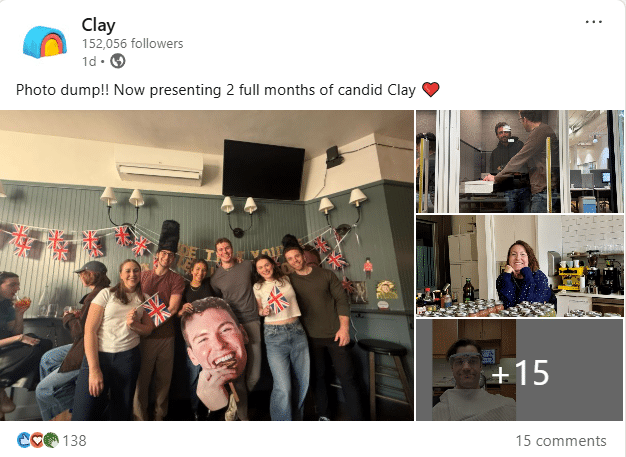
The employee welcome posts deserve a specific mention. Each one simultaneously signals company growth to prospects and investors, celebrates the new hire publicly, and creates organic recruiting content for anyone watching the page. One post, three audiences, zero additional budget.
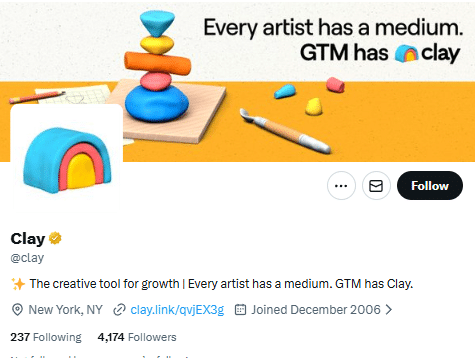
Clay has 4.1k followers and 192 posts on X (formerly Twitter). Recent posts generate almost no engagement. Average post performance runs at roughly 1 repost, 1 share, and 1 comment. Content appears to be crossposted from LinkedIn. X is not a meaningful channel for Clay at this stage and is not mapped to any meaningful funnel role.
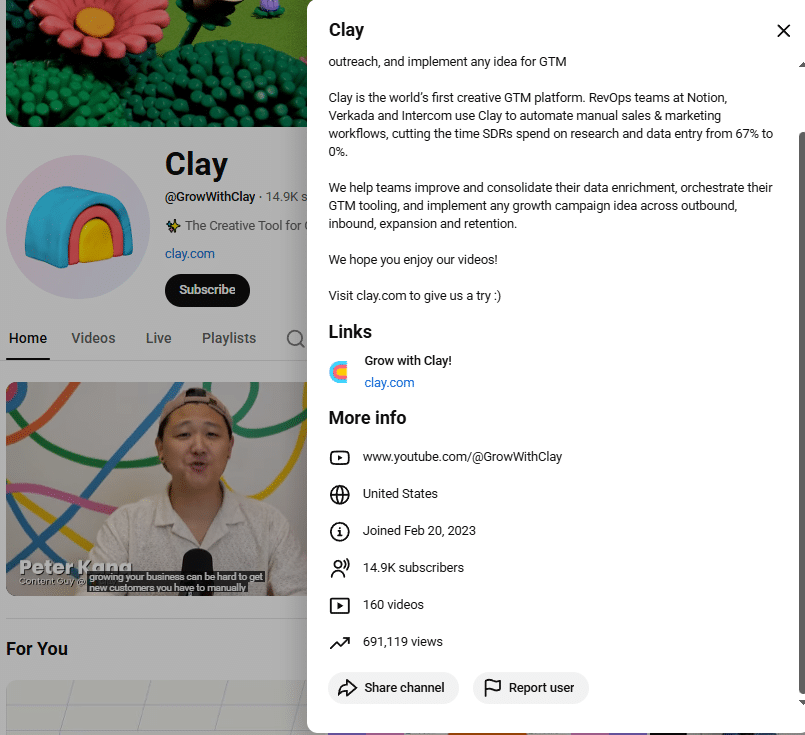
YouTube (14.9k subscribers, 691.1k total views, 160 videos) is technically Clay’s highest-reach content library.
The channel has playlists organized by topic:
- Clay 101
- CRM Enrichment
- GTM AI Hackathons
- Clay Tutorials
- Sculpt 2025
- How to Use HG Insights in Clay
- How to Sell Clay
- Clay Plays
- Using Clay for Your Company
- Clay Success Stories
- Coolest Clay Use Cases
- New to Clay?
They also have a Live playlist with 3 streamed videos. But the channel appears to be dormant. The most recent video was posted 5 months ago. Most others are from 11 months or more back. Clay is not publishing Shorts.
A channel with nearly 15k subscribers and 691k accumulated views is sitting idle while the category they invented gets more competitive. YouTube search traffic for GTM, outbound, and enrichment topics is a high-intent acquisition channel. Clay was clearly winning it at some point, but they are not actively defending it now.
LinkedIn is the only active social channel doing real GTM work right now. The content mix, event promotion, and customer story cadence align with an account-based awareness strategy: staying consistently visible to the GTM community through formats and voices that build familiarity over time. YouTube’s dormancy is a missed mid-funnel opportunity for buyers who already know what they’re looking for and search for it.
Steal This: Pick one social channel and go deep before spreading across multiple platforms. A strong presence on one platform where your ICP actually lives beats a weak presence on three. For B2B GTM teams, LinkedIn is almost always that platform.
Top-Performing Content
LinkedIn (last month)
- the story of Javeria Shah, winner of the Clay Cup, with 671 reactions, 47 comments, and 25 reposts.
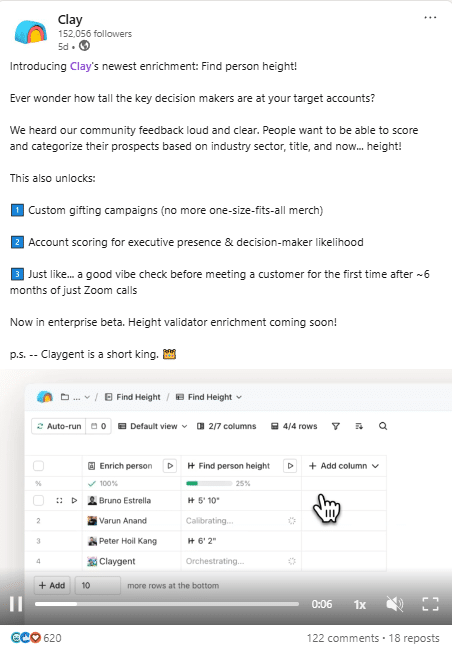
2. Find person height, the new Clay feature (April Fools prank), with 620 reactions, 122 comments, and 18 reposts.
The State of GTM Engineering post with 376 reactions, 30 comments, and 11 reposts.
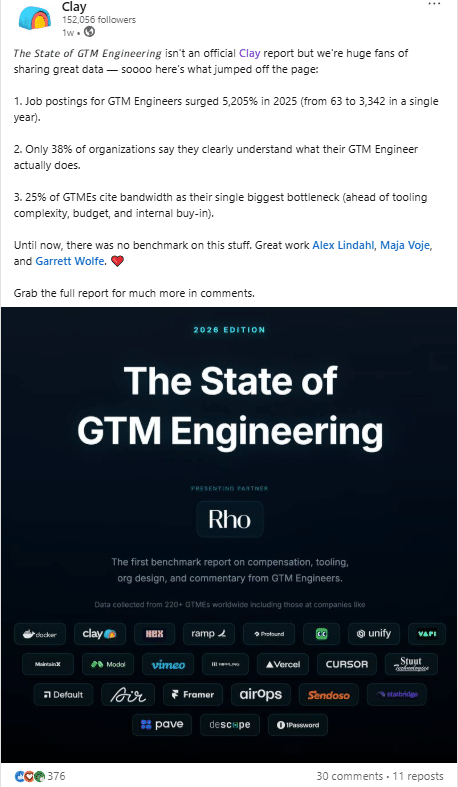
The pattern is simple. A human story about a community member winning a competition outperformed a category-level thought leadership post by a wide margin. This is consistent with what the HubSpot 2026 State of Marketing Report identifies as the dominant content direction for B2B brands: audiences reward content that feels human and specific over content that feels like brand output.
Javeria Shah’s story is both. It celebrates a real person, signals that Clay’s community has enough gravity to run competitions worth winning, and shows what the product enables for practitioners, all in one post. That combination is harder to replicate than a well-written industry take.
Youtube
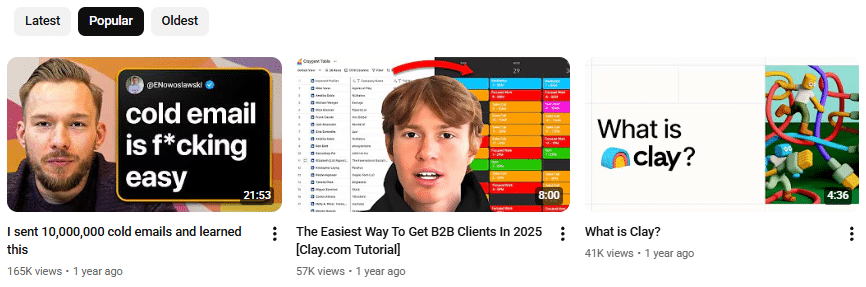
Their top videos all time are:
- I sent 10,000,000 cold emails and learned this (20-minute video, with 165k views, 4.7k likes, and 224 comments)
- The Easiest Way To Get B2B Clients In 2025 [Clay.com Tutorial] (8-minute video, with 57k views, 941 likes, 32 comments)
- What is Clay? (4-minute video, with 41k views, 399 likes, and 9 comments)
The top video’s title is a masterclass in search-optimized content. A number in the title is an implied lesson, and a direct appeal to the anxiety of anyone running cold email at scale. The tutorial format in second place confirms that instructional content with Clay in the title drives qualified traffic from people who already know they want to learn the tool.
Paid Advertising Strategy
Clay’s paid advertising is concentrated on Google Search and YouTube, with a focused LinkedIn presence and no Meta, Google Play, or Maps presence.
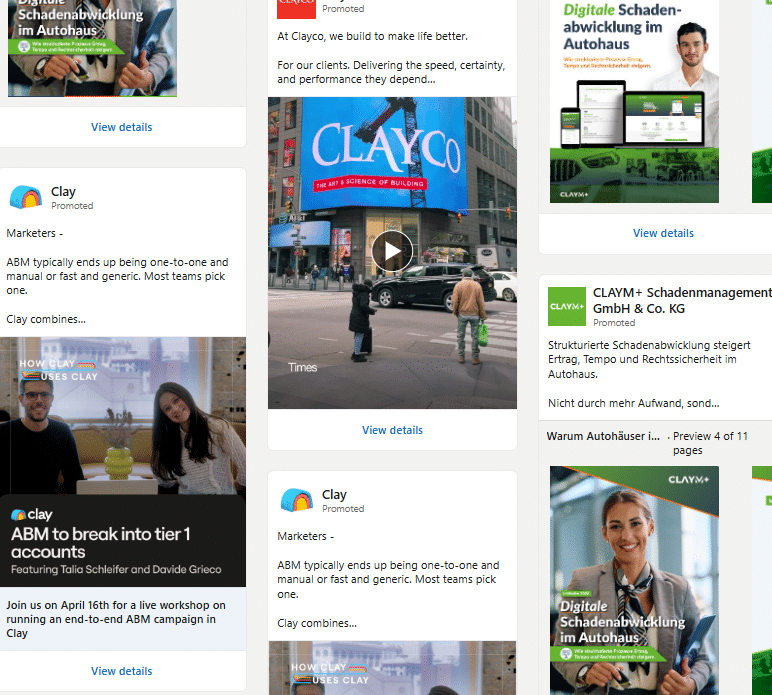
LinkedIn ads are event-driven and specific. They promote live workshops with “Join us [day] for a live workshop on [subject]” and Clay Cup 2026 (“Compete for $50k at Clay Cup 2026”), both using a Learn More CTA.
This is a structured touchpoint designed to move warm prospects into a high-engagement event format. You don’t promote a $50k competition to a cold audience. You promote it to people who already know your name.
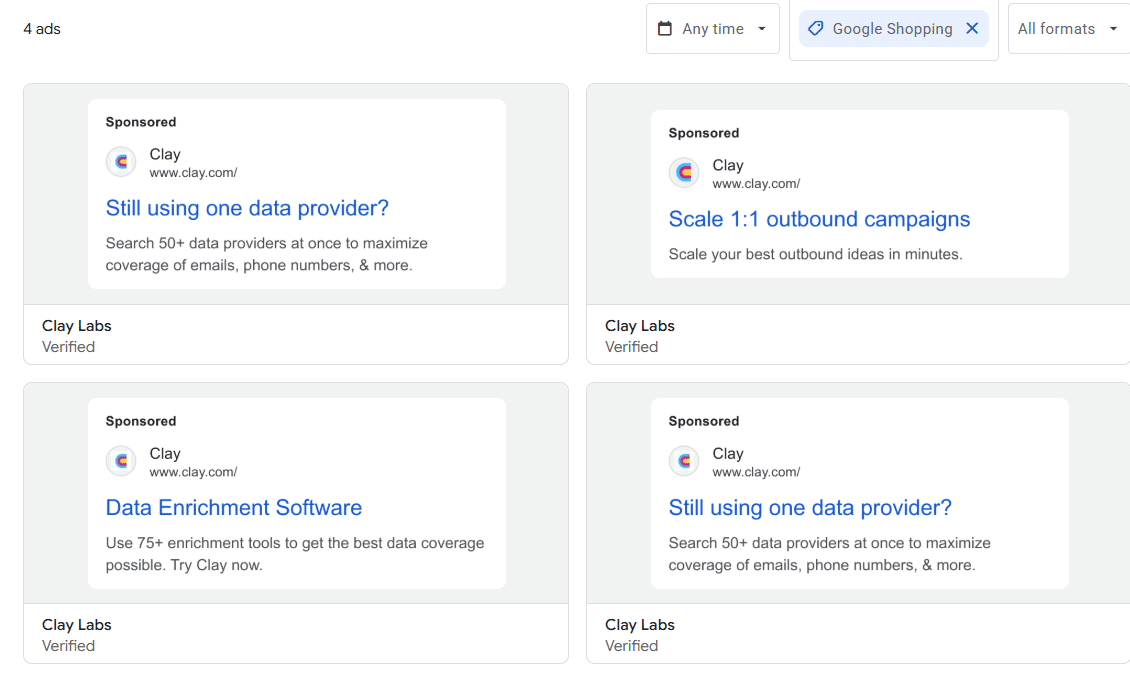
Google Shopping runs 4 ads with headlines including “Still using one data provider?”, “Scale 1:1 outbound campaigns”, and “Data Enrichment Software.” The “Still using one data provider?” framing is a direct challenge to the status quo, which aligns precisely with Clay’s core positioning against fragmented data stacks.
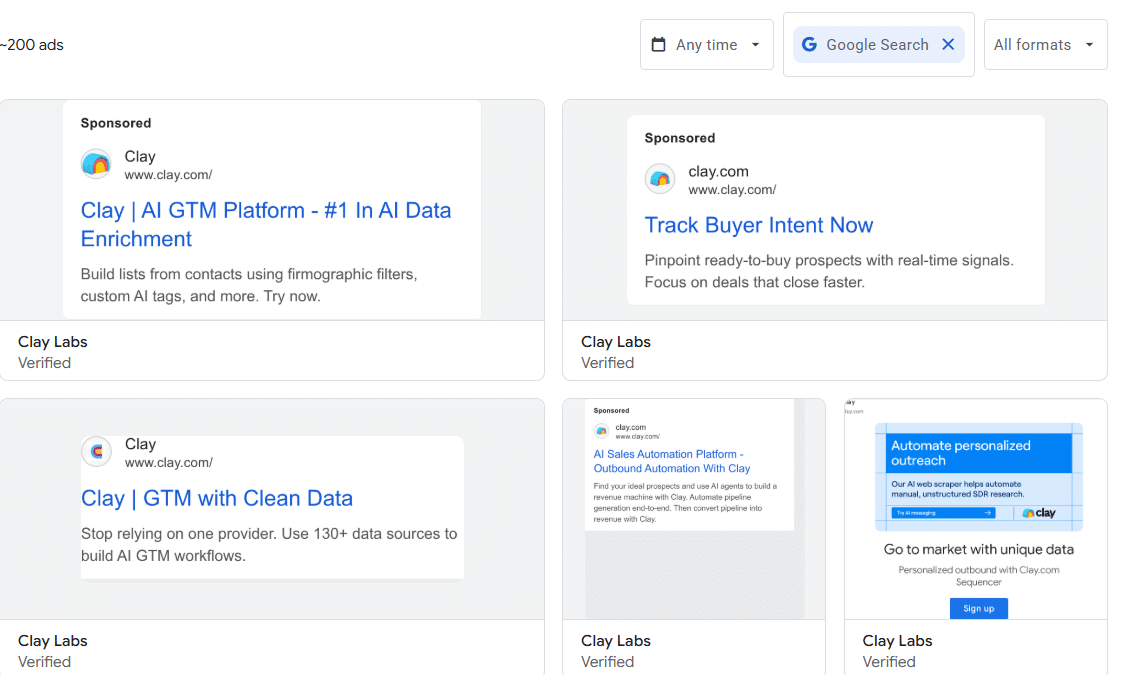
Google Search runs approximately 200 ads. Headlines include “Clay | AI GTM Platform, #1 in AI Data Enrichment,” “Track Buyer Intent Now,” “Clay | GTM with Clean Data,” and “AI Sales Automation Platform.” Google Search is where buyers who already know they need a solution go to compare options. Clay’s presence at scale in this channel signals that they are competing for high-intent, bottom-funnel traffic from people already searching for category-adjacent terms.
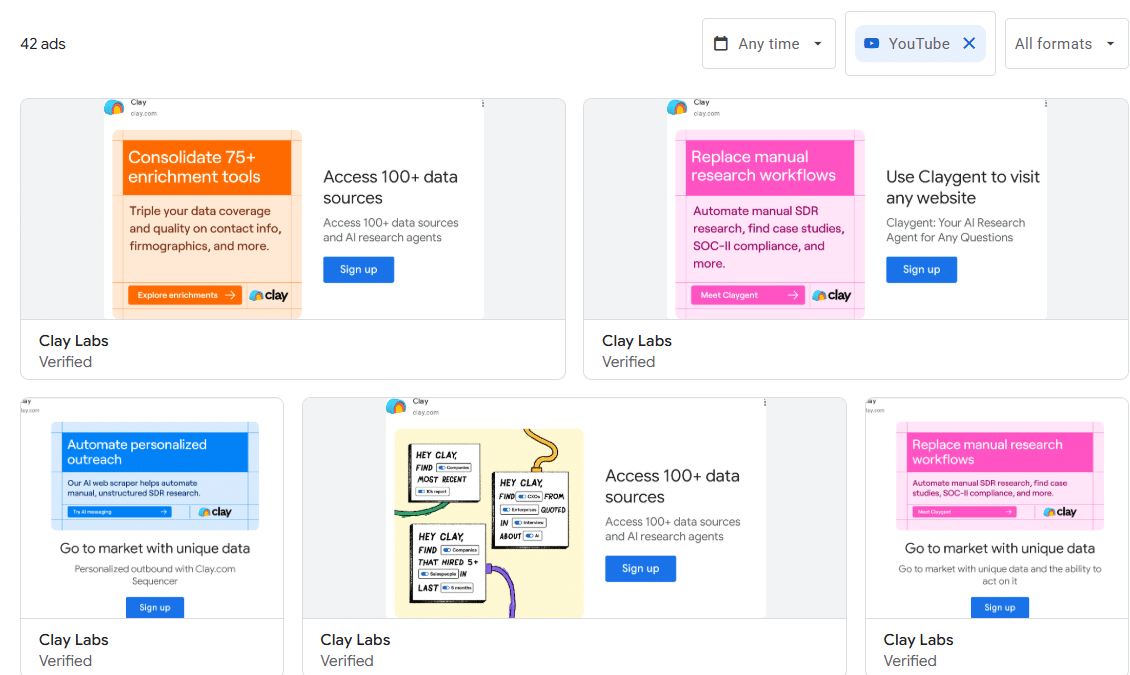
YouTube ads total 42, mostly video or image, with headlines focused on specific capability claims: “Access 100+ data sources,” “Use Claygent to visit any website,” “Replace manual research workflows,” and “Increase your data coverage with 75+ enrichment tools.” These are feature-forward and written for an audience with some category awareness already.
No Meta ads were found. This is consistent with where Clay’s ICP actually spends professional time: LinkedIn and Google, not Facebook or Instagram.
The LinkedIn event-based ad strategy is a demand capture play for accounts already in Clay’s orbit. Promoting a $50k competition or a live workshop to a warm LinkedIn audience deepens engagement with people who are already aware of the brand but haven’t converted. That’s classic ABM thinking: use paid media to move known accounts forward, not to discover unknown ones.
Stepping back from the individual platforms, the overall ad strategy tells you something specific about where Clay sits in its growth journey. They are not running awareness campaigns. There are no Meta ads, no broad interest targeting, no top-of-funnel video designed to introduce Clay to people who’ve never heard of it.
Every channel they’re active in, Google Search at 200 ads, YouTube at 42, LinkedIn with event-specific creative, targets people who are already looking. That’s a capture strategy, and it tells you Clay is confident that brand awareness is being handled elsewhere, through community, content, the GTM Engineer media brand, and word of mouth among practitioners. Paid media is the net at the bottom of a funnel that starts somewhere else entirely.
Steal This: Test event-based LinkedIn ads before always-on awareness campaigns. Promoting a specific workshop, competition, or live session gives the ad a clear reason to exist and the viewer a clear reason to click. An always-on brand awareness ad competes with hundreds of others. An ad announcing “compete for $50k in our annual championship” competes with nothing in the same category.
Sales Funnel from Social Media
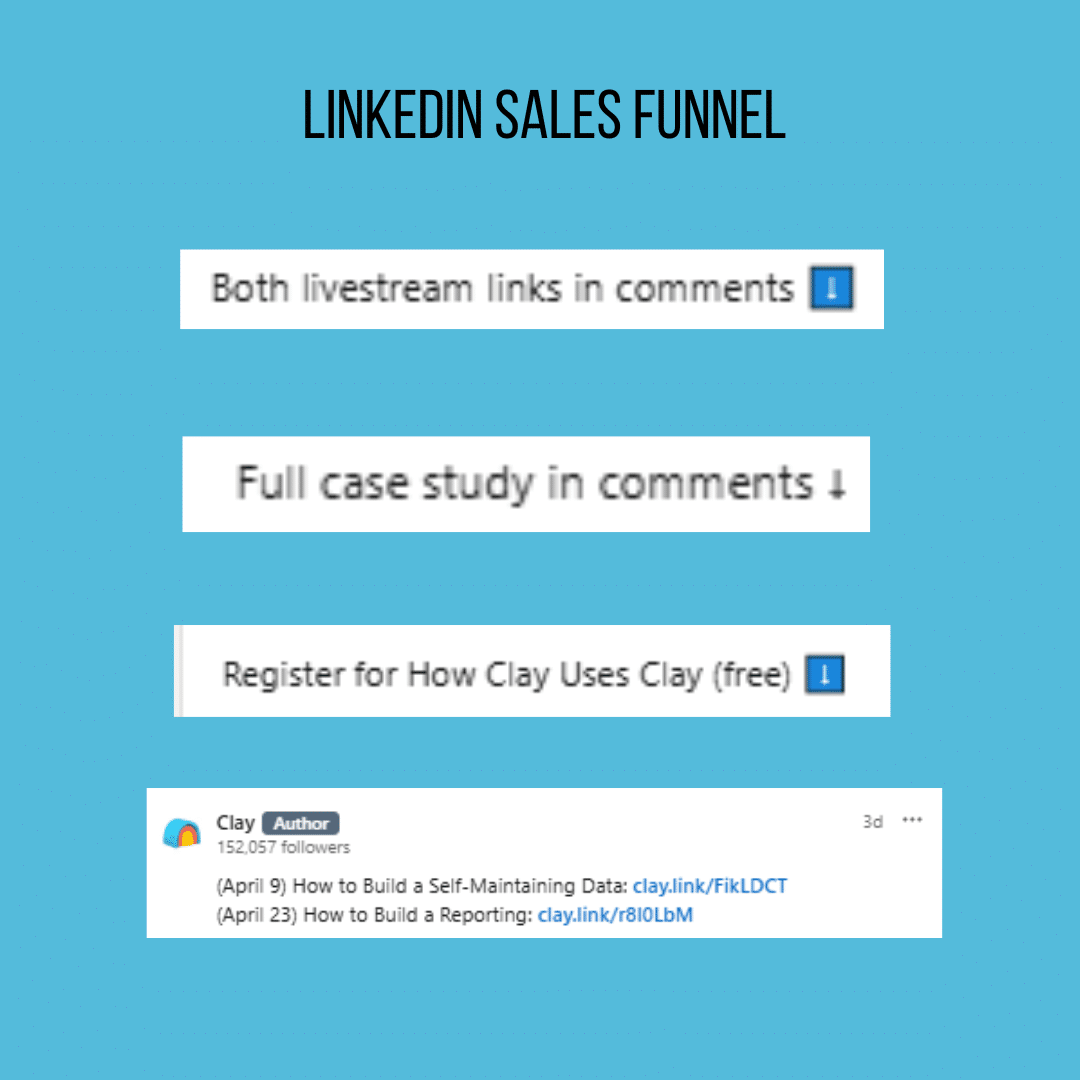
LinkedIn plays a TOFU and MOFU role. Posts drive awareness and engagement. The conversion mechanism is links placed in the comments section of posts rather than in the post body itself, pointing to livestream registration pages, case study pages, and Clay University. Some of those destinations require an email address to access.
This approach reflects a commonly observed algorithm behaviour: LinkedIn penalizes posts containing outbound links by reducing their organic reach. Placing links in comments is a workaround that preserves reach while still providing a conversion path.
The tradeoff is visibility. Viewers who don’t read comments never see the link. For posts built around storytelling or community content, this is an acceptable tradeoff. For posts where conversion is the primary goal, it’s a structural gap.
The intended next step from LinkedIn is email capture via event registration or direct traffic to clay.com for a free trial or demo request. The demo form asks for a phone number and a role selection from a dropdown: RevOps/Sales Ops, Sales, Marketing/Demand Gen, Agency/Consultant, Other. That dropdown is a qualification in disguise. It tells Clay’s sales team which motion to run before they make the first call.
Youtube
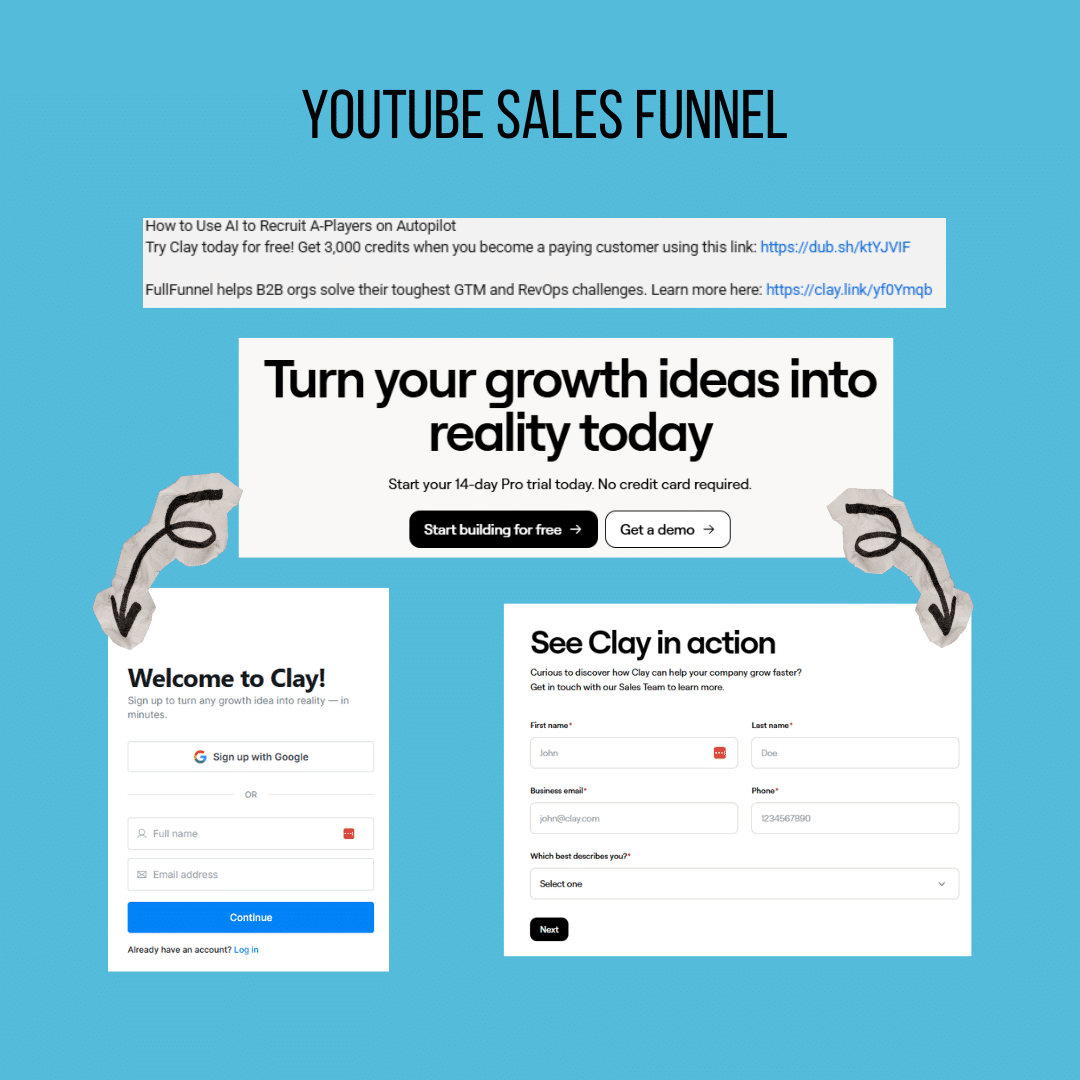
YouTube sits at TOFU and MOFU with higher purchase intent, because the viewer has already searched for something specific. The conversion path is simpler: a link in the video description to clay.com plus a free credits offer for new paying customers. The gap here is the dormant publishing schedule. A channel that’s not publishing is a channel that’s losing search-driven discovery every week it stays quiet.
X has no meaningful funnel role. No links, no CTAs, minimal engagement. It functions as a crossposting destination and nothing more.
The overall social funnel is weighted toward top-of-funnel awareness and mid-funnel education, with conversion happening on clay.com itself. The free trial removes the need for a sales call at the self-serve level. The demo form provides qualification and routing for enterprise buyers.
Steal This: Use your demo request form’s dropdown fields to qualify and route leads before your sales team sees them. Asking a prospect to identify their role and use case at the demo stage costs them 5 seconds and saves your team hours of discovery calls. Different dropdown selections should route to different sales motions or sequences automatically.
Reviews and Social Proof

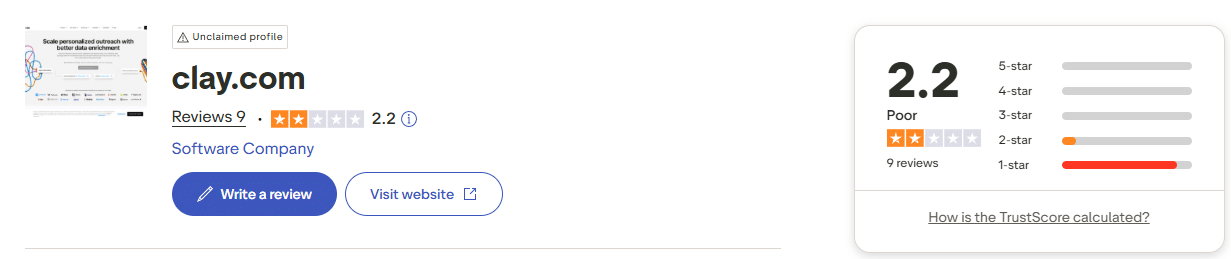
On the live badges on the homepage, they displayed a 4.9 on G2 and a 5.0 on Glassdoor.
But when we checked G2 directly, the actual score is 4.7, not 4.9. That’s a small gap numerically, but it matters. Clay’s entire value proposition is built on data accuracy. Displaying an outdated or rounded number on their own homepage, in the same section where they promote SOC 2 compliance and enterprise-grade trust signals, is the kind of detail buyers notice when they’re in due diligence mode. It’s worth fixing.
On G2, the recurring praise is around how much time Clay saves on manual research and how far the data coverage stretches compared to single-source tools. The recurring criticism is the learning curve. People find the first few weeks steep, and that tracks with what the product actually is: a flexible, multi-layered workflow tool that rewards investment in understanding it.
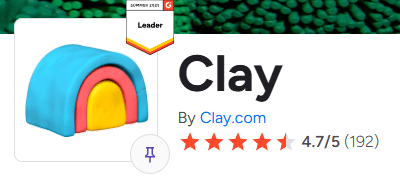
On their unclaimed Trustpilot profile, they have a 2.2/5 rating from 9 reviews. That’s too small a sample to draw reliable conclusions. People who seek out a company on Trustpilot unprompted are almost always unhappy with something, so the pool skews negative by design. The complaints about interface complexity and customer support are worth noting, and they echo the learning curve critique that appears on G2 too, but 9 reviews do not represent Clay’s customer base at 10k+ accounts. Treat it as a directional signal.
The Glassdoor 5.0 is an employee satisfaction score, not a customer review, but it’s notable on a different level: a perfect Glassdoor rating at a company of this size shows internal culture strength, which directly affects product quality and customer support.
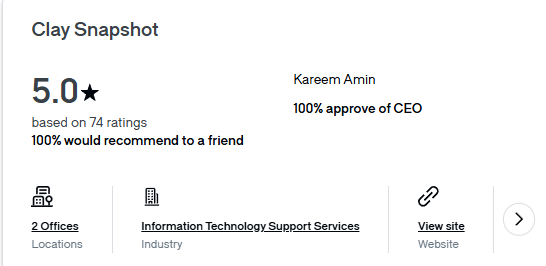
Culture & Values has a 5-star rating, Senior Management and Diversity & Inclusion have a 4.9, Career Opportunities has 4.8, Compensation and Benefits has 4.5, and Work/Life balance has 4.3.
The homepage carries named testimonials from Vanta’s CRO Stevie Case, Intercom’s Director of GTM Ops Alexander DeMoulin, Anthropic’s Head of Sales Operations Adam Wall, Rippling’s VP of Corporate and Integrated Marketing Ryan Narod, Ramp’s Sales Ops David Bulmer, Notion’s Head of Growth Programs Josh Kim, and others.
They’re attributed to named people with specific titles at specific companies. Each quote speaks to a different use case and a different buyer persona. A RevOps leader reading the Intercom quote is reading from someone in a role they recognize. That specificity is what makes testimonials work.
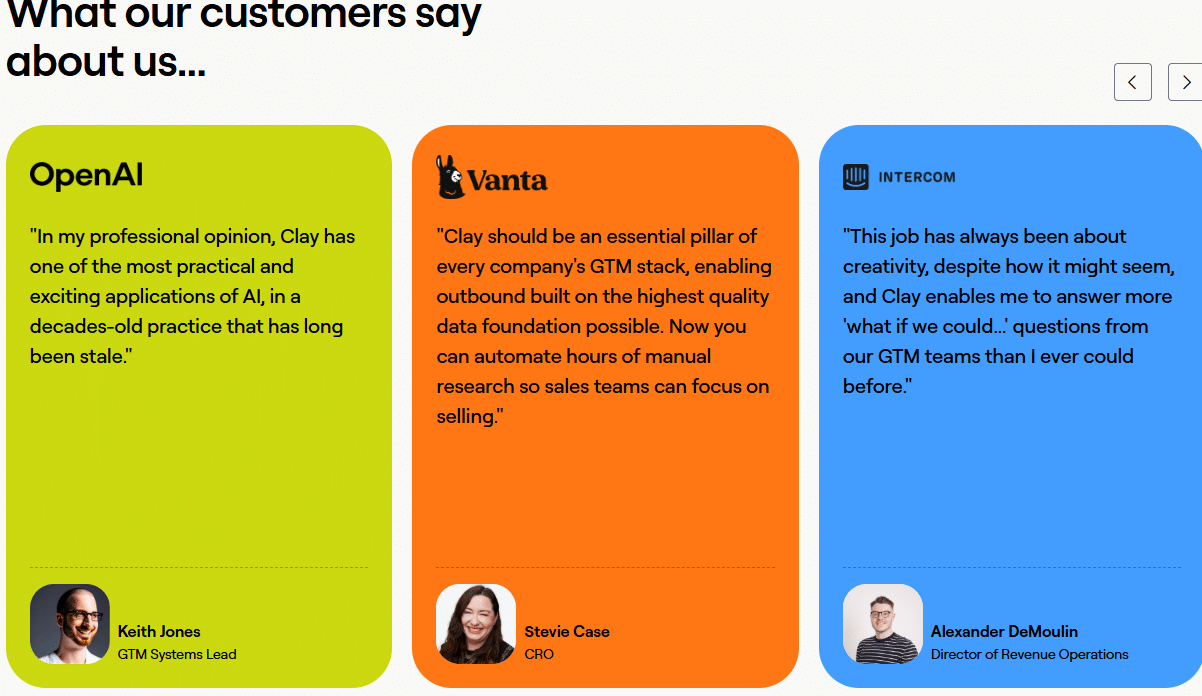
Robert Cialdini’s principle of social proof in “Influence” holds that people look for evidence of others like them making the same choice. The homepage executes this with precision: the right quote, from the right type of buyer, appears to be speaking directly to the next buyer who shares that profile.
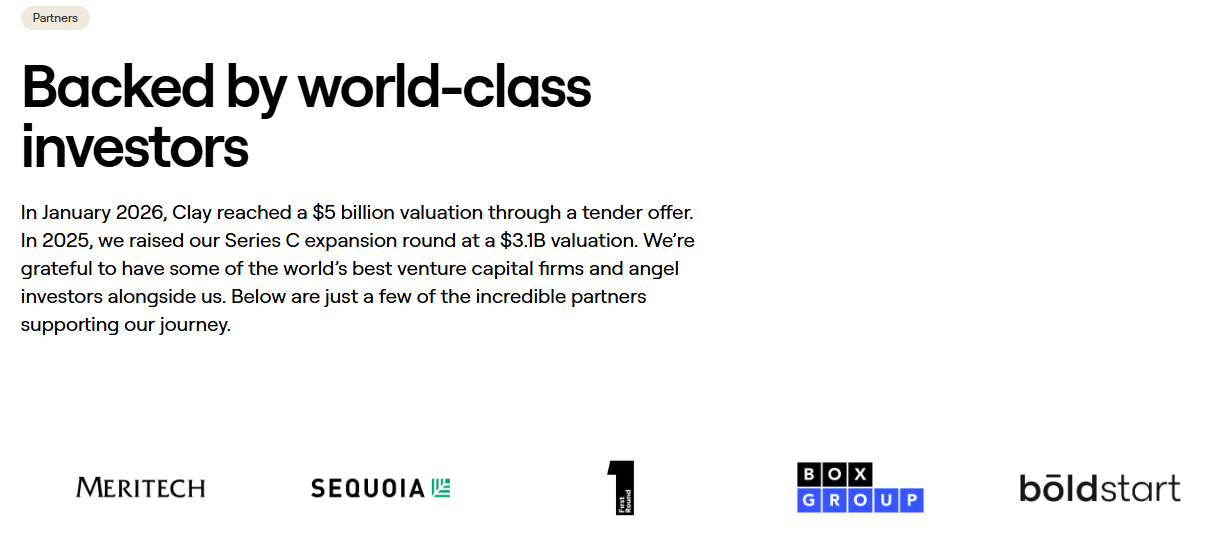
The About page notes the $5B valuation from the January 2026 tender offer, the Series C at $3.1B, and backers including Meritech, Sequoia, Box Group, and BoldStart. Funding at this scale functions as social proof in enterprise conversations, where the question “will this vendor still exist in three years?” matters as much as any feature comparison.
Steal This: Segment your testimonials by buyer persona and place them near the relevant product or solution pages, not only on the homepage. A RevOps leader reading your CRM enrichment page wants to see a quote from another RevOps leader. Match the social proof to the audience reading it, and you extend the homepage’s conversion logic across your entire product surface.
Content Marketing and Demand Generation

Clay’s blog is organized into 5 categories: Data Test, Thought Leadership, Clay Announcements, Case Studies, and Outbound Plays. Articles include screenshots and images, use H2 heading structure, and feature a navigable table of contents labeled “Index”. The content skews toward practical: how-to guides, outbound tactics, product announcements, and use case breakdowns. Publishing frequency is irregular; there’s no consistent cadence visible from public post dates.
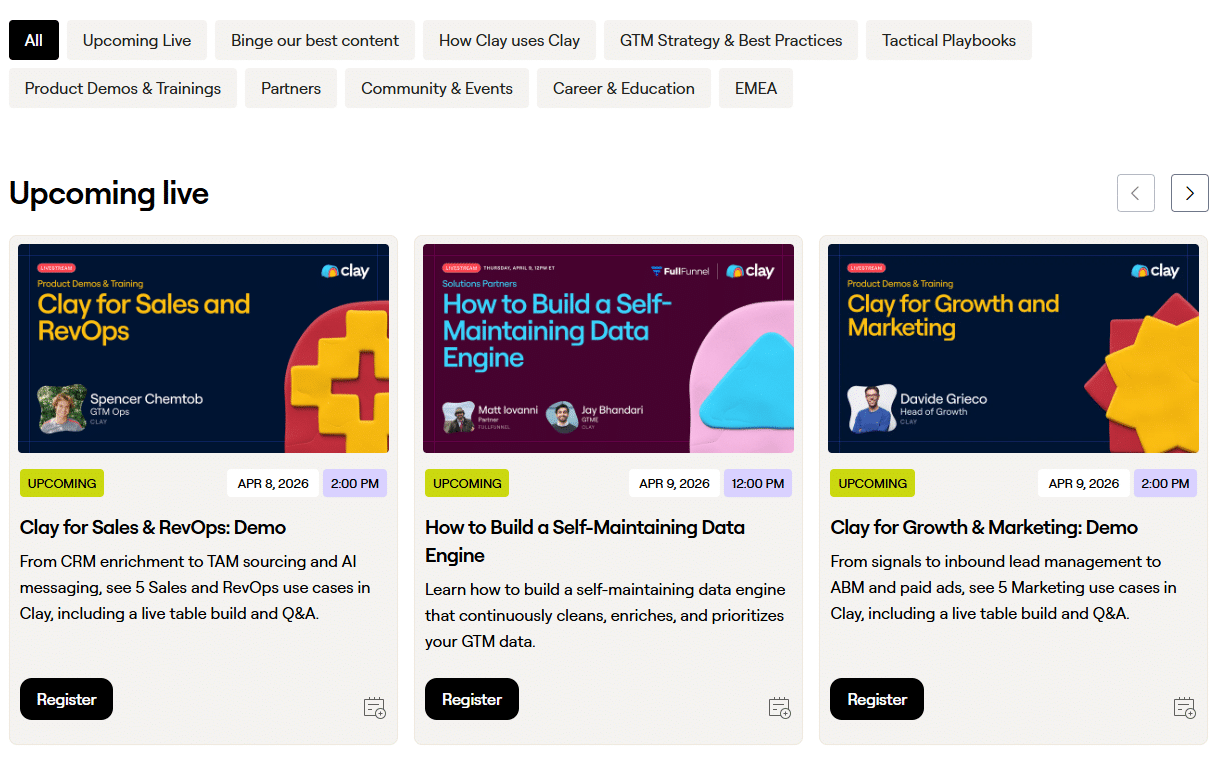
The Livestreams page organizes upcoming and recorded webinars into categories: How Clay Uses Clay, GTM Strategy and Best Practices, Tactical Playbooks, Product Demos and Trainings, Partners, Community and Events, Career and Education. Accessing recorded sessions requires registration with a name and email. EMEA-specific livestreams run in parallel with the main program, signaling early-stage European market development.
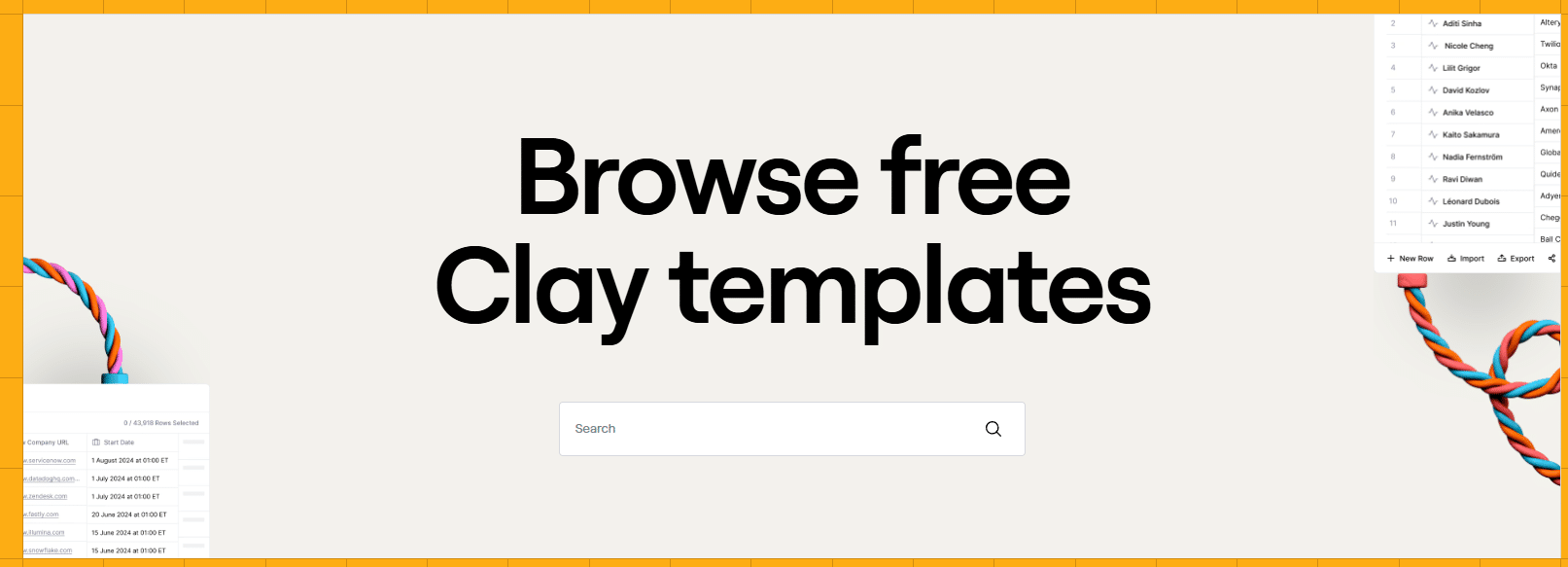
The Templates page offers free, filterable workflow templates searchable by provider, use case, role, and author. These are ungated. A free template that solves a real problem is a product experience before the user has signed up. It demonstrates depth, sets expectations for what the platform does, and builds trust through usefulness before a commercial conversation begins.
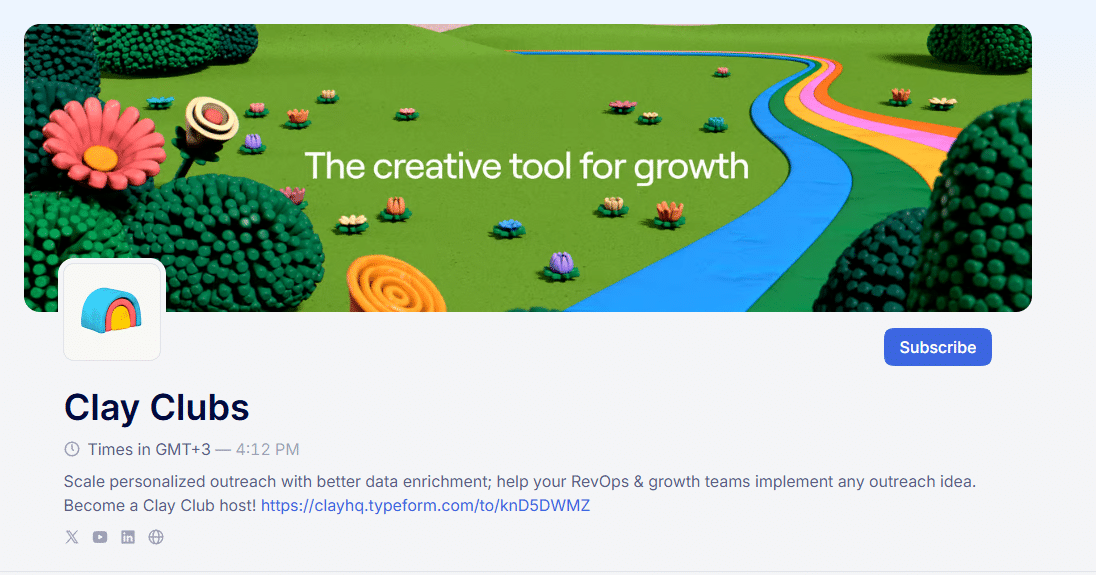
Clay Clubs, listed on Luma, bring the community together in person in cities including London, Berlin, and San Francisco, with online versions running in parallel. Each event page shows program details, registration steps, a description, a map, and host information. 60 clubs across 30 countries
Clay exists everywhere its ICP might look for help or connection, from a Slack thread to a Berlin meetup to a YouTube tutorial to a G2 review page. Each touchpoint reinforces the others. The cumulative effect is that Clay feels omnipresent to anyone working in GTM, which is exactly the perception a category leader needs to maintain.
The Livestreams page categorization reveals a mature content funnel architecture. “Tactical Playbooks” and “Product Demos” sit at MOFU and BOFU. “Career and Education” sits at TOFU and community-building. Each category serves a different stage of the buyer journey. The email capture at registration is the conversion mechanism that connects content consumption to pipeline.
Steal This: Categorize your webinar or video library by buyer intent stage, not just by topic. A visitor who clicks “Product Demo” is closer to a purchase decision than one who clicks “Industry Education.” Treat them differently in your follow-up sequence. The categorization itself gives you segmentation signals at no additional cost.
Marketing and Sales Funnel Stages
TOFU (Top of the funnel)
Clay’s top-of-funnel is built almost entirely on owned channels and organic discovery. LinkedIn posts, Clay Clubs events across 60 cities, free tools like the headcount finder and WHOIS lookup, the GTM Engineer brand and thegtme.com, and blog content that targets search terms relevant to GTM and outbound all sit here. Historically, YouTube tutorials played a major role, too. The logic is straightforward: reach people where they’re already spending time, through content that’s genuinely useful, before they know they need Clay. The free tools in particular, are a smart move because someone looking up a company’s headcount is already doing prospecting work, which is exactly what Clay sells. The tool creates a moment of relevance before any commercial conversation exists.
MOFU (Middle of the funnel)
The middle of the funnel is where Clay’s ecosystem really pulls its weight. Clay University courses and cohorts, Livestream registrations (which require an email), Claybooks templates, the Experts marketplace, and case studies organized by named company all live here.
This is the stage where a warm prospect starts asking whether they could actually use this and whether it would work for them. Clay answers both questions simultaneously: the case studies show it working for companies they recognize, and the University shows them exactly how to do it themselves.
The email capture at Livestream registration is the conversion mechanism that pulls interested visitors into a trackable pipeline. The MOFU is notably education-heavy, which makes sense for a product with a learning curve. Instead of fighting that curve, Clay has built an entire infrastructure to accelerate it.
BOFU (Bottom of the funnel)
At the bottom, Clay keeps friction deliberately low. The free 14-day Pro trial requires no credit card, which removes the biggest psychological barrier to starting. For buyers who want more guidance, the demo request form asks for a phone number and a role selection from a dropdown (RevOps/Sales Ops, Sales, Marketing/Demand Gen, Agency/Consultant, Other).
That dropdown does more than it appears to. It routes each type of buyer to the right sales motion before any human picks up the phone. The Enterprise page leans hard on removing procurement friction, consolidating vendor contracts, and delivering data coverage without engineering overhead, because those are the specific objections enterprise buyers bring to every new vendor conversation.
Retention
Clay keeps users through the same infrastructure it uses to acquire them. Clay University functions as ongoing education after signup, not just pre-sale content. The Slack community (access tied to an active account) makes leaving feel like losing a professional network.
Clay Clubs, product updates, the changelog, and the customer story program all serve to deepen the relationship between users and the product. The customer story program is particularly well-designed as a retention tool: being featured as a Clay success story gives a user a public stake in the product’s success. They’re no longer a customer. They’re an advocate with their name attached to an outcome.
Future Plans and Growth Indicators
Clay has 61 open roles listed on their website as of the time of research, with over 100 posted on their LinkedIn page. The distribution tells you where they’re investing next.
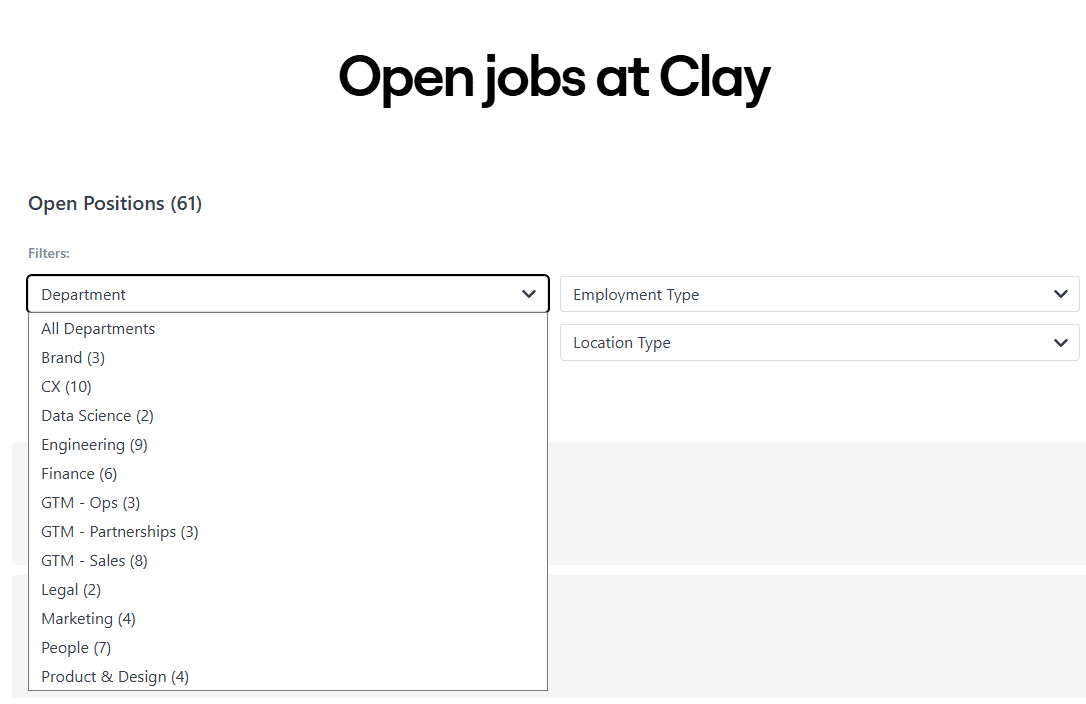
Customer Experience leads with 10 open roles. At a company with 10k+ customers and a product with meaningful depth, this shows investment in making the experience of using Clay better, not only in acquiring new users. Engineering follows with 9 roles. GTM Sales has 8. People (HR) has 7.
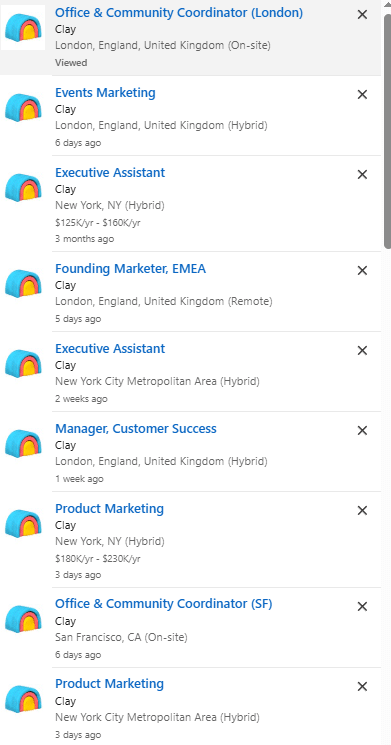
Geography adds a complementary signal. 48 roles are based in New York, 24 in San Francisco, and 8 in London. London is small but present, which aligns with the EMEA-specific livestreams and the in-person Clay Clubs in London and Berlin. European market development is in early stages but clearly underway.
The $5B January 2026 tender offer is also a signal worth reading. It’s Clay’s second tender in nine months (the first was in May 2025 at $1.5B). Companies that run repeat tenders at accelerating valuations are typically managing employee liquidity while choosing to stay private. It also tells prospective enterprise buyers something useful: this company is not going anywhere.
Steal This: When you hire into a new geography, support it with localized content and events before you expect pipeline from that market. Brand presence should precede headcount in a new region. Hiring a sales rep into a market with no brand recognition is a slow and expensive way to grow.
Inspiration Points
1. Create the category before you dominate it.
Clay didn’t win by being better than Apollo or ZoomInfo. They won by making those comparisons irrelevant. When you coin a job title, build the curriculum for it, and run the events where practitioners meet, you stop competing for market share and start owning the profession. GTM Engineer is now a real job that appears in hiring posts at Cursor, Webflow, Notion, and Lovable. Clay put it there.
The commercial logic behind this is documented. The 2025 Edelman-LinkedIn B2B Thought Leadership Impact Report found that 79% of hidden B2B buyers, the finance, legal, and procurement people who influence deals without being the primary user, are more likely to champion a vendor during an RFP if that vendor consistently publishes quality thought leadership. Clay’s GTM Engineer content reaches those people before a salesperson ever does.
2. Turn education into a retention moat.
Most companies treat onboarding as something you get through as fast as possible. Clay treats it as the product. Users who complete Clay University courses get results faster, build better workflows, and are far less likely to churn when they hit something confusing. They know what’s on the other side of the friction because they’ve already been shown.
Forrester data, cited in Zapnito’s B2B Customer Engagement Trends 2025 report, shows companies with formalized education programs retain 7.4% more customers. Conductor found that educational content makes consumers 131% more likely to purchase. Clay University isn’t a cost center. It’s probably their most underrated revenue lever.
3. Gate your community to keep it worth having.
An open Slack is a support forum. A gated Slack tied to an active account is a professional network. Clay chose the second one, and the difference is visible in who shows up. Senior GTM practitioners, not lurkers looking for free advice.
Community Marketing Statistics 2025 found that communities increase customer retention by 40% and that 73% of users who engage weekly stay active for at least 12 months. Another stat from the same research: 47% of customers are less likely to switch to a competitor when they’re part of a brand community. The gate is what makes those numbers possible. Without it, you get noise. With it, you get a network that people don’t want to leave.
4. Let your Experts ecosystem close deals you never pitched.
Clay’s 108-agency expert network is generating hundreds of millions in collective revenue. That’s a secondary sales force that doesn’t appear on their payroll, doesn’t require onboarding, and operates inside accounts Clay’s own team would never reach directly.
The Smarketers’ Community-Led Growth B2B 2026 Guide found that community-led initiatives cut customer acquisition costs by an average of 32%, and that companies with active communities grow revenue 2.1x faster than those without. The expert marketplace is a capital-efficient growth channel dressed up as a partner program.
5. Make your community members the protagonists of your content.
The highest-performing LinkedIn post Clay published last month wasn’t about a product feature. It was the story of Javeria Shah winning the Clay Cup, and it got 671 reactions and 47 comments. It beat everything else in the same period.
HubSpot’s 2026 State of Marketing Report found that 56% of marketers say the internet is flooded with AI-generated content, and 65% say consumers are getting better at filtering it out. Real people doing real things in your community cut through that. The Javeria Shah post celebrates a practitioner, signals that the community produces people worth recognizing, and shows what the product enables, all at once. A product announcement can’t do all three.
6. Run PLG entry with enterprise expansion built in from the start.
Clay’s free tier and 14-day Pro trial are not just acquisition tools. They’re qualification filters. A buyer who completes a free trial, builds a workflow, and hits a usage limit has already demonstrated intent and capability.
Mixpanel’s 2026 State of Digital Analytics report, which analyzed behavior across 12,000+ companies, names product as the new primary growth channel and shows that 58% of companies now use a PLG model as their primary or co-primary go-to-market strategy.
The same report shows that weekly retention for B2B products ranges from 44.6% to 77.9% globally, and that the gap between top and bottom quartile performers comes down almost entirely to activation quality. Clay University, cohorts, and Claybooks all serve to improve activation quality. The PLG entry point and the education infrastructure are not separate strategies. They’re the same strategy.
7. Build the ecosystem before the pipeline needs it.
Clay’s job board, talent hub, expert network, and media property (thegtme.com) were investments in category infrastructure that preceded the full enterprise motion. The 2025 Edelman-LinkedIn B2B Thought Leadership Impact Report found that over 40% of B2B deals stall due to internal misalignment within buying groups, and that 95% of hidden buyers say strong thought leadership makes them more receptive to sales outreach.
By the time Clay’s sales team reaches a buying group at a large enterprise, that group has almost certainly already encountered the GTM Engineer brand, attended a Clay Club, or read Clay University content. The ecosystem that looks like marketing infrastructure today is the reason the sales conversation starts warm tomorrow.
The real lesson from Clay’s marketing and sales strategy
Most companies think about marketing as the thing that promotes the product. Clay thought about marketing as the thing that creates the market.
They didn’t run campaigns to convince people they needed a GTM data platform. They named a profession, trained people to practice it, built a community around it, ran events for it, created a job board for it, and launched a media property about it. By the time someone searches for a GTM data tool, they’ve already been living in Clay’s ecosystem for months. The product is almost a formality at that point.
This is an infrastructure investment that compounds over the years. But the principle behind it is available to any company willing to make it: stop marketing your product and start building the world your product lives in.
Every section of this article is evidence of that one decision, made early and executed consistently. The community, the university, the clubs, the expert network, and the GTM Engineer brand. All of it points back to the same bet: that owning the profession is more defensible than owning the feature set.
If you’re building a B2B product and wondering where to put your next marketing dollar, the Clay playbook gives you a clear answer. Build infrastructure that makes the people who use your product more successful, more connected, and more recognized in their field. The pipeline follows.
Frequently Asked Questions
What does Clay do? Clay pulls data from 150+ providers, uses AI agents to research companies and people, and lets you build automated enrichment and outreach workflows without writing code. In practice, it replaces the mess of spreadsheets, manual research, and disconnected tools that most GTM teams still rely on. Sales, marketing, and RevOps teams use it to find the right accounts, get accurate contact data, score leads, and trigger outreach at the right moment.
Who founded Clay? Kareem Amin and Nicolae Rusan founded Clay in 2017, both McGill graduates who had previously sold a startup together. Varun Anand joined in 2021 as co-founder and has been central to the GTM direction since. Rusan stepped back in 2022 and is still on the board.
What are Clay’s pricing plans? Clay offers four plans: Free, Launch at $167/mo, Growth at $446/mo, and Custom for enterprise teams. Annual plans save 10%. A 14-day Pro trial is available with no credit card required, which is the easiest way to figure out whether Clay fits your workflow before committing to anything.
What is Clay University? It’s Clay’s in-house learning platform, and it goes well beyond a help center. There are structured courses at beginner and intermediate levels, live cohorts with daily exercises and direct team support, and a library of ready-to-use workflow templates called Claybooks. Certifications are currently paused while new ones are being developed.
What is Clay’s social media strategy? Clay posts on LinkedIn multiple times per week, with 152k followers and an average of 80 to 135 reactions per recent post. They cover product updates, customer stories, employee announcements, event promotion, and livestream series. Their YouTube channel has 14.9k subscribers and 691k total views but has not published new content consistently in recent months. X is present but generates minimal engagement and is not mapped to any meaningful funnel role.
What paid advertising does Clay run? Clay runs approximately 200 Google Search ads, 42 YouTube ads, and a small number of LinkedIn ads focused on event promotion (live workshops and Clay Cup 2026). No Meta ads were found. Google Search is the primary paid channel, targeting buyers searching for data enrichment and GTM automation terms.
What is a GTM Engineer? GTM Engineer is a job category that Clay created and named. It refers to professionals who use AI and automation tools to build revenue workflows. Clay supports the category through thegtme.com (a dedicated media property), a GTME job board, a talent marketplace, and Clay Clubs running across 60 cities in 30 countries.
Does Clay have a community? Two of them, really. There’s a public forum at community.clay.com with discussions, career advice, member spotlights, and job listings. Then there’s Slack, which requires an active Clay account to join. That requirement is deliberate. Third-party observers reported close to 22k Slack members in mid-2025, though Clay hasn’t confirmed an official count.