TL;DR: Conclusions and Key Takeaways
🎀 This section gives you the main insights without all the details. It’s the stuff you need to remember, whether you’re reading this now or in 6 months. We made this for people who want to get the core message fast.
6sense is a B2B revenue AI platform that helps marketing and sales teams identify which accounts are ready to buy, and engage them before competitors do. This article shows their full go-to-market strategy, from brand positioning and paid ads to community building and content, so you can take what works and apply it to your own business.
6 things worth stealing from 6sense’s playbook
- Build free tools that solve a real problem for your ICP before you ask them for anything. The ones who use them arrive at your demo already warm.
- Run a gated peer community for senior buyers, not just for customers, to create influence before the sale starts.
- Let your data do the selling. Lead with proof numbers on every product page and ad.
- Invest in executive thought leadership on LinkedIn, because even inconsistent posting outperforms silence.
- Use certification programs tied to your methodology to build a pipeline of educated, pre-sold prospects.
- Use your own product publicly and keep showing it. A content series you abandon reads as a company that stopped believing its own pitch.
📝 A quick note before you start reading: The data and analysis in this article are valid as of the time we wrote it. We don’t know when you’ll be reading this, maybe next week, maybe six months from now, and things might have changed since we looked at this company’s marketing and sales approach. Still, the insights and lessons here stay useful, even if the numbers or tactics have evolved a bit.
If your sales team is tired of cold calls going nowhere, it might be time to develop a sixth sense about who actually wants to hear from you. That is the idea behind 6sense. They built a platform that tells revenue teams who is researching solutions like theirs right now, so every outreach feels less like a cold shower and more like a warm handshake.
Here at Milk and Cookies Studio, we believe the best marketing doesn’t interrupt people. It shows up at the right moment, with the right message, for the right person. That is exactly what 6sense sells. So when we sat down to reverse-engineer their go-to-market strategy, we were curious: do they practice what they preach?
The short answer is yes, mostly. The longer answer is what follows. The data and analysis in this article reflect what we found during our research in March 2026. Marketing strategies evolve. If you’re reading this later, some specifics may have shifted, but the underlying principles hold.
Understanding 6sense
6sense was founded in 2013 by Amanda Kahlow, Viral Bajaria, Premal Shah, Dustin Chang, and Shane Moriah. The origin story is interesting: Kahlow identified the opportunity after a consulting project at Cisco, where she saw that companies had no way to know which accounts were already researching their solutions before a sales rep ever picked up the phone.
The company is headquartered in San Francisco, with additional offices in Austin, New York, London, Pune, and Bengaluru. Six offices across three continents are themselves a strategy for a platform targeting enterprise revenue teams in every major market.
In terms of funding, 6sense has raised $526M in total. Their Series E in January 2022, co-led by Blue Owl and MSD Partners, valued the company at $5.2B. A $100M conventional debt round followed in June 2023. Backers include Insight Partners, D1 Capital Partners, SoftBank Investment Advisers, Sapphire Ventures, Tiger Global, Venrock, Franklin Templeton, and others.
In September 2025, Chris Ball took over as CEO. Jason Zintak, who ran the company for 8 years and oversaw its growth from $18M to over $200M in ARR, moved to Chairman.
Brand Promise Analysis
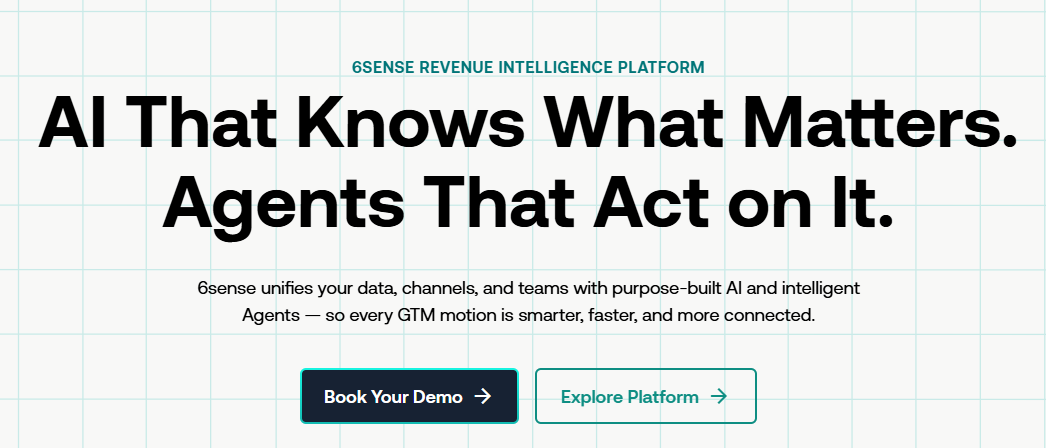
6sense’s homepage makes a clear hierarchy of claims. The big text reads: “AI That Knows What Matters. Agents That Act on It.” Below it, in smaller copy, is the fuller promise: 6sense unifies your data, channels, and teams with purpose-built AI and intelligent agents, so every go-to-market motion is smarter, faster, and more connected.
The About page sharpens this into 3 specific brand promises:
- Get them at the right time: the right buying moment won’t last forever.
- Make it personal every time: impersonal automated messages are easy to ignore.
- Reach them all in no time: you can’t grow pipeline if your processes won’t scale.
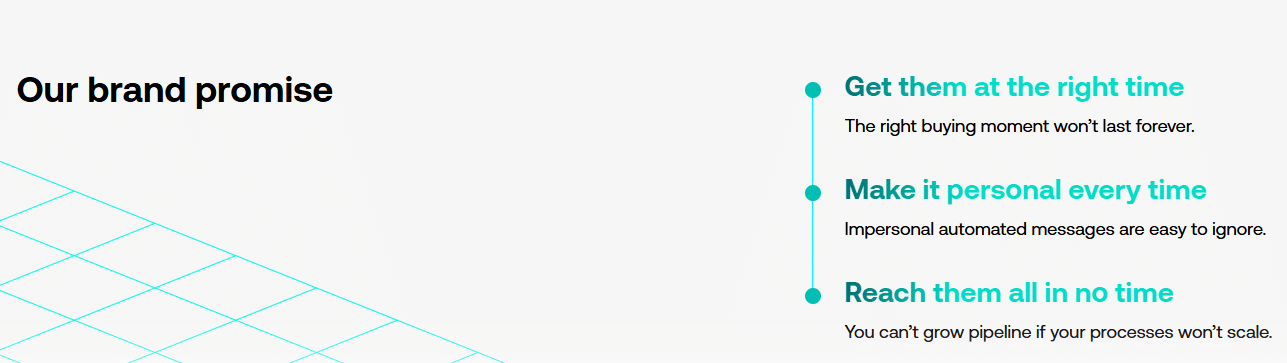
These three pillars map directly to the three objections a revenue team brings to a sales conversation about 6sense. Timing, personalization, and scale are not abstract values. They are the exact problems the product is designed to solve. The brand promise is built backwards from the customer’s pain.
The homepage then breaks the platform’s use cases into 4 concrete motions:
- Inbound: generate more demand with form shortening and enrichment, ensure instant inbound follow-up, and enhance lead qualification with intent scoring and AI-driven predictions.
- Outbound: deploy AI Email Agents that target accounts, automate and personalize email workflows, send intelligent responses, and seamlessly book meetings for reps.
- Competitive takeout: identify accounts, researching your biggest competitors and target them with ads while engaging with AI Email Agents simultaneously.
- Advertising: build dynamic audiences and activate them on any ad channel, maximizing impact and minimizing wasted spend.
Most platforms describe what they do for your pipeline. 6sense describes what they do to your competitors’ pipeline. Naming that as a standalone use case is what separates a product page from a positioning statement.
Social proof on the homepage includes logos from Sage, SAP, Custom Truck, Okta, Shell, Sumo Logic, Bynder, Tipalti, and Aruba. The logo strip covers enterprise, manufacturing, technology, and logistics. Those are the exact industries listed in their Solutions section.
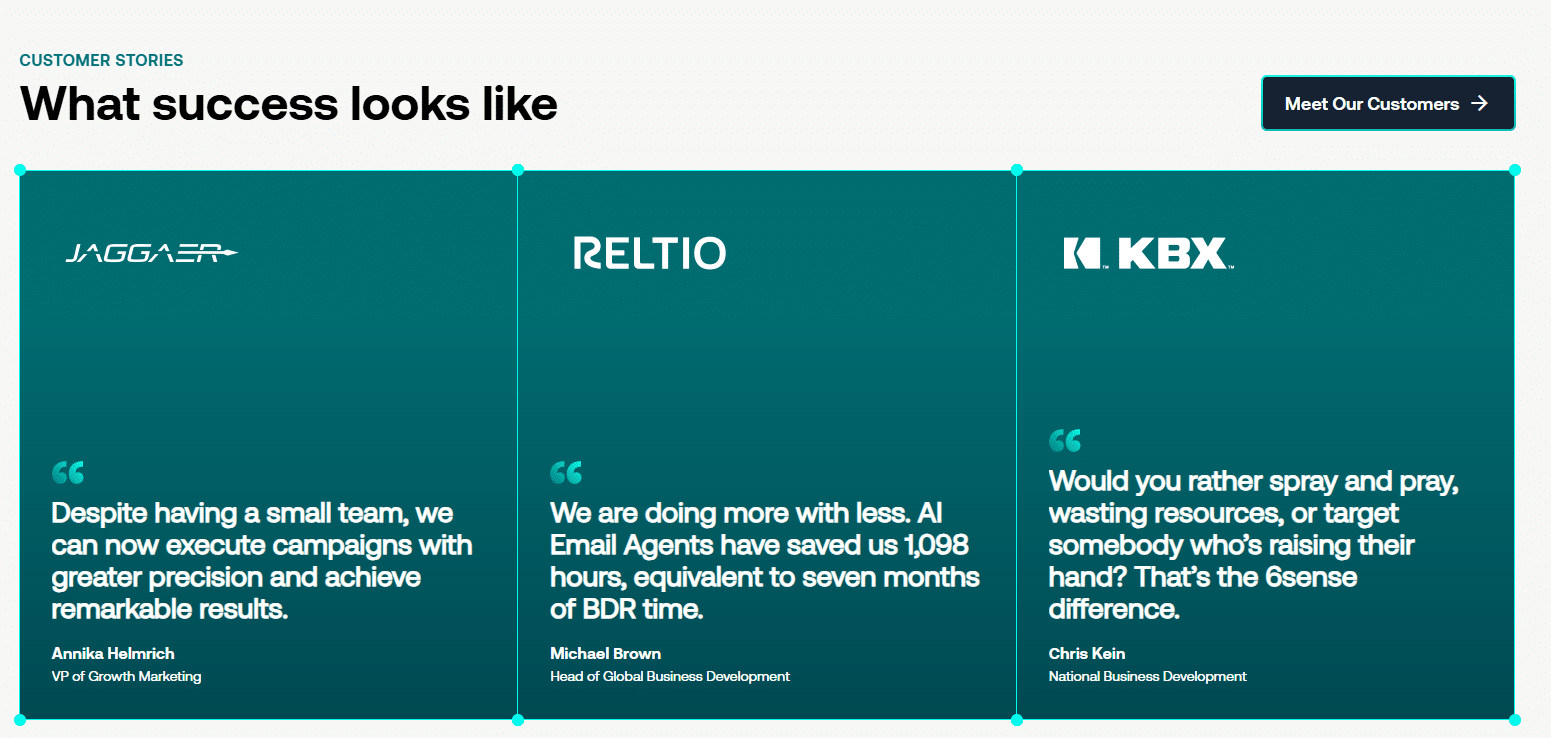
Three featured testimonial highlights round out the homepage body. One speaks to small teams running better campaigns with greater precision. Another reports that the AI Email Agent saved over 1,000 hours, equivalent to seven months of BDR (Business Development Representative) time. They name a specific role (the small team), a specific tool (the AI Email Agent), and a specific result (1,000 hours saved). That is the language of an internal business case, written for the person who has to sell this purchase to their CFO.
The homepage also explains the two core technology layers behind every product.
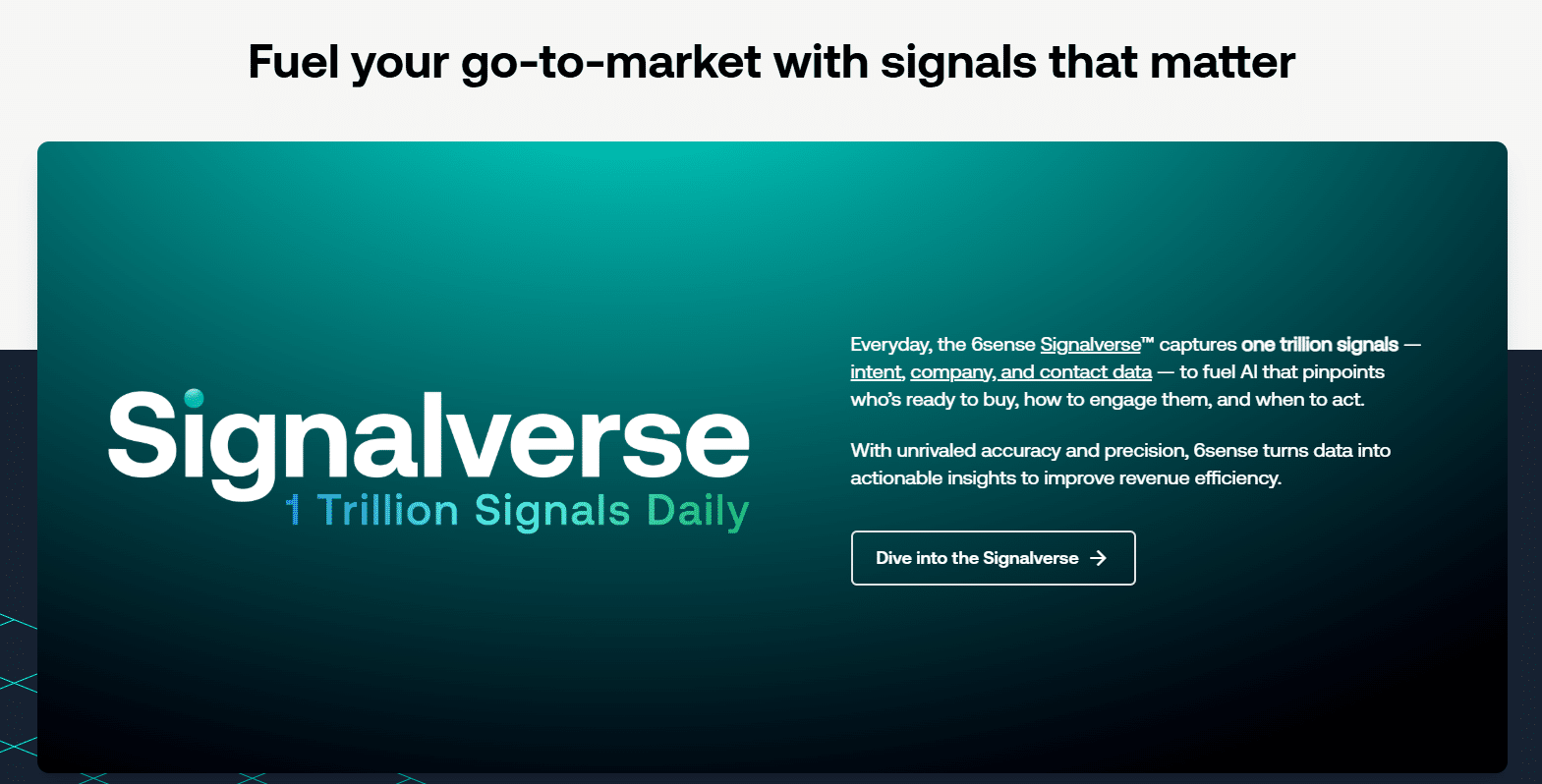
Signalverse captures over one trillion signals every day, combining intent, company, and contact data, to fuel AI that identifies who is ready to buy, how to engage them, and when to act.
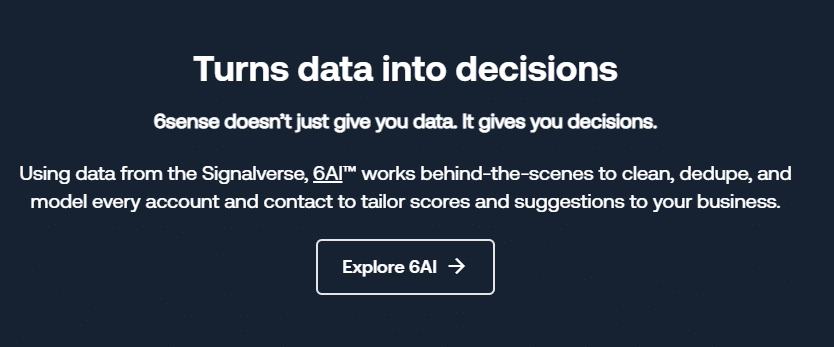
6AI works behind the scenes to clean, deduplicate, and model every account and contact, then tailors scores and suggestions to each customer’s specific business. 6AI is described as an infrastructure that makes every other part of the platform smarter over time.
The homepage closes with a banner: “6sense named a Leader in the Forrester Wave: Revenue Marketing Platforms for B2B, Q1 2026,” with a CTA to read the full report. The placement of this banner, after the product case and proof points, is used as confirmation of what they can do.

The Trust page goes further, establishing 6sense as a vendor that enterprise procurement teams can approve. It covers executive-endorsed security with dedicated teams across incident response, vulnerability management, secure SDLC, continuous monitoring, threat hunting, vendor management, and customer assurance.
The privacy program is co-managed at both the executive level (CFO, CTO, Legal) and the engineering level.
Third-party audits include annual SOC 2 Type 2 (covering all five Trust Service Criteria), ISO 27001, and ISO 42001 certifications. Compliance covers GDPR, CCPA/CPRA, and the UK-US and Swiss-US Data Privacy Framework.
Annual independent penetration testing covers network, web application, and API layers. The page also addresses Environmental, Social, and Governance commitments, covering greenhouse gas reduction targets, DEIB programs, and human rights policies.
Enterprise procurement involves at least three separate approval layers: procurement, legal, and infosec. The Trust page gives each of them something to tick off.
The brand promise structure is built for a sales-led motion from top to bottom. The homepage moves a qualified visitor from pain recognition (the 3 brand promises) through use case relevance (inbound, outbound, competitive takeout, advertising) to social proof (logos, testimonials) to technology credibility (Signalverse, 6AI) to third-party validation (Forrester Wave), and then asks for a demo. There is no self-serve path. Every element is designed to build enough trust and relevance to earn a conversation.
💡 Steal This: If your product helps customers win deals away from a competitor, mention that on your product page. Create a section just for it. The people reading it will be the ones already losing to that competitor and actively looking for a way to fight back. That is the most motivated buyer you will ever get.
Service and Product Breakdown
Products
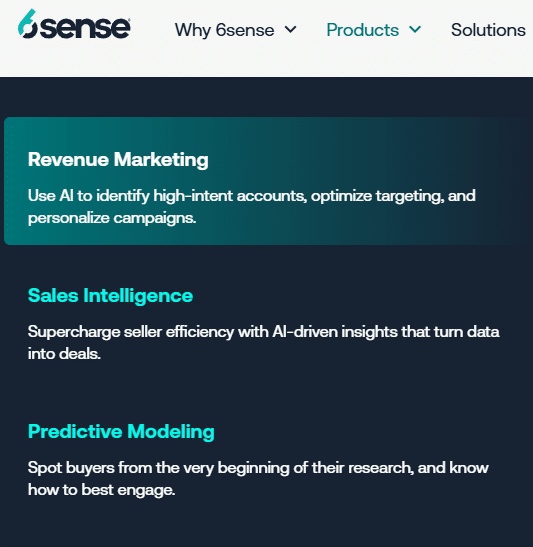
6sense organizes its platform into three product areas, each with its own page and dedicated case study evidence.
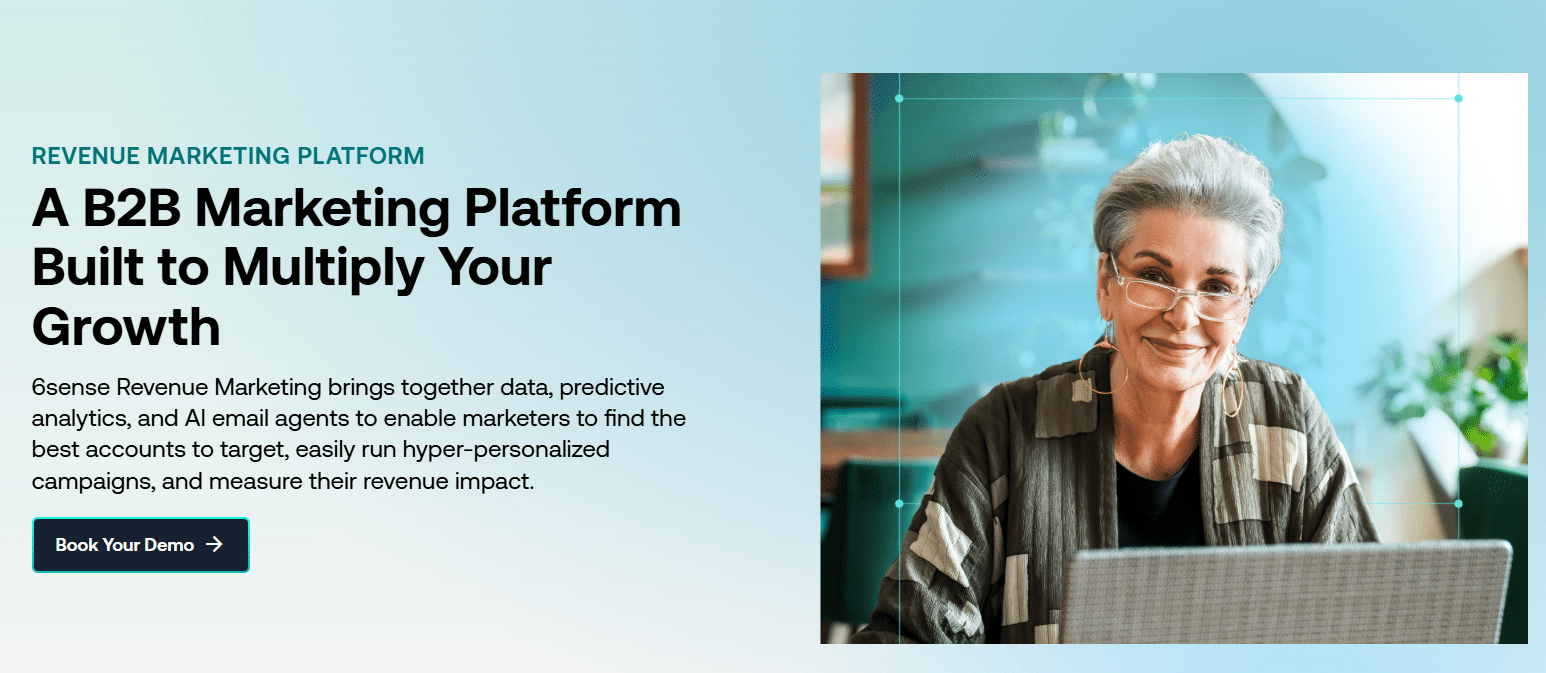
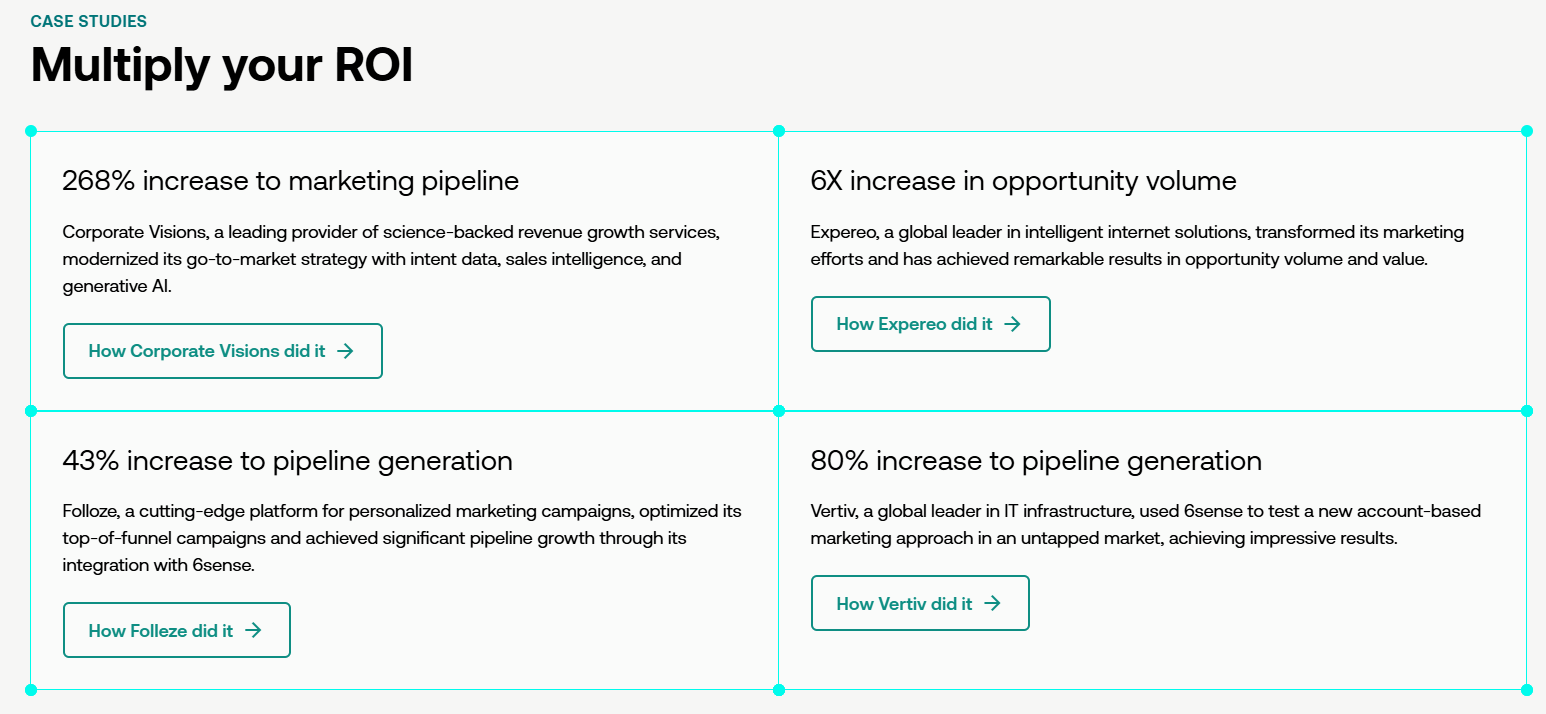
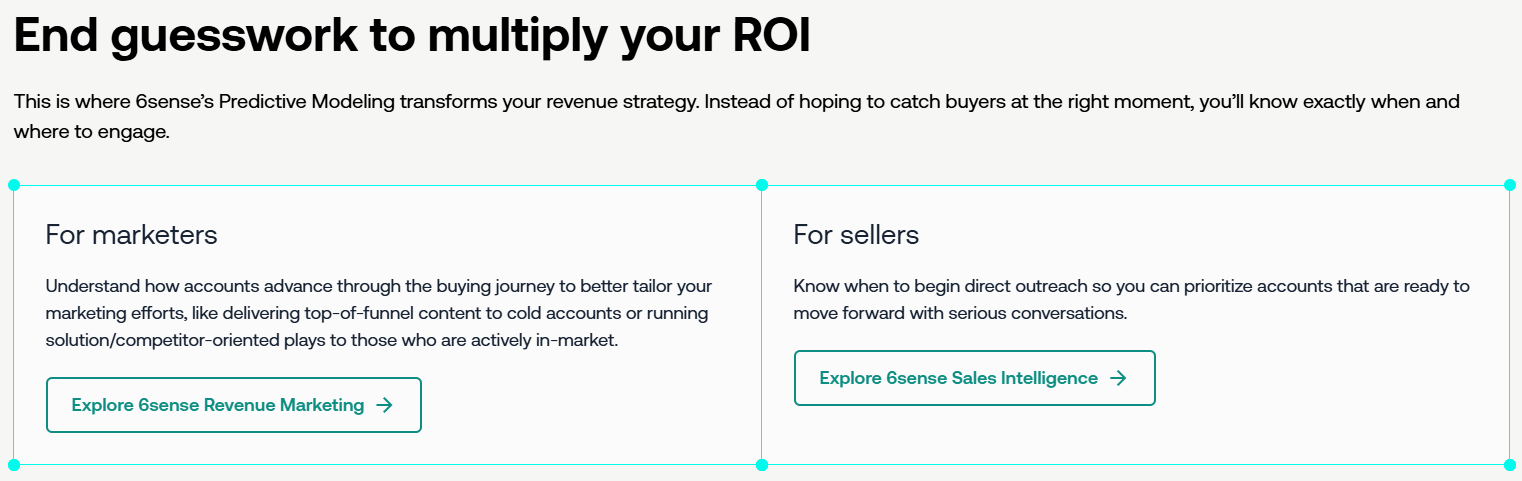
Revenue Marketing targets marketers who need to identify buying accounts, run personalized campaigns at scale, and measure revenue impact. The page leads with use cases (spot buying signals, maximize ROI, break down data silos) and closes with outcome metrics: 268% increase to marketing pipeline, 6x increase in opportunity volume, 43% increase to pipeline generation. These are client-reported results pulled from named case studies.
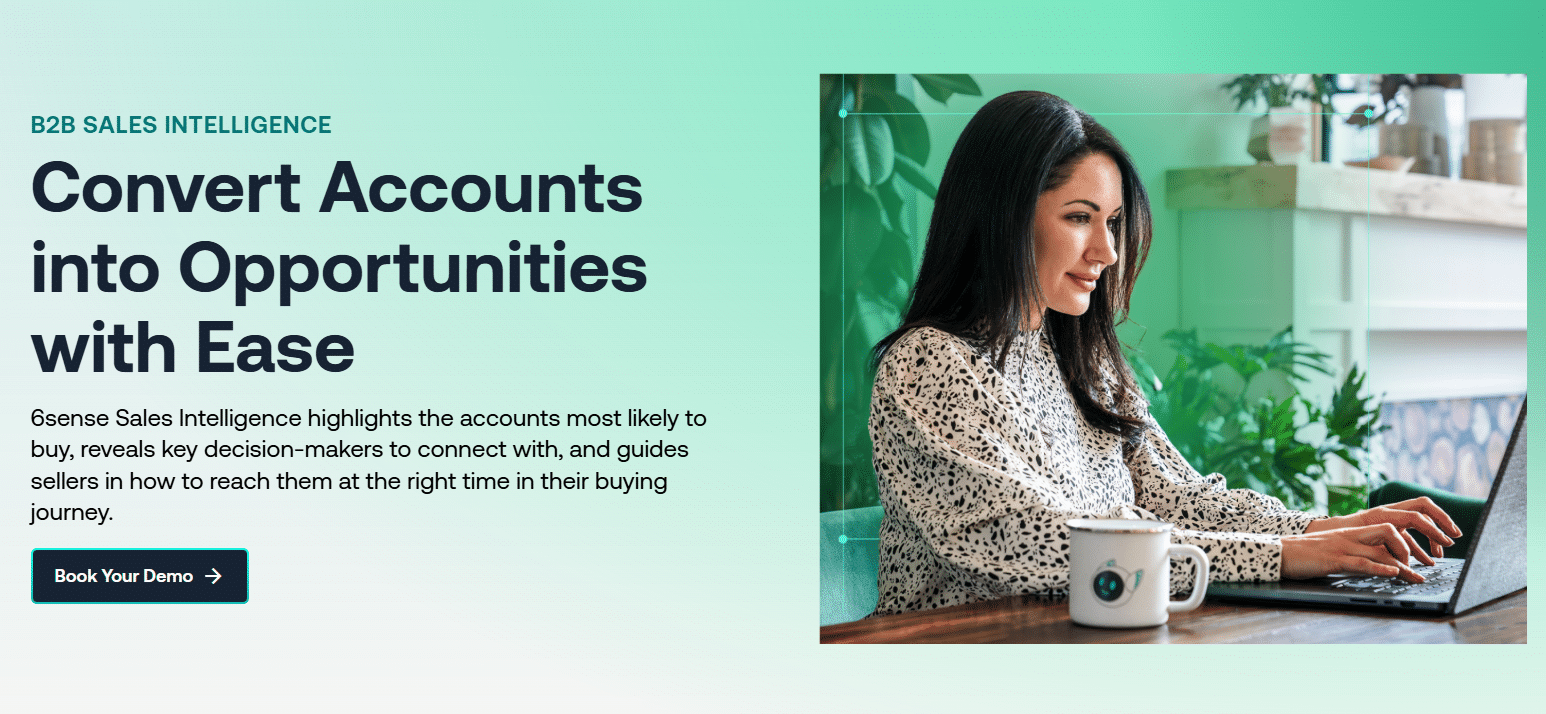
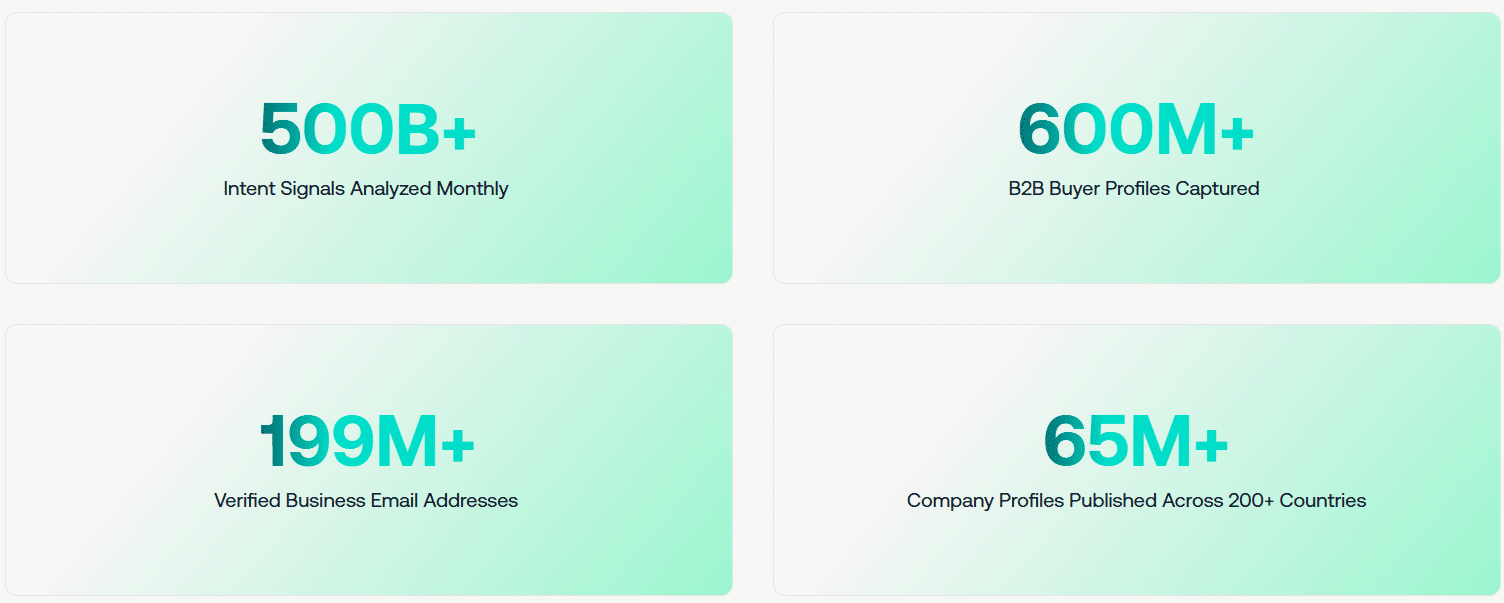
Sales Intelligence is made for sales teams. It shows which accounts are most likely to buy, identifies key decision-makers, and recommends how and when to reach them. The page includes trust signals: 500B+ intent signals analyzed monthly, 600M+ B2B buyer profiles captured, 199M+ verified business email addresses, and 65M+ company profiles across 200+ countries.
You can also find specific client results here: Okta generated $3M+ in pipeline in 6 weeks, Showpad saw 289% improvement in close rates, Bynder drove a 250% increase in outbound pipeline.
A VP of Sales in logistics does not want to read about a software company’s win rate. They want to see what happened at a company that looks like theirs. The organisation of case studies by industry is not a UX decision, but a conversion decision.
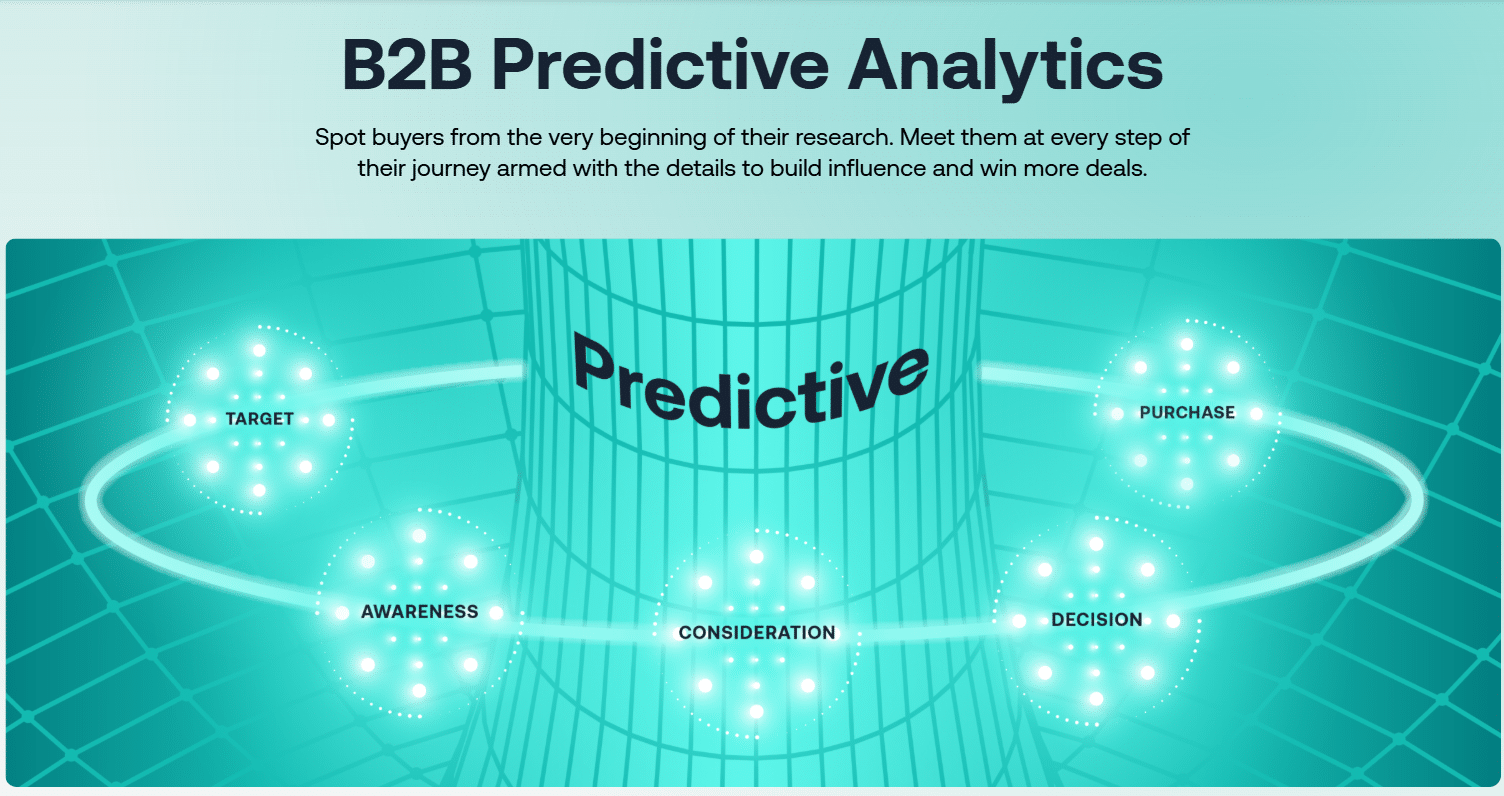
Predictive Analytics explains the engine behind both products. 6sense’s Signalverse collects over a trillion signals per day. The AI scores accounts using ICP fit, which buying personas are engaged, buying stage, and revenue potential. Predictive Analytics is where the platform’s claim to accuracy either holds or falls apart. 6sense is betting it holds.
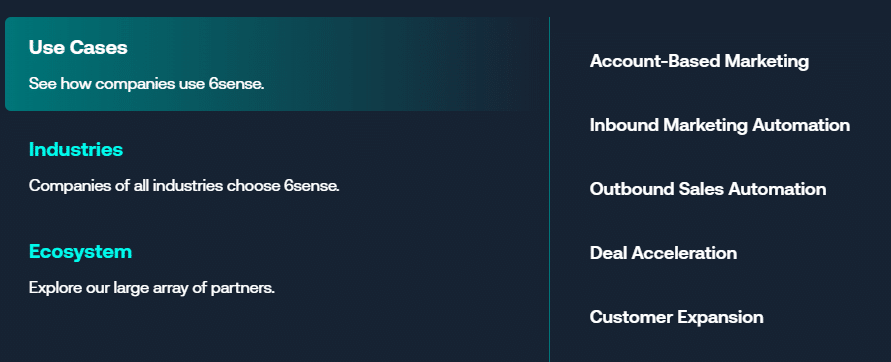
Their Solutions section maps these products to 5 use cases: account-based marketing, inbound marketing automation, outbound sales automation, deal acceleration, and customer expansion. Industries served include business services, financial services, manufacturing, software and technology, and transportation and logistics.
Pricing is not public. 6sense operates on custom contracts, typically 2-year agreements, with enterprise plans exceeding $100,000 annually for advanced capabilities. Every product page is organized around a buyer persona and a specific business outcome.
💡 Steal This: Structure your product pages around the outcome the buyer wants, not the feature you built. Lead with the result, use client metrics as the proof, and let the feature description do the supporting work.
Differentiators and Unique Assets
6sense has built a meaningful set of assets beyond the core platform.
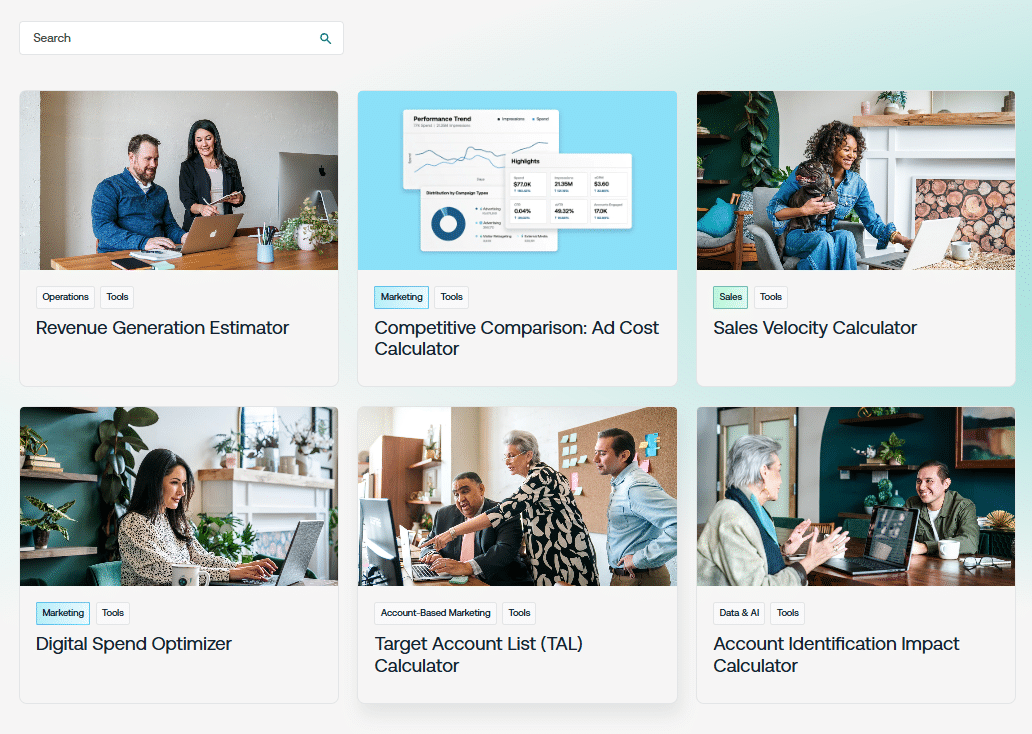
Six free calculators live on their tools page:
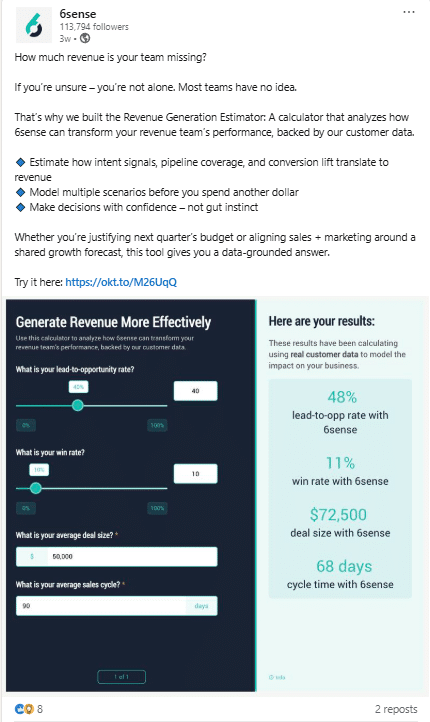
- Revenue Generation Estimator
- Competitive Comparison Ad Cost Calculator
- Sales Velocity Calculator
- Digital Spend Optimizer
- Target Account List Calculator
- Account Identification Impact Calculator.
Each one is designed for a specific member of the revenue team and requires no login. A sales leader runs the Sales Velocity Calculator before they ever see a demo. A marketing director uses the Digital Spend Optimizer to benchmark their current budget. By the time either of them books a call, 6sense has already solved a problem for them.
That is Cialdini’s reciprocity principle in practice. The help comes first, the ask comes later, and the conversion rate on that ask is higher because of it.
The Partner Network connects 3 types of partners, each with a different value proposition.
Agency Partners leverage their expertise to help clients implement ABM strategies at scale, with no additional headcount required on either side. Technology Partners build integrations into 6sense to improve customer retention, joining an ecosystem that already includes Salesforce, HubSpot, and Bombora. Publisher Partners join a preferred network that lets them sell ad placements at premium prices and expand their audiences using 6sense’s buyer data.
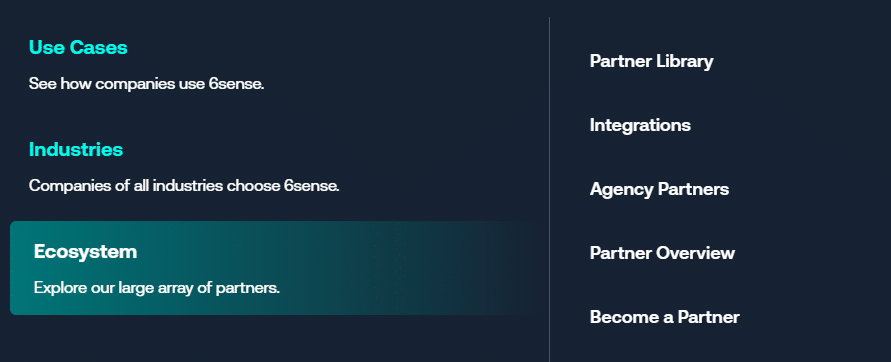
Co-marketing is part of the deal for all partner types: demand generation programs, joint content, and shared brand presence without proportional resource cost.
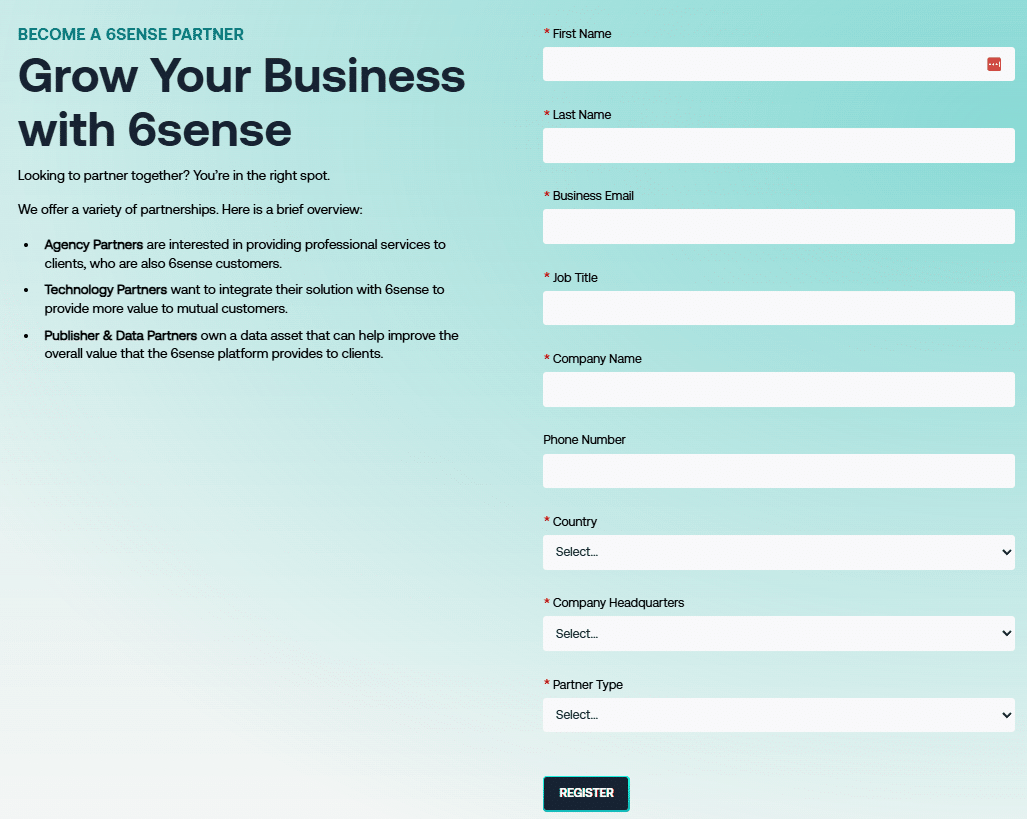
The application form asks for name, email, job title, company name, phone number, country, company headquarters, and partner type.
Once you select a type, the form continues with additional qualification questions: your company category, how ABM fits into your business strategy, and examples of the brands you work with. With this, 6sense is screening for partners who already have ABM-literate clients.
Community
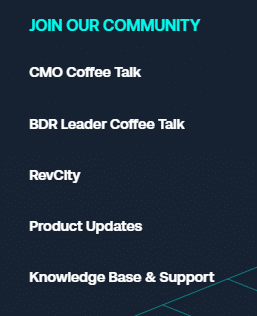
6sense built a community with multiple assets. There is RevCity, their online platform where customers and prospects learn, connect, and support each other.
There is the CMO Coffee Talk, a weekly peer forum for senior marketing leaders that runs on a no-recording, approval-only policy. There is the BDR Leader Coffee Talk, the same model for sales development leaders, running every other Friday.
There is a free ABM Certification tied to a physical book that gets shipped to your door. There is a Partner Network with three distinct tracks for agencies, technology integrators, and publishers.
And inside RevCity, a full Academy and Knowledge Base covers every product area. While most of the B2B SaaS companies have a Slack channel and call it a community, 6sense built an infrastructure. And most of it is open to people who have not bought anything yet. That is the point. The community is not a reward for becoming a customer, but it’s a reason to become one.
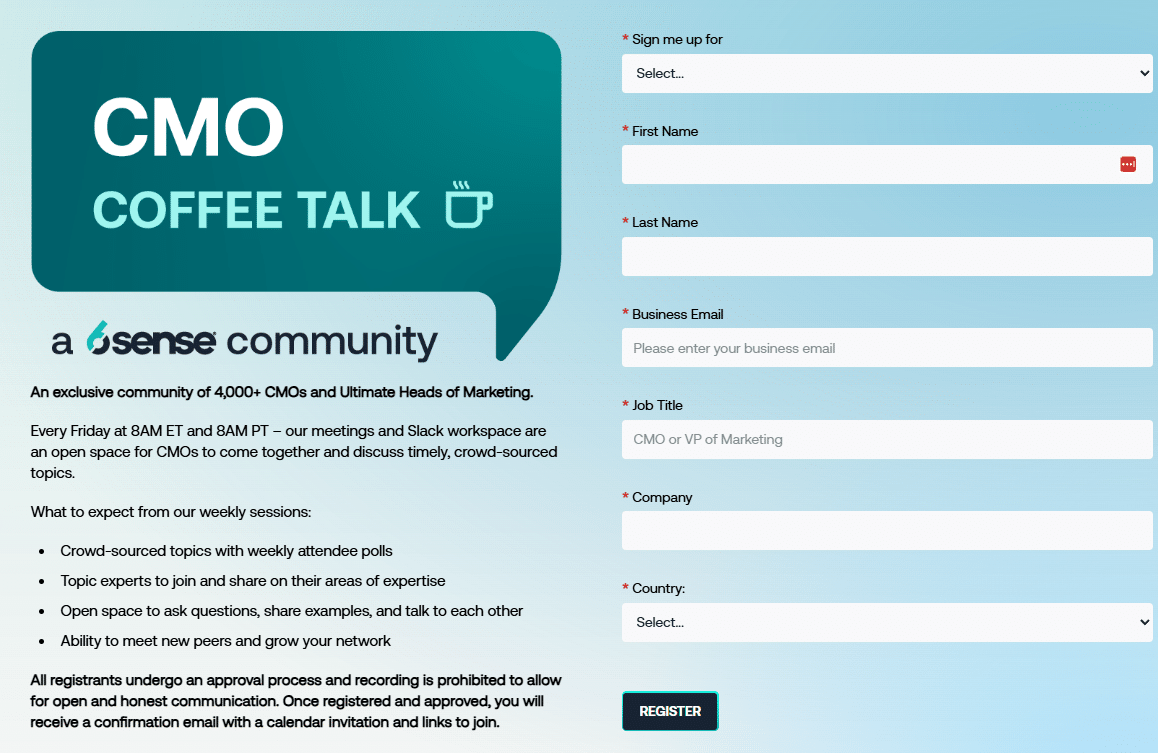
CMO Coffee Talk runs every Friday at 8 AM ET and 8 AM PT, hosted by Kelly Hopping, CMO at 6sense, and Matt Heinz, President and Founder of Heinz Marketing. Every registrant goes through an approval process before being admitted. They have a no-recording policy, which keeps the conversation honest and the room senior. Once approved, you receive a confirmation email with a calendar invite and the links to join. CMO Coffee Talk is a curated peer forum for CMOs where the gatekeeping is the product.
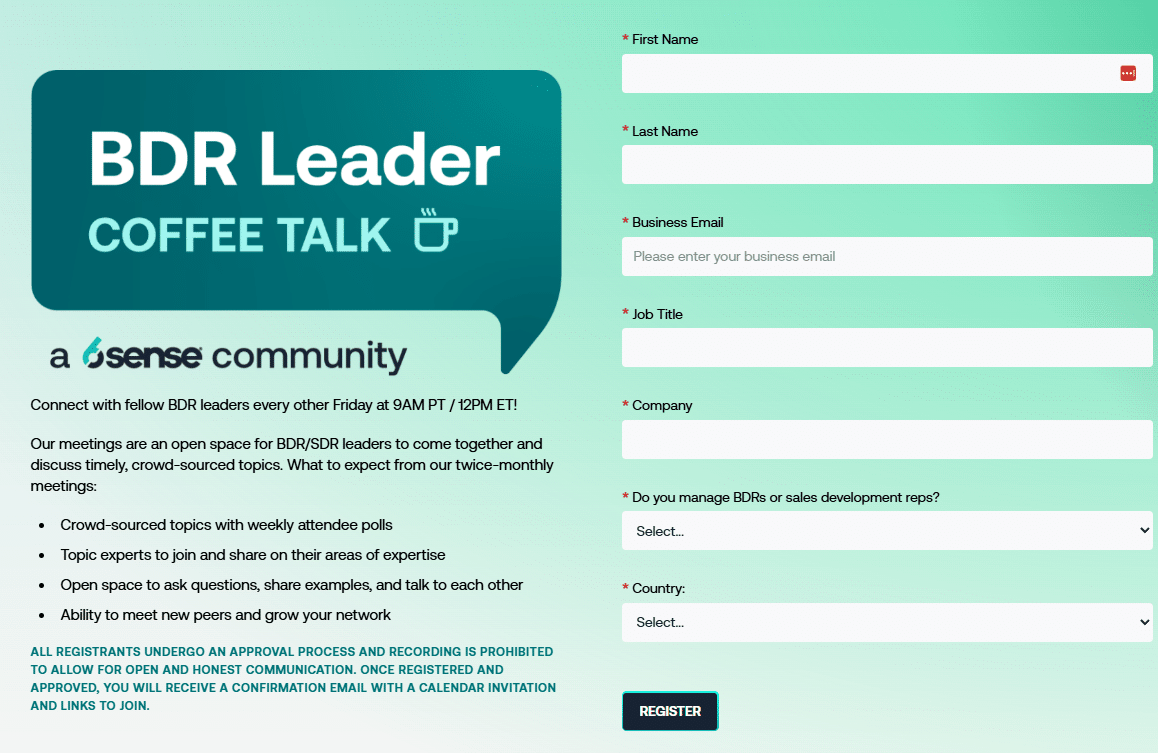
BDR Leader Coffee Talk runs every other Friday at 9 AM PT / 12 PM ET, following the same approval-required model. The format is built around 4 things:
- crowd-sourced topics voted on by attendees each week
- topic experts brought in to share on their specific area
- open Q&A where anyone can ask questions or share examples
- peer networking with other BDR and SDR leaders
The registration form asks one additional qualifying question: “Do you manage BDRs or sales development reps?” The session is clearly meant for leaders, instead of individual contributors.
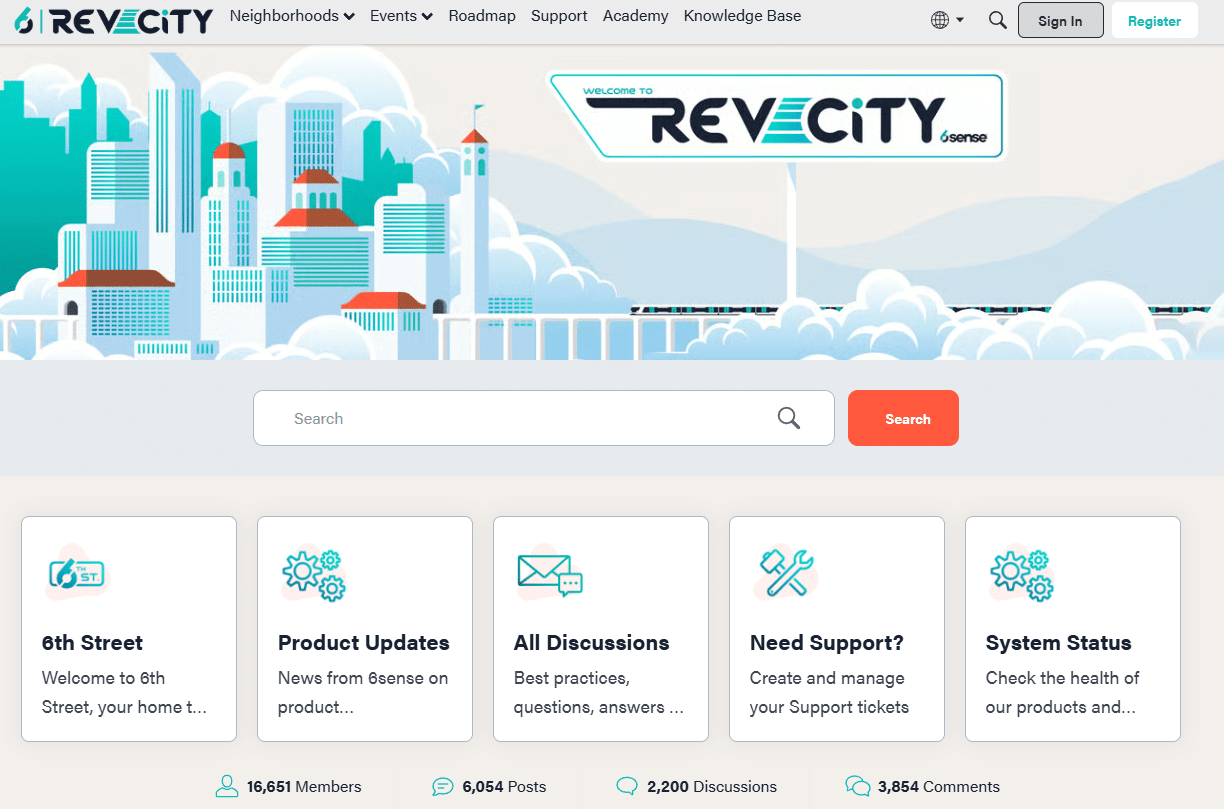
RevCity is their online community with 16.6k members, 6k+ posts, 2.2k+ discussions, and 3.8k+ comments. This platform is meant for learning, product support, and a review funnel.
Inside RevCity, The 6th Street is where new members start. It covers how 6sense uses 6sense, and includes product updates, support resources, and system status.
The right-side menu carries 4 persistent features:
- a prompt to review 6sense on G2
- a link to join the 6sense user group
- a list of upcoming events
- a top contributors leaderboard with points.
That leaderboard turns participation into a visible status signal, which keeps the community active without requiring 6sense to push content constantly.
The Academy and Knowledge Base live inside RevCity, too, covering every product area with structured articles. Topics include Revenue Marketing, Sales Intelligence, Predictive Analytics, AI Email, Intelligent Workflows, 6sense Data, Admin and Settings, Integrations and APIs, Onboarding, and Release Notes.
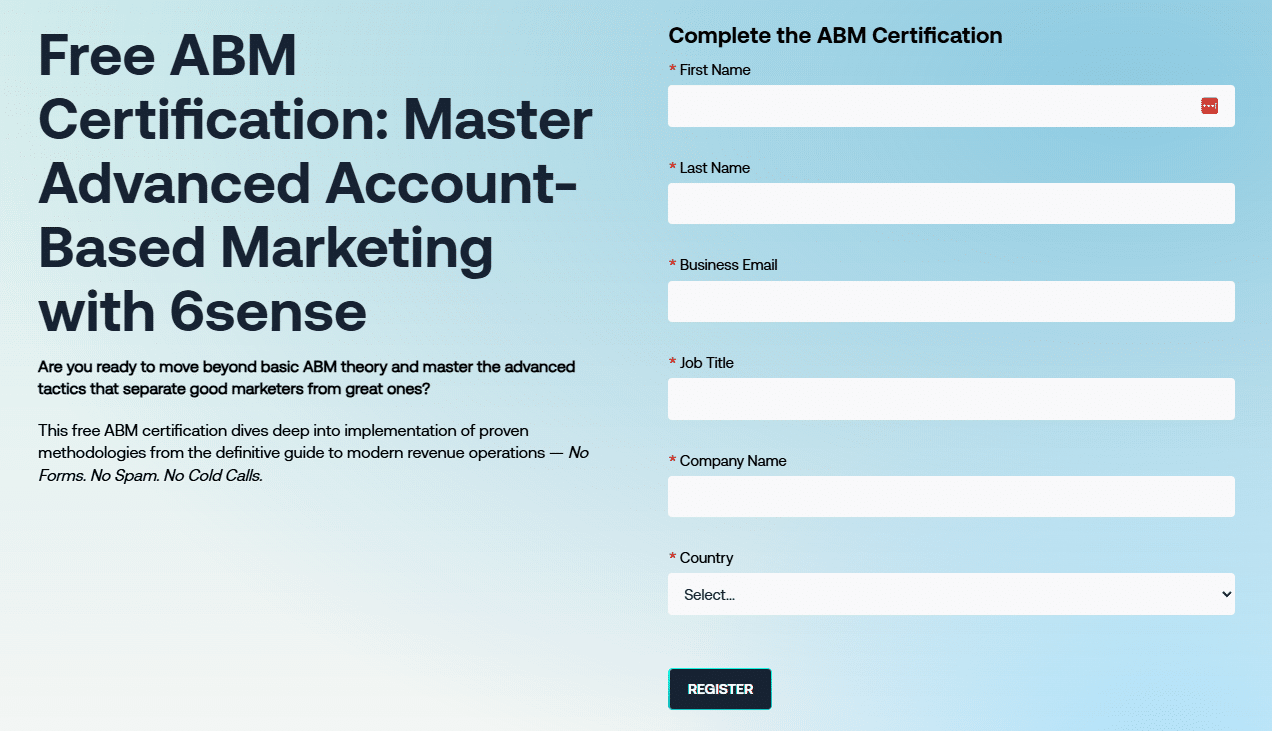
ABM Certification is a free credential program tied to the book No Forms. No Spam. No Cold Calls. by former 6sense CMO Latané Conant. The program covers four specific areas: account-based marketing and sales tactics, advanced intent signal interpretation, orchestrating personalised campaigns at scale, and revenue-focused metrics that matter to the C-suite.
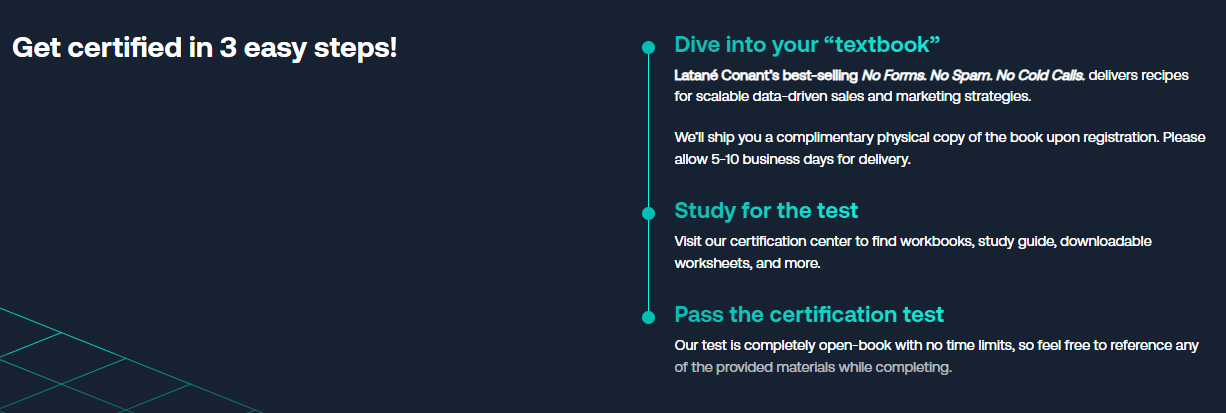
To receive the certification, you only need to take 3 steps.
- You register and 6sense ships you a physical copy of the book. Allow 5 to 10 business days for delivery.
- You visit the certification centre and work through the workbooks, study guide, and downloadable worksheets.
- You take an open-book test with no time limit. There is no pressure, no countdown clock, and no reason not to finish it.
A prospect who completes this program before ever speaking to a sales rep has already decided 6sense understands their world. That is what it means to become the pre-contact favorite. Research from 6sense’s own 2025 Buyer Experience Report shows that the vendor a buyer already favours before contacting anyone wins the deal roughly 80% of the time.
A prospect who completes this program before ever speaking to a sales rep has already decided 6sense understands their world. That is what it means to become the pre-contact favorite.
💡 Steal This: Build a free certification tied to your methodology. Train the market on how to think about the problem you solve. Certified prospects already speak your language when they arrive at a demo.
Leadership Presence Analysis
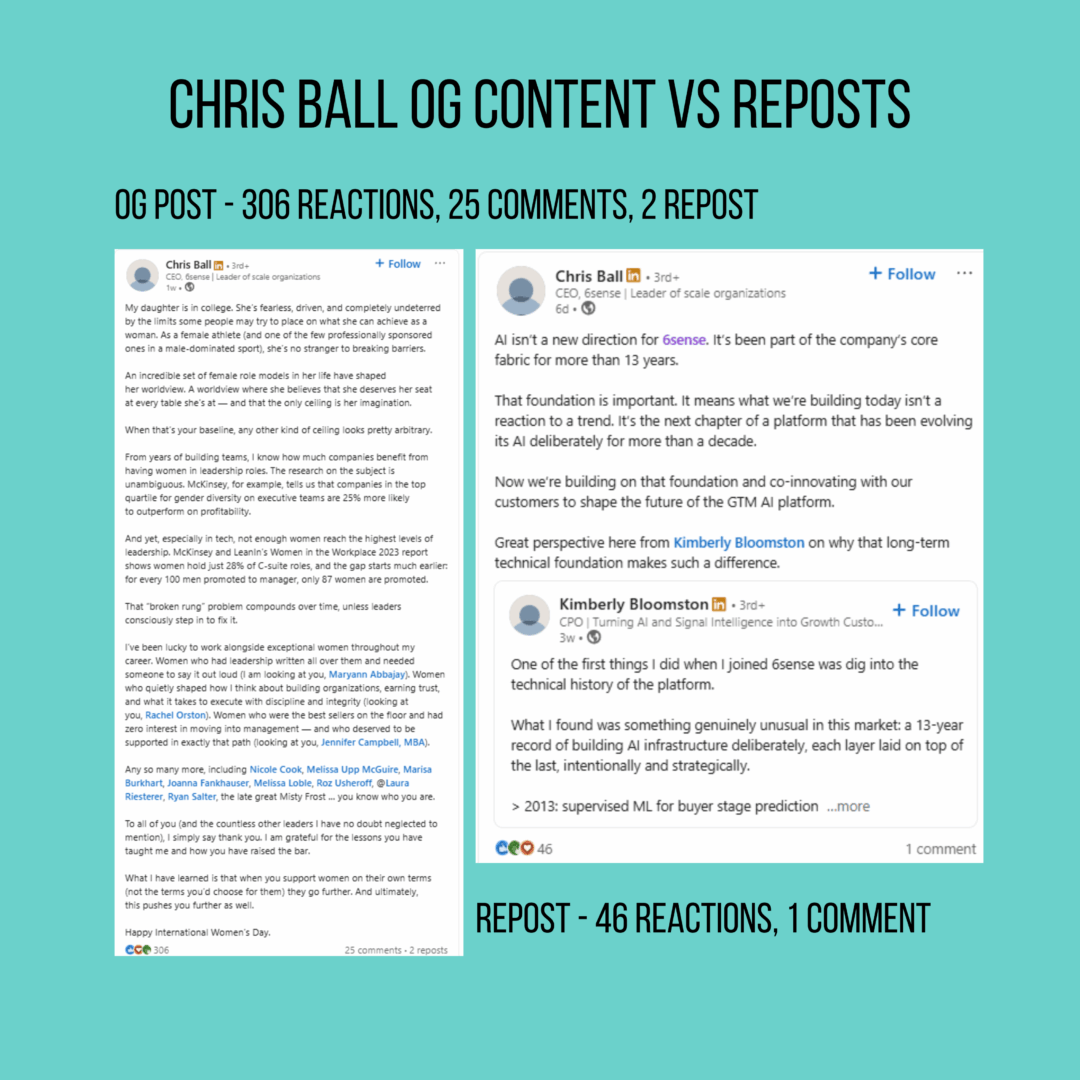
Chris Ball, the CEO of 6sense, has 4.4k LinkedIn followers. He posts primarily by resharing from 6sense’s company page, occasionally adding a short personal comment. One original post hit 306 reactions and 25 comments, but most reshares disappear into the feed. He has the audience, but there is no content strategy shown yet.
Raj Gupta, Chief Technology Officer
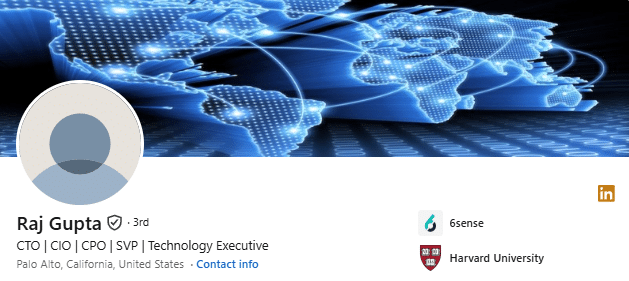
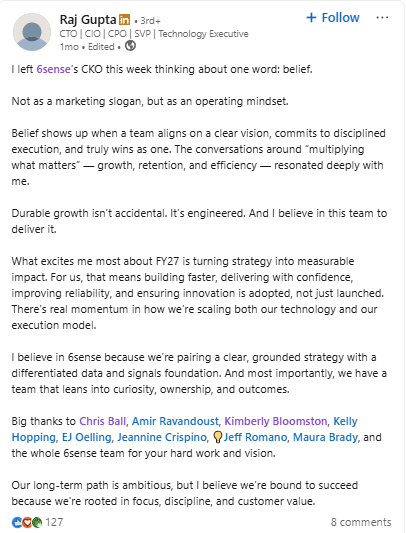
Raj Gupta, CTO has 16k followers, the largest audience of the three key people analyzed. In the last 3 months, he posted two original text-only posts, each reaching approximately 125 reactions. He has a big following and he shouldn’t sleep on that. With his posts he could reach more people and create opportunities for 6sense.
Kelly Hopping, Chief Marketing Officer
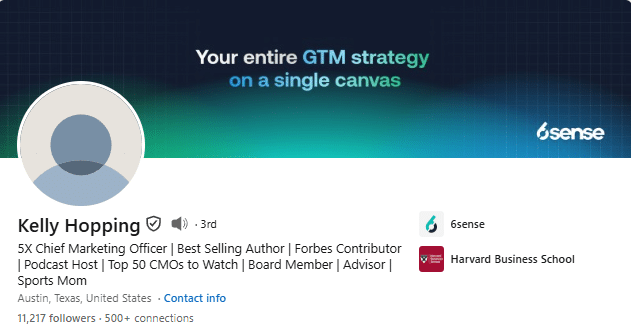
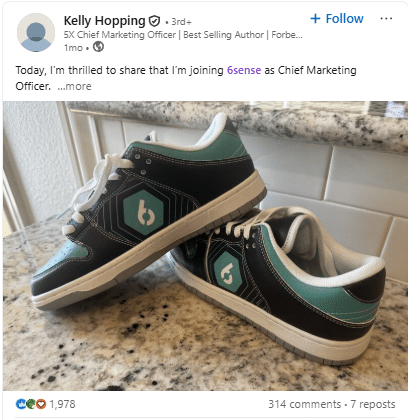
Kelly Hopping, CMO has 11.2k followers and is the most strategically active of the 3 executives reviewed. Her posting volume varies month to month, ranging from one post to seven. Most posts are original, mixing text-only and image-plus-text formats. Engagement typically falls between 150 and 350 reactions per post. Her announcement post about joining 6sense reached 1.9k reactions, 314 comments, and 7 reposts. She co-hosts the CMO Coffee Talk, which reinforces her positioning as a peer to her ICP rather than a marketer talking at them.
Across all three, the pattern is the same: strong potential, but irregular execution. LinkedIn’s 2025 B2B Marketing Benchmark found that 94% of marketers agree trust is critical to B2B success, and that buyer committees form preferences through expert voices and trusted content ecosystems long before engaging a vendor.
💡 Steal This: Your C-level executives’ LinkedIn audience is a distribution channel you’re probably not using. Even one original post per month from a technical founder or exec compounds over time into category authority you can’t buy with ads.
Social Media Strategy
LinkedIn is 6sense’s primary social channel, with 114k followers. They post multiple times per day, which is an unusually high cadence for a B2B SaaS company.
Content pillars include:
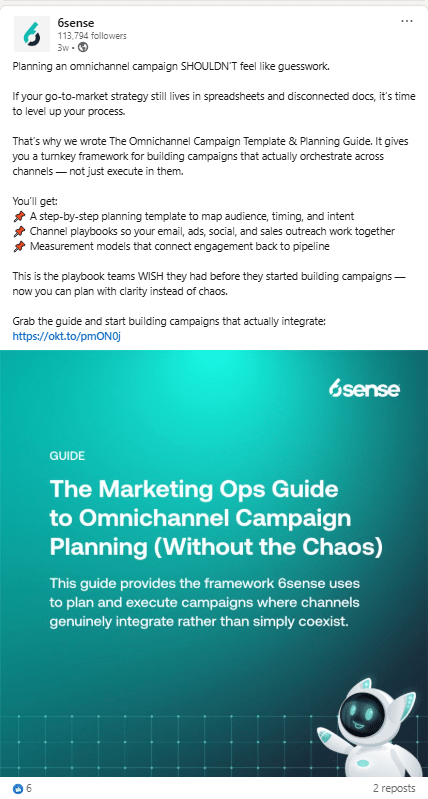
- educational guides
- webinar promotions
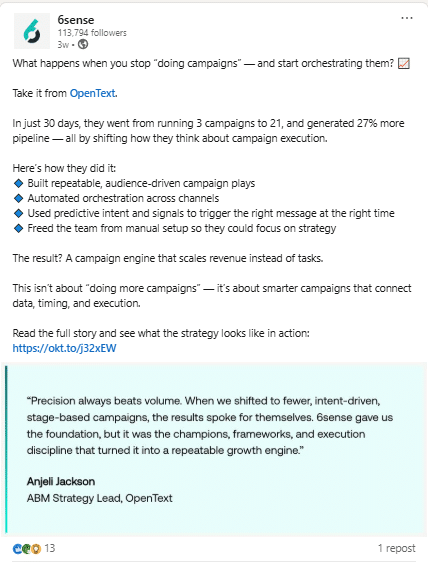
- client testimonials with links to case studies
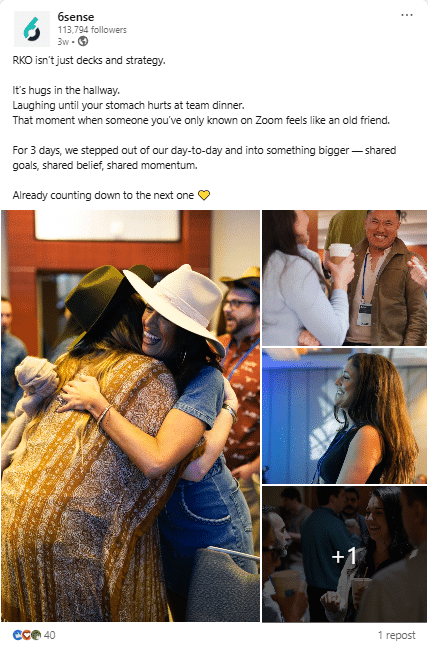
- event participation announcements
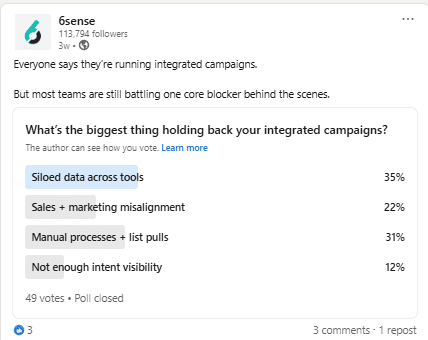
- polls
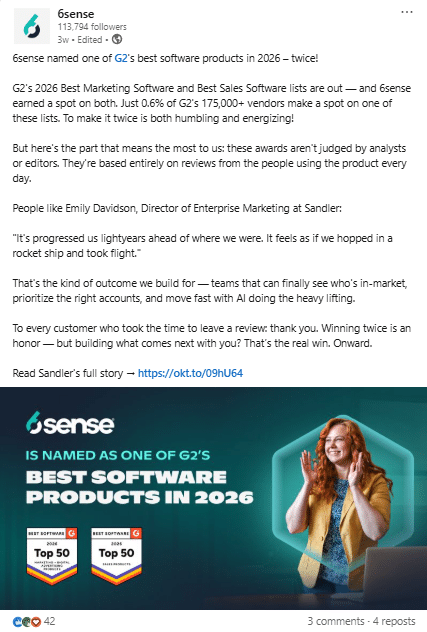
- award announcements
- blog content
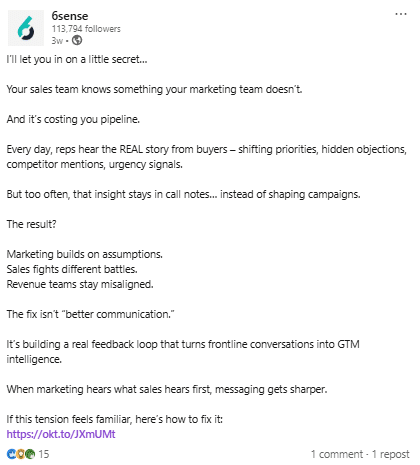
- free tools promotions
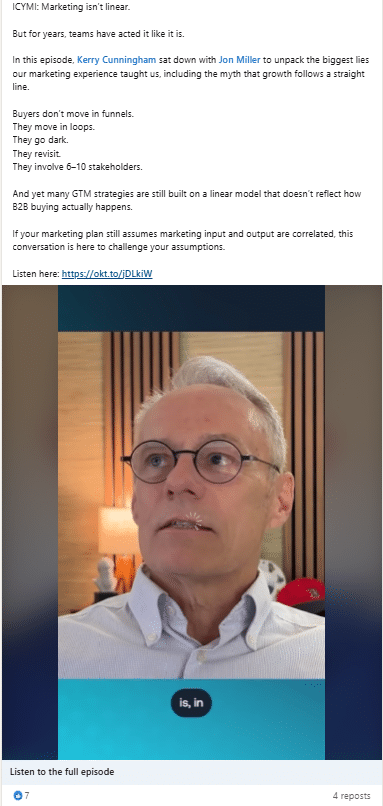
- video and podcast clips
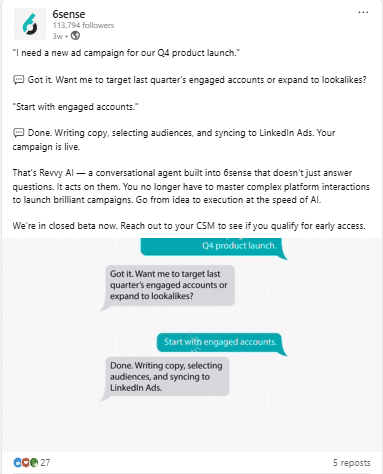
- early access to new features
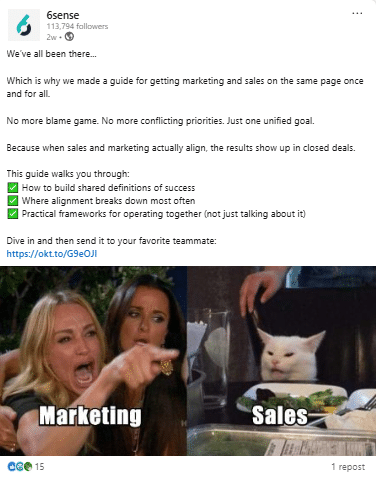
- funny memes
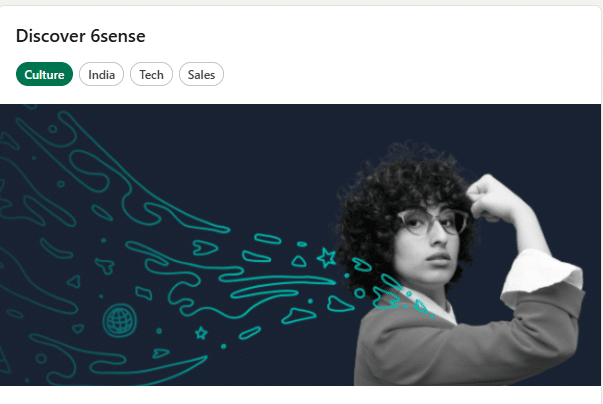
The Life tab on their LinkedIn profile segments into Culture, India, Tech, and Sales categories, featuring employee spotlights, c-suite profiles, and company photos.
The content mix strategy is really interesting. Educational guides and webinar promotions fill the top of the funnel. Client testimonials and case study links handle the middle. Free tool promotions and early feature access create a reason for existing prospects to keep following.
Polls generate engagement signals that 6sense can use to understand what their audience cares about. Memes keep the page from reading like a corporate broadcast. Every content type has a job, and none of them are decorative.
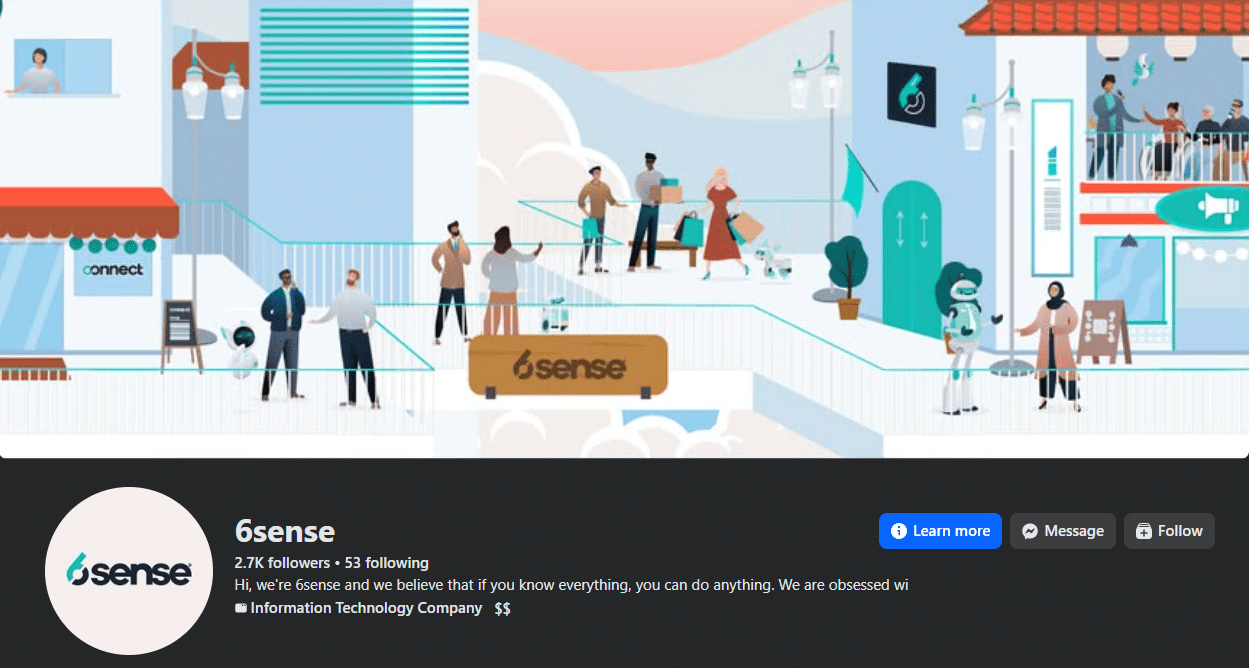
Facebook has 2.7k followers and has been dormant since September 2023. Notably, nearly every post on the page carries an angry reaction, which is unusual and worth monitoring. They were posting more about company culture than promotional posts. They were always posting about International awareness days, participation at events, and webinars.
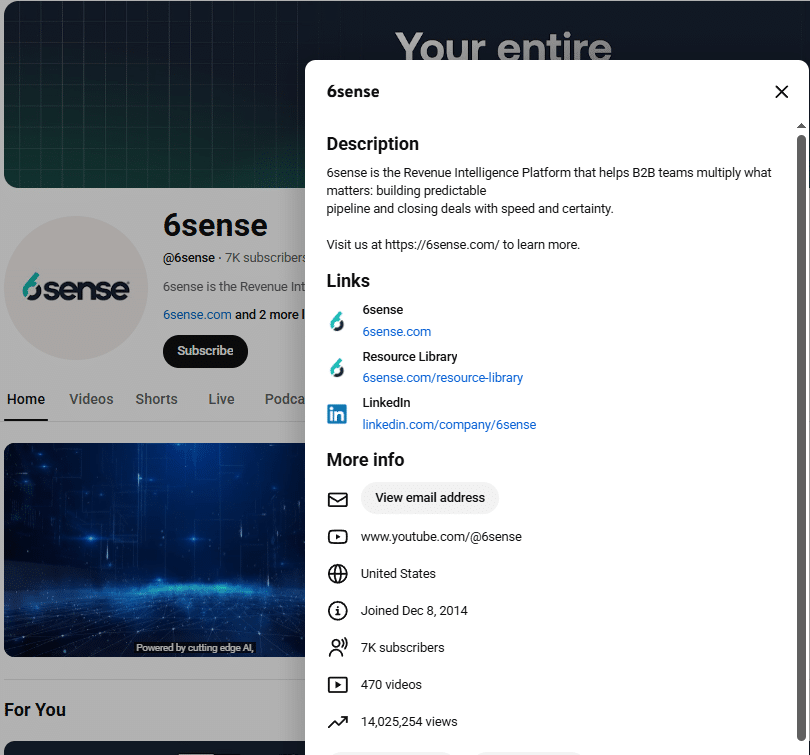
6sense’s YouTube channel has 7k subscribers, 470 videos, and over 14 million total views. The channel has long-form content under the Revenue Makers podcast brand, explainer videos, and YouTube Shorts. Long-form uploads have been irregular, with some months seeing 5 uploads and others with none. The most recent long-form video was 2 months ago, and the last YouTube Short posted was in February 2026.
On YouTube Shorts, they are mostly posting snippets from Revenue Makers, with no other strategy besides that.
No Instagram, X, or TikTok presence was found. The overall picture is a company that made two clear bets. LinkedIn gets the daily cadence, the content variety, and the organic reach with enterprise revenue teams.
YouTube gets the long-form investment that compounds in search over the years, with 14 million views to show for it. Everything else is dormant or absent. For a platform selling to revenue leaders who live on LinkedIn and search YouTube when they want to learn something, that is a great choice.
💡 Steal This: Don’t spread your social media presence across platforms you can’t maintain. One active, high-quality channel with consistent content beats four dormant ones.
Top-Performing Content
We usually analyze the last 3 months of activity, but LinkedIn stopped working when we tried to scroll this far. Therefore, these are top 3 performing content in the last 3 months.
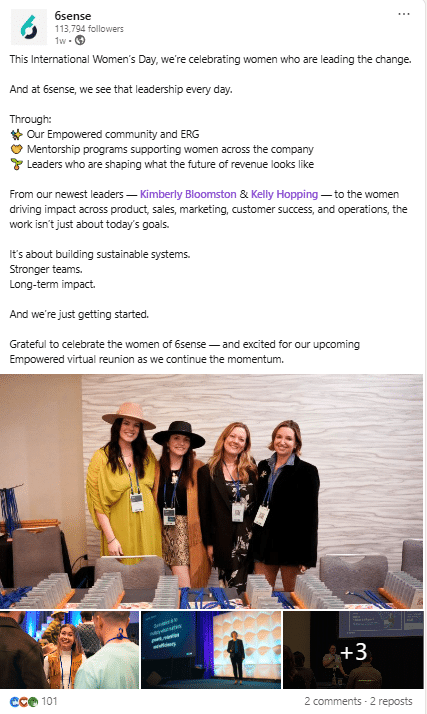
- a post about International Women’s Day, with 101 reactions, 2 comments, 2 reposts
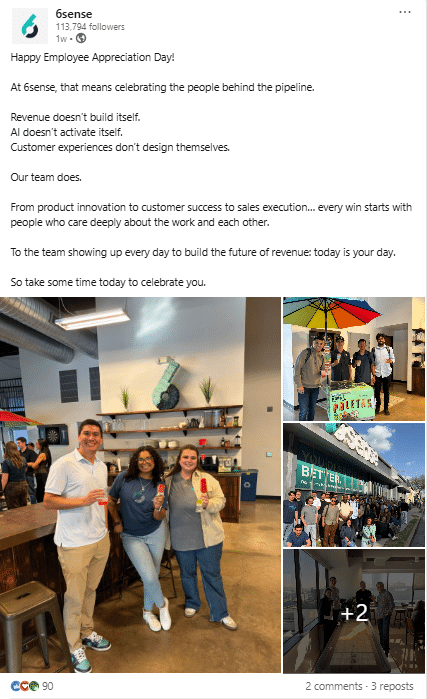
2. a post about Employee Appreciation Day, with 90 reactions, 2 comments, 3 reposts
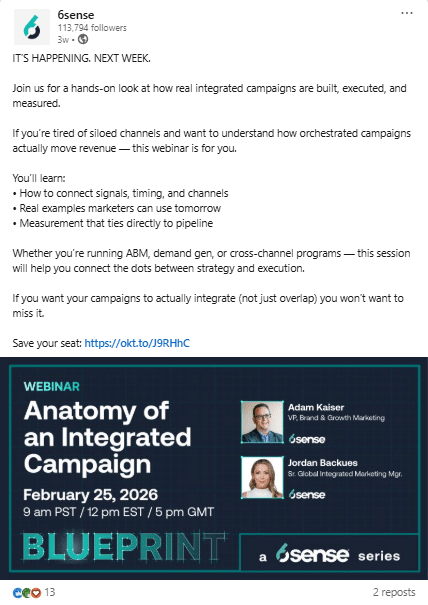
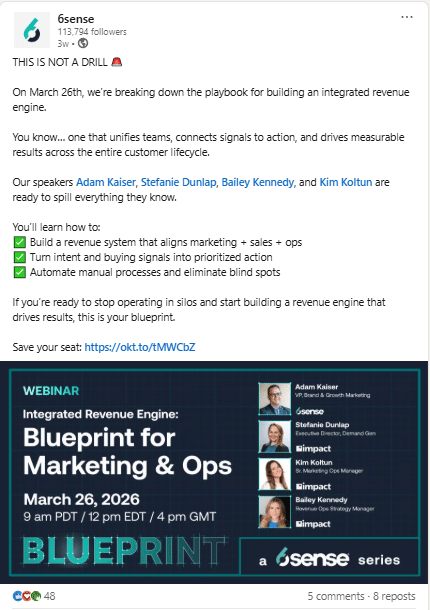
3. a post about Blueprint webinar, with 48 reactions, 5 comments, 8 reposts
Culture posts outperforming a product webinar on LinkedIn is not a 6sense-specific phenomenon. Human content travels further on the feed than product content. The value is not in the reactions themselves. It is in the algorithm reach those reactions generate, which puts the next product post in front of people who would not have seen it otherwise.
Youtube
YouTube long-form tells a different story from the LinkedIn numbers above.
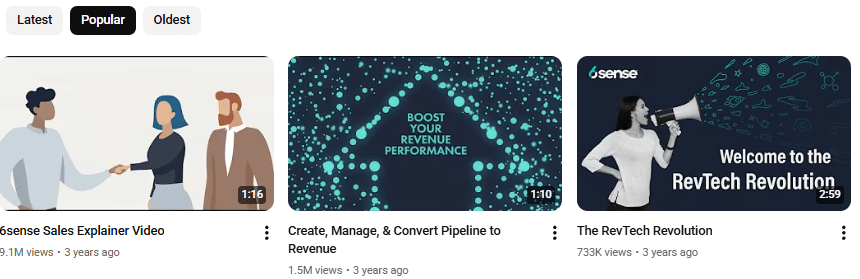
These are top 3 all time videos:
- 6sense Sales Explainer Video, with 9.1M views, 811 likes and 0 comments
- Create, Manage, & Convert Pipeline to Revenue, with 1.5M views, 1k likes, 2 comments
- The RevTech Revolution, with 733k views, 145 likes, 0 comments
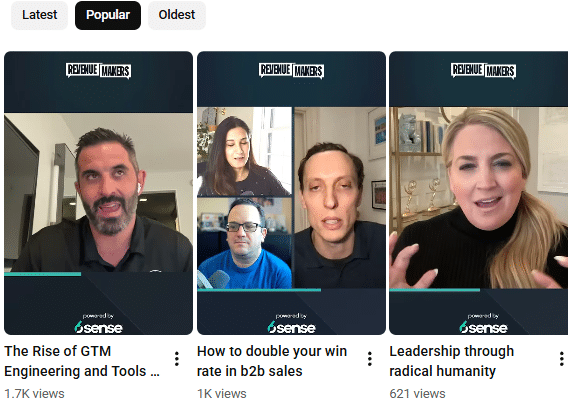
YouTube Shorts, pulled from the Revenue Makers podcast, show more modest numbers:
- The Rise of GTM Engineering and Tools Like Clay, with 1.7k views, 37 likes
- How to double your win rate in b2b sales, 1k views, 5 likes
- Leadership through radical humanity, 621 views, and 3 likes
- The Sales Explainer has been accumulating views since it was published.
The title is a search query: exactly what a sales leader types into YouTube when they want to understand how 6sense works. That is the optimisation. Title as keyword, video as answer. Create, Manage, and Convert Pipeline to Revenue follows the same logic. It names an outcome, not a feature. The RevTech Revolution is the outlier: broader, less searchable, and the view gap between it and the top two shows it. Specific titles outperform broad ones on YouTube. That pattern holds here.
The 14 million YouTube views versus 114k LinkedIn followers tells a story. LinkedIn reach comes from followers, the algorithm, and how often you post. YouTube reach comes from search. Someone types “how does account-based marketing work” or “what is intent data” into YouTube, and a 6sense video shows up. That person never followed 6sense.
They were not in any retargeting list. They found the content because the title matched what they were looking for. That is SEO running through a video channel, and it compounds every month, whether 6sense posts that week or not.
💡 Steal This: Build two content engines. Post consistently on LinkedIn to stay visible to the audience you already have. Publish videos on YouTube with titles that match what your buyers search for, so new audiences find you without you having to chase them. One engine needs daily fuel. The other one runs on its own once you build it.
Paid Advertising Strategy
6sense runs a substantial paid advertising operation across LinkedIn and Google. No Meta ads were active at the time of research.
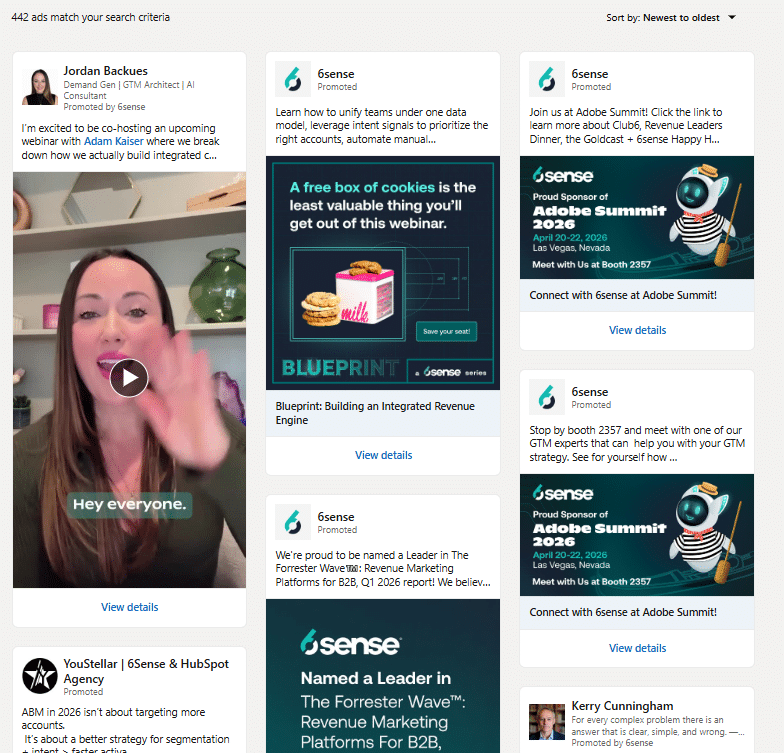
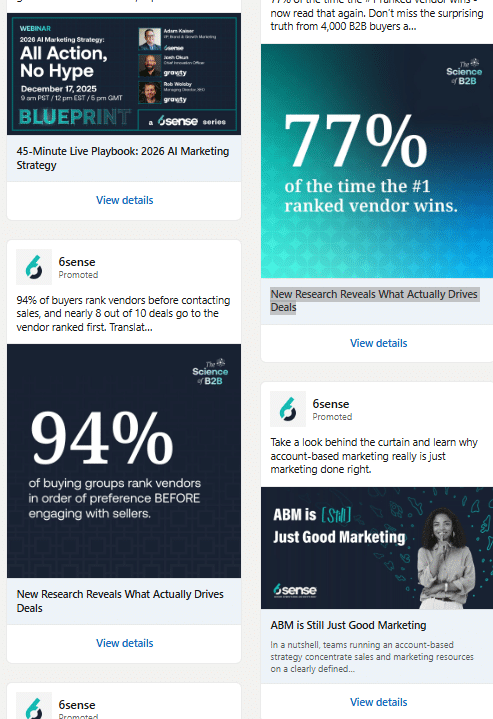
6sense is running 442 ads. Formats include sponsored content, UGC-style video, and promoted posts. Key messages include the Blueprint conference, Adobe Summit co-presence, the Forrester Wave Q1 2026 recognition, and research-led headlines like “New Research Reveals What Actually Drives Deals.” Product ads lean on specific statistics: “77% of the time the #1 ranked vendor wins” and “94% of buying groups rank vendors in order of preference before engaging with sellers.” Recruiting ads also appear in the search.
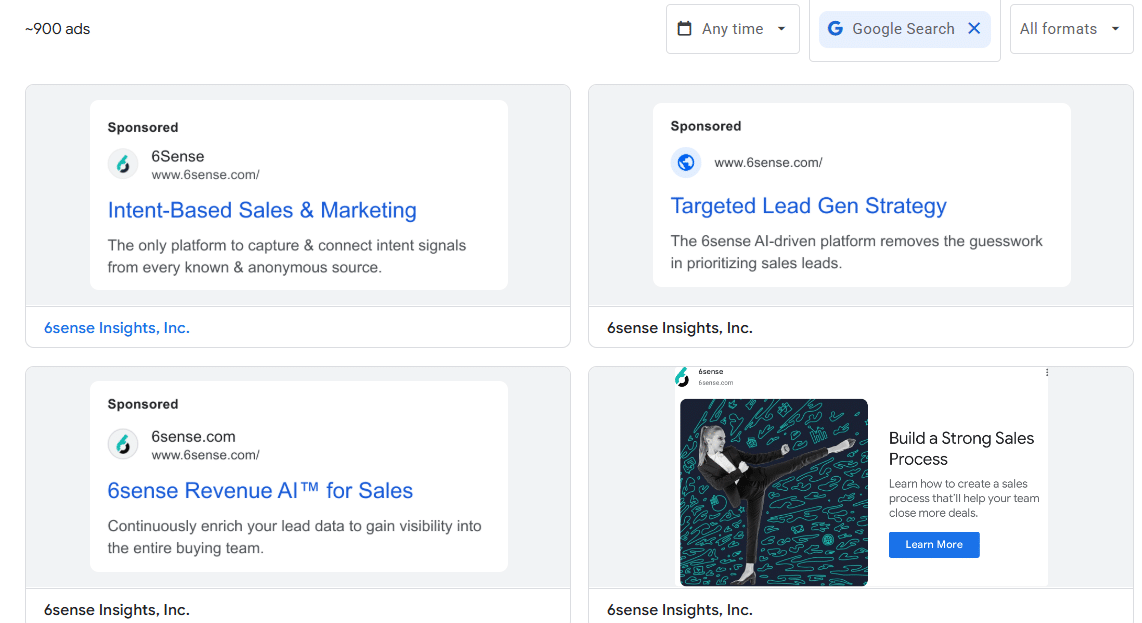
Google Search shows approximately 900 ads. Headlines include “Intent-Based Sales and Marketing,” “6sense Revenue AI for Sales,” “B2B Display Advertising – 500B+ Monthly Intent Signals,” “Corporate Email Finder,” and “5 Most Important KPIs for ABM.” These ads span both branded and category search terms, covering in-market buyers searching for 6sense by name and category researchers who have not yet landed on a vendor.
On Google Shopping 6sense has approximately 300 ads. Headlines include:
- B2B Buyer Experience Guide, Over 2500 Buyers Surveyed;
- B2B Advertising Funnels, What is Full-Funnel Marketing;
- B2B Buyer Intent Data, Uncover Hidden Demand;
- 270M Leads, 48M Companies;
- Sales Intelligence Platform, Find New B2B Insurance Clients.
The Shopping placements are being used as a content and lead magnet discovery channel, not a product purchase path, which makes sense for an enterprise SaaS with no self-serve checkout.
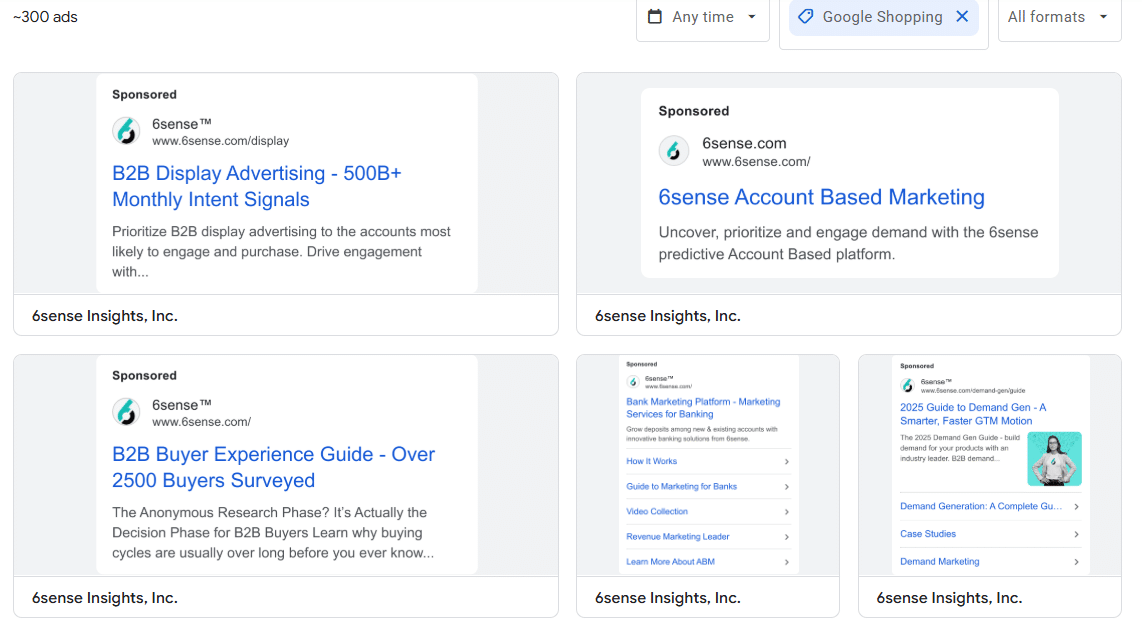
Across LinkedIn, Google Search, Google Shopping, and YouTube, the message doesn’t change: 6sense finds buyers who are already researching but have not yet contacted a vendor. The data volume (500B+ monthly intent signals, 270M leads) is the proof point that appears in ad after ad. The Forrester Wave recognition is being leveraged in paid ads, because third-party validation earns attention in crowded search results.
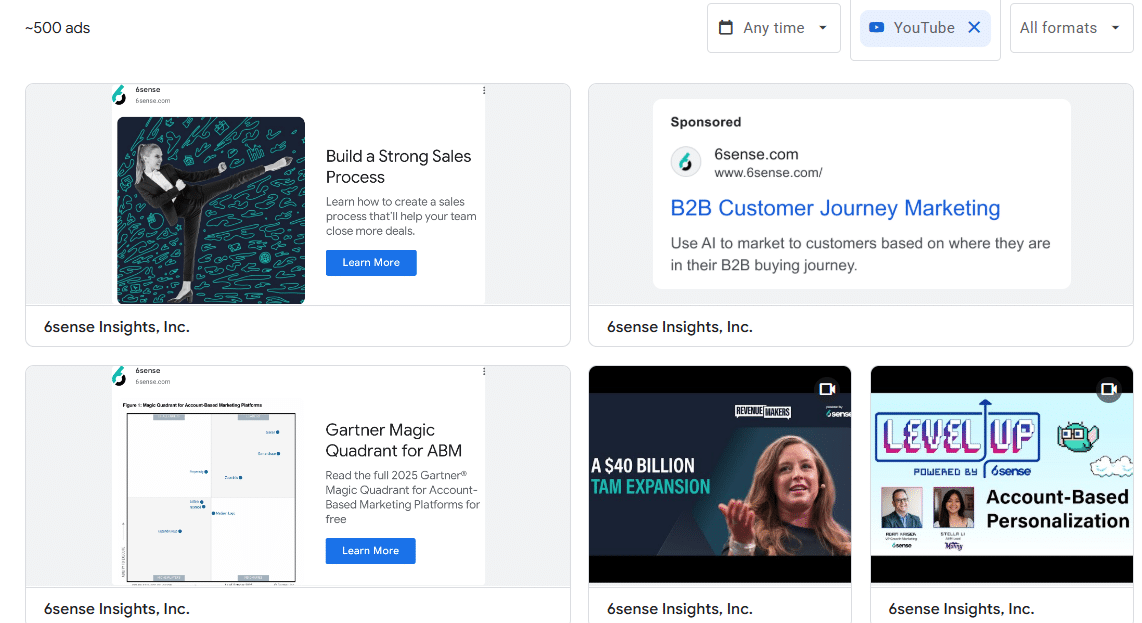
On YouTube, 6sense is running approximately 500 ads. The format mix includes promoted video content alongside text placements. Headlines across the YouTube ads include:
- B2B Customer Journey Marketing
- 6sense Buying Stages – Proceed with Confidence
- Using SPIFFs and Sales Incentives to Boost Revenue
- B2B Ads Based on Buyer Journey
- 6sense AI-powered ABM Software – Software for B2B Marketers
- 6sense B2B Marketing Tool
- See Why Companies Pick 6sense.
The YouTube ad strategy runs parallel to their organic YouTube presence: the channel already has 14 million views from evergreen content, and paid placements extend that reach to audiences who have not yet discovered the channel organically.
The cross-platform message is consistent throughout: 6sense surfaces buyers before they raise their hand, and the data behind the platform is the reason to believe it. Third-party validation earns attention in competitive search and feed environments.
A 2026 AdRoll study found that companies aligning ABM with account-based advertising see 60% higher win rates, and 82% of marketers said ABM helps them engage the right accounts at the right time. 6sense’s own ad strategy reflects this: they are running ABM-style messaging in their paid media, targeting by job title and intent signals.
The LinkedIn ads are specifically targeted by seniority and function. Product ads reference buying group behavior statistics, which signal that the targeting is aimed at CMOs, VP of Sales, and Revenue Operations leaders, not general marketers. The Adobe Summit co-presence ad is an event-based ABM play: reach the audience where they are already gathered.
There is one more layer worth noting. The statistics in those LinkedIn ads, the 94% and the 77%, come from 6sense’s own buyer research. They are using data their platform generates as the creative for ads targeting the buyers that data describes. That is a company eating its own cooking in public.
💡 Steal This: When you earn a third-party validation, put it in your ad headlines. A buyer who does not know you yet will click on a company that a recognised analyst or publication already vetted before they click on a company that is just describing itself.
Sales Funnel from Social Media
LinkedIn operates as both a top-of-funnel awareness channel and a mid-funnel conversion path. Guides and educational posts on LinkedIn lead to landing pages where the next step is downloading a campaign planning template or booking a demo.
The “Book a Demo” button is persistent in the top navigation on every page a LinkedIn post points to, which means every piece of content ultimately has an exit ramp to a sales conversation.
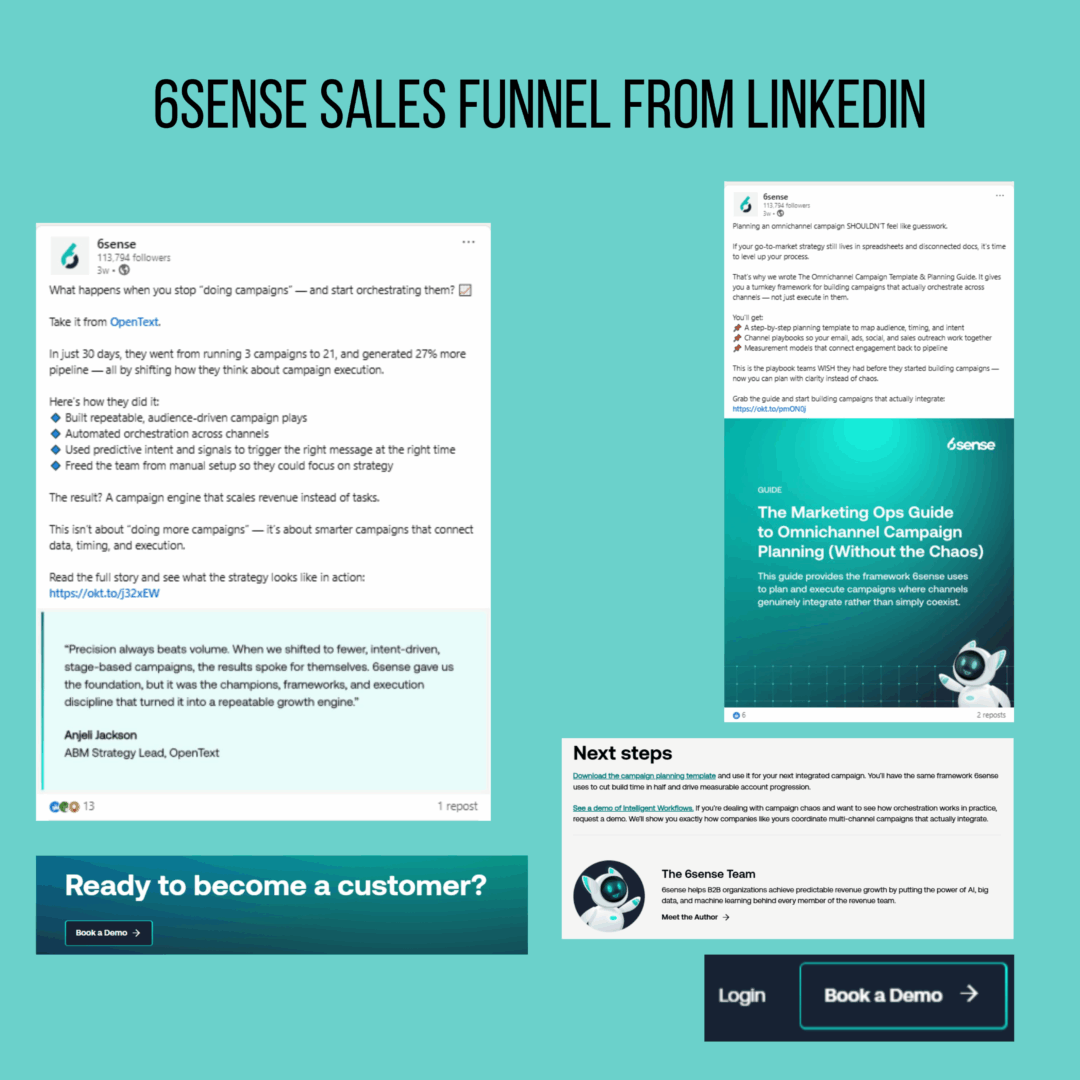
Case studies on LinkedIn link directly to the customer story pages. Each case study page ends with a “Ready to become a customer? Book a Demo” banner. The journey is: social post surfaces a business outcome, case study provides the proof, demo CTA closes the loop.
Youtube
YouTube carries a similar mechanic on some videos, with a “Schedule a Demo Today” CTA visible in the video’s description. The demo form collects name, email, company, job title, phone number, country, and what the prospect wants to know more about.
A client testimonial appears on the demo page itself: “Would you rather spray and pray, wasting a lot of resources, or would you prefer to target somebody who’s raising their hand looking for your solution? That’s the 6sense difference,” written by Chris Kein at KBX Logistics.
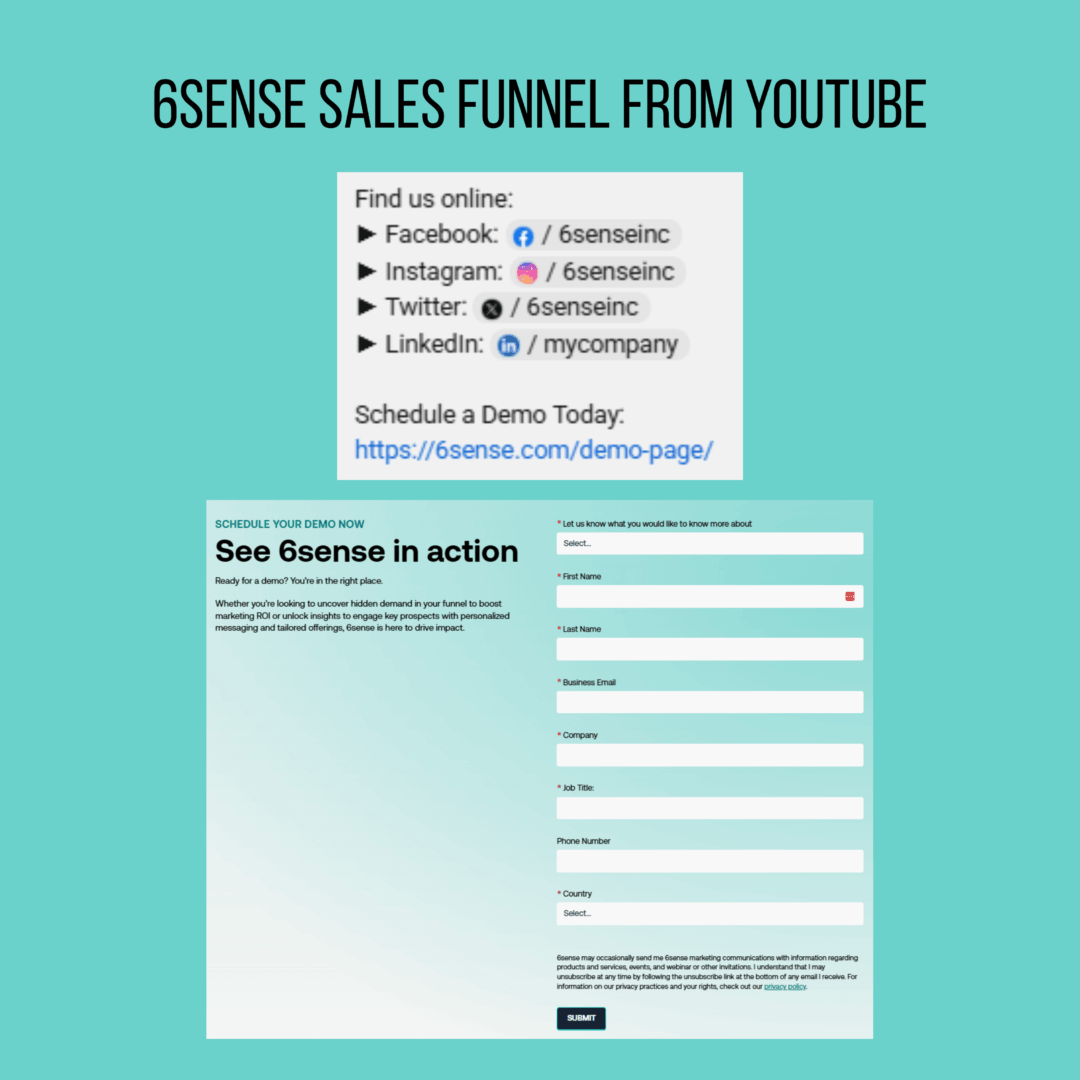
Funneling LinkedIn and YouTube traffic to a demo booking is the only conversion path 6sense offers. 6sense’s own buyer research shows that the pre-contact favorite wins roughly 80% of B2B deals, and that buyers are still around 61% through their journey before first contact. 6sense needs to be building preference through content before the buyer ever clicks the demo button. Their LinkedIn cadence and YouTube library are the mechanism for that.
This is a textbook sales-led growth funnel with content as the warming layer. Every channel role is clearly defined: LinkedIn builds awareness and delivers warm accounts, YouTube provides evergreen search discovery and product education, the demo form qualifies and routes. There is no self-serve path, no free trial, no product-led entry point. Buyers who are not ready to book a demo have no low-friction way to stay in the 6sense ecosystem outside of signing up for RevCity or the certification program.
💡 Steal This: Place your highest-converting social proof element (a client quote, a specific result) directly on your demo booking page. The moment a prospect is filling in your demo form is the highest-intent moment in their journey. Don’t let it go unassisted.
Reviews and Social Proof
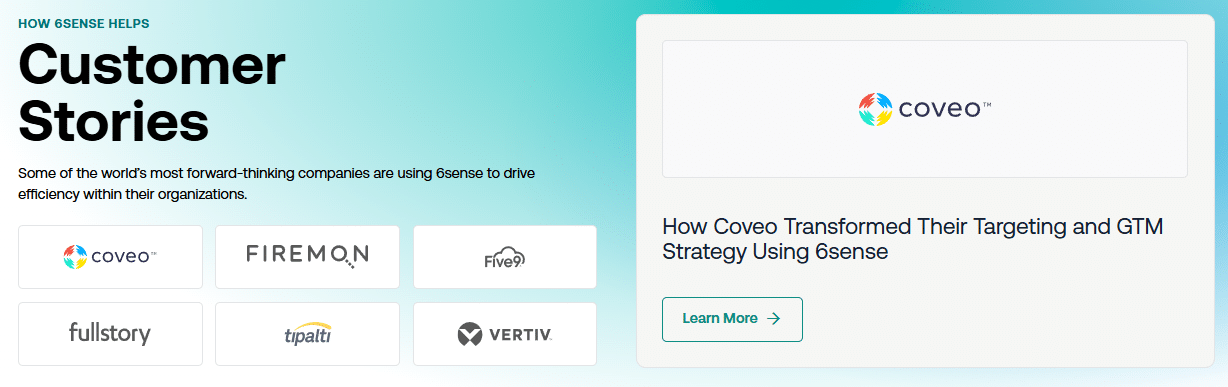
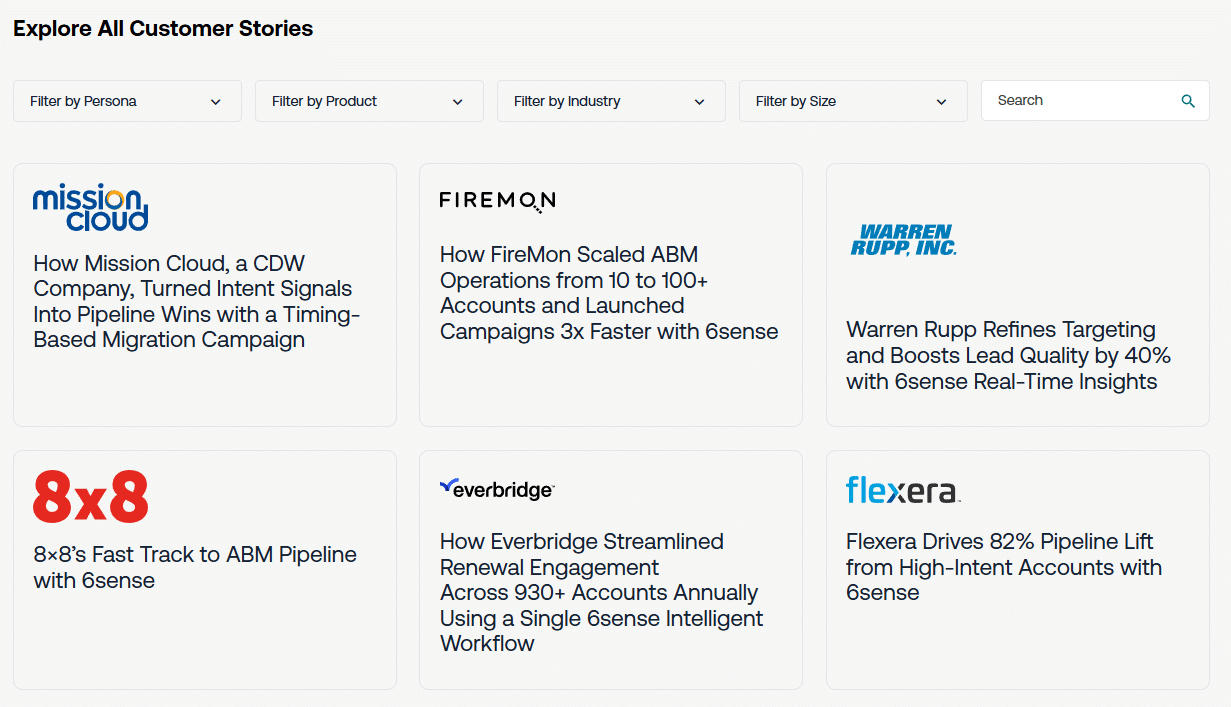
The best case for buying 6sense is not on G2. It is on their own Customer Stories page. The testimonials are from named leaders at Clari, Khoros, NanaWall, Vendavo, and Bonterra. Case studies include specific outcomes: Warren Rupp boosted lead quality by 40%, Flexera drove an 82% pipeline lift from high-intent accounts, and OpenText scaled from 3 to 21 campaigns with 27% new revenue in 30 days.
Third-party reviews
On third-party review platforms, the picture is mixed.
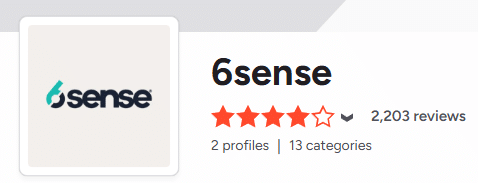
G2 shows a 4.1/5 overall. Revenue Marketing is rated 4.3/5, and Sales Intelligence is rated 4.0/5. Positive themes across both products include the strength of intent data, predictive insights, and the ability to identify in-market accounts.
Negative themes include data loading speeds, a steep learning curve, and inconsistent contact data accuracy in the Sales Intelligence product. Implementation takes 3 months for Revenue Marketing and 2 months for Sales Intelligence. Time to ROI is 13 months for Revenue Marketing and 11 months for Sales Intelligence. For an enterprise procurement team building a business case, those are the numbers that go into the slide.
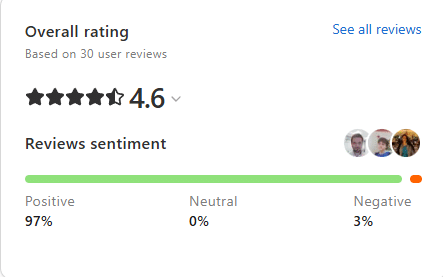
Capterra shows a 4.6/5 rating, with feature quality at 4.4 and value for money at 4.5.
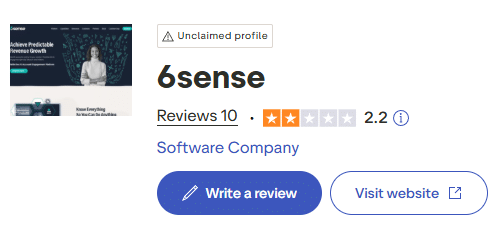
Trustpilot shows a 2.2/5 on an unclaimed profile, with reviews (dated 2024 to 2025) raising GDPR concerns and complaints about unsolicited emails. The profile is unclaimed, which means these reviews sit publicly without a company response. For a company that sells intent-driven outreach solutions, GDPR complaints about their own outreach are a significant credibility risk.
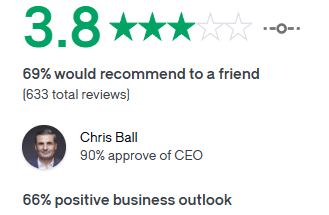
Glassdoor shows 3.8/5 overall. 69% of employees would recommend the company to a friend. 90% approve of the CEO. 66% are positive on the business outlook.
The sub-scores tell a more specific story: Compensation and Benefits 4.2, Diversity and Inclusion 4.1, Culture and Values 3.9, Work/Life Balance 3.8, Career Opportunities 3.8, and Senior Management 3.6.
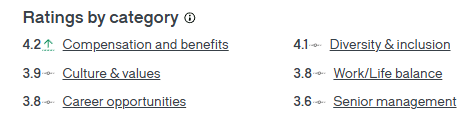
That last number is the one a buyer should pay attention to. Senior Management at 3.6 on a platform that just changed CEOs is a signal worth watching, not a reason to walk away, but a question worth asking in a vendor review.
The Trustpilot situation deserves attention. A 2.2/5 unclaimed profile surfacing GDPR complaints is the kind of thing a competitor’s sales team will use in a competitive deal. Claiming the profile and responding publicly costs nothing. Leaving it unaddressed is a choice with a cost.
💡 Steal This: Claim and actively respond to every review platform where your company appears, including ones with negative reviews. A thoughtful company response to a critical review often converts skeptical readers more effectively than five positive ones.
Content Marketing and Demand Generation
Beyond RevCity and the two Coffee Talk series covered in the Differentiators section, 6sense runs one of the most comprehensive B2B content operations in the category. Here is what they have built.
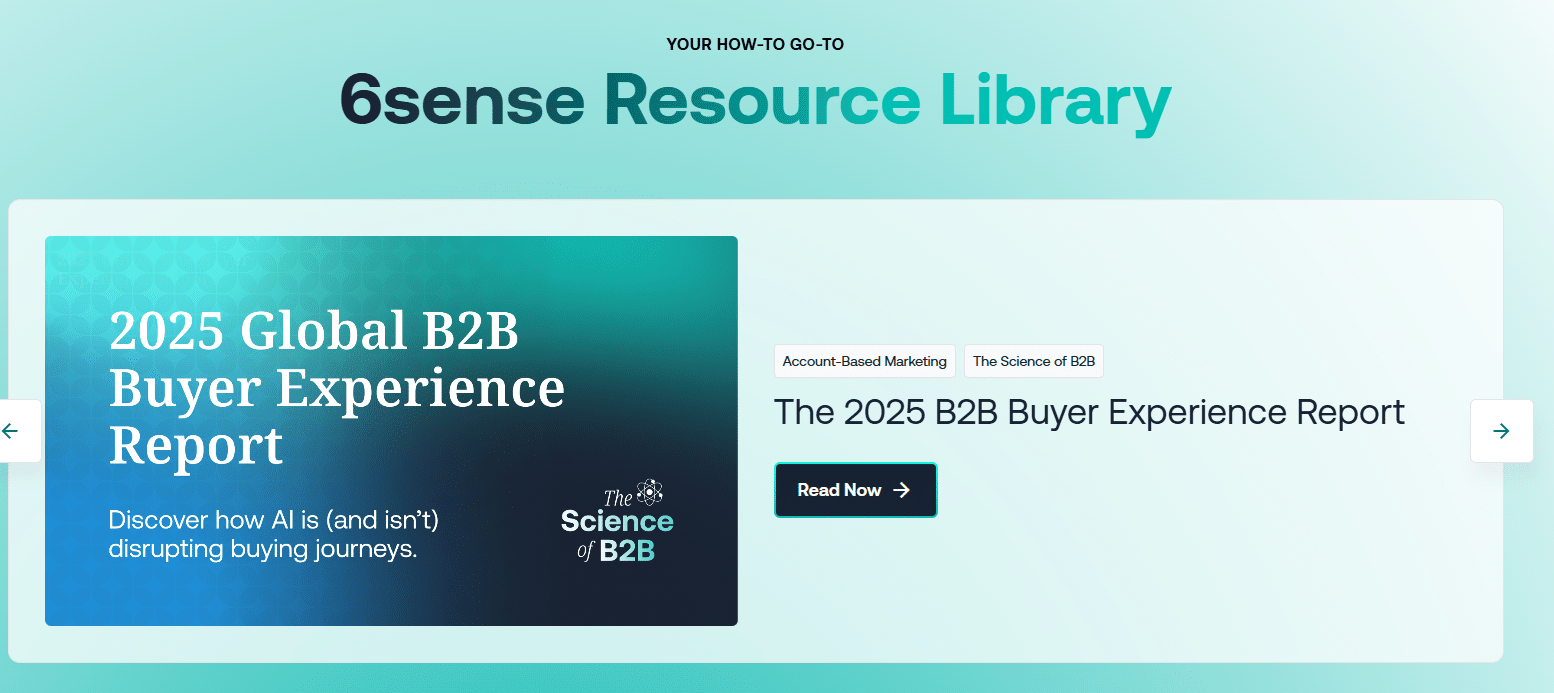
The library is filterable by topic (ABM, Data and AI, Sales, Marketing) and by content type.
This is the list of content types available:
- 6sense for 6sense
- blueprints
- ebooks and analyst reports
- events and webinars
- guides
- Pipeline Generation Tuesday
- Revenue Makers
- TalkingSense
- The Science of B2B
- tools
- videos.
Pipeline Generation Tuesdays are a video series in which hosts Mac Conn and Latané Conant (6sense’s CRO) welcome fellow revenue leaders to share their best practices for holding productive pipeline meetings. Talking Sense is another series hosted by their CRO, in which you’ll find entertaining, engaging, and full of insights revenue leaders can start using today.
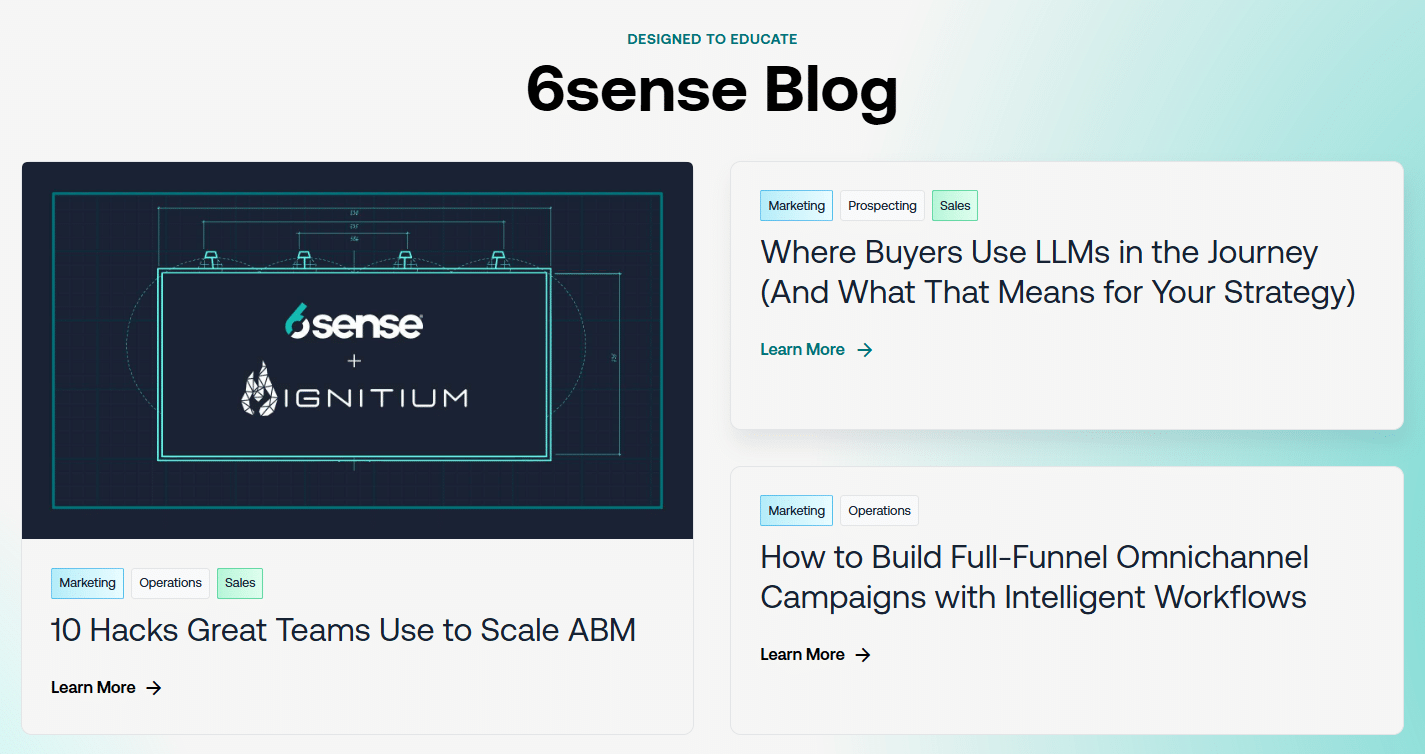
The Blog publishes approximately 6 posts per month. Topics span ABM, Data and AI, marketing, operations, prospecting, and sales intelligence. Articles are structured with H2 headings, bullet points, and inline visuals. Each post shows an author’s byline with role, reading time, and publish date. Posts close with a “Ready to see 6sense in action? Learn More” banner and a Meet the Author section with links to the author’s full archive.
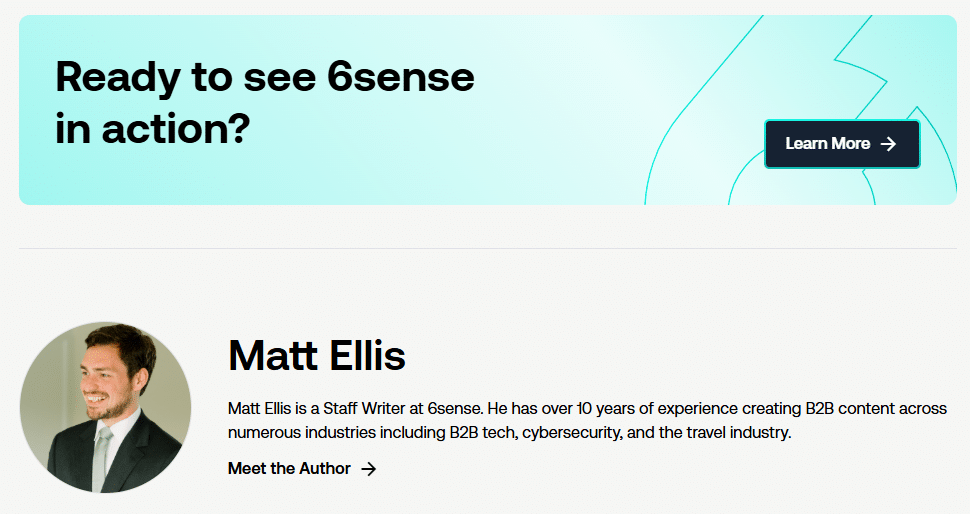
Recent titles include “10 Hacks Great Teams Use to Scale ABM” and “How to Build Full-Funnel Omnichannel Campaigns with Intelligent Workflows”. Both are written as answers to questions a practitioner would search for.
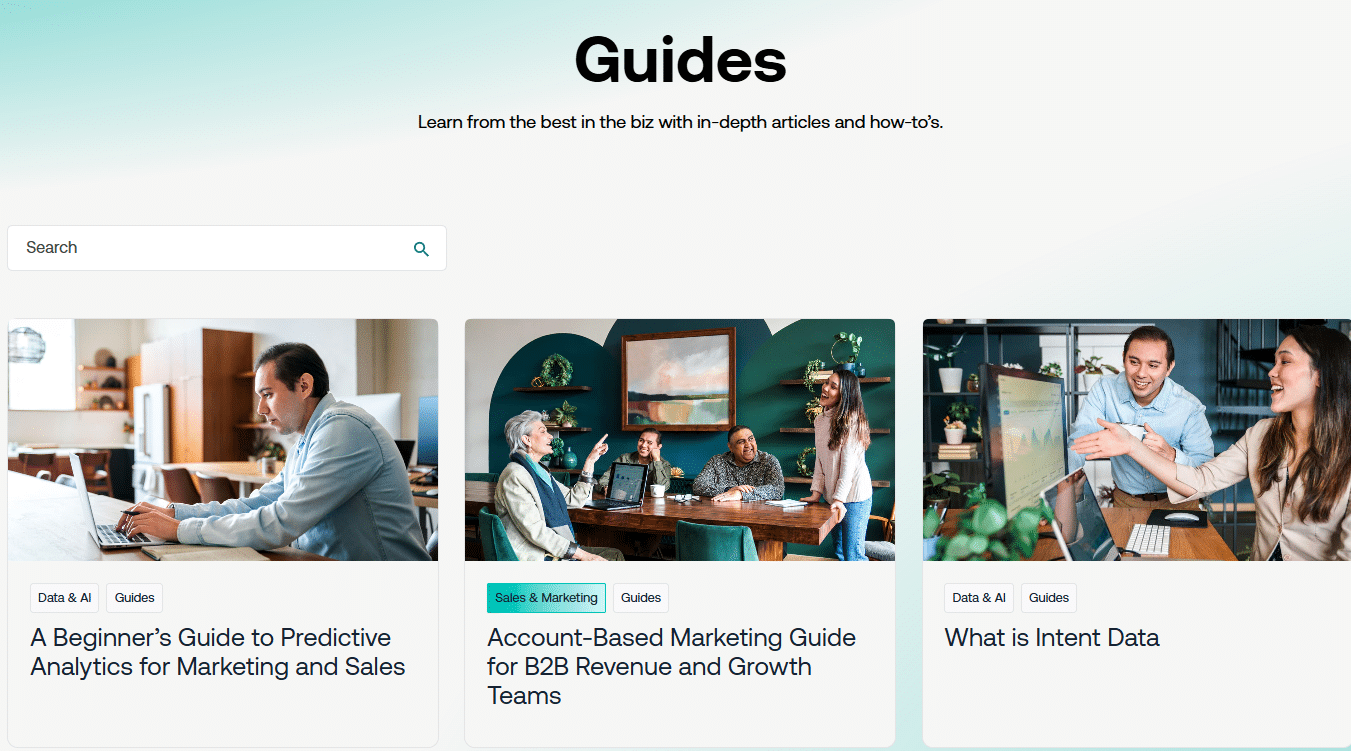
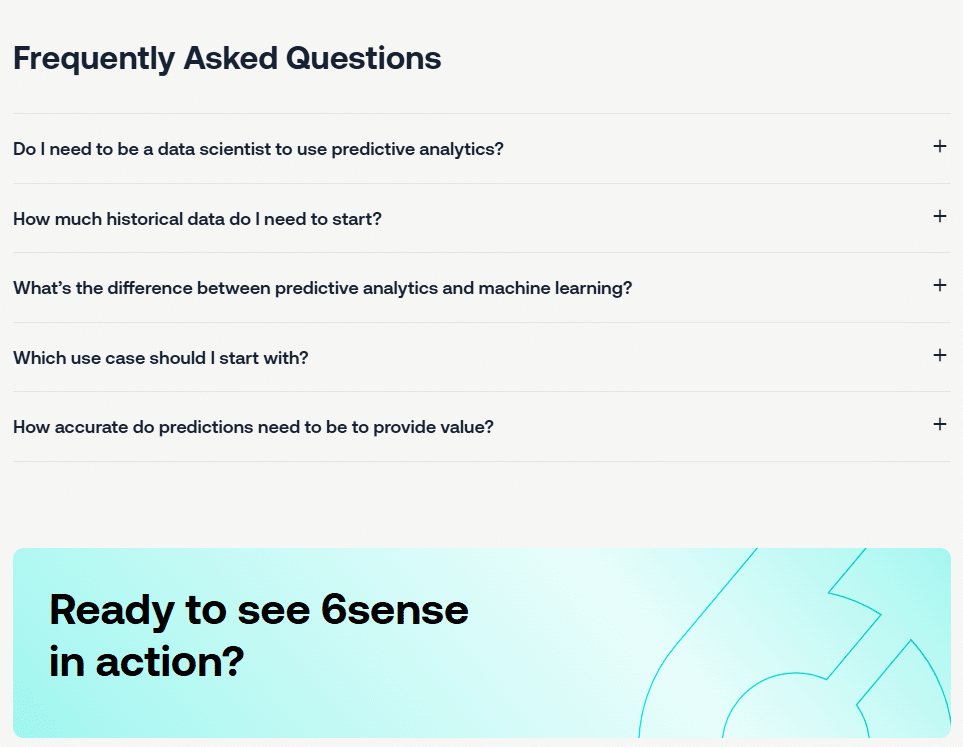
Guides are deeper how-to pieces with table of contents navigation, key takeaways, conclusions, and FAQ sections. Output is irregular: 3 guides appeared in March 2026, one in most prior months, and some months had none. Examples include “A Beginner’s Guide to Predictive Analytics for Marketing and Sales”, “Account-Based Marketing Guide for B2B Revenue and Growth Teams”, and “What is Intent Data”. The titles follow the same search-first logic as the YouTube videos: specific, outcome-focused, and written the way a buyer would type a question.
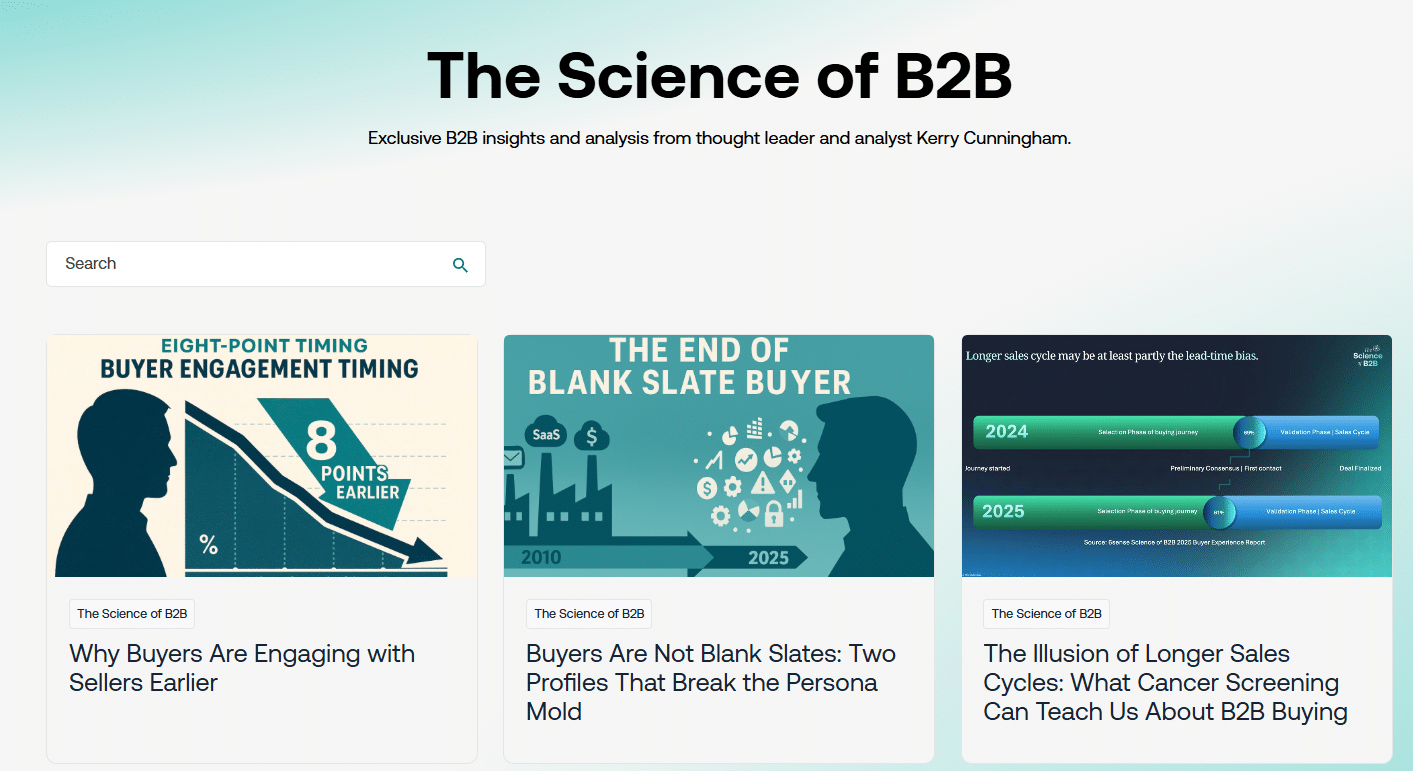
The Science of B2B is a standalone thought leadership section featuring exclusive analysis from Kerry Cunningham. All visible articles were published on February 18, 2026, which points to batch publishing rather than a regular cadence. Examples include “Why Buyers Are Engaging with Sellers Earlier”, “Buyers Are Not Blank Slates: Two Profiles That Break the Persona Mold”, and “The Illusion of Longer Sales Cycles: What Cancer Screening Can Teach Us About B2B Buying”. The titles are doing something specific: they are written for a CMO who has 10 minutes between meetings, not for a student writing a thesis. Short, counterintuitive, and immediately relevant to someone managing a revenue team.
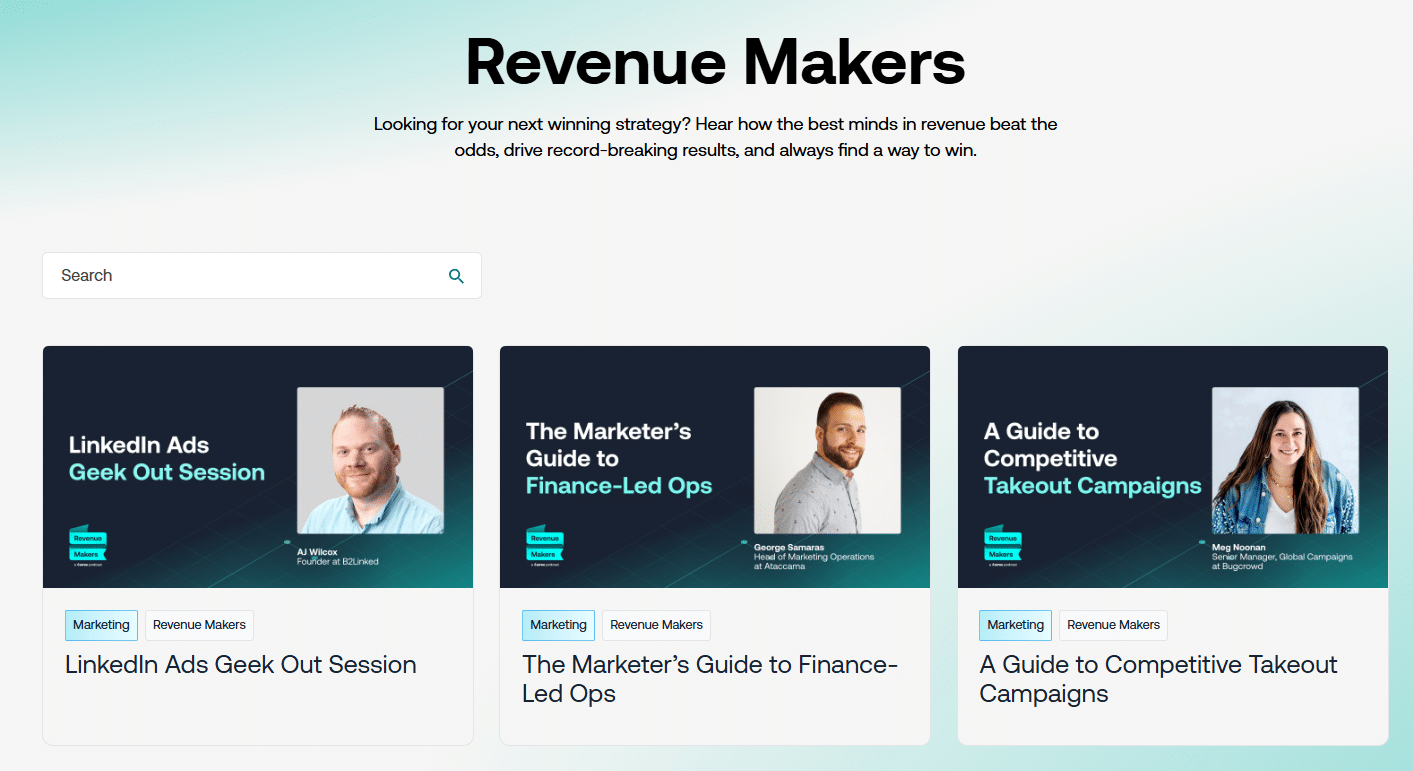
Revenue Makers is their podcast, with episodes embedded directly on the site with no signup required. Each episode includes a full description and timestamped topics. The podcast covers the same content pillars as the blog: marketing, ABM, data, and AI.
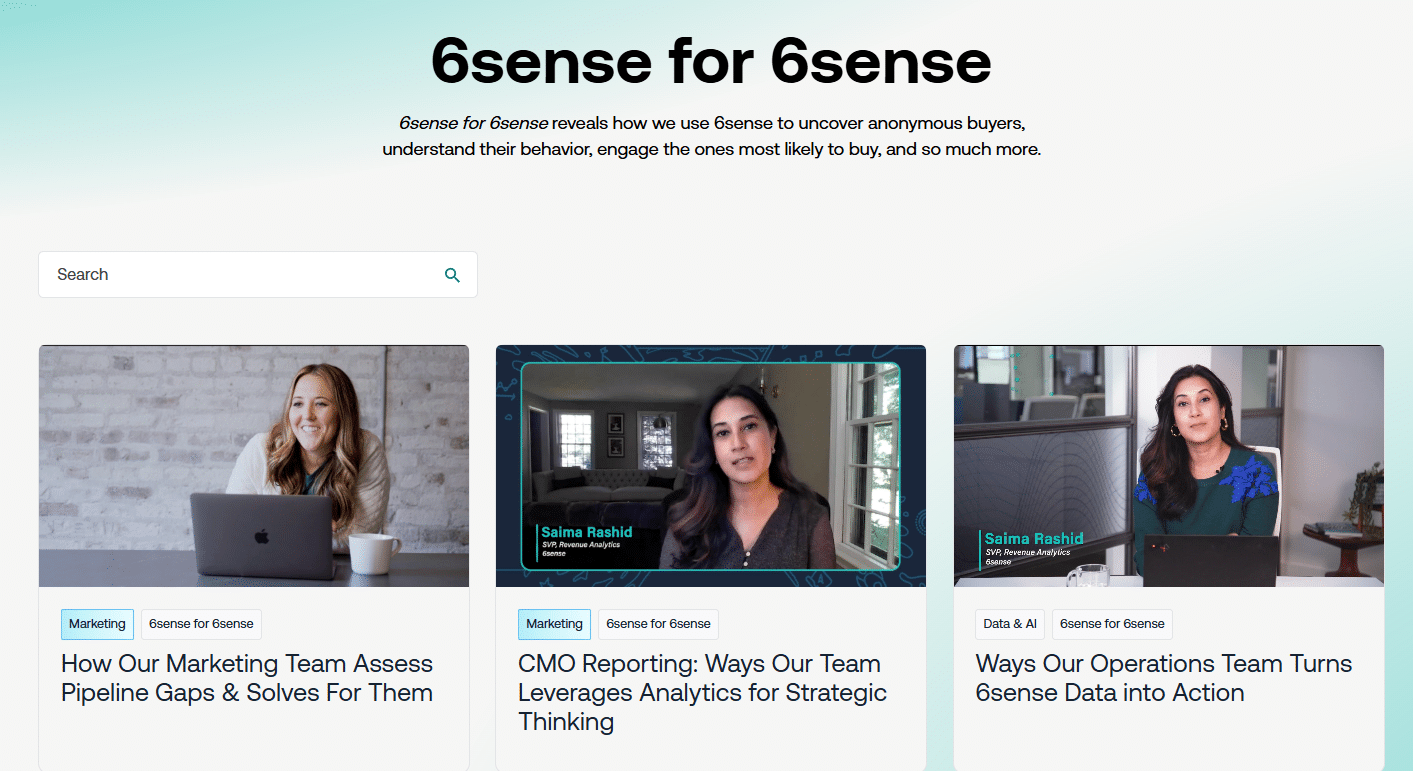
6sense for 6sense is a video series showing how the company uses its own platform. The most recent entry was published in February 2026, with the prior entries dating back to 2023. The concept is the right one: show the product working on your own business. The format works when it runs. The lesson is not just to build it, but to keep it alive.
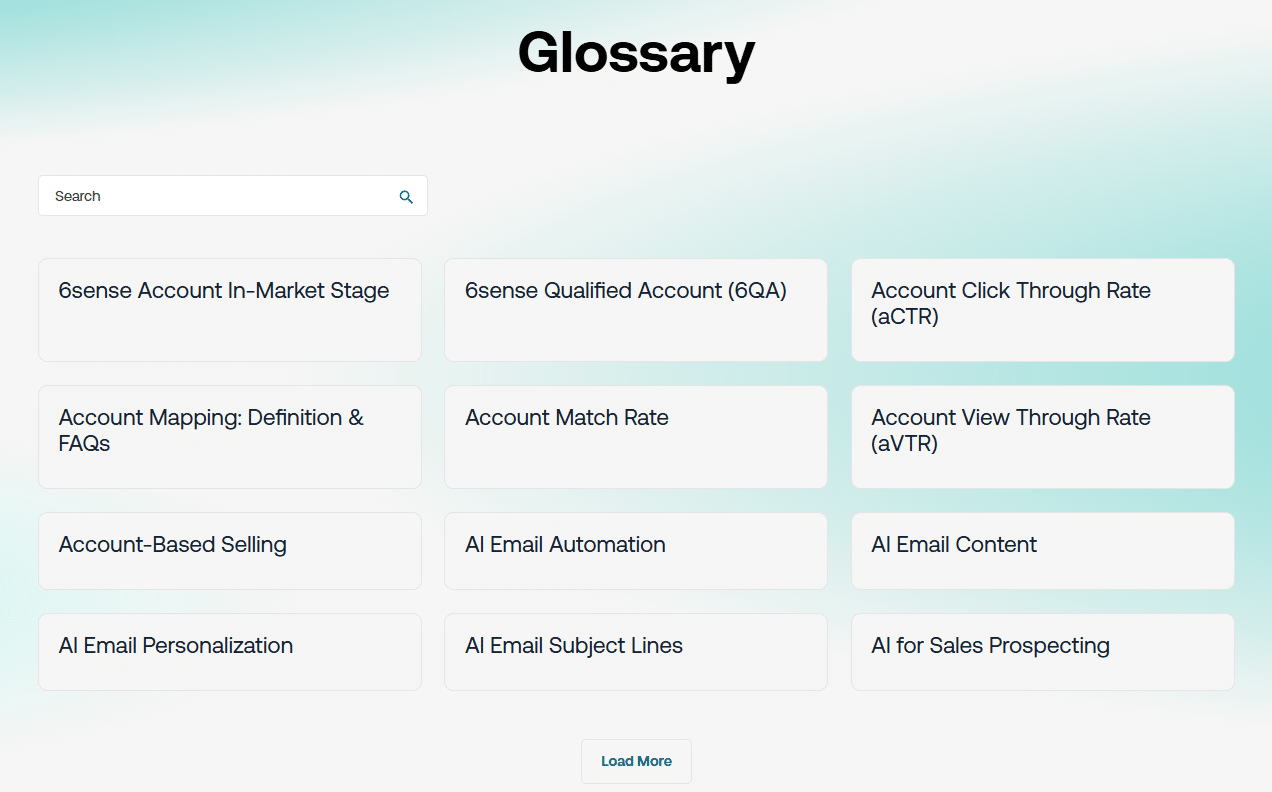
The Glossary defines terms used across the platform and content in alphabetical order. Each entry expands on click with a short definition and a social sharing option for Facebook, LinkedIn, and X.
For a buyer new to ABM or intent data, this page removes friction before it becomes a reason to leave. For a buyer already familiar with the category, it signals that 6sense built its content for the person still learning, not just for the expert already sold.
ABM Certification and RevCity (covered in Differentiators) extend the content ecosystem into peer learning and community, creating retention and pre-sale influence beyond what the blog can do.
According to Sopro’s 2025 research, 69% of B2B marketers say case studies are the most effective content type in their toolkit. 6sense leans into this: their case studies are organized by company, industry, and result, with a filter system on the Customer Stories page that lets a prospect find outcomes relevant to their own sector.
The content strategy is built for inbound sales-led growth. Blog posts and guides are optimized to rank for category searches (ABM, intent data, predictive analytics) and funnel the reader toward a demo. The certification and RevCity community are the MOFU layer: they keep warm accounts engaged without requiring a sales conversation. The podcast and Science of B2B are authority builders aimed at senior buyers.
💡 Steal This: If you use your own product internally, publish the results as content. “6sense for 6sense” is a format any B2B SaaS company can replicate: show your platform solving your own problems, with real numbers, and let it do your sales enablement for you.
Marketing and Sales Funnel Stages
TOFU (Top of Funnel)
6sense casts a wide net at the top. LinkedIn posts multiple times a day, keeping the brand visible to anyone scrolling through a revenue team feed. YouTube builds a parallel discovery channel through search, with evergreen explainer videos and the Revenue Makers podcast finding audiences who have never heard of 6sense but are already looking for answers to the problems it solves.
Google Search ads cover category keywords like “intent data,” “ABM platform,” and “B2B display advertising,” catching buyers who are actively researching the space. Blog posts do the same job in organic search. And the six free calculators sit at the edge of all of it, requiring no login and solving a real problem for someone who is not yet ready to buy but is willing to spend five minutes on a tool that tells them something useful.
MOFU (Middle of Funnel)
Once someone is aware of 6sense, the goal shifts from reach to commitment. Guides and in-depth content give researchers something to work through. The ABM Certification asks for more: time, attention, and genuine engagement with 6sense’s methodology. A prospect who completes it has effectively spent hours inside 6sense’s thinking before a sales conversation ever happens.
RevCity membership, the CMO Coffee Talk, and the BDR Leader Coffee Talk keep senior buyers in a 6sense-hosted environment on a recurring basis, which means 6sense stays present in their professional life without running another ad. Case studies organised by industry and outcome give buyers the peer comparison they need to build an internal business case.
BOFU (Bottom of Funnel)
The demo request form is the only conversion point 6sense offers, and they put it everywhere. It appears at the end of every case study, inside LinkedIn content CTAs, on YouTube videos, and persistently in the top navigation on every page of the site.
The form itself collects qualification data upfront, so by the time a prospect submits it, 6sense already knows who they are, what they want to learn, and where they work. A client testimonial sits on the demo page itself, which means the last thing a prospect reads before submitting their details is a peer telling them it was worth it.
Retention
After the sale, the same infrastructure that warmed the prospect keeps the customer engaged. RevCity provides peer support, product updates, and onboarding resources in one place. The Academy and Knowledge Base give customers a structured way to get more out of the platform over time.
The Coffee Talk series keeps CMOs and BDR leaders connected to a community they value, which means their relationship with 6sense extends well beyond their contract renewal date. And the ongoing publication of customer stories does two things at once: it validates the decisions of existing customers and gives prospects the proof they need to say yes.
The one visible gap is between TOFU and MOFU: a visitor who reads a blog post and is not yet ready for a demo has limited options other than RevCity signup or certification enrollment. A lower-friction MOFU offer, such as a newsletter or a resource download that doesn’t require full form completion, would capture more warm accounts before they go cold.
Future Plans and Growth Indicators
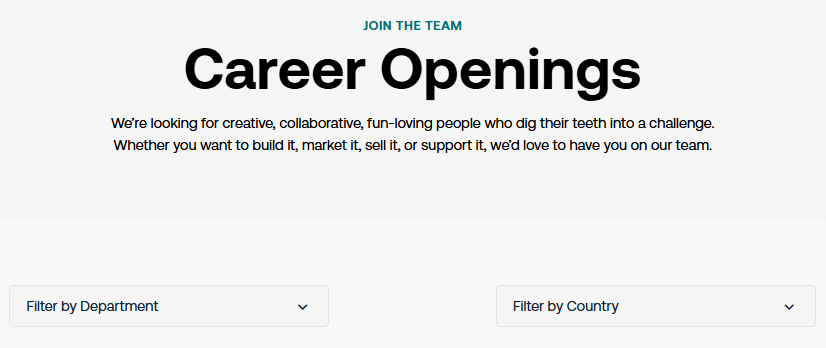
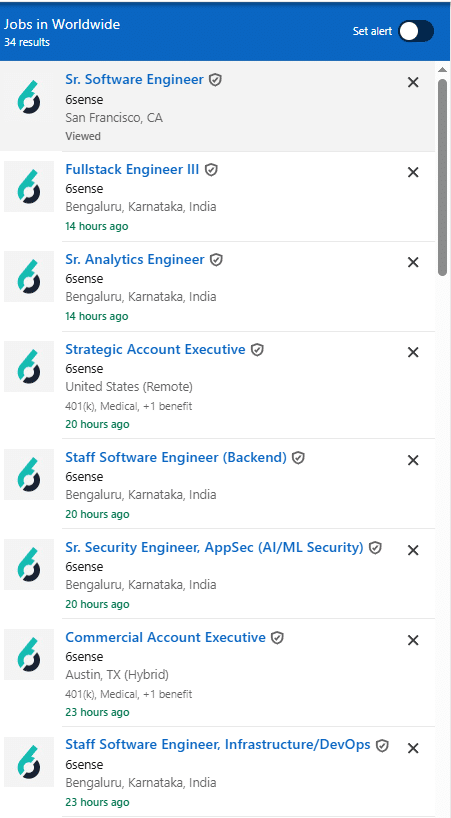
6sense is actively hiring across Marketing, Sales, Engineering, Finance, Business Technology, Product Management, Revenue COE (Center Of Excellence), and Customer Success. Positions span remote and hybrid roles in the US, UK, and India. Many listings were posted within 24 hours of our research date, pointing to active expansion rather than backfill.
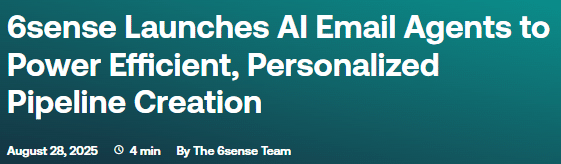
The product announcements tell a clearer story. In August 2025, 6sense launched AI Email, a product designed to handle the complete email lifecycle autonomously, freeing marketers to focus on strategy while agents handle personalized outreach at scale. The direction is not subtle: 6sense is building toward a platform where AI agents replace the manual execution layer of sales and marketing entirely.
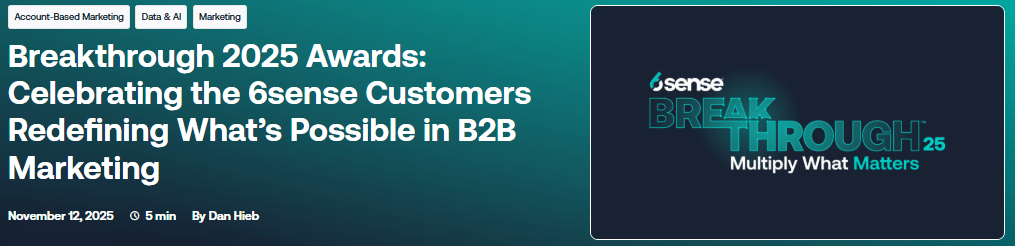
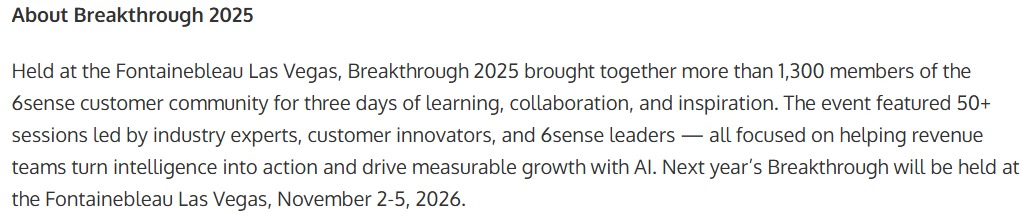
In November 2025, they launched RevvyAI at their annual Breakthrough conference, which brought together more than 1,300 marketing, sales, and operations leaders in Las Vegas. Breakthrough is now in its seventh year, and the scale of it matters as a growth signal on its own. A conference that draws 1,300 revenue leaders is a retention and expansion engine running inside the customer base.

The 2025 Breakthrough Awards give a concrete view of what customers are actually achieving. Rithum achieved 3x sales adoption in 90 days with 6sense qualified accounts driving 58% of all opportunities. Blue Yonder consolidated 200 audience workflows into 60 intelligent workflows and achieved 12x ROI. F12.net hit their annual sales target 5 months early by automating intent-based campaigns. Socure generated $52 million in pipeline in year one. These are award submissions from named customers with specific numbers attached.
On the recognition side, the momentum is consistent. 6sense was named:
- Leader in the Forrester Wave for Revenue Marketing Platforms for B2B in Q1 2026
- Leader in the Forrester Wave for Conversation Automation Solutions for B2B in Q4 2025
- Leader in the Gartner Magic Quadrant for Account-Based Marketing Platforms for the fifth consecutive year
- listed on the Deloitte Technology Fast 500 in November 2025
Four major third-party recognitions in 5 months reflect a product that is keeping pace with a category that is moving fast.
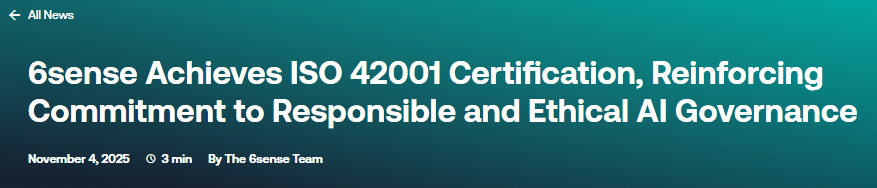
6sense also achieved ISO 42001 certification in November 2025, covering its Artificial Intelligence Management System. That certification matters more than it sounds. Enterprise buyers evaluating AI platforms in 2026 are increasingly asking how a vendor governs its AI. ISO 42001 is the answer to that question in a procurement process.
Breakthrough 2026 is already confirmed for November 2 to 5 at the Fontainebleau Las Vegas. Planning a conference a year in advance at the same venue signals a company that expects its customer base to keep growing, not one that is figuring out what comes next.
The overall picture is a company that has moved from selling intent data to building an agentic revenue platform. The product launches, the conference scale, the customer results, and the hiring breadth all point in the same direction. 6sense is not optimizing what it has already built. It is building the next version of the category.
💡 Steal This: Your annual customer conference is one of the most underused growth assets in B2B. It retains customers, generates case studies, produces content for months, and tells the market you are here to stay.
Inspiration Points
1. Build the “pre-contact favorite” through content, not cold outreach.
Use content, community, and certification to become the default vendor in your ICP’s mind before they start a formal evaluation, because 6sense’s own 2025 B2B Buyer Experience Report found that 95% of the time the winning vendor is already on the buyer’s Day One shortlist, and the pre-contact favorite wins roughly 80% of deals. The CMO Coffee Talk, ABM Certification, and RevCity community are all mechanisms for earning that pre-contact preference at scale.
2. Solve a real problem for your ICP before asking for anything in return.
Build free tools that give your ICP something genuinely useful before they ever see a demo request, because Cialdini’s principle of reciprocity shows that buyers who receive real value before a sales conversation begin that conversation already predisposed toward the vendor who helped them. A sales leader who ran your calculator before booking a call is not a cold lead. They are a warm one you already helped.
3. Let your customers’ results carry the selling weight.
Organize case studies by industry, company size, and outcome metric so a prospect from manufacturing finds manufacturing outcomes, and a prospect from financial services finds financial services outcomes, because Sopro’s 2025 research found that 69% of B2B marketers rate case studies as the most effective content type. Generic case studies are forgettable. Sector-specific ones are persuasive.
4. Run a peer community for your ICP, not just for your customers.
Build a gated community that your buyers want to join before they buy, because the Jobs To Be Done framework shows that buyers choose vendors who already understand the job they are trying to get done. A community that solves the job of “talk to peers who face my problem” gives 6sense access to buyers months before a formal evaluation starts. 6sense’s RevCity and Coffee Talk series both serve buyers who are not yet customers, which builds the pipeline from inside the community.
5. Use ABM signals to inform your paid advertising creative.
Write ad copy using the statistics your platform surfaces about buyer behavior, because a 2026 AdRoll study found that companies aligning ABM with account-based advertising see 60% higher win rates. 6sense’s LinkedIn ads cite “94% of buying groups rank vendors before engaging sellers”. They are using data from their own platform, used as ad copy, aimed at the buyers those statistics describe.
6. Publish the fact that you use your own product, and keep publishing.
Create a dedicated content series showing your platform solving your own go-to-market problems, with real numbers, because the Eat Your Own Dog Food principle signals confidence in a way that marketing copy alone cannot. 6sense built this with “6sense for 6sense” and then left it dormant for nearly three years. A page that goes quiet is not neutral. It reads as a company that stopped believing its own pitch. Consistency matters as much as the concept.
You just read 4,000 words about 6sense’s marketing strategy. Some of it confirmed what you already knew. Some of it probably did not. At Milk and Cookies Studio, we research, write, and build the content and messaging systems that put B2B companies in the room before a buyer starts a formal evaluation. If you are a B2B SaaS founder or marketing leader who wants that kind of presence, and you want someone who will tell you what is actually working and what is not, let’s talk.
Frequently Asked Questions
- What does 6sense actually do?
6sense is a B2B revenue AI platform that tells marketing and sales teams which companies are researching solutions like theirs right now, before those companies ever contact a vendor. It collects over one trillion signals per day through its Signalverse data network, scores accounts by likelihood to buy, and recommends how and when to reach them. The platform covers account-based marketing, sales intelligence, and predictive analytics.
2. Who founded 6sense and when?
6sense was founded in 2013 by Amanda Kahlow, Viral Bajaria, Premal Shah, Dustin Chang, and Shane Moriah. The founding insight came from a consulting project at Cisco, where Kahlow identified the gap between when buyers were already researching solutions and when sales teams found out about them.
3. What is 6sense’s brand promise?
6sense positions itself around three promises: reach the right buyer at the right moment, make every interaction personal, and do it at a scale that does not require adding headcount. Their homepage leads with AI-driven messaging and closes with a Forrester Wave Leader recognition, structuring the page to earn a demo request rather than a sign-up.
4. What products does 6sense offer?
6sense has three main products: Revenue Marketing for marketers running account-based campaigns, Sales Intelligence for sales teams identifying and prioritising buyers, and Predictive Analytics, the engine behind both. Pricing is not public and operates on custom enterprise contracts, typically exceeding $100,000 annually for advanced plans.
5. What community resources does 6sense offer?
6sense runs RevCity, an online community with over 16,600 members that includes a product Academy, Knowledge Base, and G2 review prompt. They also host the CMO Coffee Talk every Friday and the BDR Leader Coffee Talk every other Friday, both approval-only peer forums with no recording policy. A free ABM Certification tied to a physical book rounds out the community offering.
6. How active are 6sense executives on LinkedIn?
Kelly Hopping, the CMO, is the most active of the three executives reviewed, posting original content regularly with engagement between 150 and 350 reactions per post. Chris Ball, the CEO, posts primarily reshares with occasional original content. Raj Gupta, the CTO, has 16,000 followers but posted only twice in the last three months, which is the biggest untapped reach opportunity of the three.
7. How does 6sense use social media to generate pipeline?
LinkedIn is their primary channel, posting multiple times per day with a mix of educational guides, case studies, polls, and memes. YouTube carries 470 videos and over 14 million views, built almost entirely through search discovery rather than follower growth. Every piece of content points toward a demo booking as the only conversion path.
8. What does 6sense’s paid advertising strategy look like?
6sense runs over 440 active LinkedIn ads and approximately 900 Google Search ads, plus 300 Google Shopping placements and 500 YouTube ads. The consistent message across all platforms is that 6sense finds buyers before they contact a vendor. LinkedIn ads use their own buyer research statistics as ad creative, targeting CMOs and revenue operations leaders by seniority and function.
9. What do customers and reviewers say about 6sense?
On G2, 6sense holds a 4.1 out of 5, with praise for intent data and predictive insights and criticism for loading speeds and a steep learning curve. Capterra shows 4.6 out of 5. Trustpilot shows 2.2 out of 5 on an unclaimed profile with unaddressed GDPR complaints, which is a credibility risk for a company selling outreach solutions. Their own Customer Stories page carries the strongest proof, with named case studies showing results like 82% pipeline lift and 40% improvement in lead quality.
10. What content does 6sense produce?
6sense publishes a blog at roughly six posts per month, a guide series, a standalone thought leadership section called The Science of B2B, a podcast called Revenue Makers, a video series called 6sense for 6sense, a glossary, and two named video series in their Resource Library: Pipeline Generation Tuesday and TalkingSense. The content is built primarily for category search and MOFU nurture.
11. How does 6sense convert social media traffic into pipeline?
Every content path leads to a demo request form. LinkedIn posts link to guides that end with a campaign planning template download and a persistent Book a Demo button. Case study pages end with a Ready to Become a Customer banner. YouTube videos carry a Schedule a Demo CTA in the description. There is no free trial or self-serve option.
12. Where is 6sense headed?
In 2025, 6sense launched AI Email for autonomous outreach and RevvyAI at their annual Breakthrough conference, which drew over 1,300 revenue leaders. They earned four major third-party recognitions in five months and confirmed Breakthrough 2026 at the same venue. The hiring pattern across engineering, product, and revenue operations points toward continued AI platform investment.