TL;DR: Conclusions and Key Takeaways
🎀 This section gives you the main insights without all the details. It’s the stuff you need to remember, whether you’re reading this now or in 6 months. We made this for people who want to get the core message fast.
STACC is an Estonian AI and data science consultancy that builds custom machine learning solutions for energy companies, retailers, industrial manufacturers, and public institutions. This article maps how STACC generates clients, builds credibility, and grows without a marketing team, without a CMO, and with a single Google search ad that points to a page that no longer exists.
6 things worth stealing from STACC’s playbook:
- Use vertical-specific landing pages to do the segmentation work that paid ads normally do.
- Make your case studies function as proof-of-work documents, not testimonials.
- Write content that answers the funding question, not just the problem question.
- Get approved by the institutions your buyers trust and let them put you on the shortlist.
- Qualify your team on paper through research credentials and institutional ties as a substitute for brand awareness.
- Route every content piece to a named human, not a generic form.
📝 A quick note before you start reading: The data and analysis in this article are valid as of the time we wrote it. We don’t know when you’ll be reading this, maybe next week, maybe six months from now, and things might have changed since we looked at this company’s marketing and sales approach. Still, the insights and lessons here stay useful, even if the numbers or tactics have evolved a bit.
Data has no flavor. It does not crumble, it does not melt, and it definitely does not pair well with milk. But if you have ever watched a grocery retailer figure out exactly which discount will bring a customer back, or seen a solar farm optimize its output before a cloud rolls in, you have seen data do something close to magical.
Here at Milk and Cookies Studio, we reverse-engineer the marketing and sales strategies of B2B companies so you do not have to spend months figuring out what is actually working. We read the websites. We audit the social channels. We check the ad libraries. Then we tell you what we found, what is worth copying, and what the theory says about why it works.
STACC is one of the more unusual companies we have analyzed. They do not fit the typical B2B SaaS template. There is no pricing page, no free trial, and no CMO. There is one Google search ad pointing to a landing page that returns a 404 error. But there are real strategic choices inside a very quiet online presence, and the results are hard to argue with.
The research for this article was conducted in March 2026. Some details (job postings, team size, social metrics) may have changed since then.
Understanding STACC
STACC OÜ was founded in 2009 in Tartu, Estonia. The full legal name is OÜ Tarkvara Tehnoloogia Arenduskeskus, which translates roughly to Software Technology and Applications Competence Center. They go by STACC.
The office is in the Delta Centre, a technology park in the middle of Tartu built around the University of Tartu’s computer science faculty. That location is not incidental. STACC has close partnerships with the Institute of Computer Science at the University of Tartu, and their Head of Research holds a dual appointment there. Around a third of the team has a PhD or is pursuing one. The average age is in the early 30s. About a third of the team are women. More than 60% hold a Master’s degree or higher.
This is a research organization that learned how to sell.
STACC is not venture-backed. There is no Series A announcement. They operate as a state-recognized R&D institution, formally officiated by Estonia’s Ministry of Education and Research in 2017, and separately approved by the Estonian Business and Innovation Agency (EIS) as a qualified delivery partner for government-funded AI development grants. Since 2015, they have completed 27 EIS-funded projects, delivering R&D services totalling €4.83 million. Annual revenue is approximately €1.36 million. The team is 20+ people.
In 15+ years of operation, STACC has delivered over 200 commercial data science projects. Their client list includes Coop Eesti, Selver, Kaubamaja, Rahva Raamat, Enefit, eAgronom, the Government Office of Estonia, the Estonian National Heritage Board, the Estonian Information System Authority (RIA), the Estonian Agency of Medicines, eTerminal, Microsoft Skype, and ABB. STACC researchers have also filed three US patent applications for graph-path calculation methods developed during Skype work.
For a 20-person company in a country of 1.4 million people, that client list is not normal.
💡 Steal This: Before you raise money or hire a marketing team, build a reference list. A handful of well-known clients will do more for your pipeline than a year of ads. Name them on your website. Write case studies about them. Let the logos do the early work.
STACC’s Brand Promise Analysis

The STACC homepage headline reads: “STACC helps companies turn data into better business decisions.”
The supporting copy: “We design data-driven solutions tailored to your business needs, from automation to AI and everything in between. Our goal is to help you find the right technology to optimize processes, reduce costs, and make smarter decisions.”
This is a services positioning statement, not a product pitch. It is functional and clear: it tells you what they do and who they do it for in two sentences. There is no urgency hook, no competitive claim. The whole message assumes you already know you have a data problem and you are evaluating who to trust with it.
Four stat badges sit below the hero copy: 15+ years of AI and machine learning expertise, 20+ experts, 100+ companies that trust STACC, and 200+ successful projects delivered. These are strong numbers for a company of this size. The 200+ projects figure is independently confirmed on the ITEA4 research network profile and in conference matchmaking listings.
The primary CTA is “Get in touch,” pointing to the contact page. No free trial. No pricing teaser. No demo booking. The entire commercial intent of the homepage is: you already know you need this, now talk to us.
Client logos follow: Coop, Selver, Enefit, eAgronom, Republic of Estonia, Rademar, Thinfacility. No star ratings. No quoted testimonials on this page. The logos are the proof.

On the AI Assistants service page, STACC describes itself as “the most versatile provider of AI solutions in Estonia.” This is their own claim, not an independently verified designation. For a company that has spent 15 years building credibility through Ministry recognition, EIS approval, university ties, and patent filings, a self-declared superlative works against every other trust signal on the site. Third-party proof is the whole strategy. This line breaks it.

The “contact us” homepage model is a strong signal of sales-led growth. STACC is not trying to convert strangers. The website provides enough information to confirm the capability for a warm prospect, then routes that prospect to a person. The website is a closing tool, not a discovery tool.
💡 Steal This: If your service requires a conversation before a sale, design your homepage to prompt that conversation, not to explain everything. Trust your sales team to handle nuance. Your homepage job is to establish credibility and create a reason to reach out.
The homepage assumes a warm prospect. There is no explainer video, no “how it works” section, no pricing anchor to help a cold visitor self-qualify. That only makes sense if most visitors already know who STACC is before they arrive, which is what institutional ABM produces. The EIS partner list and conference circuit pre-qualify the audience before they hit the homepage. The website closes, it does not open.
STACC’s Service and Product Breakdown
STACC has four service verticals. None have prices. All end in a contact form and a named person.

AI for energy system developers and operators: solar and wind forecasting, storage management, electricity trading automation, and grid balancing. The contact is Jane Luht, Development Manager. A live energy cost optimizer calculator is linked from this page.
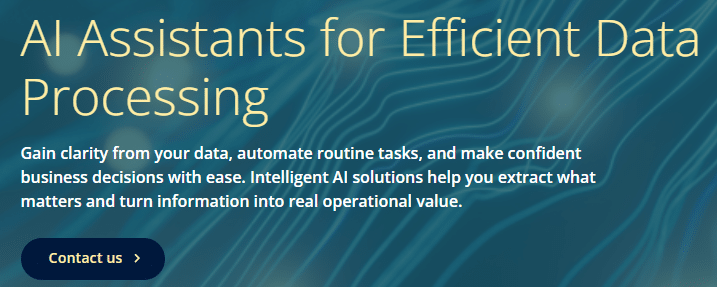
Custom AI for processing unstructured data, including text, images, and audio. Smart search using large language models, product cataloging, audio and image recognition, and task automation. Examples include a semantic search tool built for the Government Office of Estonia and drug name evaluation for the Estonian Agency of Medicines. The contact here is Kalev Koppel, CEO. That is the only service page where the CEO is the named contact, which is itself a signal about how STACC sells AI projects: at the executive relationship level.

AI for retail: personalized discounts, demand forecasting, inventory optimization, empty shelf detection, assortment planning. Live examples include the Partnerkaart and Coop apps. Named clients: Selver, Coop, Kaubamaja, Rahva Raamat. Contact is Kalev Koppel, CEO.

AI for manufacturing: process optimization, supply chain, quality control using sensors and cameras, energy efficiency, and workforce scheduling. No named clients appear on this page. STACC lays out a five-step collaboration process: define, collect, develop, implement, monitor. A manufacturing buyer who lands here gets no proof that STACC has solved their problem before. Every other vertical page names clients. This one asks for trust it has not yet earned on the page.
The ICP across all four verticals is consistent: large or mid-large Estonian enterprises with substantial data assets and operational complexity. Public institutions are a strong segment, particularly on the AI Assistants side. The absence of SME-focused messaging or pricing tiers confirms this is not a volume play.
💡 Steal This: Assign a human name and face to each product or service category. Not a department email, a specific person with a title. It lowers perceived friction for the first contact and starts the relationship before the call.
STACC’s Differentiators and Unique Assets
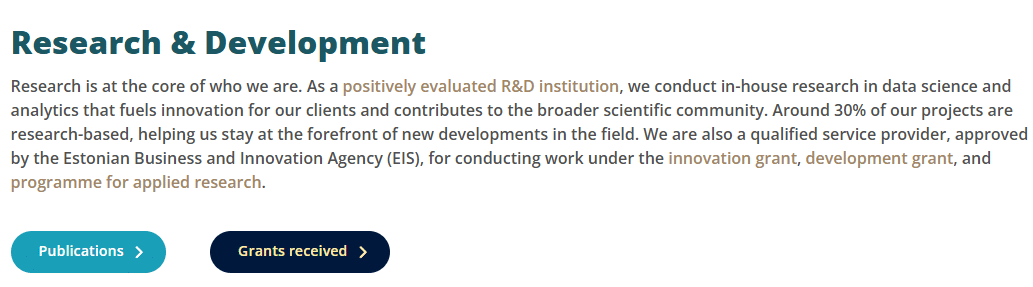
Dual state recognition STACC holds two distinct forms of official recognition: officiated as a private R&D institution by Estonia’s Ministry of Education and Research in 2017, and separately qualified by EIS as an approved delivery partner for government AI grants. These are two different gatekeeping bodies. The combination puts STACC on two separate official shortlists that prospects consult when making vendor decisions, without STACC spending anything to get there.
University of Tartu proximity

The Delta Centre location and the dual appointment of their Head of Research at the University’s Institute of Computer Science give STACC access to academic talent, research networks, and credibility that a standalone consultancy cannot replicate. This proximity gives STACC what their ITEA4 profile describes as “unlimited access to the expertise of top researchers and state-of-the-art technologies.” It is not prominently featured on the current website, which is a clear gap.
Research depth as a commercial asset

Around 30% of STACC’s projects are research-based. They are not deploying existing tools. They develop new methods. Three US patent applications have been filed for shortest-path graph calculation methods developed during Skype’s work. This is unusual for a company of this size and strengthens its R&D credibility significantly.
The AI Masterclass STACC offers an executive-facing AI masterclass. It is a workshop where company executives and STACC data scientists analyze business challenges together and produce an AI implementation roadmap and cost-benefit analysis by the end of the session. This is a low-stakes entry point that creates a relationship before any project is scoped.


A live, interactive profitability analysis tool on the Energy page. It is the only product-adjacent artifact STACC has made publicly accessible without a conversation first, and the closest thing STACC has to a product-led growth motion.
The dual state approval is the most sophisticated structural ABM asset in STACC’s toolkit. When Estonian enterprises enter grant processes or government procurement, STACC appears on official lists. According to the KLIQ Interactive B2B Marketing Report, 57% of B2B marketers are now planning or executing ABM programs, with 52% reporting positive ROI. STACC achieves a version of this outcome without running a formal ABM program at all. The Estonian state essentially runs it on their behalf.
💡 Steal This: Get certified, approved, or listed by the institutions your prospects trust. Government approvals, industry association memberships, platform partner badges. These place you in front of warm prospects at the moment they are already making a vendor decision, with zero ad spend.
If you want to build a version of this for your own company, without waiting 15 years for institutional recognition to compound, account-based marketing is the structured approach to getting in front of the right accounts before they go looking.
STACC’s Leadership Presence Analysis

Followers: 823 (user-verified, March 2026) Last post: October 2025, approximately four months before this analysis Post before that: four years earlier.
Kalev Koppel’s LinkedIn presence is essentially a single data point. One post in October 2025, promoting his attendance at RIGA COMM 2025 with a clear B2B networking intent: “As someone focused on building real, long-term business relationships, I know the power of face-to-face meetings. That’s why I’m headed to RIGA COMM 2025 to meet decision-makers and innovators from all around the world.” Then four years of silence before that.
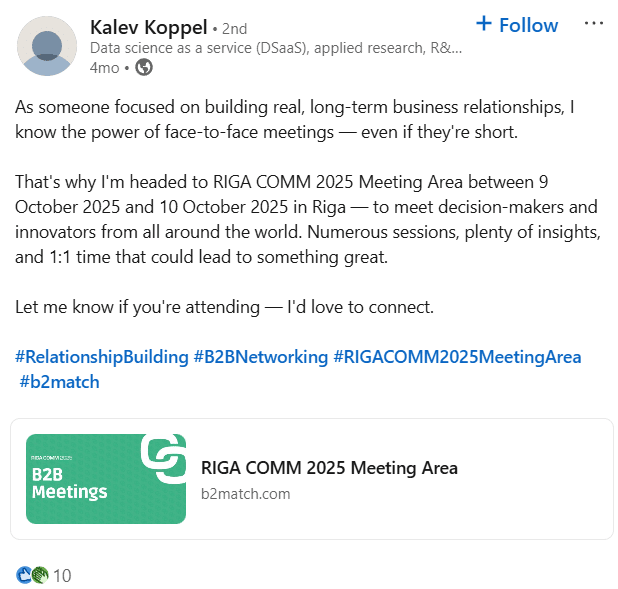
This tells you something precise about how Kalev sees LinkedIn: not as a content channel, but as a conference extension tool. He posts when he is physically going somewhere and wants to find people to meet there. The personal brand is built in rooms, not feeds.
He is more visible through others’ posts, tagged at EAS/KredEx Deep Tech Lounge, sTARTUp Day panels, and Estonian Wind Power Association events. The ecosystem places him in front of relevant audiences without him maintaining a publishing schedule.
STACC has no dedicated marketing function. No CMO, no marketing manager, no growth lead. Content appears to be handled by a single coordinator, with Annet Muru as the named author on the most recent blog posts. Commercial leads route to Hannes Ruusmaa (Sales and Project Manager) and to Kalev Koppel.
If your company is in the same position, growing on expertise and relationships with no dedicated marketing function, a Fractional CMO is how you get senior marketing thinking without hiring a full-time head of marketing you are not yet ready to fill.
This is not a gap to apologize for. It is a finding to understand. STACC has grown into one of Estonia’s most significant AI firms without ever hiring a marketer. That tells you something specific about how trust compounds in small, high-expertise markets where everyone knows everyone.
💡 Steal This: If you are a founder of a B2B services company, treat your conference attendance as a content strategy. Before attending any event, post that you are going and invite people to meet. After the event, post what you observed. Show up in others’ feeds as a participant in the ecosystem, not as a vendor looking for leads.
STACC’s Social Media Strategy
STACC has three social media profiles. Two are in use. One is dormant.

STACC has 1k followers on its LinkedIn page. They post 3 to 5 posts per month, but their latest post was in February 2026. The average engagement is between 8 and 20 reactions, zero comments, and occasional reposts.
LinkedIn is STACC’s primary channel. It reaches their ICP, mirrors Kalev Koppel’s conference-circuit presence, and distributes the blog. Although the engagement is low, the consistency matters more than performance here.
According to the HubSpot State of Marketing Report 2026, 89% of B2B marketers use LinkedIn for lead generation, and 4/5 B2B leads from social platforms come from LinkedIn specifically. For STACC, the channel establishes presence. This strategy makes sure the right person sees the name often enough to remember it.
The content pillars are:
- Hiring process

2. Event participation

3. Industry research


On its Facebook page, STACC has only 579 followers. They keep the same posting frequency as on LinkedIn (3 to 5 posts per month). On average, their posts gain approximately 6 reactions with zero comments. This channel is maintained for completeness rather than impact. STACC’s ICP does not discover B2B AI vendors on Facebook. It is a legitimacy signal, a box ticked.
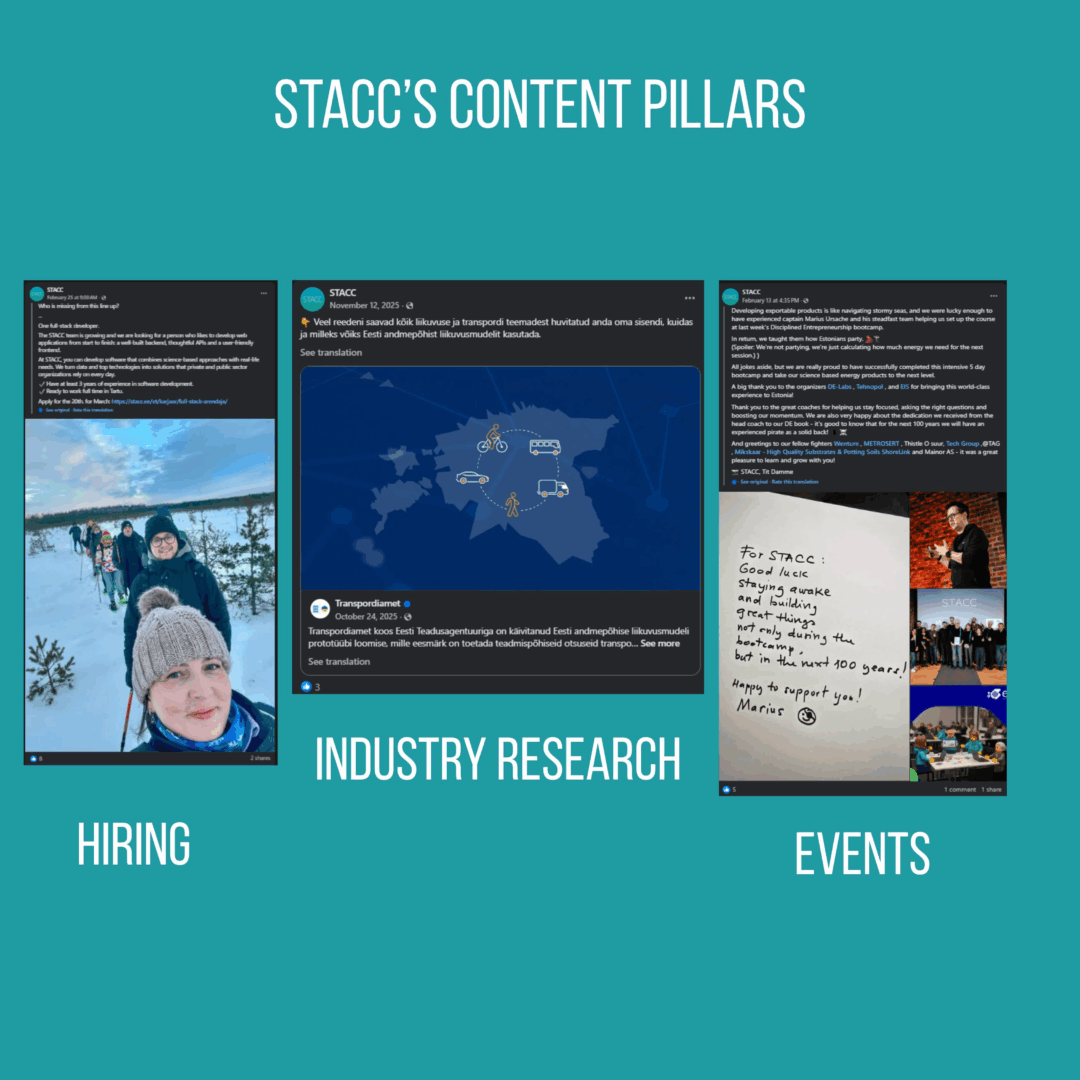
Since the posts are the same as on LinkedIn, the content pillars on Facebook are the same. In both channels, you will see bilingual posts (English and Estonian).
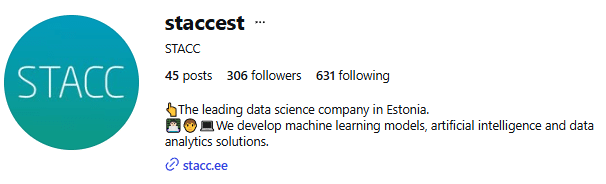
STACC has 306 followers on Instagram. Their latest post was in December 2024, which means the channel is dormant. Their average engagement in 2024 was approximately 20 likes and zero comments per post.

Instagram shows the best engagement ratio of the three channels, 20 likes per post on 306 followers. The channel was used for employer branding: team photos, event presence.
STACC doesn’t have accounts on every other social media channel (X, YouTube, TikTok, Discord), ****but this is normal considering their ICP. Enterprise B2B buyers in Estonia does no discover vendors on TikTok or Discord. The channel mix is well-aligned with a sales-led GTM targeting enterprise and public sector buyers.
💡 Steal This: Before maintaining presence on a platform you are not using effectively, ask whether your ICP actually discovers vendors there. For most B2B services companies, LinkedIn and a strong blog will outperform a multi-platform social strategy that spreads effort too thin.
STACC has no marketing team. So every post has to earn its place. Hiring posts make sense for a company competing for PhD-level data scientists in a country of 1.4 million people. That talent pool is on LinkedIn, and it is small.
Event participation posts do double duty: they show prospects that STACC is in the right rooms, and they tag speakers and attendees, which generates reach without spending anything.
Industry research posts are the only pillar aimed at buyers, blog shares, and sector commentary for the prospect who wants to verify expertise before making a call.
What is missing is client work. The Coop case study, the EIS grant guide, and the 200+ projects do not appear as a recurring content pillar. STACC’s strongest commercial proof lives on the blog. The feed never sees it.
STACC’s Top-Performing Content
In the last 3 months, these are the top-performing STACC’s content:
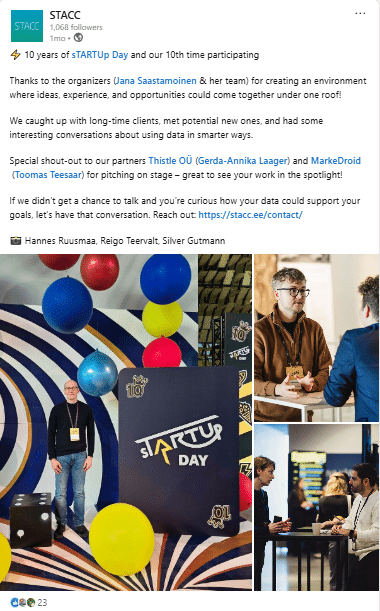
- Event participation at sTARTUp Day, with 23 reactions
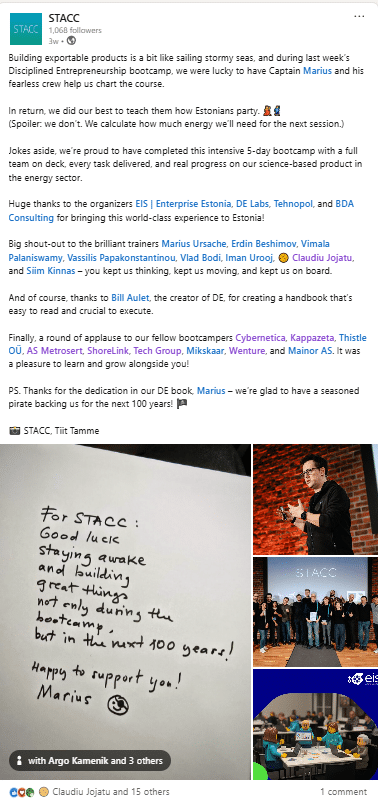
2. Event participation with 16 reactions and 1 comment
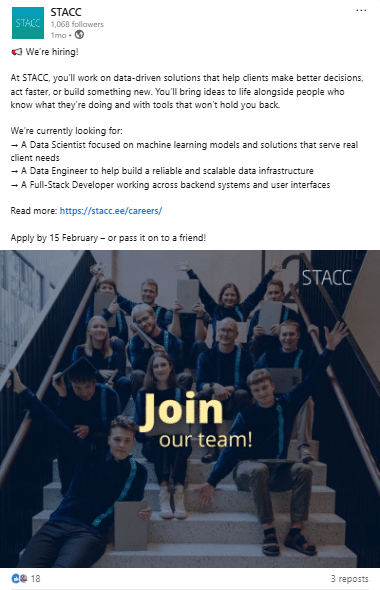
3. Hiring post, with 18 reactions and 3 reposts.
Both top posts are event participation. That tells you who is actually in the audience: not procurement managers, not enterprise buyers. Professional peers, ecosystem contacts, people who were in the same room at the same conference.
Event posts perform because they tag people who were there, which triggers notifications from a warm group who already know the name. The hiring post landing third, 18 reactions, and 3 reposts, follows the same logic. It travels through the professional networks of people who know a qualified candidate.
No blog post or case study appears anywhere in the top three. The grant guide, the Coop write-up, and the AI project framework generate less engagement than a photo from a conference booth. STACC’s audience on LinkedIn responds to community moments, not expertise signals.
- Team members’ New Year’s resolutions, with 13 reactions and 1 share.

2. Participation at sTARTUp Day, with 8 reactions.

3. Hiring news, with 8 reactions and 2 shares

The New Year’s resolutions post from team members takes the top spot. That confirms the Facebook audience is personal rather than professional: existing contacts, friends of team members, local Tartu community.
The hiring post earned 2 shares. The sTARTUp Day post earned zero. On Facebook, sharing is driven by personal connection. Someone forwarded the job posting because they knew who should apply. Nobody forwarded the conference photo because it meant something to them professionally.
Both channels are saying the same thing. STACC’s social media is a people channel, not a pipeline channel. The posts that perform are human and relational. The posts that would show commercial capability do not appear in either top three.
STACC’s Paid Advertising Strategy
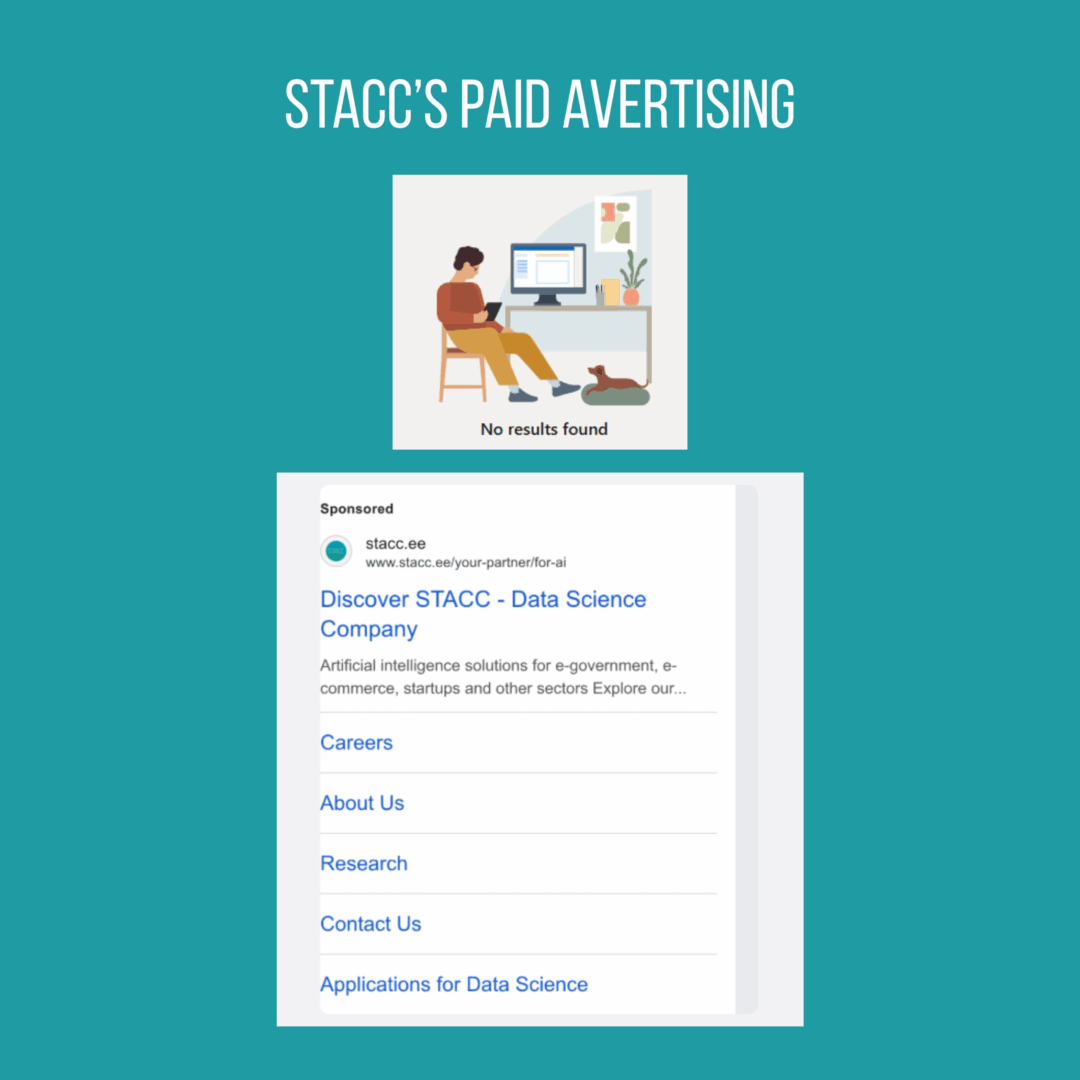
STACC runs one confirmed Google Search ad.
The ad copy reads: “Discover STACC, Data Science Company,” linking to stacc.ee/your-partner/for-ai. That URL returns a 404 error. The landing page no longer exists.
This is the entirety of STACC’s paid advertising presence across Meta, LinkedIn, and Google. One text ad, with a broken destination.
STACC clearly tested a Google Search campaign at some point and either let it lapse or has not noticed the destination URL is broken. The ad may still be running, pointing to nothing. This is worth a five-minute fix.
What makes this finding interesting is what it confirms about STACC’s GTM: paid advertising is not part of the strategy. The one ad that exists looks like an experiment that was never followed through on. And yet the business works. 200+ commercial projects, €4.83 million in funded R&D, clients including Coop, Enefit, and the Estonian government, built without a functioning paid acquisition channel.
The absence of paid advertising is not a weakness for a company with STACC’s buyer profile. Large Estonian enterprises do not discover AI vendors through search ads. They are referred, found at conferences, or directed to STACC through the EIS grant process. Paid digital is structurally misaligned with how this buyer buys.
💡Steal This: Before running paid ads, map your buyer’s actual discovery journey. If your best clients found you through a referral, a conference, or an institution and not through an ad, spending on ads may not shorten your sales cycle. And if you do run a paid campaign, check that the destination URL works.
STACC’s Sales Funnel from Social Media
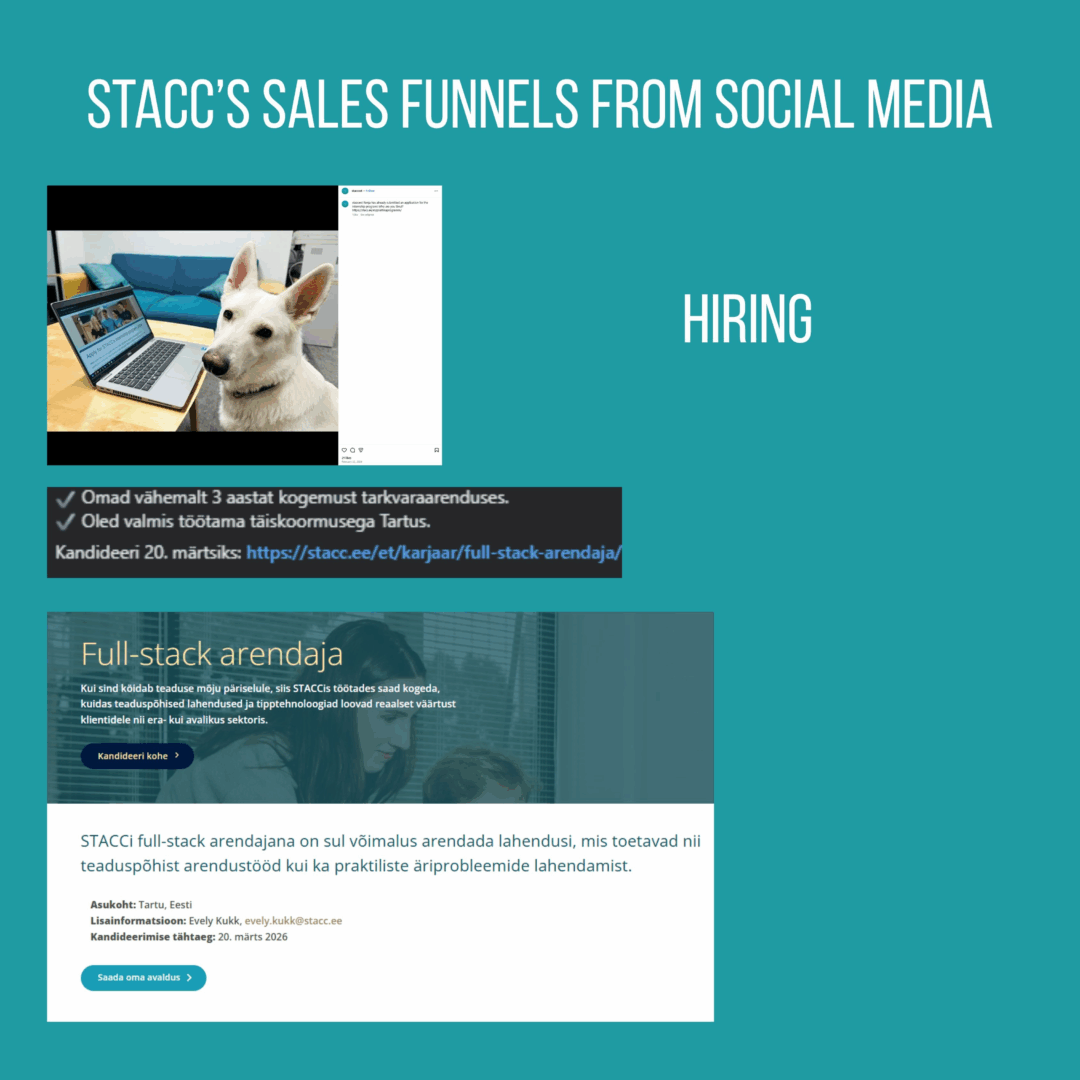
STACC’s social channels are almost entirely top-of-funnel, and even then they are aimed at peers and candidates more than buyers.
Instagram is the clearest example of a channel with a single, deliberate purpose. The only links in captions point to the internship program. That is not an oversight. The channel is about company culture, so the only logical next step for someone engaged with it is to apply. The funnel role matches the content.
Facebook and LinkedIn both carry job application links too, but the audiences are different. Facebook’s top-performing content is personal, team-focused, and local. The people sharing and reacting are existing contacts and Tartu community members.
A job link travels on Facebook because someone forwards it to a friend who fits the role. LinkedIn carries the same posts, but the audience is professional and ecosystem-facing. A hiring post there travels through candidate referral networks and sector contacts. Same CTA, different distribution logic.
If you have not met STACC at an event, the contact page is where the funnel ends. There is no lead magnet, no newsletter signup, no gated resource asking for an email. For a company whose sales cycle is consultative and relationship-driven, that is appropriate. Custom AI and data science projects for enterprise buyers do not close through a self-serve flow. The contact form is the right bottom-of-funnel for this model.

Press coverage gets shared on both Facebook and LinkedIn. The funnel role here is social proof for warm prospects already in conversation, not cold outreach. A buyer who met STACC at sTARTUp Day and is now doing due diligence will encounter these posts. They reinforce credibility at the evaluation stage without doing any of the heavy lifting of getting someone into the funnel in the first place.
💡 Steal This: If your social channels serve different audiences, treat them as different funnels. Same post, same link, same CTA across all platforms ignores who is actually on each one and why they follow you.
STACC’s Reviews and Social Proof
STACC has no presence on G2, Capterra, or Trustpilot. Those platforms exist for software buyers comparing standardized products on feature lists. A procurement team evaluating a custom AI engagement does not go to G2 to read star ratings. They ask their network, check the client list, and look for case studies. The absence from review platforms reflects the nature of the purchase, not a missed marketing opportunity.
The only public review we found is on Glassdoor, where STACC OÜ holds a 4.5-star rating with 100% of reviewers saying they would recommend it to a friend. Those reviews are written by employees, not clients. What they signal to a prospect is organizational stability: a well-run company where people choose to stay. For an enterprise buyer evaluating a long-term technical partnership, that matters. But it does not answer the question they are actually asking, which is: did STACC deliver for someone like me?
That question has no public answer anywhere STACC controls.
There are no testimonials on the website. The hero banner names the clients, Coop, Enefit, the Government Office of Estonia, but gives no one a voice. Cialdini’s social proof principle holds that people reduce uncertainty in high-stakes decisions by looking to others who faced the same decision.
A logo without a story is a claim. A named person from a named company saying what the project actually did is proof. The difference matters most for purchases like this one, where the contract is large, the timeline is long, and the buyer cannot easily reverse course if things go wrong.
According to the KLIQ Interactive B2B Marketing Report, buyers who rate content as extremely influential in their vendor decision are 131% more likely to purchase, and named client testimonials are the most influential content type for high-consideration B2B purchases.
STACC has the clients. And it has at least one strong quote. Siim Meeliste, Head of Electricity Trading at eTerminal, wrote in a published case study: “The time savings from automating these systems can be measured in entire work shifts.”
That sentence is sitting at the bottom of a blog post. It does not appear on the Energy service page, the homepage, or anywhere near a point of conversion. Coop and Enefit are household names in Estonia. A single sentence from either of them, placed next to their logo on the services page, would do more work than any amount of descriptive copy about data science expertise.
💡 Steal This: Ask every client for one quotable sentence immediately after delivery, when satisfaction is at its peak, and the result is still fresh. A name, a logo, and a quote placed on your service page shifts the burden of proof from you to someone your prospect can verify.
STACC’s Content Marketing and Demand Generation

STACC’s blog is organized into six categories: AI Assistants, Energy, Commerce, Industry, Our People, and News. There is no content frequency posting. The last posts are from 2025: one in November, one in May, 2 in April, and so on. The blog is active in bursts and dormant in between.
All content is published in both English and Estonian. No author byline is visible to readers on the rendered page. Posts read as coming from STACC as an organization. This is consistent with a company that has no dedicated content function. The blog is produced by the technical team, and the content reflects that: it reads like work written by people who built the thing, not by people hired to write about it.
Every post follows the same structure. A feature image. H3 headings only, no H2s. A contact card at the bottom pointing to either Kalev Koppel or Hannes Ruusmaa. Three “Read next” thumbnails linking to related posts. No social sharing buttons on any post. No newsletter CTA anywhere. No gated resources. The only call to action on every post is: contact us.
You can find in the articles tables, images, quotes, and graphics. That makes it easy to read.

They post about:
- Client case studies
The eTerminal electricity trading post, the Coop personalized pricing post, the smart search tool for policymakers, and the Multiplication Game user analysis all follow the same format: a named client, a specific problem, what STACC built, and what it achieved.
These posts exist to answer the question a prospect asks before picking up the phone: has STACC done something like my problem before? The answer needs to be yes, and it needs to be specific. A retailer reading the Coop post recognizes their own situation. An energy company reads the eTerminal post and sees their own data challenges described accurately.
2. Technical explainers for buyers who are not ready yet
The data cleaning in retail post does not sell a project. It educates a buyer who is considering AI but does not know what preparation it requires. Same logic with the AI project success post. These posts exist to meet a prospect earlier in their decision process, before they have a defined brief. The subtext of every one of them is: this is harder than you think, and you need a partner who has done it before.
3. Grant and funding guidance
The EIS grant guide is the most strategically deliberate post on the blog. STACC is an EIS-approved delivery partner. A company that reads that post and decides to apply for a grant will need an approved partner to execute the project. STACC wrote the guide that brings them to that conclusion. The content and the commercial outcome are the same document.
STACC has no marketing team and no content calendar. Every post has to justify itself commercially. These categories all have a direct line to a sales conversation. There are no opinion pieces, no industry trend commentary, no thought leadership for its own sake. Every post is either proof of capability or a guide that positions STACC as the expert a prospect needs before they can move forward.
The grant guide is the clearest ABM content piece on the site. It is not written for everyone. It is written for a specific buyer at a specific moment: a company that has identified an AI need, has a budget question, and is about to enter a procurement process. That buyer is already sales-qualified. The content meets them at the decision point and routes them directly to a named contact. The case studies work the same way: each one is sector-specific and written for a buyer who is already in the consideration stage for that exact type of project. This is account-based content strategy without a formal ABM program behind it.
STACC’s Marketing and Sales Funnel Stages
TOFU (Awareness)
Conferences are the primary awareness channel. sTARTUp Day, Latitude59, EnergyWeek, RIGA COMM. Kalev Koppel shows up, gets tagged in posts, and appears on panels. The name circulates in the rooms where Estonian enterprise buyers and public sector decision-makers already are.
The EIS-approved partner list adds a second awareness channel that runs without any effort from STACC: companies entering grant cycles find the list, and STACC is on it. The blog provides some organic search visibility for buyers who search “AI project Estonia” or “retail demand forecasting.” The Google Search ad was presumably meant to add a third awareness layer. It currently points to a 404 page.
MOFU (Consideration)
This is where the blog does its real work. A prospect who heard the name at a conference or found it through EIS will search for evidence. The case study library answers the core question: have they done something like my problem before? The eTerminal post, the Coop post, the policymakers’ smart search post, each one is written for a specific sector buyer to recognize their own situation.
The “How to Ensure the Success of an AI Project” post addresses the fear that sits underneath every consideration-stage conversation: what if this goes wrong? The AI masterclass is the most deliberate MOFU asset STACC has. It converts interest into a structured half-day session that produces a real deliverable. A prospect who walks out with a roadmap and a cost-benefit analysis has already started working with STACC before any contract exists.
BOFU (Conversion)
Every service page ends the same way. A named person, a phone number, a direct email. Not a form that routes to a queue. Kalev Koppel’s number is on the AI Assistants and Commerce pages. Hannes Ruusmaa handles Energy. Jane Luht is on the Energy page too.
Every blog post ends with the same contact card. The EIS grant guide is the sharpest conversion piece on the site: a prospect who finishes reading it knows which grant they need, knows they need an approved partner to execute it, and has STACC’s contact details in front of them. The content and the conversion are on the same page.
Retention
No formal retention infrastructure exists. No client newsletter, no community, no portal. What keeps clients is the nature of the work. EIS grants run in phases: innovation grant, development grant, and applied research programme. A company that completes a successful innovation grant project with STACC has a natural reason to continue into the development grant with the same partner. The retention path is built into the funding structure, not into a CRM sequence. For clients outside the grant system, repeat work comes from ongoing data science needs that do not end when the first project closes.
💡 Steal This: If your clients can grow through multiple stages with you, name those stages explicitly on your website. Show the progression from first engagement to long-term partnership. Clients who see a map are more likely to keep walking the path.
STACC’s funnel is almost entirely relationship-gated. Awareness happens in rooms and on official lists, not in feeds or ad units. The EIS partner list functions as an always-on account targeting system: it surfaces STACC to companies that have already identified a need and a budget, which is the definition of a warm account in ABM terms. Conference presence builds the personal relationships that turn those warm accounts into conversations. The blog handles the consideration layer for accounts that found STACC through search rather than through a room.
STACC’s Future Plans and Growth Indicators
As of March 2026, STACC has three open positions: Full-Stack Developer, Data Engineer, and Data Scientist, according to their Career page.

No sales, marketing, or client success roles are being hired. This tells a specific story: demand is being driven by existing relationships and institutional channels, not by an intention to expand the pipeline through new acquisition channels.
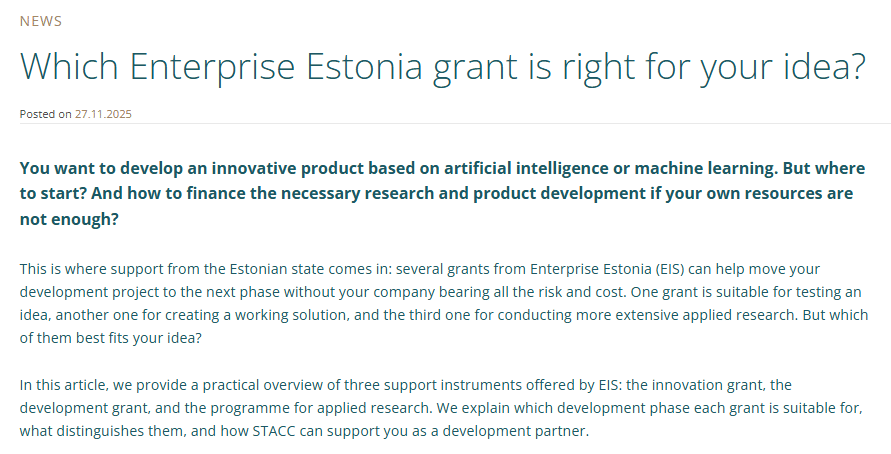
The November 2025 grant guide is also a forward-looking signal. By publishing a detailed explanation of the EIS grant landscape, STACC positions itself as the natural partner for companies entering grant application cycles in 2026. New grant rounds open regularly. Companies discovering those programs will find STACC’s guide, and STACC’s contact details, at the bottom of it.
STACC also participates in Horizon projects (EU-funded research programs) and ITEA4 (the international tech research consortium). Both are multi-country research programs. They place STACC in front of European partners and clients that the Estonian market alone would not reach.
No product launches, VC funding rounds, or geographic expansion signals were found in the research.
💡 Steal This: Look at your open job roles as a public strategy signal, because your prospects and competitors read them. If you want to signal growth, hire for the function that opens new doors. If you only hire delivery, the market reads it as: this company is busy but not expanding.
Inspiration Points
1. Organize your website by buyer vertical rather than by service feature, because the Jobs To Be Done theory shows that buyers are hiring a solution for a specific job in a specific context. STACC’s four-page vertical architecture means every prospect lands on a page that speaks their industry language, with case studies from their sector and a contact person who has already solved that problem. Vertical segmentation does the qualification work before the first conversation happens.
2. Use case studies as proof-of-work documents rather than testimonials, because the Elaboration Likelihood Model (Petty and Cacioppo) shows that expert buyers process evidence centrally. They want specifics, not praise. A named client, a specific problem, and a measurable outcome is more persuasive to a technical buyer than a star rating. The Content Marketing Institute’s 2025 B2B benchmarks confirm this: 53% of B2B marketers rate case studies as the most effective content type.
3. Write content that answers the funding question, not just the problem question, because the Challenger Sale framework (Dixon and Adamson) shows that top-performing sales approaches teach buyers something new about their own situation. STACC’s EIS grant guide teaches clients how to fund an AI project through state programs, an insight most enterprises lack. A prospect who learns how to finance the project from your content will look to you to execute it.
4. Get approved by the institutions your buyers trust and let them put you on the shortlist, because Cialdini’s authority principle shows that buyers defer to external legitimacy signals over self-claimed expertise. STACC’s recognition by Estonia’s Ministry of Education and Research and their EIS-approved partner status place them on two official lists that prospects consult, without STACC spending anything to appear there. Third-party endorsement at the institutional level converts intent that already exists.
5. Qualify your team on paper through research credentials and institutional affiliations as a substitute for brand awareness, because Spence’s Signaling Theory shows that verifiable credentials reduce information asymmetry in markets where buyers cannot easily evaluate quality before purchase. In custom AI and data science, a buyer cannot assess capability from a product demo. A team with PhDs, patent filings, and university ties signals capability in a way that a portfolio page cannot. Credentials are marketing for buyers who distrust marketing.
6. Route every content piece to a named human rather than a generic contact form, because B2B trust research consistently shows that buyers engage more readily when there is a specific person to contact rather than a department. According to the HubSpot State of Marketing Report 2026, personalization in outreach significantly increases response rates. Every STACC blog post ends with a named person, a photo, a phone number, and a direct email. The CTA is not “contact us.” It is “call Kalev” or “email Hannes.” That distinction lowers the perceived cost of reaching out.
We build marketing strategies for B2B tech companies that sell the way STACC sells: through credibility, relationships, and content that earns trust before the first call. If that sounds like your company, start here.
Frequently Asked Questions
- What does STACC do?
STACC is an Estonian data science and AI consultancy founded in 2009. They build custom machine learning solutions for companies in four sectors: energy, retail and commerce, industrial manufacturing, and government and public sector AI applications. They do not sell packaged software. Every engagement is a bespoke project, scoped through a direct conversation.
2. Who are STACC’s clients?
STACC’s confirmed clients include Coop Eesti, Selver, Kaubamaja, Rahva Raamat, Enefit, eAgronom, the Government Office of Estonia, the Estonian National Heritage Board, the Estonian Information System Authority, the Estonian Agency of Medicines, eTerminal, Microsoft Skype, and ABB. These are primarily large Estonian enterprises and public institutions, plus European-scale organizations.
3. Is STACC a SaaS company?
No. STACC is a services and consultancy firm. There is no pricing page, no subscription product, and no self-serve onboarding. Every engagement starts with a conversation.
4. How does STACC generate new clients?
Based on this analysis, STACC’s primary acquisition channels are conference presence across Estonian and Baltic tech events and their status as an EIS-approved R&D partner, which places them on official shortlists for grant-funded projects. The blog reinforces both: case studies give sector-specific proof to prospects already in evaluation, and the EIS grant guide captures buyers at the moment they are deciding how to fund a project. The CEO’s conference attendance contributes to ecosystem visibility.
5. What is STACC’s Glassdoor rating?
STACC OÜ holds a 4.5-star Glassdoor rating, with 100% of reviewers saying they would recommend the company to a friend.
6. What social media channels does STACC use?
STACC is active on LinkedIn (approximately 1,000 followers) and Facebook (579 followers), posting 3 to 5 times per month on both. Their Instagram account (306 followers) has been dormant since December 2024. They have no presence on X, YouTube, TikTok, or Discord.
7. What makes STACC different from other Estonian AI firms?
STACC holds formal recognition from two separate government bodies: Estonia’s Ministry of Education and Research (officiated as a private R&D institution in 2017) and the Estonian Business and Innovation Agency (EIS, approved delivery partner for government AI grants). Combined with close ties to the University of Tartu, a team where roughly a third hold or are pursuing a PhD, and three US patent filings, STACC occupies a distinct position between academic research and commercial AI delivery that few competitors replicate. They also offer an executive AI masterclass that produces a roadmap and cost-benefit analysis in a single session, and a live Energy Cost Optimizer tool on their website, both of which are entry points that do not require a formal project brief to begin.
8. What is the EIS grant and why does it matter for STACC?
The Estonian Business and Innovation Agency offers three grant tiers for AI and R&D development: an innovation grant (up to €7,500), a development grant (up to €35,000), and a programme for applied research (up to €2M). STACC is a state-approved delivery partner for these grants. Since 2015, they have completed 27 EIS-funded projects totalling €4.83 million in R&D services, meaning the grant system itself is a significant and ongoing source of qualified project work.