TL;DR: Conclusions and Key Takeaways
🎀 This section gives you the main insights without all the details. It’s the stuff you need to remember, whether you’re reading this now or in 6 months. We made this for people who want to get the core message fast.
Pipedrive is an Estonian CRM that hit $1.5 billion valuation in 2020. They serve over 100k companies globally and built their reputation on being the anti-Salesforce: simple, visual, and actually designed for the people doing the selling. In 2026, they’ve gone all in on AI, positioning the CRM as a digital teammate instead of just a database.
YouTube and LinkedIn do the heavy lifting. YouTube acts as a self-service education library with 23 million views, while LinkedIn is where their actual buyers (sales managers and directors) spend time. Instagram, Facebook, and X get the same recycled content with low engagement. They’ve accepted that social media is a distribution channel, not a community space. Paid ads run aggressive campaigns on Google (claiming “#1 Cheapest CRM”), LinkedIn (targeting pipeline anxiety), and Meta (pushing free trials with action-heavy copy).
Pipedrive publishes encyclopedic blog posts (around 2.9k words each) that answer every sales question in depth. They give away high-value resources like the State of Sales and Marketing 2025 report, ROI calculators, and tax guides to capture emails. The goal is to build authority so AI search engines cite them as the expert source. Their content teaches people how to sell, which builds trust before anyone even considers buying the software.
What can you steal from Pipedrive’s strategy?
- Focus on quick wins in onboarding so users don’t quit in the first 48 hours.
- Stay in your lane instead of trying to be everything to everyone.
- Use visual proof (like their color-coded pipeline) to let the product sell itself.
- Give away real expertise through guides and research to earn trust early.
- Make pricing transparent with no hidden fees or call us games.
- Offer 24/7 support to every user, not just enterprise accounts.
- Create ungated tools (calculators, templates) that solve immediate problems before asking for an email.
- Use localized content for different markets so global users feel like you built it specifically for them.
- Lead with authority badges and review scores in your hero section to let customers do the bragging.
- Teach a philosophy (activity-based selling) instead of just listing features.
📝 A quick note before you start reading: The data and analysis in this article are valid as of the time we wrote it. We don’t know when you’ll be reading this, maybe next week, maybe six months from now, and things might have changed since we looked at this company’s marketing and sales approach. Still, the insights and lessons here stay useful, even if the numbers or tactics have evolved a bit.
Here’s the thing every sales manager secretly knows: you have no idea where your deals actually stand. And finding out usually means becoming the office’s most hated person: the one who sends those “just checking in” Slack messages that everyone ignores until the Friday afternoon pipeline meeting.
You’re stuck between 2 bad options: either accept that revenue is vanishing into the void because a lead went cold, or turn into a micromanager with a complex CRM that everyone hates using. Monthly reports are a mess of “maybe” and “soon,” your forecast is basically a dartboard, and high-value deals leak through your fingers while your reps spend hours manually logging data.
Which brings us to why we’re looking at Pipedrive. At Milk and Cookies studio, we don’t waste time on tools that solve one problem by creating three others. We track companies that actually understand the assignment: make selling better without making salespeople miserable.
Pipedrive’s pitch is simple: a CRM shouldn’t be a database where deals go to die. They’ve built a visual, activity-based system that actually works the way a salesperson thinks, not the other way around. No month-long implementation nightmares, no training manuals thicker than a phone book, and no optimization workshops. Just… drag, drop, and close.
This Estonian powerhouse, founded in 2010 by a group of door-to-door sales veterans: Timo Rein, Urmas Purde, Ragnar Sass, Martin Tajur, and Martin Henk, is a masterclass in the power of empathy. They knew the proper CRMs on the market didn’t help people sell. So they built a $1.5 billion “Unicorn” by focusing on the people in the trenches. Today, they serve over 100k companies globally, backed by the heavy-hitting Vista Equity Partners, proving that being “easy to use” is a serious competitive advantage.
So what separates Pipedrive from the hundreds of CRM tools launched every decade? Their marketing strategy looks less like a corporate manual and more like a high-authority mentorship program. They’ve turned dry industry data into the State of Sales and Marketing report, swapped boring feature lists for an AI Sales Assistant that acts as a co-pilot, and built a global Pipedrive Academy that acts as an automated pre-selling machine. Meanwhile, their leadership is focused on an AI-native future while their marketing team uses localized guides and interactive calculators to drive one of the highest user activation rates in the SaaS world.
Curious how they turned a saturated CRM market into a billion-dollar success story? Let’s break down Pipedrive’s marketing and sales strategy, tactic by tactic.
Understanding Pipedrive
Born in 2010 in Tallinn, Estonia, Pipedrive was built by sales veterans who were tired of CRM software designed for bosses rather than the people actually doing the selling. This “by salespeople, for salespeople” philosophy transformed the company from a small startup into a global unicorn, eventually reaching a $1.5 billion valuation after the investment by Vista Equity Partners in 2020.
The platform is centered around a visual, activity-based workflow. It allows users to track their sales pipelines, automate repetitive admin tasks, and use AI-driven insights to figure out which deals need attention right now. While many CRMs act as a passive database, Pipedrive is designed to be a proactive partner in the sales process.
Over the years, the product has evolved from a simple pipeline tool into a full-scale revenue platform. The core CRM remains the heart of the business, but they have expanded their ecosystem with specialized add-ons like LeadBooster for lead generation, Campaigns for email marketing, and Smart Docs for document management. As of 2026, the company has pivoted to an “AI-native” model, integrating artificial intelligence into every layer of the software to help SMBs scale without adding more manual work.
Pipedrive’s Brand Promise Analysis
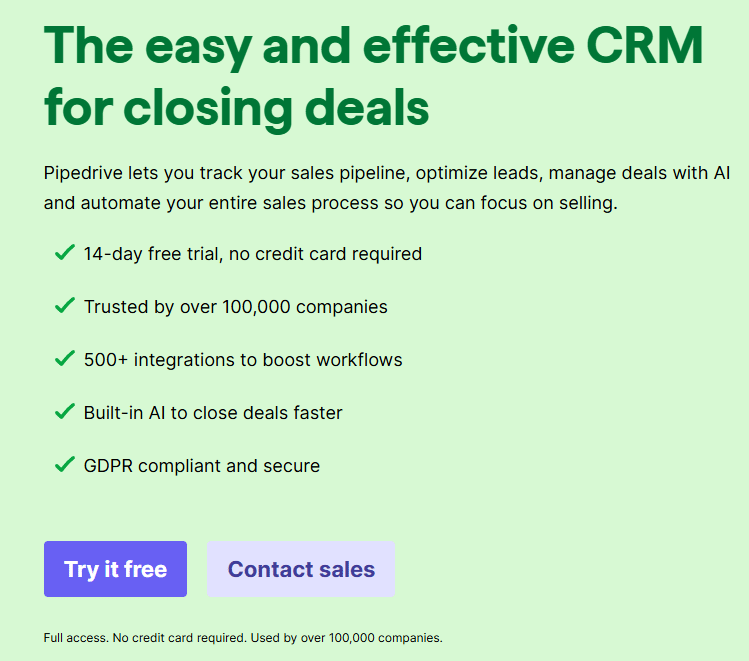
Pipedrive positions itself as the go-to CRM for people who actually want to spend their time selling rather than fighting with software. It’s built around the idea that a CRM should be easy to use and effective at one specific thing: closing deals.
The platform handles the heavy lifting by tracking your pipeline, optimizing leads, and using AI to manage deals. Automating the repetitive parts of the sales cycle, it clears the way for you to focus on your customers.
Pipedrive has built a solid reputation with over 100k companies globally. Why do teams choose it?
- Zero risk to start. You get a 14-day free trial, no credit card details needed.
- It uses built-in AI to help you identify which deals to prioritize so you can close them faster.
- It’s fully GDPR compliant and keeps your data secure.
- The platform consistently earns high marks across major review sites like Capterra, G2, and Gartner, usually hovering between a 4.2 and 4.7 star rating.
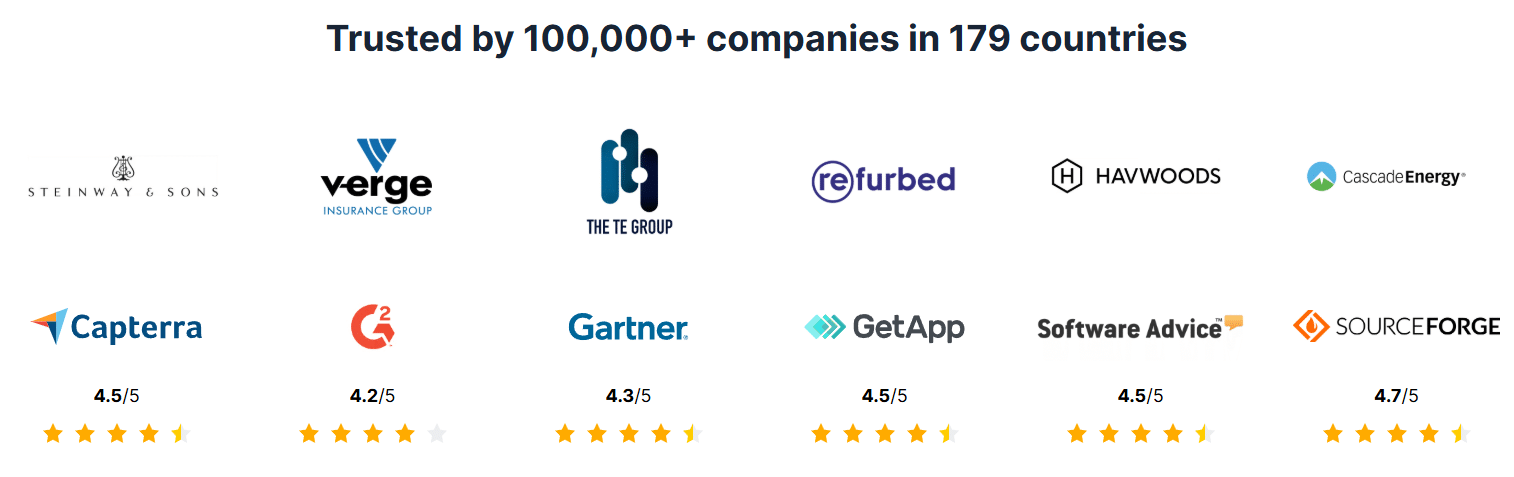
💡 Steal This: Put in the hero section a “Badge of authority”. Use the highest rated category or reviews from different sites to increase authority and trust. Research shows that 80% of B2B buyers check review sites before a demo. By leading with your “User-Rated” status, you let your customers do the bragging for you.
Gartner’s research shows a massive shift in buyer behavior: 61% of B2B buyers now prefer a rep-free purchasing experience. Buyers define their shortlist long before contacting sales. To compete, CRMs must interpret digital intent (like pricing page visits) automatically. This supports Pipedrive’s frictionless funnel. By offering a 14-day trial without a credit card, Pipedrive aligns with the modern buyer who wants to test the product before talking to a human.
To reinforce trust, they drop major names like Steinway & Sons, Verge Insurance Group, and Refurbed to keep their sales moving.
At the end of the day, it’s a CRM designed for the people actually doing the work. It saves hours through automated lead nurturing and provides the kind of deep sales insights you need to grow. Plus, it’s flexible enough to tailor the setup to fit your specific business needs.

Pipedrive’s Service and Product Breakdown

Pipedrive is a modular ecosystem. While the core is a sales CRM, you can layer on marketing, project management, and lead generation tools depending on your business needs.
The platform is divided into several specialized software areas:
- Sales & AI CRM (includes pipeline management, activity tracking, and AI-powered deal insights)
- Email Marketing & Lead Gen (tools to find new prospects and nurture them through automated campaigns)
- Project Management (a built-in way to handle the after-sales work without switching apps)
- Security & Marketplace (over 500 integrations like Slack, Zoom, and Zapier, and full GDPR compliance to keep your data safe)
Subscription Plans
You can choose to pay monthly or save some money by committing to an annual plan. Every tier comes with a 14-day free trial, so you can take it for a spin before paying.
| Plan | Annual Price (per seat/mo) | Monthly Price (per seat/mo) | Best For… |
|---|---|---|---|
| Lite | 14€ | 24€ | Simple organization and pipeline tracking. |
| Growth | 39€ | 49€ | Teams needing email sync and basic automation. |
| Premium | 59€ | 79€ | Scaled teams focused on collaboration and forecasting. |
| Ultimate | 79€ | 99€ | High-volume businesses needing top-tier security and support. |
The tiered pricing allows them to capture different buyer personas: startups on Lite, growing teams on Growth, and enterprises on Ultimate. The add-ons create a model that prevents feature confusion for basic users while allowing power users to customize their experience. This maximizes market coverage without alienating either segment.
Annual contracts improve cash flow predictability and reduce churn risk. The discount is actually a customer acquisition cost arbitrage. They’re willing to take a lower margin upfront to lock in 12 months of revenue and increase LTV. It also creates a psychological sunk cost that reduces mid-contract churn.
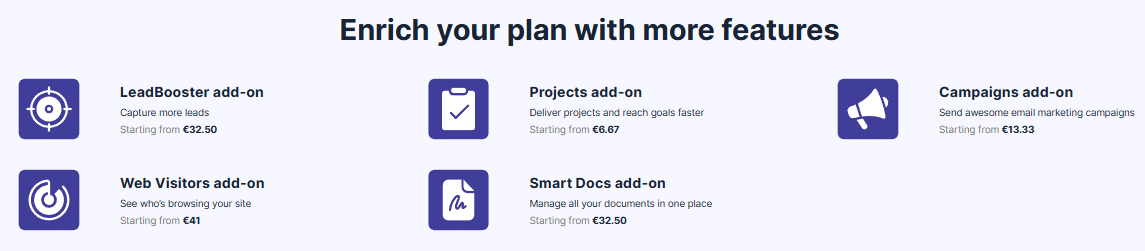
If the base plans don’t cover everything, you can power up with extra features:
- LeadBooster (from 32.50€/mo): Includes chatbots, live chat, and web forms to grab leads 24/7.
- Web Visitors (from 41€/mo): See which companies are browsing your site, even if they don’t fill out a form.
- Campaigns (from 13.33€/mo): A dedicated email marketing tool inside your CRM.
- Smart Docs (from 32.50€/mo): Centralize proposals and contracts with e-sign capabilities.
- Projects (from 6.67€/user/mo): Move from closed-won straight into project execution.
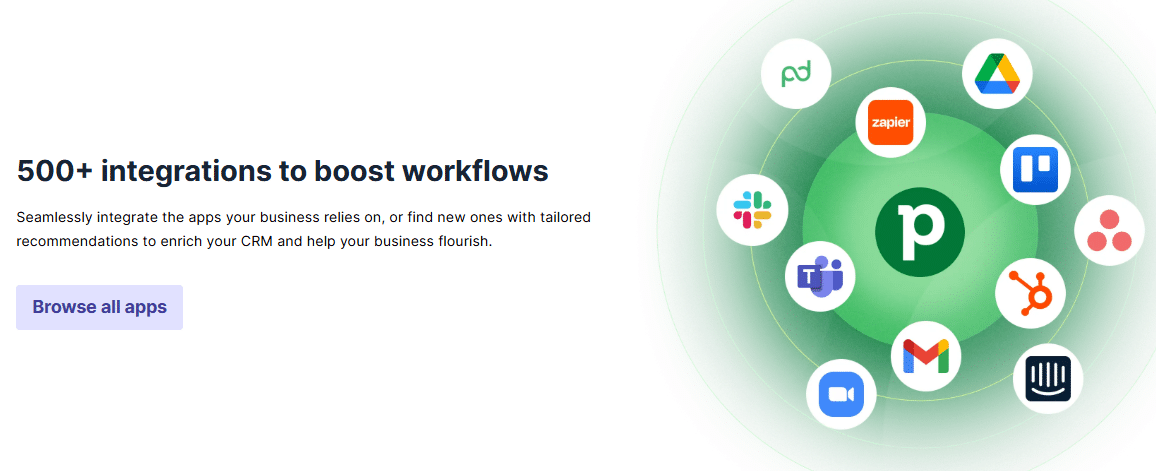
Pipedrive is often measured against the big three: HubSpot, Salesforce, and Monday.com. You can see the comparisons on their vs. pages. They rely on the fact that Pipedrive is generally easier to set up and more focused on the daily grind of sales, whereas the others are broader, more expensive all-in-one platforms. They’ve accepted they can’t out-feature the giants. Instead, they’re redefining the buying criteria from most powerful to most likely to be adopted by your team.

If you’re unsure how to scale, you can talk to their sales experts. They’ll ask for the basics (name, company size, and how you found them) to give you a tailored walkthrough of how the platform fits your specific industry.
Pipedrive’s Differentiators and Unique Assets

Pipedrive offers 3 ways for businesses and creators to team up with them. Whether you build software, consult with clients, or just have a large audience, there is likely a track that fits your business model.
Solution Providers
This path is designed for resellers, consultants, and agencies. If you help other companies implement software or streamline their sales processes, this is where you belong.
The application process for this tier is quite thorough. They want to know your company history, your annual revenue, and your marketing budget. You will also need to detail your experience with other CRM or ERP tools and provide a realistic estimate of how many Pipedrive seats you expect to sell in your first year. It is essentially a business plan to prove you are a good long-term fit for their ecosystem.
Technology Partners
If you have built a tool or platform that complements a CRM, you can join its integration ecosystem. This is the most straightforward entry point: you sign up for a Sandbox account with your name and email to start testing how your software works with theirs.
Affiliate Partners
The affiliate program is made for influencers, content creators, VCs, and website publishers. If you have an audience that needs a better way to manage sales, you can earn commissions by referring them.
When you apply, Pipedrive looks for specific details on how you plan to drive traffic. They will ask about: your strategic approach to promotion, the social media platforms you use, your monthly estimations for sign-ups and sales, and whether you are currently working with any of their competitors. They are looking for active partners, so be ready to share links to your best content and explain your experience with sales automation.
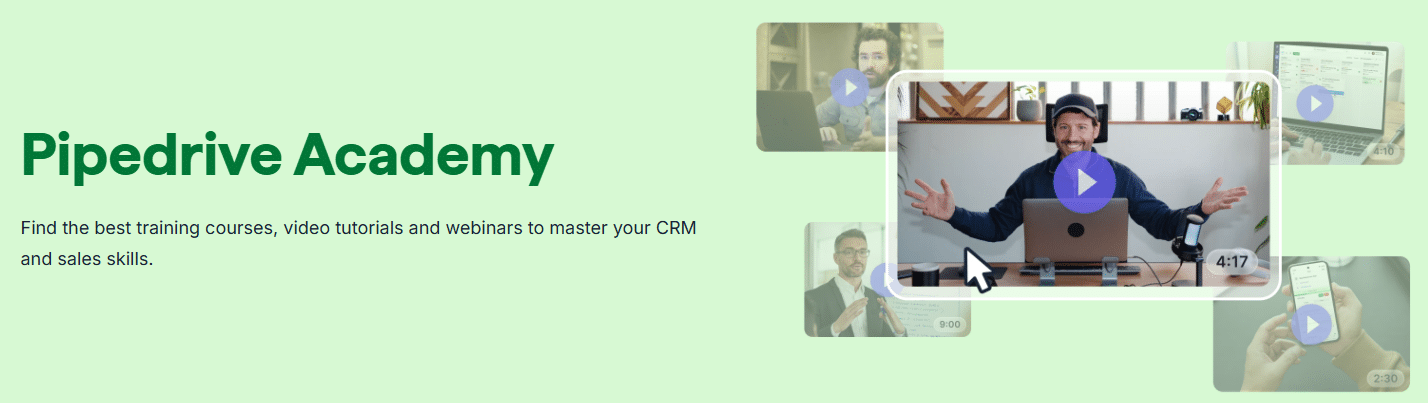
If you want to move past the basics and actually master the software, Pipedrive Academy is the central hub for training. It’s designed to help both new users and seasoned admins get more out of their sales process without having to figure it all out by trial and error.
Once you finish these, you can earn certificates to showcase your skills on LinkedIn or your CV. To get started, you just log in with your Pipedrive account to unlock the lessons.

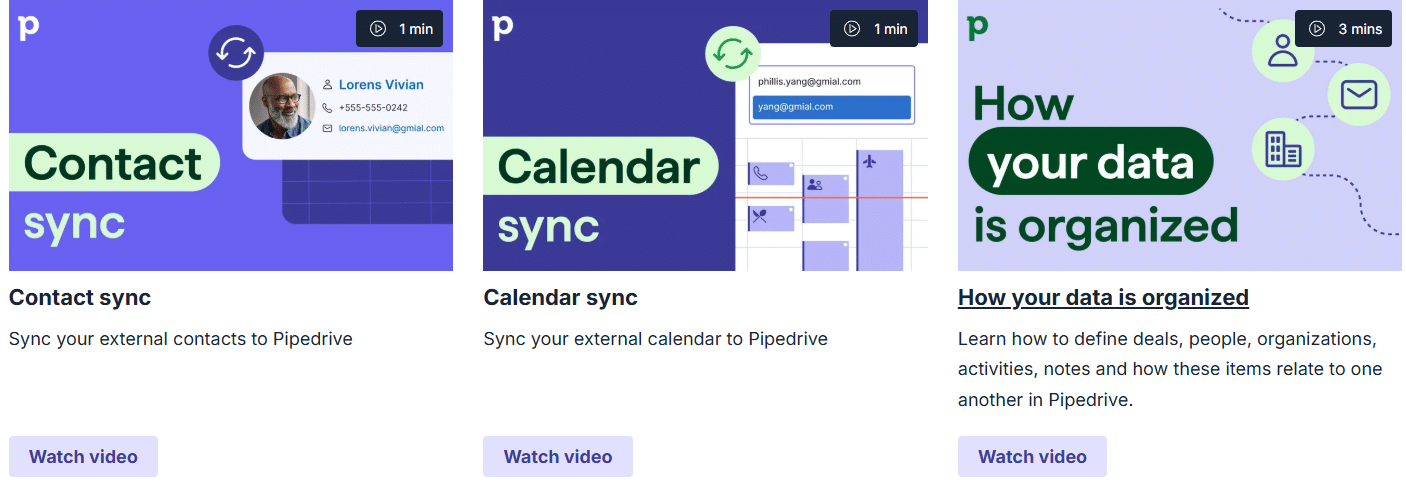
Free Video Tutorials
If you don’t have time for a full course, they have a library of free, bite-sized videos. These are great for when you’re stuck on a specific task or want to explore a new feature. Topics include:
- Setup & Organization (how to import data from spreadsheets and sync your calendar)
- Communication (managing the Sales Inbox and using email tracking)
- Automation (setting up workflows and automatic lead assignment to save time)
- Reporting (using “Insights” to create custom dashboards and track your goals)
- Lead Gen (getting the most out of the LeadBooster add-on and Web Forms)
Live Webinars and Events
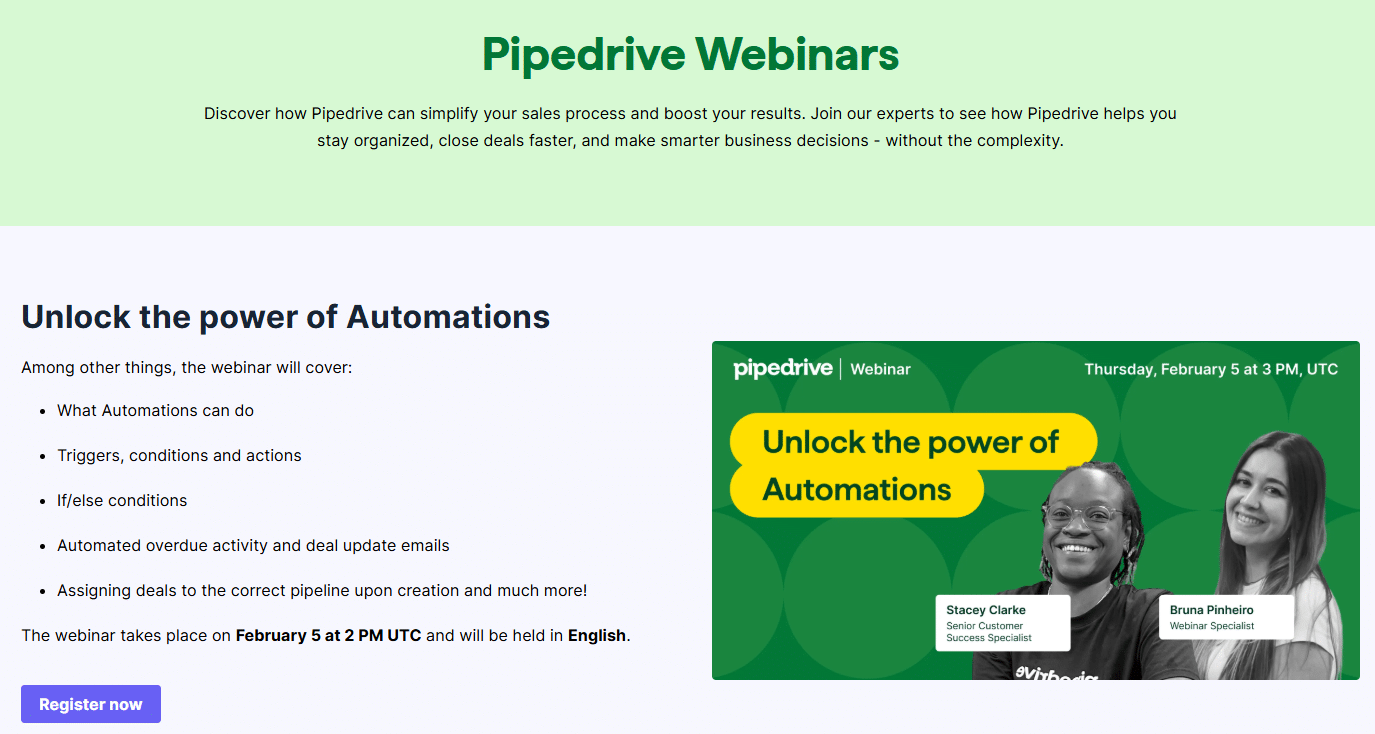
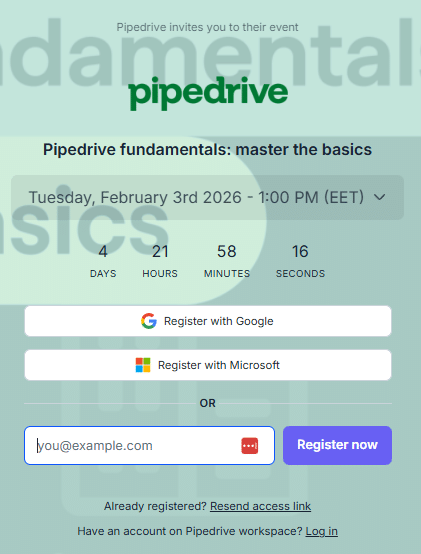
For those who prefer a live, interactive experience, Pipedrive hosts regular webinars. These usually last about an hour and are hosted by product experts. You can see a schedule of what is coming up in the next few days. To enroll, you can sign up using Google, Microsoft, or your work email. Events are often held in different languages, so you can pick the one that fits you best.
Whether you are just trying to get your data imported or you want to build a fully automated sales machine, the Academy has the resources to get you there.
Pipedrive Academy is free and comprehensive. This is a retention and activation play disguised as education. The real goal is getting users to their aha moment faster. Educated users have higher activation rates, lower churn, and become product advocates. The certification creates personal investment that makes users emotionally tied to the platform.
Help Center

Pipedrive keeps its support system fairly straightforward by splitting it into 3 main areas: the Knowledge Base, a real-time Status page, and direct Contact Support.
The Knowledge Base
This is where you go for self-service help. It’s a library of articles that walk you through every feature of the platform. To make things easy to follow, the articles use visual aids. You will find plenty of screenshots and tables, so you aren’t just reading walls of text.
💡 Steal This: The “Visual-First“ Documentation: Replace 50% of your text-heavy support articles with annotated screenshots and “Quick-Glance” tables.
Each article shows you exactly who wrote it and when it was last updated, so you know the information is current. If you find a solution that your team needs to see, you can quickly share the link via Facebook, LinkedIn, or X.
Real-Time Status
Before you assume something is wrong with your specific account, you can check the Status page. This gives you a live look at their servers and services, letting you know if there is a known outage or if everything is running smoothly.
Contacting Support
If you can’t find the answer yourself, Pipedrive has a support team that stays active around the clock. You have a few different ways to get a hold of them:
- Live Chat & Email: Available directly through your Pipedrive account for quick troubleshooting.
- Phone Support: If you need to speak with someone live, they offer phone support in multiple languages (currently available in English and Portuguese).
Between the detailed articles and the 24/7 support team, you are rarely left on your own if you hit a block.
The 2026 Localization Trends report found that literal translation is no longer enough. Companies using transcreation (creative adaptation) see 2.4x higher engagement than those using basic translation. Pipedrive’s regional guides (like Portuguese or Spanish tax tips) are an emotional impact play. The study shows that 2026 market leadership requires cultural intelligence, making the user feel the product was built specifically for their local regulations.
This destroys any barrier to international markets. SMBs in Portugal or Germany need compliance confidence. By providing region-specific guidance, Pipedrive removes the “will this work in my country?” objection, which is often the silent deal-killer in global SaaS sales.
Free downloads and online tools

Beyond the software itself, Pipedrive offers a library of free educational resources designed to help sales teams sharpen their skills. You don’t need to be a customer to access most of these; they are available to anyone looking to improve their sales process.
💡 Steal This: Build a simple, ungated web calculator (e.g., an ROI or “Activity Needed” calculator) that gives users a custom result before asking for their email to “save” it. It provides immediate value and proves your expertise.
To get your hands on these guides or calculators is a quick 4-step process:
- Enter your email address.
- Click the “Send to me” button.
- Check your inbox for the link.
- Download and save your free content.
They have other interactive tools that help you plan your finances and sales targets without needing a complex spreadsheet. The Sales and Tax Calculator is a tool that reverse-engineers your income goals. You enter how much you want to earn, and it tells you exactly how many activities you need to complete to get there. The US Sales Tax Guides is a set of localized resources to help you navigate state-specific tax rules.
The ROI calculator is ungated initially, to show value before you try it. The calculator provides instant gratification (immediate insight), which builds trust before asking for an email. Once a user sees their potential ROI, the psychological commitment is already made, and the email capture is just formalizing what they’ve already mentally agreed to.
One of their most popular downloads is an 11-lesson ebook written by Pipedrive co-founder Timo Rein. This is a masterclass in pipeline management, condensing years of door-to-door and B2B sales experience into actionable advice. This guide will help you understand the logic behind conversion rates and revenue, give you actionable steps to keep your pipeline moving and avoid stagnant deals, teach you how to approach larger deals with more confidence and at a faster pace, and give you techniques to ensure you spend time on the activities that actually matter.
Pipedrive has The State of Sales and Marketing 2025 report. Their sixth edition report features insights from over 1k professionals globally, covering everything from startups to large enterprises.
The report explores:
- AI integration: How teams are actually using AI to change their daily workflows rather than just talking about it.
- Performance trends: What distinguishes the teams hitting their goals from those falling behind in a shifting economy.
- Work-life balance: New data on how hybrid work models and employee well-being are impacting sales results.
- Industry benchmarks: A look at how different industries are adapting to new sales and marketing technologies.
Whether you need a quick template or a full report on where the industry is heading, these resources are made to give you a head start.
Pipedrive’s Leadership Presence Analysis
Looking at the digital footprint of Pipedrive’s key figures over the last 3 months, there is a clear divide between the new corporate guard and the founders.
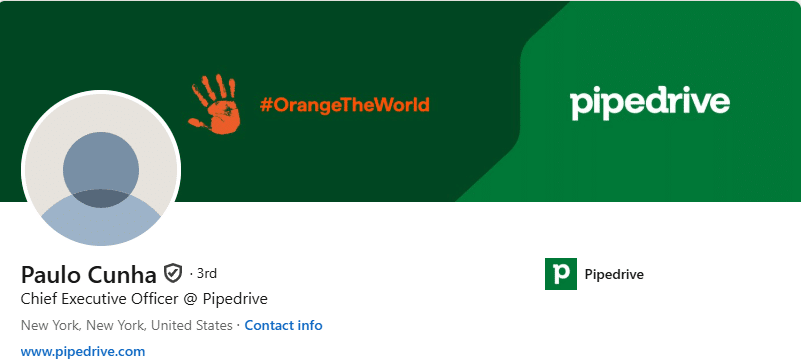
Since taking the helm in early 2025, Paulo has maintained a professional but relatively quiet presence on LinkedIn.
His activity mostly consists of reposting company news rather than sharing original, thought-leadership-style content. Over the last 3 months, his focus has been on the Pipedrive 3.0 vision, specifically the transition to an AI-native CRM. Despite his position, his 2.9k follower count suggests he isn’t using his personal profile as a primary marketing engine for the brand.
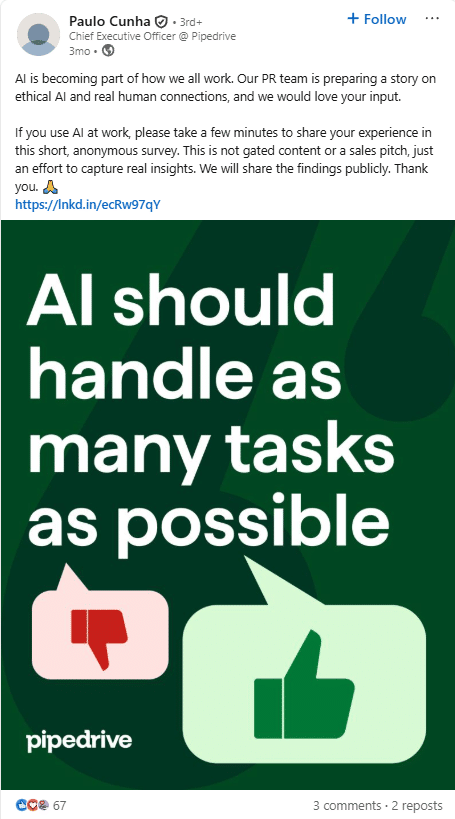
The lack of content keeps the brand institutional, rather than personality-driven. Unlike founder-led startups that use personal brands, Pipedrive is positioning for long-term institutional stability post-Vista acquisition. A quiet CEO presence suggests they’re building enterprise credibility over charismatic influence.
The original team that built the by salespeople, for salespeople culture has largely stepped back from the brand’s daily narrative. Ragnar Sass is a major LinkedIn influencer in the Estonian tech scene. He rarely, if ever, mentions Pipedrive operations or updates. Timo Rein, the co-founder and former CEO, is essentially invisible on the platform. He does not have an active public account for the community to engage with. There has been no posting activity from Martin Henk and Martin Tajur in the last 3 months.
Vista Equity Partners typically professionalizes brands post-acquisition. The absence of founder voices shows they’re intentionally moving away from the heroic founder narrative to a proven system narrative, which appeals more to risk-averse enterprise buyers.
Pipedrive’s Social Media Strategy
Pipedrive is present across all the major platforms, but its strategy is built on efficiency rather than platform-specific creativity. For the most part, they use a “create once, publish everywhere” approach, which keeps their branding consistent but can feel a bit repetitive for followers who track them on multiple channels.

On LinkedIn, Pipedrive has 112k followers. This is their primary hub for professional engagement. While the follower count is high, the content strategy largely mirrors what they post elsewhere. You’ll see a mix of product updates, an AI-focused survey, and links to their latest blog posts. This is where they make the “corporate” announcements.
Facebook & Instagram
Pipedrive has 64k followers on Facebook and 21.9k on Instagram. These two channels are essentially mirror images of each other, repurposing content consistently.
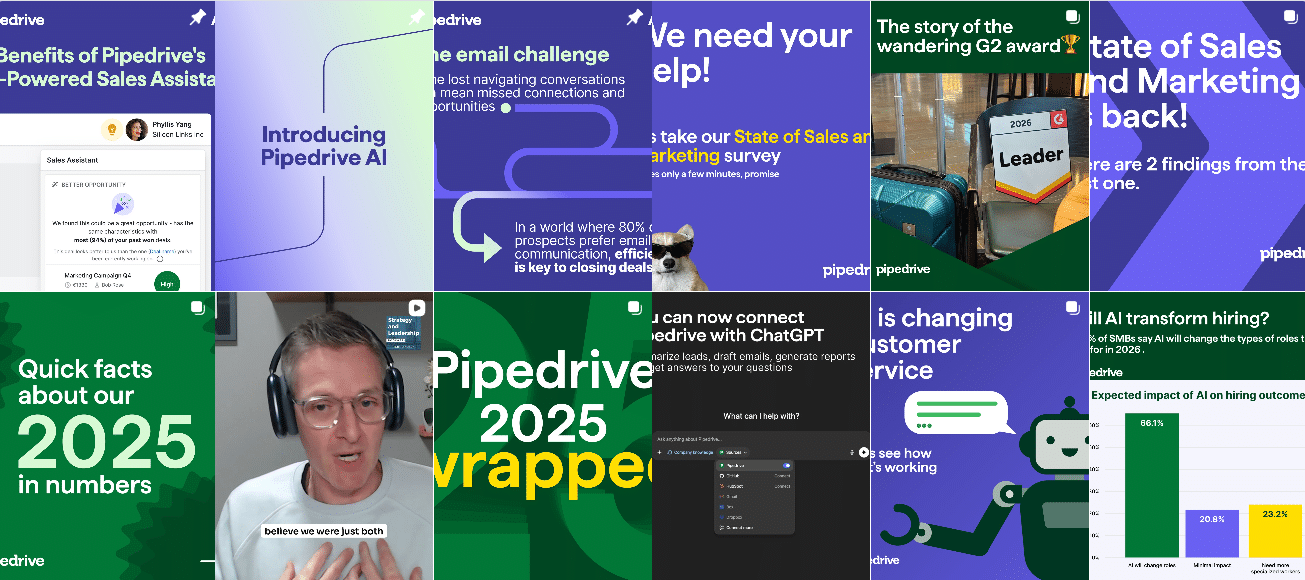
For their visual style, they stick strictly to their brand color scheme, using polished images and short video clips. There was a noticeable lull in activity from late December through early January, suggesting a scheduled break in their content calendar during the transition into 2026.
As for the content pillars, they mostly post “how-to” tips and motivational sales content, though it rarely deviates from the templates used on LinkedIn.
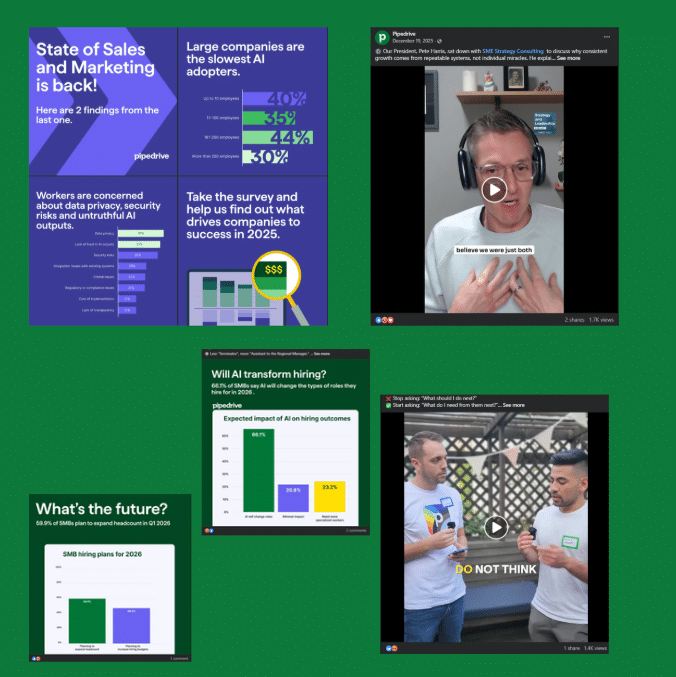
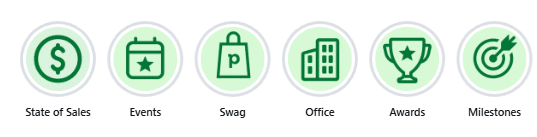
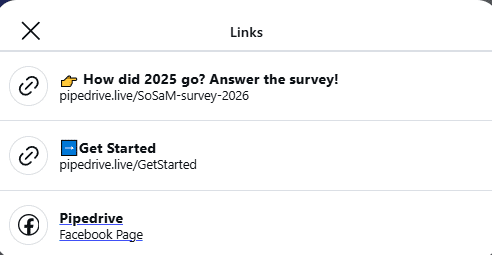
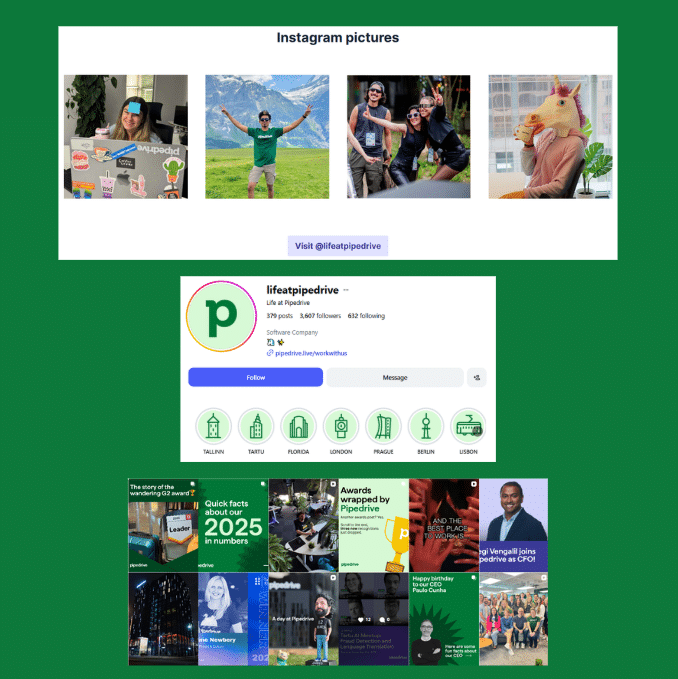
On Instagram, Pipedrive has 3 links in the bio: the 2025 survey, the Get Started with Pipedrive link, and their Facebook page. They have the following Highlights: State of Sales, Events, Swag, Office, Awards, and Milestones.

X (formerly Twitter)
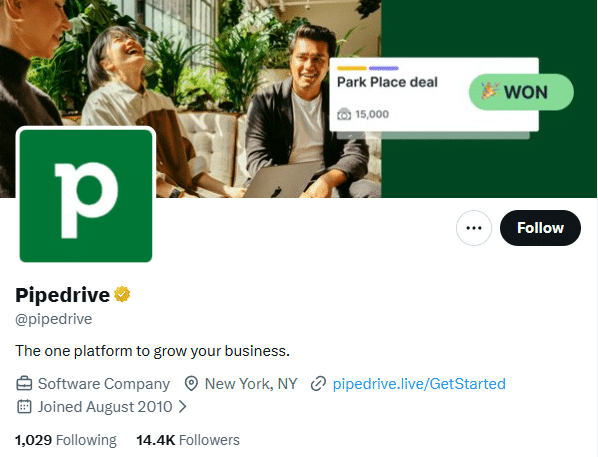
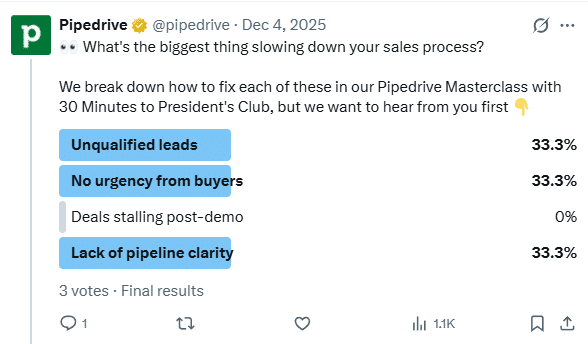
On X, Pipedrive has 14.4k followers. X is arguably their quietest channel. While they do occasionally use the poll feature to get quick feedback from the community, the account often goes dormant. Their last significant activity was in December 2025, and they don’t cross-post every single piece of content here, likely because the platform’s fast-paced nature doesn’t align with their more static, image-heavy posts.
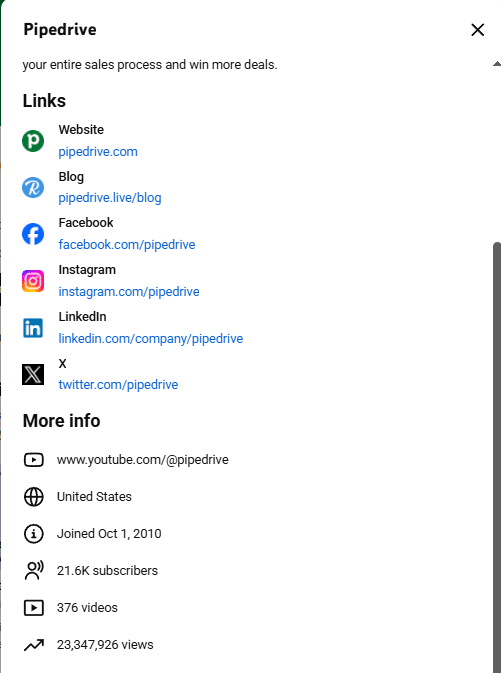
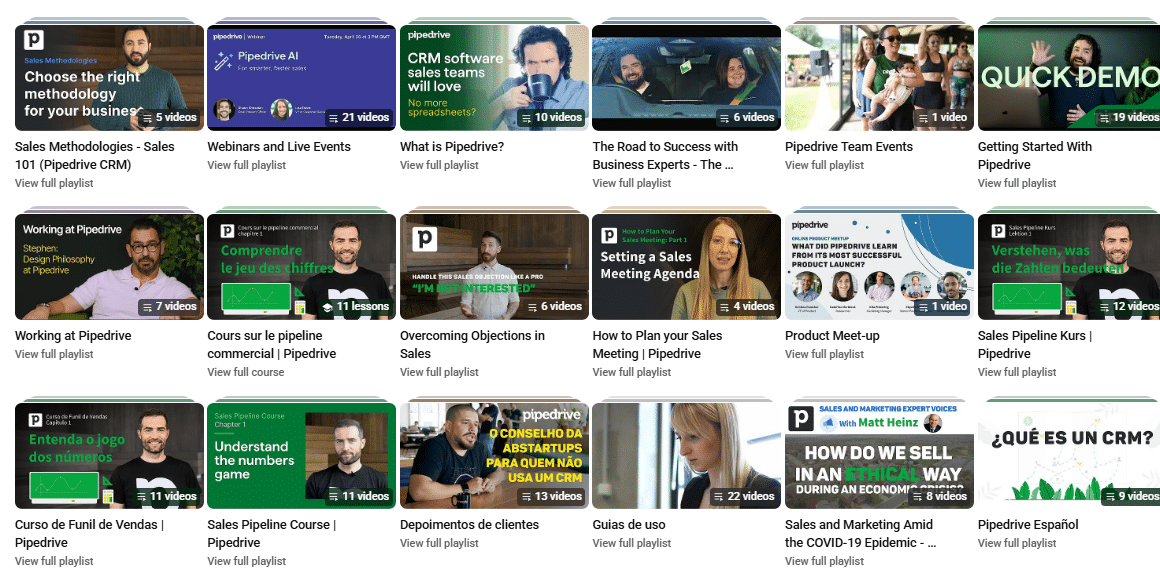
Here, Pipedrive has 21.6k subscribers and 376 videos posted. YouTube is where Pipedrive’s content actually provides the most depth. With over 23 million total views, it serves as a massive educational library. They offer playlists and courses in multiple languages, making it a key tool for their international user base.
The content mix is great. You’ll find everything from long-form webinars and “Sales Pipeline” courses to quick YouTube Shorts that highlight new features. Unlike their other socials, YouTube stays active with “Live” replays and tutorials, like their recent January 2026 webinar on marketing best practices.
In a world full of AI-slop content that floods the web, authenticity is the new currency. Pipedrive uses real people in their videos because the studies show that B2B conversion is now driven by Trust Signals. Users are becoming “AI-aware” and specifically seek out content that shows a human face or first-hand expert experience.
💡 Steal This: Make a “YouTube Academy”. Turn your most common customer “How-to” questions into a series of YouTube Shorts and 3-minute tutorials organized into a Masterclass playlist. This creates a self-sustaining education machine. Pipedrive’s 23 million views are from people searching for how to sell better.
Conclusions
The overall strategy is highly centralized. If you’ve seen a post on Facebook, you’ve likely seen it on LinkedIn and Instagram too. While this ensures a unified brand voice, it leaves little room for platform-specific community building. Their YouTube channel remains their strongest asset, acting as a functional extension of their Help Center rather than just another social feed.
If you create once and publish it everywhere, you optimize the resources. Instead of building platform-specific content teams, they’re maximizing efficiency by repurposing core assets. For a B2B SaaS company, social media is primarily a distribution channel for demand gen content, not a community-building exercise.
LinkedIn is where their ICP (Ideal Customer Profile) lives. Sales managers and business owners aren’t scrolling Instagram for CRM recommendations. They’re on LinkedIn, consuming professional content. The 112k followers represent concentrated buying power, making it their highest-intent social channel.
YouTube serves triple duty: SEO (Google owns it and prioritizes video), education (long-form tutorials reduce support costs), and retargeting (video viewers are warmer leads). The 23M views represent compound interest on content; old videos continue driving traffic years later, unlike short social posts.
They’ve likely run the CAC analysis and determined that Facebook and Instagram don’t convert for B2B SaaS. The minimal engagement is strategic deprioritization. They maintain presence for the brand’s entireness but don’t waste resources chasing vanity metrics that don’t correlate with the pipeline.
Pipedrive’s Top-Performing Content
If we look at the raw engagement numbers from late 2025 into January 2026, there is a massive gap between what Pipedrive pushes and what users actually care about. While their reach is wide, the depth of interaction is surprisingly modest on most platforms.
LinkedIn, the fact-heavy hub
The strongest performers here are carousels. They turn reports and numbers into quick, swipeable facts. The vibe is highly professional and educational, but the conversation is one-way. People are consuming the data, but they aren’t necessarily starting discussions in the comments.

The top 3 posts are:
- The one where they wish Happy Birthday to their CEO, Paulo Cuhna, with 154 reactions, 6 comments, 1 repost
- Facts about their 2025 in numbers, with 73 reactions, 3 comments, and 7 reposts
- Pipedrive 2025 wrapped, with 99 reactions, 3 comments, and 3 reposts

Carousels are the LinkedIn algorithm’s favorite format in 2026. They generate high engagement (swipes = engagement), are easy to digest (visual > text), and feel native to the platform. Pipedrive is gaming the algorithm by giving it what it wants while delivering data-heavy content that positions them as thought leaders.

On Facebook, Pipedrive hides the total count of reactions, but a quick scroll shows a recurring trend: almost every post has an “angry” reaction. Usually, this isn’t about the content itself. In the CRM world, this often stems from users venting about customer support issues or recent price hikes on the only public wall available to them.

Despite having over 20k followers, the engagement is low. These are the 3 top posts:
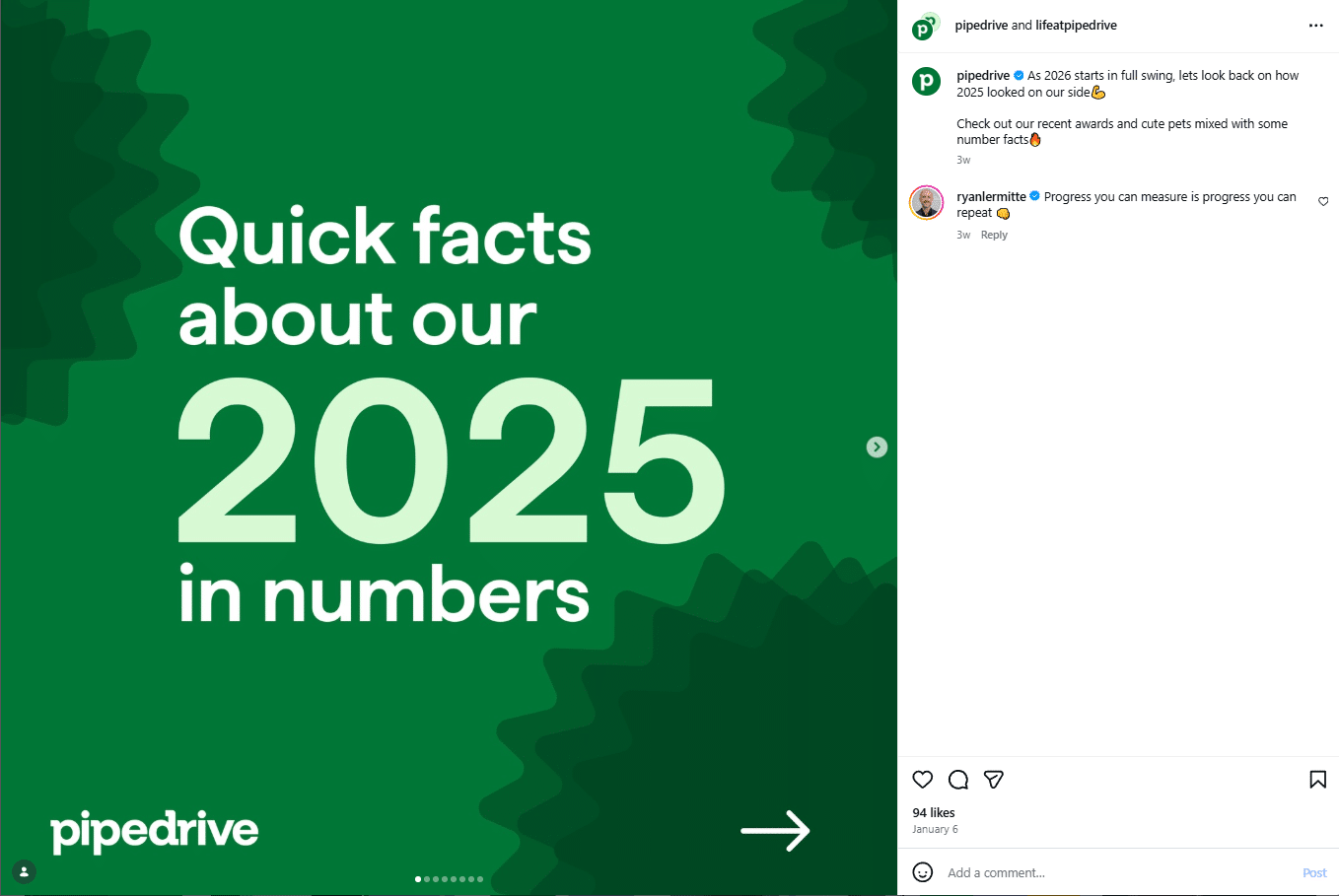
- Quick Facts about our 2025 in numbers: 94 likes, 1 comment.
- Pipedrive Wrapped: 73 likes, 4 comments.
- Best place to work Prize: 61 likes, 1 comment.
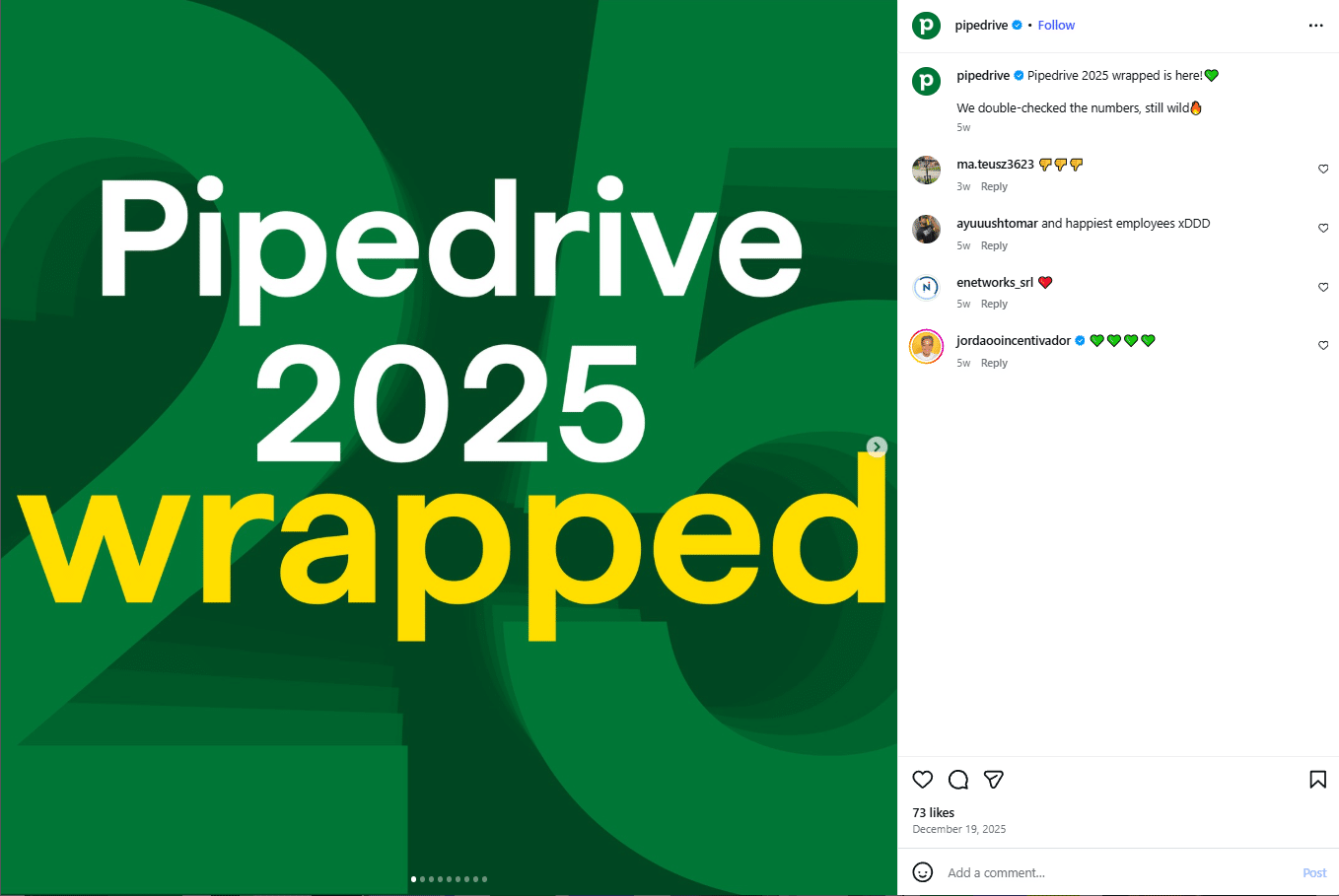
Using the same company colors and polished photos can act like a barrier on Instagram, because it looks like an ad, so people scroll past it like it.

X (formerly Twitter)
Activity on X has slowed to a crawl. The views are there, likely due to the algorithm, but the interaction is nonexistent. A typical high-performing post might get 5.5k views but only 2 likes.
Most other posts struggle to get a single repost or like, despite reaching over 1k people. It’s clear the audience here has moved on or simply isn’t looking to X for CRM tips anymore. Look at their top posts:
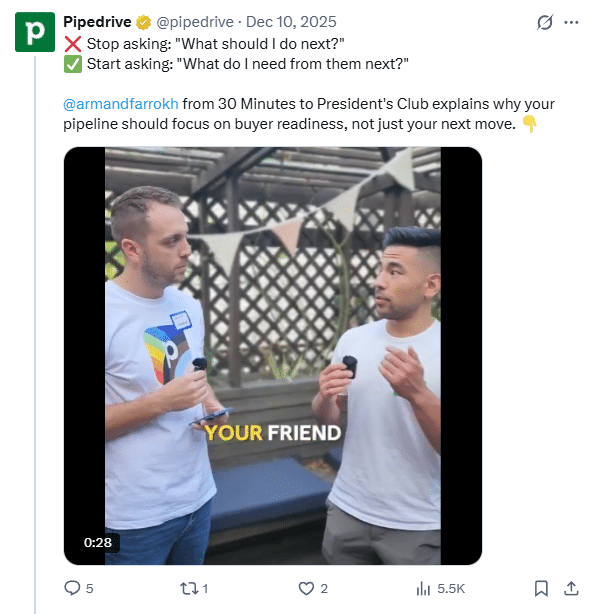
- 5 comments, 1 repost, 2 likes, and 5.5k views
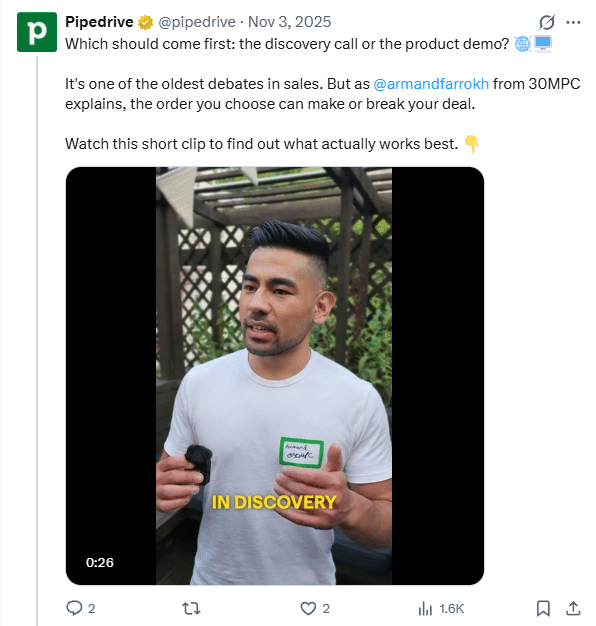
- 2 comments, 2 likes, 1.6k views, no reposts
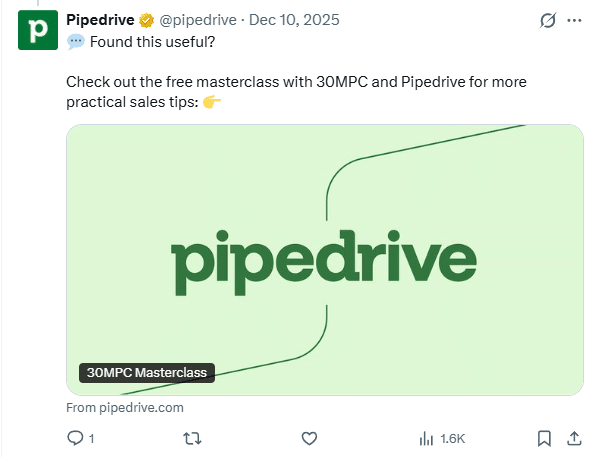
- 1 comment, 1.6k views, no likes or reposts.
Youtube
Although they have a million views on some videos, the engagement is low, with only a few comments on their top performers.
Top Videos

- Navigating the Fast Lane to Growth 🏎️ | Pipedrive CRM – 12 million views, 38 likes, 1 comment
- Driving Business Growth 🚗💨 | Pipedrive CRM – 4.8 million views, 11 likes, no comments
- Celebrate winning sales on the go with our mobile app. – 1.7 million views, 6 likes, no comments
When you see millions of views paired with double-digit likes, it usually means the video is being played as a non-skippable ad rather than being searched for and watched organically.
Top Shorts

- 😱 Is #ThePipedrive fake? – 2.3k views, 18 likes, no comments
- Cold Call vs Cold Email #salestips – 1.3k views, 10 likes, no comments
- What’s the most underrated sales tactic right now? #salestips – 1k views, 8 likes, no comments
Their sales tips shorts get much more natural engagement. Even though the view counts are smaller, the like-to-view ratio is much healthier here, showing that viewers are actually finding value in the quick sales coaching.
The millions of views come from pre-roll ad placements, not organic discovery. Pipedrive is using YouTube’s ad platform to force exposure, banking on the *Mere Exposure Effect (*the more people see the brand, the more familiar and trustworthy it becomes), even if they skip the ad.
Shorts are capturing search intent. People searching “cold call vs cold email” want quick answers, and Pipedrive is providing them. The healthier engagement ratio shows these are found content, not pushed content.
Conclusion
Pipedrive is great at producing volume, but they are struggling with real connection. Their most “successful” content by the numbers is actually just paid reach. The content that people actually like, the quick tips and human-led shorts, is currently the smallest part of their strategy.
Pipedrive’s Paid Advertising Strategy
Pipedrive’s advertising across LinkedIn, Meta, Google, and YouTube is built on one core message: visibility and simplicity. While their social media organic presence can feel repetitive, their paid strategy is a highly coordinated machine designed to catch sales leaders right as they are planning their year.
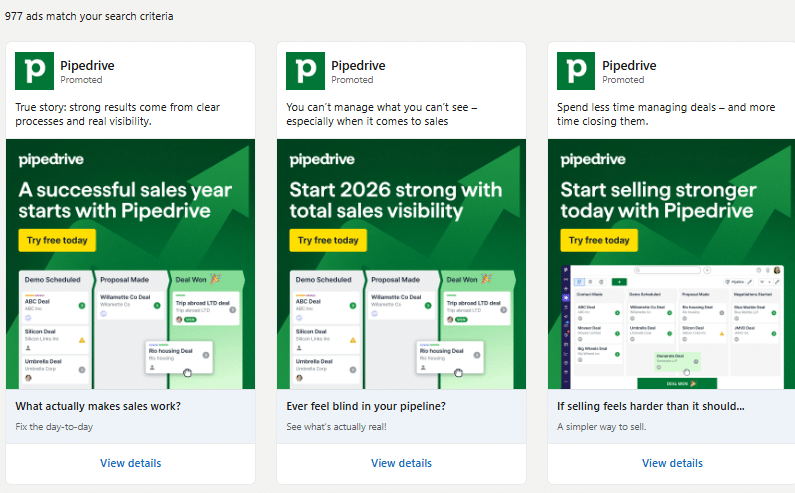
On LinkedIn, Pipedrive targets managers and directors who feel like they’ve lost control of their team’s data. Their ads focus heavily on the psychological relief of seeing your sales process clearly. For hook, they use phrases like You can’t manage what you can’t see and Ever feel blind in your pipeline? to hit on common management frustrations.
The goal is moving from potential to closed. They push the idea that fixing the daily workflow is the only way to hit annual revenue targets. For the format, Pipedrive uses mostly single-image ads that look like professional insights rather than flashy commercials.
💡 Steal This: Use the “Negative Hook” in Ad Copy. Run a search ad that targets the anxiety of your target audience, rather than the benefit of your tool. Fear of loss is a more powerful motivator than the hope of gain.
They’re selling to the pain, not the gain. Pain triggers loss aversion (fear of losing deals), which is psychologically stronger than the desire for gain (closing more deals). By positioning their CRM as the solution to an active crisis, they create urgency that generic grow your business ads can’t match.
Meta
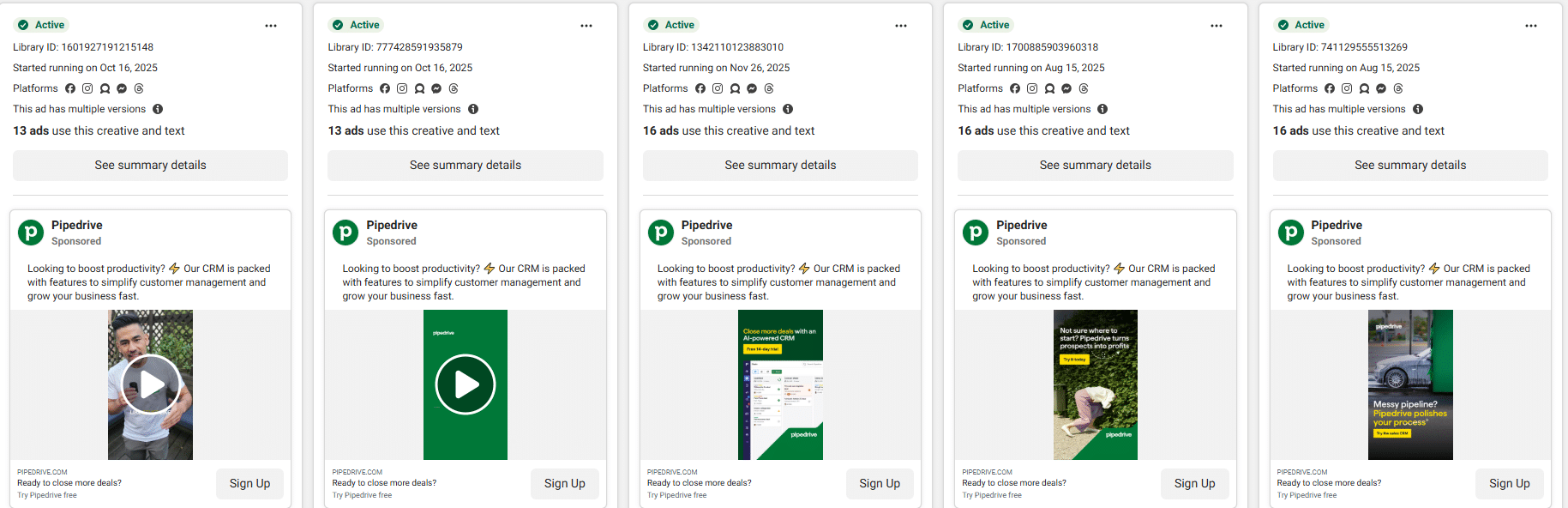
On Facebook and Instagram, the tone shifts from management oversight to speed and productivity. The ads here are much more direct and action-oriented. You’ll see plenty of Try Pipedrive free buttons with emoji-heavy copy like Ready to close more deals? 🤝 or Boost productivity ⚡.
They lean into their established color palette, keeping the design clean so the Sign Up button stands out. A major theme for 2026 is their enterprise-grade automation, showing users how to sync leads from Facebook directly into their CRM without manual entry.
Meta users are in a different mindset than LinkedIn users. They’re scrolling for dopamine, not professional development. The emoji-heavy, action-oriented copy matches the platform’s casual tone and increases thumb-stopping power in a crowded feed.
Pipedrive’s search strategy is aggressive. They aren’t just bidding on “CRM”. They built their reputation as the “easy” and “affordable” alternative to giants like Salesforce.
No Google Maps or Google Play ads are running right now.
Google Shopping
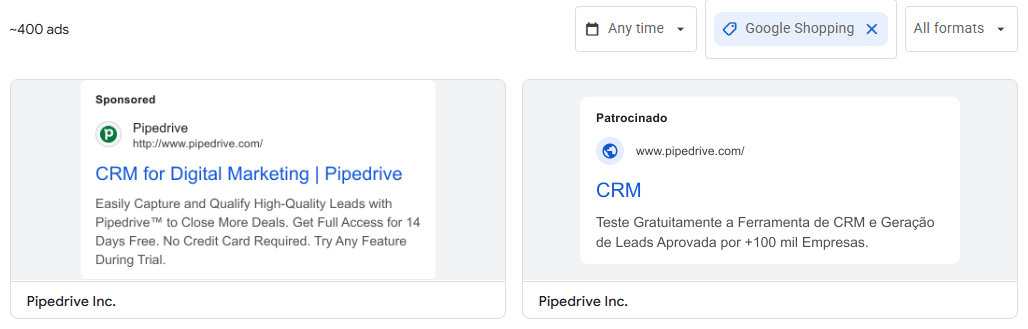
For headlines, they use punchy, competitive claims like “#1 Cheapest CRM” and “**#1 Easiest CRM”.**
They capture users specifically looking for “CRM for Digital Marketing” or “Pipeline CRM”, ensuring they show up when a buyer is ready to compare.
Google Search
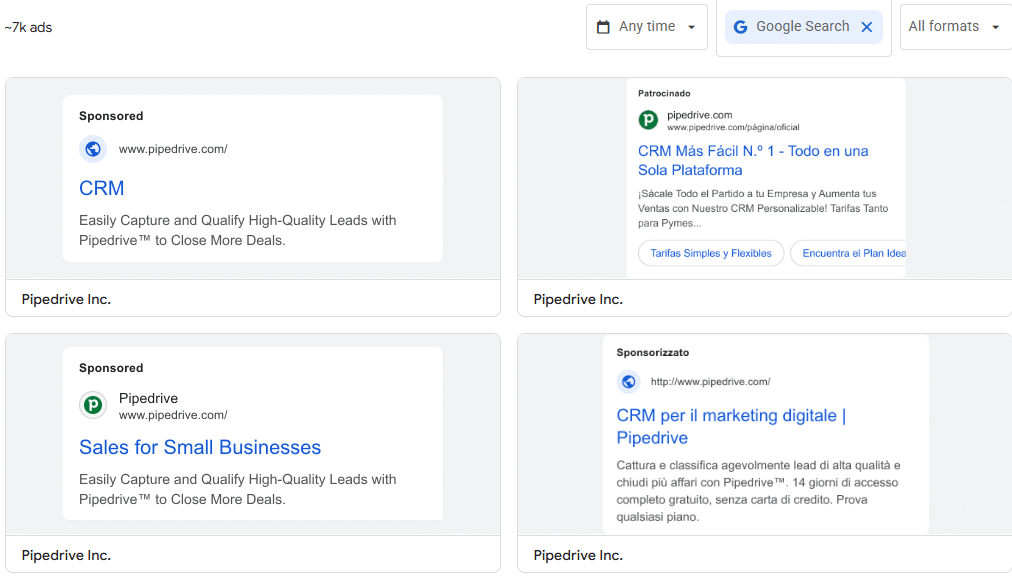
They run these ads in multiple languages to maintain their status as a global leader for small to mid-sized businesses.
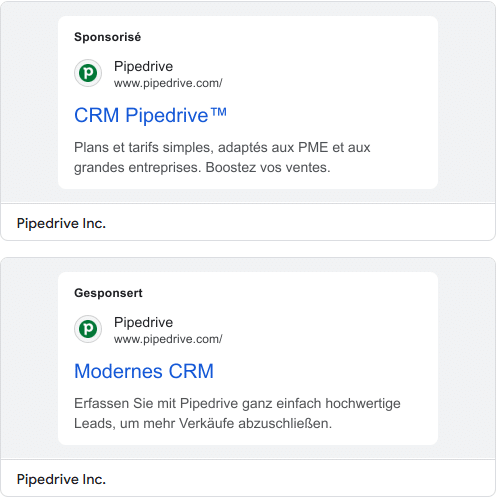
They’re capturing bottom-of-funnel, price-sensitive searches. Someone Googling “cheapest CRM” has already decided to buy, and they’re just comparing options. By claiming the price leadership position, Pipedrive wins the click from buyers whose primary decision criteria is budget, which is perfect for their SMB focus.
Youtube
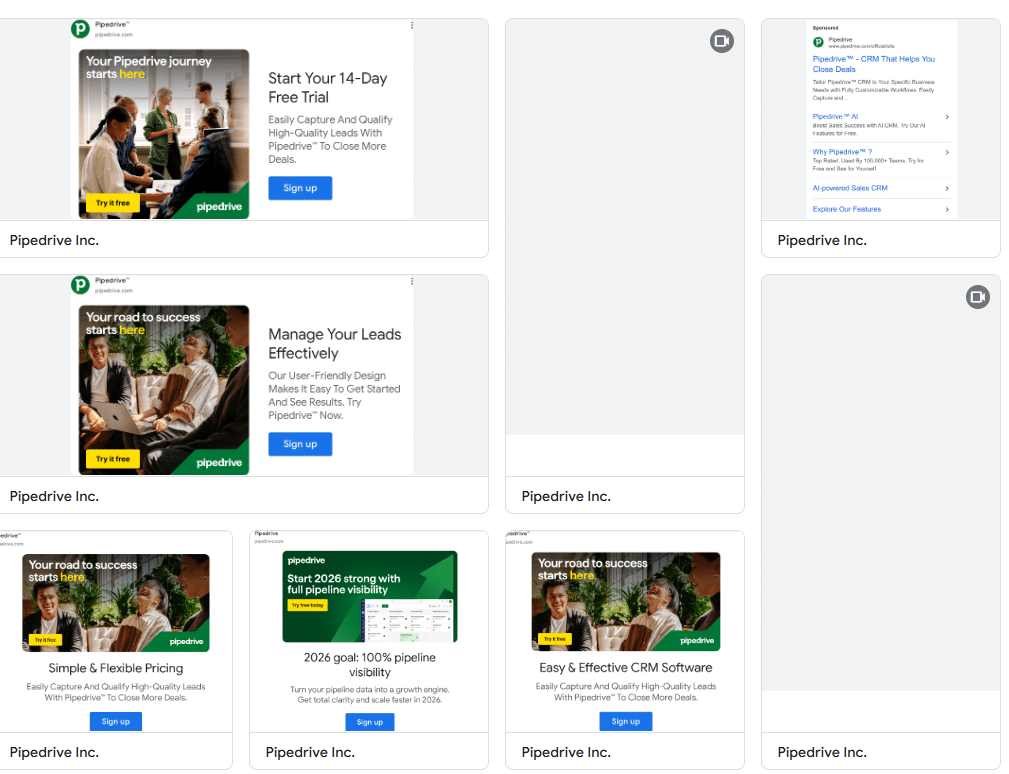
In January 2026, their YouTube ads are focused on the new year’s resolution of sales teams. January is when sales teams set goals and assess tools. The 2026 framing creates temporal relevance, and it’s specifically tied to this planning cycle. This exploits the Fresh Start Effect, when people are most open to behavior change.
Conclusion
Pipedrive isn’t trying to get the “most creative” advertiser prize. They are more formal, but consistent. Whether you are on your phone (Meta), searching for a solution (Google), or watching a tutorial (YouTube), they want you to associate Pipedrive with a stress-free, visible sales pipeline.
Message consistency builds brand recall through repetition. In marketing, it takes 7+ touchpoints to create memory. By hammering pipeline visibility everywhere, they ensure that when a prospect is finally ready to buy (which could be months later), Pipedrive is top-of-mind as the visibility CRM.
Pipedrive’s Sales Funnel from Social Media
Pipedrive uses social for brand recall, not instant deals. No one’s buying a CRM from a LinkedIn post. The goal is simple: move someone from scrolling to starting a trial with as little friction as possible.
At the top, it’s all about pain. On LinkedIn and Meta, they call out messy pipelines and spreadsheet chaos with clean, simple visuals and one clear problem at a time. They’re not selling yet. They just want a click or a video view so they can retarget you later.
Once you’ve interacted, the value trade starts. Now you’re seeing ads for their State of Sales report or guides about pipeline management. Big-picture expertise, free, in exchange for your work email. The conversation moves from social feeds into your inbox, where they have more control.
When you’re warm, they push for the trial. YouTube does a lot of heavy lifting here with tutorials and problem-based videos that feel helpful but double as product demos. On LinkedIn and Meta, the sign-up is built to be ridiculously easy, often with native lead forms and trial buttons that don’t even ask for a credit card.
After the trial starts, everything gets synced into their CRM through their own integrations. From there, automated emails guide setup and first wins. Because the lead came from social but lives in the CRM, they can track exactly which ad or video turned into real revenue.
The big picture: social isn’t their community space, it’s their prospecting engine. B2B deals take months, so social’s job is to spark interest, prove credibility, capture contact info, and hand things off to email and the product.
Giving away big reports builds authority and filters for serious buyers. Watching a long YouTube tutorial is basically a self-serve demo. Native lead forms reduce friction, especially on mobile, so more people convert. And by running all of this through their own CRM, they’re proving it works.
Pipedrive’s Reviews and Social Proof
Pipedrive maintains a strong reputation across the major review platforms, usually landing in the 4.2 to 4.7-star range. However, the feedback is split: while the desktop version is a favorite for sales management, the mobile experience and specific technical syncs receive more scrutiny.
| Platform | Rating | Key Takeaway |
|---|---|---|
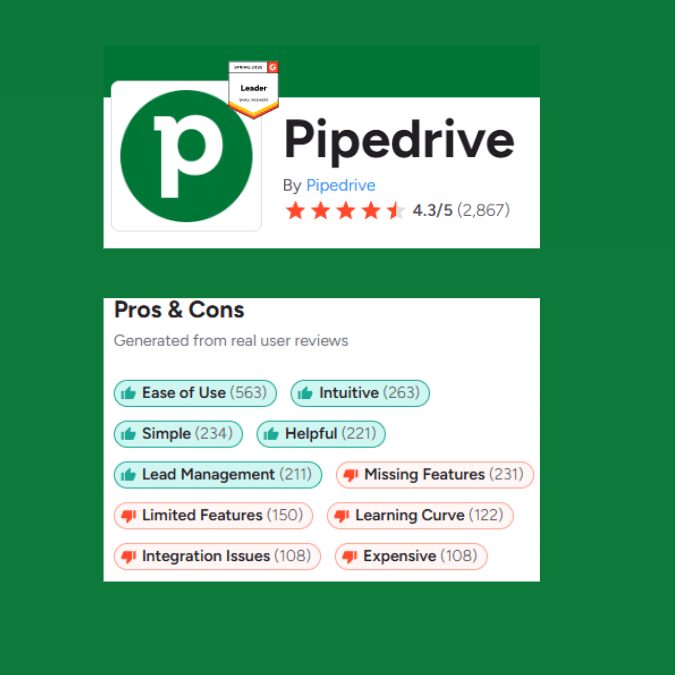
| G2 | 4.2 / 5 | Users love the visual pipeline but often ask for more advanced automation at lower price points. |
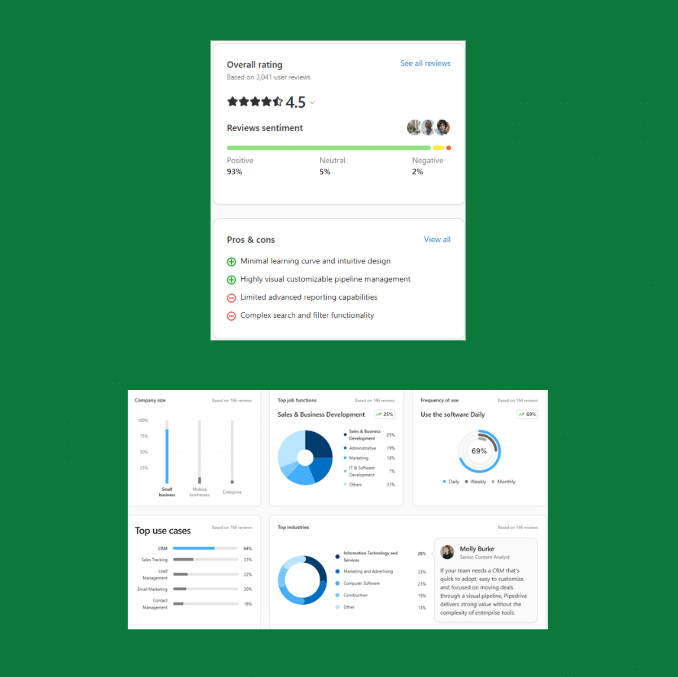
| Capterra | 4.5 / 5 | High marks for ease of use and being a cleaner alternative to Salesforce. |
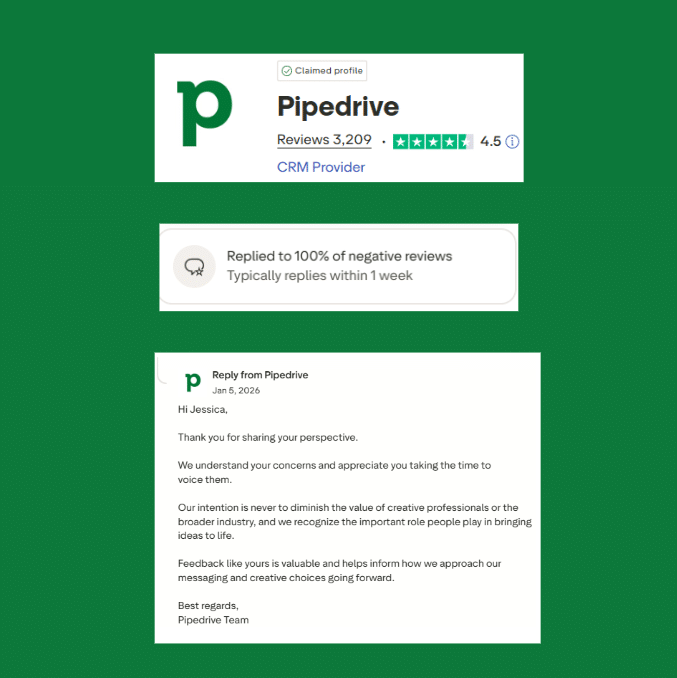
| Trustpilot | 4.5 / 5 | Strong recent reviews (Jan 2026) praising the implementation and onboarding teams. |
| Software Advice | 4.5 / 5 | Noted as a FrontRunner for contact management and lead tracking. |
| Gartner | 4.3 / 5 | Recognized for Business Value Created and Ease of Implementation. |
| SourceForge | 4.7 / 5 | Awarded Summer 2025 Leader status; ranked in the top 5% of all software. |
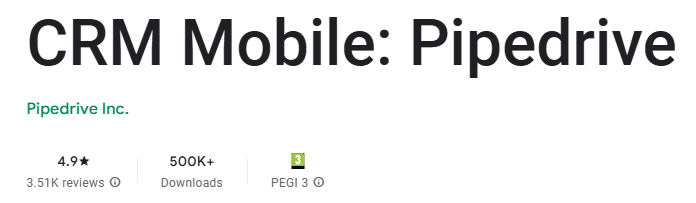
| Google Play | 4.0 / 5 | Generally positive, though users complain about limited multi-file uploads. |
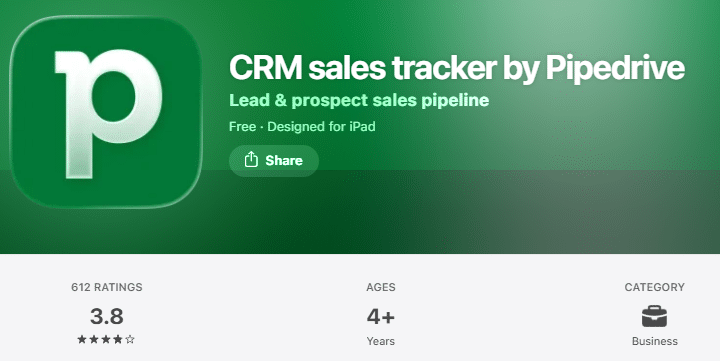
| Apple App Store | 3.8 / 5 | The lowest of their scores. Users find the mobile app lacks the depth of the desktop version. |
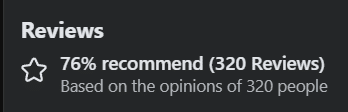
| 76%/100% | A lot of users complain about their customer service. | |
| Get App | 4.5 / 5 | Positive reviews about adaptability, pipeline, and assistance. |
What’s working
The most consistent praise focuses on the core sales tasks. If you are using Pipedrive for its primary purpose, you’ll likely be happy with:
- the visual pipeline (the drag-and-drop interface is still considered the industry gold standard for clarity)
- lead tracking (users find it easy to see exactly where a prospect sits in the funnel)
- onboarding (multiple reviews from early 2026 highlight that the setup process is painless, especially for teams moving away from spreadsheets or clunky legacy systems)
The pain points
When users get frustrated, it usually falls into these categories:
- mobile sync (there are recurring complaints on the App Store about the mobile app feeling like a lite version that doesn’t always talk perfectly to the desktop site)
- email & contact management (while the basic functions work, some users find that full email sync is too expensive and that managing massive contact databases can feel manual)
- pricing transparency (a few recent reviews mentioned a lack of transparency when transitioning from the free trial to a paid plan, especially when trying to downgrade features)
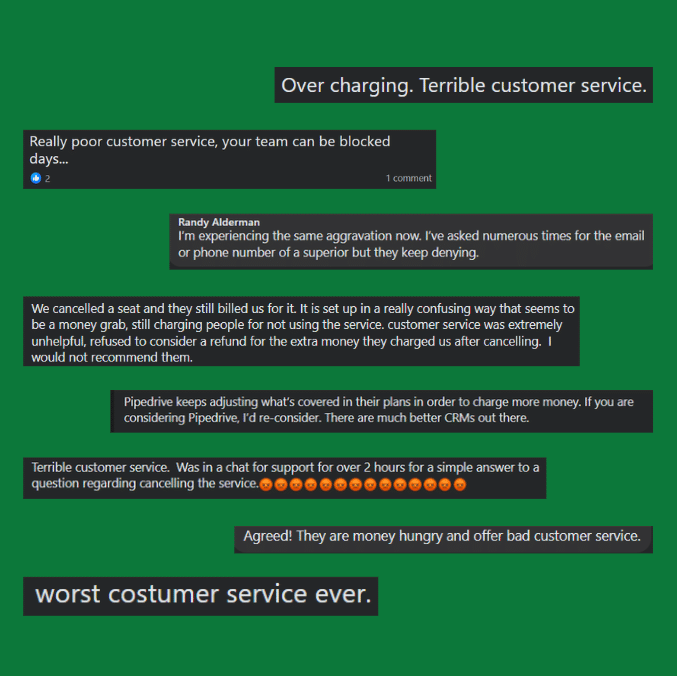
G2
Capterra
Trustpilot
Gartner
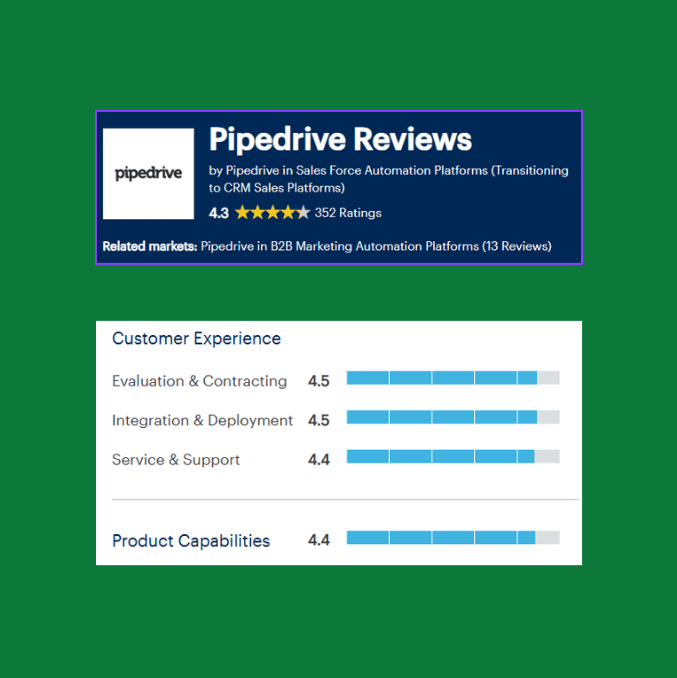
GetApp
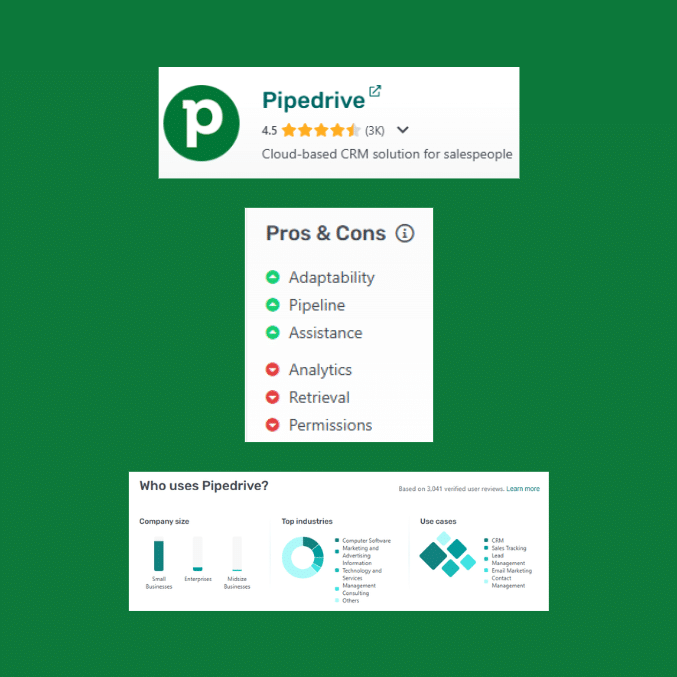
Software Advice
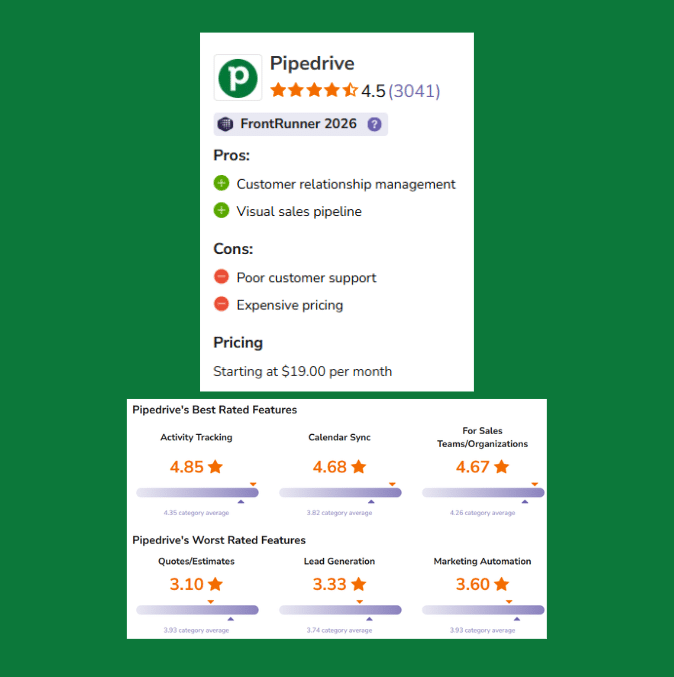
SourceForge
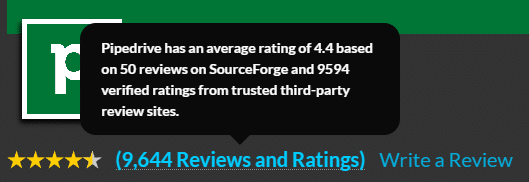
Google Play
Apple
Pipedrive really leans on customer reviews, and it works because they have volume and consistency. The overall vibe people describe is that it feels like a calm in the storm: simple, clear, and way less overwhelming than bigger, more complex CRMs.
They show up on a ton of review sites because different buyers trust different places. Startups might live on G2, bigger companies look at Gartner or Capterra. Being strong everywhere means no matter where someone researches, they keep running into positive proof instead of a competitor owning the narrative.
They’re surprisingly open about weaker spots, too, like the mobile app. That kind of honesty builds trust fast. When they admit something isn’t perfect, everything else they say feels more believable, and expectations are set properly from the start.
A lot of their positioning comes back to ease of use, not endless features. They know the real risk is buying a system the team never actually adopts. If reps use it, it works. If they don’t, nothing else matters.
Pipedrive’s Content Marketing and Demand Generation
Pipedrive uses a massive library of educational resources to pull people into their ecosystem, positioning themselves as a sales mentor rather than just a software provider.
Newsletter

You can sign up for their newsletter to receive valuable sales and marketing insights and stay informed about the latest Pipedrive updates.
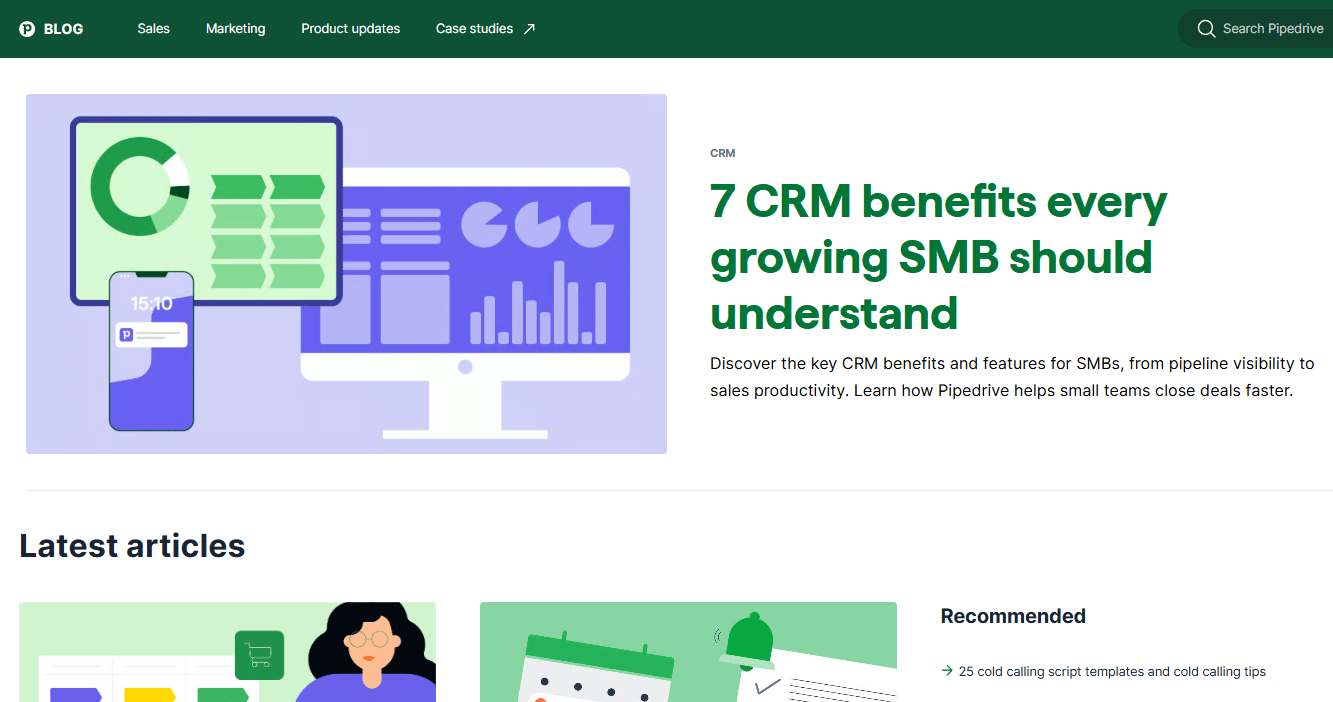
The blog is the heart of their organic traffic strategy. It is divided into four main categories: Sales, Marketing, Product Updates, and Case Studies.
Their typical articles are meaty, often reaching around 2.9k words. They are structured like mini-textbooks with clear tables of contents, actionable scripts, and screenshots. Despite the length, they use bullet points, bolded key phrases, and numbered lists to make the information easy to digest for busy professionals.
They make it easy to spread the word with dedicated sharing buttons for LinkedIn, Facebook, and X.
WordStream’s 2026 Content Marketing Trends report found that Zero-Visit Visibility is the most influential trend of the year. Because AI assistants now summarize info for users, brands must provide deeply structured, high-authority content to be cited as the source. 89% of B2B buyers now want brands to provide multi-media, long-form content to help them self-educate via AI search.
They use high-value assets to turn casual readers into leads:
- ebooks & guides
- calculators
- case studies
Pipedrive’s content explains how sales work. By solving a user’s immediate problem, like How do I write a follow-up email? they build the trust needed to eventually sell the CRM as the permanent solution to that problem.
They’re optimizing for AI citations and topical authority. Google’s algorithm rewards comprehensive content that fully answers a query. Long-form content also has more surface area for internal links, keywords, and backlinks. In the GEO era, being the most thorough source means ChatGPT cites you instead of a competitor.
A clear table of contents improves scannability (reducing bounce rate) and helps Google extract structured data for rich results. It also positions content as reference material, something users bookmark and return to, which signals quality to search algorithms.
Immediate value creates reciprocity. The calculator solves an urgent problem (sales planning math) instantly, which triggers the psychological need to reciprocate. When the tool asks for an email to save results, the user feels they owe something, and the conversion is social, not transactional.
Pipedrive’s Marketing and Sales Funnel Stages
Pipedrive’s strategy is built on the idea that marketing and sales should be a relay race, where the baton is passed seamlessly from broad awareness to long-term loyalty.
Top of the Funnel (Awareness)
At this stage, Pipedrive is casting a wide net to find people who are CRM-curious or simply frustrated with their current mess of spreadsheets. The goal here is brand discovery and interest. They dominate SEO with “How-to” guides and sales templates. Their paid ads on LinkedIn and YouTube focus on high-level pain points. Ungated blog posts, infographics, and short social videos that provide immediate value without asking for anything in return.
Middle of the Funnel (Consideration)
Once a prospect realizes they have a problem, Pipedrive moves in to show them why their specific solution is the answer. This is where the value exchange happens. The goal here is lead generation and qualification. They use lead magnets to get you onto their email list. If you want to read the 2025 State of Sales Report or the Sales Pipeline Course, you’ll need to provide your email. Webinars, comparison checklists (e.g., Pipedrive vs. Salesforce), and in-depth ebooks are used to score leads.
Bottom of the Funnel (Conversion)
This is where the marketing funnel becomes a sales funnel. The prospect is now evaluating the software directly. The goal here is to turn a trial into a subscriber. The 14-day free trial is the primary driver here. During this window, Pipedrive uses in-app cues and AI suggestions to show you exactly how much time you’re saving. For this, they use product demos, case studies from similar industries, and personalized outreach from their sales experts to help with the technical setup.
Retention (Loyalty & Expansion)
Their business model relies on keeping users active and eventually moving them to higher-tier plans. The goal is to reduce churn and increase Lifetime Value (LTV). They use automated onboarding sequences to make sure you hit your first win (like importing your first 100 contacts) within the first 48 hours.
They use constant updates via the Pipedrive Academy to keep users engaged. To upsell, they are promoting add-ons like LeadBooster or Smart Docs once a user has mastered the basic CRM. Pipedrive is encouraging referrals and reviews on sites like G2 and Capterra to feed back into the Top of the Funnel.
Pipedrive’s Future Plans and Growth Indicators
After reaching unicorn status with a $1.5 billion valuation back in 2020, Pipedrive has spent the last year retooling its executive team and product roadmap to move beyond being just a CRM and toward becoming an AI-native revenue platform.
In 2025, Pipedrive overhauled its C-suite to support this next phase of growth. CEO Paulo Cunha brought in three heavy hitters from global tech brands like Microsoft, Booking.com, and Expedia Group: Joe Futty (CPTO), Steven Quach (CMO), and Jonny Carroll (CDAO).
Their AI-first CRM vision includes:
- AI Sales Assistant: This is being upgraded from a simple notification tool to a full co-pilot that flags rotting deals and suggests the best next step based on historical success.
- Data Enrichment: A major focus for the 2026 Ultimate Plan is automatic data enrichment; essentially filling in missing contact info (like phone numbers and LinkedIn profiles) automatically so reps don’t have to.
- Automation at Scale: They are phasing out old booster packs by the end of 2026 in favor of stackable top-ups, allowing teams to buy more automation capacity without jumping to a much more expensive tier.
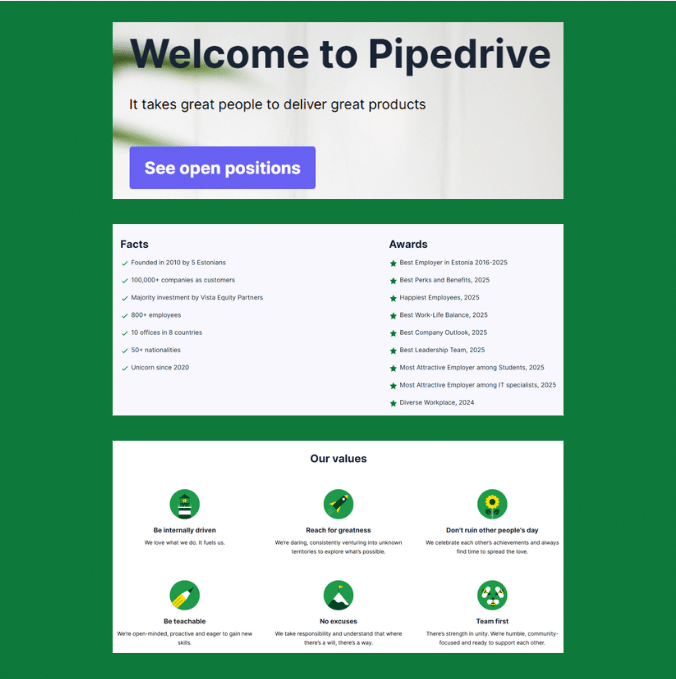
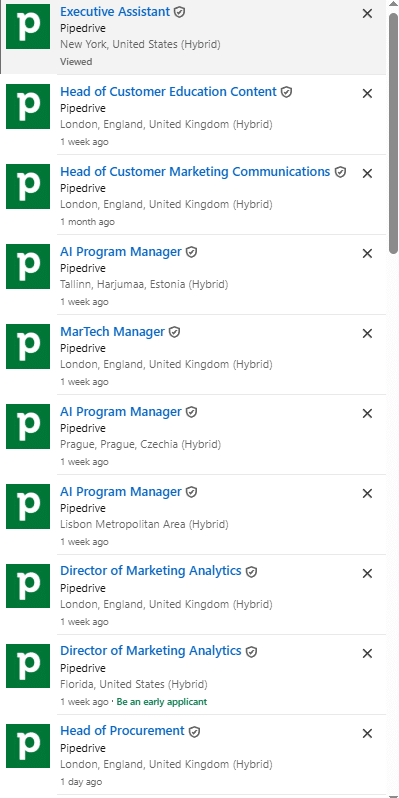
Their current recruitment focus is heavily weighted toward Engineering, Product, and Data roles in their European hubs (Estonia, Portugal, Czechia, and Latvia) and their New York headquarters.
When you apply, they’ve kept the process standardized: the essentials (resume, LinkedIn profile, and current location) and expectations (they ask for your gross salary expectations and eligibility to work in the specific country upfront, reflecting a very practical, transparent hiring culture).

You can also see current openings on the LinkedIn Jobs tab from their page.

While there hasn’t been a new funding round since the Vista Equity Partners acquisition in 2020, the company’s financial indicators remain steady. They are currently positioned as one of the few profitable, self-sustaining unicorns in the CRM space.
Under Vista Equity’s guidance, Pipedrive has transitioned from founder-led growth to institutional scaling by installing seasoned executives and prioritizing a product-led, AI-native strategy. The company is simplifying its pricing and shifting its hiring toward engineering to drive efficiency, positioning itself as a profitable, self-sustaining alternative to growth-at-all-costs competitors. This focus on financial stability and organic growth serves as a strategic moat, preparing the firm for a premium IPO or acquisition by 2026.
Inspiration Points
Here are 10 things they are doing exceptionally well in 2026.
- Quick wins first. They make the first 48 hours easy by celebrating small steps like moving a deal, which stops new users from giving up.
- Staying in their lane. They refuse to be a do-it-all tool, focusing entirely on being the best choice for sales teams instead of trying to handle HR or finance.
- Selling a mindset. They teach a method where reps focus only on their own daily actions, which lowers stress and makes the software feel like a philosophy.
- Friendly AI. AI is marketed as a simple assistant that handles boring chores like summarizing notes, making it feel helpful rather than intimidating.
- Expert teaching. Their guides offer real advice on how to sell, which builds trust and makes them look like a mentor rather than just a vendor.
- Clear costs. They avoid hidden fees and call for a quote games, using simple pricing to win over small businesses that want honesty.
- Seeing is believing. The visual pipeline uses colors to show when deals are stuck, letting the interface prove its own value without needing a sales pitch.
- Local focus. They adapt everything from tax rules to language for different countries, making global users feel like the tool was built just for them.
- Giving data away. By sharing original research and industry reports for free, they earn respect and get leads by being genuinely useful first.
- Help for everyone. They treat 24/7 support as a major feature available to all users, removing the fear of being left alone with a technical problem.
Pipedrive proved that you don’t need to be the most powerful tool in the market to win. They built a $1.5 billion company by staying obsessively focused on one thing: making sales teams actually want to use their CRM. While competitors like Salesforce and HubSpot kept adding features for every department, Pipedrive stuck to its lane and doubled down on pipeline visibility and simplicity. Their marketing strategy reflects this same discipline. They don’t chase viral social media moments or try to be everywhere at once. Instead, they invest in long-form educational content, AI-powered automation that feels helpful instead of invasive, and a product-led growth model that lets the software prove itself during a friction-free trial. The result is a stable, profitable company that continues to grow without the chaos of constant fundraising or feature bloat. For any SaaS company trying to compete in a crowded market, Pipedrive’s playbook is clear: pick your core value, communicate it relentlessly, and build every piece of your marketing around proving that one thing works better than anyone else’s version.
Frequently Asked Questions
1. How does Pipedrive position itself differently from competitors like Salesforce and HubSpot?
Pipedrive refuses to compete on features. While the big players try to do everything (HR, finance, marketing automation), Pipedrive stays in its lane as the sales-first CRM. Their entire pitch is built around one thing: pipeline visibility. They know sales managers are terrified of not knowing which deals are real, so they hammer home the visual Kanban board as the cure. They’ve basically redefined the buying criteria from “most powerful” to “most likely to actually get used by your team.”
2. What role does content marketing play in their demand generation strategy?
Pipedrive treats content like a long-term investment in authority. They publish encyclopedic 2,900-word blog posts that answer every possible question about sales processes. The State of Sales and Marketing 2025 report isn’t just a lead magnet; it’s proof they know what they’re talking about. Their calculators and templates solve immediate problems for free, which builds trust before anyone even considers the software. In a world where AI does the searching, they’re making sure they’re the source that gets cited.
3. How does their social media strategy actually work?
It doesn’t, at least not the way most people think. Pipedrive’s organic social engagement is low across Instagram, Facebook, and X. They post the same polished content everywhere, which keeps branding consistent but doesn’t spark conversations. The real workhorses are YouTube and LinkedIn. YouTube acts as a self-service education library with 23 million views, while LinkedIn is where their actual buyers live. They’ve clearly decided social isn’t for community building; it’s a distribution channel for getting people into the funnel.
4. What’s the core messaging in their paid advertising?
Fear. Every ad targets the anxiety sales managers feel when they can’t see their pipeline. On LinkedIn, it’s “You can’t manage what you can’t see.” On Meta, it’s all about speed and productivity with big CTAs like “Try Pipedrive free.” On Google, they go aggressive with claims like “#1 Cheapest CRM” to catch bottom-of-funnel searches from price-sensitive buyers. They’re selling relief from the chaos of managing sales with spreadsheets.
5. How does Pipedrive use AI in its 2026 marketing and product strategy?
They’ve gone all-in on being “AI-native.” The marketing now positions the CRM as a digital teammate, not just a database. The AI Sales Assistant flags dying deals, predicts success rates, and automates admin work. But they’re careful to make AI feel friendly and helpful rather than threatening. It’s marketed as a co-pilot that handles boring tasks so salespeople can focus on actual selling. This pivot is part of their “Pipedrive 3.0” vision under new CEO Paulo Cunha.
6. What makes their free trial and onboarding strategy effective?
The 14-day trial requires zero credit card info, which removes friction for people who just want to test it. Once you’re in, they focus obsessively on quick wins in the first 48 hours (like importing your first 100 contacts or moving a deal). The Pipedrive Academy and automated email sequences make sure you hit a milestone fast, which creates momentum. They know if your team doesn’t adopt it immediately, you’ll churn. The entire onboarding is designed to prove value before you ever talk to a salesperson.