Optimizing Your Go-to-Market Strategy: A Practical Guide to Improving GTM Performance
This is a practical guide about optimizing your go-to-market strategy. Learn more about refining your ideal customer profile to optimize your sales enablement content, ensuring you’re equipped to make data-driven decisions that boost revenue and growth.
Article summary
Share
Go-to-market (GTM) strategy optimization isn’t about tearing down your existing plan; it’s about fine-tuning a machine already in motion. Think of it as diagnosing why your conversion rates are lagging or your sales cycles are stretching longer than expected. This guide provides actionable insights to help you identify areas for improvement, implement targeted adjustments, and drive better outcomes from your existing GTM strategy. We’ll cover everything from refining your ideal customer profile to optimizing your sales enablement content, ensuring you’re equipped to make data-driven decisions that boost revenue and growth.
What Go-to-Market Optimization Actually Means
How GTM Optimization Differs from Building New Strategies
Building a strategy from scratch and optimizing an existing one are fundamentally different exercises. When you’re optimizing, you’re not starting with a blank slate. You already have a functioning approach to market, real performance data, and actual customer feedback. Your job is to make what’s working work better and fix what isn’t.
Think of optimization as tuning a race car that’s already on the track. You’re adjusting fuel mixture, tire pressure, and aerodynamics while the engine is running. You’re not rebuilding the engine or redesigning the chassis. This distinction matters because it changes how you approach the work, what resources you need, and what results you can expect.
In practical terms, optimizing your approach to market means systematically improving specific components of your strategy based on evidence. You’re looking at conversion rates in HubSpot, analyzing customer acquisition costs in your financial dashboards, and listening to what your sales team tells you about objections they’re hearing. Then you’re making targeted adjustments to messaging, channel allocation, or sales processes to drive better outcomes.
The optimization mindset requires you to be both analytical and pragmatic. You need to identify which levers will actually move the needle on revenue and growth, not just which changes are easiest to implement. This means getting comfortable with data, establishing clear baselines before you make changes, and being willing to kill initiatives that aren’t delivering results.
What makes optimization challenging is that you’re working within constraints. You can’t completely reposition your product or abandon your existing customer base. You need to improve performance while maintaining momentum. This requires diagnostic capabilities, change management skills, and the ability to prioritize ruthlessly based on potential impact.
Now that we’ve defined what GTM optimization means, let’s explore the key moments when you should prioritize it to maximize your ROI.
When You Should Optimize Your Go-to-Market Strategy
Key Performance Signals That Indicate Optimization Needs
You don’t optimize on a whim. You optimize when specific signals tell you that your current approach is leaving money on the table or creating unnecessary friction. Here’s how to know when optimization should be your priority.
Rising Customer Acquisition Costs: If your CAC has increased by 30% over two quarters without corresponding LTV growth, your targeting or messaging needs refinement
Lengthening Sales Cycles: When your average sales cycle extends from 45 to 75 days, something in your process is creating unnecessary friction
Declining Conversion Rates: If your MQL to SQL conversion rate drops below historical averages, your lead quality or qualification process needs attention
Competitive Pressure: When well-funded competitors enter with aggressive pricing, your value proposition and differentiation require adjustment
Product Evolution: Every significant feature release should trigger a review of positioning, messaging, and sales enablement materials
Market dynamics also trigger optimization needs. When a well-funded competitor enters your space with aggressive pricing, you can’t ignore it. When your target buyers start asking about features or capabilities you haven’t emphasized, your value proposition needs adjustment. When economic conditions shift and budgets tighten, your entire approach to demonstrating ROI may need refinement.
Listen to your front-line teams. When your sales reps consistently report that prospects don’t understand your differentiation, that’s a messaging problem. When your customer success team sees high churn in a specific segment, that’s a targeting or expectation-setting problem. When your marketing team can’t generate enough qualified pipeline from their current channel mix, that’s a channel allocation problem. These qualitative signals often surface issues before they show up clearly in your quantitative metrics.
Geographic or segment expansion demands optimization. What works in the mid-market doesn’t automatically work in enterprise. What resonates in North America may fall flat in Europe or Asia. When you move into new markets or segments, you need to adapt your approach while maintaining the core elements that made you successful in your initial market.
Even if nothing seems broken, schedule quarterly strategy reviews. Markets evolve, competitors adapt, and customer expectations shift. Regular optimization prevents the slow drift that happens when you’re not paying attention. It’s easier to make small adjustments continuously than to realize you’re six months behind the market and need to make dramatic changes.
Now that you know when to optimize, let’s dive into the core areas where you can focus your efforts for maximum impact.
Core Areas of Go-to-Market Strategy Optimization
High-Leverage Components for GTM Improvement
Not all optimization efforts deliver equal returns. You need to focus on the areas that actually drive revenue and growth, not just the ones that are easy to change. Here are the components that consistently offer the highest leverage when you optimize them effectively.
Ideal Customer Profile Refinement: Most companies start with assumptions about their best customers, then never revisit those assumptions as they gather real data. Your ICP should reflect reality, not your initial hypothesis
Messaging and Value Proposition: This directly impacts conversion rates at every stage of your funnel. Test different messaging frameworks with real prospects and use conversation intelligence to identify what resonates
Channel Performance Optimization: Most companies have significant opportunities to reallocate resources toward higher-performing channels. Build clear attribution models and shift budget based on data
Sales Process Improvement: Small improvements in conversion rates compound across multiple stages. Map your current process, identify drop-off points, then systematically test improvements
Pricing and Packaging Adjustments: Changes can dramatically impact both revenue and market positioning without requiring complete repositioning of your offer
Sales Enablement Enhancement: Your reps need current battlecards, competitive intelligence, case studies, and ROI calculators to execute your strategy effectively
Cross-functional Alignment: When marketing, sales, product, and customer success work from different playbooks, you create confusion in the market and waste resources internally
Your ideal customer profile and segmentation deserve constant attention. Most companies start with assumptions about who their best customers are, then never revisit those assumptions as they gather real data. Look at your actual customer base in Salesforce or your CRM of choice. Which segments have the highest lifetime value? Which close fastest? Which have the lowest churn? Your ICP should reflect reality, not your initial hypothesis. When you sharpen your targeting, everything downstream gets easier: your marketing becomes more efficient, your sales conversations become more relevant, and your product roadmap becomes more focused.
Messaging and value proposition optimization directly impacts conversion rates at every stage of your funnel. This isn’t about wordsmithing your homepage copy. It’s about ensuring that the problems you’re solving and the value you’re delivering align with what your target buyers actually care about. Test different messaging frameworks with real prospects. Record sales calls and identify which talking points resonate and which fall flat. Use tools like Gong or Chorus to analyze thousands of conversations and find patterns in what works.
Channel performance varies dramatically, and most companies have significant opportunities to reallocate resources toward higher-performing channels. You might be spending 40% of your budget on paid search when it’s only driving 15% of your qualified pipeline. Meanwhile, your partner channel might be underinvested despite generating your highest-quality leads. Build a clear attribution model in Google Analytics 4 or your marketing analytics platform, then have the courage to shift budget based on what the data tells you.
With a clear understanding of the core areas, let’s zoom in on optimizing market segmentation and targeting for a more focused and effective GTM strategy.
Optimizing Market Segmentation and Targeting
How to Refine Your Ideal Customer Profile Using Real Data
Most companies get segmentation wrong in predictable ways. They either cast too wide a net and dilute their message, or they define their target so narrowly that they can’t build a sustainable business. Effective segmentation optimization means finding the sweet spot where you’re focused enough to be relevant but broad enough to scale.
Analyze your existing customer base with fresh eyes: Pull your customer data from your CRM and look for patterns you might have missed. Which industries have the highest win rates? Which company sizes close fastest? Which use cases generate the most expansion revenue?
Build your ICP based on evidence, not intuition: Look at customers who have been with you for at least a year. Calculate their lifetime value, measure their engagement with your product, and assess their likelihood to refer others
Test your segmentation with targeted campaigns: Run segment-specific content and ads, then measure whether you see higher engagement and conversion rates compared to generic approaches
Refine messaging for each priority segment: When talking to financial services companies, lead with compliance and security. For high-growth startups, emphasize speed and scalability
Deprioritize segments that aren’t working: If you’ve been trying to crack enterprise for two years without meaningful traction, maybe enterprise isn’t your market right now
Start by analyzing your existing customer base with fresh eyes. Pull your customer data from your CRM and look for patterns you might have missed. Which industries have the highest win rates? Which company sizes close fastest? Which use cases generate the most expansion revenue? You’re looking for segments where you have natural advantages, where your product fits particularly well, where you have strong references, or where your competitors are weak.
Build your ideal customer profile based on evidence, not intuition. Look at customers who have been with you for at least a year. Calculate their lifetime value, measure their engagement with your product, and assess their likelihood to refer others. These are your best customers. Now identify the characteristics they share. This might be company size, industry, technology stack, business model, or growth stage. Your ICP should describe the customers you want more of, not just the customers you can get.
Use account-based marketing tools like Demandbase or 6sense to identify and prioritize accounts that match your ICP. These platforms help you focus your resources on the accounts most likely to convert and generate value. They also provide intent data that tells you when target accounts are actively researching solutions in your category, allowing you to time your outreach more effectively.
Once you’ve nailed your market segmentation, it’s time to optimize your value proposition and messaging to resonate with those specific targets.
Optimizing Value Proposition and Messaging
Aligning Your Message with What Customers Actually Buy
Your value proposition isn’t what you think you sell. It’s what your customers believe they’re buying. The gap between these two perspectives is where most messaging optimization happens. You need to understand not just what your product does, but why customers actually choose you and what outcomes they’re trying to achieve.
Interview recent customers about their buying decision: Don’t ask what they like about your product. Ask what problem they were trying to solve, what alternatives they considered, and why they ultimately chose you
Conduct systematic win-loss analysis: Use services like Clozd or build your own process to understand what tips decisions in your favor and where you fail to communicate value
Test different messaging frameworks: Create multiple versions of your homepage, email sequences, or sales decks that emphasize different value propositions, then measure conversion rates
Align messaging with buyer stakeholders: Your economic buyer cares about ROI, technical buyers care about implementation, and end users care about daily workflow
Simplify until prospects can repeat your message: If your sales reps need 30 minutes to explain what you do, your positioning is too complex
Start by talking to customers who recently bought from you. Don’t ask them what they like about your product. Ask them what problem they were trying to solve, what alternatives they considered, and why they ultimately chose you. Ask them what they told their boss to justify the purchase. These conversations reveal the real value drivers that matter in your market, which often differ from what you emphasize in your marketing.
Analyze your win-loss data systematically. If you’re not doing structured win-loss interviews, start now. Use a service like Clozd or build your own process. When you win, understand what tipped the decision in your favor. When you lose, understand what you were missing or where you failed to communicate value effectively. Look for patterns across dozens of deals, not just individual anecdotes.
Align your messaging hierarchy with how buyers actually make decisions. Most B2B purchases involve multiple stakeholders with different priorities. Your economic buyer cares about ROI and strategic alignment. Your technical buyer cares about implementation and integration. Your end users care about ease of use and daily workflow. Your messaging needs to address all these perspectives, with the right emphasis for each stage of the buying process.
With a compelling value proposition in place, the next step is to optimize your channel mix and route-to-market to effectively reach your target audience.
Optimizing Channel Mix and Route-to-Market
Reallocating Resources Based on Channel Performance Data
Channel optimization is where companies waste the most money. They spread resources across too many channels, none of which get enough investment to really work. Or they stick with channels that worked in the past but are declining in effectiveness. You need to be ruthless about measuring channel performance and reallocating resources based on results.
Build comprehensive attribution models: Use tools like Bizible or HubSpot’s attribution reporting to understand which channels drive pipeline and revenue, not just activity
Calculate true cost and return by channel: Factor in fully-loaded costs including agency fees, platform costs, content creation, and internal team time
Test new channels systematically: Pick one or two new channels per quarter, give each test enough budget and time to generate meaningful data
Optimize best-performing channels first: If content marketing is working well, can you double down and get even better results before adding new initiatives?
Align channels with customer buying preferences: Some buyers want self-service research, others want consultative selling and hands-on support
Build a comprehensive attribution model that tracks the customer journey from first touch to closed deal. Use tools like Bizible or HubSpot’s attribution reporting to understand which channels are actually driving pipeline and revenue, not just generating activity. Look at both first-touch attribution (what brought them in) and multi-touch attribution (what influenced them along the way). Most importantly, look at the quality of leads from each channel, not just the quantity. This is a key component of a robust digital marketing strategy.
Calculate the true cost and return for each channel. Paid search might generate a lot of leads, but if those leads have a 2% conversion rate while your organic leads convert at 8%, the economics look very different. Factor in the fully-loaded cost of each channel, including agency fees, platform costs, content creation, and internal team time. Then compare the customer acquisition cost and payback period across channels.
Consider the full route-to-market, not just top-of-funnel channels. How are you actually delivering your product to customers? Are you selling direct, through partners, or both? Are you using inside sales, field sales, or self-service? Each route has different economics and scales differently. Many B2B companies find that a hybrid model works best—self-service for small deals, inside sales for mid-market, and field sales for enterprise.
With your channels optimized, let’s turn our attention to pricing and packaging, which can significantly impact your GTM performance.
Optimizing Pricing and Packaging Within GTM
Making Pricing Adjustments That Improve GTM Performance
Pricing optimization is one of the highest-leverage activities you can undertake. Small changes in pricing can have dramatic impacts on revenue and profitability. Yet most companies set their pricing once and rarely revisit it systematically. You should be testing and refining your pricing at least annually, if not more frequently.
Analyze Current Pricing Performance: What’s your average contract value? How does it vary by segment, deal size, and sales rep? What percentage of deals involve discounting?
Test Different Pricing Models: Per-user pricing works for collaboration tools but poorly for infrastructure software. Consider offering multiple models and letting customers choose
Create Clear Pricing Tiers: Most successful B2B companies offer three tiers with clear differentiation and value gaps that justify price gaps
Implement Value-Based Pricing: Your price should reflect the value you deliver to customers, not your cost to deliver the service
Use Packaging for Expansion: Create natural upgrade paths that become valuable as customers grow or get more sophisticated
Start by understanding your current pricing performance. What’s your average contract value? How does it vary by segment, deal size, and sales rep? What percentage of deals involve discounting, and how much? Use your CRM data to identify patterns. If you’re consistently discounting by 20%, your list price is probably too high. If you never discount, you might be leaving money on the table.
Test different pricing models to find what resonates with your market. Per-user pricing works well for collaboration tools but poorly for infrastructure software. Usage-based pricing aligns costs with value but can create unpredictability. Flat-rate pricing is simple but may not capture value from your largest customers. Consider offering multiple pricing models and letting customers choose what works best for them.
Implement value-based pricing rather than cost-plus pricing. Your price should reflect the value you deliver to customers, not your cost to deliver the service. If your product saves customers $100,000 per year, you can charge significantly more than if it saves them $10,000. Develop ROI calculators and business cases that quantify your value, then price accordingly.
With optimized pricing and packaging, the next critical area is sales execution and enablement, ensuring your team can effectively deliver your GTM strategy.
Optimizing Sales Execution and Enablement
Improving Sales Processes and Team Performance
Your strategy is only as good as your team’s ability to execute it. Sales execution optimization means ensuring your reps have the skills, tools, and support they need to consistently win deals. This requires ongoing investment in training, enablement, and process improvement.
Map your current sales process in detail: Identify specific stages from first contact to closed deal, activities at each stage, and conversion rates between stages
Implement a structured sales methodology: Whether it’s MEDDIC, Challenger, or another framework, ensure your entire team follows a common approach
Create comprehensive sales playbooks: Document qualification criteria, discovery questions, demo scripts, objection handling, and closing techniques based on what actually works
Invest in sales enablement content: Provide case studies, ROI calculators, competitive battlecards, and technical documentation organized in accessible platforms
Establish regular coaching and feedback loops: Sales managers should spend at least 50% of their time coaching reps, not just managing pipeline
Start by mapping your current sales process in detail. What are the specific stages from first contact to closed deal? What activities happen at each stage? What are the conversion rates between stages? Use your CRM data to identify where deals are getting stuck or falling out of the pipeline. These bottlenecks are your highest-priority optimization opportunities.
Implement a structured sales methodology that your entire team follows. Whether it’s MEDDIC, Challenger, or another framework, having a common approach ensures consistency and makes it easier to diagnose problems. Train your team thoroughly on the methodology, then reinforce it through coaching and pipeline reviews. Use conversation intelligence tools like Gong or Chorus to identify reps who are executing the methodology well and those who need additional support.
Create comprehensive sales playbooks that document your best practices. These should include qualification criteria, discovery questions, demo scripts, objection handling, and closing techniques. Base your playbooks on what actually works, not what you think should work. Analyze your top performers’ calls and deals to identify the behaviors and approaches that correlate with success, then codify them for the rest of the team.
Implement sales automation to eliminate low-value activities and let reps focus on selling. Use tools like Outreach or SalesLoft to automate email sequences and follow-up tasks. Use scheduling tools like Calendly to eliminate the back-and-forth of booking meetings. Use proposal software like PandaDoc to streamline contract generation. Every hour you save on administrative work is an hour your reps can spend with prospects.
Effective sales execution hinges on a well-aligned team. Let’s explore how to optimize GTM team alignment and ownership for smoother operations.
Optimizing GTM Team Alignment and Ownership
Creating Shared Goals and Mutual Accountability
Misalignment between marketing, sales, product, and customer success kills more strategies than any external factor. When these teams are working from different playbooks or optimizing for different metrics, you create internal friction that prospects can feel. Alignment optimization means creating shared goals, clear handoffs, and mutual accountability.
Establish Shared Revenue Goals: Marketing shouldn’t be measured solely on leads generated, and sales shouldn’t be measured solely on deals closed. Both teams should share responsibility for pipeline and revenue
Define Clear Service Level Agreements: Marketing commits to specific lead volumes, sales commits to follow-up timeframes, customer success commits to retention targets
Create Shared Definitions: What exactly is an MQL? What makes a lead sales-ready? When does a prospect become an opportunity? Document these in your CRM
Use Shared Dashboards: Everyone should see the same data about pipeline, conversion rates, and revenue performance using tools like Tableau or Looker
Start by establishing shared revenue goals that force collaboration. Marketing shouldn’t be measured solely on leads generated, and sales shouldn’t be measured solely on deals closed. Both teams should share responsibility for pipeline generation and revenue attainment. This creates natural incentives to work together rather than pointing fingers when results fall short.
Define clear service level agreements between teams. Marketing commits to delivering a specific number of qualified leads per month. Sales commits to following up on those leads within a specific timeframe and providing feedback on lead quality. Customer success commits to specific retention and expansion targets. Document these commitments and review performance against them regularly.
Establish clear ownership for each component of your strategy. Who owns the ICP definition? Who owns messaging? Who owns channel strategy? Who owns pricing? Shared responsibility often means no one is truly accountable. Assign clear owners for each area, then give them the authority to make decisions and the accountability for results.
With your team aligned and focused, it’s crucial to measure and prioritize your GTM optimization efforts effectively.
Measuring and Prioritizing Go-to-Market Optimization Efforts
Identifying High-Impact Metrics and Optimization Opportunities
You can’t optimize what you don’t measure. Effective optimization requires clear metrics, consistent tracking, and disciplined prioritization based on potential impact. Most companies track too many metrics and focus on too few that actually matter. You need to identify the vital few metrics that drive your business and obsess over improving them.
Website to Lead, Lead to Opportunity, Opportunity to Close
Small improvements compound across funnel stages
Efficiency Metrics
Customer Acquisition Cost, Payback Period by Channel
Guides resource allocation and channel optimization
Start with your north star metric, the one number that best captures the value you’re delivering to customers and the health of your business. For a SaaS company, this might be monthly recurring revenue or net revenue retention. For a marketplace, it might be gross merchandise value. For a usage-based business, it might be active users or consumption. Everything you do should ultimately move this metric in the right direction.
Build a metrics hierarchy that connects activities to outcomes. At the top level, you have revenue and growth metrics. Below that, you have pipeline metrics like opportunities created and win rates. Below that, you have activity metrics like leads generated and meetings booked. Understanding the nuances of demand generation is crucial here, as it focuses on creating awareness and building long-term customer relationships, directly impacting these top-of-funnel activities. This hierarchy helps you understand which activities actually drive results and which are just vanity metrics.
Track your key conversion rates at each stage of the funnel. What percentage of website visitors become leads? What percentage of leads become opportunities? What percentage of opportunities close? Small improvements in conversion rates compound across stages. A 10% improvement at each of four stages results in a 46% improvement overall. Use your CRM and analytics tools to track these rates consistently and identify where you have the biggest opportunities.
Implement a prioritization framework for optimization initiatives. Score each potential initiative on three dimensions: potential impact on key metrics, confidence that it will work, and ease of implementation. Multiply these scores together to get a priority ranking. Focus your resources on the initiatives with the highest scores, the ones that offer meaningful impact with reasonable confidence and effort.
To truly excel, GTM optimization should be a continuous process. Let’s explore how to build a continuous GTM optimization operating model.
Continuous Go-to-Market Optimization: Operating Model
Building Optimization into Your Regular Operations
One-time optimization projects deliver temporary improvements. Sustainable competitive advantage comes from building optimization into your operating model, making it a continuous process rather than a periodic initiative. This requires establishing the right cadence, processes, and culture to support ongoing improvement.
Create a regular optimization cadence: Quarterly planning cycles with monthly check-ins to assess progress and make tactical adjustments
Establish a cross-functional optimization team: Representatives from marketing, sales, product, and customer success with real authority to make decisions
Build experimentation into your culture: Encourage teams to test new approaches, measure results, and share learnings in a safe environment
Document your optimization process: Create a central repository tracking what you’ve tested, learned, and plan to test next
Invest in analytics infrastructure: Clean CRM data, proper website tracking, and dashboards that make monitoring key metrics easy
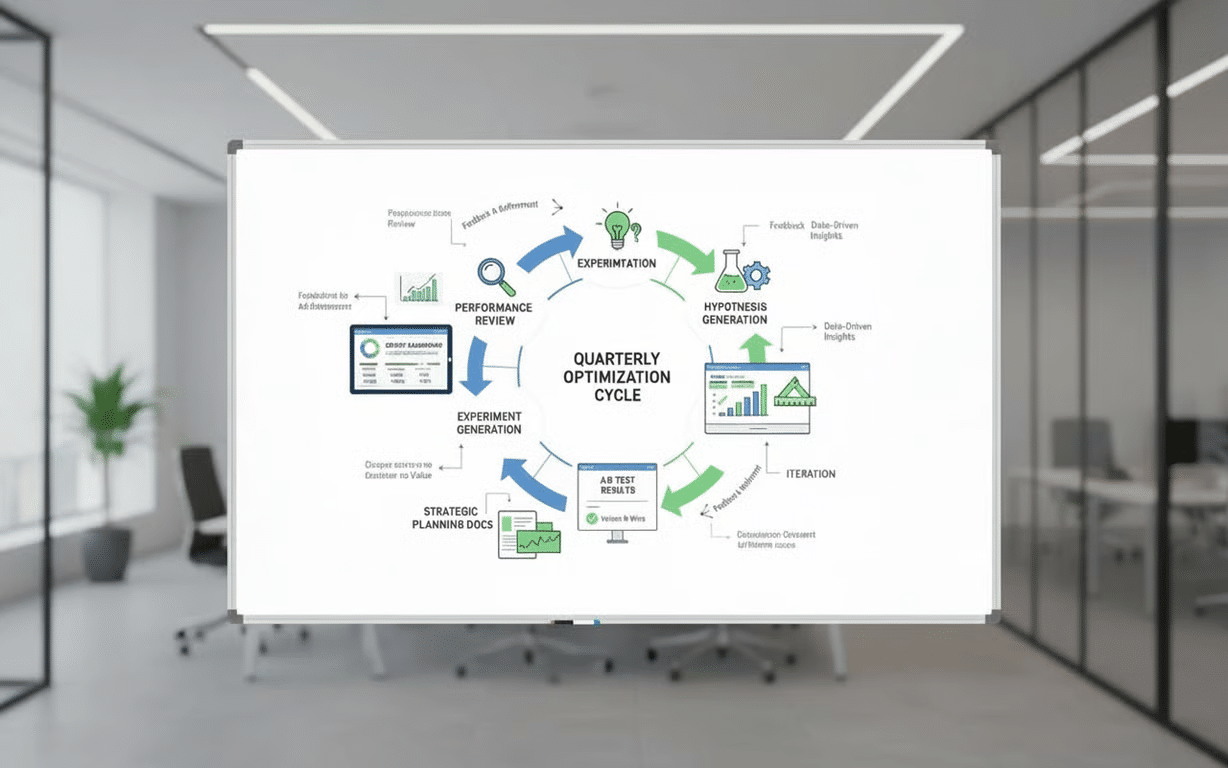
Create a regular optimization cadence with clear milestones and reviews. A quarterly planning cycle works well—review performance, identify optimization priorities, and allocate resources. Within each quarter, have monthly check-ins to assess progress and make tactical adjustments. This rhythm ensures you’re consistently improving without creating constant disruption.
Establish a cross-functional optimization team with representatives from marketing, sales, product, and customer success. This team meets regularly to review performance data, discuss customer feedback, and prioritize improvement initiatives. Give this team real authority to make decisions and allocate resources. Without executive sponsorship and cross-functional buy-in, optimization efforts get deprioritized when things get busy.
Build experimentation into your culture and processes. Encourage teams to test new approaches, measure results, and share learnings. Create a safe environment where failed experiments are viewed as learning opportunities rather than mistakes. Use tools like Optimizely for website testing, Outreach for sales email testing, and Google Optimize for landing page testing. Make experimentation easy and celebrate teams that generate insights, regardless of whether their tests succeed.
Build optimization goals into individual and team objectives. If optimization is important, it should be reflected in how you evaluate and reward performance. Marketing should have goals around improving conversion rates. Sales should have goals around improving win rates. Product should have goals around improving activation and retention. When optimization is part of everyone’s job, it becomes part of your culture.
Still have questions? Let’s address some frequently asked questions about GTM strategy optimization.
GTM Strategy Optimization FAQ: Your Top Questions Answered
How is optimizing a go-to-market strategy different from creating a new one? Optimization works within your existing framework and uses real performance data to make targeted improvements. You’re refining what’s already in market rather than building from scratch. This means you can move faster, test more precisely, and measure impact more clearly because you have baseline metrics to compare against.
What’s the single most important metric for measuring GTM performance? Customer acquisition cost relative to lifetime value is the most telling metric. If your CAC is $10,000 and your LTV is $50,000, you have a healthy business model. If those numbers are inverted, no amount of optimization will save you. You need fundamental changes. Track this ratio by segment and channel to understand where your strategy is working and where it’s not.
How often should we revisit our ideal customer profile? Review your ICP quarterly using actual customer data from your CRM. Look at which segments have the highest win rates, fastest sales cycles, lowest churn, and highest expansion revenue. Your ICP should evolve as you gather more data about who actually succeeds with your product, not remain static based on initial assumptions.
Should we optimize multiple areas simultaneously or focus on one at a time? Focus on one or two high-impact areas per quarter. Changing too many things simultaneously makes it impossible to understand what’s actually driving results. Use your prioritization framework to identify the areas with the highest potential impact, then execute those initiatives thoroughly before moving to the next priority.
How do we know if our messaging is actually resonating with prospects? Track conversion rates at each stage of your funnel and use conversation intelligence tools like Gong to analyze sales calls. If prospects are engaging with your content, taking meetings, and moving through your pipeline efficiently, your messaging is working. If you’re seeing high drop-off rates or long sales cycles, your message isn’t landing.
What’s the best way to test pricing changes without disrupting our existing customer base? Implement new pricing for new customers first and measure the impact on conversion rates over at least three months. If the new pricing performs well, you can consider migrating existing customers at renewal or offering them upgraded packages at the new price points. Never change pricing for existing customers mid-contract without significant added value.
How can we improve alignment between marketing and sales teams? Create shared revenue goals and establish clear service level agreements for lead quality and follow-up speed. Implement regular pipeline reviews where both teams discuss performance together. Use shared dashboards in tools like Salesforce or HubSpot so everyone sees the same data. Most importantly, make sure both teams are measured on pipeline and revenue, not just their individual activities.
What tools are essential for effective GTM optimization? You need a solid CRM like Salesforce or HubSpot, marketing automation like Marketo or Pardot, conversation intelligence like Gong or Chorus, and analytics tools like Google Analytics 4 and Tableau. More important than any specific tool is having clean data and people who know how to extract insights from it. Start with the basics and add specialized tools as your needs become clear.
How do we balance optimization with the need to move quickly and hit our numbers? Build optimization into your regular operating rhythm rather than treating it as a separate initiative. Dedicate 20% of your resources to testing and improvement while 80% focuses on execution. This ensures you’re continuously improving without sacrificing short-term performance. The key is making optimization a habit, not a project.
What’s the biggest mistake companies make when optimizing their go-to-market strategy? Optimizing based on opinions rather than data. Too many companies make changes because someone senior has a strong opinion or because they saw a competitor do something. Effective optimization requires establishing clear baselines, making targeted changes, measuring impact, and being willing to reverse course if the data doesn’t support your hypothesis. Let evidence guide your decisions, not intuition.
*Please note that if we do not get clear details and accurate info, you might not get a reply from us!
Nice to meet you, amazing human! Fill out this super short form and start your journey!
Welcome to our cozy data-driven digital marketing studio for bold B2B tech companies.
Your journey starts with you filling in our contact form. It’s a very short form. #PinkyPromise. It only takes you 45 seconds to fill it in, but it helps us a lot to understand who you are, what your challenges are and if we are the right partner to help you.
We don’t want to waste your time. So… a big thank you in advance for your effort.
Please don’t hesitate to reach out with questions or if you would like to discuss any of your challenges or ideas in depth.
You can contact us using this form on the right or you can send us an email at hello (at) milkandcookies (dot) studio.
We will reach out to you as soon as possible. Usually no more than a couple of hours.