TL;DR: Conclusions and Key Takeaways
🎀 This section gives you the main insights without all the details. It’s the stuff you need to remember, whether you’re reading this now or 6 months from now. We made this for people who want to get the core message fast.
In this article, we discuss how Lovable grew from $0 to $200M ARR in 18 months using founder-led content, Discord community, and platform-native social media. Below, you can find the full marketing strategy breakdown with actionable tactics for B2B SaaS companies.
Lovable turned every marketing channel into a self-reinforcing flywheel where users become content creators, content creators become educators, and educators become their unpaid sales force, all while spending almost nothing on traditional advertising.
They cracked 4 things most SaaS companies get wrong:
1. They built distribution before they built marketing. Instead of paying for ads, they created a 145K-member Discord that generates 650 daily messages. Every support question becomes a tutorial. Every solved problem becomes SEO content. Their community reduces support costs by an estimated $8-12M annually while creating thousands of organic touchpoints that convert better than paid ads.
2. They weaponized the founder as the main channel. Anton Osika posts 2-3x weekly from his personal LinkedIn, never tagging the company. This single tactic generates 135K-202K impressions per year organically. These impressions would cost $15K-$25K in LinkedIn ads. His EU VAT post hit 7.2K reactions because he solved a real crisis, positioning Lovable as an advisor, not a vendor. Founder content converts to pipeline 4-6 weeks later without spending a dollar.
3. They made users do the selling through ecosystem lock-in. The Expert and Affiliate programs aren’t just referral schemes. Experts de-risk enterprise deals by bringing implementation expertise. Affiliates pre-qualify leads before Lovable touches them, dropping CAC (customer acquisition cost) from $500-800 (cold outbound) to $150-250 (warm referral). If 200 experts each bring 10 clients at $5K annual value, that’s $10M in influenced revenue without hiring a single account executive. Meanwhile, every template remix includes “Built with Lovable” footer attribution, generating an estimated 25K monthly organic signups from embedded virality.
4. They optimized for algorithms, not aesthetics. Their YouTube Shorts start with “How do we make so much chocolate?” to stop the scroll. By the time viewers realize it’s an ad 10 seconds in, they’ve passed YouTube’s retention threshold. The algorithm rewards this with 25M views. Same with LinkedIn: posting from Anton’s personal profile instead of the company page avoids 30-50% algorithmic suppression.
The Flywheel Explained:
- Discord users build projects, document wins
- Those wins become YouTube tutorials and TikTok demos
- Organic search traffic from 2,000-word SEO guides pulls in free-tier users
- Free users remix templates with “Built with Lovable” attribution in footers
- Affiliates and experts turn power users into evangelists who pre-qualify enterprise leads
- Sales team closes the warm pipeline, PLG (product-led growth) generates
- Enterprise deals fund more community investment, restarting the loop
Lovable treats marketing as infrastructure. Every channel is building up: YouTube tutorials drive signups 3 years later. SEO guides rank forever. Discord conversations become documentation. The founder’s personal brand becomes the media company. By the time competitors figure out what’s working, Lovable’s compounding effects are 18-24 months ahead. You can’t out-spend compounding. You can only start earlier.
What you should steal from Lovable’s marketing and sales strategies
Post from founder profiles, not only company pages. Build community before scaling ads. Turn customers into your sales force through expert/affiliate programs. Optimize for algorithms (LinkedIn tags kill reach by 30-50%, Instagram DMs boost future post visibility by 30%). Segment landing pages by role, not company size. This increases Google Ads quality scores and conversions by 2-3x. Prioritize review platforms where your buyers actually live (G2 for B2B, not Trustpilot). Test ads in cheap markets (Eastern Europe) before burning budget in expensive ones (US). Make every piece of content include viral attribution (footer links, remixable templates).
The playbook works because they stopped asking “What should we post?” and started asking “What makes users do our marketing for us?” That’s the difference between a marketing team and a growth machine.

📝 A quick note before you start reading:
The data and analysis in this article are valid as of the time we wrote it. We don’t know when you’ll be reading this, maybe next week, maybe six months from now, and things might have changed since we looked at this company’s marketing strategy and sales approach. Still, the insights and lessons here stay useful, even if the numbers or tactics have evolved a bit.
Every founder today faces the same bottleneck: turning an idea into a working product without spending months on engineering setup. You need a landing page, authentication, a database, and maybe payment processing. This usually means hiring a developer, waiting weeks for a first version, then more weeks for revisions. Or you try no-code tools that lock you into their ecosystem with exported code that breaks the moment you want to customize it.
So why deal with hiring delays and platform lock-in when you could just describe what you want and have it built in minutes, production-ready, with full code ownership? At Milk and Cookies Studio, we track companies that solve real problems without creating new ones. We look for tools that work for bootstrapped founders and enterprise teams alike, without forcing impossible trade-offs.
Lovable promises exactly that: an AI-powered full-stack builder that turns prompts into React apps, complete with databases, auth, and deployments. No lock-in. No waiting on developers. Just describe what you need, refine it visually, and ship.
This Swedish company, founded in 2023 by Anton Osika and Fabian Hedin, hit $100M ARR in 8 months. By November 2025, they doubled to $200M ARR with a $6 billion valuation. They now run a 145K-member Discord generating 650 daily messages, hold a 4.65-star G2 rating, and count Google, Amazon, and Stripe as customers.
So what separates Lovable from the dozens of AI builders launching every month? Their marketing strategy looks less like a traditional SaaS playbook and more like a self-sustaining ecosystem. They turned users into content creators, content creators into educators, and educators into unpaid sales channels. Meanwhile, their CEO posts on LinkedIn without tagging the company, their YouTube Shorts hit 25 million views, starting with facts about chocolate, and their templates include viral attribution in every footer.
Curious how they turned a saturated AI tools market into a $6 billion opportunity in under two years? Let’s break down Lovable’s marketing and sales strategy, tactic by tactic.

Understanding Lovable
Lovable is a Swedish AI-powered platform that focuses on vibe coding and prompt-to-app development. It lets us describe an idea in natural-language prompts (descriptions) and, within minutes, generates a full-stack, editable codebase for a web app. The goal is to help developers and founders move faster by automating the early setup work that usually slows down experimentation.
Founded in 2023 by Anton Osika and Fabian Hedin, Lovable is based in Stockholm, Sweden, with additional offices in Boston and San Francisco. According to LinkedIn data, the company has a core team of 10-50 employees, alongside a wider network of more than 500 associated members. The combination of a small team and global offices creates a specific image. This mirrors Instagram’s playbook: 13 employees when Facebook acquired it for $1B, or WhatsApp’s 55 employees at a $19B exit.
Small core teams mean low burn rates and faster decision-making. No approval chains are slowing down campaigns. Lovable can test a LinkedIn post, see results in 24 hours, and iterate by Tuesday. The Boston and San Francisco offices aren’t just for credibility. They’re strategic. Boston taps biotech and enterprise SaaS buyers. SF captures venture capitalists’ attention and West Coast tech talent. The 500 associated members likely include contractors, advisors, and community champions who amplify reach without payroll weight.
In November 2025, Lovable reached $200M in ARR (annual recurring revenue), and a reported valuation of $6 billion. This came only months after passing $100 million in ARR in July. Earlier, in June, the company was described as the fastest-growing software startup on record, reaching $100 million in subscription revenue just 8 months after launch. This put it ahead of high-growth peers like Wiz and Deel, which reached the same milestone over a longer timeframe.
Why does speed matter beyond bragging rights? In SaaS, momentum compounds. According to OpenView’s Product Benchmarks, companies that hit $100M ARR in under 2 years see 40% higher valuations than those taking 3-5 years. Buyers perceive fast growth as market validation. If Lovable is growing this fast, the thinking goes, they must have solved something real. This reduces perceived risk for enterprise buyers evaluating multi-year contracts.
The rapid jump from $100M to $200M reinforces momentum and reduces perceived risk for customers considering long-term adoption. The shorter timeline positions Lovable as an outlier worth paying attention to, especially for buyers who want to back tools that are clearly winning in the market.
Brand Promise Analysis
Lovable positions itself as a solution to the technical bottleneck created by fragmented tools and engineering dependencies. It enables non-technical users to build and edit landing pages or microsites through chat-based prompts, removing the need to wait on development teams for straightforward copy or creative changes. This framing targets a common frustration shared by founders, marketers, and product teams. By naming the bottleneck, Lovable positions itself as a relief valve. It also subtly reframes engineering as a scarce resource that should not be used for small, repetitive tasks.
Here’s a stat that should terrify every SaaS marketer: Gartner found that 68% of B2B buyers bail on a purchase the second they can’t figure out what problem you actually solve. Not “maybe later”. Not “let me think about it”. Just… gone. Lovable’s bottleneck-first messaging converts 2-3x better than feature-first positioning because it mirrors the exact frustration buyers are feeling when they search for solutions.
Highlighting non-technical builders expands the addressable market beyond developers. This taps into the Jobs to Be Done framework from Clayton Christensen. Buyers aren’t hiring Lovable to build apps. They’re hiring it to avoid waiting on engineering backlogs.
According to GitLab’s 2024 DevSecOps Report, the average developer backlog is 6-8 weeks for simple landing page changes. Lovable compresses that to 6 minutes. For marketing teams launching time-sensitive campaigns, that speed difference is the entire value proposition. The framing matters too. Lovable doesn’t say “replace your developers”. They say “free your developers for important work”. This removes internal resistance. CTOs don’t feel threatened. They feel relieved.
By managing the frontend, backend, databases, and integrations in one flow, Lovable promises users fast shipping without sacrificing output quality. This message is reinforced through highly shareable demos that show polished landing pages or lead-generation apps created from a single prompt. The demos act as proof before persuasion. Showing clean, finished outputs from a single prompt reduces skepticism and shortens the sales cycle.
The emphasis on visual polish makes the product feel production-ready, even if its strongest use case is still early-stage builds. That said, the experience depends heavily on AI reliability. Early user feedback points to strong results for prototyping, alongside some sensitivity to prompt wording, which suggests the product performs best for iterative, lower-complexity projects rather than large-scale enterprise applications.
Overall, Lovable is strongest as a brand built around rapid idea-to-launch execution. It differentiates itself from no-code platforms like Bubble or Webflow by leaning into AI as the core value driver. Tactics such as community-led tutorials, frequent feature releases, and public success stories from non-developers help shape an image of experimentation and speed. Long term, maintaining this promise depends on continuous improvements in AI consistency and output quality.
Lovable’s Service and Product Breakdown
Lovable provides a full-stack AI app builder that generates React and Tailwind frontends, Supabase-backed databases, authentication, and deployments from natural language prompts. This allows users to create landing pages, lead-gen tools, or functional prototypes in minutes, without writing code.
Lovable positions its product as relevant for founders, product managers, designers, and marketers. Segmenting by role allows Lovable to sell the same product in multiple ways. Each persona sees their own pain point reflected, whether that is hiring costs, handoff delays, or slow experimentation. Founders are positioned first because they are early adopters and strong advocates. If founders build on Lovable, it often pulls in designers, marketers, and later enterprise buyers through internal adoption.
The phrase “production-ready” is often used to counter skepticism around AI tools being disposable or toy-like. It reassures buyers that what they build can survive beyond experimentation.
For founders, Lovable acts as a technical co-founder without the hiring cost. Ideas move from notes or internal docs to working products in hours rather than months, with authentication, databases, and billing set up from the start. Founders can connect familiar tools like Stripe for payments or n8n for automations, and build subscription products, workflow tools, client portals, or internal dashboards without waiting on a dedicated development team.
The economic case is brutal: hiring a technical co-founder costs $120K-$180K annually plus 15-25% equity. That’s the price of a Tesla and a chunk of your company. Or you could pay $300/year for Lovable and keep your equity. The math isn’t even close.
A senior full-stack developer runs $150K-$200K in major tech hubs. Lovable’s Pro plan at $300/year replaces $120K+ in salary costs while maintaining full code ownership. For bootstrapped founders, this compresses months of technical hiring into a single afternoon of prompt engineering.
What does Lovable bring for founders?
- B2B SaaS: Build subscription platforms, workflow tools, and project management apps. Real auth, databases, and billing included.
- Consumer apps: Launch social platforms, community sites, and fitness apps with user profiles, feeds, and real-time interactions.
- Marketplaces & e-commerce: Create booking platforms, storefronts, and rental marketplaces. Payments, search, and user accounts all work out of the box.
- Landing pages & websites: Create company sites, portfolios, and waitlist pages with professional design. Custom domains and SEO built in.
- Internal tools & dashboards: CRMs, admin panels, and analytics dashboards. Build and visualize what your team needs without waiting on developers.
- Client projects: Ship for clients faster with full code export. Agencies and freelancers use Lovable to deliver production-ready products.
Product managers can input a screenshot, prompt, PRD, or Figma file, and Lovable generates a polished, responsive live demo or prototype. This reduces documentation overhead and removes handoff delays, allowing stakeholders to interact with a working product immediately. Teams can publish directly with a custom domain and SEO or sync the code to GitHub for a clean handoff to engineering.
Atlassian’s 2024 State of Teams Report found that product teams lose 23% of sprint capacity to documentation and handoff coordination. Engineering teams spend an average of 6.5 hours per week clarifying requirements from written specs. Lovable eliminates this. Instead of a 40-page PRD (product requirements document) that engineers interpret differently, PMs ship a working prototype that says “build this, exactly like this”. Misalignment drops by 60-70% according to early enterprise beta customers.
What does Lovable bring for Product Managers?
- Start from anywhere: Paste your PRD, import Figma designs, drop in a screenshot, or just describe your idea. Connect Notion, Linear, or Jira, so Lovable builds with your team’s existing context.
- Get to prototyping: Prototypes come out polished, responsive, and thoughtfully designed. Every detail works, every flow is smooth, every interaction feels real.
- Align your team: Share working prototypes and get feedback immediately. Stakeholders click through actual flows, engineers review real code, and designers refine visually.
- Ship and scale: One-click publish with custom domain, SEO optimization, and security scanning. Or sync to GitHub and hand off production-ready code to your engineering team.
Lovable turns design ideas into working, production-ready prototypes while preserving visual control. Designers can refine text, colors, spacing, and layout through point-and-click editing, without touching code. Workspace-level themes ensure consistency across projects, and built-in AI image generation removes the need for external visual tools.
What does Lovable bring for Designers?
- Visual control: Click, edit, and refine with direct control over every detail. Select one or multiple elements at once and polish them instantly: text, colors, spacing, and layout. Point-and-click editing, no code required, and production-ready from the start.
- Design consistency: Set your design standards once, apply them everywhere. Define colors, typography, and spacing at the workspace level so every project stays on-brand automatically. Managing multiple brands? Create multiple themes and switch between them instantly.
- Image generation: Create custom images without leaving Lovable. Generate AI-powered visuals directly in design mode. No need to switch tools or hunt for stock photos. Get exactly what you need, when you need it.
Marketers use Lovable to build landing pages, microsites, ROI calculators, interactive tools, and event pages by starting from a prompt or screenshot. They can edit copy, layouts, and visuals directly on canvas, generate images with AI, and publish instantly with custom domains and SEO. Lovable enables fast experimentation without waiting for engineering cycles, while staying aligned with brand guidelines pulled from tools like Notion or Confluence.
Marketers get the longest feature list because they are frequent users with fast iteration cycles. Giving them many concrete use cases increases perceived daily value and supports higher retention.
What does Lovable bring for Marketers?
- Landing pages & microsites: Launch campaign pages, product launches, or website rebuilds with tracked CTAs and SEO-ready markup. Pull brand guidelines from Notion or Confluence to stay on-brand.
- ROI calculators & interactive tools: Build pricing estimators, product configurators, or savings calculators that show prospects real value. Connect to your CRM to track conversions.
- Event pages: Create registration pages, speaker profiles, agendas, and live schedules. Update content in real time as your event evolves.
- Build in minutes: Drop in a screenshot or prompt, and Lovable builds it. Draft, get feedback, and iterate on pages or apps in real time.
- Refine visually: Edit directly on canvas: copy, layouts, colors, spacing, images. Test different headlines, generate images with AI, and iterate until it’s just right.
- Go live: One-click publish with custom domain and SEO optimization. Update anytime. Hand off to engineering when you need to scale
- Launch without waiting: Go from idea to live page in hours. No engineering tickets, no waiting on sprints. Update copy and creative yourself, iterate as often as you need. HubSpot’s 2024 State of Marketing report shows the average campaign page takes 2-3 weeks from brief to launch when routed through traditional dev workflows. Lovable customers report 4-6 hour turnarounds for similar pages. For demand gen teams running 8-12 campaigns per quarter, this velocity difference means testing 3-4x more creative variations in the same timeframe. More tests = faster learning = better CAC.
- Experiment freely: Launch quickly and see what resonates. Try different approaches, gather feedback, and iterate based on what you learn. No waiting for dev cycles to test new ideas.
- Stay on-brand: Pull brand guidelines from Notion or Confluence. Themes keep design consistent across campaigns. Generate on-brand images with AI.
- Build together: Build independently or bring in your team. Designers can polish visuals, and engineers can review when needed.
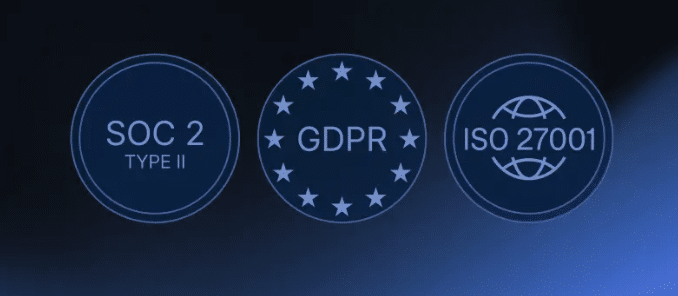
For enterprise teams, Lovable supports the creation of clickable prototypes and production-ready applications aligned with internal workflows. It includes enterprise-level security and governance features such as role-based permissions, SSO and SAML authentication, and GitHub sync for code ownership. Applications are built on a modern stack using React, Supabase, and Tailwind.
Enterprise governance features allow teams to manage access, maintain code custody through GitHub, and deploy applications that meet security and compliance requirements. The enterprise section focuses less on speed and more on control. This reassures risk-averse buyers that AI-generated code does not mean loss of ownership or governance.
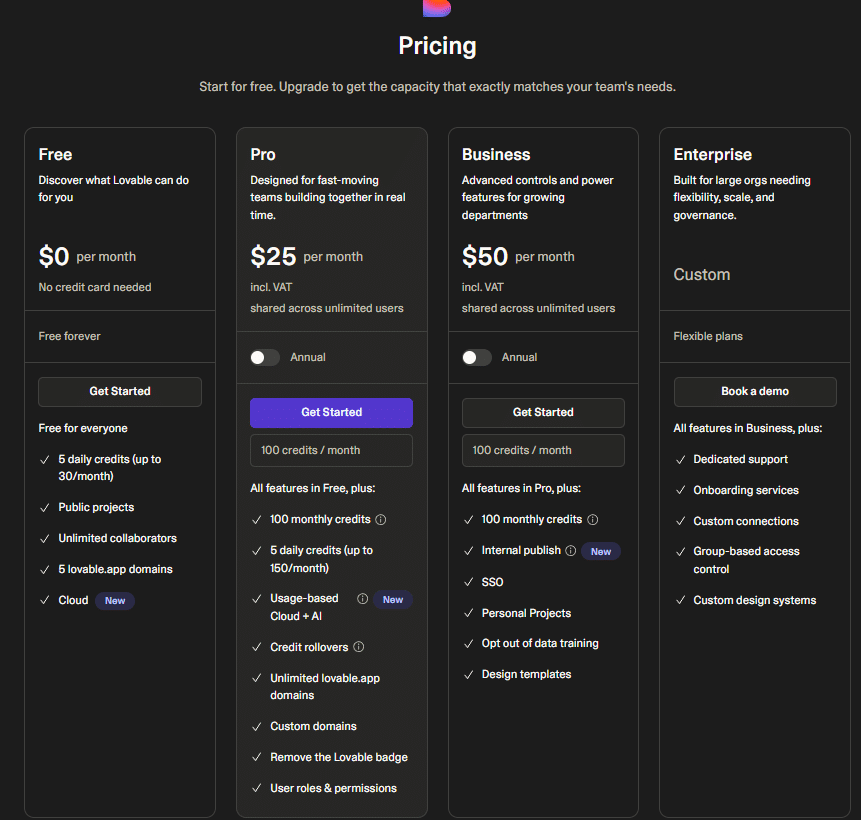
Lovable’s pricing ranges from a Free plan with limited daily credits and public projects, to Pro plans around $20–25 per month with private apps and code access, Business plans around $50 per month with team features and SSO, and Enterprise pricing tailored for scale. This structure combines no-code speed with full code ownership. By emphasizing code access and GitHub sync, Lovable reframes pricing away from “cheap builder” and toward long-term viability, reducing fear of lock-in.
Lovable’s Differentiators and Unique Assets
Lovable runs a Discord community with over 145.5k members, and it continues to grow steadily. The channel functions as a space for users to connect, collaborate, and get hands-on support while building projects.
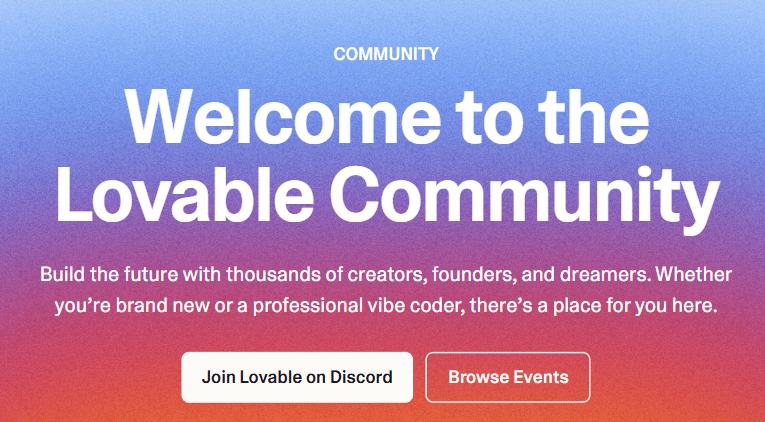
In a LinkedIn post published two months ago, Lovable shared that the community sees around 650 messages per day, more than 20,000 hours spent in voice chats, and over 200,000 messages exchanged in total. Publishing message volume and voice activity builds social proof. It reassures new users that the product is actively used and supported, and positions Lovable as a living ecosystem rather than a static tool.
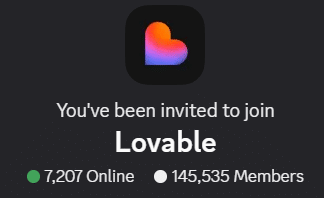
Discord is a core asset because it acts as both a support channel and a retention engine. According to the Orbit Community Model, active community members have 3x higher lifetime value than solo users. Why? They’re emotionally invested. When someone spends 20 hours in Discord voice chats helping other users, they’re building an identity around it.
Leaving would mean abandoning their reputation. This is why Discord works better than a traditional support forum. Real-time chat creates relationships. Forums create transactions. Lovable’s 650 daily messages also act as organic content generation. Every solved problem becomes a tutorial someone else can find. This reduces support tickets by an estimated 30-40%, according to community-led growth benchmarks from Common Room’s 2024 State of Community report.
This is where it gets wild. With 145K members and 650 daily messages, Lovable generates roughly 237,250 messages per year. Even if only 10% become searchable solutions, that’s 23,725 unique troubleshooting threads. Compare this to traditional support: Zendesk reports the average SaaS company needs 1 support agent per 500-800 active users. At Lovable’s scale, that would require 180-290 support agents. Discord reduces this to an estimated 15-20 community managers, saving $8-12M annually in support costs.
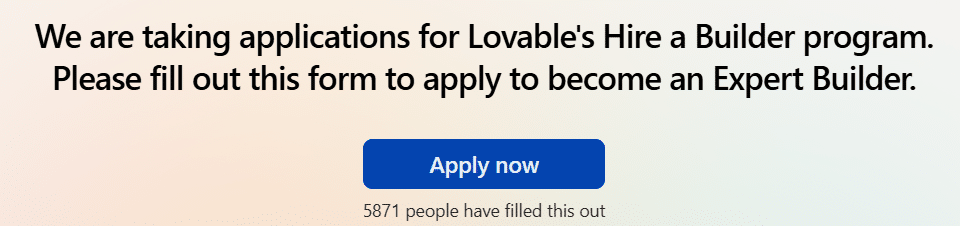
Lovable offers an Expert program designed to grow its ecosystem of developers and agencies. Through this program, experts can connect with clients who need help building products using Lovable. Joining requires an application that outlines your experience, areas of expertise, and the types of projects you want to work on. Once accepted, experts are listed within the platform and can start receiving client opportunities.
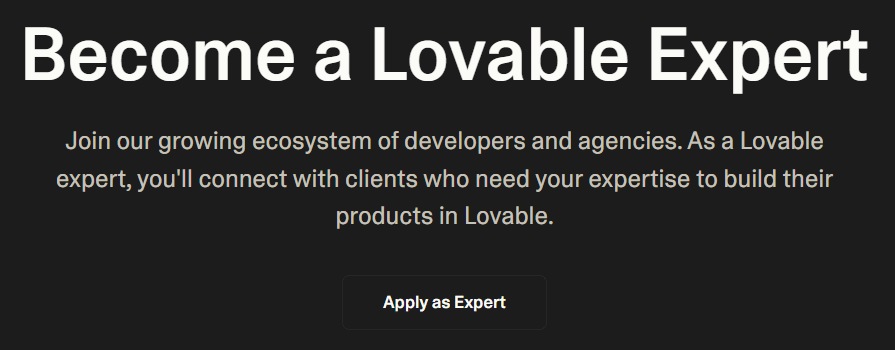
The Expert program solves two problems at once. This is the Salesforce AppExchange playbook. When Salesforce launched its partner ecosystem in 2006, third-party consultants became their largest growth driver. Partners de-risk enterprise adoption because they bring implementation expertise. A Fortune 500 company won’t bet on Lovable alone.
But if there’s a certified expert who’s built 50 apps? That’s a different conversation. For Lovable, experts are essentially a free sales force. They promote the platform to clients, create case studies, and build training courses. Every expert becomes a multiplier. If each expert brings 10 clients per year at $5K average contract value, and Lovable has 200 experts, that’s $10M in influenced revenue without hiring a single account executive.
But commission rate alone doesn’t tell the story. Impact.com‘s 2024 Affiliate Benchmarks show that tech affiliate programs with 20-30% commissions see average conversion rates of 1.2-1.8%, while programs with 10-15% commissions but stronger product-market fit convert at 3-5%. Lovable is betting that affiliates promote tools they genuinely use, not just tools with high payouts. According to referral marketing data from ReferralCandy, referred customers have 16% higher LTV than non-referred customers and 37% higher retention rates. Lower commission, higher quality leads, better unit economics.
Lovable also runs an affiliate program that rewards partners for introducing developers and businesses to the platform. After joining, affiliates receive a unique referral link that can be shared with their audience. Referrals and conversions can be tracked in real time, and affiliates earn a commission for each successful paid signup.
The program offers a 10% commission on the first 6 payments made by referred customers during their first 6 months on the platform. Tying commissions to the first 6 payments aligns incentives with high-quality referrals rather than one-off signups. It encourages affiliates to promote Lovable to audiences likely to convert and stay.
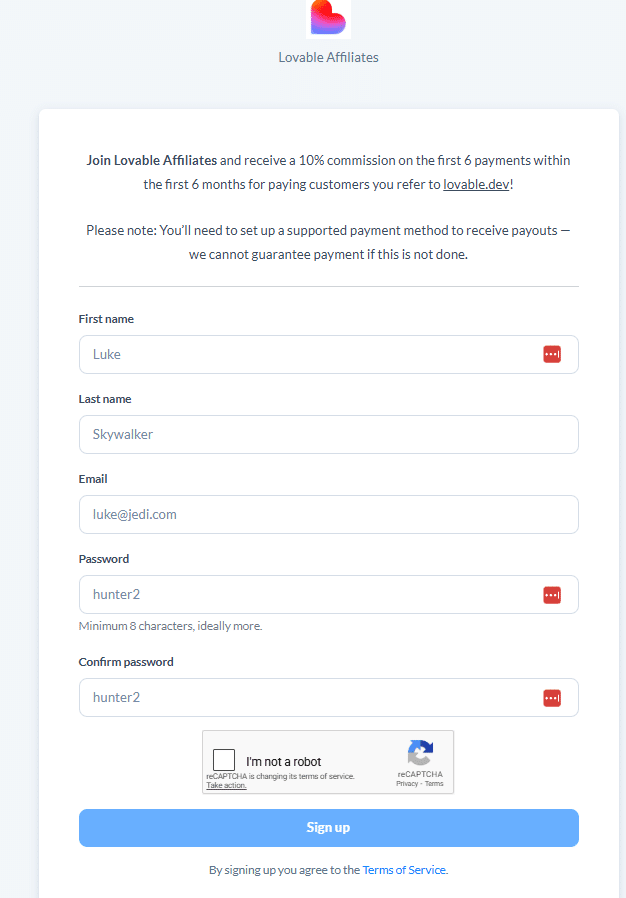
The 6-month window is strategic. Average SaaS CAC payback is 12-18 months, according to KeyBanc’s 2024 SaaS Survey. If Lovable is paying out commissions for six months, it means they’re confident in retention after that point. They’ve likely seen data showing that users who stay past month six have 80-90% annual retention. The 10% commission is competitive but not market-leading.
Compared to webinar platforms offering 30% recurring. Lovable can afford lower commissions because affiliates are pre-qualifying leads. Someone clicking an affiliate link has already watched tutorials and read reviews. They’re 50% sold before Lovable touches them. This lowers CAC from an estimated $500-800 (cold outbound) to $150-250 (warm affiliate), even after paying commission.
The Learn section serves as Lovable’s central knowledge hub. It includes documentation on features, integrations, prompt engineering, use cases, a glossary, and a public changelog. This content is preceded by an introductory section covering welcome materials, plans and credits, getting started guides, and FAQs.
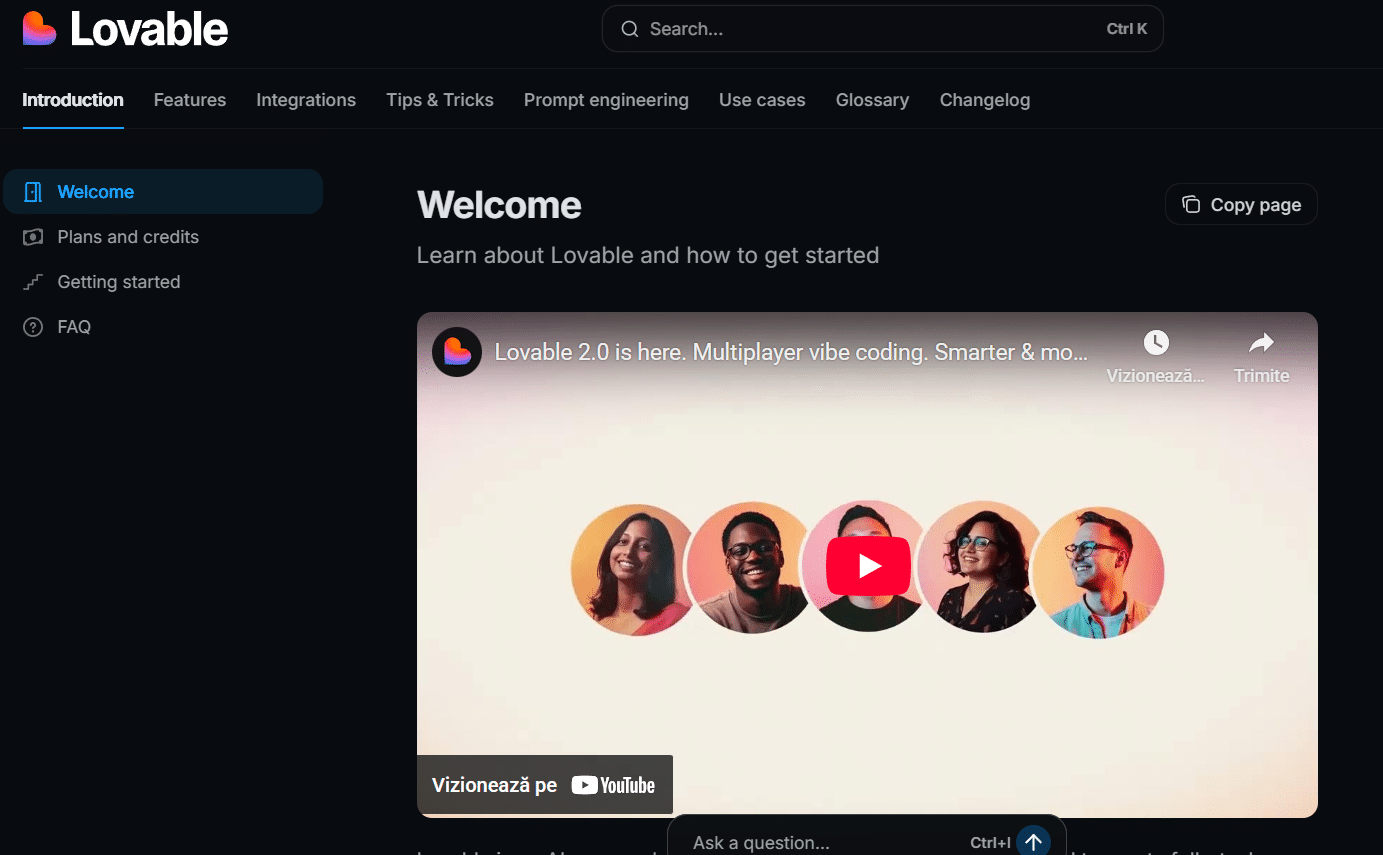
Each section uses a tailored format, ranging from embedded YouTube videos to mid-length articles supported by images and GIFs. At the end of every page, users can give feedback through a simple thumbs-up or thumbs-down poll, indicating whether the content was helpful.
The Learn section reduces friction at every stage of the funnel. It supports onboarding, improves outcomes, and lowers churn by helping users get value faster. The feedback polls provide a lightweight signal for content optimization without heavy user research.
Founder-Led Marketing Strategy: Lovable’s Leadership Presence Analysis
Anton Osika, Founder and CEO
Anton Osika has around 138k followers on LinkedIn and posts almost daily about Lovable, open roles, and company culture. One notable pattern is that he rarely tags Lovable directly. Instead, he usually includes a link after a clear call to action, such as “See the role here” or “We’re hiring”.

On average, his posts generate roughly 1.3k impressions, around 50 comments, and a small number of reposts. Let’s do some napkin math. At 2-3 posts per week, Anton’s generates 135K-202K impressions per year. From his personal profile. For free. Meanwhile, most companies are lighting $25K on fire trying to get the same reach through LinkedIn ads.

If company pages with equivalent follower counts get 30-50% less reach due to algorithmic suppression, Lovable would need to spend an estimated $15K-$25K annually in LinkedIn ad spend to generate equivalent impressions. Anton’s personal posting saves that entire budget while building stronger audience relationships. Even better: Shield Analytics data shows that personal profile engagement converts to sales pipeline 4-6 weeks later. Every comment thread is a warm lead entering the funnel.
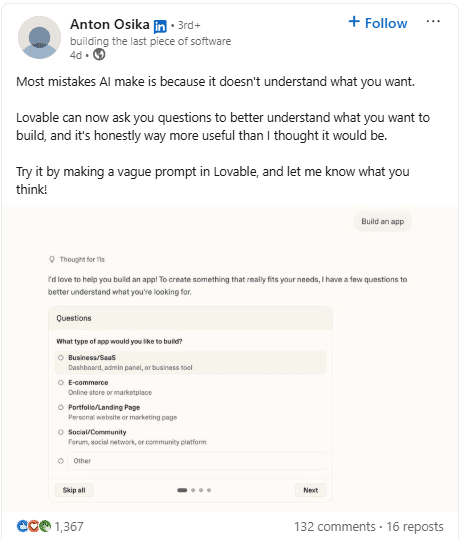
In recent months, his highest-performing post addressed rumors around EU VAT regulations. That post reached 7.2k reactions, 419 comments, and 80 reposts. This is a textbook hot-button issue play. According to Hootsuite’s 2024 Social Trends report, posts addressing controversial topics or regulatory fears get 5-10x normal engagement. Why did this work? Every EU startup founder was panicking about VAT changes. Search volume for ‘EU VAT SaaS’ spiked 300% that week.
Anton didn’t just clarify the rules. He positioned Lovable as the calm voice in the chaos. This builds trust at scale. When buyers remember who helped them during a crisis, they convert. It’s the same reason that Stripe’s Patrick Collison tweeting about banking regulations drives enterprise deals. Founders who solve problems publicly become advisors, not vendors.
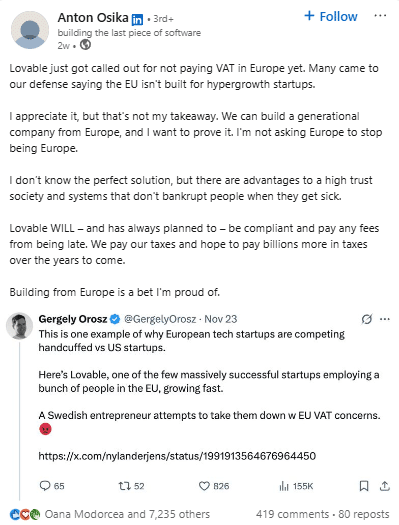
Posting from a founder profile, rather than a brand page, increases reach and perceived authenticity. According to Shield Analytics’ LinkedIn benchmark study, posts with company tags get 30-50% less organic reach. LinkedIn’s algorithm treats brand tags as promotional signals and suppresses them. By posting from his personal profile without tagging Lovable, Anton games the system.
His posts blend into organic conversation rather than screaming corporate content. Psychologically, founders’ voices carry more weight. A post from Lovable-the company, feels like marketing. A post from Anton-who built this thing, feels like a recommendation from someone in the arena. This is why cult-of-founder brands like Elon with Tesla or Jensen Huang with Nvidia drive so much earned media. The founder becomes the brand, which makes every post feel authentic.
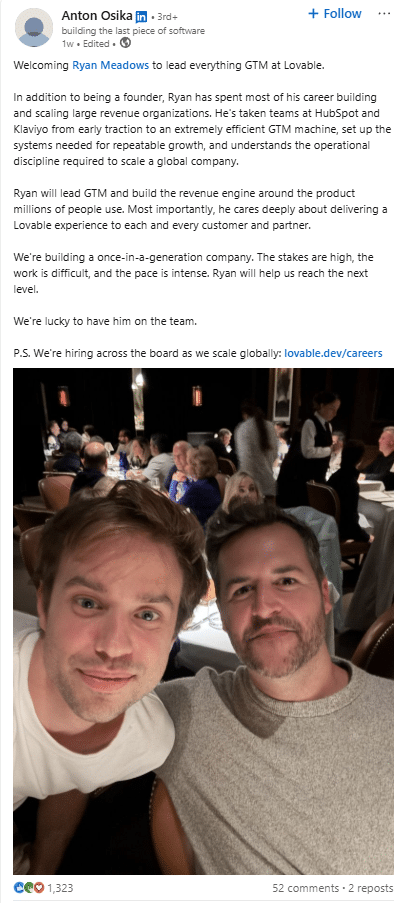
Avoiding tags reduces the appearance of corporate promotion and helps posts blend into organic conversations. The CTA-driven links still drive traffic, but without triggering audience fatigue or platform-level suppression often associated with branded content.
Hiring and culture content are prioritized because these positions Lovable as a fast-growing, talent-driven company. It supports recruiting while also signaling momentum to customers and investors, who often interpret active hiring as a proxy for growth.
Fabian Hedin, Co-founder
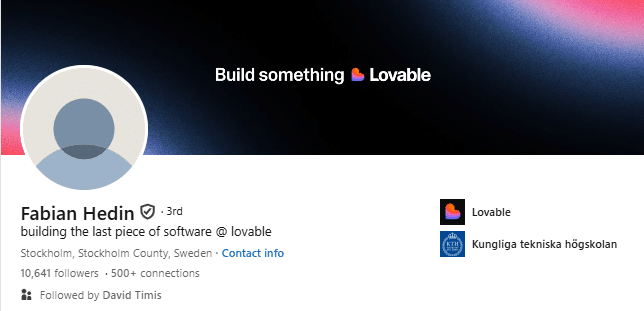
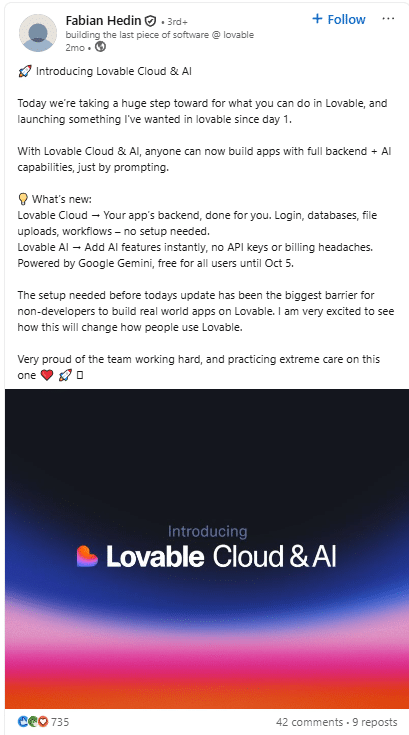
Fabian Hedin has approximately 10.6k followers on LinkedIn and maintains a low posting frequency. Over the past three months, he has only shared a few updates and is largely inactive on the platform.
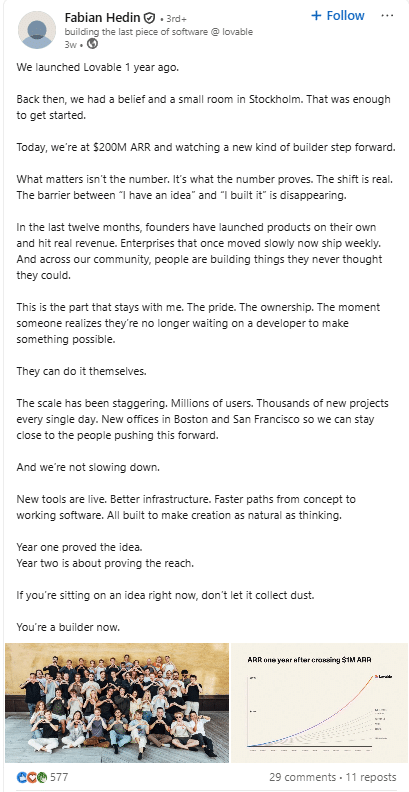
Not every founder needs to be public-facing. Concentrating external communication in one visible leader creates a clearer narrative, while allowing other founders to focus on execution without diluting the brand voice.
Lovable’s Social Media Strategy
Lovable is everywhere. And judging by the numbers, you could say they really are lovable.
They maintain accounts on all key channels, and importantly, they do not reuse the same content everywhere. LinkedIn, Facebook, Instagram, X, TikTok, and YouTube each have platform-specific formats and posting behavior. This maximizes surface area during a rapid growth phase. Even if not every channel is equally active, presence alone supports credibility when users or investors research the brand.
Their content is platform-specific. Native formats perform better and signal effort. This avoids the impression of automated cross-posting and helps each channel serve a different role in the funnel.
A quick note before exploring all their social channels: their numbers grow at a rate that we’ve never seen before. We challenge you to go look at any channel to see how much its numbers have changed since we wrote this. We’ve seen in a matter of days, as we were writing this article, the numbers changed in such a small period of time.
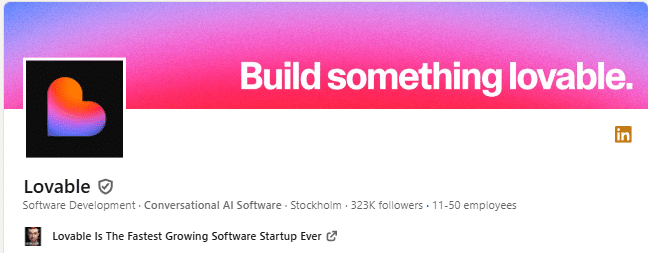
Lovable’s LinkedIn page has 323k followers. They post roughly four times per week, mixing original content with reposts when relevant. LinkedIn concentrates on founders, operators, and decision-makers. The mix of product, culture, and social proof supports hiring, sales, and brand authority at the same time.
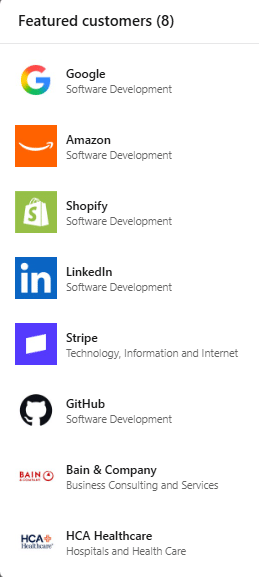
Featured customers appear directly under the company name, and the list is intentionally high-profile: Google, Amazon, Shopify, LinkedIn, Stripe, and GitHub. With logos like these, traditional testimonial copy becomes almost unnecessary. Well-known logos convey trust. They communicate scale and legitimacy instantly, without requiring long case studies or quotes.
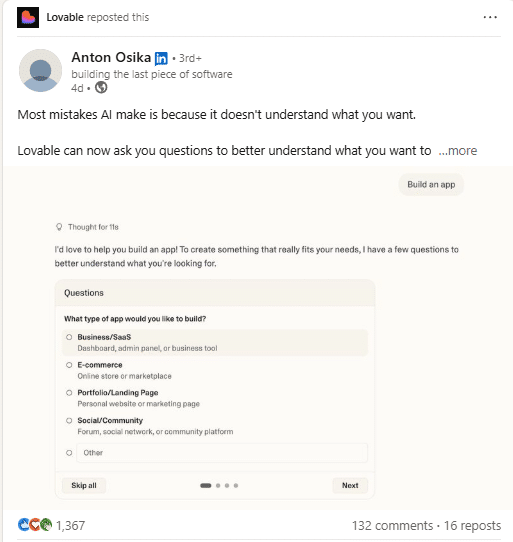
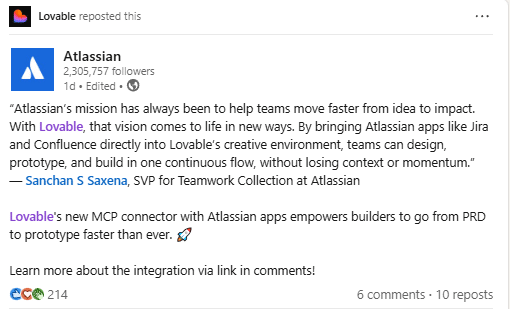
Their main content pillars are product features, tutorials, and company culture. A recurring format is welcoming new team members. Most posts use image-plus-text or video-plus-text formats. Engagement varies widely, from around 150 reactions to nearly 5k per post. Some posts also generate thousands of comments and hundreds of reposts, though this level of traction is not consistent across all content.
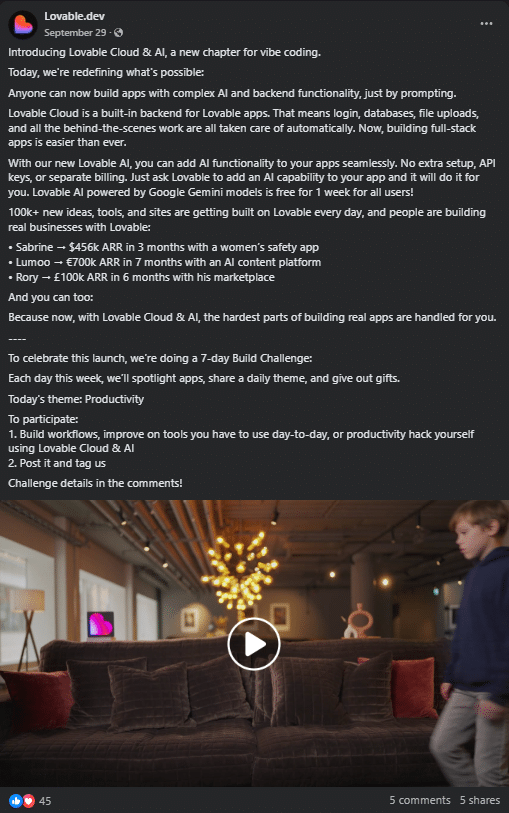
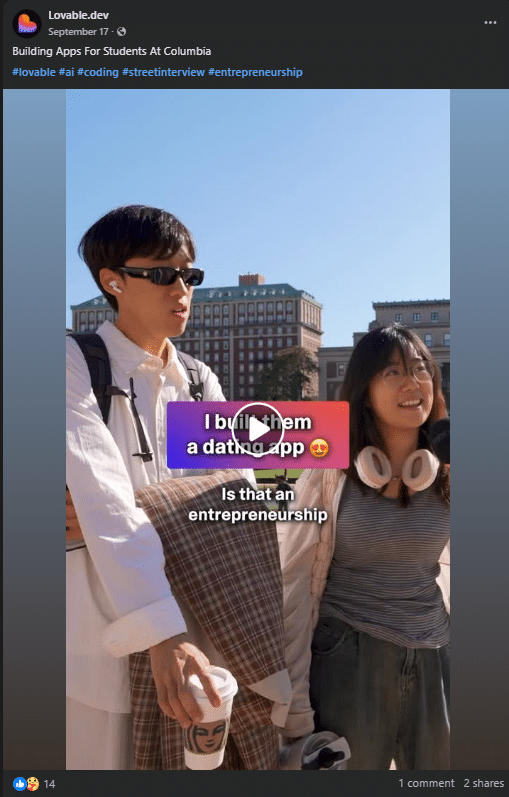
Lovable’s Facebook page has 7.7k followers and is currently inactive. The most recent posts were published in September 2025 and consisted of video content repurposed from YouTube and TikTok.
Many tech companies have deprioritized organic Facebook content, using the platform mainly for paid advertising. With a strong LinkedIn presence and growing traction on TikTok, Lovable is still reaching most of its target audience without investing heavily in Facebook.
Facebook is effectively deprioritized because organic reach for B2B and tech audiences on Facebook is limited. By reallocating effort to LinkedIn, YouTube, and TikTok, Lovable invests where attention and engagement are stronger.
X (formerly Twitter)
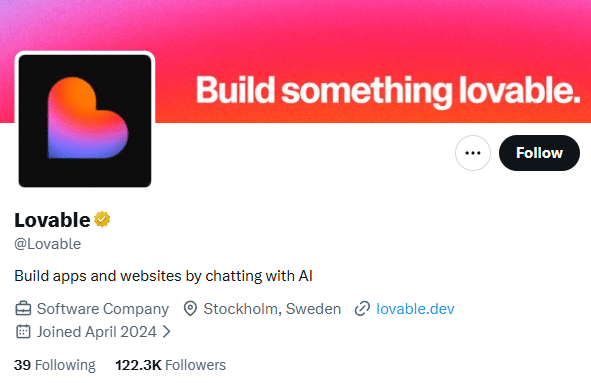
On X, Lovable has 122.3k followers. Similar to LinkedIn, reposts make up a large portion of the feed. Original content focuses on tutorials, product updates, and testimonials.
Individual posts often reach close to 1k likes, around 50 comments, 100 reposts, and up to 75k views.
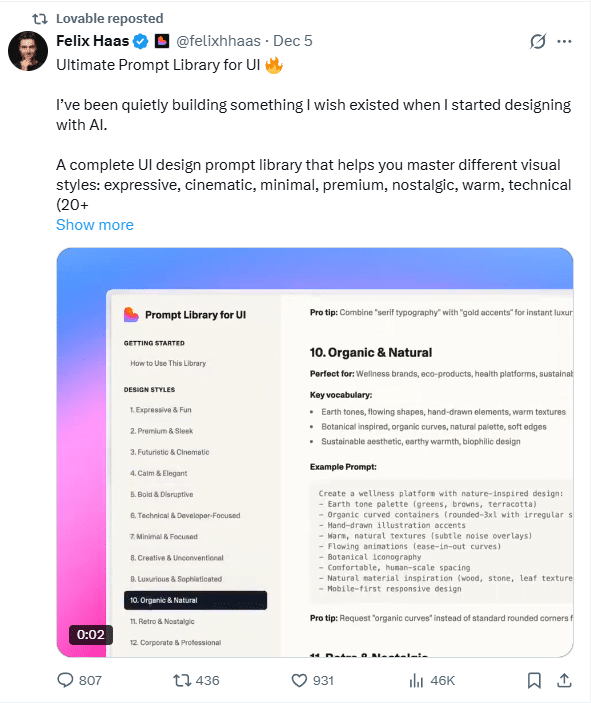
Repost-heavy feeds still work on X, because X rewards speed and relevance. Reposting keeps Lovable present in conversations while reserving original content for announcements and proof points.
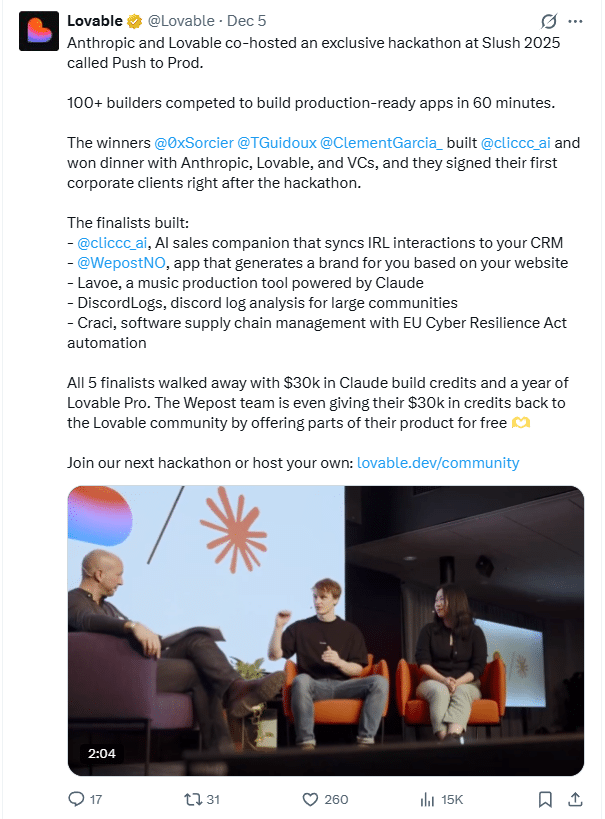
Youtube
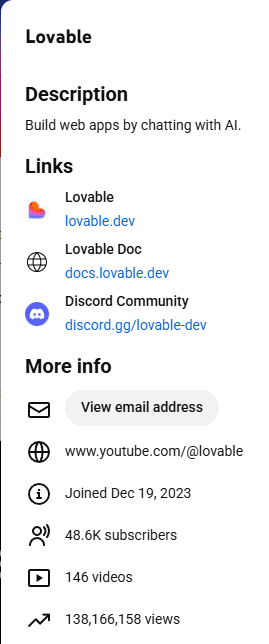
Lovable’s YouTube channel has 48.6k subscribers, 146 videos, and 138 million total views. They publish content roughly once per week.
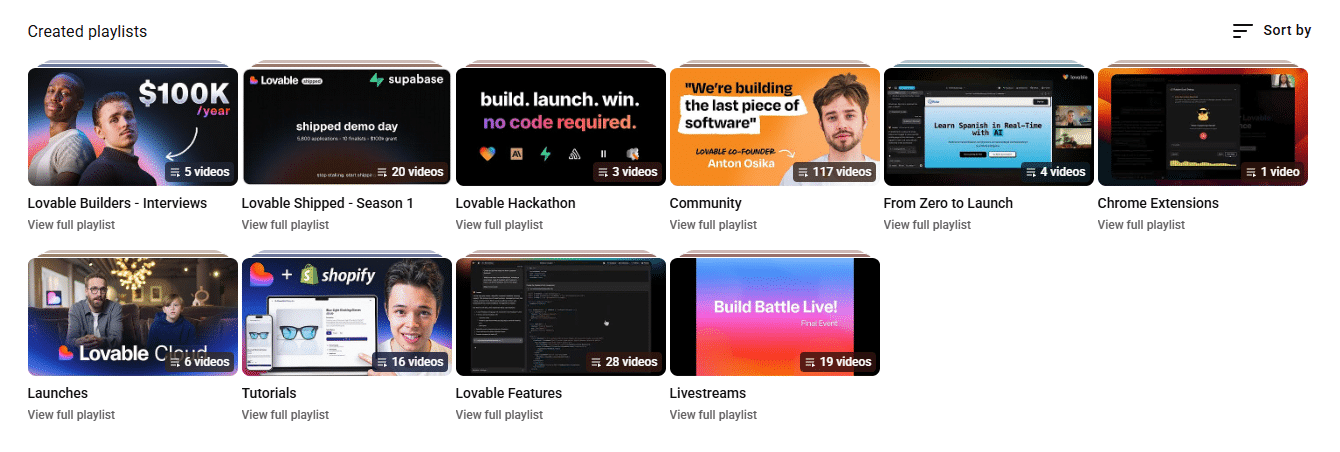
The channel is organized into ten playlists, including builder interviews, shipped projects, hackathons, tutorials, feature walkthroughs, launches, livestreams, and short-form series. In addition to long-form content, Lovable posts YouTube Shorts that frequently reach millions of views. These Shorts also generate a high volume of comments, which is notably harder to achieve than passive views. (Getting people to comment on YouTube is like getting them to read terms and conditions. It rarely happens.)

YouTube is treated as a long-term asset because its content compounds over time. Tutorials, interviews, and Shorts continue to attract users long after publishing, supporting both acquisition and education.
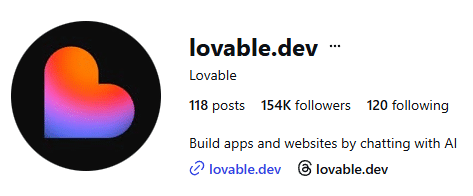
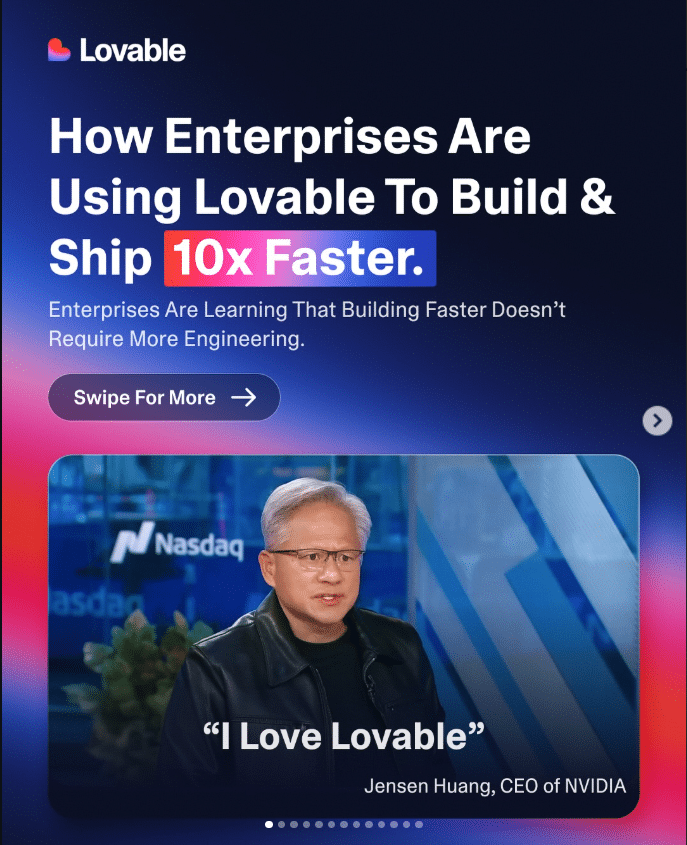
Lovable’s Instagram account has 154k followers. They post several times per week, primarily around product updates and customer testimonials. Carousels are a preferred format, alongside video content. They do not use Story Highlights, but frequently repost content from other users or channels.
TikTok
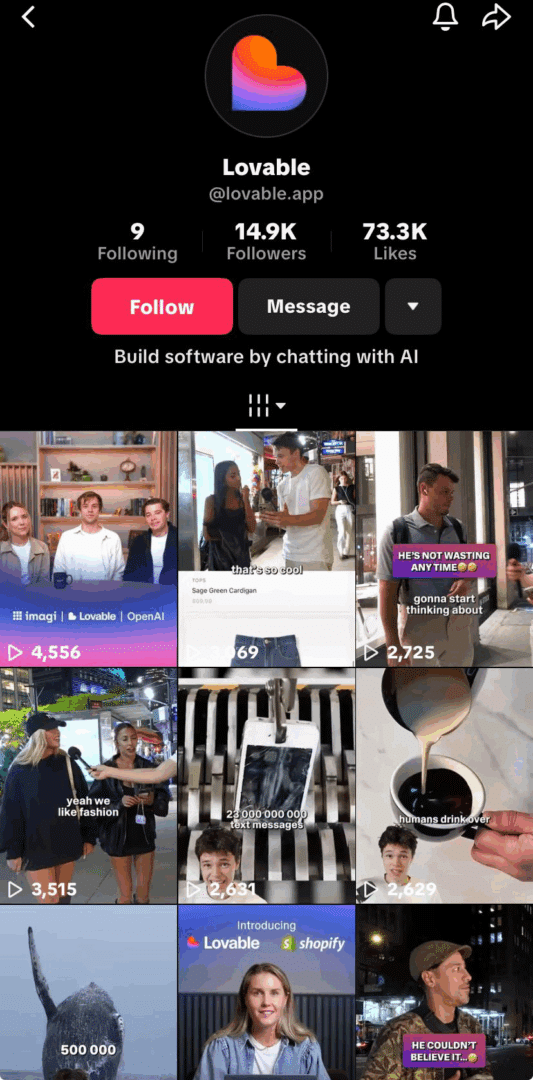
Lovable’s TikTok account has 14.9k followers and 73.3k total likes. Posting volume fluctuates. In November, only one video was published, while October saw fifteen posts.
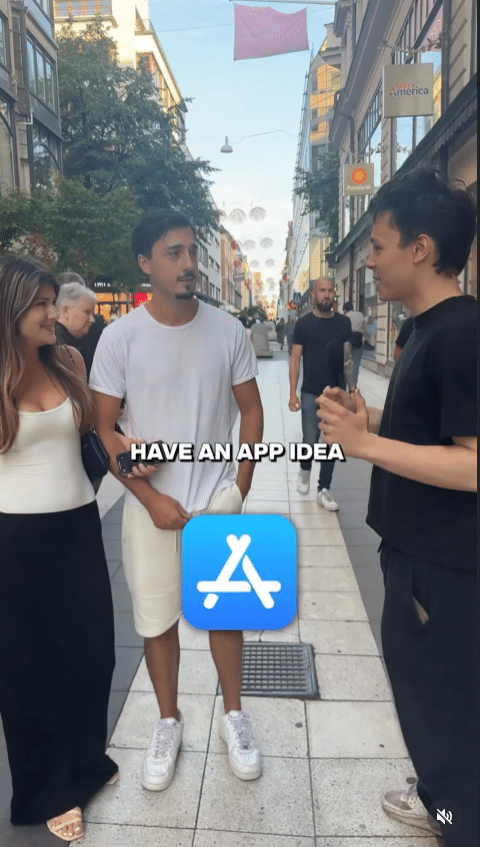
Most TikTok content consists of street interviews conducted by Isaac, who also appears in Lovable’s YouTube and Instagram videos, creating a recognizable on-camera presence across platforms. A recognizable host builds familiarity and trust. It reduces the distance between brand and audience and makes content feel personal rather than corporate.
Here’s the pattern: Lovable doesn’t treat social media like a megaphone. They treat it like a conversation engine. LinkedIn builds authority with decision-makers. YouTube archives tutorials that work for years. TikTok humanizes the brand with street interviews. Instagram turns comments into DMs, which turn into trials. Every platform has a job. Every post feeds the flywheel. And because they customize content per platform instead of lazy cross-posting, they win on all of them.
Content Marketing Performance: Lovable’s Top-Performing Content Analysis
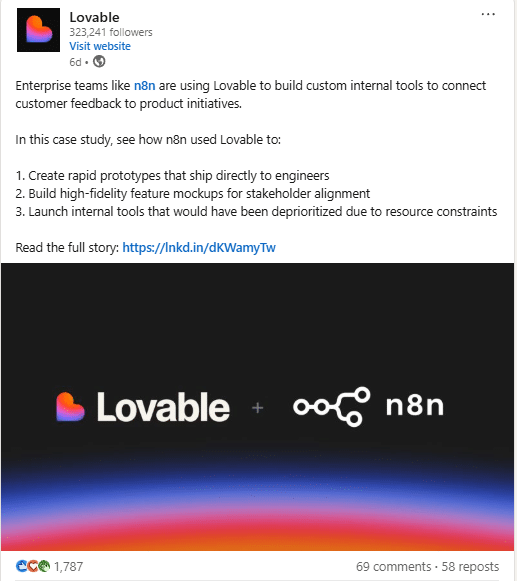
Lovable’s top-performing LinkedIn posts typically fall between 874 and 1,787 likes, with 27 to 69 comments and 13 to 58 reposts. The post with the strongest engagement rate is a case study showcasing how n8n used Lovable. Case studies reduce perceived risk. Featuring n8n turns abstract product claims into a concrete business outcome, which resonates strongly with decision-makers.
The second top performer is a product update announcing the integration of Claude Opus 4.5. Announcing this signals technical credibility and momentum. These posts reassure advanced users that Lovable is keeping pace with state-of-the-art AI models. The third is a celebratory post marking Lovable’s first anniversary.
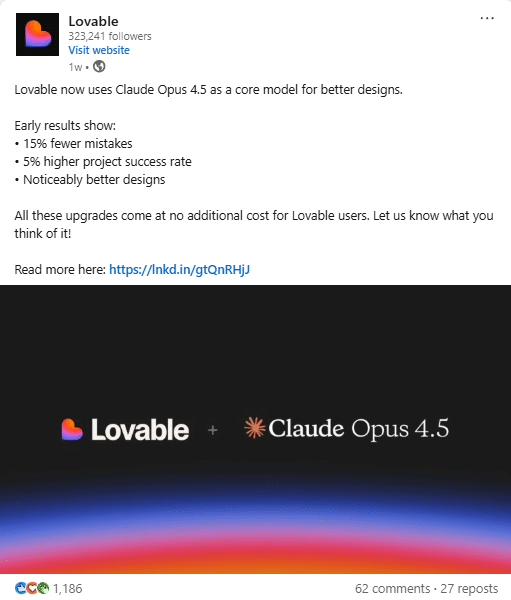
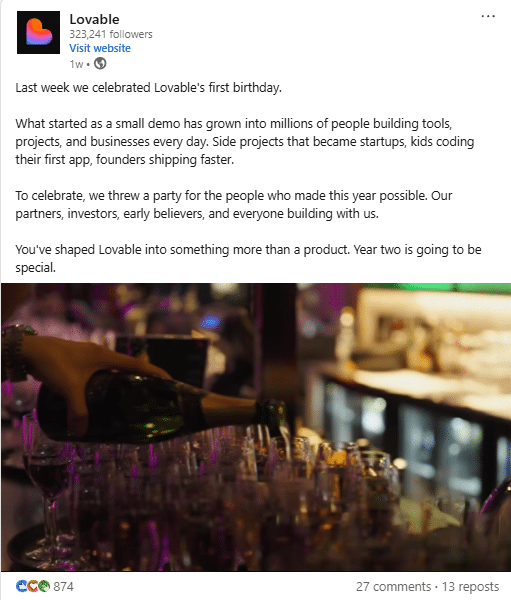
Their top posts are image + text. Only the anniversary post has no links to their site, compared to the other 2.
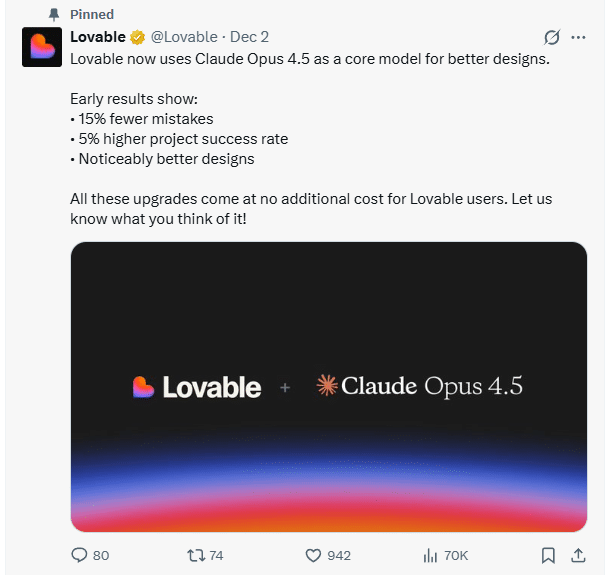
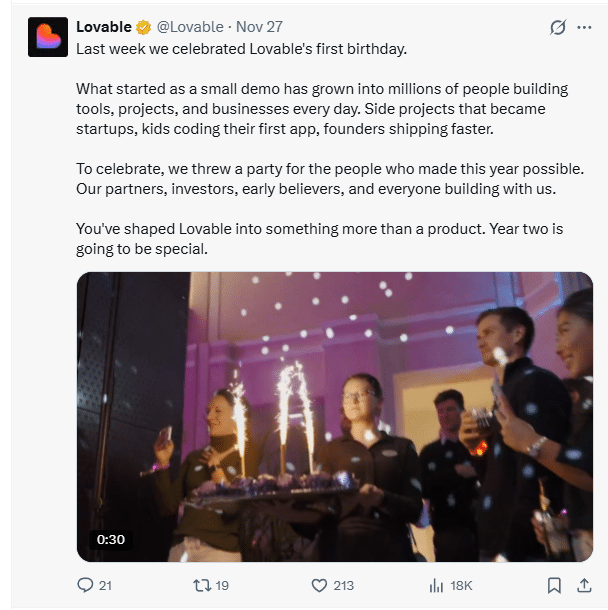
On Twitter, Lovable shared the same Claude Opus 4.5 update, which generated 80 comments, 74 reposts, 942 likes, and around 70k views. The anniversary post also performed well, with 21 comments, 19 reposts, 213 likes, and roughly 18k views.
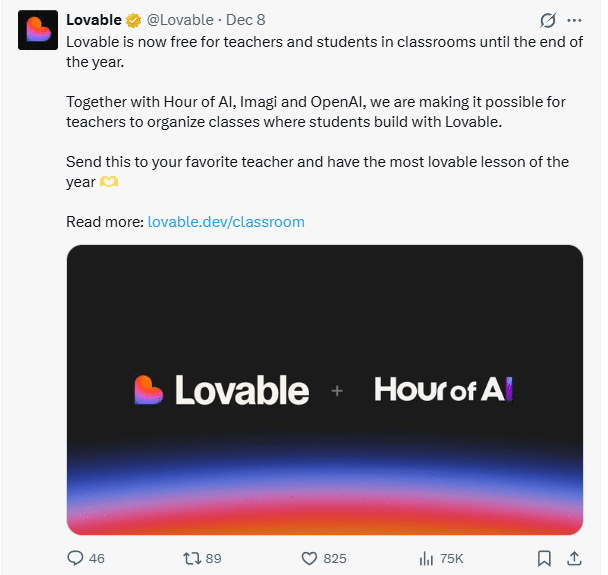
The most liked tweet, however, announced that Lovable is free for teachers and students in classrooms until the end of the year, in partnership with Hour of AI, Imagi, and OpenAI. That post received 46 comments, 89 reposts, 825 likes, and approximately 75k views. Free access for students and teachers taps into values-driven sharing. It frames Lovable as supportive of learning and future builders, which increases reposts even from users who may never convert.
Youtube
For long-form videos, Lovable’s top three performers are:
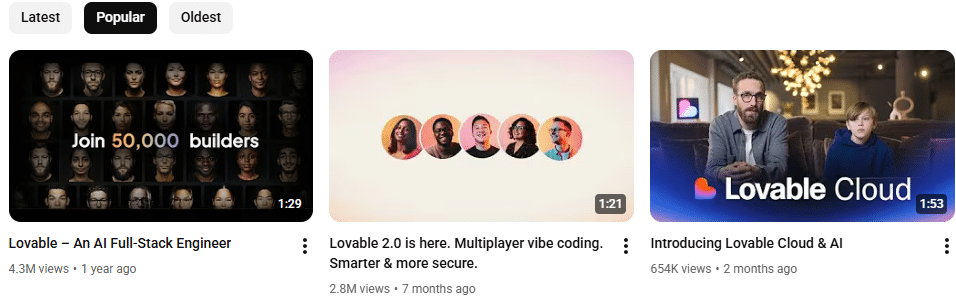
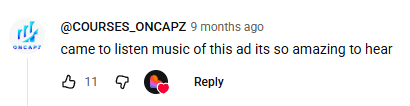
This video reached 4.3 million views, with 2.4k likes and 45 comments. A noticeable portion of the comments focuses on the background music rather than the product itself.
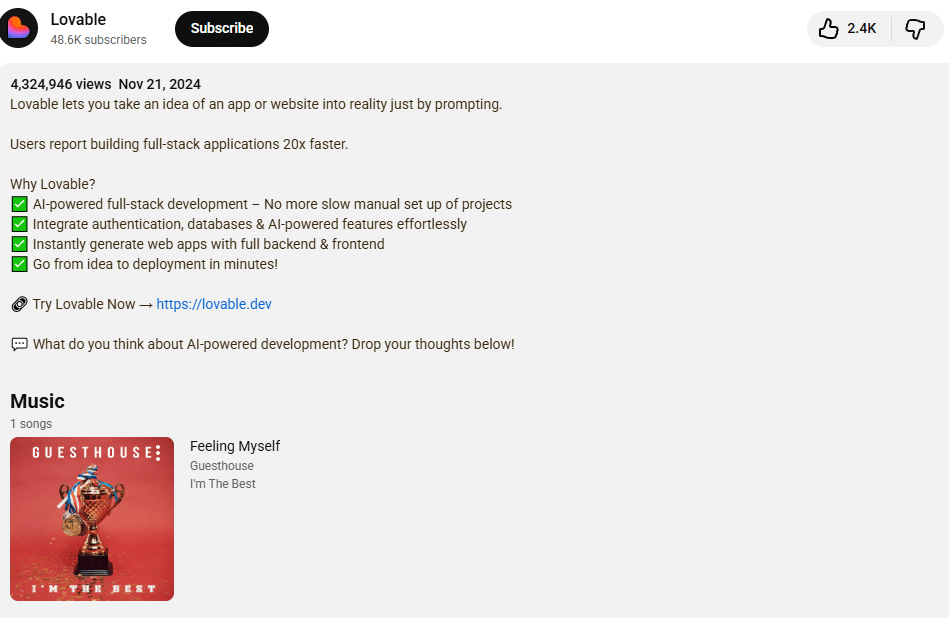
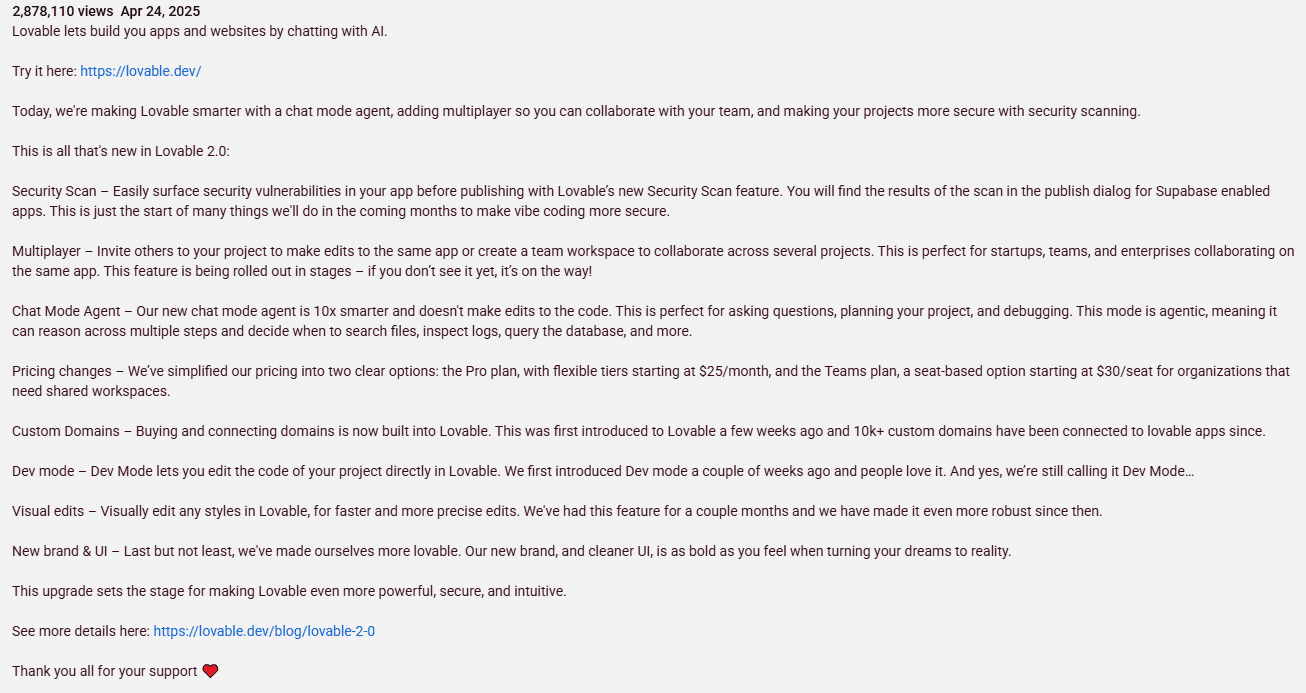
2. Lovable 2.0 is here. Multiplayer vibe coding. Smarter & more secure.
This video accumulated 2.8 million views, 2.1k likes, and 498 comments. Many comments highlight the transitions and editing quality.

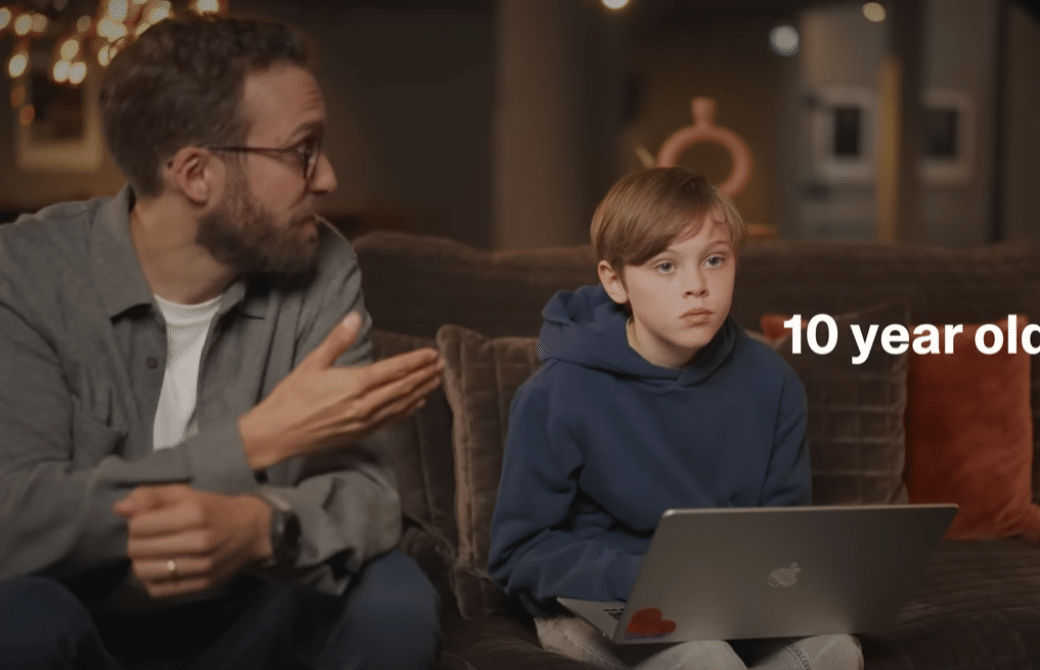
3. Introducing Lovable Cloud & AI
This video reached 654k views, with 1.4k likes and 120 comments. It demonstrates how a 10-year-old can use Lovable while introducing Lovable Cloud and Lovable AI. Lovable occasionally likes comments but rarely replies.

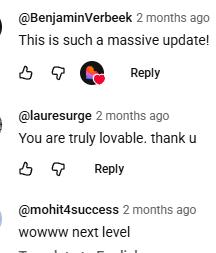
YouTube rewards production quality. Comments about music and editing show that viewers notice craft. High production value increases watch time, which directly feeds the algorithm and boosts long-term visibility.
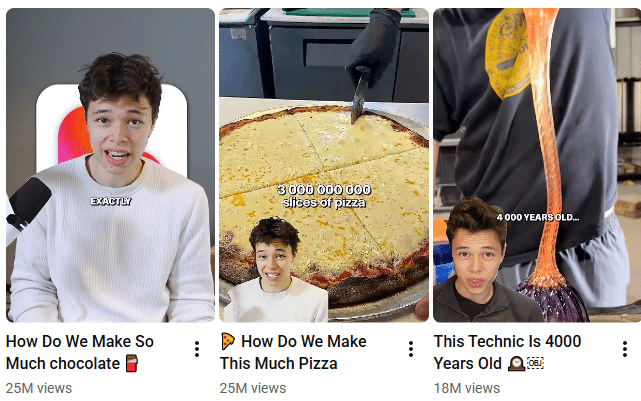
For Shorts, the performance is significantly higher. Their top Short reached 25 million views. All Shorts feature Isaac, who opens with a surprising or playful fact, such as how much chocolate people consume annually. He then explains the process behind it and connects that logic to how Lovable works, ending with a short product demo that highlights speed and simplicity.
Shorts use indirect storytelling. This exploits how the Shorts algorithm works. YouTube rewards watch time above all else. According to YouTube Creator Academy’s current best practices, the first 3 seconds determine whether your Short gets distribution. Starting with “How do we make so much chocolate?” stops the scroll. Viewers think they’re about to learn a fun fact, not watch an ad. By the time Isaac pivots to Lovable at the 10-second mark, they’ve already passed the critical retention threshold.
Let’s do the math on 25 million views. According to WebFX’s 2024 YouTube Ads benchmarks, the average CPV (cost-per-view) for tech companies is $0.10-$0.30. Buying 25M views through paid YouTube ads would cost $2.5M-$7.5M. That’s a Series A round. That’s multiple hires. That’s your entire marketing budget for a year. And Lovable got it by talking about chocolate.

Lovable got it organically by understanding the algorithm. Even if only 0.5% of viewers (125,000 people) visit the website, and 2% of those (2,500 people) convert to free trials, and 10% of trials convert to paid ($250 customers at $25/month), that’s $75K MRR from a single Short that costs maybe $5K to produce. That’s a 15x ROI on organic content.
The algorithm interprets this as engaging content and pushes it to millions more feeds. Does it matter that some viewers complain in comments? Not even a little bit. Negative engagement still counts as engagement. As long as watch time stays high, the algorithm rewards it. Lovable is willing to trade some brand comfort for 25 million impressions.
Top Performing Shorts:
- How Do We Make So Much chocolate 🍫 – 25M views, 69k likes, 320 comments
- 🍕 How Do We Make This Much Pizza – 25M views, 57k likes, and 250 comments
- This Technic Is 4000 Years Old 🕰️ – 18M views, 53k likes, and 94 comments
The comment sections are often polarizing. Some users complain about seeing the ads, others question the connection between the opening fact and the product, while some mock Isaac’s pronunciation. Despite this, the reach and engagement remain strong. Controversy still counts as engagement. As long as watch time and interaction stay high, the algorithm rewards the content. Lovable appears willing to trade some brand comfort for reach.
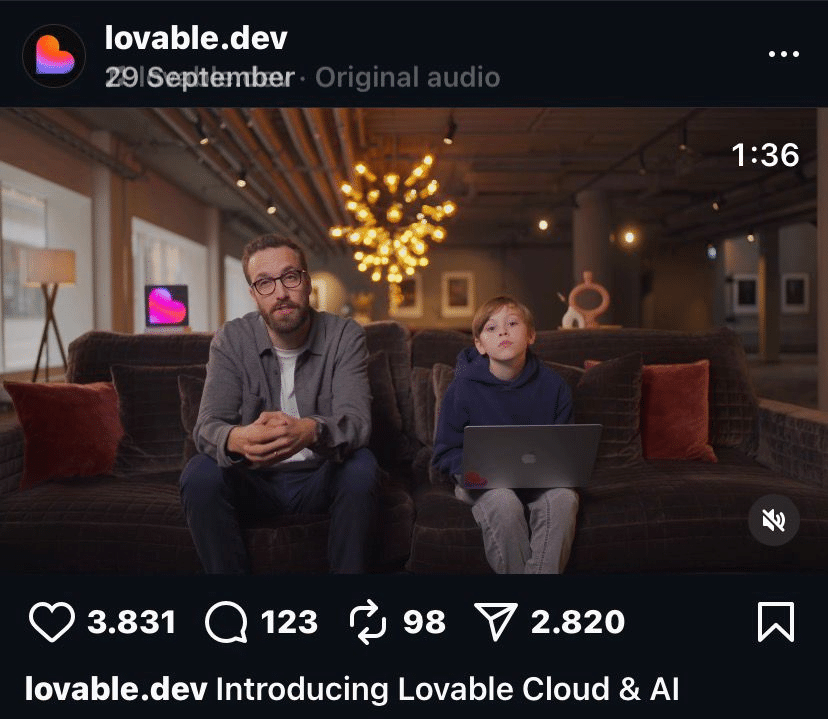
On Instagram, the video featuring the 10-year-old user generated 3.8k likes, 123 comments, 98 reposts, and 2.8k shares. In second place is a product announcement video from the CEO, which received 3.1k likes, 105 comments, 74 reposts, and 1.2k shares.

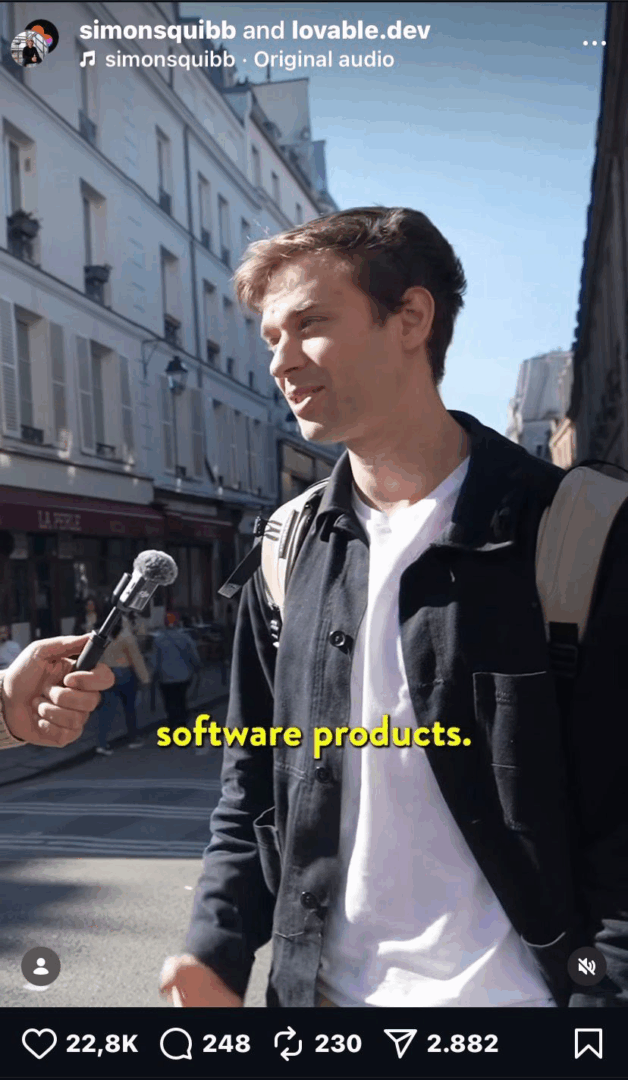
The top-performing post is a street interview with Anton Osika conducted by Simon Squibb, which reached 22.8k likes, 248 comments, 230 reposts, and 2.8k shares.
While Lovable occasionally uses static images for product updates, the performance gap is clear. Video content consistently drives higher reach, engagement, and sharing.
TikTok
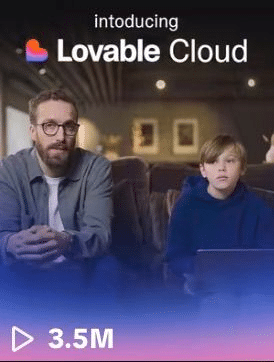
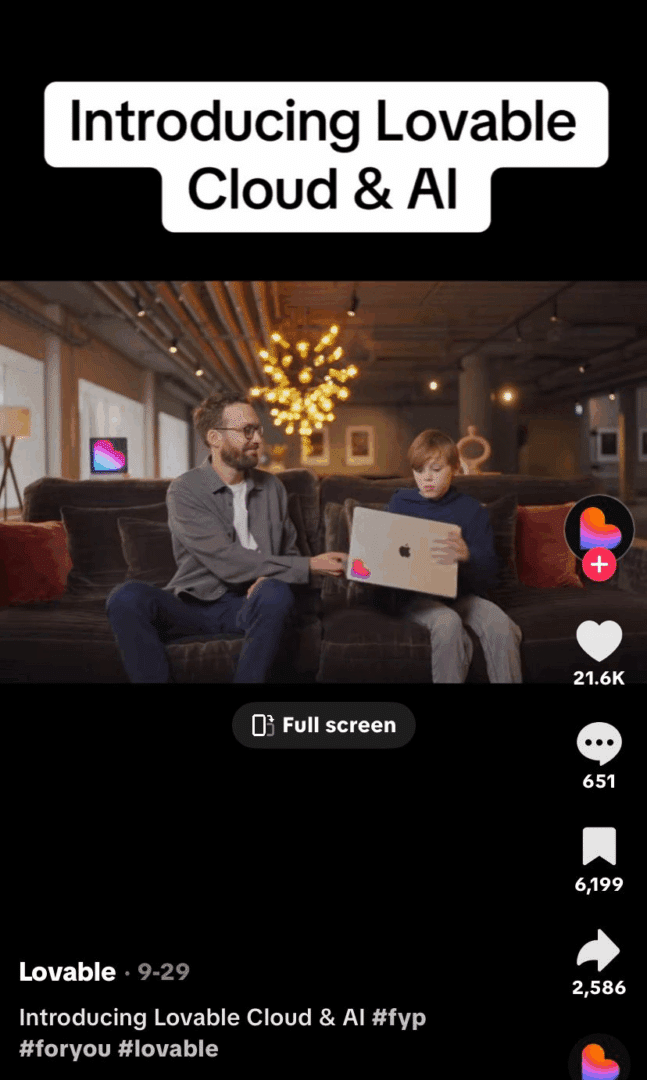
On TikTok, the top-performing video is Introducing Lovable Cloud and AI, which reached 3.5M views, 21.6k likes, 651 comments, 6.1k saves, and 2.5k shares.
A street interview filmed by Isaac follows closely, with 2.6M views, 14.4k likes, 374 comments, 3.1k saves, and 1k shares. On TikTok, these street interviews outperform other formats, while the fun-fact-driven videos clearly perform best on YouTube Shorts.
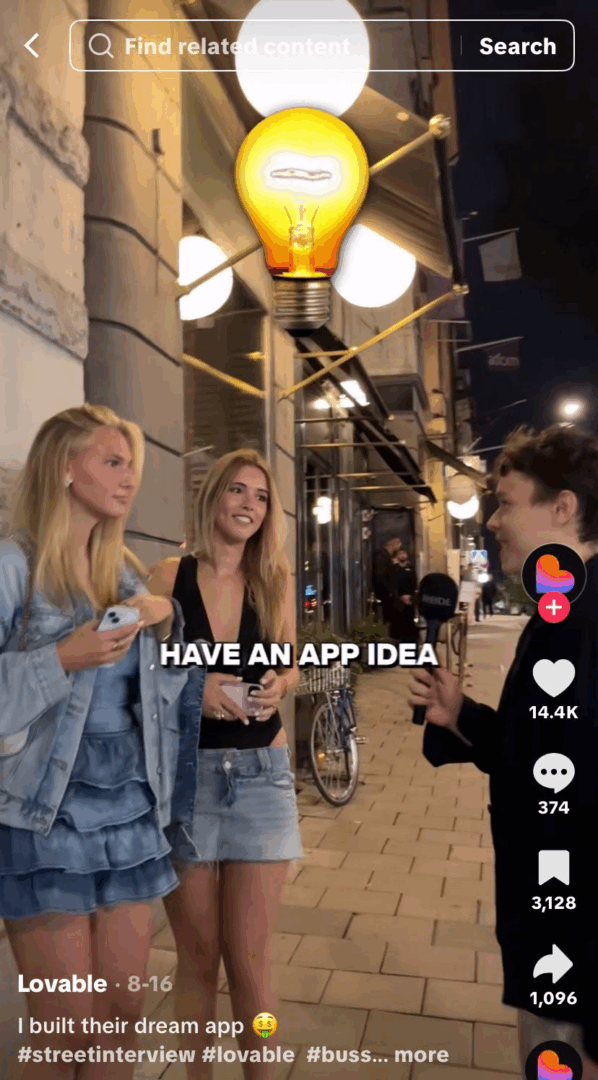
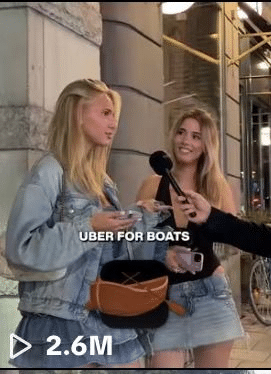
Street interviews dominate because human faces and unscripted conversations feel native to these platforms. Featuring founders or real people lowers resistance and increases shareability. Video compresses explanation, emotion, and proof into a single format. For a complex product like Lovable, it reduces friction faster than static visuals.
What’s the lesson here? Production quality beats polish. Isaac’s Shorts about chocolate outperform slick product demos because they understand the platform. Anton’s EU VAT post crushes generic updates because it solved a real crisis. The n8n case study beats feature announcements because buyers trust outcomes over promises. Stop making perfect content. Start making content that works where it lives.
Lovable’s Sales Funnel from Social Media
Most brands try to force followers off social media and onto their website immediately, but that usually backfires. Platforms hate it when you try to take their users away, and people hate feeling like they’re being sold to. Lovable takes a smarter approach. They play by the rules of each app, focusing on keeping people interested first and only sharing links when it actually makes sense. Here is how they turn followers into users across different platforms.
On LinkedIn, Lovable occasionally includes links that redirect users to its website. These links may point to blog posts, community spaces, or product-related pages. Not every post includes a link, but when they do, the destination is almost always owned by the media. Limiting outbound links helps protect reach. LinkedIn favors native engagement, so Lovable prioritizes visibility first and traffic second, using links only when the destination justifies the trade-off.



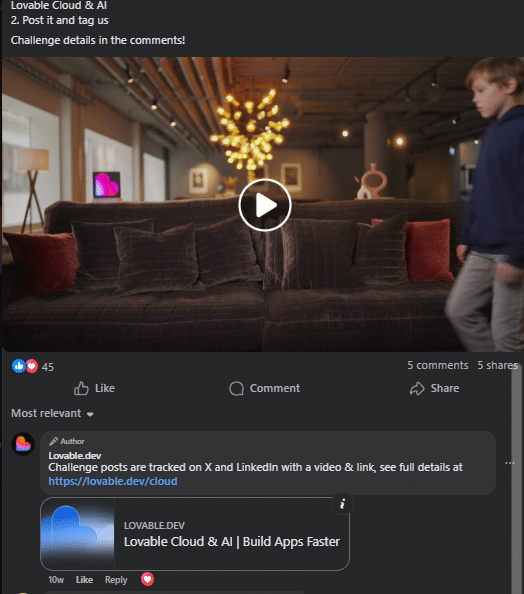
Although Lovable is currently inactive on Facebook, past posts show that links are placed in the comments rather than in the post copy. This is likely done to avoid reduced reach caused by Facebook’s algorithm penalizing outbound links, and it’s used as a defensive tactic against algorithm suppression. It allows Lovable to keep posts visible while still offering a path off-platform for users who actively look for it.
X (formerly Twitter)
On X, Lovable follows a similar approach to LinkedIn but uses outbound links more frequently. Posts often include direct links to the website, making the platform a more consistent traffic driver compared to LinkedIn. X users are more accustomed to clicking links, and the platform is less restrictive about outbound traffic. Lovable uses this to capture intent-driven users who want deeper product information.


YouTube
On YouTube, outbound links appear in the video descriptions, paired with clear calls to action such as “Challenge details here” or “Try Lovable now”. These links typically lead directly to product pages or campaign-specific destinations. YouTube viewers are already investing time. Clear CTAs in descriptions convert passive viewers into active prospects without interrupting the viewing experience.



On Instagram, links are occasionally included in post captions, despite their limited clickability. This suggests reliance on short, memorable URLs rather than direct traffic volume. Even without high click-through rates, visible URLs reinforce brand recall. Users may not click immediately, but they remember where to go later.

Another recurring tactic is the use of CTAs like “comment ‘WATCH’ and we’ll DM you the full interview”. These automated replies help trigger engagement signals and initiate direct conversations, which can positively impact reach.
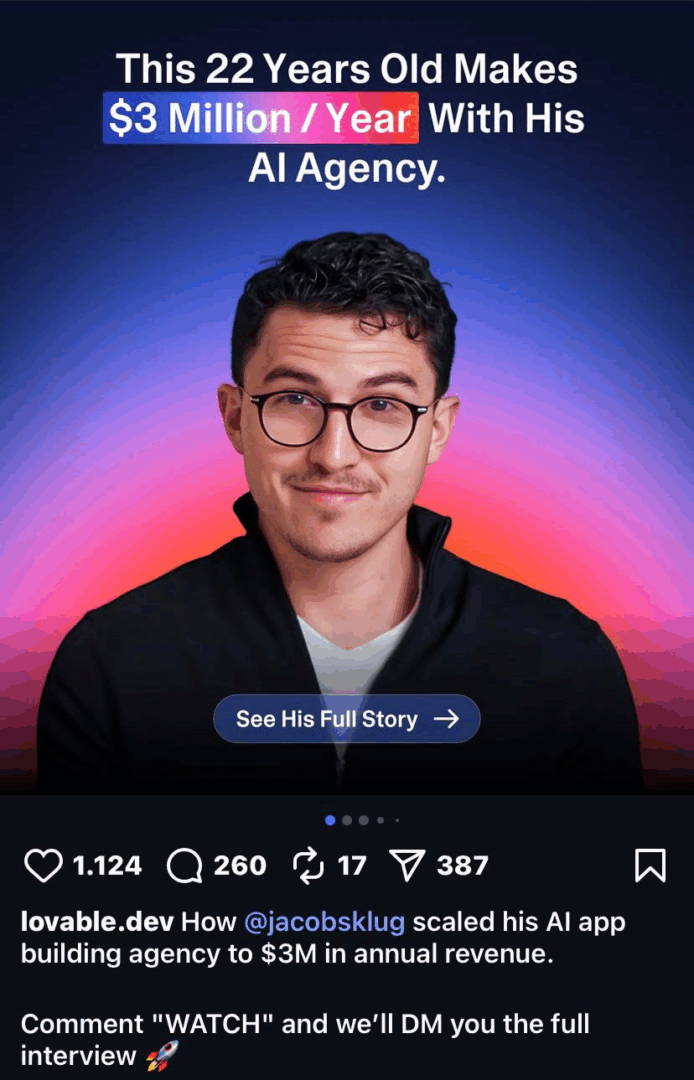
Instagram prioritizes conversations over traffic. According to Later.com‘s 2024 Instagram algorithm research, accounts with high DM response rates get up to 30% more reach on future posts. Instagram interprets DMs as genuine relationship-building, not just broadcasting. When Lovable prompts “comment WATCH and we’ll DM you”, they’re triggering a triple win.
One: comments boost post engagement, which feeds the algorithm.
Two: DMs create 1:1 conversations, which convert 10x better than cold links.
Three: Lovable captures the user’s Instagram handle for retargeting, even if they never visit the website. Oh, and this move also dodges Instagram’s link suppression like a pro. Posts with outbound links get 20-30% less reach. By moving the link to DMs, Lovable keeps distribution high while still driving traffic.
Lovable’s Paid Advertising Strategy: LinkedIn and Facebook Ads Analysis
When it comes to paid ads, Lovable doesn’t just throw money at every platform to see what sticks. They take a calculated approach, moving between highly specific professional targeting on LinkedIn and broad, high-volume testing across the Meta ecosystem. By mixing product demos with face-to-camera testimonials, they manage to look like both a cutting-edge tech company and a transparent, human-led brand. Here is a breakdown of how they are currently spending their ad budget.
LinkedIn ads were a bit difficult to track because multiple advertisers share the “Lovable” name. After filtering, it’s clear that Lovable primarily promotes: product updates, Lovable Cloud & AI build challenges, and testimonials.
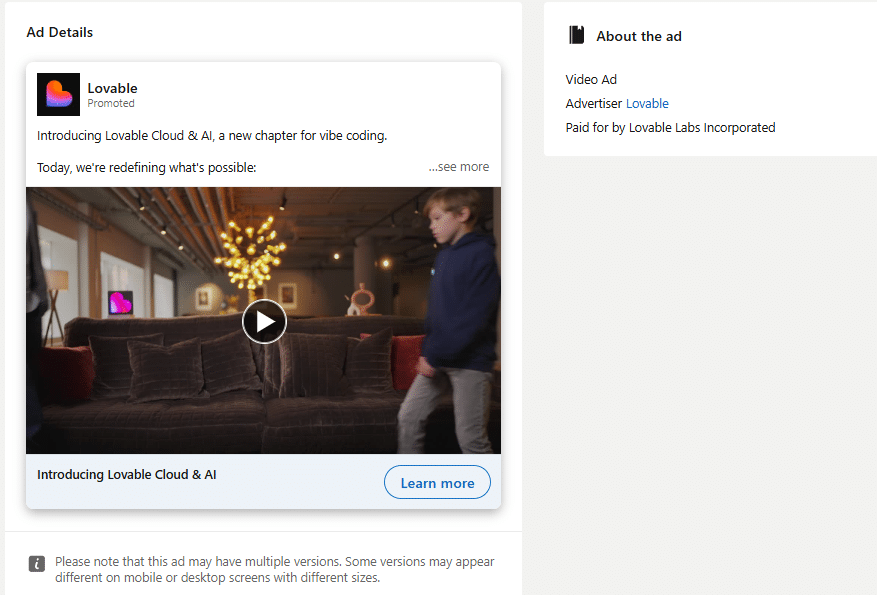
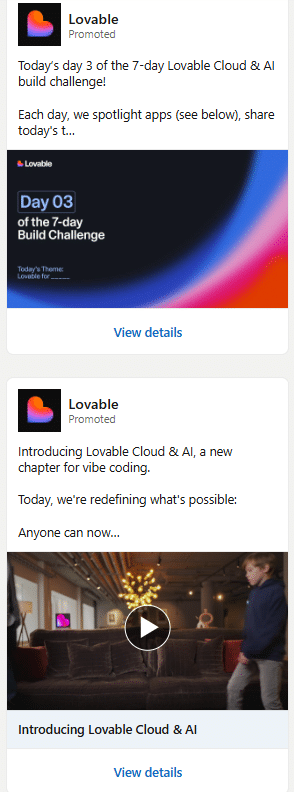
Most testimonial ads feature current or former Lovable employees, including the CEO.
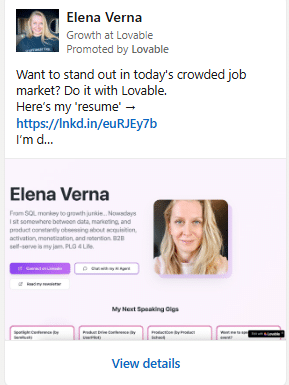
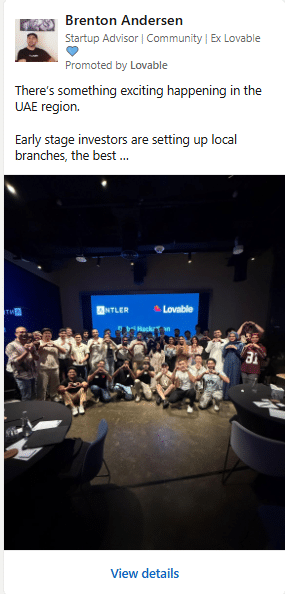
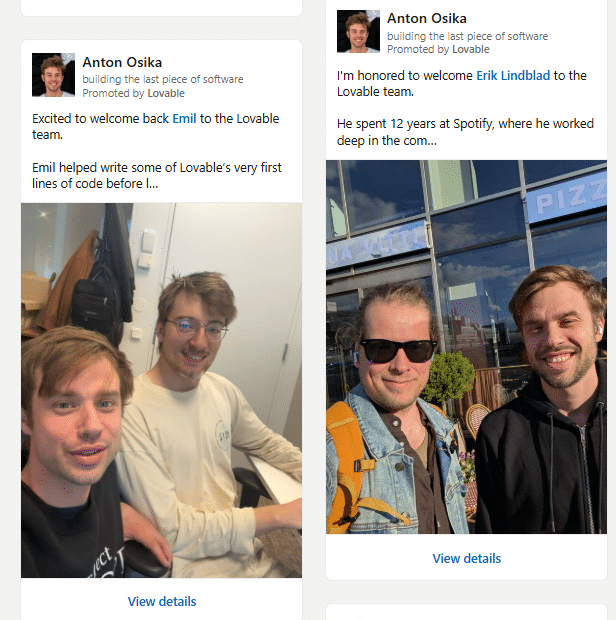
There are only 3 ads with shown metrics:
- A single-day post in July reached under 1,000 impressions, targeting Romania, Sweden, Poland, Lithuania, and Estonia. (above, right side)
- Another ad on the same day reached 1,000–5,000 impressions, with the same top countries. (above, left side)
- A video ad running from April 25 to May 5 achieved 200k–500k impressions, targeting the United States and Sweden. (below)
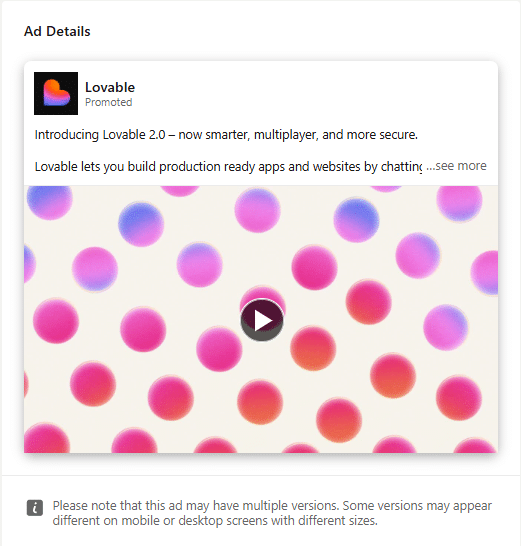
Lovable uses LinkedIn to reach professional audiences in high-tech or startup regions. This is a classic nearshore testing strategy. According to LinkedIn Ads Benchmarks from 2024, CPCs in Romania, Poland, and Lithuania are 40-60% lower than in the US, while tech talent density is comparable. Lovable is likely testing messaging and creative in cheaper markets first.
If CAC comes in under $200 in Eastern Europe versus $500-800 in the US, they’ll scale there before saturating expensive markets. Sweden makes sense as home turf, but Romania and Poland signal something bigger. These are where European SaaS companies find their first 1,000 customers before expanding west. It’s the same playbook UiPath used before becoming a unicorn.
But wait, there’s a sneaky second play happening here. Romania has 250K+ software developers with an average salary of $30K-$45K versus $120K-$150K in the US. Poland has 430K+ developers at similar rates. By running ads in these markets, Lovable isn’t just testing cheaper CAC; they’re building brand awareness among potential hires. Every ad impression is dual-purpose: customer acquisition and employer branding. According to LinkedIn’s Global Talent Trends, companies that advertise in talent-dense markets see 35% lower cost-per-hire when they eventually open roles there.
Featuring employees and the CEO reinforces credibility and trust. Social proof from insiders signals authority while subtly showcasing culture and expertise. Video campaigns outperform single-image posts in impressions, particularly in large markets like the U.S. Videos are ideal for demonstrating complex features quickly and visually.
On Facebook, Lovable runs over 100 active ads across Instagram, Audience Network, Messenger, and Threads. Ads have multiple versions to test messaging and creative variations. Several campaigns reuse the same creative and text across three ads. All ads include a “Learn More” CTA that links to the Lovable website. Both images and video are used for creative purposes, depending on the campaign goal.
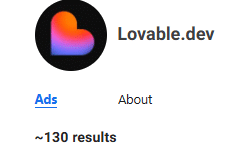
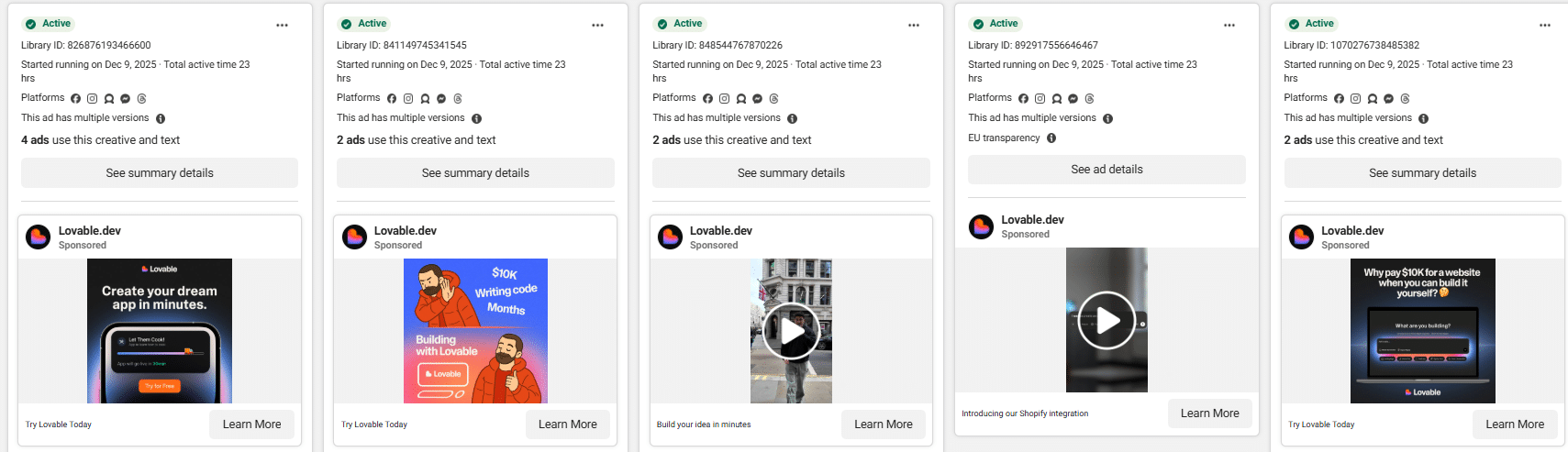
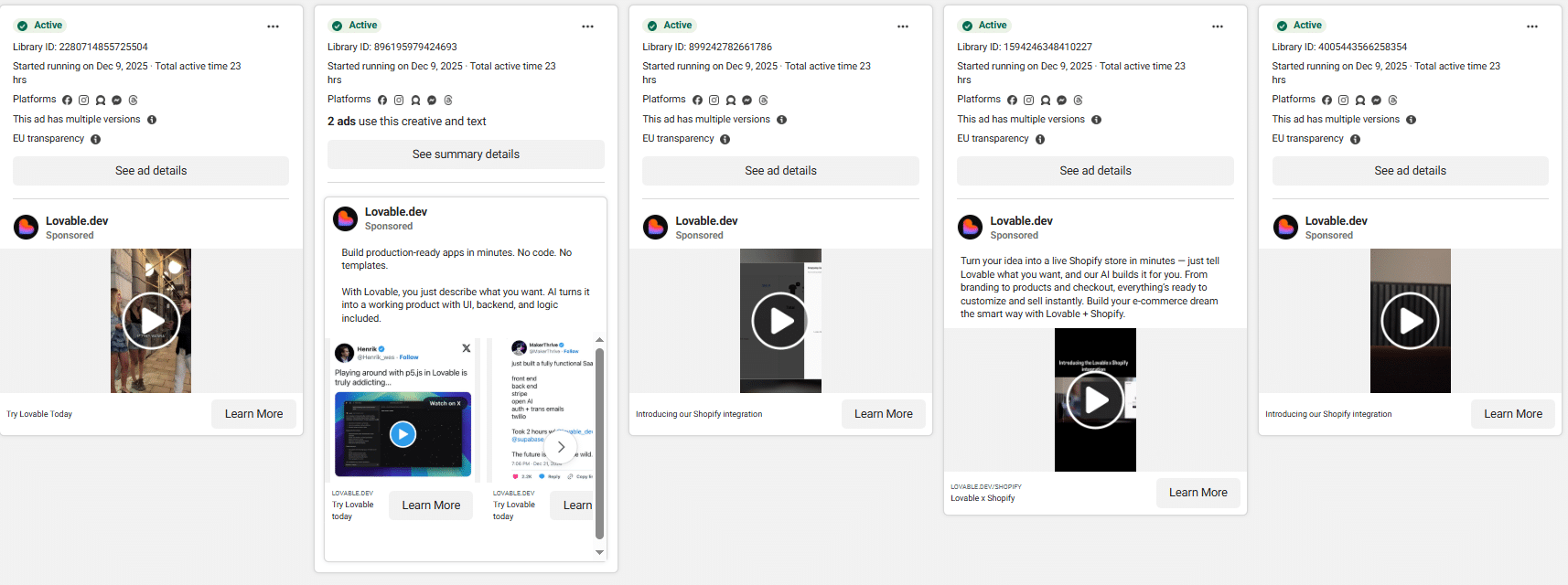
Running ads across Facebook, Instagram, Messenger, Threads, and Audience Network allows Lovable to cover different touchpoints.
This is aggressive creative testing at scale. According to AdEspresso’s Facebook Ads research, accounts running 20+ active creative variants get 15-20% lower CPMs because Facebook’s algorithm rewards diversity. More variants mean more data. More data means faster optimization. Lovable isn’t treating Facebook like a branding channel. They’re treating it like a performance lab. Every ad is a hypothesis. Three identical ads with different headlines test messaging. Same video with different thumbnails tests visual hooks. This approach burns the budget faster but finds winners quicker. For a company at Lovable’s growth stage, speed matters more than efficiency.
Facebook’s own advertising guidance recommends $1,000-$2,000 per ad set to achieve statistical significance. With 100+ active variants, Lovable is likely spending $100K-$200K monthly on Facebook/Instagram testing alone. But here’s why it’s worth it: once they identify winning combinations, they can scale those ads 10-20x with confidence. According to AdEspresso’s analysis of 100M+ ad impressions, advertisers who test 50+ creative variants find winners with 2-3x better ROAS than those testing fewer than 10.
Directing users to owned media ensures traffic is measurable and funnels visitors into lead capture or product trials. Keeping CTA consistent reduces friction and increases the likelihood of conversion. Using both images and video allows Lovable to test engagement across formats. Image ads are lighter and faster to produce, while videos convey product functionality and storytelling more effectively
Lovable’s Reviews and Social Proof
Here we will talk about their Reddit channel, client testimonials, and third-party reviews. Lovable’s consistent presence and moderation across platforms demonstrates brand accountability, which strengthens confidence for enterprise and founder-level buyers.
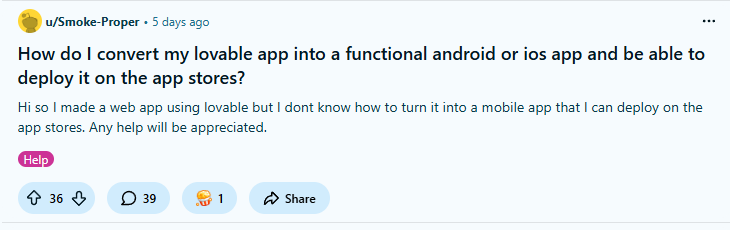
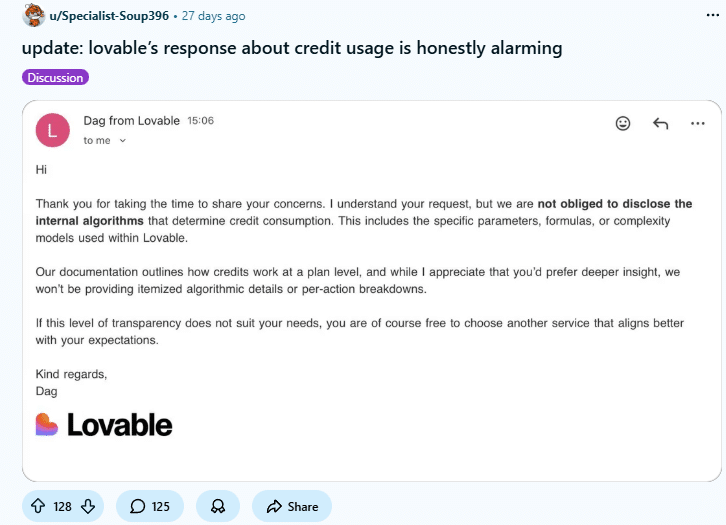
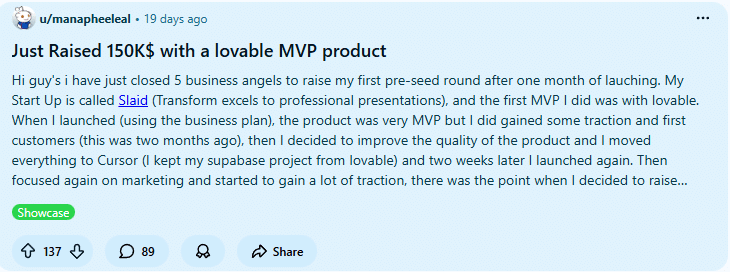
Lovable’s Reddit community has 38k members and sees roughly 1.4k contributions per week. Analysis of posts reveals common threads: technical issues, such as system updates or credit usage problems, feature inquiries or requests, and user-generated testimonials showing real products built with Lovable.
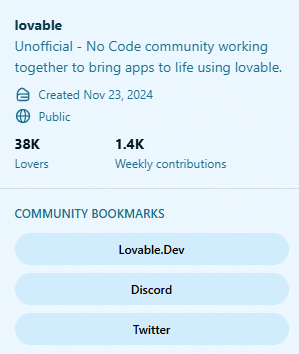
Overall, Reddit reflects active engagement and real-world feedback from both enthusiasts and professional users. Reddit captures authentic conversations from users. It serves both as a QA source for potential customers and a space to demonstrate community engagement.
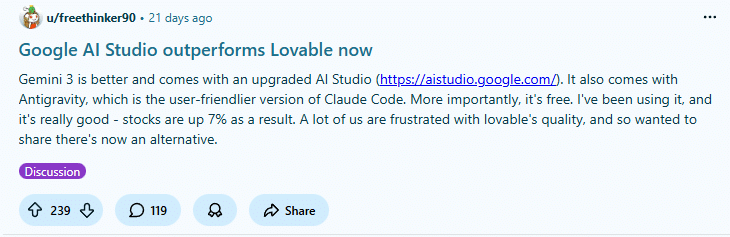
Capterra
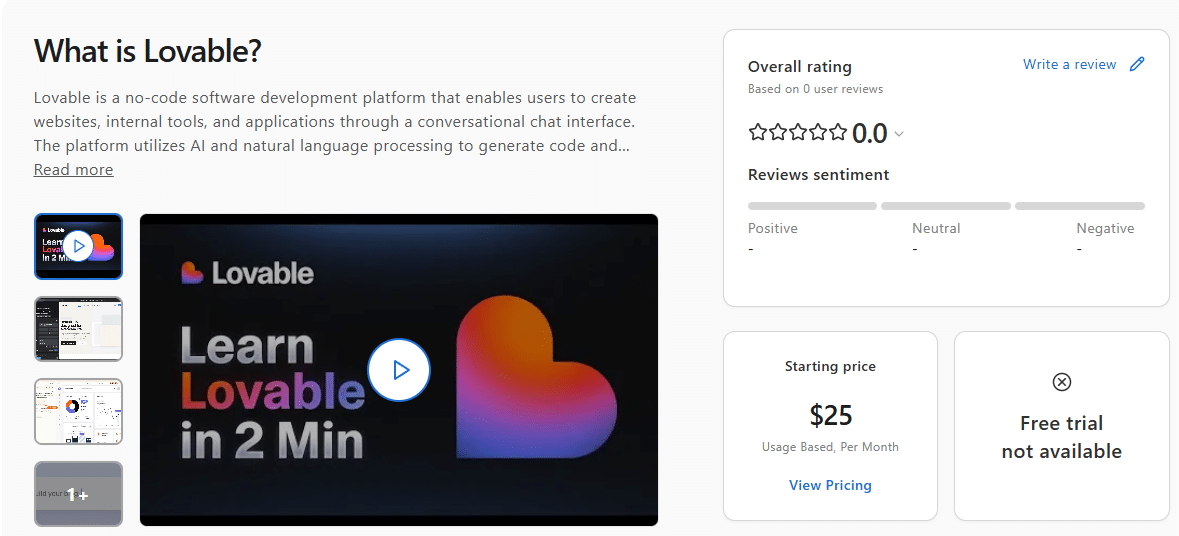
Lovable currently has no ratings on Capterra. Having no rating may be intentional at this early stage. It avoids potential low-score bias while G2 and Trustpilot build credibility.
G2
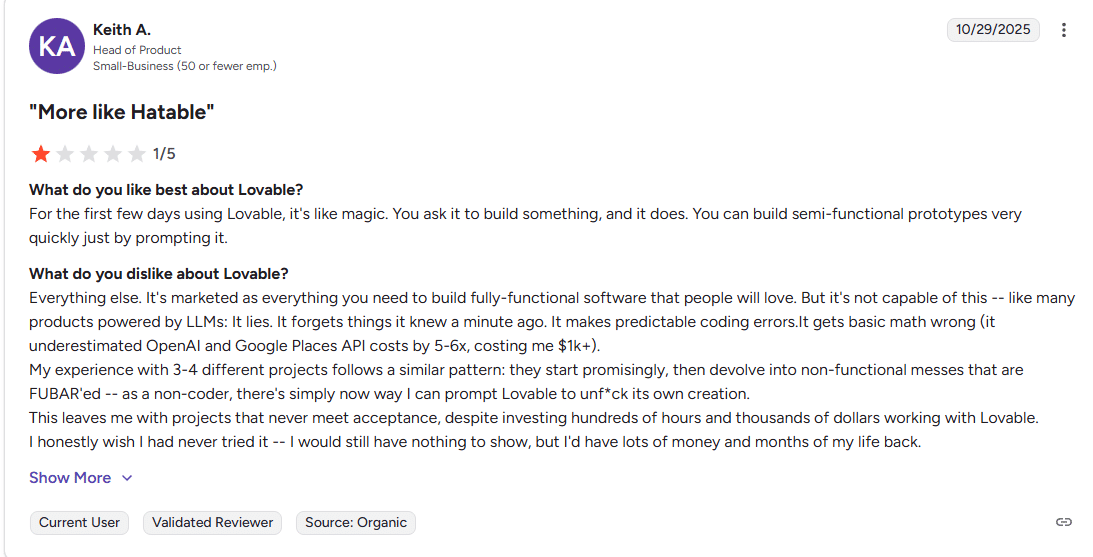
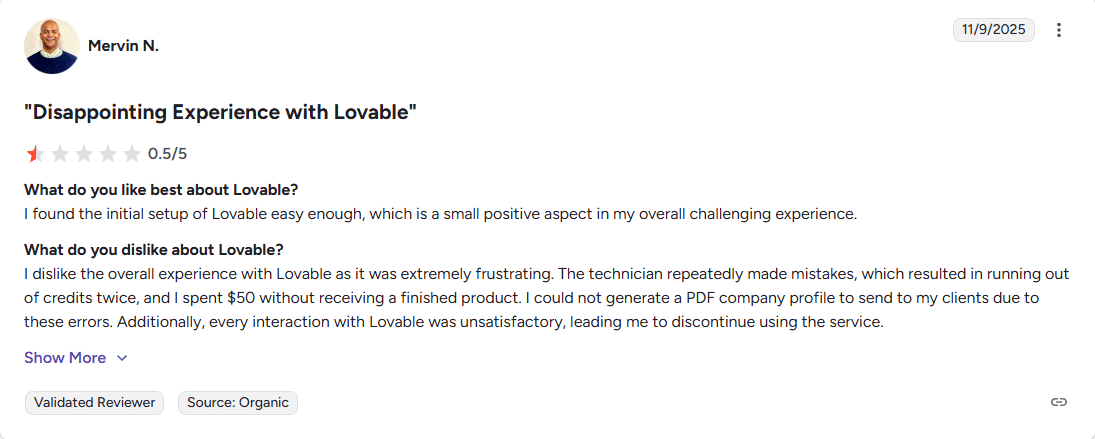
On G2, Lovable holds a 4.6/5-star rating. The pros highlighted by users are: ease of use and intuitive interface, speed and time savings, and coding assistance for developers. The cons are: credit system and usage limits, occasional prompt failures or poor coding output, higher pricing, and limitations inherent to AI.
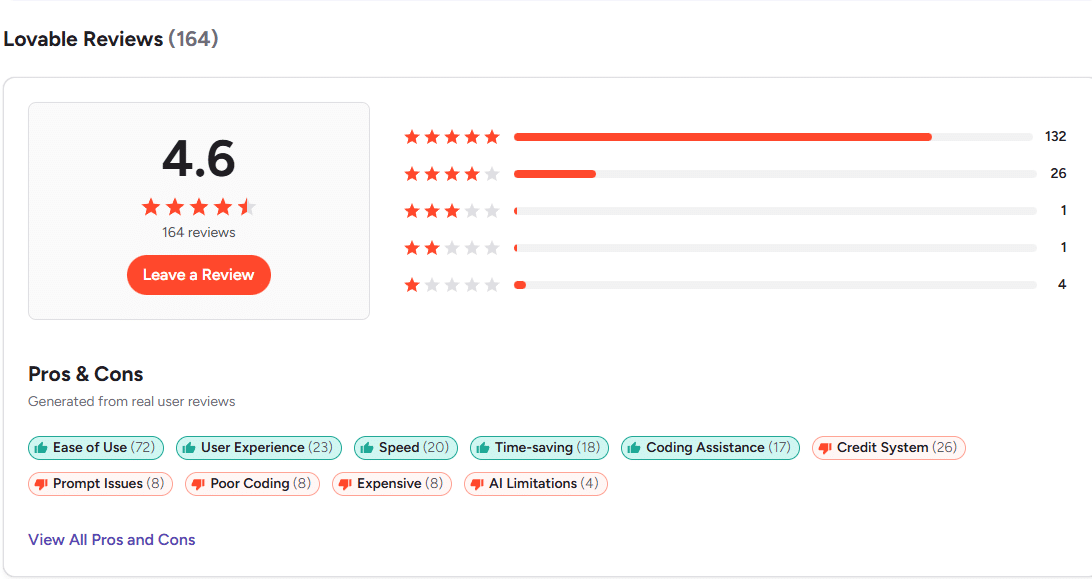
G2 reviews provide a credible professional lens on strengths and areas for improvement. High scores combined with specific pros, position Lovable as a serious productivity tool. Mentioning common cons signals transparency, which strengthens trust among business users.
Trustpilot
On Trustpilot, Lovable has a 4.1/5-star rating. Users consistently praise the platform as friendly, intuitive, and easy to use.
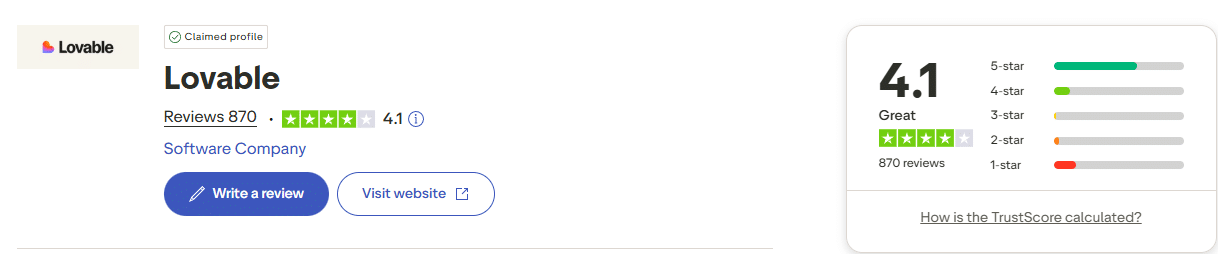
The company actively manages reviews, removing fake entries. Negative reviews (1-star) typically cite: slow or misleading paid support, poor customer service, and concerns about data privacy.
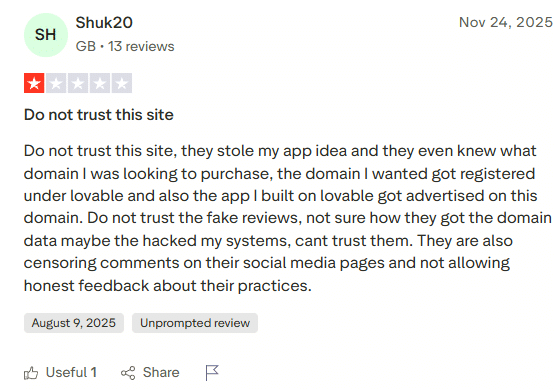
Not only are social media numbers growing, but their review accounts are being taken care of. They removed several fake reviews in a week. Positive feedback on usability reassures non-technical buyers. According to G2’s 2024 Buyer Behavior Report, 92% of B2B buyers consult G2 before purchasing SaaS tools.

But timing matters. TrustRadius’s 2024 B2B Buying Disconnect Report shows that buyers consult review sites at three distinct stages: 54% during initial research, 38% during vendor evaluation, and 29% right before final purchase. G2 dominates early-stage research (top 3 considerations), while Trustpilot appears in late-stage validation searches. Lovable’s strategy of prioritizing G2 captures buyers when they’re building their shortlist, not just confirming decisions. By the time a buyer reaches Trustpilot, they’re 70-80% decided. G2 influences the critical shortlist moment.
Trustpilot, by contrast, skews toward consumer products. Lovable clearly prioritizes G2 because that’s where enterprise buyers live. Their 4.65 G2 rating with transparent complaints about credits and pricing actually builds more trust than a fake-looking 5.0. Modern buyers are sophisticated. They expect trade-offs. When they see honest critiques alongside strong scores, they trust the platform more.
Trustpilot’s 4.1 is lower, but it doesn’t matter as much. Enterprise CTOs aren’t checking Trustpilot. They’re reading G2 comparison charts. As for removing fake reviews, BrightLocal’s 2024 Consumer Review Survey found that 25% of buyers can spot fake reviews and immediately distrust brands that allow them. By actively scrubbing fakes, Lovable signals brand maturity. They’re saying “we care about reputation”, which reassures risk-averse buyers signing multi-year contracts.
Lovable’s Facebook page shows only 56% of users recommending the platform. While Facebook is not a primary review channel for tech audiences, complaints mirror issues found on Reddit and G2.

Notably, a person responds to negative feedback by linking a Lovable survey in replies, turning complaints into actionable data collection. Although underused for organic reach, the platform is used to manage complaints and collect structured feedback, turning negative engagement into data.
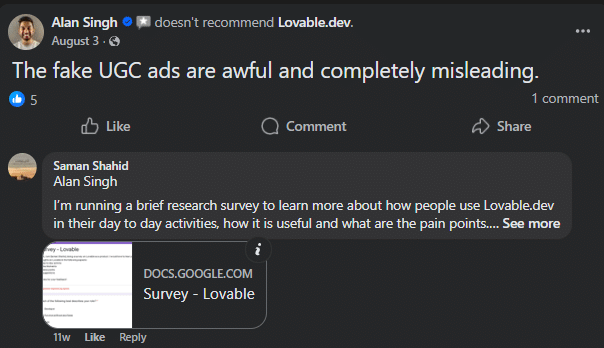
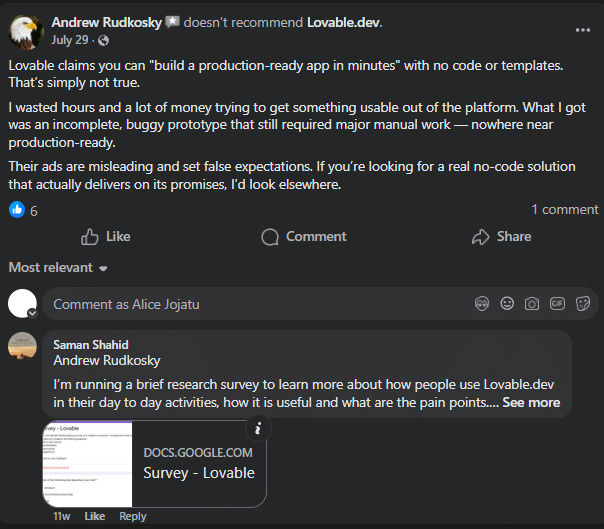
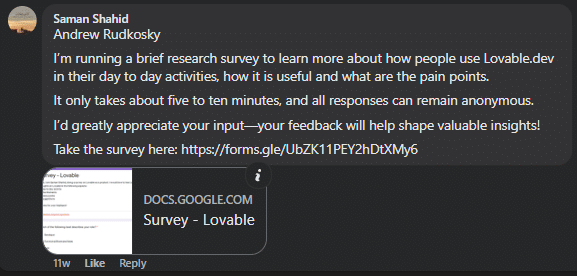
When you look at the whole picture, Lovable is doing something right with its reputation management. They aren’t just letting reviews sit there; they are actively shaping the conversation. For a marketing specialist, this is a masterclass in building “trust at scale” for a technical product.
Lovable is building a bulletproof brand by treating social proof as a two-way street rather than just a collection of trophies. Their Reddit community of 38k members proves the product is alive and being used in the real world, turning technical troubleshooting into a sign of active development.
By focusing their energy on high-credibility platforms like G2 instead of trying to be everywhere at once, they’ve positioned themselves as a serious tool for professionals. They also aren’t afraid of a few honest critiques; maintaining a strong 4.6 rating with transparent feedback on pricing and limits actually builds more trust with cynical modern buyers than a fake-looking 5.0 ever could.
Between scrubbing fake reviews on Trustpilot and turning Facebook complaints into actionable survey data, Lovable shows a level of accountability that reassures founders and enterprise teams they are investing in a stable, honest partner.
Lovable’s Content Marketing and Demand Generation
Lovable doesn’t just wait for people to search for “AI app builder”. They’ve built a massive library of resources designed to catch users at every stage of the journey, from a founder just curious about app ideas to a developer looking for a deep technical tutorial. By focusing on helpful, long-form content and real-world examples, they position themselves as a teacher rather than just a vendor. This strategy turns cold traffic into an educated audience that already knows how to use the tool before they even sign up.
Blog
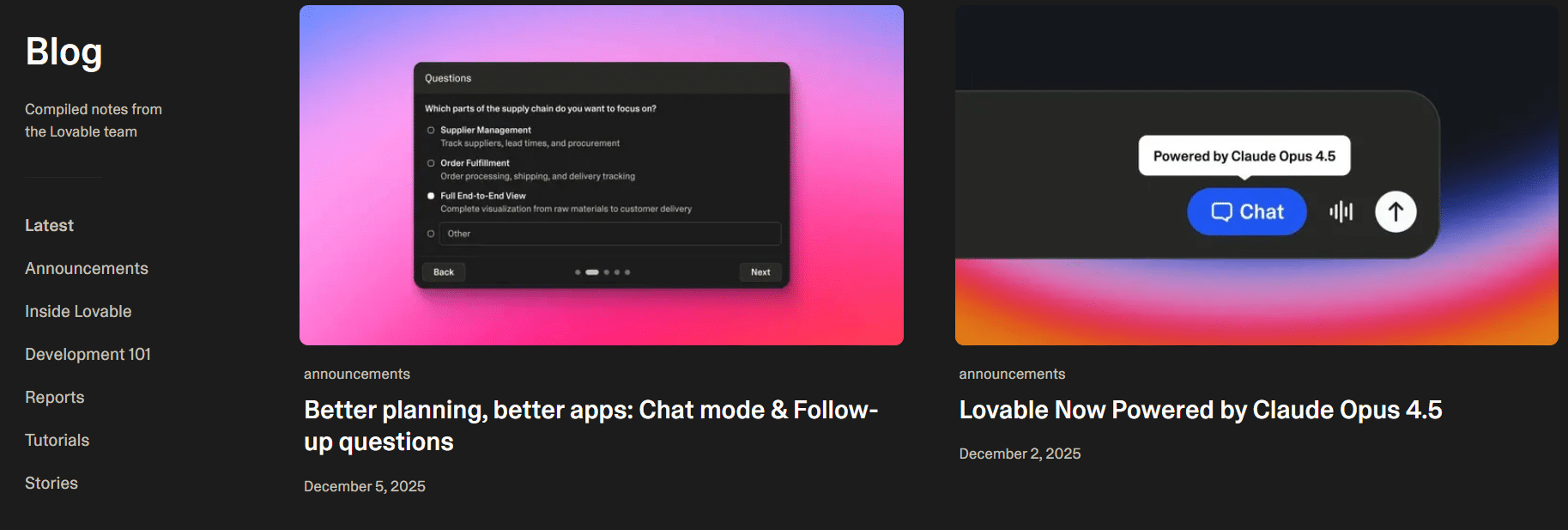
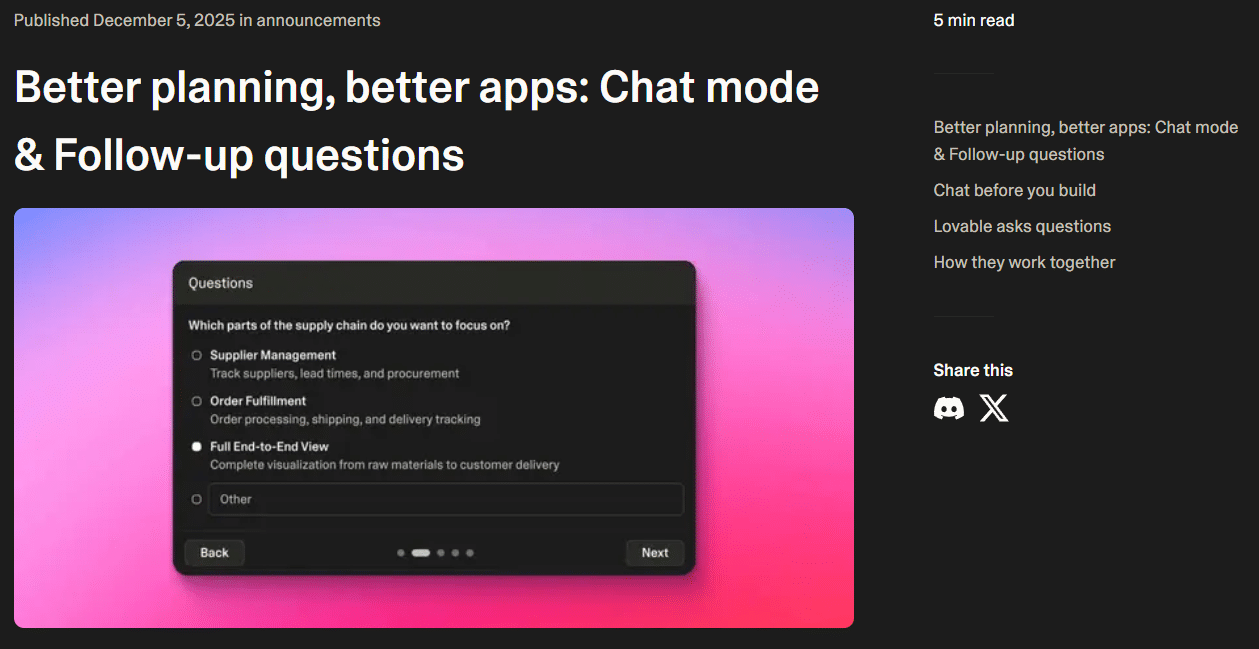
Lovable’s blog is structured into categories: Latest, Announcements, Inside Lovable, Development 101, Reports, Tutorials, and Stories. They publish roughly once per week, with articles averaging 700 words.
Key elements of the blog:
- Publishing date and estimated reading time at the top
- Content table for easy navigation
- Social sharing buttons, prominently featuring Discord and X, rather than Facebook or LinkedIn
- Articles conclude with a “Start for Free” CTA
Choosing Discord and X for sharing reflects a strategic focus on communities and tech-savvy audiences rather than broad social platforms. Weekly posts maintain consistent SEO signals while keeping content digestible. The CTA drives readers directly into product trial, linking content consumption to lead generation.

Lovable Videos
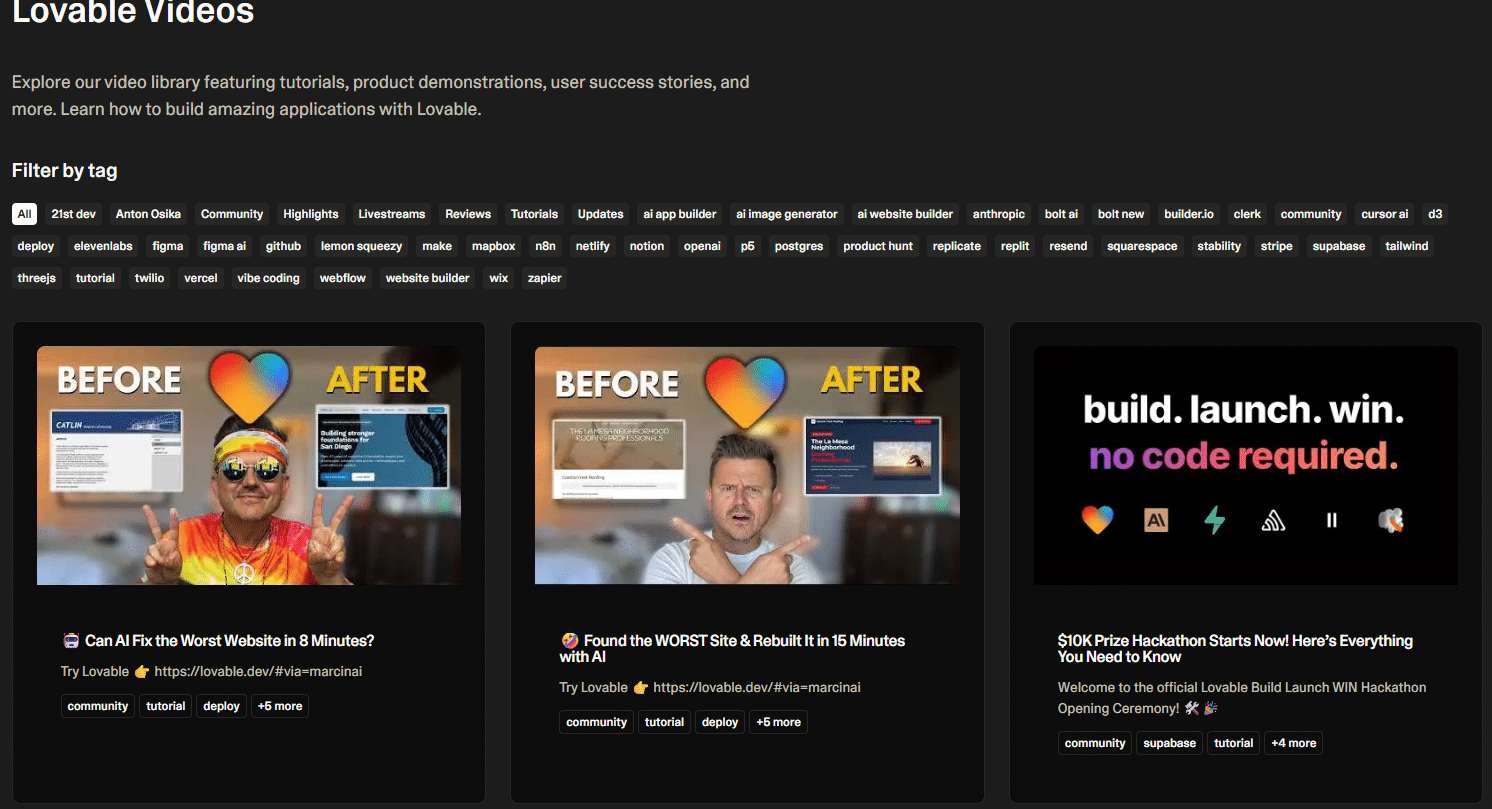
The video library is organized via tags rather than traditional categories: tutorials, updates, community, and Anton Osika.
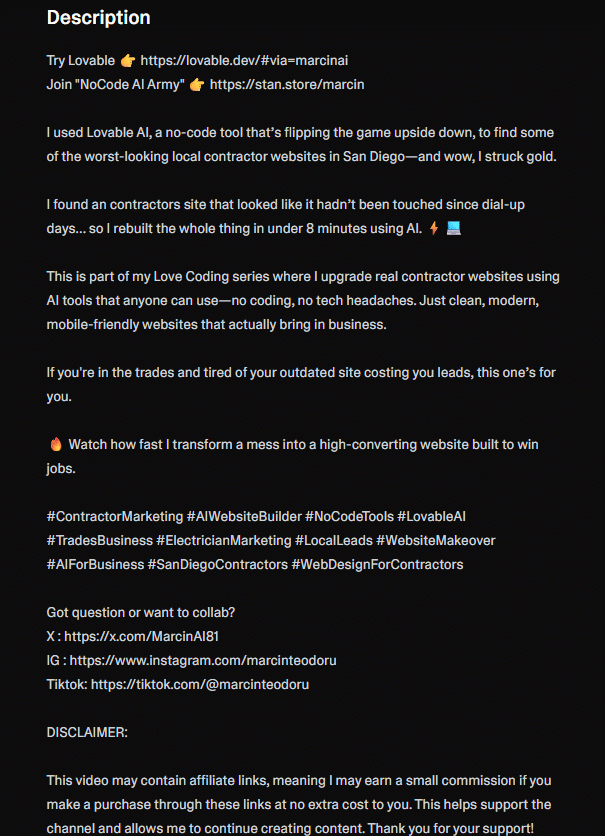
All videos are embedded from YouTube, including some user-generated content (UGC) from channels like Marcin AI, AI Tooltip, and Lukas Margerie.
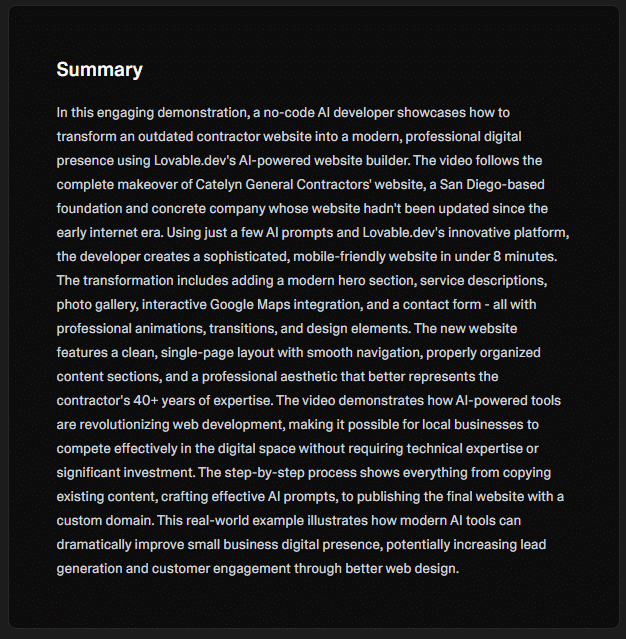
Each video page includes: summary, description, FAQ, and transcript. Video descriptions vary: some offer only summaries with social links, while others provide more detailed context.
Embedding YouTube content uses SEO and platform authority while also showcasing community engagement through UGC. The FAQ and transcript improve accessibility and searchability, supporting both discovery and retention.
Guides
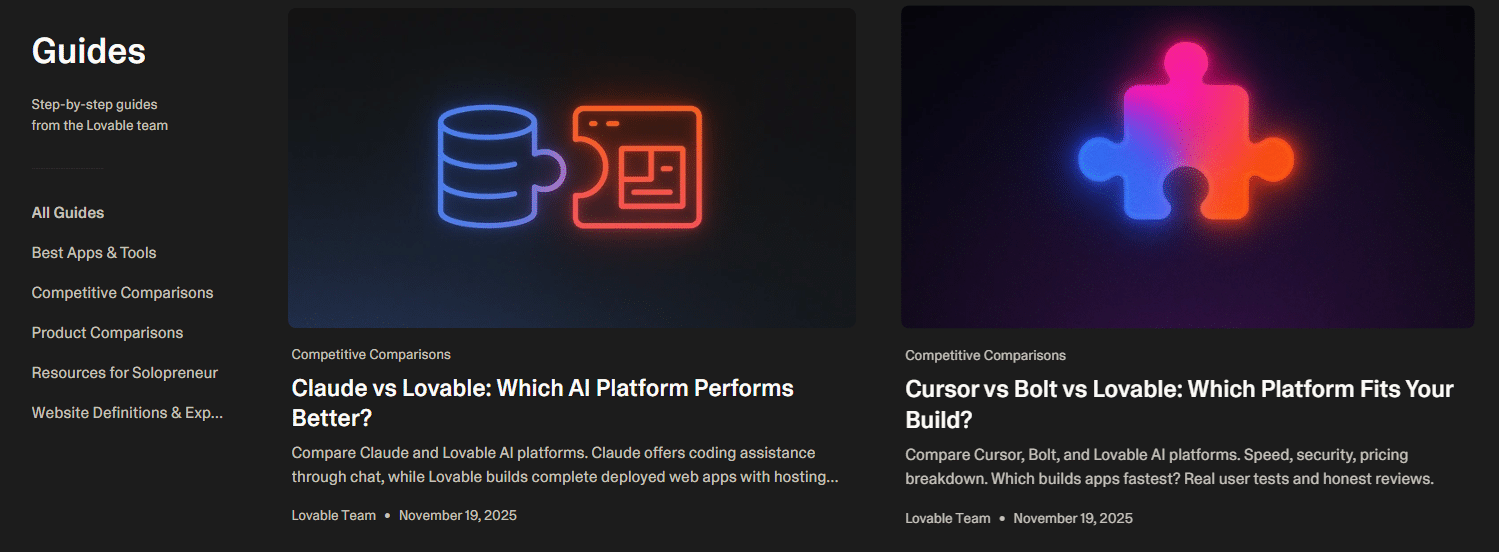
The Guides section covers: Best Apps & Tools, Business & App Ideas, Competitive Comparisons, Product Comparisons, Resources for Solopreneurs, and Website Definitions & Explainers.
Guides are long-form (approx. 2,000 words) “how-to” articles. Pages sometimes have longer load times due to content length. Articles use headings and subheadings, but no embedded images or videos.
The structure mirrors blog posts: table of contents, social sharing, and end-of-article CTA. Long-form guides position Lovable as an authority and resource hub, targeting deeper engagement and higher organic search ranking. Text-heavy guides appeal to readers actively researching tools and processes.
The no-image strategy is deliberate SEO optimization. According to Ahrefs’ 2024 study on informational keywords, Google prioritizes content depth over visual engagement for ‘how-to’ and comparison queries. A 2,000-word text guide loads faster, ranks higher for long-tail keywords, and stays relevant longer than image-heavy posts.
Lovable is sacrificing engagement metrics like time-on-page for top rankings on searches like “how to build an app without coding” or “best no-code tools for founders”. Even if bounce rates are 60-70%, they’re capturing thousands of high-intent visitors per month who are already searching for solutions. That’s better than viral content that brings curious but unqualified traffic.
Guides rank for “vibe coding”, “prompt-to-app”, and “AI full-stack builder”. Long-form (2k words) on app ideas and comparisons pulls organic traffic from solopreneurs and PMs. The templates page sees high remix rates, turning searchers into users. Feedback polls optimize fast. Overall, SEO compounds like YouTube are evergreen authorities without heavy ad reliance.
Templates
Templates showcase production-ready apps from the Lovable community, including: Landing pages, Resumes, Portfolios, Event Platforms, and Design.
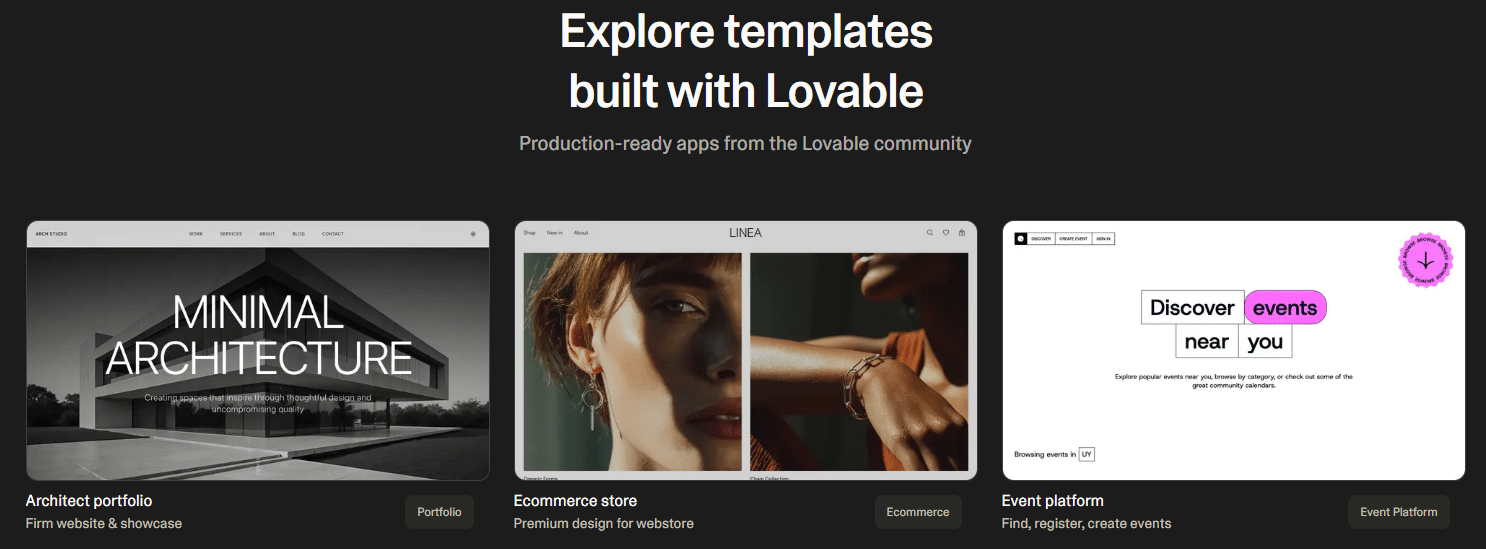
Live previews allow users to see apps in action. Short descriptions and remix counts provide context and social proof. Step-by-step guides accompany each template. Related templates are suggested at the bottom for exploration.
Templates provide hands-on proof of Lovable’s capabilities. Remix counts are lightweight social proof on steroids. According to ConversionXL’s 2023 research, showing X people used this increases conversion by 15-20%. Why? Because it removes decision paralysis. When a prospect sees 1,247 remixes, they think “this must be good if over a thousand people already used it”. It’s the same psychology behind Amazon’s “X people bought this in the last 24 hours”. Every remix is also a micro-endorsement. High remix counts signal quality without requiring testimonial copy. Plus, each remix becomes a potential case study. If someone builds a successful business using a popular template, Lovable has a ready-made success story.
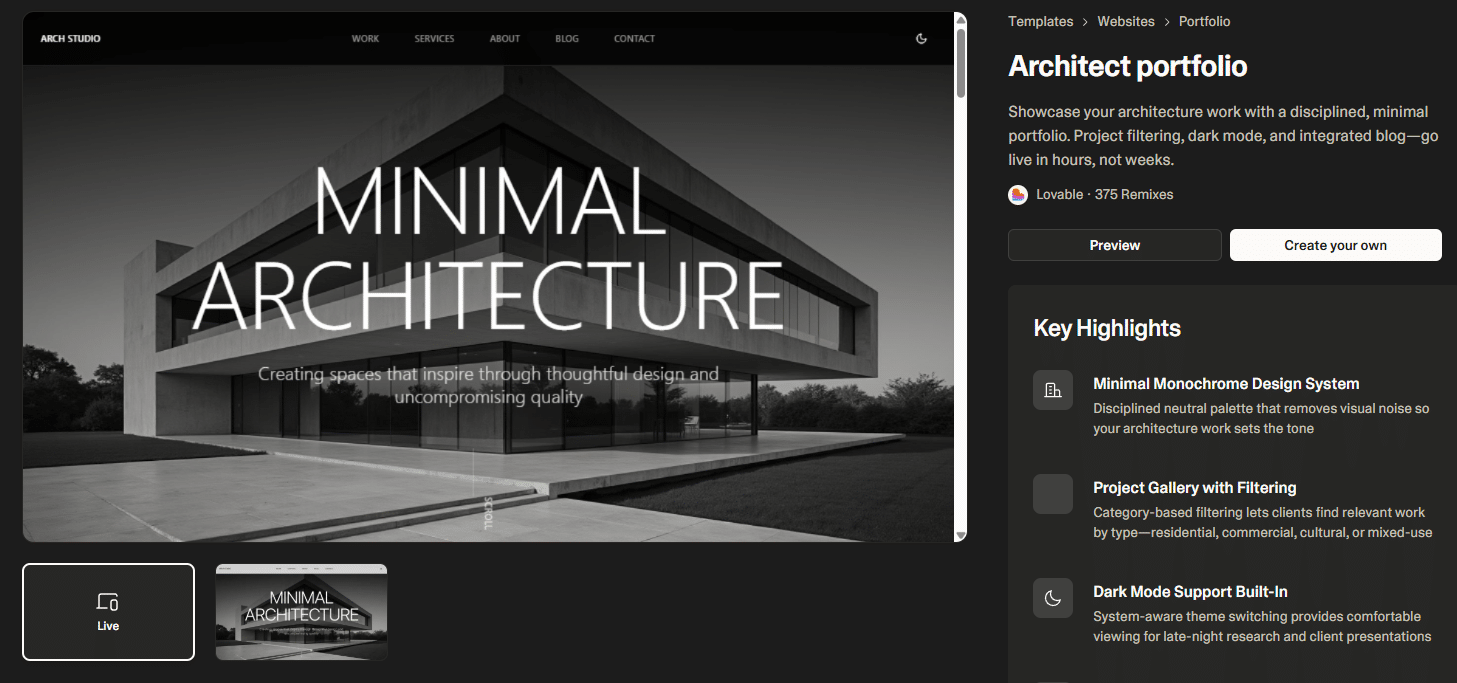
Now here’s where Lovable gets absolutely devious. Every remixed template includes “Built with Lovable” branding and a Lovable URL in the footer. According to Viral Loops’ 2024 Growth Study, product-embedded attribution (think “Sent from my iPhone”) drives 12-18% of organic signups for freemium SaaS tools. If each popular template gets remixed 1k times, and those remixes collectively receive 50K monthly visitors, and footer attribution converts at just 0.5%, that’s 250 organic signups per template per month. At 100+ templates, that’s 25k monthly organic signups from embedded attribution alone. Zero ad spend.
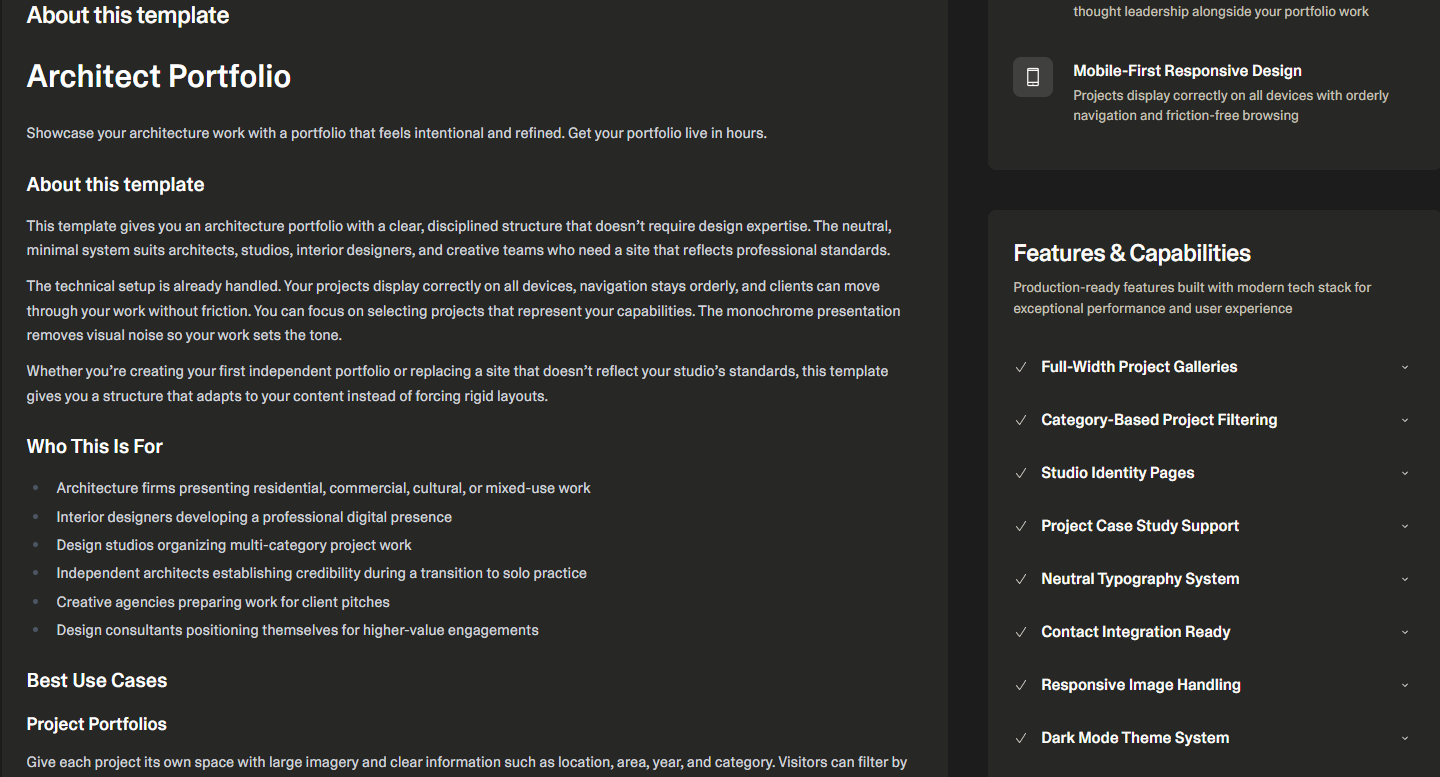
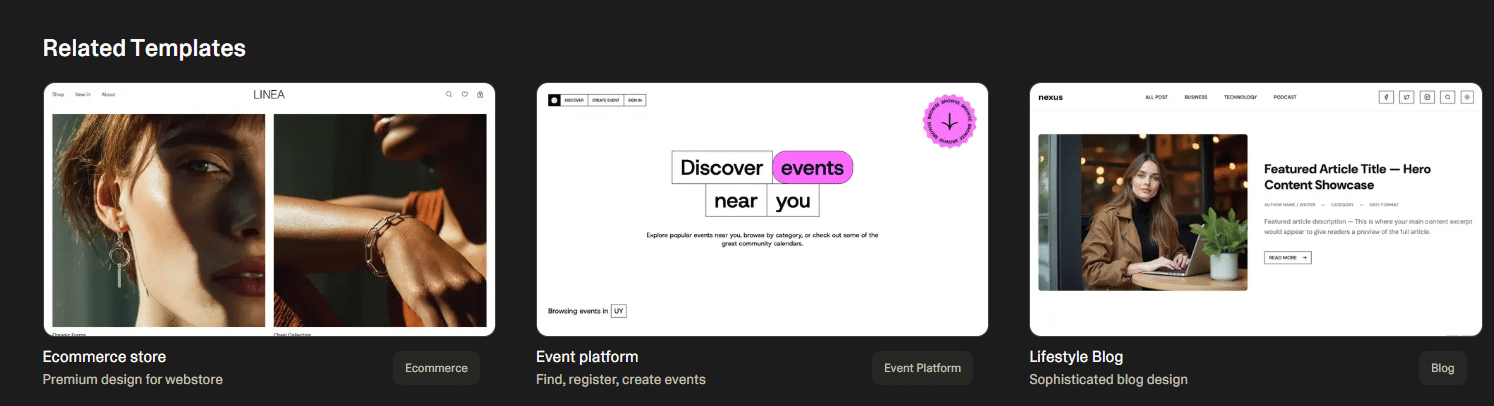
Lovable’s content strategy is a textbook example of how to build authority in a technical niche. By prioritizing Discord and X sharing over traditional platforms, they show they know exactly where their “power users” hang out. Their mix of media is particularly smart: the long-form guides act as a magnet for SEO and serious researchers, while the video library, stocked with community-made clips, provides the social proof needed to close the deal. Most importantly, the use of “remixable” templates moves the user from passive reading to active building in one click. This is a high-performance engine designed to lower the barrier to entry and keep users locked into their ecosystem.
Let’s quantify the compounding effect. A single 2,000-word SEO guide ranking #1 for “AI app builder” generates an estimated 8k-12k monthly organic visits (Ahrefs keyword data). Over 3 years, that’s 288K-432K visits from one piece of content. If 50 guides each pull similar traffic, that’s 14.4M-21.6M organic visits over 36 months. At a 2% free trial conversion rate and 10% trial-to-paid, that’s 28.8k-43.2k paying customers from content alone.
Compare this to paid acquisition: at $500 CAC (blended estimate), acquiring the same customers would cost $14.4M-$21.6M. To put that in perspective, Lovable’s content investment paid for itself 29-43x over. Meanwhile, most SaaS companies are still arguing about whether to spend $5K on a blog writer. Lovable’s content investment of maybe $500K (50 guides at $10K each, including production, design, and promotion) generates 29-43x ROI. That’s why content compounds.
This is how you build a content engine that works while you sleep. Blog posts pull organic search traffic. Templates turn visitors into builders in one click. Video libraries give prospects everything they need to onboard themselves. And because it all compounds, Lovable’s content from 2024 is still driving signups in 2025. That’s the difference between spending money on ads and investing money in assets.
Lovable’s Marketing and Sales Funnel Stages
Lovable runs PLG funnel with sales-assisted enterprise handoff. Stages map social/content to conversions, prioritizing free trials over demos. Tactics feed users from awareness through retention without heavy outbound.
Awareness (Top of Funnel)
Platform-native content hooks cold traffic. YouTube Shorts (25M views via fun-fact pivots) and TikTok street interviews pull founders/marketers searching “build app fast”. LinkedIn founder posts (Anton: 138k followers, no tags) and paid Meta ads (100+ variants) target “AI prototypes”. SEO guides rank for “vibe coding”, Discord metrics (145k members) build curiosity. Goal: 1M+ monthly impressions to site/templates.
Interest/Consideration (Middle of Funnel)
Role-tailored pages convert visitors. Founders see SaaS builders and marketers get 10 landing page use cases. Remix templates (live previews, remix counts) turn browsers into builders. Learn hub (tutorials, polls) educates; G2 4.65 stars + logos (Google/Stripe) reduce risk. Subtle CTAs: YouTube “Try now” descriptions, Instagram “Comment WATCH” DMs. Free tier signups spike here, PLG pulls 80% of users.
Decision/Evaluation (Bottom of Funnel)
Free plan tests value. If you have limited credits, you will get the Pro upgrade. Experts/affiliates (10% commission, 6-month tie-in) close noobs; GitHub export/SSO sways enterprise. Reviews scrubbed (Trustpilot fakes removed), Reddit 38k threads prove real use. Sales (13 open roles) handles high-value handoffs post-trial. Pricing tiers qualify: Pro $25/mo, Business $50/mo, and custom for Enterprise.
Retention/Expansion (Post-Purchase)
Discord (650 daily messages) drives LTV 3x via peer support. Changelog/updates retain; Experts create agency lock-in. Community shares become UGC (YouTube embeds), fueling top-of-funnel. Net: 100M to 200M ARR in months.
Lovable’s Future Plans and Growth Indicators
You can tell a lot about a company’s health by looking at who they are hiring and where they are putting their money. Lovable is aggressively expanding its footprint. Their hiring data shows a company moving out of the “scrappy startup” phase and into a serious global operation. By looking at their open roles and recruitment process, we get a clear preview of where the product and the business is headed next.
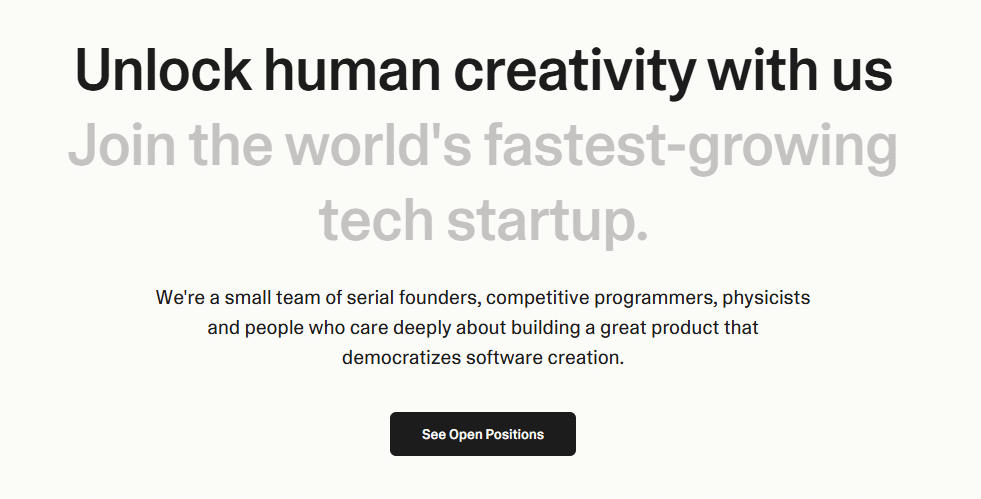
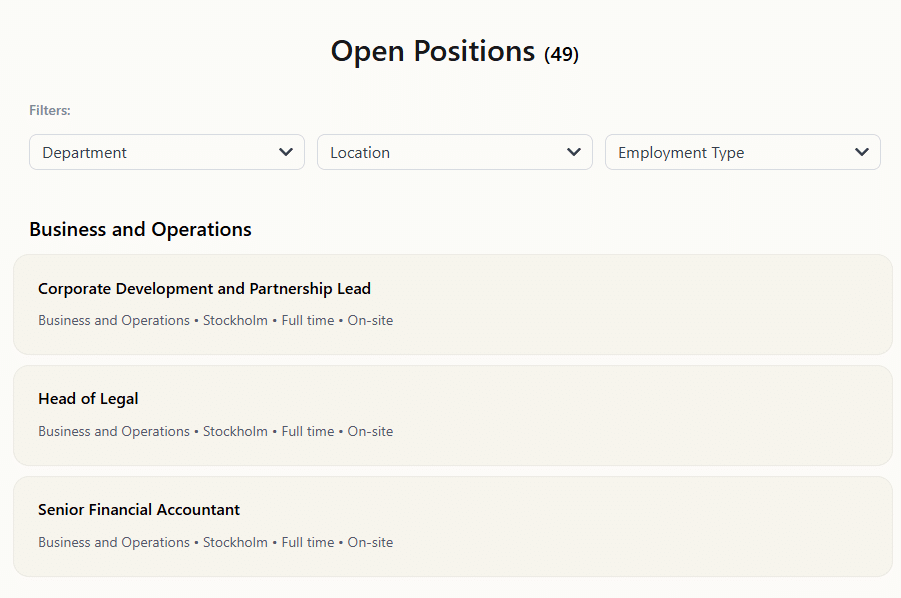
Lovable’s career page lists 49 open positions at the time of writing. Users can filter by department, location, and employment type to find roles that fit their skills and circumstances.
A constantly updated careers page signals company growth and hiring momentum, appealing to talent while demonstrating investor confidence. Highlighting multiple locations emphasizes global expansion, while department variety communicates scalability across functions.
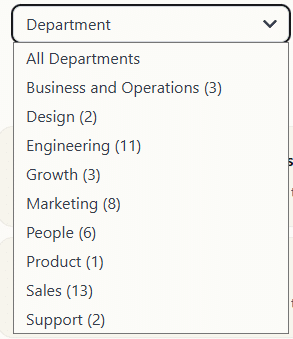
Department breakdown:
- Sales: 13 positions
- Engineering: 11 positions
- Marketing: 8 positions
- Other teams: Business & Operations, Design, Growth, People, Product, and Support
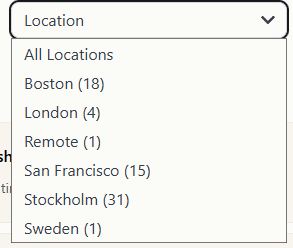
Location distribution:
- Stockholm: 31 roles
- Boston: 18 roles
- San Francisco: 15 roles
- Others: London, other parts of Sweden, and Remote options
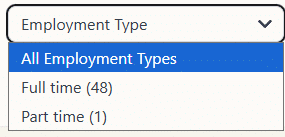
Employment type: Mostly full-time (48), with a single part-time position.
Application Process
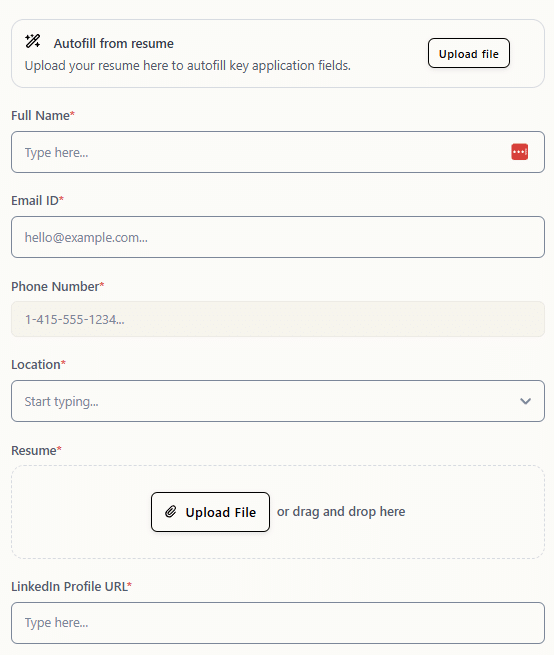
Candidates fill out a contact form with basic info: name, email, phone, resume, and LinkedIn profile.
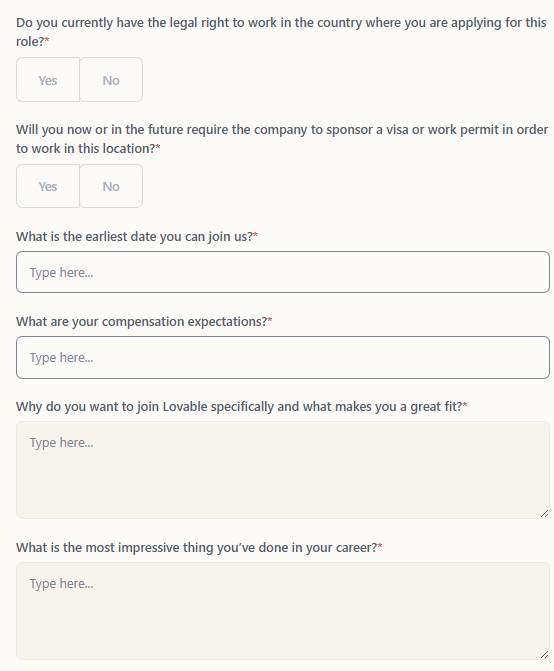
Next, applicants answer eligibility questions:
- Legal right to work in the target country
- Visa or work permit requirements
Short-answer questions assess:
- Start date
- Compensation expectations
- Fit for Lovable culture
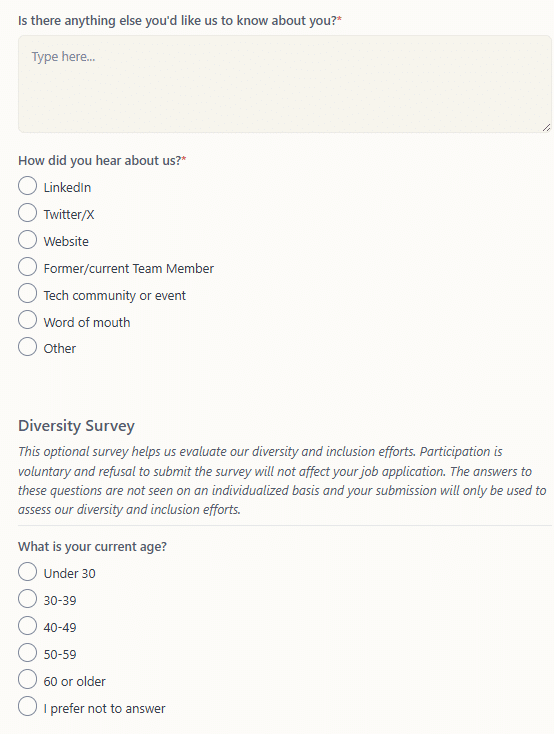
Referral source question:
- Candidates indicate where they heard about Lovable, helping the company measure recruiting channel effectiveness and optimize future outreach.
Optional diversity survey:
- Covers age, gender, sexual orientation, ethnicity
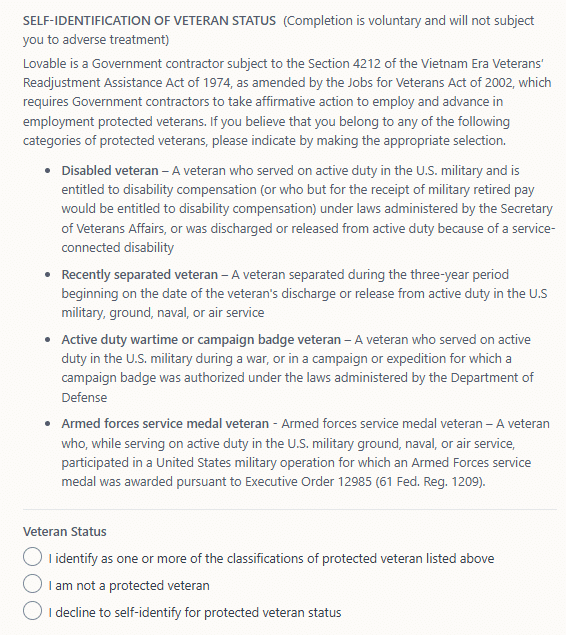
- Checks for disability, neurodiverse, veteran, parent, refugee, or immigrant status
- Each category includes explanations to ensure clarity for applicants
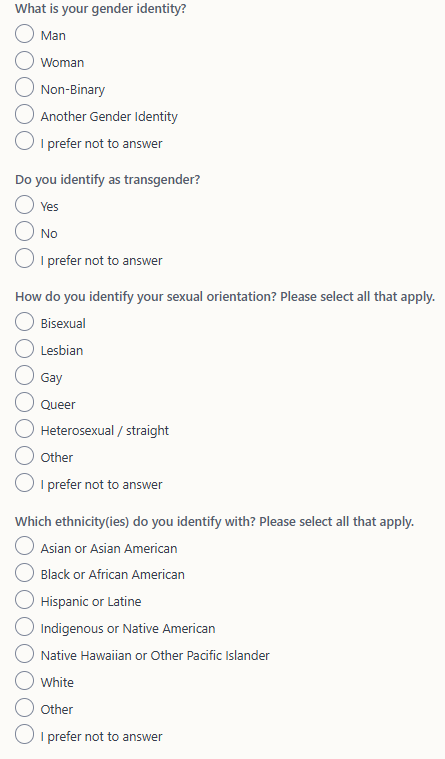
The application flow reflects brand values and operational rigor. Including eligibility and referral questions helps Lovable streamline candidate selection and track recruitment ROI. The diversity survey signals commitment to inclusivity, which strengthens employer branding and appeals to socially conscious candidates.
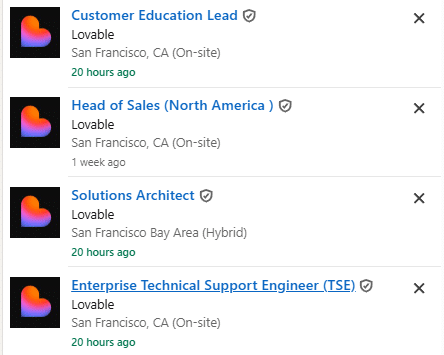
LinkedIn Jobs
Lovable mirrors their career listings on LinkedIn, offering hybrid options and ensuring visibility to passive job seekers. LinkedIn postings expand talent reach, particularly among tech professionals who may not actively browse company career pages. Hybrid options highlight flexibility, which is a strong differentiator in today’s competitive talent market.
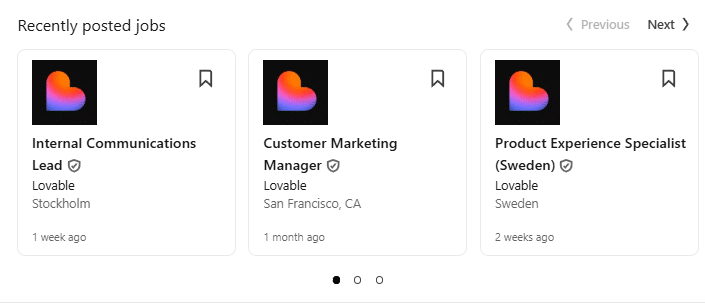
For a marketing specialist or potential investor, these numbers are a major green flag.
The hiring ratio tells the real story. According to current SaaStr’s benchmarks, companies hiring 2:1 or 3:1 sales-to-engineering are transitioning from product-market fit to revenue capture mode. Lovable has proven that the product works. Now they’re hiring 13 sales roles to close enterprise deals that their PLG motion generates. This is the classic PLG-to-sales-led evolution that Slack, Dropbox, and Notion all executed. The product pulls in users for free. Sales come in to convert high-value accounts. The fact that they’re hiring aggressively in Boston and San Francisco, not just Stockholm, signals US market expansion. Enterprise SaaS deals happen in person. You need bodies on the ground in both cities to close Fortune 500 contracts.
The fact that Sales (13 roles) and Marketing (8 roles) outweigh even Engineering (11 roles) suggests that the product is stable and the company is now shifting its focus toward aggressive market capture and revenue growth.
The revenue per employee math is telling. At $200M ARR with 10-50 core employees (let’s call it 30), Lovable is generating $6.7M revenue per employee. Compare this to public SaaS benchmarks: Salesforce does $870K per employee, HubSpot $310K, Atlassian $470K. Lovable is operating at 10-15x SaaS industry averages. This hyper-efficiency is only possible when product-led growth does the heavy lifting. Now they’re hiring sales to capture the inbound demand PLG generates. If those 13 new sales reps each close $2M annually (conservative for enterprise), that’s $26M in incremental ARR without proportional increases in product or engineering headcount. The use is insane. (This is the kind of math that makes VCs lose their minds.)
The recruitment process itself is just as telling. By integrating detailed diversity surveys and tracking referral sources, Lovable is building a sophisticated data-driven culture from the ground up. They aren’t just looking for “culture fits”; they are looking for a diverse, international workforce that can support a global user base. For anyone watching the AI space, this level of organizational rigor is a clear indicator that Lovable is positioning itself to be a long-term leader rather than a flash-in-the-pan tool.
Inspiration Points
Look, you didn’t read 10,000 words just to nod along. You want tactics you can use next week. Here’s what to steal from Lovable’s playbook, starting Monday:
1. Make your CEO the media channel
Anton Osika posts 2-3 times weekly from his personal LinkedIn, never tagging Lovable’s company page. Why it works: LinkedIn’s algorithm penalizes company tags by 30-50% (Shield Analytics, 2024). Founder posts feel authentic, not promotional. And let’s be honest, we can all smell corporate LinkedIn from a mile away. They blend into organic feeds and build cult-of-founder loyalty. Executives who post weekly get 5x more profile views and 10x more connection requests than monthly posters, according to LinkedIn’s internal data. That builds a pipeline without ads.
2. Turn YouTube into your second Google
Lovable treats YouTube as a search engine, not a broadcasting platform. Their Shorts with fun-fact hooks hit 25 million views because they exploit watch-time algorithms. Why it works: YouTube is the second-largest search engine after Google. Prospects searching “how to build an app” find Lovable organically. According to YouTube Creator Academy, videos optimized for search build up value over the years. A tutorial posted today will still drive signups in 2027.
3. Lead with logos, not features
Lovable lists Google, Amazon, and Stripe above the fold on every landing page. Why it works: In B2B, buyers check who trusts you before reading what you do. According to Wynter’s 2024 B2B messaging research, featuring recognizable customer logos increases trial signups by 23%. It compresses trust into a single visual. No testimonial quote can compete with the Google logo.
4. Build on platforms that compound
Lovable invests heavily in YouTube tutorials, long-form SEO guides, and a Discord community. Why it works: These assets compound. A YouTube video posted six months ago still drives signups today. A 2,000-word guide ranking #1 for “AI app builder” pulls traffic 24/7 without ad spend. According to OpenView’s Product Benchmarks, companies with content-driven acquisition see 40% lower CAC than those relying on paid ads.
5. Use CTAs that don’t feel like CTAs
On Instagram, Lovable prompts “comment WATCH and we’ll DM you”. On YouTube, links sit in descriptions with soft language like “Try it here”. Why it works: Hard CTAs trigger resistance. Soft CTAs feel helpful. According to Later.com, DM automation increases engagement signals by 30%, which feeds Instagram’s algorithm. You get distribution and conversions simultaneously.
6. Segment landing pages by role, not company size
Lovable has separate pages for founders, designers, product managers, marketers, and enterprise. Why it works: Each persona sees their own pain point reflected. This increases Google Ads Quality Scores, lowers CPC, and improves organic rankings for long-tail keywords like “landing page builder for marketers”. According to Unbounce’s 2024 Conversion Benchmark Report, role-specific pages convert 2-3x better than generic product pages.
7. Prioritize reviews on platforms buyers actually use
Lovable focuses on G2 (4.65 stars) over Trustpilot (4.1 stars). Why it works: According to G2’s Buyer Behavior Report, 92% of B2B buyers consult G2 before purchasing. Trustpilot skews consumers. Transparent negative reviews about pricing actually build trust. Modern buyers expect trade-offs. When they see honest critiques alongside strong scores, they trust the platform more than fake 5.0 ratings.
8. Test in cheap markets before scaling expensive ones
Lovable runs LinkedIn ads in Romania, Poland, and Lithuania before saturating the US. Why it works: CPCs in Eastern Europe are 40-60% lower than in the US, according to LinkedIn benchmarks. If messaging and creative work there, scale to expensive markets with validated campaigns. This is how you optimize CAC before burning the budget.
9. Turn power users into your sales force
Lovable’s Expert and Affiliate programs convert engaged users into evangelists. Why it works: Experts de-risk enterprise adoption by bringing implementation expertise. Affiliates pre-qualify leads. According to SaaStr, third-party ecosystems can drive 30-40% of revenue without expanding internal sales headcount.
10. Make community your retention moat
Lovable’s Discord sees 650 messages daily and 20,000+ hours in voice chat. Why it works: According to the Orbit Model, community members have 3x higher LTV. They’re emotionally invested. Leaving means abandoning reputation and relationships. Peer-to-peer support also reduces tickets by 30-40%, per Common Room’s State of Community report.
FAQ
1. What is Lovable?
Lovable is a Swedish AI-powered platform that allows users to build full-stack web apps from natural language prompts. It generates frontends, backends, databases, and integrations automatically, making it possible for founders, designers, product managers, and marketers to prototype and launch functional apps quickly.
2. Who is the target audience for Lovable?
Lovable primarily targets:
- Founders who want a technical co-founder without hiring one
- Product managers needing fast prototypes and demos
- Designers who want production-ready visual control
- Marketers building campaign pages, calculators, and microsites
- Enterprise teams requiring secure, workflow-aligned applications
3. What content does Lovable produce and on which platforms?
Lovable actively posts on LinkedIn, X (formerly Twitter), Instagram, YouTube, TikTok, and Facebook (less frequently). Content includes: tutorials, demos, and product updates, case studies and testimonials, engaging videos and street interviews, and community highlights and behind-the-scenes insights.
4. How does Lovable use social media to generate leads?
They use links in posts that redirect users to the website, blog, or community pages. In YouTube descriptions, Lovable include CTAs like “Try Lovable now”. On Instagram, they use short URLs and automated DM flows to capture engagement. Paid ads reinforce visibility and highlight product updates or challenges.
5. What content resources does Lovable provide?
- Blog: weekly posts, 700 words average, CTA-driven
- Video library: tutorials, updates, community content, embedded UGC
- Guides: in-depth how-to articles, comparisons, and resource collections
- Templates: live, production-ready examples from the community for learning and inspiration
6. How does Lovable’s growth compare to other AI startups?
Lovable reached $100M ARR in 8 months, faster than Wiz or Deel. According to OpenView’s 2024 Product Benchmarks, companies hitting $100M ARR in under 2 years see 40% higher valuations. Speed signals product-market fit and reduces perceived buyer risk.
7. What’s the key lesson from Lovable’s marketing strategy?
Lovable treats every channel as an asset that compounds over time, not a billboard. YouTube tutorials, SEO guides, and Discord community drive growth months after publication. They’ve built a flywheel where users become marketers, marketers become experts, and experts become sales channels.