TL;DR: Conclusions and Key Takeaways
🎀 This section gives you the main insights without all the details. It’s the stuff you need to remember, whether you’re reading this now or in 6 months. We made this for people who want to get the core message fast.
Sunday’s marketing strategy is a mixed bag. They’ve built a solid product with impressive numbers (80 million diners, 3.5k clients), but their marketing execution feels scattered. LinkedIn is their main channel, posting inconsistently about employees, achievements, and product updates. Their CEOs are active, especially Victor Lugger with 15k followers, but they’re essentially preaching to the converted rather than reaching new audiences.
The real problem? They’ve abandoned Instagram (last post 2022), protected their X account, and killed their Facebook presence. Their blog is decent with practical restaurant advice, but gating webinars and white papers through forms is pretty standard B2B stuff. The referral program offering $1,000 per restaurant is smart, though.
The elephant in the room: customer reviews are rough. A 3.2/5 on Trustpilot with complaints about hidden fees (like £1.99 per person for split bills) and confusing UX. Reddit and review sites show diners actively avoiding restaurants that use Sunday. That’s a serious red flag when your product sits between restaurants and their customers. They’re hiring aggressively across all departments post-funding, so growth is the priority. But if they don’t fix the customer experience issues, scaling might just amplify the problems.
📝 A quick note before you start reading: The data and analysis in this article are valid as of the time we wrote it. We don’t know when you’ll be reading this, maybe next week, maybe six months from now, and things might have changed since we looked at this company’s marketing and sales approach. Still, the insights and lessons here stay useful, even if the numbers or tactics have evolved a bit.
Sunday wants to turn every payment into profit. Bold claim for a payment platform, right? Founded in 2021 by the Big Mamma restaurant group founders and Christine de Wendel, they’ve grown fast with 3.5k restaurant clients and 80 million diners using their QR codes and smart terminals. They just raised $21 million to expand in the US, France, and the UK.
But here’s the thing: having a good product and knowing how to market it are two different games. Sunday has the numbers (176 million in tips redistributed, 2 million 5-star Google reviews annually), but their marketing feels like it’s running on autopilot. Social media is half-abandoned, paid ads are nonexistent, and customer reviews tell a story their LinkedIn posts don’t mention.
We’re putting Sunday under the microscope to see what’s working, what’s broken, and what other B2B SaaS companies can learn from their approach. Spoiler: there’s plenty of both good and bad to unpack.
Understanding Sunday
Sunday is the payment company for restaurants, with a wide range of payment solutions (QR code, smart payment terminal, click & collect, pre-payment) and the feature set to power businesses (more tips, more reviews, analytics, instant tipping, accounting).
Founded in 2021 by Victor Lugger and Tigrane Seydoux, the entrepreneurs and foodies behind Big Mamma, and Christine de Wendel, Sunday is based in Paris, London, Atlanta, and Chicago, with 201-500 employees and 233 associated members.
Sunday just raised $21 million to grow its payment platforms used by 80 million diners. This funding will help them expand in the US, France, and the U.K., accelerate product innovation, and grow their team to keep making payments seamless for restaurants and guests everywhere.
Starting a payment company when you already run successful restaurants (Big Mamma group) means Sunday was born from actual pain points, not market research. They built this because they lived the problem. That insider credibility is huge in the restaurant industry, which is notoriously skeptical of tech companies that don’t understand hospitality. The founders can say “we use this in our own restaurants”, which is more powerful than any case study.
The timing of their 2021 launch was perfect. COVID accelerated contactless payments and QR code adoption. Restaurants were desperate for touchless solutions, and diners were already comfortable scanning codes for menus. Sunday launched right when the market was primed for their product. They rode a behavior change wave that would have taken years to create organically.
Brand Promise Analysis
Sunday promises to offer the most complete payment and restaurant management tools on the market and to turn every payment into profit.
With over 3.5k clients, over 80 million diners, $176 million from tips redistributed to staff per year, and 2 million 5-star Google reviews per year, it’s hard not to choose them.

Trusted by thousands of restaurants, from QRSs (quick restaurant services) to Michelin-starred, Sunday has become the standard for modern hospitality, helping restaurants handle 100% of their payments with one seamless platform to run faster, serve better, and connect with every guest.

Every payment creates value: for guests, staff, and operators. How?
- For Operators: faster table turns, more insights, higher revenue.
- For Staff: Higher tips, smoother service, better guest-connections.
- For Guests: Fast, simple, personalised checkout they’ll remember.

With 24/7 support ready for you, 7 days to receive your QR and be ready, and 100% walk-out coverage, Sunday promises to save (your) time for what really matters.
Service and Product Breakdown

Sunday offers Smart Handheld, Digital Bill, Hybrid, Order & Pay, and Click & Collect. On their Pricing page, you can choose from 3 packages: Starter, Standard, and Premium. Most payment companies hide pricing behind “contact sales.” Sunday shows three tiers with feature breakdowns. This suggests confidence in their pricing model or an attempt to qualify leads before sales conversations.

According to Saffron Edge’s 2025 analysis, pricing pages with transparent pricing achieve a 4.6% conversion rate, compared to just 2.8% when there’s no transparent pricing. G2’s 2025 Buyer Behavior Report found that 57% of buyers expect their organizations to increase software spending over the next year, and pricing acts as a gatekeeper for shortlisting products G2.
All details about Payment Solutions, Features, Digital bill via QR code, Smart handhelds, Support, and setup are below.
If you’re ready to power your business with Sunday payment solution, fill out the form and a restaurant management expert will contact you.

You can become a Partner or enjoy the Referral program, from which you can get $1000 per restaurant onboarded. $1,000 per restaurant after 3 months live is a significant customer acquisition cost. This suggests either healthy unit economics or an aggressive growth-at-all-costs mentality post-funding. Most SaaS referral programs offer $50-200. This shows how valuable each restaurant client is to them, probably because of transaction volume and recurring revenue.
They offer payments for: Digital Bill, Smart handheld, Hybrid, Order & Pay, Click & Collect, Digital Tab, Pre-ordering, Pre-payment, and Guest Platform. Each feature is described in a simple slideshow.
For example, the Digital Bill is a QR code for the client’s bill. This eliminates the need to call a waiter and the waiting time. The Smart handheld helps with split billing, right on the app, saving up to 15 minutes for big tables. With this QR code, the client can view the menu, tip the waiter, open a tab, and leave reviews.

For big groups, they offer pre-ordering and pre-payments. This is meant to protect against no-shows, cut down admin work, update your inventory on time, and offer the most streamlined experience for them.

Sunday offers nice features like Dynamic Menu, which changes depending on the time of the day, the area in your venue, or your stock status, push matching products and combos to maximize upsell, and AI translation.

For staff, they offer dynamic tips, live notifications, and customized tips. Their managers can see the staff performance directly on the app.

Sunday offers a new feature for Branding. You can now customize payment flow to match your brand’s identity and voice.

Differentiators and Unique Assets

How does it work? You recommend as many restaurants as you know that would love to work with them, and get $1000 per restaurant onboarded. Payouts are made once the referred restaurant has been live with Sunday for 3 months.
Fill out a form with your contact information (name, email, company name, address) and the referred restaurant’s contact information (name, email, restaurant’s name, phone, relationship with the restaurant).


At the bottom of the page you’ll find a FAQ section.

Recent 2025 data shows that B2B firms with established referral programs experience 86% more revenue growth, and referred customers demonstrate 18% more loyalty than customers acquired through other marketing channels. Additionally, 72% of SaaS companies now offer customer referral incentives, and tiered referral programs generate 27% more referrals.

On this page, you’ll find everything you need to know about Sunday: how to get started, learn about features, and how the dashboard works.

The categories that have the most articles are Dashboard and Payment terminal/ Handheld.
A live chat button is displayed both on the bottom-right corner of the page and inside the article.

The articles have a satisfaction quiz at the end.

Leadership Presence Analysis

Christine de Wendel, the CEO and Co-Founder of Sunday, has 4.2k followers on LinkedIn. She posts one or twice per week. Sunday is her only topic of discussion. The engagement varies between 20 to 90 reactions, a few comments, and up to 10 reposts.
She’s not using hashtags, but instead she puts a link at the end of almost every article. The links send you to either press releases about Sunday, or to a job opening post (from their site or LinkedIn profile).


Victor Lugger, the CEO and co-founder of Sunday, has 15k followers on LinkedIn. He posts twice per week. Since he has a bigger following than Christine de Wendel, the engagement rate is better. His posts gain over 200 reactions, 15 comments, and up to 10 reposts.
He talks about Sunday a lot, but he also speaks about participation in events. He posts both in English and French.


It appears that they don’t have a CMO. Both co-founders are active on LinkedIn, which often happens when companies rely on founder credibility instead of formal marketing leadership. Victor Lugger has restaurant industry street cred from Big Mamma, which carries more weight with restaurant owners than a traditional marketing executive might. They could be intentionally keeping marketing close to the founding team rather than delegating it.
They might be prioritizing sales, product development, and operations over marketing leadership. The job openings show they’re hiring across sales, tech, and ops. A CMO salary (plus the strategic shifts a new executive would bring) might not be the priority when they’re focused on geographic expansion and product features like the upcoming delivery ordering.
According to LinkedIn’s 2025 B2B Marketing Report, content shared by company leaders receives an average of 3 times more engagement than content shared by company pages alone. Scale Venture Partners found that founders who post regularly on LinkedIn see 33% more leads on average.
Social Media Strategy

On LinkedIn, Sunday has 41k followers. Their posting schedule is inconsistent. They have weeks when they post once, and weeks with more posts. The engagement rate varies from 20 to a hundred reactions on a single post.
Their content pillars are:
- Employees Spotlights

2. Company achievements

3. Product advertising

4. Press coverage

5. Talent scouting

Posting in both English and French serves their three markets (US, UK, France) but dilutes impact. French posts don’t help US expansion, and English posts might not resonate in France. They’re trying to serve everyone and might be reaching no one effectively.

They don’t use hashtags in their posts, but they will sometimes use links to press coverage.
Their Facebook page is inactive, and their X page has 996 followers, but their posts are protected. This means that only approved followers can see them. Why have a social media account if you’re going to lock it? This suggests either a past crisis they’re hiding from, an extremely cautious legal/PR team, or they simply abandoned it but didn’t delete it. Either way, it’s a missed opportunity or a red flag.


On Instagram, they have 6.6k followers. Their highlights are: TPE, Reviews, spotted, text me, and in action. Their latest post is from 2022.


Posting about team members is great for employer branding and recruitment, but it doesn’t help acquire restaurant clients. This content serves hiring goals (they’re expanding aggressively) but not revenue goals. The strategy feels split between “we’re hiring” and “buy our product” without clear prioritization.
Top-Performing Content


Paid Advertising Strategy
As we searched, we couldn’t find any active ads on LinkedIn or Meta.
Those Trustpilot reviews (3.2/5 stars) and Reddit complaints about hidden fees are serious problems. Running paid ads when customers are actively complaining about £1.99 split-bill charges would be throwing money into a leaky bucket. You’d drive traffic to a product that’s frustrating end users (diners), even if restaurant owners are happy. Smart move to pause paid advertising until they fix the customer experience.
The $1,000-per-restaurant referral program is basically paid advertising with better ROI. Instead of spending on Facebook ads hoping to reach restaurant owners, they’re incentivizing existing clients and industry connections to make warm introductions. This works better in B2B when you need trust and credibility. The same logic applies to their partner program. Restaurant POS systems, suppliers, and consultants have existing relationships that paid ads can’t replicate.
Restaurants don’t impulse-buy payment systems after seeing a LinkedIn ad. The decision involves comparing pricing tiers, talking to current POS providers, training staff, and coordinating implementation. This needs nurture campaigns, demos, and relationship building. Paid ads work better for short sales cycles. Sunday’s approach of educational content, referrals, and direct sales conversations fits their buying process better than click-through ad campaigns. Even without cold acquisition ads, they could retarget website visitors who checked pricing or started the demo form. This is low-hanging fruit they’re ignoring.
Sales Funnel from Social Media
Their LinkedIn strategy is broadcasting company news, employee highlights, and achievements to people who already follow them. There’s no clear call-to-action, no lead magnets, and no progression path from “saw a LinkedIn post” to “booked a demo.” They’re using social media like a press release channel rather than a lead generation tool. Posts end with links to press coverage or job openings, not demo booking pages or free trials.
Instagram has been dead since 2022, Facebook is inactive, and the X account is private. Even if they had a funnel strategy, they’ve eliminated most entry points. LinkedIn alone can’t carry an entire social media funnel, especially when posting is inconsistent, and engagement is modest (20-100 reactions per post). You need multiple touchpoints and platforms to guide prospects through awareness, consideration, and decision stages.
With 3.5k clients and targeting restaurants (a defined, reachable market), Sunday probably relies on outbound sales, partnerships, and referrals rather than inbound social media funnels. Their pricing page leads to a form for a “restaurant management expert” to contact you. That’s a sales-led approach, not a marketing-qualified-lead approach. Social media is just a brand presence to make the company look legitimate when prospects Google them, not an active lead generation channel. The real funnel lives in their sales team’s CRM, not in social media engagement metrics.
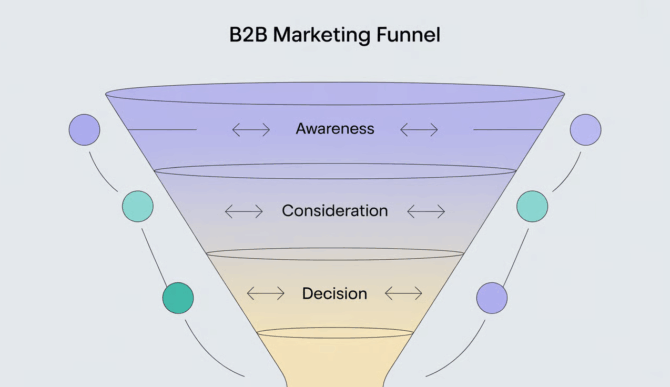
Social media just makes Sunday look legitimate. The actual funnel (awareness to consideration to decision) happens entirely on the website through product pages, pricing, help center, and demo forms. Social is brand insurance, not lead generation.
Reviews and Social Proof
The review disconnect is their biggest problem. Sunday promotes 2 million 5-star Google reviews annually, but its own Trustpilot is 3.2 stars. They help restaurants get great reviews while getting bad ones themselves. That’s a positioning disaster.
Capital One Shopping’s 2025 research found that 91.1% of consumers typically read at least one review before purchasing a product, and 93% of consumers agree that their purchasing decisions depend on reviews from other people. According to an August 2025 Emplifi study, 87% of consumers said that real-life customer reviews and ratings have a greater impact on purchasing decisions compared to influencer or celebrity reviews.
Third parties
They don’t have reviews on G2 or Capterra. On Trustpilot, they have a 3.2/5 stars review.

With a score so low, we will have a look at 1-star reviews.
Customers are complaining about the hidden costs of some features. For example, to use the split the bill feature, you will be charged a £1.99 fee per customer paying.

Others complain about the usability of the app. Some of them understood that they would give the app a review, not for the restaurant, while others didn’t understand the tipping and tax calculations.
There are numerous complaints from customers that they will not come back to said restaurant because of this payment system. Charging diners £1.99 per person to split bills isn’t a UX problem; it’s a revenue model problem. Someone decided to monetize a basic feature that competitors offer for free. This creates friction at the worst moment (payment) and makes diners blame the restaurant, not Sunday.


These complaints can be found on Reddit, too. When customers go to Reddit to complain about your product, you’ve lost control of the narrative. These aren’t just bad reviews; they’re people actively warning others. Sunday is becoming known as “that annoying payment app” in some circles.


On Glassdoor, they have a 4.4/5 stars rating.

There are employees who complain about company culture discrepancies and bad leadership.

There are multiple people who complain about difficult interviews and negative experiences with the process.
Testimonials
The testimonials can be found as part of their Blog. In some of their posts you can see some quotes, but they are not linked to an authorative person from their client.


Content Marketing and Demand Generation
Blog

Sunday’s blog features different articles, like Why Your Old Terminal Won’t Survive the Black Friday Rush, or Surviving the Rush: Keeping Your Team Motivated from Thanksgiving to New Year’s.
Their reading time plug-in appears to be broken for the latest articles, since every article has 0 minutes of reading time. The broken reading time plugin is sloppy. “0 minutes” on every article looks unprofessional and suggests a lack of attention to detail. Small things like this erode trust, especially for a company selling reliability to restaurants.
On the right side of the screen, you’ll find social media buttons for sharing the article, the copy link button, and a progress circle, that moves along with your reading.


Sunday uses different headings, which makes the article easy to read. Articles have around 200 words. To highlight a word, instead of using bold letters, they color it with their brand’s magenta pink. 200-word articles are too short for thought leadership. These are snackable tips, not authoritative content. Good for quick engagement, bad for establishing deep expertise. They’re optimizing for skim-readers, not serious restaurant operators researching solutions.

At the end, you’ll find a FAQ section, a picture of the article’s author, and a related content banner.

The blog is further divided into 2 categories: Restaurant Toolkit, Sunday News, and Testimonials. Here you’ll find advice for restaurant owners, the company’s news, and customer success stories.


White Papers
On this page, you’ll find resources for restaurateurs, guided by industry professionals.

This is the only white paper on their website, and it’s gated through a form. Fill it with your contact details, like name, email, and business name, to access it.


For a company claiming to be the most complete solution, having one gated asset is thin. This suggests either content production bandwidth issues or they’re not investing in demand generation content.
Webinars

In November 2025, they have 3 ended webinars on this page.

Their webinars are on demand, and you’ll need to fill out a form to register for the event. Restaurants can’t attend live webinars during service hours. Recording them and gating for lead capture gives flexibility while still collecting contact information.

Marketing and Sales Funnel Stages
Top of the funnel: Sunday relies heavily on organic LinkedIn presence through company posts and CEO activity. Victor Lugger and Christine de Wendel post regularly about company news, funding, and events. The blog offers free educational content for restaurant owners (holiday rush tips, team motivation, terminal advice), which helps with SEO and positions them as industry experts. Their referral program ($1,000 per restaurant) turns existing clients into lead generators.
Middle of the funnel: Once prospects show interest, Sunday pushes them to the website where they can explore product features through interactive slideshows and detailed pricing pages. The Help Center provides self-service education. Gated webinars and white papers collect contact information from serious prospects. The 24/7 support promise and 7-day setup timeline address common objections. Case studies and testimonials (though not linked to specific people) provide social proof.
Bottom of the funnel: The pricing page offers three clear tiers (Starter, Standard, Premium) with transparent feature breakdowns. Prospects fill out a form to connect with a restaurant management expert for personalized demos. The partner program and referral incentives create multiple entry points. The promise of 100% walk-out coverage and fast onboarding reduces friction for decision-makers ready to commit.
Future Plans and Growth Indicators
After the funding, you’ll find a long list of job openings on their Career page. You can filter them by department and location.

The current locations are in France, the U.K., and the U.S., and the departments that are growing are sales, marketing, brand & communication, people, tech, finance, product, country & central Ops, Revenue Operations, legal, and partnerships. The hiring across all departments shows rapid scale.

Some of their jobs are on-site, others are hybrid, and some are full remote. Offering flexibility shows they’re competing for talent in tight markets (tech, sales). The US expansion likely requires an on-site presence, while European teams can be more flexible.

One thing stood out in the features section: Order delivery, which will be coming soon to their platform. Competing with Toast, Square, and the delivery platforms in this space is expensive and complex. This suggests Sunday wants to own the entire restaurant commerce stack, not just checkout. That’s ambitious, but it also spreads their focus thin when core payment UX has issues.

Inspiration Points
- Make referrals worth it. Sunday’s $1,000 per restaurant referral program isn’t playing around with $50 gift cards. They understand their customer acquisition cost and have built a referral incentive that actually motivates people to make introductions. If you’re in B2B, calculate what a customer is worth to you over their lifetime, then offer referral rewards that reflect real value. Nobody’s going out of their way to recommend your product for a Starbucks gift card.
- Use your brand color strategically. Instead of bolding text in their blog posts, Sunday highlights it with their magenta pink. It’s a small design choice that creates visual consistency and burns their brand into your brain without being obnoxious about it. Think about ways your brand colors can show up in functional design elements, not just logos and headers.
- Turn your help center into a lead source. Sunday’s Help Center isn’t just for existing customers. It has a live chat button, satisfaction tracking, and likely ranks in Google for “how to use Sunday payment” searches. Your knowledge base can be an SEO asset and conversion tool, not just a cost center. Make it public, make it searchable, and put demo CTAs in strategic spots.
- Know when NOT to run ads. Sunday has funding but zero paid advertising. That’s not an oversight, it’s a choice. When your Trustpilot rating is 3.2 stars and Reddit threads are warning people away from restaurants that use your product, paid ads would just amplify negative word-of-mouth. Fix your product experience before you scale acquisition. Growth on a broken foundation is expensive and unsustainable.
- Make webinars on demand for your audience. Restaurants can’t attend the 2 pm Tuesday webinars because they’re in the middle of lunch service. Sunday records everything and gates it behind a form so restaurant owners can watch at 11 pm after closing. Think about when your target audience is actually available to consume content, then deliver it that way.
- Don’t abandon channels you can’t maintain. Sunday’s Instagram hasn’t posted since 2022, their Facebook is dead, and their X account is locked. If you’re not going to maintain a channel, redirect the domain or shut it down. A graveyard of abandoned profiles makes you look disorganized or struggling. Better to own one active channel than five dead ones.
Conclusions
Although Sunday has, in theory, a great product and branding, they are not using it to the max potential. Their website has broken links and plugins, are the long-form content is nowhere in sight. Having long content not only builds trust and authority, but it also helps with SEO and GEO metrics. If you want to differentiate in a B2B SaaS market, you need to consider this ASAP.
Also, having no backlinks or reputable sources mentioned in articles decreases the chance to stand out in this competitive market. GEO will not be happy with you, and your product will be harder to find.
As for the social media strategy, one thing needs to be remembered. It’s better to focus only on one channel, instead of having multiple inactive profiles. Also, even if you choose to create content only for LinkedIn, you should have links to your product. You should educate the people about your product’s features or company culture. Give something back to the people who are following you. A newsletter, insights, or anything that your clients can find useful. Simple posting, without any strategy, can cause long-term damage to your brand.
And the most important part is to have a community manager. Reviews shouldn’t be unanswered. You’ll create a snowball that will become so heavy, that it will be hard to lift it up.
Frequently Asked Questions
1. What is Sunday, and what does it offer?
Sunday is a payment platform built specifically for restaurants. They offer QR code payments, smart handheld terminals, click and collect, pre-ordering, and pre-payment options. Beyond processing transactions, they provide analytics, automated tipping systems, review collection tools, and accounting integrations. Their platform handles everything from quick service restaurants to Michelin-starred establishments across France, the UK, and the US.
2. What makes Sunday different from other payment solution providers?
Sunday focuses exclusively on restaurants rather than being a general payment processor. Their QR code system lets diners pay, tip, split bills, and leave reviews without flagging down servers. The platform claims to increase table turnover, boost tips for staff, and generate more customer reviews. They also offer features like dynamic menus that change based on time of day or inventory, AI translation, and customizable branding. The $1,000 referral program is more aggressive than most competitors.
3. How does Sunday approach content marketing?
Sunday keeps it simple with a blog divided into three categories: Restaurant Toolkit (operational advice), Sunday News (company updates), and Testimonials (client stories). Articles are short (around 200 words) with practical tips for restaurant owners. They use their brand’s magenta pink for highlighting instead of bold text. White papers and webinars are gated behind forms to capture leads. The content is free and accessible, though the reading time plugin appears broken on recent posts.
4. Is Sunday active on social media?
Barely. LinkedIn is their only active channel with 41k followers and inconsistent posting (some weeks once, others multiple times). They post about employee spotlights, company achievements, product updates, press coverage, and job openings in both English and French. Instagram has been dead since 2022, Facebook is inactive, and their X account is protected (only approved followers can see posts). Their CEOs are more active than the company page, especially Victor Lugger, who has 15k followers and posts twice weekly.
5. What are the main risks or downsides restaurants should consider before adopting Sunday?
The biggest risks are reputational and UX-related. While Sunday helps restaurants collect more 5-star Google reviews, its own Trustpilot rating sits around 3.2/5, with diners complaining about hidden fees (like £1.99 per person for bill-splitting in some markets) and confusing tipping/tax flows. Some reviewers explicitly say they avoid restaurants using Sunday. If you adopt it, you need to understand exactly how fees are presented to guests, test the UX thoroughly, and decide whether the trade-off between operational speed and potential guest frustration is worth it for your brand.
6. Who is Sunday best suited for, and who might struggle with it?
Sunday is best suited for busy, mid-to-large restaurants that care about faster table turns, staff tipping, and review generation, and that already have some digital infrastructure (POS integrations, online ordering, etc.). It fits teams comfortable with QR codes, hybrid service, and data-driven decision-making. Smaller, low-tech venues or restaurants with older clientele might struggle more with QR-first journeys and guests who prefer traditional payment flows. Restaurants with a strong “no hidden fees” brand promise should also scrutinize Sunday’s fee structure carefully before rolling it out.