TLDR: Conclusions and Key Takeaways
🎀 This section gives you the main insights without all the details. It’s the stuff you need to remember, whether you’re reading this now or 6 months from now. We made this for people who want to get the core message fast.
Let’s look at CurbWaste for a minute. They exist in this weird space between old-school waste management and modern SaaS marketing. And honestly? Their approach tells you something important about selling B2B software to blue-collar industries. Your marketing doesn’t need to be flashy; it needs to be credible.
Three things stand out after digging through everything they’ve got online.
First, their whole brand is built around founder authenticity.
Mike Marmo didn’t just wake up one day and decide to make software for waste haulers. He was a waste hauler who got fed up with garbage software (pun intended). You’ll find the origin story everywhere: homepage copy, customer testimonials, and on the about page. It’s not some manufactured positioning statement cooked up in a boardroom. When you’re trying to convince independent operators to change the way they run their business, that distinction matters.
Second, they prioritize utility over visibility.
Most SaaS companies are out there chasing engagement metrics and trying to go viral. CurbWaste? They built a library of genuinely useful tools. Lead finders, competitors reports, valuation calculators, and an industry glossary. These aren’t those annoying gated assets designed to steal your email. They’re functional resources that show CurbWaste actually gets the waste management grind. Independent haulers don’t have time for thought leadership webinars or 15-touch nurture sequences. They need software that works and resources that solve problems today, not next quarter.
Third, their social media presence is small.
For a company that just raised $10 million in Series A and made the SMBTech 50 list, you’d expect aggressive content marketing and community building. Instead, they post sporadically, engage modestly, and seem perfectly comfortable being quiet.
You can see this as a missed opportunity, but consider their ICP. Their customers aren’t scrolling LinkedIn at 2 pm looking for waste management SaaS content. They’re running routes, managing drivers, and dealing with the operational chaos that CurbWaste promises to fix.
But here’s the thing: can this low-key strategy actually work when they’re trying to grow past their current customers?
Bottom line? Their website does the heavy lifting, their social media doesn’t. Pricing transparency, clear feature explanations, use-case pages for different hauler types, and a Network page that doubles as a lead-gen tool. Their content strategy leans on SEO optimized glossaries and utility apps. Less sexy than viral posts, but probably more effective for their buyers. The gap is between their industry expertise and their digital presence. Even if you rely on face-to-face marketing, you still need updated digital content. Otherwise, a competitor gets there first.
📝 A quick note before you start reading the full article:
The data and analysis in this article are valid as of the time we wrote it. We don’t know when you’ll be reading this, maybe next week, maybe six months from now, and things might have changed since we looked at this company’s marketing and sales approach. Still, the insights and lessons here stay useful, even if the numbers or tactics have evolved a bit.
Running a waste hauling company is like managing a restaurant, a taxi service, and a logistics firm all at once, except your product is trash, your customers are everywhere, and 1 missed pickup can ruin your reputation. Independent waste haulers work with dispatch boards, billing systems, route planning, customer calls, and mountains of paperwork, often using pen and paper or outdated software that wasn’t built for them.
At Milk and Cookies .Studio, we’ve watched niche industries get stuck with generic tools that don’t understand their unique challenges. Waste management is one of those industries where software solutions lagged for decades, leaving family-run haulers struggling to compete with national giants.
CurbWaste created a platform made “by haulers, for haulers” to fix this pain point. Since this is a quirky topic, we wanted to see how their approach translates into smart marketing. Let’s see how they position themselves, what their marketing playbook looks like, and if their tactics actually work in a traditionally low-tech industry.
Understanding CurbWaste
CurbWaste is an all-in-one waste management software platform built specifically for independent waste haulers. The platform centralizes waste management operations for haulers by combining order management, fleet dispatch, inventory tracking, driver mobile apps, and automated invoicing into a single system.
Founded in 2016 as Curbside and officially launched as CurbWaste in 2020 by CEO Michael Marmo, the company operates from New York with teams distributed across the world. According to their LinkedIn page, they have 11-50 employees and 56 associated members.
Curbside started as a digital order form. After their first investment in 2018, they introduced customer-facing digital experiences in 2019: live text, ETA, pay now functionality, customer portal, and e-commerce capabilities.
Post-COVID, they started getting market pull from peers asking to use their product. In 2021, they introduced fintech features, allowing customers to sync all the invoicing and payment information.
In 2022, they raised venture capital co-led by Mucker Capital and B Capital Group, and in 2023, they brought on TTV Capital, which led a seed extension to offer better fintech solutions.
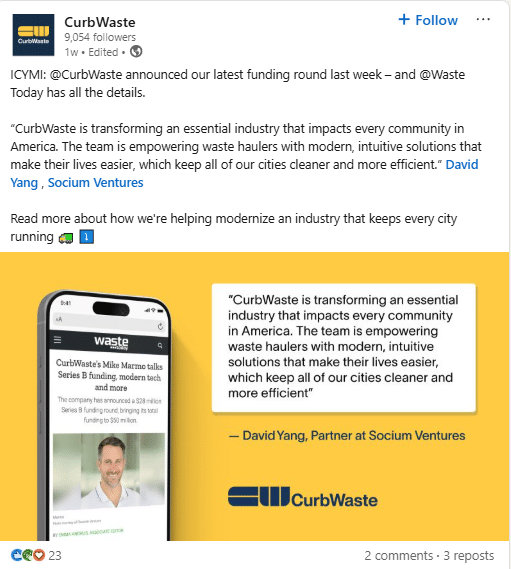
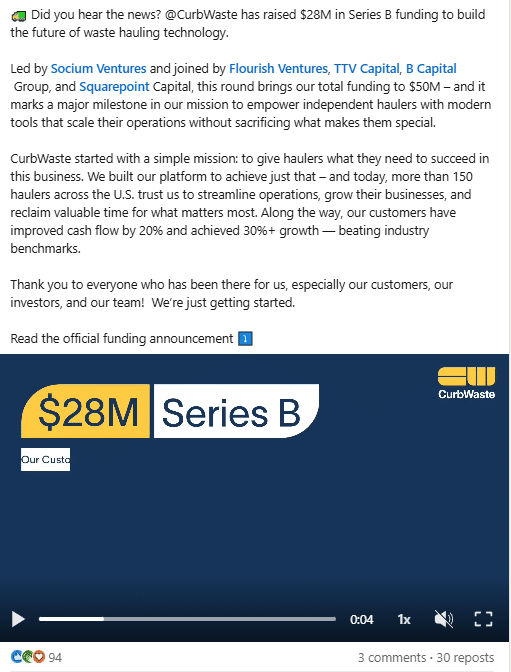
In 2024, CurbWaste raised $10 million in Series A Round and joined the SMBTech 50 2024 list. Recently, they announced $28 million in funding in Series B to power the future of waste hauling.
For us, understanding the background helps us see why they make certain choices. CurbWaste’s evolution from a founder’s personal pain point to a funded SaaS platform explains why they rely on operational credibility over marketing polish. Industry knowledge matters more for vertical SaaS companies, than horizontal ones.
Brand Promise Analysis
CurbWaste’s homepage leads with a clear message: “Waste management software by haulers, for haulers.” Right away, you trust them a bit more. They’re not outsiders trying to fix an industry they don’t understand. They’ve lived the pain points.
They promise to help you with everything you need to run your business: order management, track inventory and live ETA, automated invoicing, data-centric reporting, online ordering, iOS and Android Driver App, and Real Time Dispatch.

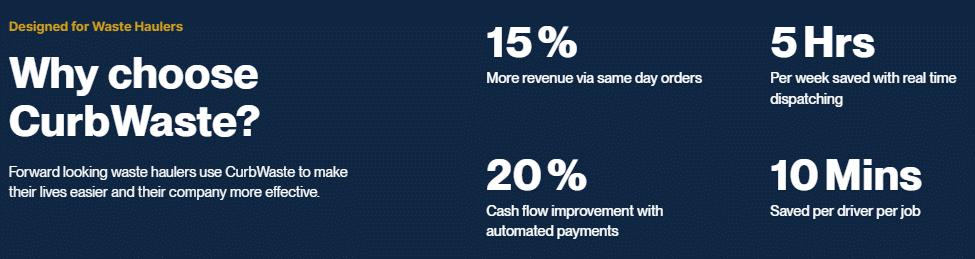
If you choose CurbWaste, you’re promised to get 15% more revenue via same-day orders, 20% cash flow improvement with automated payments, 5 hours saved per week with real-time dispatching, and 10 minutes saved per driver per job.
They promise an all-in-one waste management platform with new features added all the time and a fully customized onboarding, training, and implementation built around your operations.
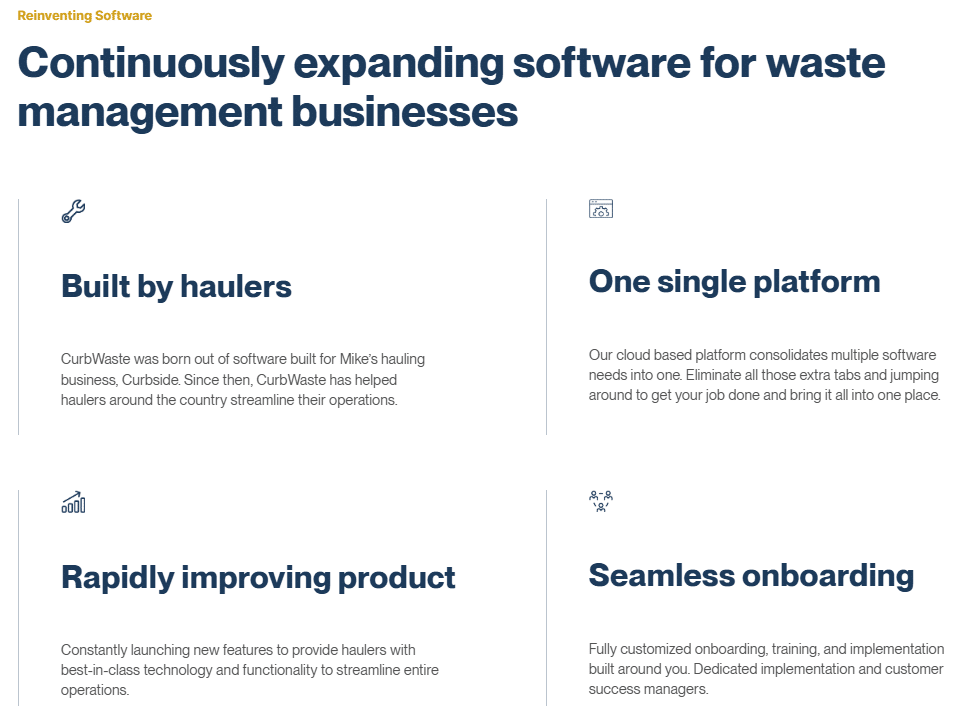
Their About Us page tells the founder’s story. Mike Marmo started working as a scale operator at a local transfer station, then started his own waste company (Curbside) servicing New York City, founded CurbWaste to help haulers digitize nationally, and eventually sold Curbside to focus on growing CurbWaste full-time. Mike’s story proves he wasn’t some tech bro who thought he could fix waste management from his laptop.

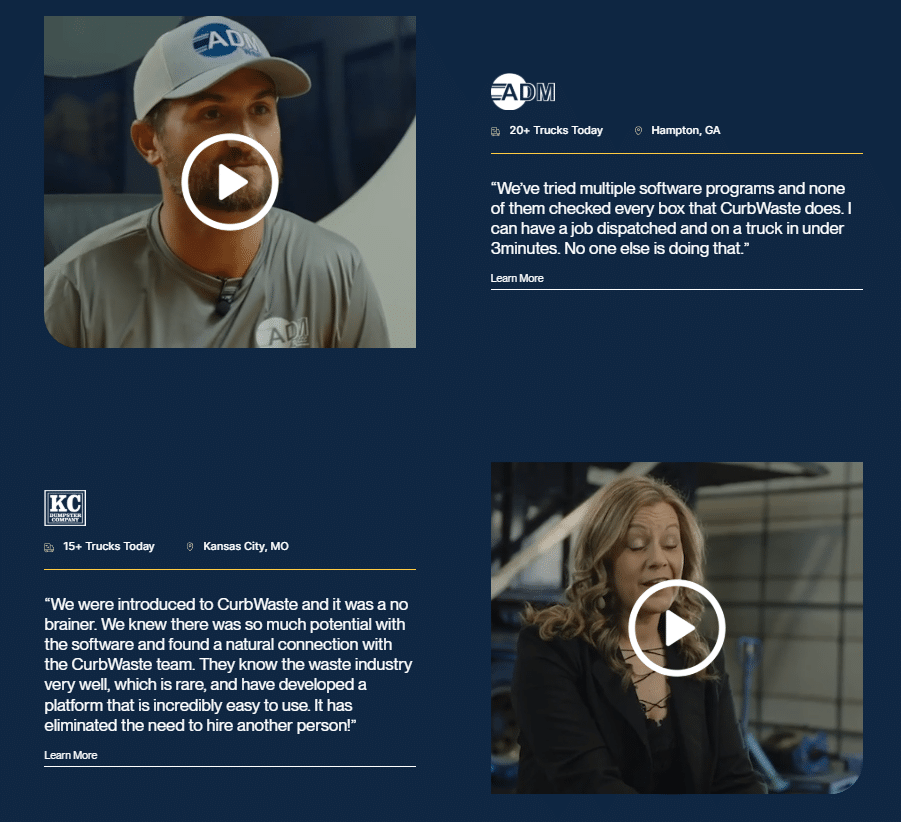
Customer testimonials highlight speed and ease of use with statements like “I can have a job dispatched and on a truck in under 3 minutes. No one else is doing that.” or “It has eliminated the need to hire another person!”.
Service and Product Breakdown
On their site, you will not find a classic Products tab, but you can understand what they offer from categories like Features and Pricing.

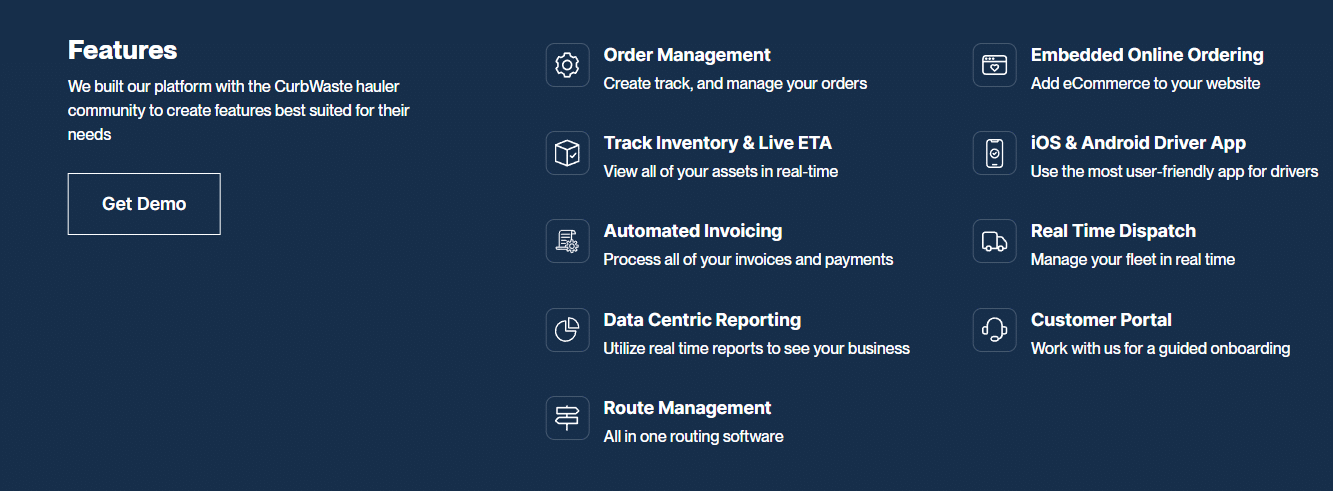
Looking at their Features tab, we can see they offer: Order Management, Track Inventory & Live ETA, Automated Invoicing, Data-Centric Reporting, Route Management, Embedded Online Ordering, iOS and Android Driver App, Real-Time Dispatch, and Customer Portal.
Click on any of these, and another page with descriptions will open. The Order Management page shows you can make work orders in seconds, track order statuses, and edit your orders directly from the dashboard or dispatch so you can make adjustments on the fly.
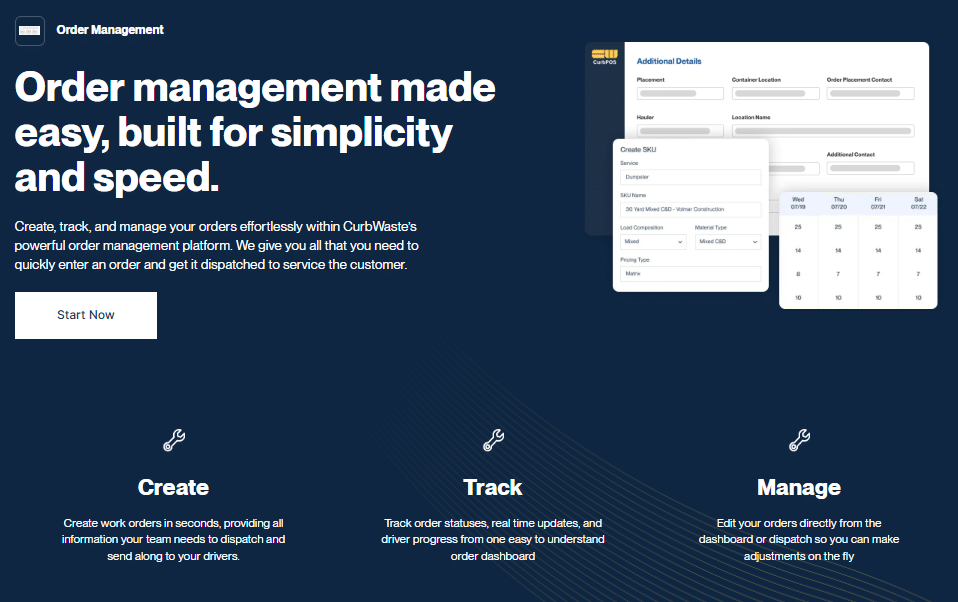
You can also see location-specific details, real-time inventory projections while creating your work order, build customized pricing options for any customer, and save it to their account.
If you are ready to transform your operations, simply contact them by clicking the Contact Us button.
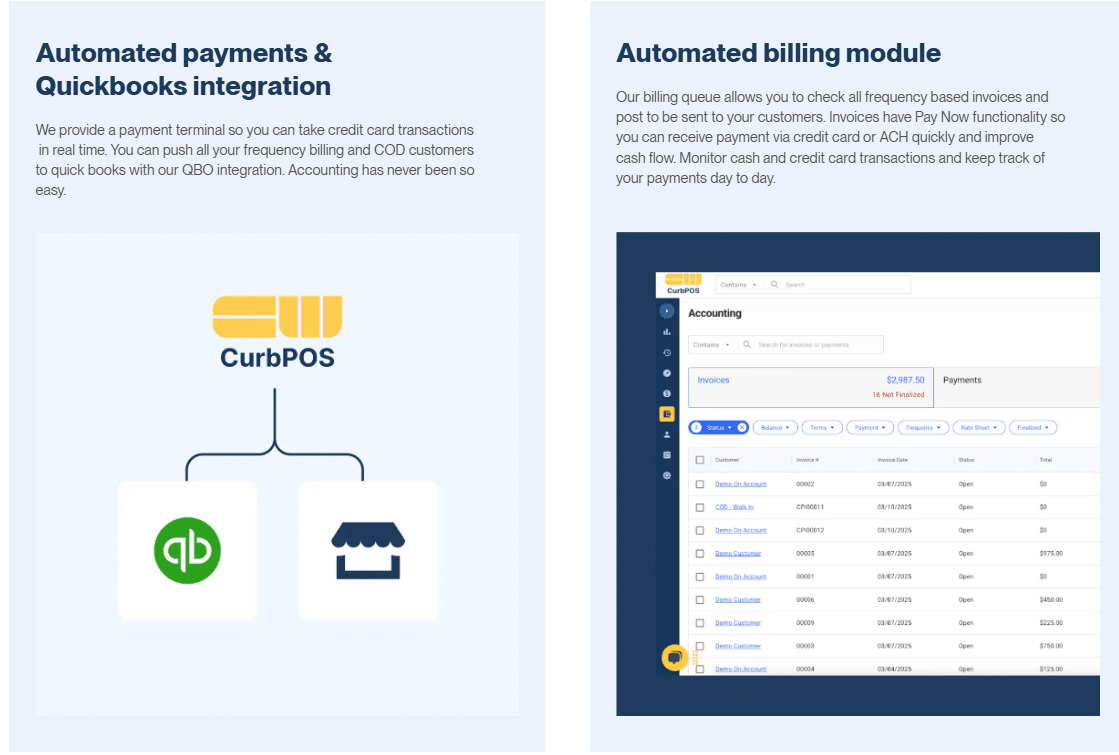
CurbPOS gives you everything you need to run your transfer station, with inbound POS and outbound management, automated LEED and RCI reporting, access reports, and analytics that let you pull orders, inbound and outbound tonnage, yardage, and more.
CurbPOS allows automated payments, QuickBooks integration, and an automated billing module.
Everything’s laid out pretty clearly with infographics and screen captures used as sneak peeks.
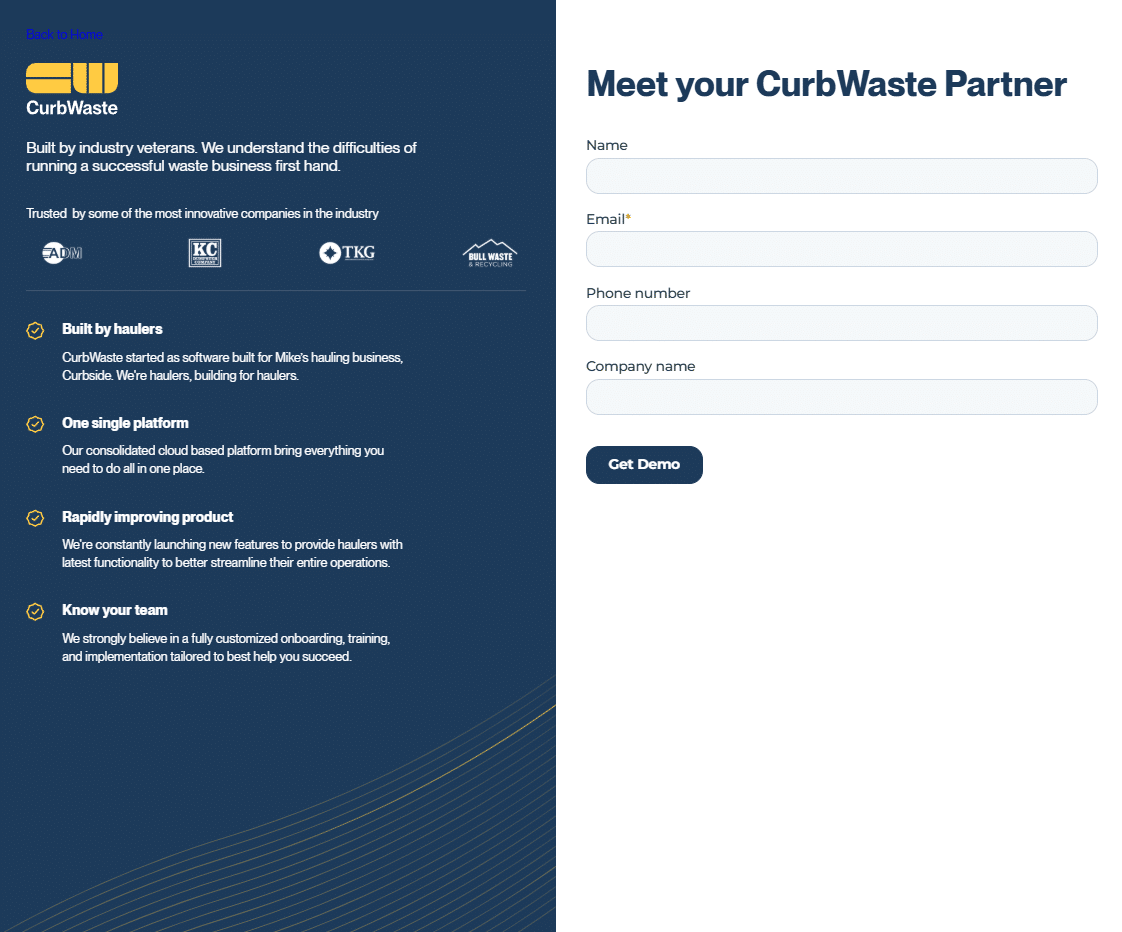
The Pricing page offers 3 tiers: Core, Pro, and Enterprise. If you click the Get Demo button, you need to fill out a form.
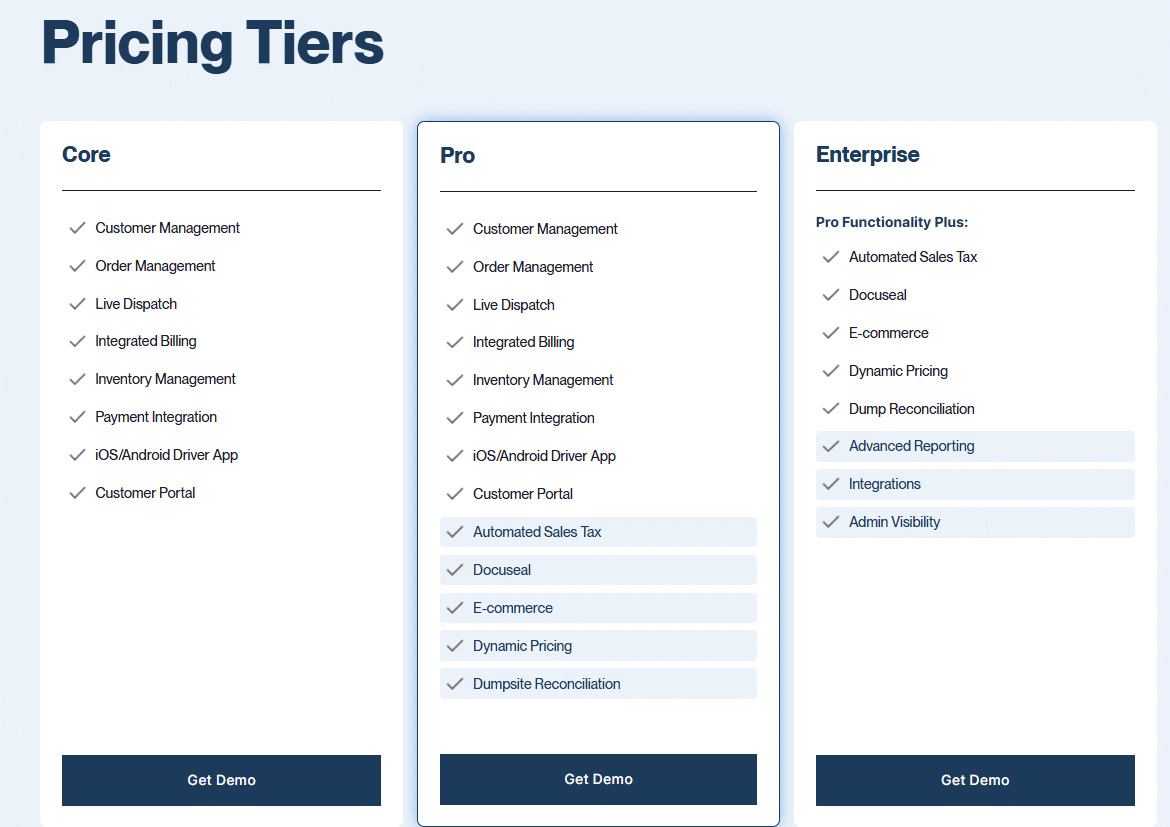
The Core plan offers Customer Management, Order Management, Live Dispatch, Integrated Billing, Inventory Management, Payment Integration, iOS/Android Driver App, and Customer Portal.
The Pro plan adds: Automated Sales Tax, Docuseal, E-commerce, Dynamic Pricing, and Dumpsite Reconciliation.
The Enterprise one adds Advanced Reporting, Integrations, and Admin Visibility to the game.
Below you’ll see the payment rates for CurbWaste and CurbPOS.
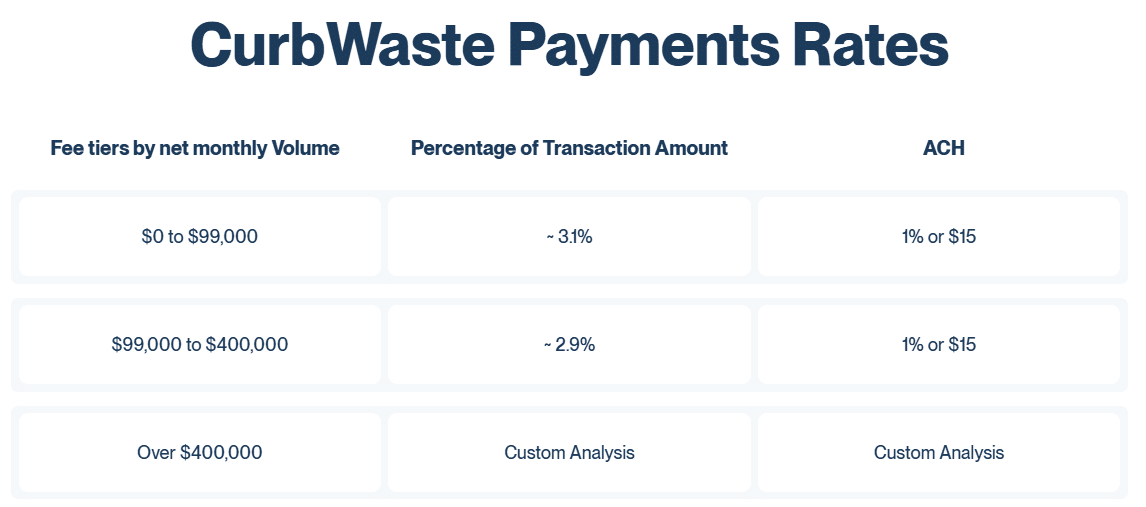
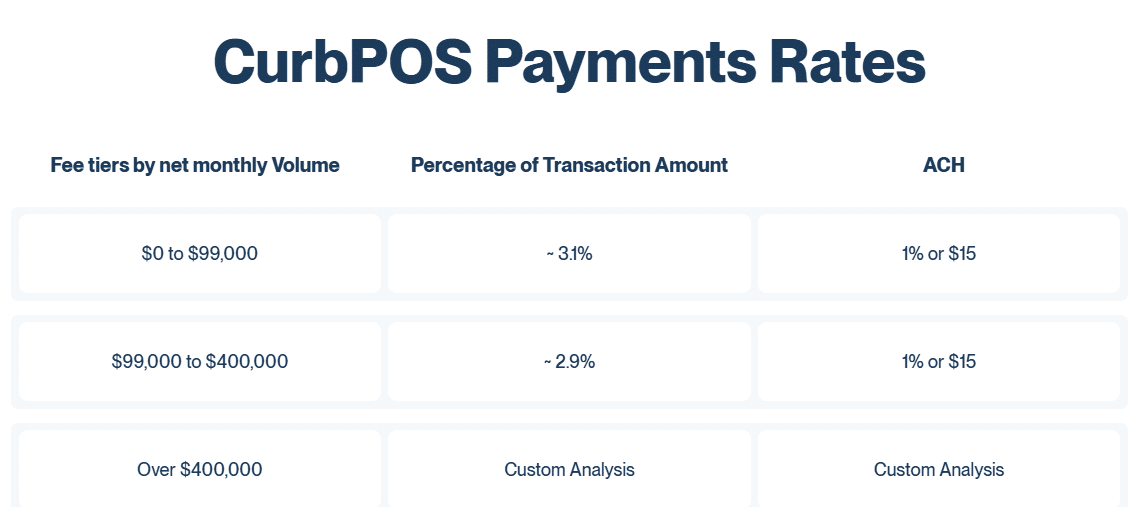
These days, B2B buyers want to see prices up front before engaging with sales teams. Sopro’s 2025 State of Prospecting report shows that buyers are doing way more independent research and requiring more competitive intelligence and case studies before making decisions. By displaying their pricing tiers, CurbWaste reduces friction in the consideration stage, though the lack of specific dollar amounts still requires a demo request for final purchasing decisions.
Differentiators and Unique Assets
Change management
From a separate page, you can learn about change management, the process of guiding individuals, teams, and organizations through a transition to a new system or way of working.
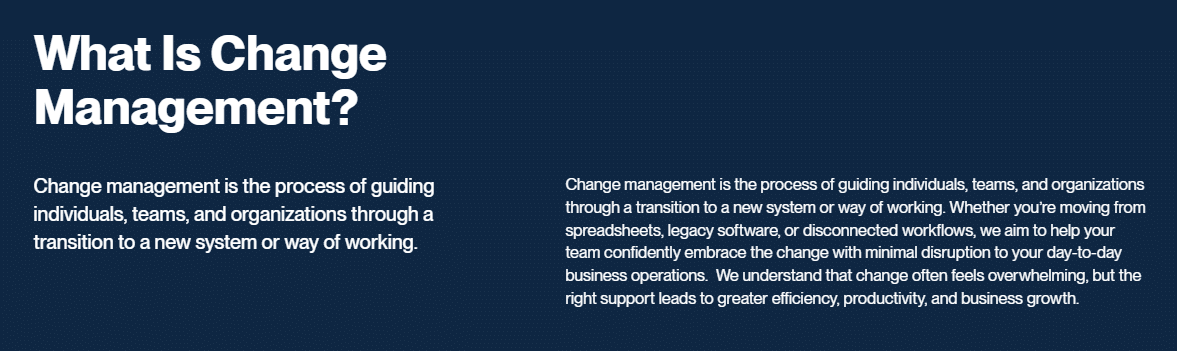
With strategic planning and hands-on execution, CurbWaste’s change management has the following stages: Assess & Plan, Communicate & Align, Train & Enable, Implement & Support, and Monitor & Optimize.
Without structured change management, software adaptation can be slow, frustrating, and met with resistance. With their process, you’ll experience faster adoption with minimal business disruption, increased operational efficiency and productivity, higher employee engagement and satisfaction, and a long-term solution for sustainable growth.
They actually care about change management. International Journal of Engineering Business Management (Errida & Lotfi, 2021) notes that several studies highlight that most organizational change initiatives fail, with an estimated failure rate of 60-70%. For waste management companies specifically, where employees might be skeptical of new technology, having a structured change management approach can be the difference between successful software adoption and expensive shelfware.
The change management software market itself is growing fast. Cognitive Market Research’s April 2025 report shows that the global market hit $ 1,752.8 million in 2025 and is projected to reach $ 3,492.6 million by 2033, expanding at a 9% annual growth rate. This growth is driven by increasing demand for automated IT resource management and digital transformation needs. CurbWaste’s explicit commitment to change management addresses one of the primary barriers preventing small and medium enterprises from adopting new systems: the high cost and complexity of implementation.
Use Cases
A use case describes a specific scenario or situation of how a user interacts with a system to achieve a particular goal, commonly used in software development. It outlines the sequence of actions, user inputs, and system responses to complete a task, including both successful and alternative paths, to ensure a product meets specific functional requirements and goals.
CurbWaste has 3 use cases on their site: Roll Off, Residential, and Commercial. Each one has a different page with a product description and how it can help you, alongside testimonials from clients in that area.

Breaking things down by service type is smart, because it shows they actually understand the business. Each one of them operates differently from the other. 2025 data shows that waste management companies market specialized segments rather than trying to be everything to everyone. By creating dedicated use case pages, CurbWaste allows prospects to see themselves in the solution rather than trying to find the needle in the haystack from a very complex description. This is what other smart B2B companies are doing: use hyper-niche strategies to get to one specific audience, instead of talking to a larger audience.
Network
On the Network page, you will find an alphabetical list of waste management businesses.
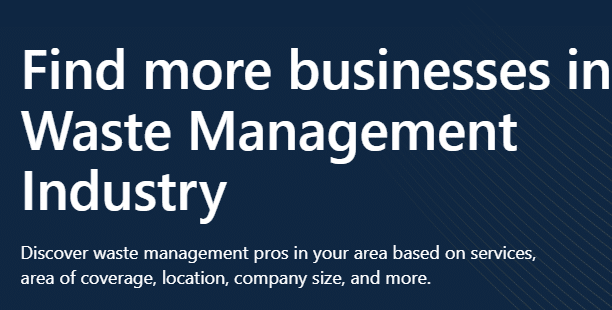
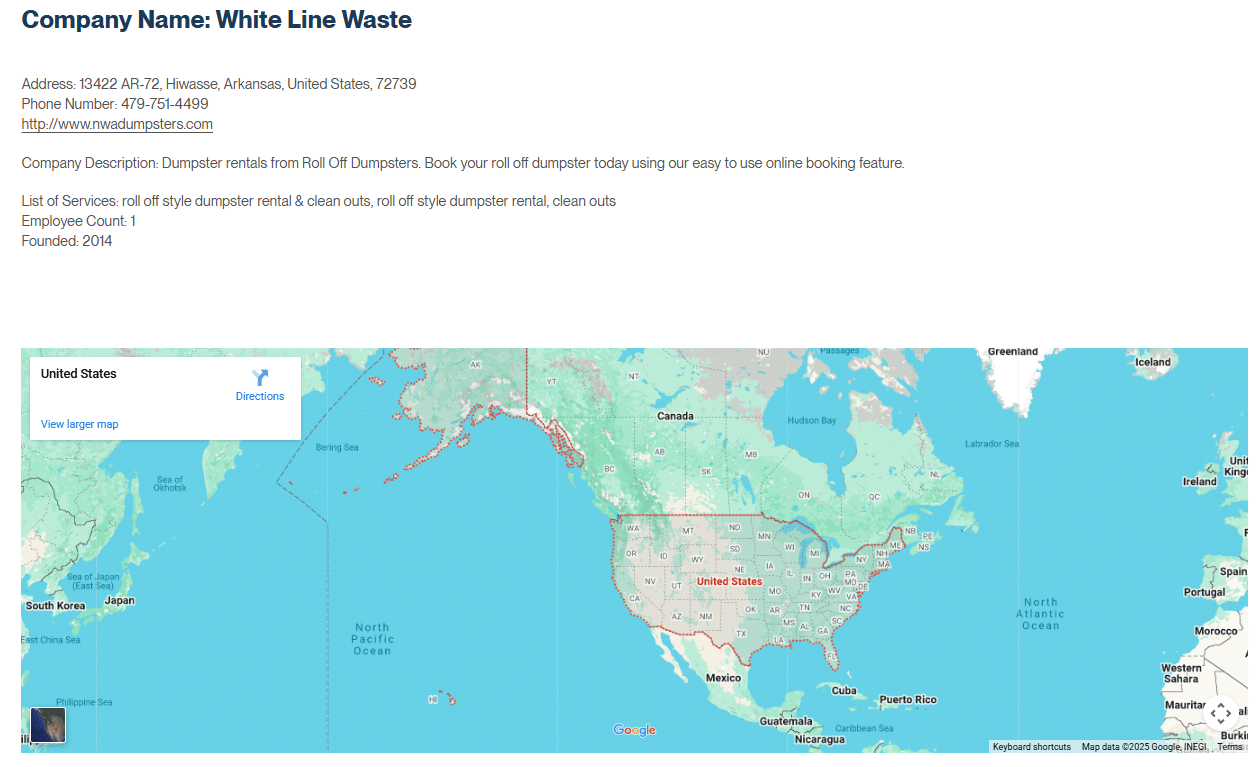
Click any name and you’ll see contact details like address, phone numbers, site, services, employee count, and more, along with a map that shows you covered areas by this company.
Glossary
Used by many
CurbWaste provides a glossary with clear definitions and explanations of industry-specific terminology.
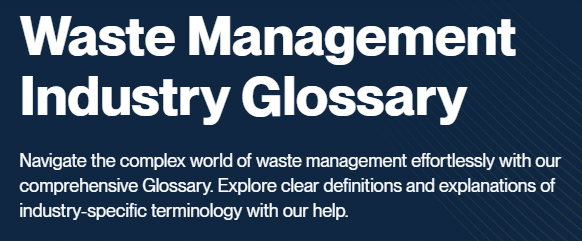
Click on hooklift trucks, for example, and a new page with an article will appear. A short definition is given at the beginning of the article. At the end, you’ll find a list of companies that sell this product, a banner of their top customers, and the Get Demo button CTA.
The glossary has double duty: SEO strategy and educational resource. Search behaviour evolves with AI-powered tools, and it changes how people find information. To get referenced in AI-generated answers, you need clear and authoritative definitions. Research from McKinsey & Company shows that SaaS companies are increasingly writing content that’s easily understood by large language models: short, clear, with real answers instead of SEO jargon. CurbWaste’s glossary approach makes them look like the go-to experts for waste management terminology, which matters when prospects are doing preliminary research before reaching out to sales.
CurbWaste’s Apps
They offer multiple free apps, such as CurbWaste LeadFinder, Competitor Reports, and Business Valuation Calculator.

Click on the first one, and you’re redirected to a page where you can find companies near you needing junk removal, construction cleanup, and remodeling services. Their database updates every Monday.
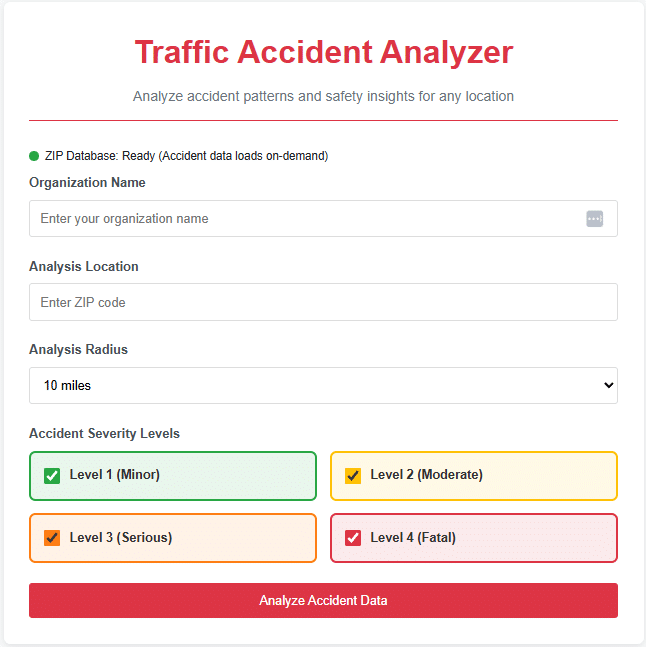
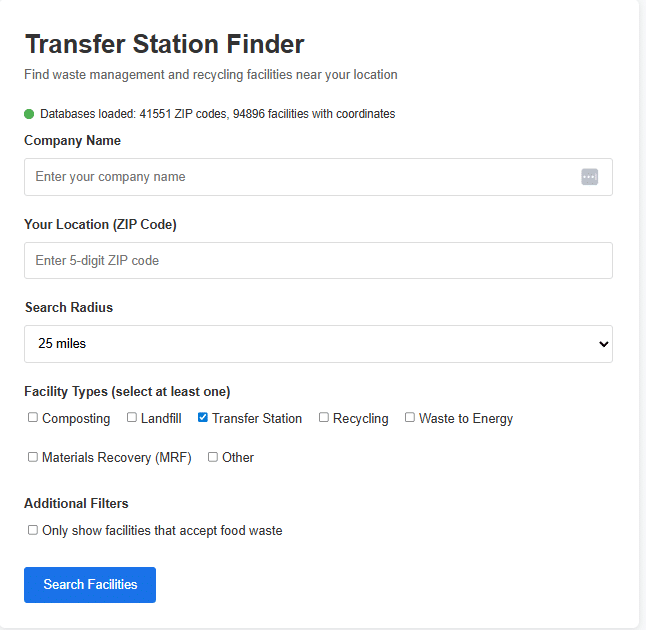
To find a lead, you will need to fill out the form with the company name, ZIP code, search radius, and select company size. The process is similar if you want to get a personalized competitor’s report.

The Get Demo button is present on every page, ready to be pushed.
These utility apps represent a different approach to lead generation than typical gated content. Rather than downloading a whitepaper you might never read, prospects get immediate value from tools that help them run their business better right now. These days, B2B buyers have extremely low attention spans and prefer shorter, more actionable content. CurbWaste’s apps provide instant utility while capturing lead information naturally as part of using the tool, not as a barrier to accessing generic content. Just imagine their product’s capability, if their free lead finder works this well.
Leadership Presence Analysis
Let’s examine how CurbWaste’s leadership uses social media for personal branding and company growth. None of the other executives is active online, so we decided to analyze the CEO’s presence only.
CEO Michael Marmo
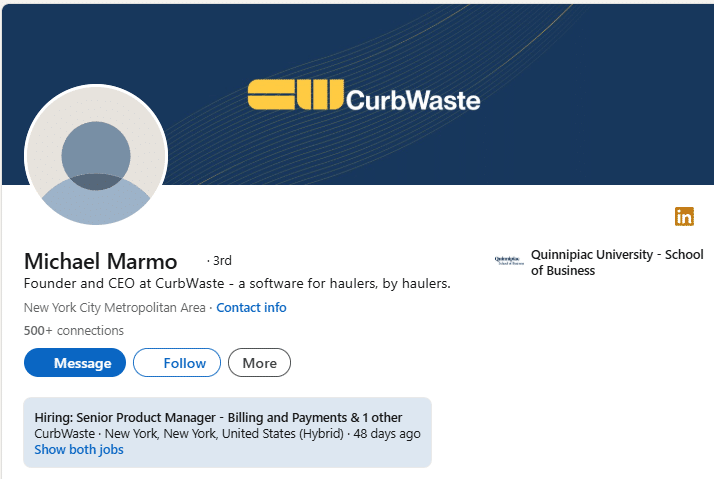
Michael (Mike) Marmo has over 2.1k followers on LinkedIn. As founder and CEO, he’s the public face of CurbWaste.
He’s not that active, posting around twice a month. He uses his profile to reshare, along with some thoughts, CurbWaste’s posts. There are some spikes in engagement, with posts gathering almost 200 reactions, 60 comments, and 5 reposts. The other posts have around 20 reactions, with 1 comment and no reshares. He usually posts about open positions at CurbWaste, company accomplishments, and participation in events.
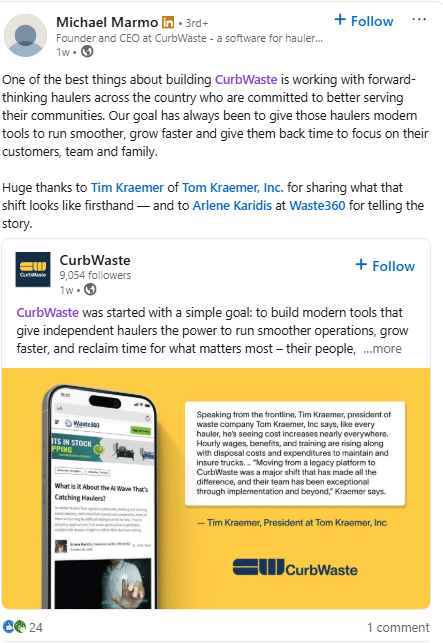
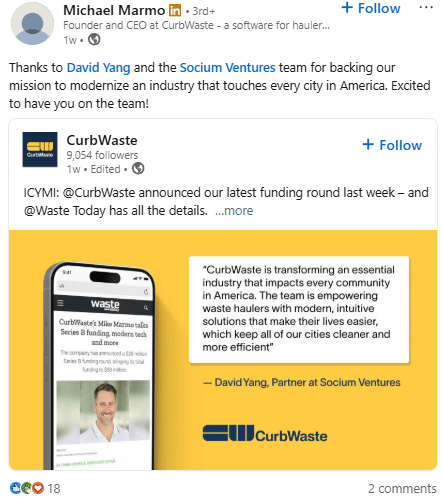
He makes sure to tag partners and people in his posts. LinkedIn data shows tags and hashtags significantly increase the expected number of reactions, with tags also increasing comments. ResearchGate study analyzed 991 LinkedIn posts and revealed that tagging people creates clickable mentions that send notifications to the tagged person or company, expanding reach beyond immediate networks. When someone tags 2 to 3 relevant people, posts perform 21% better than posts with no tags or excessive tagging. Tagging another creator or company in the post increases comment rates by 26%, and the tagged person’s engagement lets the LinkedIn algorithm know that the content is high quality, pushing it to even more people.
On Instagram, Mike Marmo has 515 followers, but only 2 posts from 2025. One is announcing the Series B funding, and the other is announcing the birth of his son. On the second post, he gained 146 likes, 26 comments, and 3 reposts, while the funding news has 41 likes, 7 comments, and 2 shares. Sharing personal life updates combined with company news could boost his visibility and CurbWaste’s authority.
People follow people, not logos. Founder accounts get way more engagement than company pages. According to 2025 data, personal LinkedIn profiles generate up to 3x the engagement of company pages because people connect with people, not logos. Given Mike’s authentic founder story of being a former waste hauler who built software to solve his own problems, this story could resonate with prospects who are skeptical of tech companies that don’t understand their industry. Buyers are tired of being marketed to like robots and want actual experiences and authentic stories from people they can relate to. Mike’s limited but genuine social presence suggests he understands this intuitively, even if he hasn’t fully committed to building it into a strategic channel.
Social Media Strategy
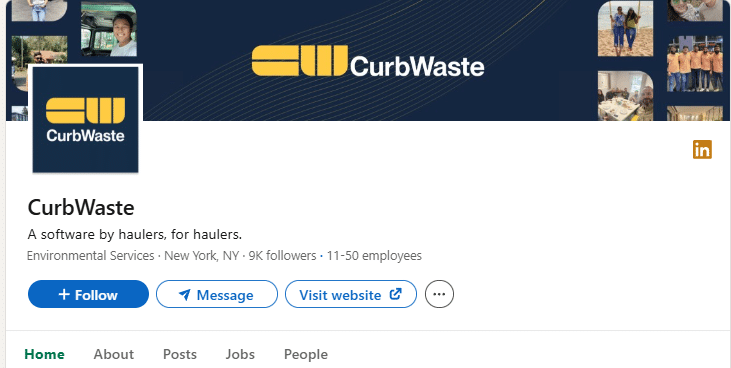
CurbWaste has 9k followers on LinkedIn but limited activity. Recently, they posted about company achievements, talent searching, and the company’s team updates around 3 times per month.
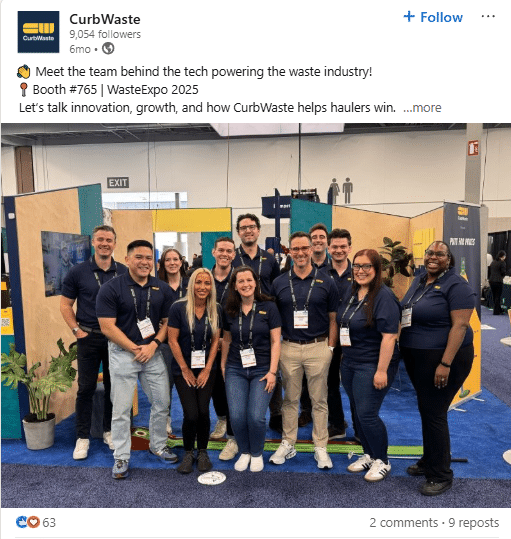
Their posts usually gain no more than 30 reactions, 2 comments, and some reposts. The only ones that are breaking the pattern are the ones announcing the funding news.
Research examining B2B SaaS marketing reveals a critical insight: limited posting and engagement make it difficult to build brand awareness in an increasingly crowded market. While waste management might seem like a niche where social media doesn’t matter, the data tells a different story.
Waste management companies started caring more about marketing. Thousands of companies begin to explore strategy, channels, branding, and content across digital platforms. In fact, even within traditionally offline industries, companies are recognizing that both digital and traditional marketing approaches are vital to staying relevant, building trust, and driving growth.
For tech companies specifically, posting more often gives better visibility and stronger pipeline generation. Companies that maintain consistent posting schedules of 3-4 posts per week reach approximately 60% of their audience, while those posting less frequently see significantly diminished reach and engagement.

Their Facebook page has 530 followers, with minimal activity. Less posting, little engagement. But looking through the tabs, we found the only review from a real person.
Below you can see the 2024 review of 1/5 stars, with complaints about bad response time and fake advertising.
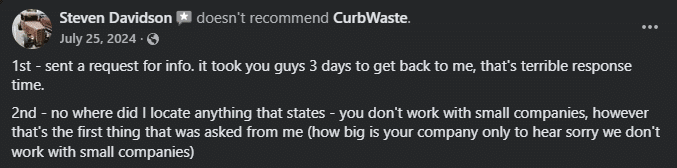
Unanswered negative reviews create lasting damage to brand perception, particularly for B2B companies where trust and responsiveness are critical buying factors. Research shows that potential customers read reviews before making purchasing decisions, especially the bad ones, and a single negative review can significantly impact conversion rates when left unaddressed. The lack of response suggests either that CurbWaste doesn’t monitor their Facebook presence or that it’s made a strategic decision not to invest resources in that channel. Either way, it represents reputational risk that compounds over time.
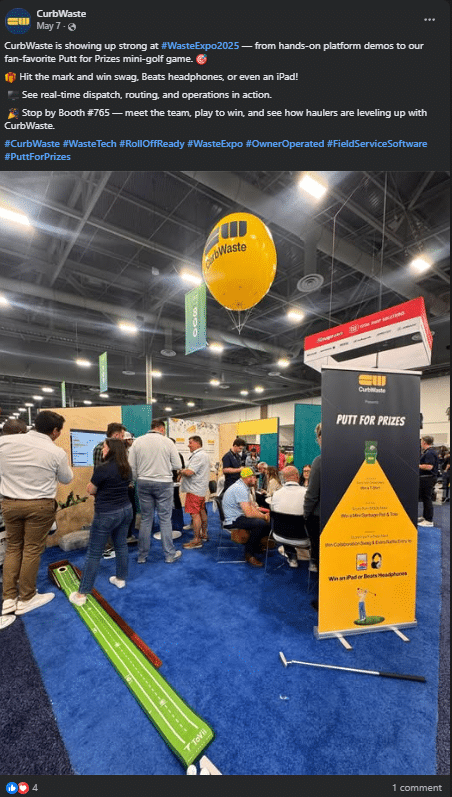
They haven’t posted in a while, since the pinned posts are from 2024, and the last post was from May 2025. Because of that, we couldn’t find any posts about the last funding round. Looking through their old content, we could see that some posts are identical to ones from LinkedIn. Their posts have around 5 reactions, with no comments or reshares.
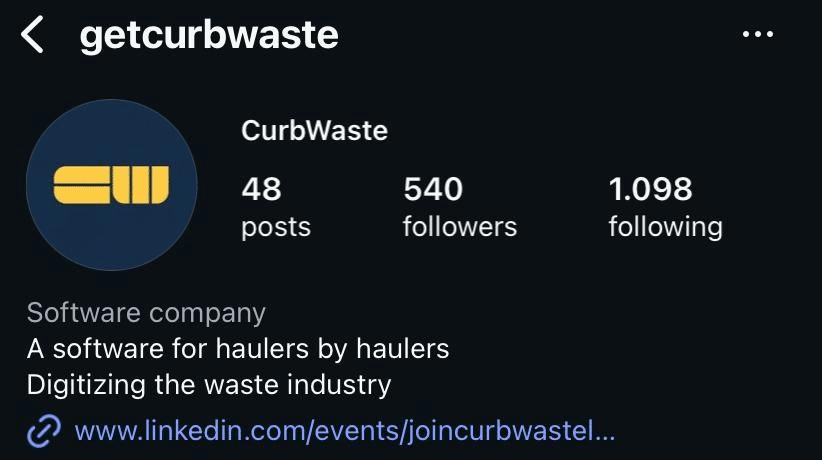
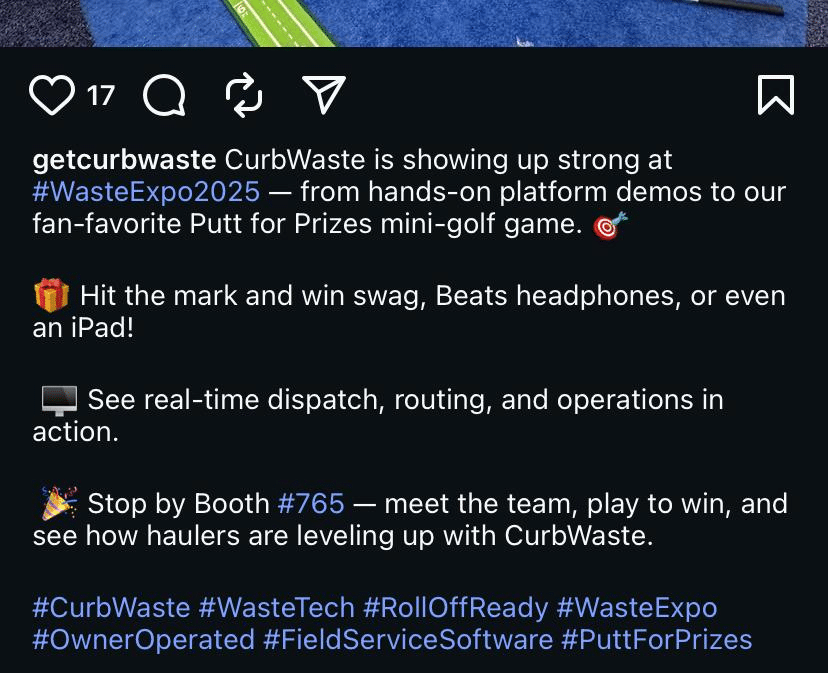
On Instagram, CurbWaste has 540 followers. Just by opening their page, we’ve noticed 2 things. One, the link in bio is the homepage or a landing page. But they have a link to a LinkedIn event. Two, the Testimonials Highlight has only 1 story, a thank-you message for KC Dumpster for believing in them.
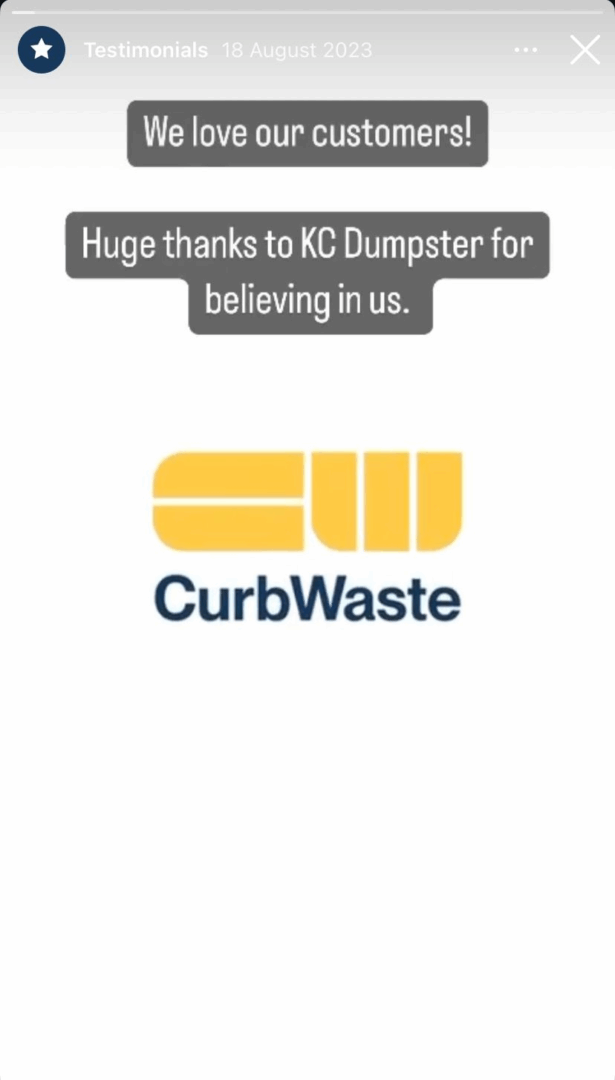
Highlights stick around after Stories disappear, which is useful because they remain accessible on profiles long after Stories disappear. For B2B companies, using Highlights strategically for testimonials, product demos, or company culture content allows prospects to quickly understand value propositions without scrolling through feed posts. This is particularly valuable given that Instagram users typically spend only seconds evaluating whether to follow or engage with business accounts.
Just like on Facebook, their latest post is from May. The content posting frequency is low, with few posts per month. Unlike other platforms, on Instagram, they use relevant hashtags like #CurbWaste, #WasteTech, and #RollOffReady.
YouTube
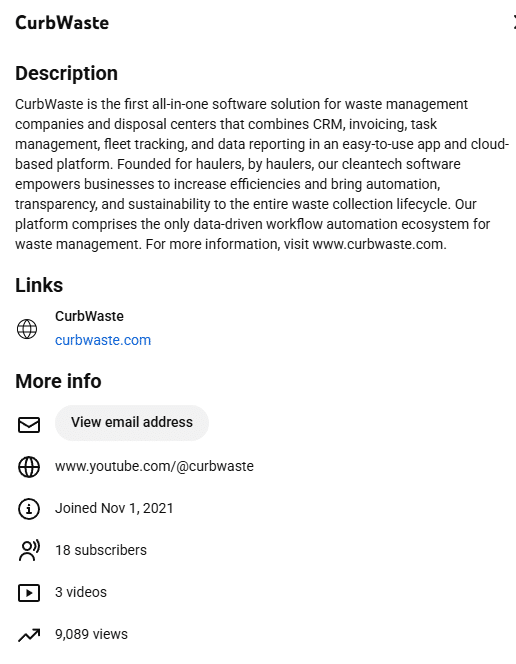
On YouTube, CurbWaste has 18 subscribers and 3 videos posted that gained around 9k views in total.
Two of them are testimonials, and the other one is a cartoon animation explaining the product. They’re well executed, with full production behind them. YouTube is a space where your company can get awareness in a non-traditional way, so maybe, in the future, they will explore more in that area.
Video matters now more than ever in B2B marketing strategies. Research by Caroline Giegerich shows that video consumption on LinkedIn has increased significantly, with native videos generating 22% more engagement than text-only posts.
YouTube is the second-largest search engine after Google, so well-optimized video content can capture search traffic from prospects in early research phases. For waste management companies specifically, video allows demonstration of complex software functionality in ways that screenshots and text descriptions cannot match.
X (formerly Twitter)
With 1 follower and no official source that this is their account, we have nothing to analyze here.
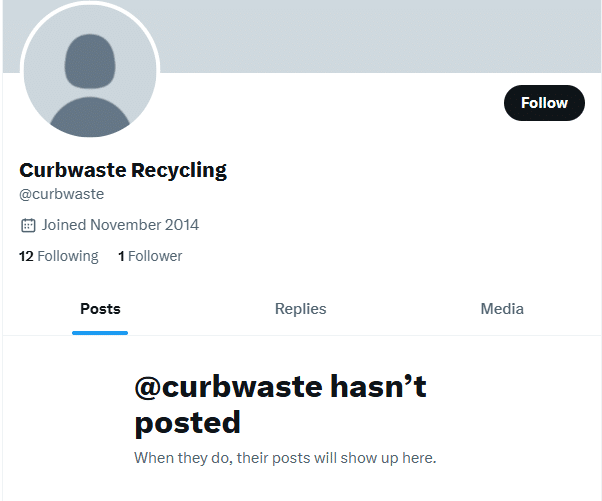
While X has become a less essential platform for many B2B companies, it still serves important functions for tech startups and SaaS companies, especially in the U.S. The platform excels at real-time industry conversations, founder visibility, and connecting with investors and press. Many SaaS companies use X for customer support, product announcements, and building thought leadership around industry trends. CurbWaste’s absence from the platform represents a missed opportunity for founder-driven content and industry engagement, particularly given how active the broader SaaS community remains on X despite platform changes.
Conclusions
With limited posting and engagement, it is hard for us to make assumptions. It’s clear that right now, their focus is not on growing their social media presence. This could be detrimental for CurbWaste in the long run.
Data from 2025 examining B2B SaaS marketing shows that social media plays a vital role in establishing credibility, supporting lead generation through brand validation, and connecting businesses with potential customers.
While waste management might seem like an industry where social media doesn’t drive pipeline, the reality is that decision-makers in these companies are still people who spend time on social platforms daily. Content marketing remains one of the most powerful tools in a SaaS company’s growth strategy, driving organic traffic, nurturing leads, and establishing thought leadership. Companies that neglect a consistent social media presence risk becoming invisible to potential customers who are actively researching solutions on these platforms.
We usually analyze top-performing content too, but with so little to work with, we skipped this part.
Sales Funnel from Social Media
They’re posting more about company culture and participation in events. Even so, we couldn’t find any links to their site in any of their recent social media posts.
On the awareness stage, they don’t excel, since they’re not posting regularly. Yes, word-of-mouth and conference participation are great, but companies often forget that behind every company are real people who spend time on social media daily. Some of them will use it for doom scrolling, some of them will use it to be updated on industry news, or search for something they’re interested in.
Be honest: when you want to search for a new recipe, your next holiday destination, or a simple fact check, do you still use only Google? Or do you also search for it on YouTube, TikTok, or any other platforms that can answer your question quickly and smoothly, looking for social proof?
For the consideration stage, prospects likely research CurbWaste after hearing about it from peers or seeing it at conferences. Searching for them on social media platforms is a real challenge. On the first try, you will find mostly posts of others that tag them, not their account.
For the decision stage, prospects can get a demo from their website to close the deal. The real conversion happens in one-on-one conversations with haulers who understand their pain points.
They’re banking on relationships and word-of-mouth rather than digital marketing solutions. This approach aligns with how waste management marketing typically functions.
The waste management industry has traditionally operated through local relationships, municipal contracts, and word-of-mouth referrals rather than digital acquisition channels. However, as the industry modernizes and younger operators enter the market, digital channels are becoming increasingly important for awareness and consideration, even if final decisions still happen through traditional relationship-driven sales processes.
Reviews and Social Proof
Customer Testimonials
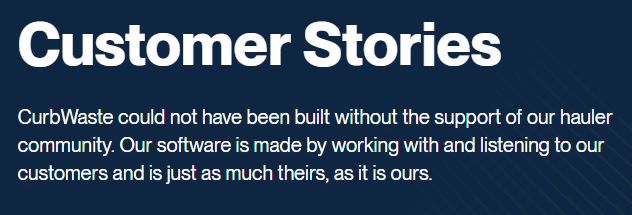
CurbWaste features customer testimonials on a dedicated page: Customer Stories.
They used the same YouTube videos, but shorter, with a quote from the interview.
These testimonials emphasize three themes: speed, ease of use, and industry understanding.
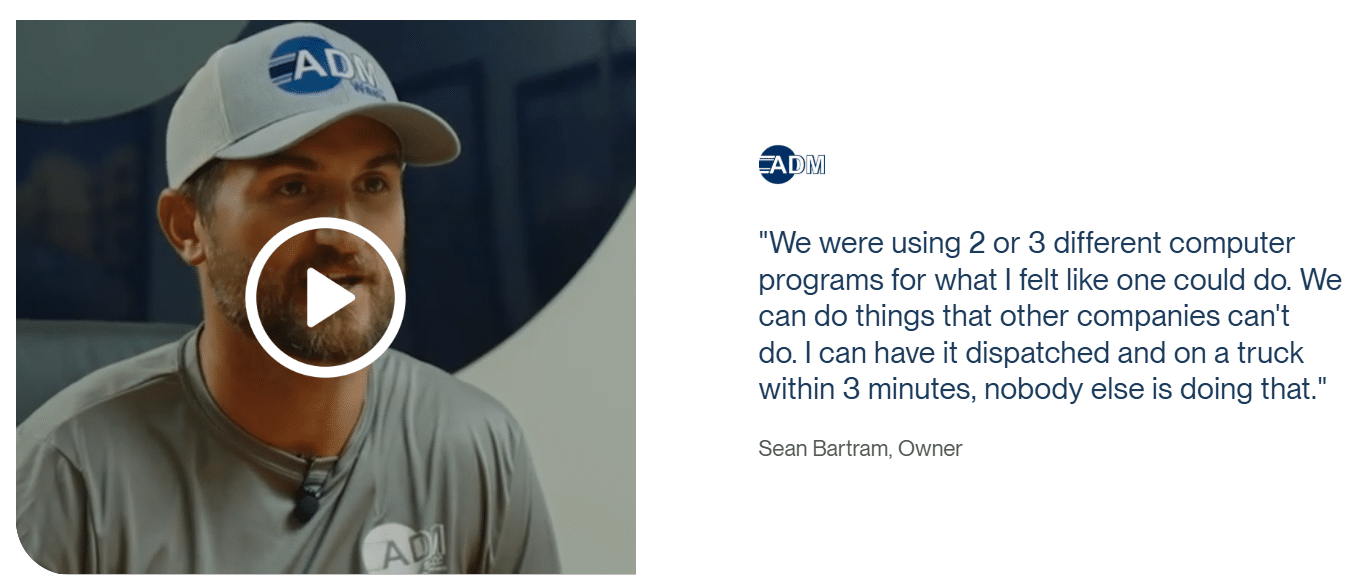
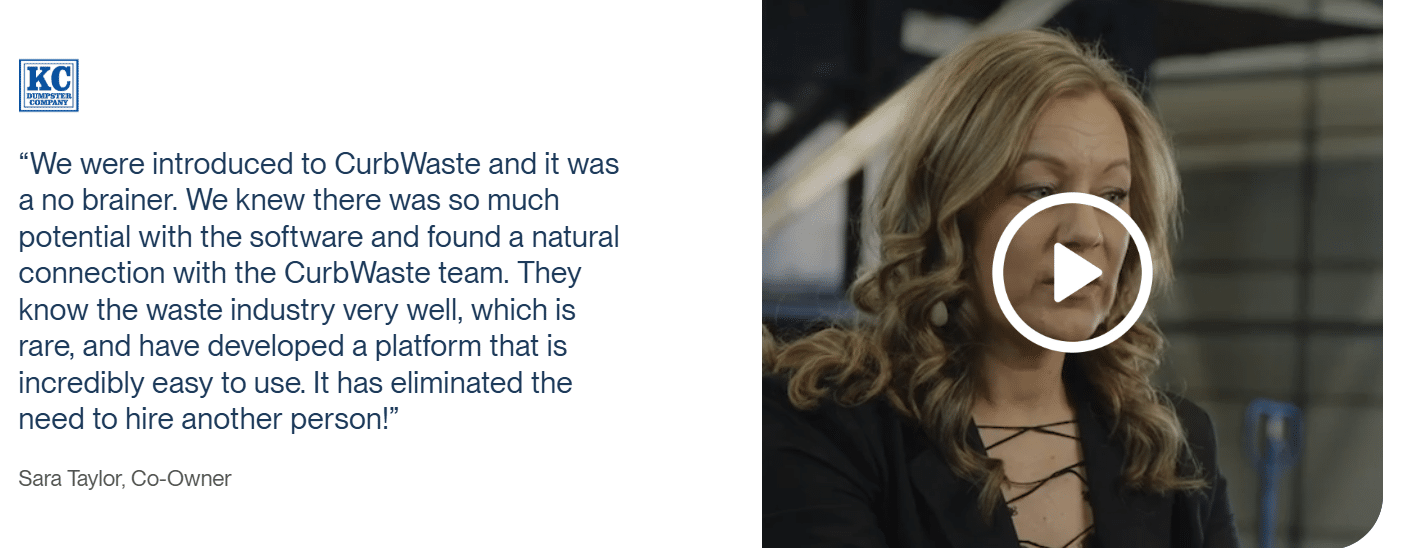
Throughout the site, you will see a banner with their clients’ logos, with the tagline: “Trusted by some of the fastest growing and most innovative companies in the industry”.
In B2B, testimonials actually matter. Customer testimonials serve as powerful social proof that impacts purchasing decisions in complex B2B sales cycles. When prospects are evaluating software solutions that will affect their entire operations, seeing real customers describe tangible benefits provides the credibility that marketing copy alone cannot achieve.
Video testimonials are particularly effective because they convey authenticity through tone, body language, and specific operational details that written testimonials often lack. CurbWaste’s focus on speed and ease of use in their testimonials directly addresses the primary concern of independent haulers: will this actually make my life easier, or will it be another complicated system that creates more problems than it solves?
Third-Party Reviews
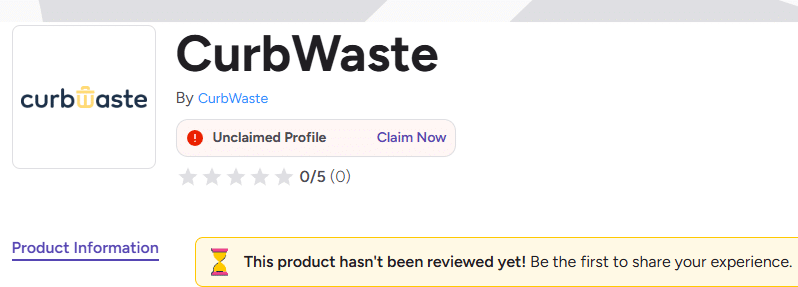
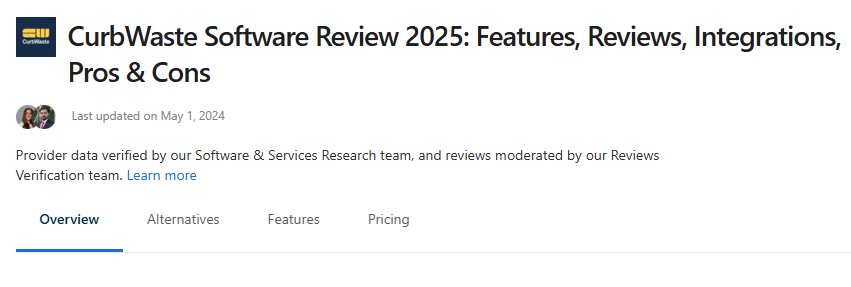
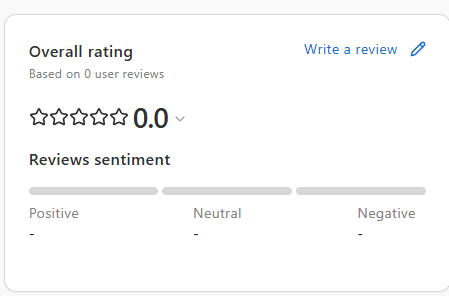
Unfortunately, we couldn’t find any reviews on G2, Capterra, or GetApp.
G2
Capterra
Get app
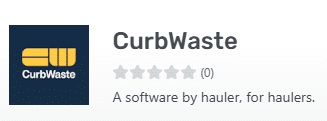
The only third-party review we could find is on Featured Customers, where they gave 12 testimonials and scored a 4.8/5 stars rating.
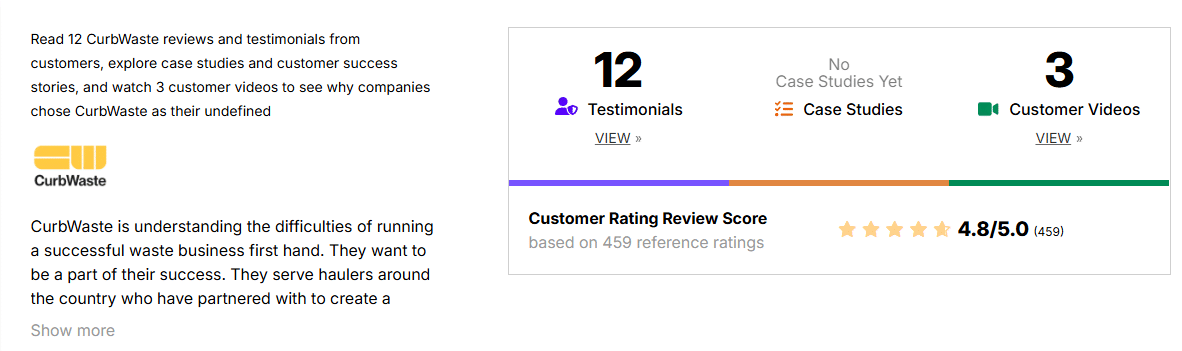
Third-party reviews matter because buyers don’t just trust what companies say about themselves. Potential customers actively seek out reviews on platforms like G2 and Capterra during their evaluation process, and the absence of reviews can create doubt about whether a solution is adopted or if the company is hiding negative feedback.
These review platforms contribute to SEO and discovery, as many buyers begin their software search directly on these sites rather than through Google. G2 and Capterra also provide valuable structured feedback that helps prospects compare competing solutions across specific feature categories, pricing, ease of use, and support quality. Without presence on these platforms, CurbWaste makes it harder for prospects to validate their buying decision and compare them against alternatives.
Paid Advertising Strategy
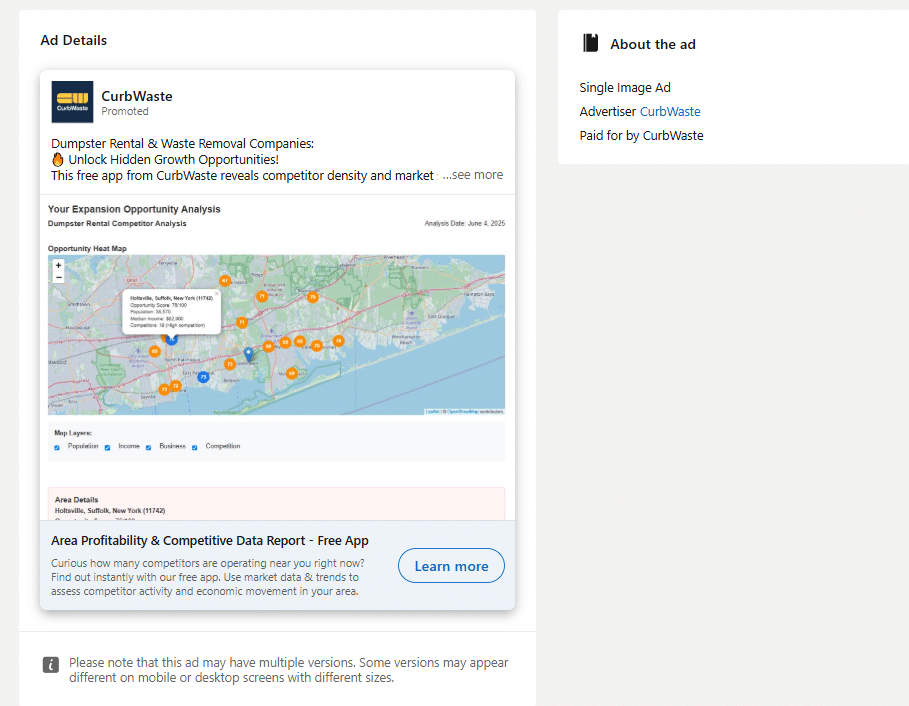
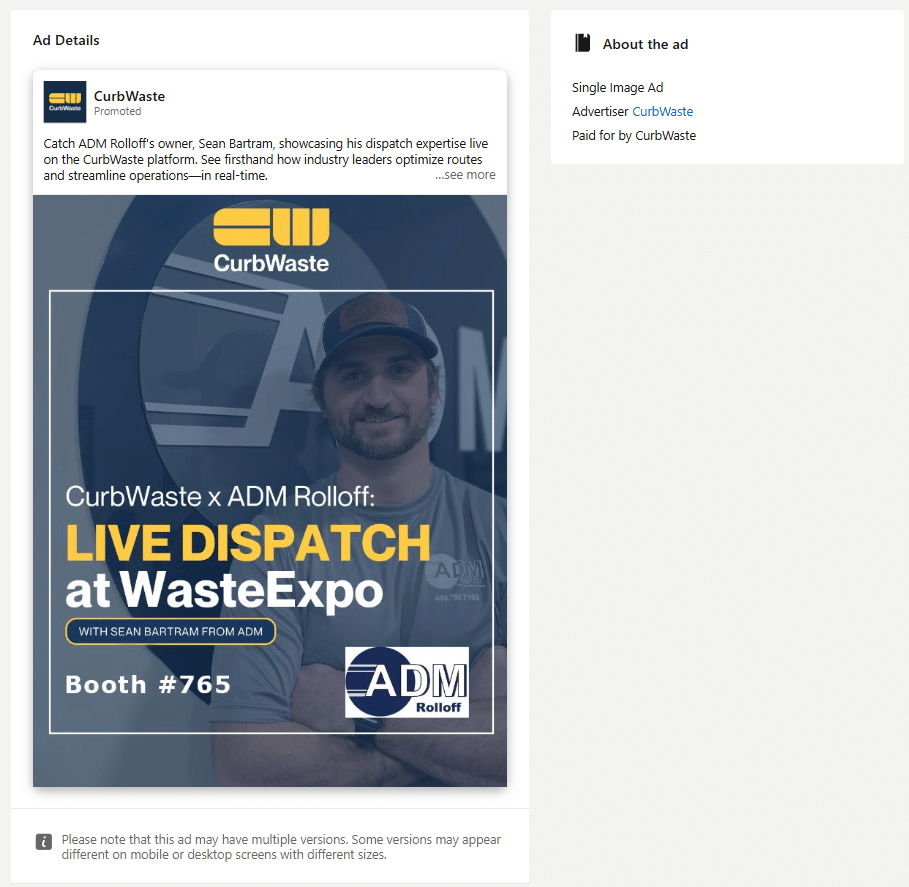
On LinkedIn, we found 4 ads running, with no data available to analyze. This could happen because of a low delivery volume, targeting an audience that’s too small, or an issue with the selected time range.
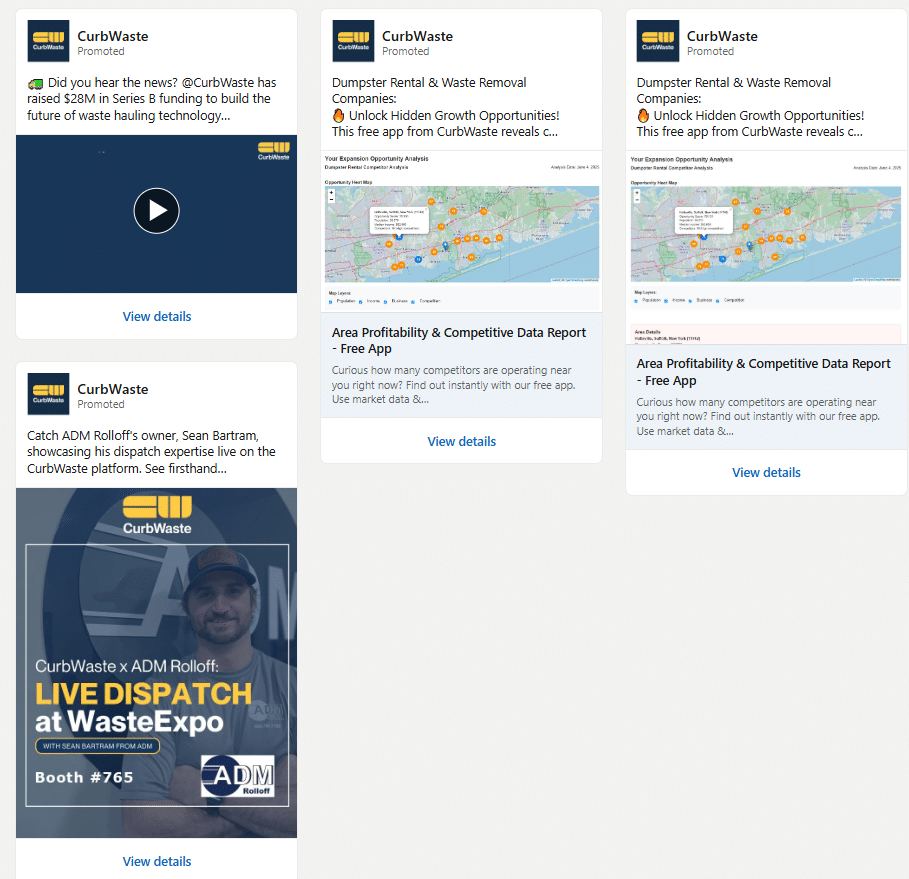
They have 3 single-image ads and 1 video ad. One is promoting the funding news, 2 are promoting the Area Profitability & Competitive Data Report app, and one is participating in an industry event.
Their advertising choices suggest a focus on credibility signals (funding news), lead generation tools (free reports), and industry presence (event participation) rather than direct product promotion. In B2B SaaS, ABM tactics are becoming increasingly important.
Forrester found that 99% of companies with ABM (account-based marketing) teams report that their ABM programs deliver higher ROI (return on investment) vs traditional marketing programs. By advertising utility apps and credibility markers rather than aggressive sales messages, CurbWaste is likely targeting specific accounts with content that builds trust and demonstrates expertise before pushing for demos.
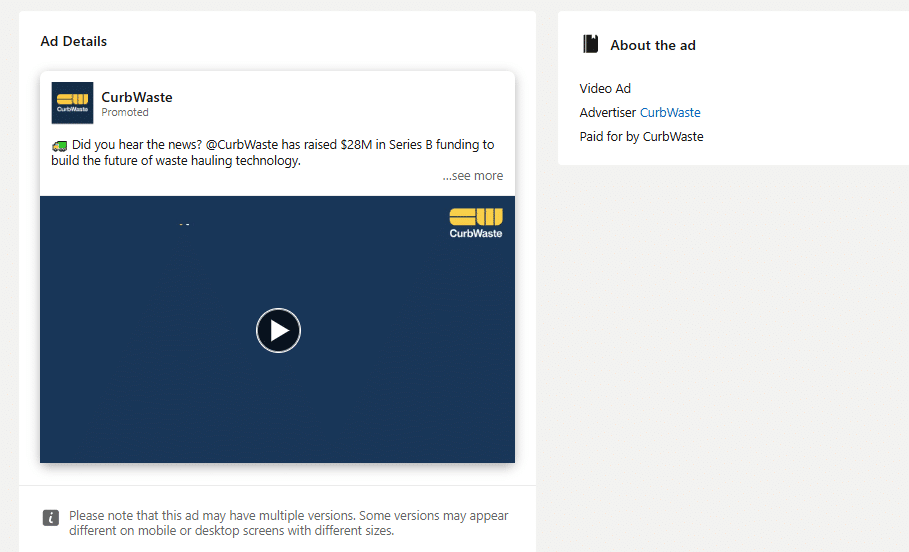
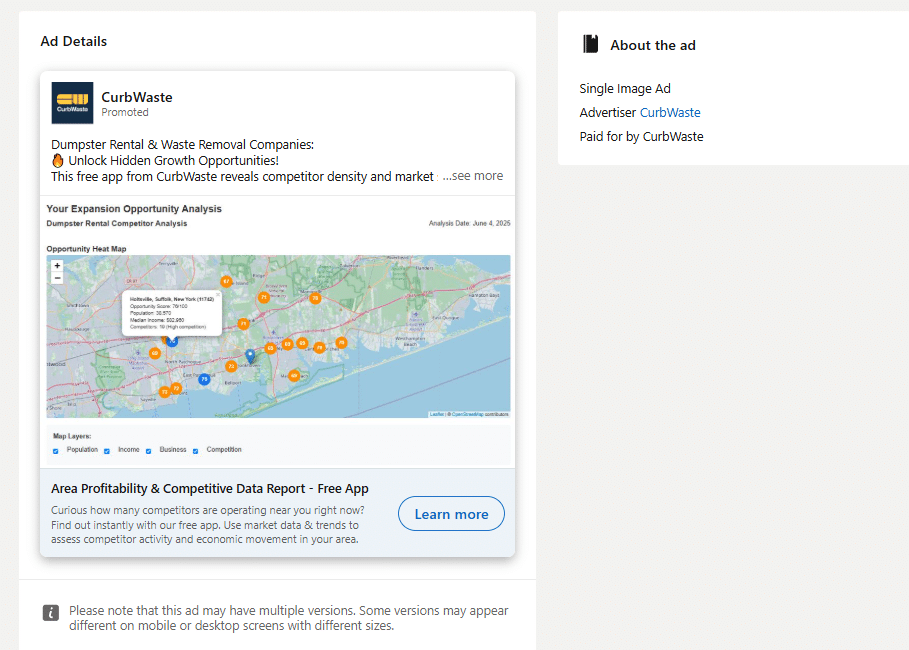
On Facebook, they have 18 active ads. Some of them are client testimonials, others are product promotions. Their ads have multiple versions, and a lot of them are using the same creative and text. They’re advertising only on Facebook, but not on Instagram, although they have an active Instagram account, and the Meta Business platform allows you to send the same ad on multiple Meta platforms.
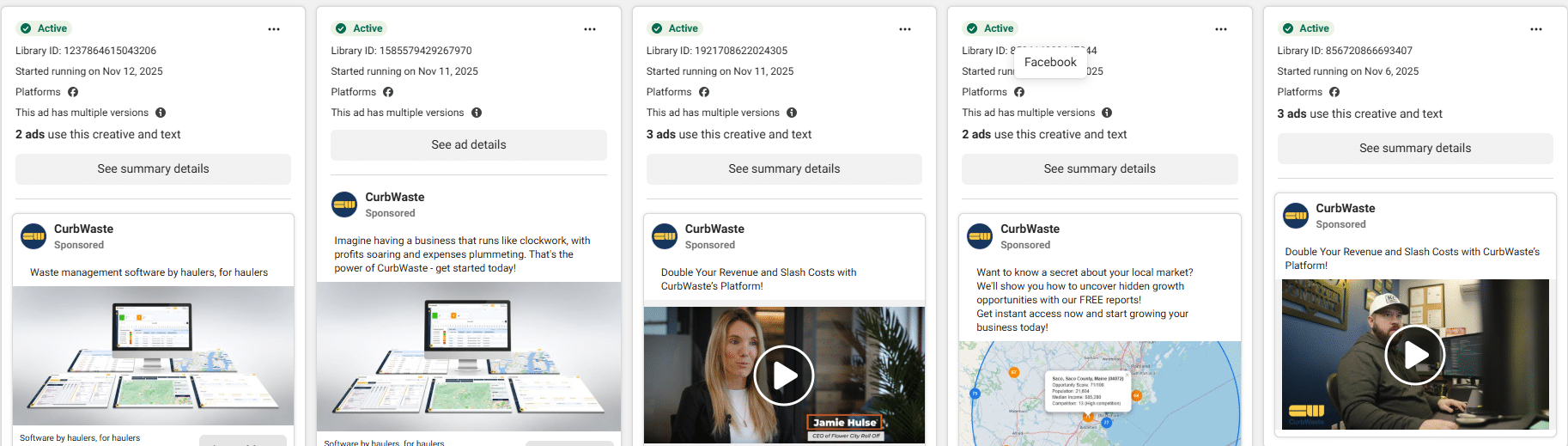
This might mean that their clients are more active on Facebook. While Instagram has higher engagement rates overall, Facebook remains the primary platform for many small business owners in traditional industries who use it for both personal and business purposes.
However, CurbWaste’s own marketing report from 2025 shows that Instagram is actually the top social media platform for waste management companies, followed by Facebook and YouTube. This might be a wasted opportunity for them, based on outdated assumptions about where their audience spends time.
Content Marketing and Demand Generation
Since we already talked about Use cases, Network, Glossary, Change management page, and CurbWaste Apps, we will discuss in this section their blog and webinars.
Blog

Although structured as a normal blog, we can see more than just the normal Read More button. Here you’ll find buttons like: Open Safe Route Planner App, Open App, and Watch Now.
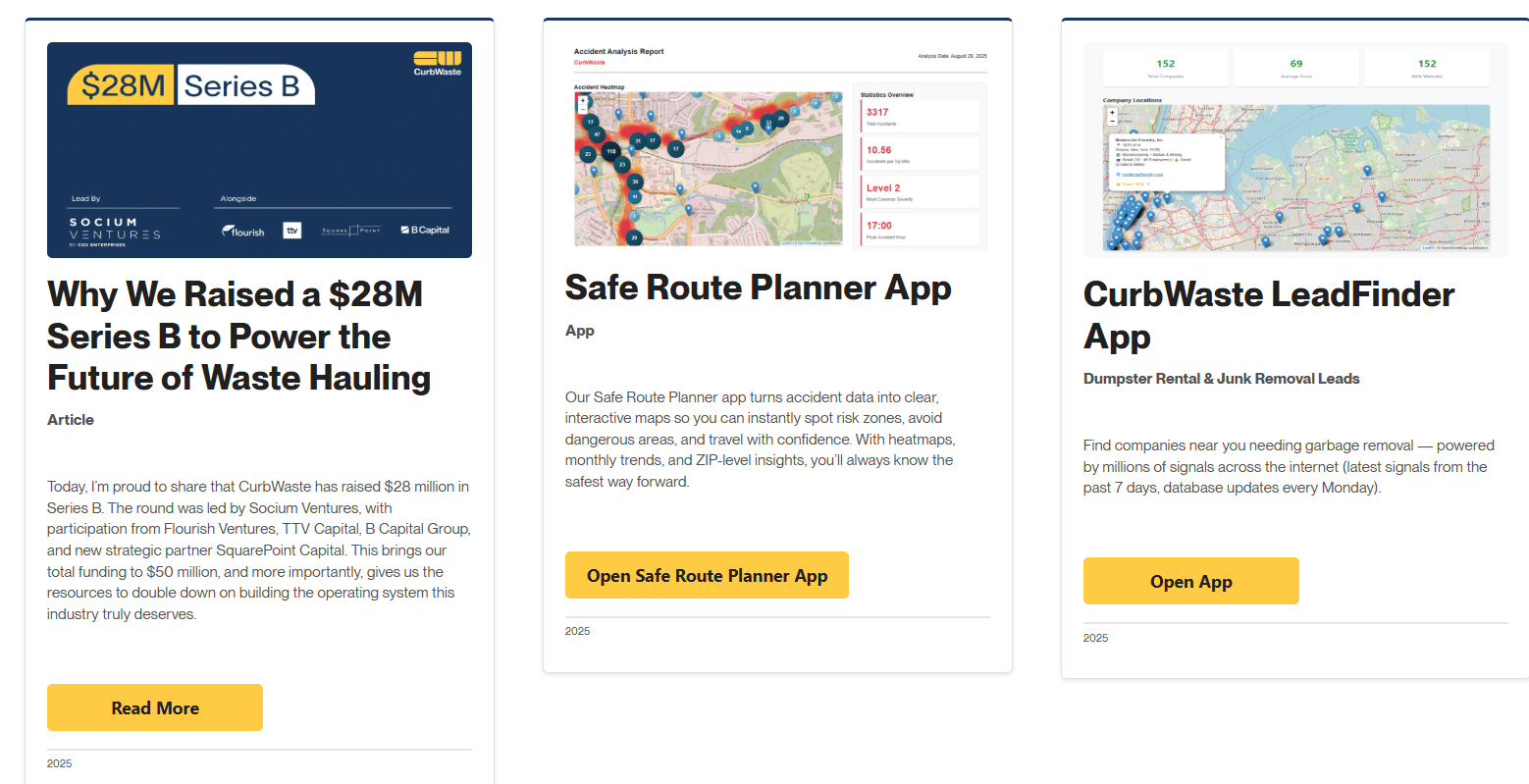
Some of their articles are short, others are longer. But all of them are made for industry professionals. They’re a subtle way to redirect prospects to their product. For example, in the article How to leverage data to impact your business, they’re giving tips on why you should consider a software solution for your business. (wink, wink)
Every article ends with Ready to get started? banner.
The top 1500 waste management companies and their innovative marketing technologies are actually a report, not an article. If their short description convinced you, you can access the report by clicking the Read Now button.
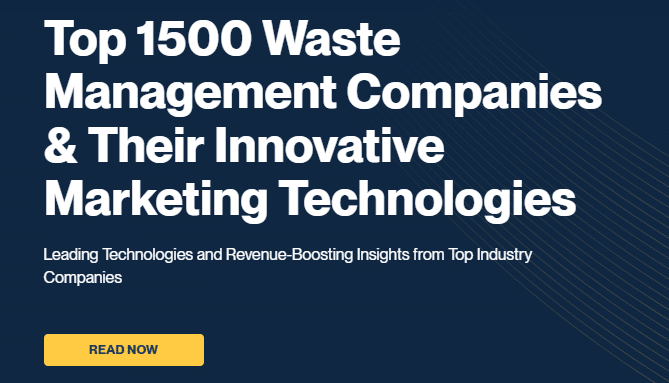
The report highlights the MarTech and AdTech usage of waste management companies across the following 13 technology categories, like: Web analytics, AB testing tools, marketing automation platforms, and CMS (content management systems).
Clicking any CTA button about their apps, you will be redirected to different free app pages, where you fill out a form, select the filters, and then you will receive the results.
A Watch Video button usually redirects to a Loom page with a webinar, like this one, called “Discover the Top 5 Must-Know Competitive Research Tools”.
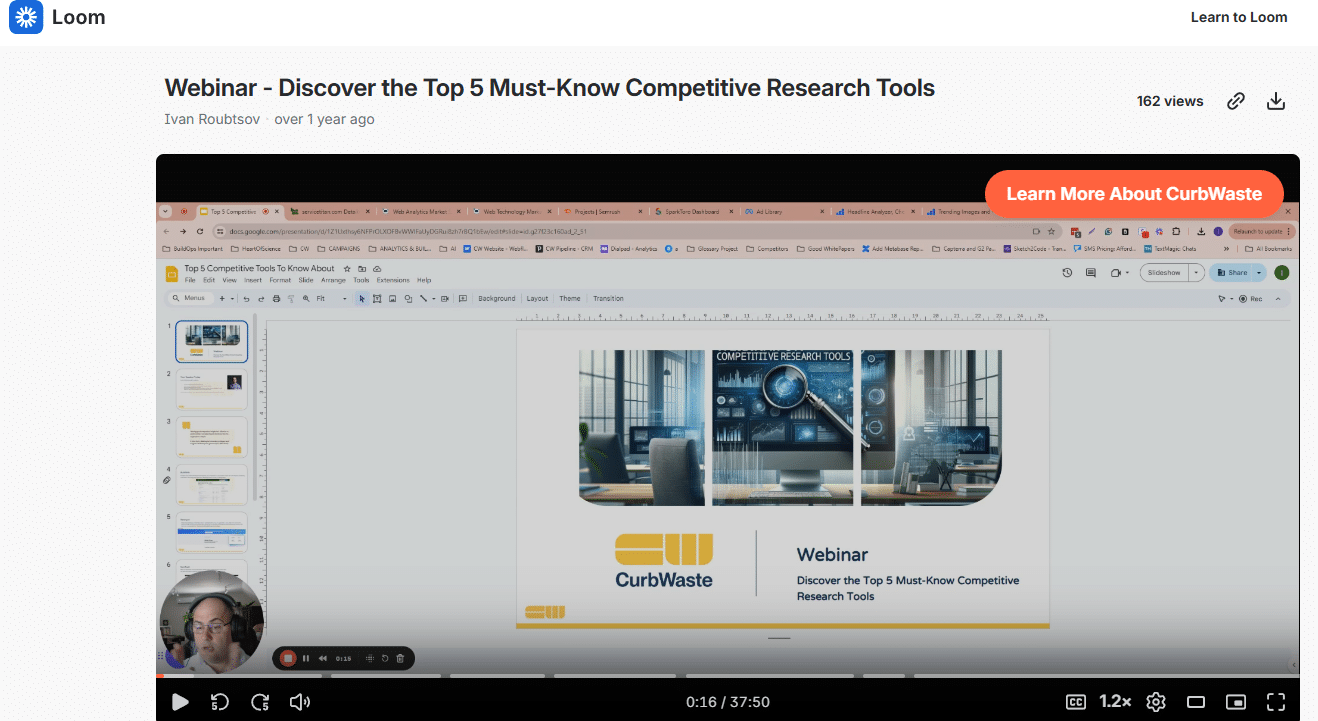
Using varied CTAs beyond standard “Read More” means that the content marketing recognizes different reader intentions and engagement levels. Someone reading an article about route optimization might want to try a route planning tool, while someone reading about industry trends might prefer to watch a webinar.
By offering multiple conversion paths within the same content experience, CurbWaste increases readers’ engagement to take action rather than simply consuming content and leaving.
Webinars & White-Papers

Following the same route as the blog page, you will find CTA buttons like Open App, Customizable Estimate Template App, Read More, Watch Now, and Open Database.
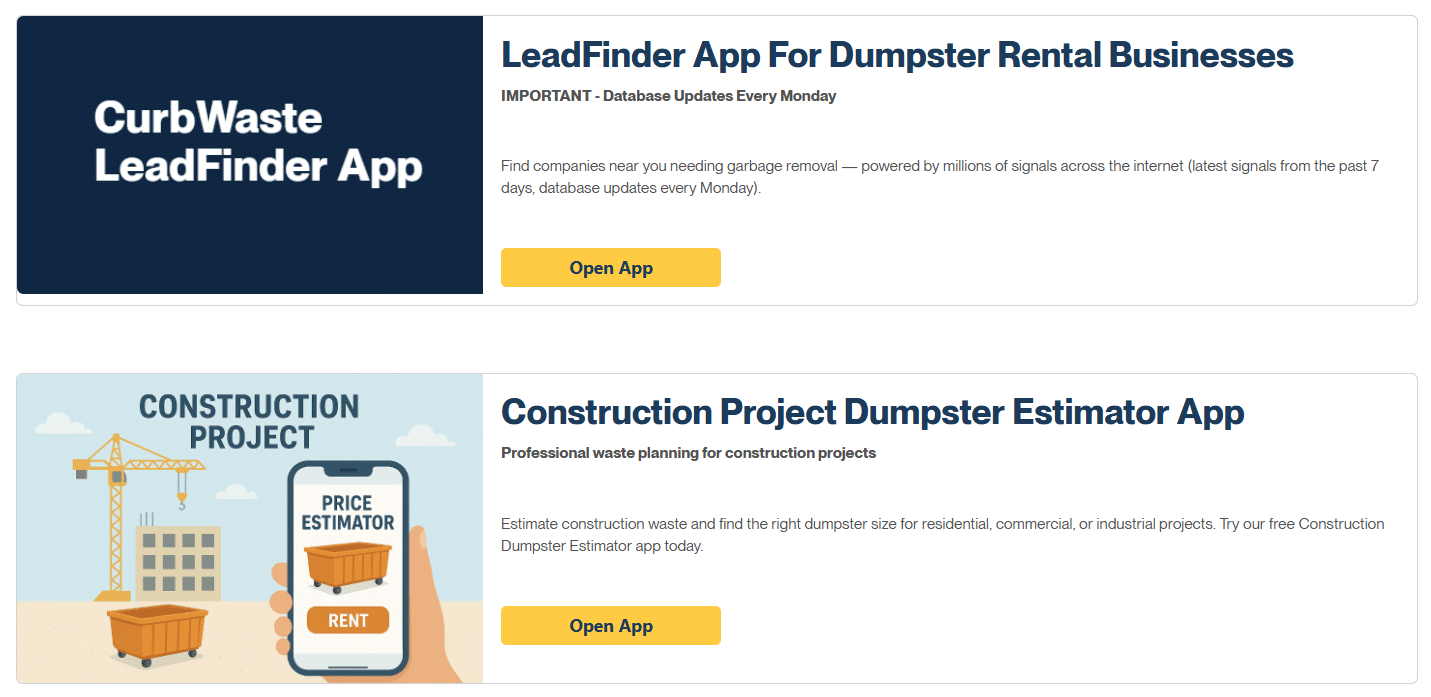
Click on any Read More button and you will find a 20k-word document, with the following structure:
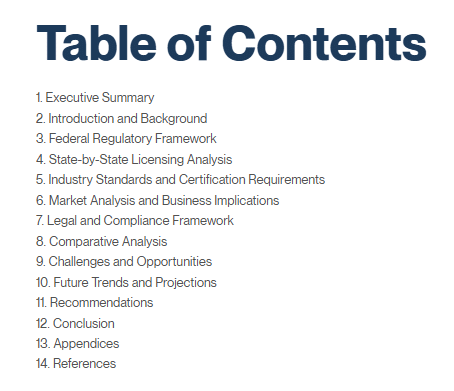
Publishing long-form content is an SEO strategy aimed at comprehensive topic coverage and authority building. These pages or guides target broad search queries where Google favors in-depth, authoritative content that fully answers a user’s question without requiring them to visit multiple sites.
However, this approach comes with tradeoffs. While long-form content can rank well and attract organic traffic, it requires significant time investment to read and may not align with how modern B2B buyers actually consume content. The effectiveness of 20k-word documents depends entirely on whether they’re structured for skimming (with clear headings, summaries, and actionable takeaways) or if they’re just dense walls of text that few people will fully read.
Marketing and Sales Funnel Stages
For the top of the funnel, awareness is made through their founder’s story, SEO-optimized content, and industry relationships rather than aggressive digital marketing. They publish long-form guides, glossary terms, and ungated industry reports that capture organic search traffic when haulers research waste management solutions. Their social media presence is minimal (sporadic posts on LinkedIn, Facebook, Instagram, with only 3 YouTube videos), and they have no X presence. Instead, they lean on word-of-mouth, peer recommendations, and face-to-face networking at industry conferences. It works for reaching their current audience, but limits broader visibility as they scale.
In the middle of the funnel, CurbWaste uses free utility apps and transparent pricing to move prospects forward without typical SaaS friction. Their apps, reports, calculators, and Network page provide immediate value while capturing lead information naturally. Use case pages segment solutions by service type (Roll-Off, Residential, Commercial), helping prospects see themselves in the platform. Video testimonials emphasize speed, ease of use, and industry understanding. They run paid ads on LinkedIn and Facebook, promoting credibility signals (funding news) and lead-gen tools (free reports). The major gap? No reviews on G2, Capterra, or GetApp, which matters when B2B buyers actively seek third-party validation during evaluation.
And for the bottom of the funnel, CurbWaste converts through demo requests and one-on-one sales conversations rather than self-service trials. The Get Demo button appears on every page, leading prospects into direct conversations with people who understand hauler pain points. Customer testimonials reinforce tangible outcomes. They promise fully customized onboarding, training, and structured change management to address the primary barrier preventing small waste companies from adopting new technology. The funnel relies on industry credibility and practical utility over digital polish, which matches their current customer base but may struggle as younger decision-makers enter the market, expecting more digital presence and customer reviews.
Future Plans and Growth Indicators
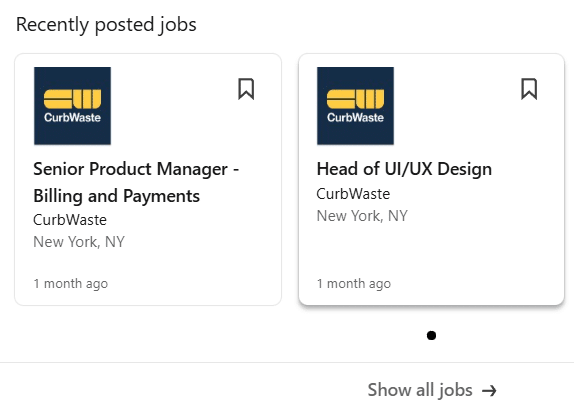
On their Careers page, we can see these openings as of November 2025. It looks like they’re searching for months for Prince Charming.
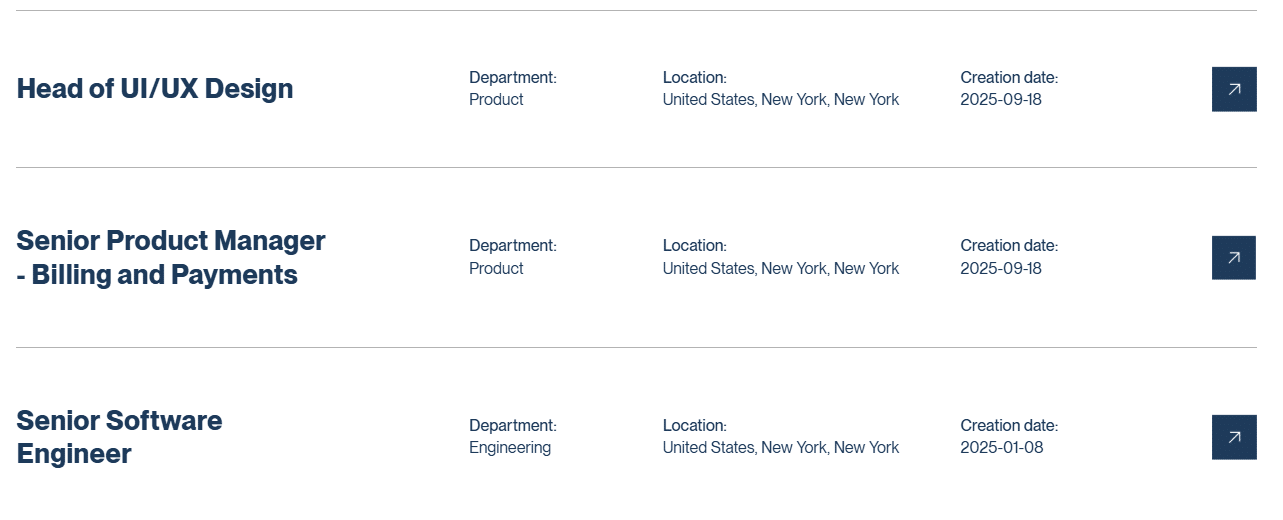
Scrolling, we can see a cool feature: the possibility to send them your CV, even if they don’t have a specific role listed for you.

This open application approach means they’re looking to scale rather than just filling immediate gaps. Companies that offer general application submissions tend to be in expansion mode, looking to bring on talented individuals even before specific roles are defined. For candidates, this suggests a dynamic environment where new positions emerge regularly. For prospects evaluating CurbWaste as a potential software partner, active hiring indicates financial stability and growth trajectory, which matters when committing to a software platform that will run your business operations.
Looking side-by-side with LinkedIn it’s possible that they don’t update their site very often, as we couldn’t find the Senior Software Engineer position.
Inspiration Points
B2B SaaS companies are either everywhere or invisible online. Too much gated content or too much free stuff. The real move? Understand your ICP. Know how they think, where they spend time, and what they actually need. Choose channels based on that, not vanity metrics.
CurbWaste nailed three things.
1. Founder authenticity.
Mike Marmo was a waste hauler who got fed up with bad software, so he built his own. That story isn’t manufactured; it’s a lived experience, and it shows up everywhere. When you’re asking independent operators to change how they run their business, that credibility matters.
2. Utility over visibility.
They built tools people actually use: lead finders, competitor reports, valuation calculators, and an industry glossary. No annoying gates. Just functional resources that prove they get the waste management grind. Independent haulers don’t have time for webinars or 15-touch nurture sequences. They need software that works today.
3. Their website does the heavy lifting that social media doesn’t.
Clear pricing, segmented use cases, straightforward feature pages. The Network page turns into a lead-gen tool disguised as a directory. Smart.
Their social media presence is small, and you could call that a missed opportunity. But their customers aren’t scrolling LinkedIn at 2 pm. They’re running routes and managing chaos. The question: does this low-key approach scale, or will they eventually need to turn up the volume? Here’s the gap: strong industry credibility, weak digital presence. Even if you rely on face-to-face marketing, you need updated digital content. Otherwise, a competitor gets there first. CurbWaste shows you don’t need perfect execution everywhere, just excellence where your customers actually make decisions. Minimal LinkedIn but comprehensive website. Low social engagement but crystal-clear messaging. No review platforms, but solid video testimonials. Figure out what brings in customers, then do more of that. Double down on what works, even if it means ignoring conventional wisdom.
We hope you found this article helpful and full of inspiration for your future digital marketing campaigns. There’s much more to come, so be sure to follow us as we continue to analyse and share insights from tech companies’ digital marketing and sales strategies.
Frequently Asked Questions
1. What is CurbWaste, and what does it offer?
CurbWaste is an all-in-one waste management software platform built specifically for waste haulers. The platform centralizes waste management operations for haulers by combining order management, fleet dispatch, inventory tracking, driver mobile apps, and automated invoicing into a single system.
2. What makes CurbWaste different from other waste management software providers?
CurbWaste is built by industry veterans who understand the challenges of running a successful waste business firsthand. Its software offers an integrated solution tailored for waste and recycling haulers, combining CRM, task management, online ordering, invoicing, payments, and real-time dispatch into one platform. This integration enables haulers to streamline their operations at every step in real time, improving customer communication, operational efficiency, and business insights.
3. How does CurbWaste approach content marketing?
CurbWaste focuses on long-form, high-quality content, including blog articles, use cases, and free tools. Their content is customer-focused and addresses waste management challenges.
4. Is CurbWaste active on social media?
CurbWaste’s social media presence is limited, with their LinkedIn, Facebook, Instagram, and YouTube pages being moderately active. They post infrequently and focus mainly on sharing customer testimonials, event participation, and employee highlights.
5. Who is CurbWaste best suited for?
CurbWaste is built primarily for independent waste and recycling haulers who manage roll-off, residential, and commercial services, as well as transfer stations using CurbPOS. It’s especially useful for family-run and regional operators who want to centralize orders, dispatch, billing, and inventory in one system instead of juggling spreadsheets, paper tickets, and generic software.
6. How does CurbWaste support onboarding and change management?
CurbWaste uses a structured change management approach with clear phases: assessing your current operations, aligning stakeholders, training teams, implementing the software, and monitoring results over time. The goal is faster adoption with minimal disruption, so crews, dispatchers, and office staff can transition from legacy systems to CurbWaste without losing productivity.