Marketing spotlight
/
Marketing Spotlight: Mapping Monday's Marketing and Sales Tactics
In this article, we put monday.com in the “Marketing Spotlight” as we take a closer look at how their sales and marketing strategies are working and what sets them apart in August 2026.
TL;DR: Conclusions and Key Takeaways
🎀 This section gives you the main insights without all the details. It’s the stuff you need to remember, whether you’re reading this now or in 6 months. We made this for people who want to get the core message fast.
Monday is an AI work platform that helps teams manage projects, sales, service, and development from one place. This article breaks down how monday.com builds trust, sells, and shows up across social, ads, reviews, and content, and where the gaps sit underneath the polish.
Key Takeaways
Monday anchors every trust claim to a hard number tied to a named client, and that specificity is what cuts through an AI-saturated market right now.
The AI agent builder strips out the technical step entirely: describe, connect, watch it run, which matters more than the AI itself, since adoption usually stalls the moment a tool needs a developer.
The paid Academy certifications are one of Monday's strongest retention tools, creating a switching cost no discount would replace.
Alongside its broad product ads, Monday runs separate copy built around single, specific buyer pain points, like HR teams drowning in candidate sourcing.
📝 A quick note before you start reading: The data and analysis in this article are valid as of the time we wrote it. We don’t know when you’ll be reading this, maybe next week, maybe six months from now, and things might have changed since we looked at this company’s marketing and sales approach. Still, the insights and lessons here stay useful, even if the numbers or tactics have evolved a bit.
Before it was a Nasdaq-listed AI platform, Monday was an internal tool built to solve a communication problem at Wix. Teams were scaling faster than their existing tools would handle, work was getting lost between people, and nobody had a clear view of who was doing what. That specific, unglamorous problem became the entire foundation of the company.
At Milk and Cookies Studio, we spend our time helping B2B SaaS companies figure out how to turn a product into a marketing and sales system that converts. A company that took an internal fix, rebuilt it into a public platform worth billions, and still centers its entire homepage on hard, named-client numbers is exactly the kind of case worth looking at. The data and analysis here are valid as of August 2026.
Understanding Monday
Monday was founded in 2012, originally as an internal tool built inside Wix by Roy Mann and Eran Zinman to fix the communication and project tracking problems that came with Wix's rapid growth. Recognizing the tool had value beyond Wix's own walls, Mann and Zinman spun it out as a separate company under the name daPulse, with Wix as its first customer. The product itself launched to the wider market in 2014, and in November 2017 the company rebranded from daPulse to monday.com.
Monday is headquartered in Tel Aviv, Israel, with additional offices including New York, and today serves customers across more than 200 industries worldwide. The core platform is a no-code work operating system that scales from a single person tracking personal tasks to full enterprise process management, with dedicated product lines covering project and work management, CRM and sales, service management, and software development.
The company's own product marketing frames all of this as one connected, AI-powered foundation rather than four separate tools bolted together. Headcount has grown past 3,000 employees globally.
Monday's last major private funding round came in July 2019, a $150 million Series D led by Sapphire Ventures, with participation from Hamilton Lane, HarbourVest Partners, ION Crossover Partners, and Vintage Investment Partners, valuing the company at $1.9 billion.
Less than two years later, Monday went public on Nasdaq under the ticker MNDY in June 2021, at a valuation north of $8 billion. That IPO marked the shift from venture funding rounds to public market financials, which is where the company's growth story picks up today, covered in more detail later in this article.
Brand Promise Analysis
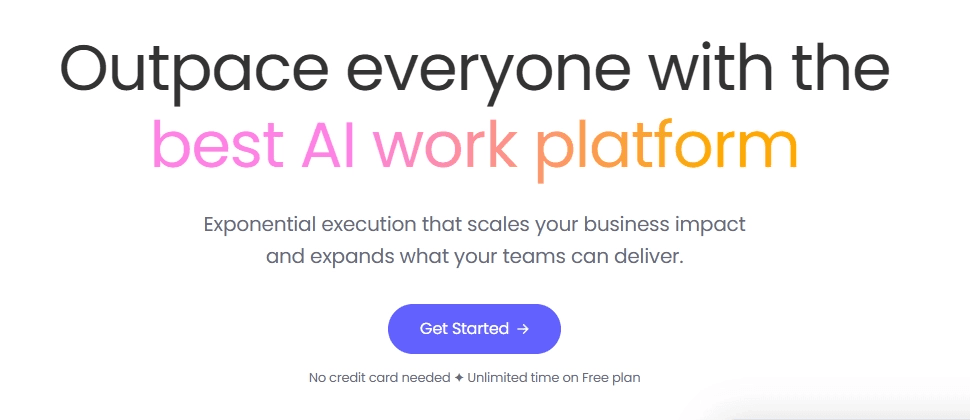
Monday 's homepage promise is direct: "Outpace everyone with the best AI work platform." The supporting line pushes the same idea further, promising exponential execution that scales business impact and expands what teams can deliver. No credit card is needed to start, and the Free plan comes with unlimited time to try monday out.
The homepage banner lists names like CAT, Universal, Coca-Cola, Lionsgate, and Carrefour, positioning monday as a platform big brands already rely on.
Monday's pitch centers on AI woven directly into the work itself. The AI-powered product suite is framed as a way to solve every work challenge, with each product built for a specific department and all of them connected to run operations across the organization from one place.
The platform is built on one open, connected, and context-aware foundation. Monday describes this as an open ecosystem with unified data, infinite knowledge, and integration with any AI model, which is the technical backbone behind the "everything connected" promise.
Purpose-built solutions exist for PMO and Ops, Marketing, Sales and Revenue, IT and Support, and Product and Engineering, all sitting on the same intelligent platform so teams stay aligned without switching tools.
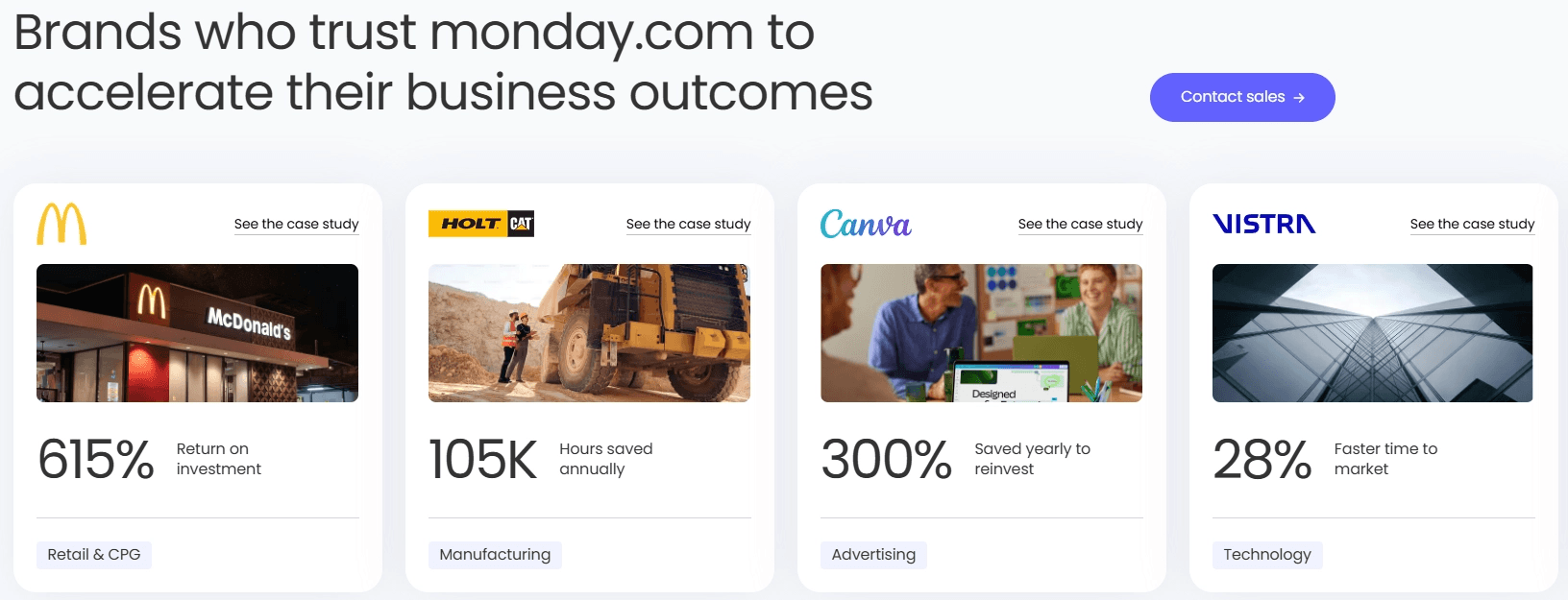
The case studies lead with numbers. McDonald's reports 615% ROI, Holt-CAT saves 105,000 hours a year, and Canva reinvests 300% in savings annually. These are the proof points Monday puts front and center rather than generic praise. Motorola is cited as a 346% result according to the referenced research, another named-brand proof point layered onto the homepage.
Security gets its own spotlight. Monday describes enterprise-grade AI infrastructure with built-in protection, data privacy, governance, permissions, and compliance, backed by GDPR, AICPA SOC 2, ISO 27001, and HIPAA certifications.
Monday also positions itself as the only work management platform recognized as a Leader in the Gartner Magic Quadrant, a credibility marker aimed squarely at enterprise buyers doing vendor comparisons.
The homepage closes on the same note it opened with: "Are you ready to outpace everyone with the best AI work platform?".
HubSpot's 2026 State of Marketing report points to exactly this specificity: in a market flooded with AI-generated claims, the brands winning attention are the ones with a sharp, evidenced point of view. Monday skips the vague "trusted by thousands" language and goes straight for numbers tied to named companies, which is the harder thing to fake.
McDonald's, Motorola, Holt-CAT, and Canva span food service, telecom-adjacent manufacturing, industrial equipment, and creative software, four distinct verticals chosen so that a buyer from almost any large-enterprise sector sees a company that looks like theirs.
That is an account-based signal sitting inside a brand page most readers would read as generic social proof. Paired with the Gartner Magic Quadrant callout, the homepage is quietly speaking to a buying committee, even while the free trial CTA sitting a few lines above speaks to exactly that individual. The result is a homepage doing double duty for two different buyer types at once.
💡 Steal This: Attach a specific, named-client number to every big claim you make. "615% ROI" from a real company beats any adjective, because a number is something a buyer can repeat to their own boss.
Service and Product Breakdown
Pricing structure
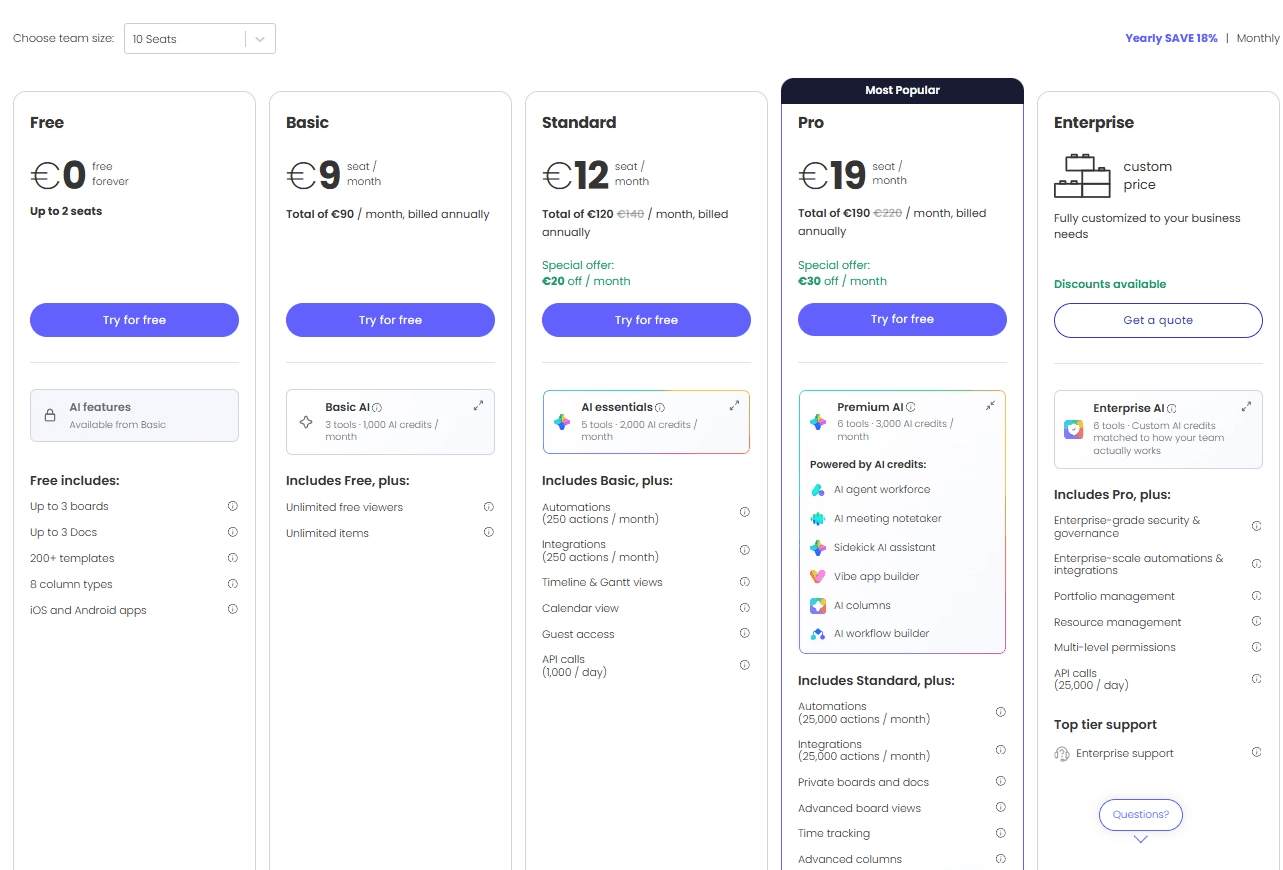
Monday runs five pricing tiers for its core work management product. Free covers up to 2 seats. Basic costs €9 per seat per month and includes unlimited free viewers and teams. Standard, the most popular tier, is €12 per seat per month and adds automations, integrations, Timeline and Gantt views, Calendar view, guest access, and API calls.
Pro is €19 per seat per month and unlocks private boards and docs, advanced board views, time tracking, and advanced columns. Enterprise adds enterprise-grade security and governance, enterprise-scale automations and integrations, portfolio management, resource management, multi-level permissions, and top-tier support.
Monday CRM has four tiers: Basic at €12 per seat per month, Standard at €17, Pro at €28, and Ultimate at custom pricing. Monday Service runs at €31 per seat per month for the base tier, €45 for Pro, with Enterprise on custom pricing. Monday Dev starts at €9 for Basic, €12 for Standard, €20 for Pro, with Enterprise on custom pricing.
AI agents
Monday's AI platform layer is built around agents, ready-made or custom, that act directly inside the tools teams already use. Building one is presented as a three-step process: describe what you need, connect the knowledge and tools the agent should use, and watch it work.
Monday sidekick

Sidekick is monday's AI assistant, described as understanding the work itself. It is built to think, recommend, and run work at scale, positioned as a way to speed up execution rather than track it.
Security and control get the same four-part breakdown as the rest of the AI suite: enterprise-grade security built on Monday's existing standards, private-by-default data and chats that stay untouched unless the user shares them, actions that run only with user approval, and full visibility into every step taken so nothing happens without the user knowing why.
Monday Vibe turns plain language into work apps. Describe what is needed, and Vibe adds secure, custom work apps to the workspace in moments. Monday's automation layer is code-free and covers notifications, date reminders, auto-assigned tasks, task creation, custom automations, ready-made automations, and task handovers, all aimed at cutting manual admin work out of the day.
The three-step framing on agents (describe, connect, watch it run) matters more than it looks. HubSpot's 2026 AI predictions report notes that over 64% of organizations already use AI in some marketing or work capacity, but adoption stalls the moment a tool asks for technical setup.
Monday collapses agent building into language a non-technical operator can follow, which is the same reason its no-code automation layer works. The barrier is not whether AI can do the task. The real barrier is whether the person setting it up needs a developer in the room, not whether AI can do the task.
💡 Steal This: Collapse your most complex feature into three plain steps anyone can follow. The fastest way to drive adoption of something powerful is to make it sound simple.
Differentiators and Unique Assets
Monday academy

The Academy offers lessons, learning paths, certifications, and webinars, covering everything from monday fundamentals for beginners to account security and management for admins. Certification pricing runs $95 for the Admin certification, $95 for the CRM certification, $195 for the Work Management Advanced certification, and $95 for the Work Management Core certification.
mondayERT (Emergency Response Team)
Monday runs a dedicated program supporting aid organizations that respond to disasters, helping them scale crisis response through digital transformation of their core emergency operations. The support spans the disaster stage itself as well as preparedness and recovery, with the stated goal of scaling partner impact during crisis response.
Monday spaces

Spaces works differently than a typical template library. Any account admin can take an existing workspace, built for a real use case, and publish it as a "Space" for the wider monday community to browse and clone directly into their own account.
Before it goes live, the submission gets reviewed and categorized as Enterprise use cases, Editors' Picks, or Newly Added, and the person submitting it has to answer three questions: who the space is for, what problem it solves, and what impact it had, ideally backed with numbers or screenshots.
The result is a gallery that ranges from niche, almost playful use cases, tracking wedding vendor logistics, checking game room usage, to full enterprise process templates a company might otherwise pay a consultant to build.
In effect, Monday's own power users are running an unpaid product research and content pipeline, and any prospect browsing Spaces gets an instant, working example of the platform solving a problem shaped exactly like theirs.
The Startup for Startup Podcast
Each episode digs into a different challenge Monday faced while growing as a company, covering everything from how the company culture was defined to the thinking behind its product methodology.
Userpilot's 2026 guide on B2B loyalty points to certification-based education, the same model behind HubSpot Academy and Salesforce Trailhead, as one of the few loyalty mechanics that survives champion turnover. A certified admin has sunk hours into learning Monday specifically, which raises the switching cost of leaving far more than a discount ever would.
Taken together, these four assets aim at four different moments in a buyer's decision. The Academy raises switching costs after the sale. Spaces gives a prospect proof the platform works for their exact use case before they ever talk to sales. The Emergency Response Team is the kind of story that gets picked up by press and adds a halo to the brand that no product page could manufacture on its own.
The Startup for Startup Podcast opens up the company's own internal decision-making to anyone evaluating whether Monday is a company worth betting a workflow on. Most SaaS companies pick one of these levers. Monday is running all four at once, and each one is doing a job the others cannot.
💡 Steal This: Build a set of differentiators that each target a different moment in the buyer's journey, not four versions of the same trust signal. A certification, a customer showcase, a cause-driven program, and an internal story each convince a different kind of skeptic.
Leadership Presence Analysis
Roy Mann, co-founder and Co-CEO
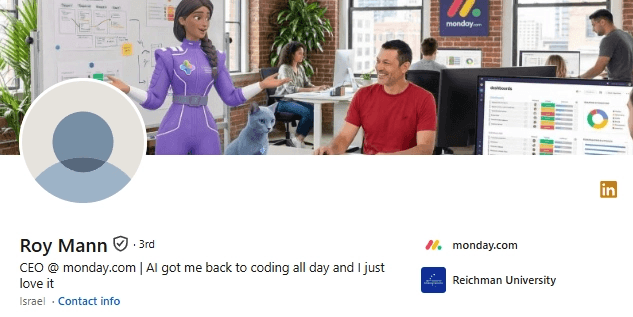
Roy Mann runs a modest LinkedIn presence for someone leading a company of Monday's size. He has 8.3k followers, and he posts a few times a month. His content stays close to home. Almost every post is about Monday itself, the product, the team, or the company's direction, with little personal branding layered on top.
Engagement sits in a consistent range: his posts pull almost 200 reactions, 5 comments, and a handful of reposts each time. That is a modest number relative to his follower count, but it reads as an audience that shows up reliably rather than one that spikes and disappears.
Eran Zinman, co-founder and Co-CEO

Eran Zinman's LinkedIn footprint looks different from his co-CEO's. He has 31k followers, nearly four times Roy Mann's count, but he posts far less often, roughly once every couple of months. When he does post, the results vary widely.
Some posts pull in the hundreds of reactions with only a few comments, the kind of numbers you would expect from an exec audience that reacts but rarely engages in discussion. One post breaks that pattern completely: his post about his journey to Monday and the company's start with agents pulled 1.7k reactions, 102 comments, and 165 reposts, a result that stands far above anything else on his profile.
That gap between his usual output and this one post says something about what moves his audience: not routine company updates, but a personal story tied to a moment the company is betting its future on.
Metricool's 2026 LinkedIn study, which analyzed over 673,000 posts across more than 63,000 accounts, found personal profiles outperform company pages by 63% on engagement and generate 238% more comments per post. Monday's own numbers back this up directly: a single personal post from Zinman had more reactions than several months of the company page combined. The lesson is that personal posts matter more than generic company content.
Executive-voice content is one of the few formats that reaches senior buyers who ignore brand pages entirely, and Monday has two co-CEOs already producing it organically, for free.
💡 Steal This: Let a founder post rarely and personally instead of putting them on a content calendar. One real story from a real person can outperform months of scheduled company posts.
Social Media Strategy
Monday's LinkedIn page has 353k followers, and the content here carries the most polish of any channel. The mix leans on brand storytelling. The BAFTA-nominated short film and the Odyssey-timeline post both ran here first, alongside product and agent announcements, and the occasional culture or employer-brand piece, like the kids' apparel post.
Everything is delivered in English, with average engagement around 100 reactions, 10 comments, and a matching number of reposts. Of every channel, this is the one built to be shared inside a company.

Monday's Facebook page has 407k followers. The tone here shifts noticeably more formal than Instagram, and nearly every video is reformatted specifically for Facebook rather than reused as-is. The content leans heavily promotional. Average engagement sits around 20 likes per post, with light comments and shares.

Monday's Instagram account has 209k followers, organized around 7 story highlights: CX Corner, Events, ERT, CRM, Pride, Partners, and In The News. Average posts have around 70 likes with light comment activity. The format mix includes single images, carousels, and video. The tone leans playful but product-anchored, like the post comparing Monday's own on-time project delivery to the ten-year delay of the Odyssey timeline. Beyond the jokes, the feed covers product features, agents, case studies, and events.
X (formerly Twitter)
On X, monday has 40.7k followers. The content is essentially a blend of what runs on Facebook and Instagram. Engagement is thin, a handful of likes, shares, and reposts per post, with reach averaging around 1.5k views.
YouTube

Monday's YouTube channel has 107k subscribers, 1.2k videos posted, and a combined 1,349,851,774 views. The content spans long-form videos, Shorts, podcasts, courses, and webinar recordings, organized into 89 playlists, including Spanish-language playlists, product tutorials, and webinars.
The course library includes: Reporting in monday.com (webinar), The Formula Column (webinar), Building Workflows in monday.com (new course), Getting Started with monday projects (webinar), Getting Started with monday marketer (webinar), and Getting Started with monday sales CRM (webinar). The podcast, The Standup, has 13 episodes released. Content is written in multiple languages, including English, Spanish, Portuguese, German, and French.
TikTok
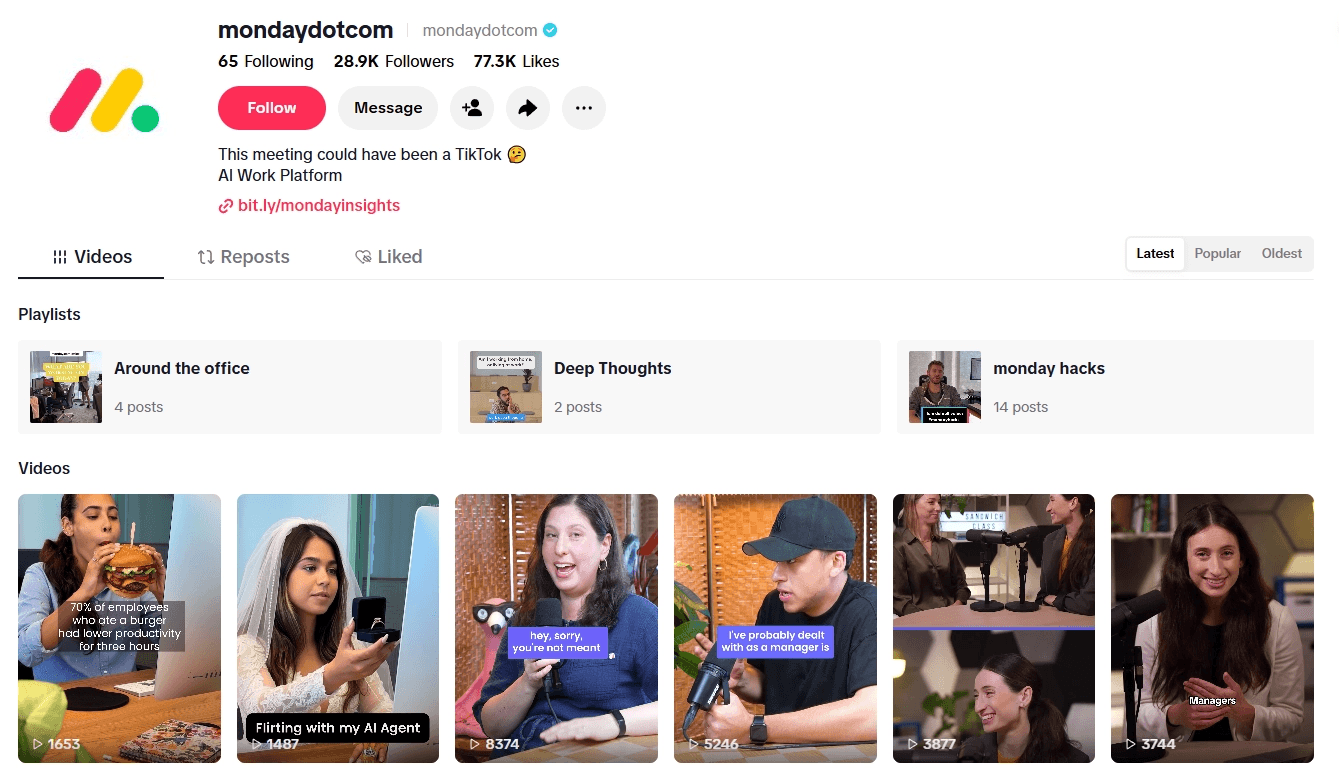
There is confusion built into Monday's own site. One linked account shows only 37 followers and no content posted yet, while the actual active account, mondaydotcom, has 28.9k followers and 77.3k likes, organized into three playlists: Around the Office, Deep Thoughts, and monday hacks.
Average views land around 5k per post, with about 50 likes, 10 comments, and 5 saves or sends. The content mixes funny videos with interviews, but since the most recent posts date back to January, this channel will not be analyzed in the Top-Performing Content section.
HubSpot's 2026 State of Marketing report found Instagram at 48.4% B2B usage, YouTube at 40.5%, Facebook at 36.9%, and X at 31.3%, the same order of priority Monday's own follower counts roughly reflect (Instagram 209k, YouTube 107k, Facebook 407k, X 40.7k). What the data does not explain is engagement quality.
Facebook's 407k followers pulling only 20 likes per post, against Instagram's 209k pulling 70, suggests Monday is treating Facebook as a distribution checkbox rather than a channel it is optimizing for.
Monday runs genuinely native content across English, Spanish, Portuguese, German, and French. A native-language playlist, webinar, or course shows "we built this for you."
Given that Monday serves customers across more than 200 industries and a genuinely global footprint, that difference in effort is exactly why the multilingual content earns real regional relevance instead of reading as an afterthought, and it lines up with the same language-matched routing documented later in the Paid Advertising chapter, where Spanish ads land Spanish visitors on a Spanish site.
💡 Steal This: Give each platform its own voice instead of recycling one tone everywhere, and where you localize, build content natively in that language rather than subtitling one master version.
Top-Performing Content

A short film by a BAFTA-nominated director brought in 413 reactions, 51 comments, and 71 reposts, the strongest LinkedIn result in the set.
The monday kids' apparel post earned 407 reactions, 16 comments, and 6 reposts.
The Odyssey-themed post pulled 300 reactions, 21 comments, and 26 reposts.
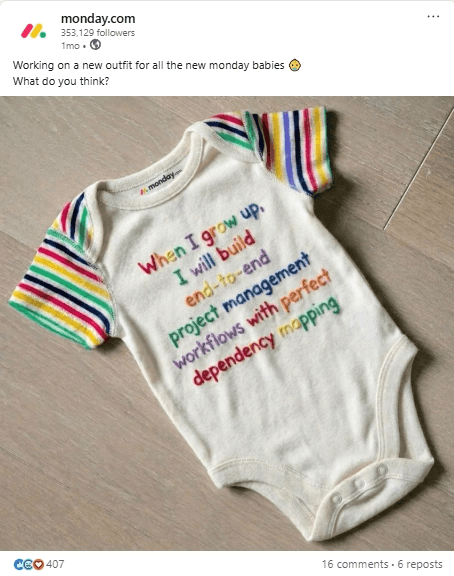
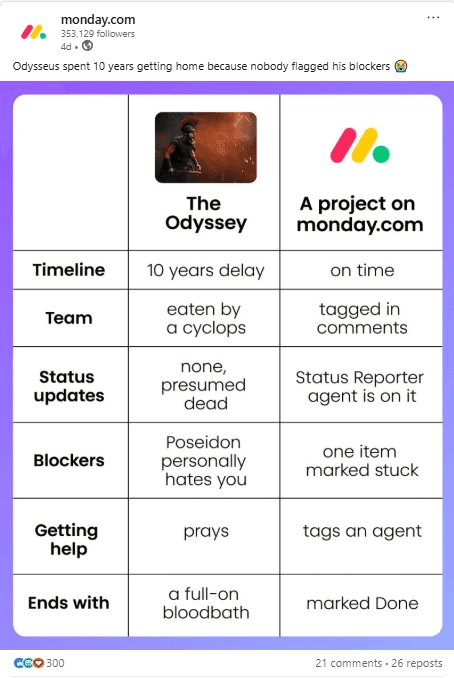
What stands out here is that none of the top three are straightforward product posts. A short film, a merchandise drop, and a pop-culture reference all outperformed anything pulled straight from the product roadmap. LinkedIn's audience for Monday is clearly responding to craft and cultural relevance first, product news second, which tracks with why the channel carries the platform's most polished content overall.
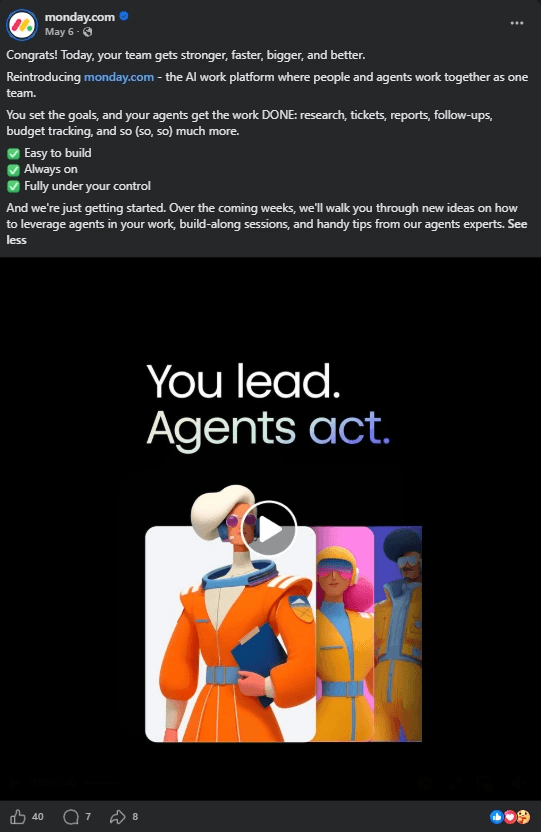
The agents post reached 40 likes, 7 comments, and 8 shares.
A video about people and agents working together closed out the top three with 30 likes, 19 comments, and 8 shares.
The Create Draft tool for Gmail post pulled 26 likes, 12 comments, and 1 share
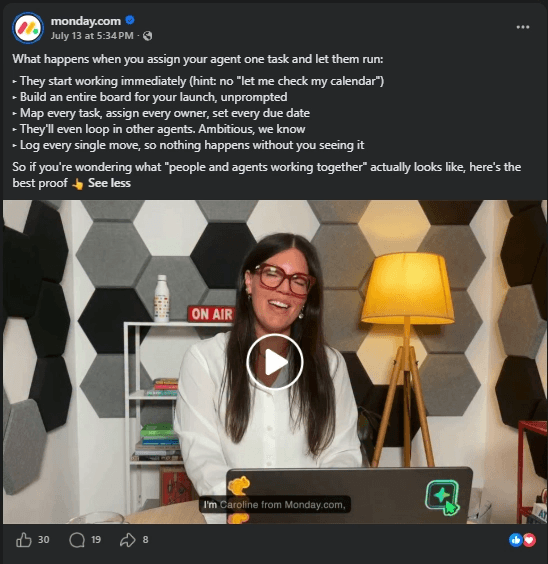
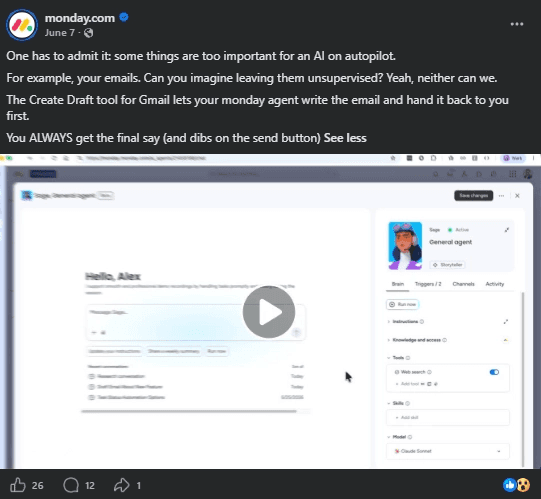
All three top Facebook posts are product-focused: agents, a specific integration, a workflow demo, which fits the more formal, promotional tone documented in the Social Media Strategy chapter. The ceiling here is low across the board, even the best post barely clears 40 likes, which suggests Facebook's audience for Monday engages with product news out of habit rather than genuine excitement.
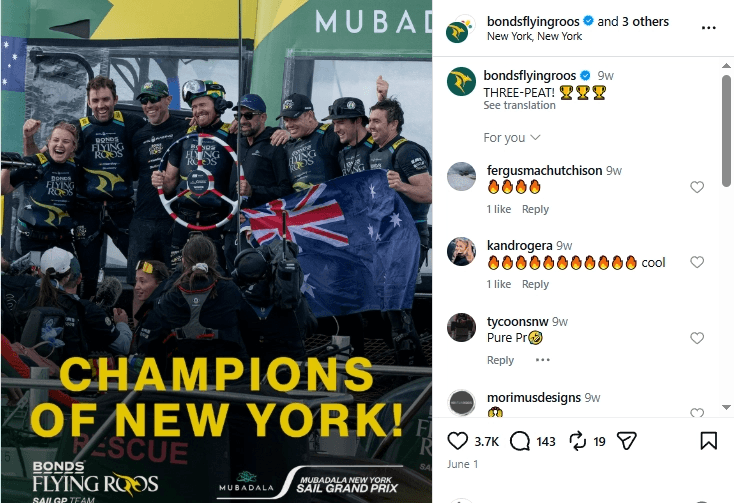
A collab post with Bonds' Flying Roos, tied to the New York Champions moment, led the pack with 3.7k likes, 143 comments, and 19 reposts.
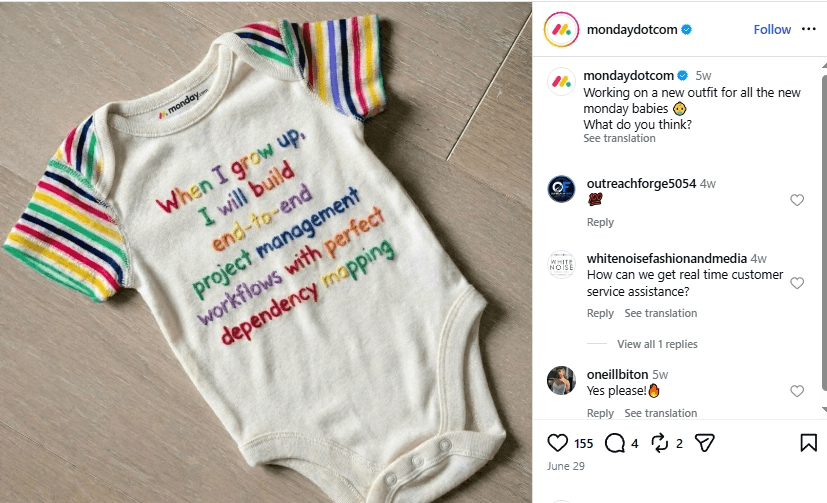
The monday baby apparel post pulled 155 likes, 4 comments, and 2 reposts.
The "5 new monday agents" post closed the top three with 110 likes, 4 comments, and 4 reposts.
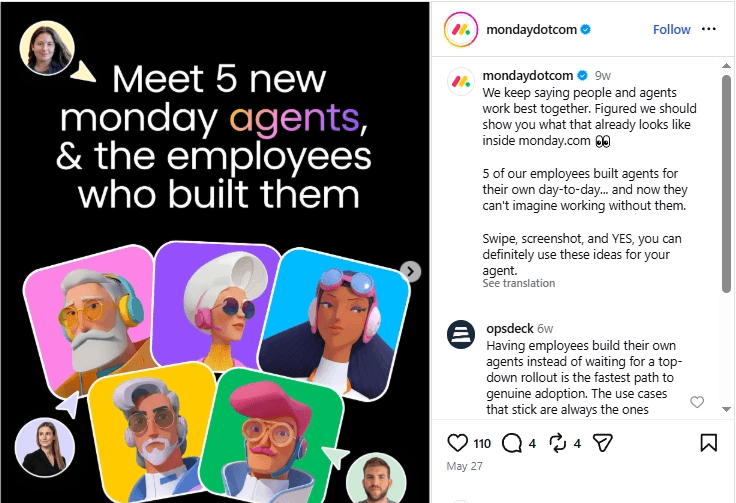
The collab format is doing something the account's usual content cannot, and the size of that gap between the posts is the clearest tell in the entire research that collaboration content deserves a bigger share of the calendar.
Youtube
1. Long form videos

"Descomplique seus processos de gestão do trabalho com a monday.com" leads with 104M views, 1.9k likes, and 15 comments.
"monday sidekick: AI that actually works" appears twice in the top results, one version at 57M views with 14 likes and 1 comment, and another at 52M views with 33 likes and 5 comments.
2. Shorts

"The War on Potholes pt. 130 #shorts," which shows Monday being used to report potholes in New York, pulled 13k views, 569 likes, and 7 comments.
"Send lots of emails to lots of people in a click with mass emailing! Need a step-by-step? #shorts" pulled 8.9k views, 126 likes, and 3 comments, tied to Monday CRM's phone call logging automation.
"Log calls on mobile: You won't believe how easy it is to log calls on the go #shorts" pulled 6.8k views, 75 likes, and 10 comments.
The second and third spots in the long-form ranking are the same video, with different views and for Shorts, names.
Extremely high views paired with almost no interaction is the signature of paid video placements, pre-roll or in-feed ads that autoplay in front of a large audience that never chose to watch, rather than organic search or recommendation traffic. The most likely explanation is that one of these two entries is the organic upload and the other is the same video running as a paid ad unit, which would explain why the title, content, and rough performance shape repeat almost exactly while the videos are cataloged as two separate entries.
Views and likes move together in a normal ratio across all three, which confirms this is organic performance, not paid reach. The strongest Short is also the most narratively unusual one, a real-world, slightly absurd use case (reporting potholes), which suggests Shorts audiences reward a surprising story over a straightforward feature walkthrough.
Conclusions
Co-branded content pulls 36% more engagement than solo brand posts, according to 2026 HubSpot data. But the per-channel pattern underneath that headline number matters just as much: LinkedIn rewards craft and cultural relevance, Facebook rewards nothing in particular, X rewards technical AI news for a narrower audience, and Shorts rewards a genuinely surprising real-world story over a tidy feature demo.
Monday runs almost no collab content and very little of the surprising, real-world storytelling that its own Shorts and Instagram data say works best. The evidence for what to make more of is right there.
💡 Steal This: Read your top post on each platform as a different lesson. Monday's own data points to collabs on Instagram, craft and culture on LinkedIn, technical news on X, and surprising real-world stories on Shorts, four distinct playbooks hiding inside one account.
Paid Advertising Strategy
Monday runs almost 3,000 ads on LinkedIn, all pointing straight to the website, whether that is webinars or product pages. Formats span single image, carousel, and video. Recurring copy includes lines like: "See monday agents work right inside your boards, with your business context built in from day one. Connect agents to any tool via MCP, get set up fast, and keep full visibility across every process. Plus: a first look at monday.com's redesigned AI Work Platform."
Other variations read: "You've got agents at your fingertips on monday.com. See what they can do for your team today,"and "You're already on monday. But that tedious task you keep dreading by hand? There's an agent for that. Turn your biggest work pet peeves into workflows that run themselves, inside the workspace you already use."
The dominant CTA button across these ads is "Learn more." Impressions sit around 10k per ad, targeted at the United States, India, Canada, and Mexico.
A separate set of LinkedIn ads runs pure text, aimed at HR and recruiting use cases: "Hire strong talent faster. AI agents handle sourcing and screening so you stop losing time searching," "Skip the sourcing grind. AI agents pre-screen candidates. You skip straight to the shortlist," and "Cut time-to-hire with AI. Agents screen candidates so you spend time only where it counts."
Meta
Across Meta's platforms, Monday runs around 910 ads, mostly single images and video, split between Spanish and English copy. Spanish examples include "Todo tu trabajo en un solo lugar" (all your work in one place) and "Crie processos para o seu trabalho fluir e colaborar com eficiência," (create processes so your work flows and you collaborate efficiently) ****paired with bullet points like "Fácil de usar e personalizável" (easy to use and customizable) and "Importe seus dados de outras plataformas com facilidade." (import your data from other platforms with ease)
**English examples include "There's a reason why 250K+ customers use monday.com to efficiently manage their teams, work and processes. See why," and "Your HR team wasn't hired to coordinate. Let monday.com agents handle the tedious work so they can focus on people." The routing is consistent with the language: Spanish ads land on the Spanish version of the site, English ads on the English version. There are no TikTok ads.
Monday runs multiple ad accounts on Google. Under monday.com LTD, the split is 1 ad on Google Maps, 7k ads on Google Shopping, 30k ads on Google Search, and 20k ads on YouTube.
Google Shopping copy includes: "Best Construction Management - With monday.com - Access your free trial," "What Makes monday.com Better?", "Project Management Templates," "Top Gantt Chart Software," "#1 Workflow Software," "Construction App," "monday.com Official Site," and "Customizable Workflow Software." Some of these run in Spanish as well.
Google Search copy runs in both German and English, reusing several of the same lines above, alongside: "monday.comTo-Do-Listen," "Top Project Management Tool," "Online To Do List Tool," "#1 Project Tracker Template," and "Simplify Your Schedule Now."
Under the separate monday.com account, the volume runs 72 ads on Google Maps, 7k on Google Shopping, 30k on Google Search, and 20k on YouTube.
Google Shopping copy like "Best Construction Management - With monday.com" is textbook vertical ABM, written for one specific industry's buyer. LinkedIn, the platform built for precision job title and seniority targeting, is running country-level targeting only, US, India, Canada, Mexico, with no documented industry or seniority layer.
The channel best suited to account-based precision is running the broadest targeting in the mix, while the channel least suited to it, Shopping ad copy, is carrying the vertical message.
Almost every LinkedIn ad in Monday's library is a single image, carousel, or video pointing to a landing page, run under a generic "Learn more" CTA. ZenABM's 2026 LinkedIn ABM Performance Benchmarks Report, built from 211 B2B companies and over 161,000 ads, found Thought Leader Ads (sponsored posts from real executive profiles) pull a 2.68% CTR at $2.29 CPC, against 0.42% CTR and $13.23 CPC for standard single-image ads, nearly six times more efficient.
Conclusions
Google is the workhorse, tens of thousands of Shopping and Search ads doing brute-force category capture across nearly every construction, project management, and workflow-related search term available.
LinkedIn is the precision channel, in theory, but is running at Google's volume (almost 3,000 ads) without Google's targeting depth. Meta is the smallest and most linguistically tailored of the three.
A company running this many ads across this many accounts is operating paid media as a primary acquisition channel at full production scale, which fits a company reporting $351.3 million in quarterly revenue and still investing this heavily in top-of-funnel capture.
💡 Steal This: Match your ad spend across platforms to what each platform is actually good at. Let Google handle volume and category capture, and treat LinkedIn as the precision channel it's built to be, even if that means running fewer ads with sharper targeting instead of matching Google's scale.
Sales Funnel from Social Media
On LinkedIn, Facebook, and X, Monday sometimes drops links in the post description that send viewers straight to the app store.
On YouTube, viewers are pointed toward following Monday through the bio, which links out to LinkedIn, Instagram, Facebook, the website, the blog, and the community directory. On Instagram, the funnel runs through a Sprout link in the bio, which fans out to news, events, and product pages.
This is a more complete funnel than most B2B SaaS accounts bother building. A lot of companies this size stop at a single link in bio pointing to a homepage with no clear next step once someone lands there, treating social as a one-way awareness channel and leaving conversion entirely to whoever finds the pricing page on their own.
Monday's version gives a visitor multiple, distinct paths depending on what platform they came from and what they were already looking at, an app store link for someone who wants to try the product immediately, a YouTube bio that maps the entire cross-platform ecosystem for someone doing deeper research, and an Instagram bio that segments by intent (news, events, or product).
A bio link that fans out to news, events, and products, without a single clear next step, works against conversion, not for it. The general rule across 2026 link-in-bio guidance is one primary CTA up top, everything else secondary and below it. Monday's Instagram funnel does the opposite: three destinations with equal visual weight.
💡 Steal This: Build more than one path back to your product from social, a direct app-store link for someone ready now, a full ecosystem map in the bio for someone still researching, and an intent-based menu for someone unsure what they need yet. Most B2B accounts stop at one generic link and call it a funnel.
Reviews and Social Proof
G2
Monday holds a 4.7 rating from 18.6k reviews overall. The platform breaks reviews out by product.
The AI Work Platform has 4.7, with reviewers praising ease of use, team collaboration, project management, organization, and task management, while the recurring complaints are missing features, a learning curve, limited features, low intuitiveness, and limited customization.
Monday CRM has 4.5 from 1.4k reviews, with praise for ease of use, integrations, customizability, automation, and intuitiveness, against complaints of missing features, a learning curve, limited features and customization, and price.
Monday Service has 4.4 from 176 reviews, praised for ease of use, efficiency, automation, organization, and features, with complaints centered on limited features, performance issues, limited functionality, limited automation, and low intuitiveness.
Monday Dev has 4.5 from 4 reviews, praised for ease of use, integrations, features, and team collaboration, with complaints around a learning curve, price, limited features, lack of tooling, and integration issues.
Capterra
The AI Work Platform holds 4.6 from 6k reviews, with reviewers pointing to comprehensive project monitoring tools and highly customizable workflow management as the strengths, and high or complex pricing plus frequent bugs and technical glitches as the complaints.
Monday CRM holds 4.7 from 463 reviews, praised for being intuitive and accessible with highly adaptable workflow customization, with cost for small teams flagged as the main drawback. Monday Dev holds 4.6 from 66 reviews.
Trustpilot
On Monday's claimed Trustpilot profile, the rating is 2.3 from 3.4k reviews, a sharp contrast to the other platforms. Most of the negative feedback centers on support. To their credit, Monday does respond to reviews, though the turnaround runs around a month per response.
App stores
On Google Play, the monday.com AI Work Platform app has 5 stars from 45k reviews. On the Apple App Store, it has 4.8 from 47k reviews.
Glassdoor
Monday has 4 stars from 817 ratings, with 72% of employees saying they would recommend the company to a friend and 87% approving of co-CEOs Roy Mann and Eran Zinman. The category breakdown reads: Culture and values 3.9, Diversity and inclusion 3.9, Compensation and benefits 3.9, Career opportunities 3.8, Work/life balance 3.6, and Senior management 3.6.
Monday's G2 and Capterra ratings are above 4.5, while Trustpilot sits at 2.3. G2's 2026 Buyer Behavior Report, based on over 1,000 B2B software buyers, found evaluation is now the longest stage of the buying journey, ahead of research and decision, precisely because buyers cross-check multiple sources before committing.
A buyer who only checks G2 sees a confident 4.7. A buyer who also checks Trustpilot sees a support complaint pattern that G2 does not surface. Monday responding to every Trustpilot review, even slowly, is the right move given that gap. Not responding at all would let the lowest-rated platform become the deciding one.
💡 Steal This: Respond to every review on your lowest-rated platform, even the slow ones. A visible, consistent response habit is worth more to a skeptical buyer than the star rating itself.
Content Marketing and Demand Generation
Helpcenter
Monday's help center is organized by product (work management, CRM, dev, service) and by topic (getting started, reporting, plans and billing, connect and automate, profile and administration, data, infrastructure and security). It also links out to Academy lessons for deeper learning, plus chat support, a community forum, and expert help for anything the self-serve content does not cover.
Partnerships
Monday's partner program is pitched as a growth channel for partners themselves: additional revenue streams, access to new customers, and a listing on the monday.com partner directory. Partners can join as a solution partner, a service partner, or a tech partner, or sign up for the affiliate program directly. The program includes marketing materials, banners, social posts, and links built into the platform, with a tiered commission model that pays up to 100% of a referred customer's first-year sales.
Investors Relations

Monday maintains a dedicated Investor Relations section on its site. Monday trades on Nasdaq under the ticker MNDY. The company reported revenue of $351.3 million in the first quarter of 2026, up 24% year over year, alongside record GAAP and non-GAAP operating income. For the full 2026 fiscal year, monday.com projects total revenue between $1.466 billion and $1.474 billion. The company also posted record net additions of customers with more than $500,000 in ARR, and repurchased $552.6 million worth of shares in that same quarter.
Community hub
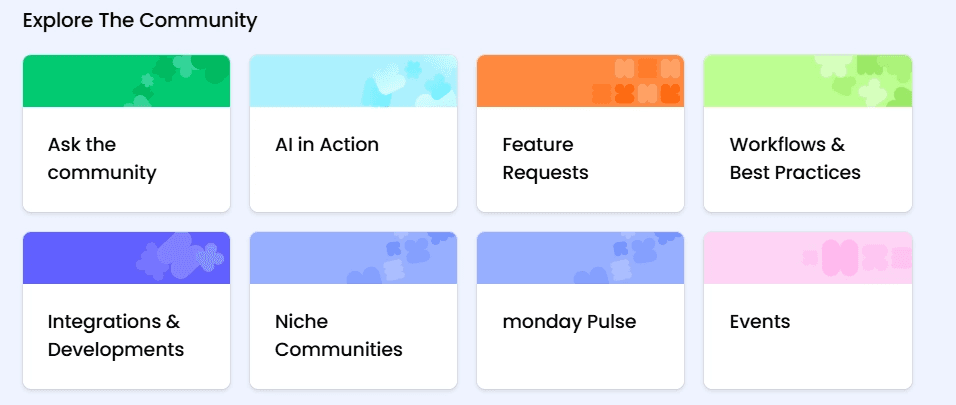
The Community Hub is organized into eight categories: Ask the Community, AI in Action, Feature Requests, Workflows and Best Practices, Integrations and Development, niche communities built around specific industries or use cases, monday Pulse, and Events.
It functions less like a support forum and more like an open product roadmap, Feature Requests gives users direct visibility into what other customers are asking for, and AI in Action turns the community itself into a live showcase of how people are actually using agents and Sidekick day to day, which is a more convincing proof point than anything Monday could write about its own AI on a product page.
Events
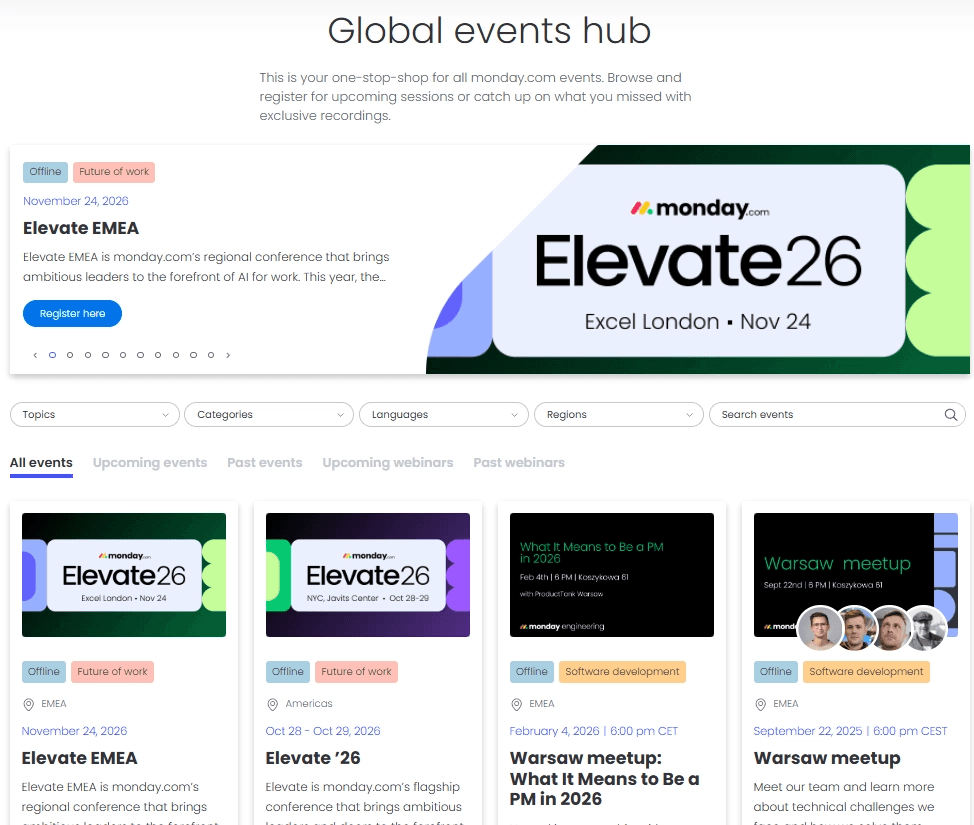
Monday's Global Events hub functions as a single destination for the company's entire events calendar, upcoming sessions people can register for directly, and past sessions available as recordings for anyone who missed the live version.
Rather than treating events as one-off webinars announced separately, the hub packages everything: product launches, customer panels, regional meetups, under one browsable archive, which means a prospect doing research six months from now still has access to the same material someone watching live would have had.
Blog
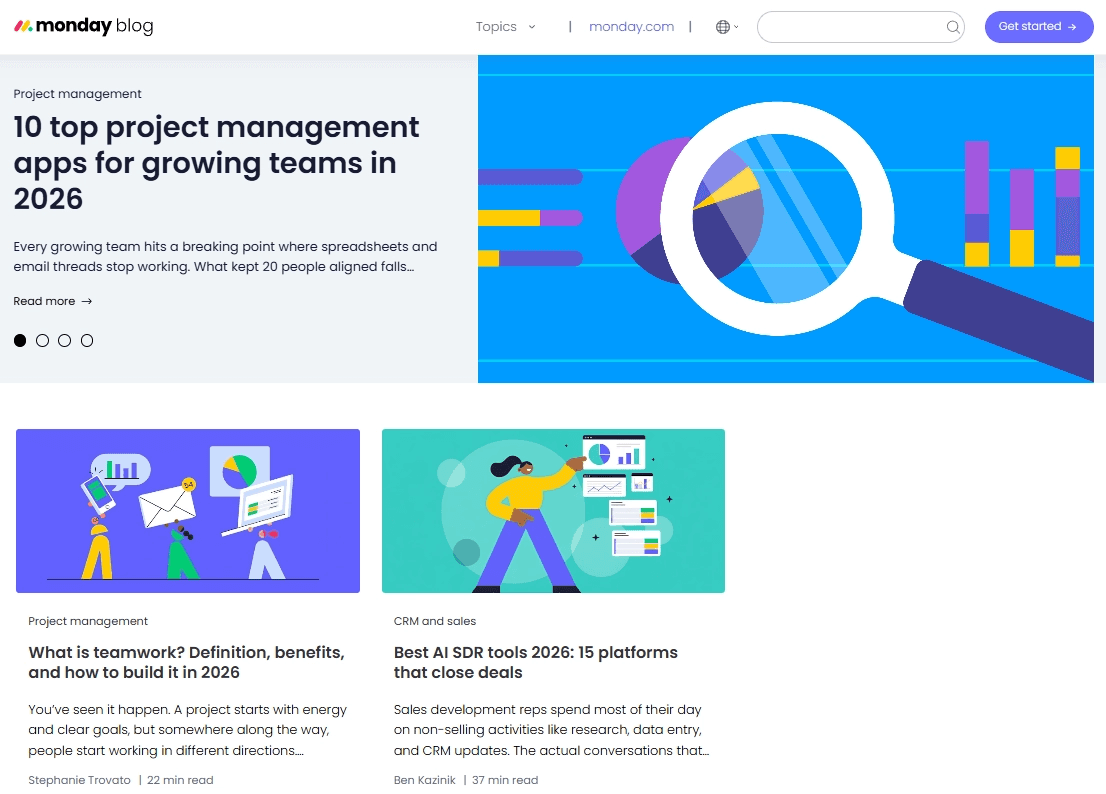
The blog is organized into categories: work management, CRM and sales, product development life cycle, service management, and a broader "explore more" section. Articles run long, with a table of contents, headings, infographics, or screenshots, and an average reading time of 20 minutes.
Long-form content over 2,000 words earns 77% more backlinks than short posts, per 2026 blogging data, and B2B blogs specifically generate more leads per post than B2C blogs despite lower traffic volume. Monday is writing to rank and to get cited.
Insights
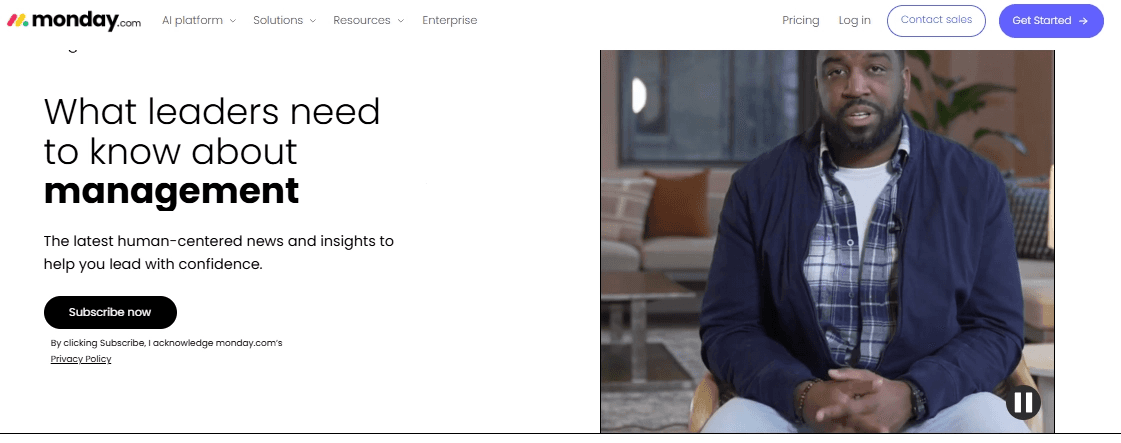
Monday's Insights newsletter is described as human-centered news to help readers lead with confidence, reaching 3.7 million subscribers with work news, trends, and insights delivered to inboxes every Tuesday.
Beyond the partner tiers above, Monday runs a standalone Affiliate program as another path to becoming a revenue partner. Also, Monday publishes ESG reporting, though the most recent report on file dates back to 2024.
Looked at as a whole, this is a demand generation system built for every stage of research. The Help Center and blog capture someone searching for an answer to a specific problem.
The Community Hub and Insights newsletter keep a reader coming back over months, long before they are ready to buy. Global Events and the Academy give a prospect who is seriously evaluating the platform something to attend or complete. Very few B2B SaaS companies maintain all four layers at this depth simultaneously.
💡 Steal This: Write for a 20-minute read when the goal is ranking and getting cited, and build at least one layer of content, a community, a newsletter, or an events calendar, that gives a reader a reason to come back before they are anywhere near ready to buy.
Marketing and Sales Funnel Stages
TOFU (Top of Funnel)
Awareness runs almost entirely through organic social and long-form content. Instagram, Facebook, X, YouTube, and TikTok each carry a slice of this load, though Facebook's 407k followers pulling only 20 likes per post suggests the channel is present for reach.
The blog does heavier lifting here than the social channels combined. A 20-minute article with a table of contents is built to rank on a search query and hold a reader who already typed a specific problem into Google. LinkedIn ads at almost 3,000 in volume, most running a generic "Learn more" CTA toward a landing page, sit in this stage too, functioning as paid amplification for the same awareness message rather than a direct path to a sale.
MOFU (Middle of Funnel)
The Academy's certification tracks, the Insights newsletter reaching 3.7 million subscribers, the Community Hub's Feature Requests and Workflows sections, and the case studies on the homepage all sit in consideration territory. A prospect who has moved past "what is this" and into "would this work for my team" finds a lot to read here: webinars, product tutorials, a podcast walking through the company's own growth story.
BOFU (Bottom of Funnel)
The path to a sale is short and repeated everywhere. The homepage CTA, "no credit card needed," the free trial language on Google Shopping ads, and the pricing page's five tiers all point at the same low-friction self-serve entry.
There is no gated demo wall blocking the free plan, and the CRM, Service, and Dev product lines each have their own pricing page with the same self-serve logic. For a company running $351.3 million in quarterly revenue, this stage still leans on product-led signup over a sales-assisted close, at least at the entry tier. Enterprise pricing, by contrast, is the one place custom quotes and a sales conversation take over.
Retention
Retention runs through the Community Hub, the Academy certifications, and Monday Spaces, where users share their own templates and workflows back into the ecosystem. A certified admin or a workspace built from a shared template both raise the cost of leaving, through the time already invested in learning and building inside the platform. The partner and affiliate programs extend this further, turning some of the most invested users into a distribution channel rather than a retained account.
Laid out this way, Monday's motion is a hybrid. The self-serve free trial, no credit card, instant signup is pure product-led growth, built for an individual to say yes without asking anyone's permission.
The Gartner Magic Quadrant positioning, the enterprise-grade security messaging, and the custom Enterprise pricing tier are sales-led growth, built for a buying committee that needs a quote and a conversation.
Most competitors in the category, tools like Asana, ClickUp, and Smartsheet, run some version of this same split, but the mix differs by company. Monday's balance leans on a genuinely frictionless PLG bottom to fund a heavier, proof-driven SLG top, and the case study selection covered earlier in Brand Promise Analysis is doing the enterprise half of that job quietly, on a page most visitors read as simple social proof.
TOFU and MOFU are stacked with content, tools, and channels. BOFU is a single, well-worn path. You have a free trial, the pricing page, aaand you’re done. Retention is real but understated, built more on switching costs than on active engagement campaigns. For a platform this size, that is a defensible shape. The trial removes friction at the point of decision, and the depth of MOFU content does the work of building trust before a buyer gets there.
💡 Steal This: Run a frictionless free trial for individual signup and a fully separate, proof-heavy path for enterprise buyers, on the same site, without either one diluting the other.
Future Plans and Growth Indicators
Monday currently lists 19 open jobs across 9 locations and 10 teams: R&D, People, Product, Finance, Customer Success, Consulting (Sales), InTech, GTM Manager, CEO Office, and Services. The CEO Office has the highest concentration of open roles of any team.
The hiring pattern is a small piece of a much bigger growth story that recent company announcements make easier to see. In May 2026, Monday completed what it calls its biggest transformation yet, going all in on AI by repositioning from a work management platform into a full AI Work Platform, a shift that runs through the pricing structure, the product suite, and the public messaging covered throughout this article.
That announcement followed the March 2026 launch of Agentalent.ai, a managed marketplace built in collaboration with AWS and Anthropic where enterprises can post roles, evaluate qualified AI agents, and hire them for defined business functions, complete with authentication and qualification steps before an agent gets introduced to a company's workflows.
Early interest reportedly came from Wix (Monday's own original home before it spun out as a company) and Mesh Payments, along with partner-ecosystem organizations including Matrix, Ness Xebia, Devoteam, Impresoft Engage, and Demicon exploring agent roles across marketing and operations.
On the leadership side, Monday promoted Ben Barnett to General Manager of EMEA in June 2026, expanding his remit from the UK and Ireland region he had led since 2021 to the full Europe, Middle East, and Africa territory. The timing lines up with real regional performance: Monday's EMEA revenue grew 26% year over year in 2025, and Barnett's mandate now includes driving the region's go-to-market strategy for the newly launched AI Work Platform specifically.
A 2026 analysis of over 1 million B2B software purchases found job postings correlate with buying activity at only 7%, far behind headcount growth (38%) or AI tool adoption (46%). Nineteen open roles concentrated in the CEO Office says less about where Monday is headed than the fact that customers with over $500,000 in ARR hit a record net addition rate last quarter, an AI-agent marketplace already live with named early adopters, and a regional leadership promotion tied directly to that AI platform's rollout. Those three data points together tell a far more concrete growth story than any job board could.
Inspiration Points
1. Anchor every proof point to a number.
Put a number next to a named client and let the number do the work. Monday's homepage runs on McDonald's 615% ROI, Holt-CAT's 105,000 hours saved, and Canva's 300% reinvestment instead of vague praise. HubSpot's 2026 State of Marketing report found that in a market flooded with AI-generated claims, brands with a sharp, evidenced point of view are the ones earning attention, not the ones with generic trust badges. A specific number tied to a real company is harder to fake and harder to scroll past.
2. Strip the technical step out of AI adoption.
If a customer needs a developer in the room to use your AI feature, most of them will not use it. Monday's agent-building flow collapses into three plain steps: describe, connect, watch it run. HubSpot's 2026 AI predictions report notes adoption stalls the moment a tool demands technical setup, even with usage already above 64% among organizations.
3. Build a set of differentiators that hit different moments in the buyer's journey.
A certification, a customer showcase, a cause-driven program, and an internal story each convince a different kind of skeptic, and most companies only build one of these. Monday's Academy raises switching costs after the sale, Monday Spaces gives proof before a sales call ever happens, mondayERT builds a press-worthy halo, and its internal podcast opens up the company's own decision-making.
Userpilot's 2026 guide on B2B loyalty points to certification-based education specifically, the same model behind HubSpot Academy and Salesforce Trailhead, as one of the few loyalty mechanics that survives a champion leaving the account, and that is only one piece of what this set of assets is doing.
4. Read your top-performing post on each platform as a separate lesson.
Monday's own data shows four different things working on four different platforms: a brand collab on Instagram beating the account average by ten times, craft and cultural relevance outperforming product news on LinkedIn, technical AI announcements pulling the strongest results on X, and a surprising real-world story beating a tidy feature demo on Shorts.
HubSpot's 2026 data found co-branded content alone earns 36% more engagement than solo brand posts, and that is just the Instagram half of the pattern. Treating one platform's top post as the template for every other platform misses what each audience is actually telling you.
5. Watch the review platform your best rating is not on.
A confident G2 score does not mean the whole picture is perfect. Monday sits at 4.7 on G2 and 2.3 on Trustpilot, and G2's 2026 Buyer Behavior Report, surveying over 1,000 B2B software buyers, found evaluation has become the longest stage of the buying journey precisely because buyers now cross-check more than one source before deciding.
A buyer who stops at G2 sees one story. A buyer who checks Trustpilot sees a support complaint pattern the first platform never surfaced. Responding to every review on the lowest-rated platform, even slowly, matters more than the rating itself.
We hope you enjoyed this edition of Marketing Spotlight and discovered an idea or insight you'll take with you into your next meeting. We certainly loved putting it together, and we hope to see you again in the next edition.
Milk and Cookies Studio helps B2B founders and marketing leaders in deep-tech and complex-tech companies build go-to-market strategy, demand generation, and social selling systems that hold up under this kind of scrutiny. If you're expanding into a new market, tightening a hybrid PLG and SLG motion, or want an honest audit of where your own gaps sit, get in touch.
Frequently Asked Questions
What is Monday's main value proposition?
Monday positions itself as an AI work platform built to help teams execute faster, backed by named client results like McDonald's 615% ROI and Holt-CAT's 105,000 hours saved annually, rather than generic productivity claims.
How much does monday.com cost per month?
Monday's core work management product runs five tiers, from a Free plan for up to 2 seats through Basic at €9 per seat, Standard at €12, Pro at €19, and custom-priced Enterprise. CRM, Service, and Dev each carry separate pricing structures.
Does monday.com offer AI agents?
Yes. Monday's AI platform lets users build ready-made or custom agents through a three-step process, describe the need, connect the relevant tools and knowledge, and run the agent, alongside Sidekick, an AI assistant built to recommend and execute work directly.
What makes monday.com different from other project management tools?
Beyond the core product, monday runs a dedicated Emergency Response Team supporting disaster relief organizations, a paid certification academy, a user-built template gallery called Monday Spaces, and an internal podcast documenting the company's own growth.
Are monday's co-CEOs active on LinkedIn?
Roy Mann posts a few times a month to a steady, modest audience of 8.3k followers. Eran Zinman, with 31k followers, posts far less often, but his rare personal posts, including one about the company's start with AI agents, have outperformed the company's own LinkedIn page by a wide margin.
Which social media platform performs best for monday.com?
Instagram carries the strongest engagement relative to its follower count, at around 70 likes per post against 209k followers, while Facebook's much larger following of 407k pulls only about 20 likes per post, suggesting reach without matching engagement.
Does monday.com run paid advertising?
Yes, across LinkedIn, Meta, and Google. LinkedIn carries close to 3,000 ads, mostly single image, carousel, and video formats pointing to product pages, while Google runs the highest volume overall, with tens of thousands of Search and Shopping ads across multiple ad accounts.
How does someone go from social media to becoming a Monday customer?
The path runs through profile bio links on Instagram and YouTube, and occasional direct app store links on LinkedIn, Facebook, and X, funneling toward the same self-serve free trial that anchors monday's homepage.
What do Monday's reviews say?
G2 and Capterra ratings sit above 4.5 across most product lines, with reviewers praising ease of use and customization while flagging pricing and a learning curve. Trustpilot tells a different story, at 2.3 from 3.4k reviews, with most complaints centered on support response times.
How does monday.com generate leads through content?
Primarily through a long-form blog averaging a 20-minute read per article, paired with an Insights newsletter reaching 3.7 million subscribers and a Community Hub built around feature requests and workflow sharing, all aimed at ranking, getting cited, and building trust ahead of a purchase decision.
What does monday's sales funnel look like from top to bottom?
Awareness runs through social and long-form content, consideration through the Academy, case studies, and community, and conversion through a self-serve free trial with no credit card required. Retention leans on certifications and user-built templates rather than active outreach.