Business
/
The 5 stages of marketing and sales maturity for B2B companies
The five stages of marketing and sales maturity in B2B technology, from founder-led sales to a company that can win and retain customers consistently.
/
Enjoy reading!
In a single winter, a family-owned maker of packaging machines learns that its largest customer will buy through tenders from now on and that its best salesman is leaving. For eleven years the founder has won that customer over coffee, and he has never had to write down why it chose him. Now a stranger in procurement wants exactly that, on paper and by a deadline, from a company whose best account notes live in the head of the man clearing his desk.
Now, some of you might empathise with at least some form of this scenario, more than you'd like to. If yes, this article is for you. If no, this article is also for you, as there's a big chance you will, sometime in the future.
Now, for today's exercise, let's consider Halas Line Systems, a fictional manufacturer of packaging machines and provider of maintenance services & consumables (such as supplies & materials). Its founder has spent years earning the trust of factory managers. Customers trust his judgment and call him when something breaks.
His relationships have built a business that somehow works rather okay. But when he takes some time away, things kind of stall, most of the commercial operations waiting for his input or feedback.
The letter from the dairy cooperative arrived on a Monday in February, printed on paper, which was the first sign that something had changed. For eleven years Viktor Halas had sold the cooperative its end-of-line equipment and consumables over coffee in the plant manager's office: case packers, a palletiser, a stretch wrapper that still carried a service sticker with Viktor's mobile number written on it by hand, and tons of carton and stretch wrapper. The cooperative's new procurement director wrote that every new line and the consumables would now be bought through a formal tender, with three suppliers invited.
On Thursday, same week, Karel came into Viktor's office and closed the door. He had sold for Halas Line Systems for nineteen years, looked after most of its FMCG customers and had accepted a regional director's job with a German competitor. He left on good terms, which did nothing to change the arithmetic. The cooperative accounted for nearly a third of the company's revenue and Karel's accounts for much of what Viktor did not handle himself.
That evening Viktor scrolled through the 1,400 contacts on his phone, collected over twenty years and tried to count how many of the people who had signed his orders were still in the jobs where he had met them.
Halas Line Systems was a healthy business by so many standards. Its machines ran in multiple FMCG plants across the region and it had grown on referrals, repeat orders and its founder's reputation. This is a legitimate way to build a company, at least for some years.
In reality, their problem was narrower and more dangerous: it could not reproduce its results without the same two men. Hiring a replacement or buying ads or some PR would not repair that on its own (at least not fast enough), since both assume a system exists for new people and for the new clients acquisition.
Buyers have not abandoned relationships either. To put this in perspective, McKinsey's 2026 Global B2B Pulse Survey, created with responses from nearly 4,000 decision makers in 13 countries, found that buyers still divide their interactions roughly into thirds between in-person meetings, remote conversations with a person and digital self-service and use an average of ten channels along the way.
The share of buyers McKinsey describes as relationship-oriented grew to 53%, from 44% in 2024, which the authors read as a sign that fast technological change may be making trusted relationships more important than ever.
What is this "commercial maturity" thing in B2B?
In the context of this article, commercial maturity is a company's ability to attract, win, retain and develop customers consistently and repeatable. The five stages you will discover below show you how that ability develops in different stages of a company. They are our own framework and not an "universal truth" type of model. A company can be in Stage 3 for customer retention and in Stage 1 for acquiring new clients. The tools listed under each stage are alternatives to choose from according to your constraint, your existing systems and the territory you serve, and reaching maturity does not require buying any of them. There are plenty tools out there to choose from. And by no means are we associated with any of them. We are not getting paid nor do we get any fees out of it. They are used in this article based on our experience.
Before we start, an important note: Halas Line Systems is a fictional illustration, built to show what each stage feels like from the inside and no figure in its story describes a real company or person. Its story shows how the framework works; it cannot prove that these practices generate the results described. The research we cite is real and listed at the end. Any resemblance to actual persons or company is purely coincidental.
Let's start!
STAGE 1: Relationship-led, when business comes from people who know you
Within a month Viktor did the obvious thing. He hired Tomas, a capable salesman from a conveyor supplier, and gave him a company car, the price list and Karel's old desk. Six months later Tomas had closed two orders, both from friends of Viktor's who had called the office and asked for him by name.
Tomas was not the problem. Nobody had told him which companies to call, what they usually asked or why they had bought from Halas in the first place, because that knowledge had never been written down. It lived in Viktor's head and in Karel's, and Karel now sold for the competition.
So Viktor spent three weekends at his kitchen table with six years of quotations from the grey ring binders behind his desk. He found buyers who had asked for exactly what Halas sold and heard nothing after the quotation went out, several of whom had lost their budget one year, found it the next and bought elsewhere because nobody called back. Viktor wrote beside each name who still owned the project and Tomas spent the next month calling them. When he listed his twenty best customers, he saw a pattern he had sensed for years without naming: the majority of them packed chilled products, where cartons come out of the cold store damp and cheaper machines jam.

This stage describes founder-led companies, family businesses and specialist suppliers whose reputation was built one handshake at a time and it works for a very good reason. In a complex purchase the buyer carries the risk of a wrong decision and personal credibility stands in for the brand recognition a small supplier lacks. McKinsey's survey points the same way: when large orders come rarely, buyers strongly prefer to deal with people. The weakness is key-person dependency, since relationships and commercial knowledge belong to individuals and leave with them.
You will recognise it when the owner joins most important sales conversations, customer details are scattered across inboxes, phones and spreadsheets, nobody can say with confidence what will sell next quarter, and marketing supports conversations but almost never starts one.
To improve the situation, some five basic steps are enough to begin with:
List your 20 most valuable customers and write down what they have in common in process, product, purchasing need, margin and service demands, and why each one chose you.
Record how each new customer first found you, starting with the next enquiry.
Keep customers, contacts and open opportunities in one shared place, even if that place is a spreadsheet in Google Drive (or SharePoint, knock on wood).
Write down the questions buyers ask before they purchase, and answer them on a website that shows the industries you serve, proof of your work and how to request a quotation.
Agree a standard follow-up after every meeting, quotation and introduction.
The richest material is mani times already in the building. Recording a handful of the owner's real sales conversations, with the customer's permission, captures the questions, objections and buying criteria that keep returning. Viktor's recordings became Tomas's training, and the story of a dairy plant that had cut its unplanned stoppages after Halas replaced an older case packer became the company's first case study, two pages long and more persuasive than any brochure Halas had printed.
The most common mistake at this stage is the one Viktor made first: hiring a salesperson and expecting them to reproduce the founder's network without a target market, sales information or credible sales materials to send.
You are ready for Stage 2 when the business can describe its ideal customers, record its opportunities and follow a consistent sales routine without relying entirely on the owner.
A spreadsheet that everyone updates beats a CRM that nobody opens.
When you are ready for software, these tools suit the stage.
Tool | What it does for you | Worth it when |
|---|---|---|
HubSpot (free CRM) | Shared records of customers, contacts and opportunities, with email logging | You expect to add marketing tools later |
Bigin by Zoho | A simple pipeline CRM built for small teams moving off spreadsheets | You want sales stages and reminders and little else |
Brevo | Customer emails, follow-up sequences and simple newsletters + a pretty good sales pipeline CRM | You need to stay in touch with a few hundred contacts |
Jamie or tl;dv | Transcribe and summarise conversations with data hosted in the EU. Jamie also works for meetings in person and deletes the audio after processing; tl;dv keeps recordings of online calls | You want the owner's questions and answers in writing, always with permission |
Google Search Console | A free report of the searches that bring visitors to each page | You want to know whether buyers find you for the problems you solve |
HotJar or Microsoft Clarity | Session recordings and heatmaps of how visitors use the site | You are rebuilding the website and want to see where buyers leave |
LinkedIn Sales Navigator | Finds companies like your best customers and the people inside them | You know your ideal customer and want more like them |
STAGE 2: Process-led, when sales becomes repeatable
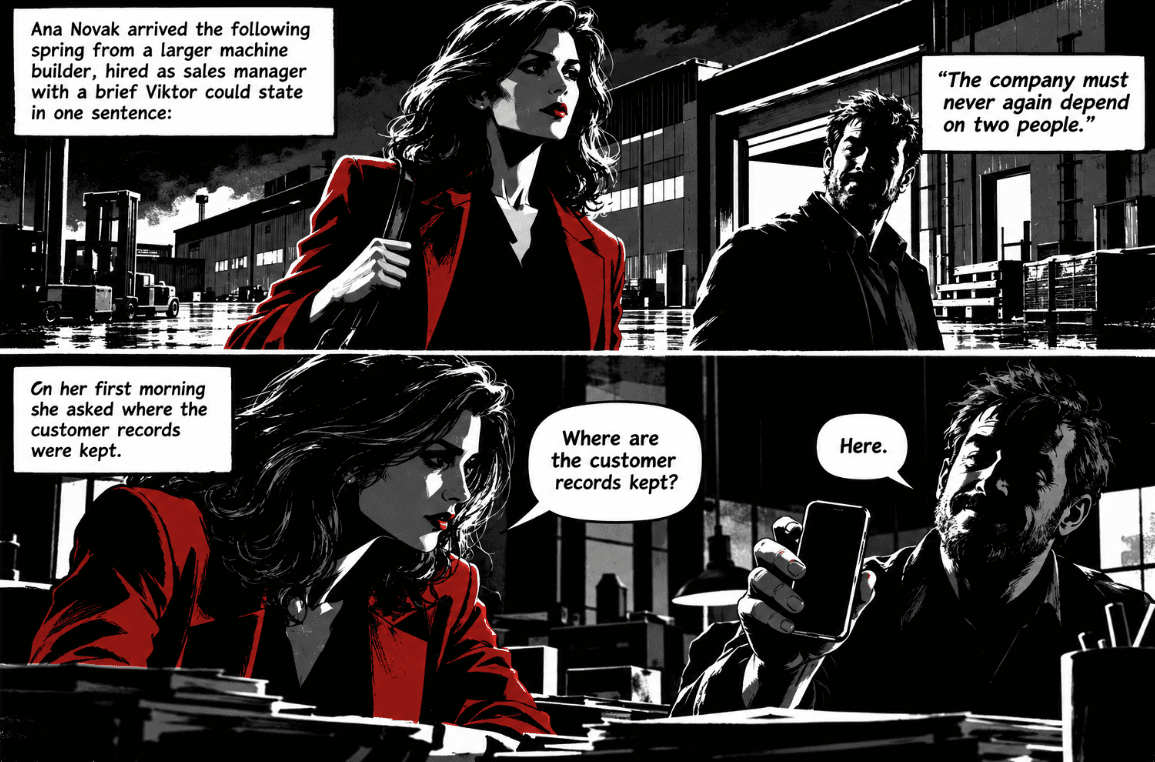
Ana Novak arrived the following spring from a larger machine builder, hired as sales manager with a brief Viktor could state in one sentence: the company must never again depend on two people. On her first morning she asked where the customer records were kept.
"Here," Viktor said, and held up his phone.
By then Halas had three salespeople, and each worked a different way. Tomas followed up within a day and kept notes nobody else could read, while the other two relied on memory and their phone notes. Ana drew the company's sales stages on the meeting-room whiteboard, from first contact to signed order, and asked the team to agree what had to be true before an opportunity moved from one stage to the next. The argument took two afternoons and was the most useful thing the department did that year.
Then she classified every quotation the company had lost in the previous two years. Price and delivery explained fewer losses than anyone expected. The largest category was no decision: quotations sent to a plant manager who wanted the machine and never reached the person who approved the money. Halas had been writing quotations for engineers while finance directors made the decisions, and finance directors wanted to know the payback period.
From then on, every quotation above a set value carried a one-page business case, and the team sent quotations through a tool that showed when they were opened and when a recipient forwarded them through it. The first time a plant manager forwarded one to his finance director, Ana called the plant manager that afternoon and asked what the finance director would need to see.
What Ana was building has a plain name, a standardised sales process. A repeatable process removes avoidable variation and lets the company learn from what happens to every opportunity, while leaving room for individual skill, which still matters a great deal in technical selling.
The signs of this stage are very familiar for so many people. A sales & marketing team exists but each person works differently, management watches orders and revenue instead of the actions that produce them, the CRM holds patchy data and forecasts rest on individual judgement.
Five steps move the company forward:
Define the ideal customer by industry, company size, geography, purchasing need and commercial potential.
Agree the stages from first contact to order, and what must be known before an opportunity moves on.
Give every opportunity an owner, a next step and a date.
Write a simple prospecting routine that covers company research, finding the right contact and the first approach.
Track quotation-to-order conversion, sales cycle length and the reason for every loss.
Fifty calls in a week show management little, unless they lead to conversations with qualified buyers, so measure the conversations as well. Classify losses as price, delivery terms, technical suitability, timing, competitor preference or no decision, because each calls for a different response. Dormant customers teach faster than unknown prospects, since a company that bought three years ago and stopped has a reason that a short call will usually reveal.
Companies at this stage most often go wrong by introducing software and administrative requirements before agreeing how the company wants to sell. Ana chose the CRM after the whiteboard argument, never before it. The company has outgrown this stage once the process is followed consistently, the company knows its conversion rates and management can see where new business is lost.
Two cautions apply to the tools below. European data protection law covers business contacts too, and the rules for unsolicited email and calls differ from country to country, so check them before any outbound campaign. Anyone you record in a meeting should be told.
Tool | What it does for you | Worth it when |
|---|---|---|
Pipedrive | A visual pipeline with agreed stages, reminders and follow-up tasks | You need a process salespeople will actually keep up to date |
PandaDoc | Builds quotations from CRM data and shows when a quote is opened, which pages are read and when it is forwarded through the platform | You lose more business between quotation and order than before it |
Tacton CPQ | Configures complex machines from engineering rules and turns each configuration into a priced quotation | Options interact so much that every quote needs an engineer; expect an implementation project, not a quick subscription |
Cognism | European contact data with phone-verified mobile numbers screened against do-not-call registers | Your team prospects by phone across several European countries |
Leadfeeder (Dealfront) | European company data drawn from trade registers, filtered into prospect lists | You sell mainly into Europe and want company-level targeting |
Apollo.io | A large contact database with built-in email sequences | Your targets include North America; test its European coverage first |
Power BI or Looker Studio | Reports on conversion, cycle length and loss reasons across systems | Your CRM's built-in reports no longer answer management's questions |
STAGE 3: Marketing and sales working together, when the company creates demand instead of waiting for it
The sales process now worked and that exposed the next limit. Ana's team could convert enquiries, but almost every enquiry still came from someone who already knew the company. When Viktor agreed to hire for marketing, Ana passed over the agency veterans and chose Mira, an applications engineer who had spent six years commissioning Halas machines in customers' plants and kept a notebook of the questions people asked her on the factory floor. Could the case packer handle cartons that came out of a spiral chiller wet? How long did a format change take? What did the machine need from the plant's control system?
Mira turned the notebook into the website. Instead of a page for each machine, she wrote pages for problems: packing chilled dairy into damp cartons, changing formats twice a shift, fitting a palletiser into a hall with a low ceiling. Within a few months enquiries began arriving from companies nobody at Halas had met, among them a pet-food producer planning a new line for the following year.
The first wave was not what anyone wanted. The page on format changes ranked well and drew a stream of enquiries from high-speed beverage plants running lines faster than any machine Halas built, and the salespeople spent most of a month quoting work the company could not win. Tomas called it marketing's homework landing on sales. Mira rewrote the page to state the speed range plainly and added one question about line speed to the enquiry form, and the following month brought fewer enquiries and more of them worth answering.
The salespeople wanted to drop the pet-food enquiry, since nothing would be bought for twelve months. Mira wanted to put the plant manager on a quarterly email and invite him to see a reference line in the spring. Settling that disagreement is the work of this stage.
Mira won that argument. When the pet-food plant manager came to see the reference line in the spring, he spent less time watching the machine than questioning its operator about what happened when it stopped, because if a new line jammed in its first month, he would be the one explaining lost output to the directors who had approved the money on his recommendation.
This is the turning point of the model, where a traditional B2B company stops relying only on its salespeople to find demand and starts building a coordinated marketing and sales function to create it. Not every potential customer is ready to buy, and not every marketing contact should become a sales opportunity. Marketing builds familiarity, shows expertise and identifies demand, while sales qualifies opportunities and develops the relationship.
The relationship between the two functions decides whether this works. In 2006 Philip Kotler, Neil Rackham and Suj Krishnaswamy wrote in Harvard Business Review that poor coordination between sales and marketing raises market-entry costs, lengthens sales cycles and increases the cost of selling, and they traced the strain to a shared budget and to two cultures that measure success differently. A 2018 article in the same journal by Wendy Ritz and colleagues found a common cause in B2B companies: the two functions set strategy and goals separately, especially on pricing and sales pay, which can push salespeople to give up company profit to hit their own targets.
In a company at this stage, target industries and buyer groups are defined, several sources of new business are developed and measured separately, sales and marketing agree which opportunities deserve pursuit, and prospects who are not ready to buy stay in contact with the company. Six steps build it:
Map how your customers buy, including technical evaluation, procurement and management approval.
Choose two or three acquisition channels according to how your buyers actually behave.
Build website pages around applications, industries and customer problems, and answer real buyer questions in technical detail.
Start an email list of prospects and customers with a clear reason to stay subscribed.
Prospect a chosen list of target companies systematically, with an agreed handover from marketing to sales.
Measure qualified opportunities, quotations and revenue by source.
Pages like Mira's matter more each year. McKinsey's 2026 survey places AI assistants among the five channels buyers now use most to find and evaluate suppliers, alongside supplier websites, in-person contact, web search and video calls, and an assistant can only recommend a supplier whose expertise it can read.
For equipment, engineering and industrial services, early technical conversations can shape how requirements are written, provided procurement rules are respected. Trade shows pay best when they are run as campaigns, so Mira chose the companies Halas wanted to meet before each fair, the salespeople booked the meetings, and every conversation had a follow-up date before the stand came down.
The trap here is measuring marketing by traffic and contact volume while sales is measured on orders. Halas settled it with a one-page definition of a qualified opportunity, signed by Ana and Mira, and the pet-food producer stayed on the list as early demand with its own follow-up schedule. Stage 4 becomes the right next step once several sources regularly produce qualified opportunities, both teams use the same information and management knows which investments contribute to revenue.
Tool | What it does for you | Worth it when |
|---|---|---|
Google Search Console | Shows which searches bring visitors to each application page | You publish problem-led pages and want to know whether buyers find them |
Semrush | Researches search demand and the pages competing suppliers rank with | You are choosing which customer problems to write about |
Google Analytics 4 | Measures where consenting visitors come from and which of them enquire; visitors who decline cookies are only partly visible | You want enquiries linked to their source wherever tracking allows |
Leadfeeder (Dealfront) | Identifies companies visiting your website and matches them to European company data | You sell to known accounts; consent rules limit how much European traffic it can identify |
Europages and wlw | B2B marketplaces, run by Visable, where buyers search for suppliers by category | You sell standard equipment, components or services that buyers look for by category |
Brevo or HubSpot Marketing Hub | Email lists and nurture sequences for prospects not yet ready to buy | You hold early-stage demand you would otherwise forget |
LinkedIn Ads | Shows your content to companies or contacts from a list you upload, narrowed by job title or seniority | You have a defined target list and something worth their time |
STAGE 4: Integrated growth, when marketing, sales and customer relationships share one set of numbers
Three years after the letter, Halas had more opportunities than it could pursue, and the next surprise came from the finance office. Petra, the finance manager, had connected the CRM to the order and costing data for the first time, so that every quotation could be traced to the margin it produced. The large beverage bottlers, the accounts the sales team was proudest of, carried the thinnest margins in the business. Each order involved custom engineering that was never fully priced, and each negotiation ended in a discount, because the salespeople's commission rewarded booked revenue and barely registered the profit that discounts and unpriced engineering took away.
The same data held a warning. The dairy cooperative's spare-parts orders, which had arrived every five or six weeks for years, had stopped twelve weeks earlier, and nobody had noticed, because spare parts belonged to the service department and the cooperative belonged to Viktor. When Ana called, she learned that the new procurement director was trialling a cheaper parts supplier, and that the plant manager Viktor had known for eleven years no longer made those decisions.
Petra's two discoveries were one problem seen twice: as a company grows, the people who win an order and the people who maintain it end up holding different pieces of the same customer. Buyers notice: in McKinsey's 2026 survey, inconsistent information across a supplier's teams became the leading reason for switching suppliers, ahead of difficulty reaching someone knowledgeable.
Commercial performance is the combined result of acquiring customers, converting opportunities, keeping accounts and increasing their value, and optimising each department on its own can leave the whole worse off. Kotler, Rackham and Krishnaswamy describe the most developed relationship between sales and marketing as full integration, with shared performance measures and rewards and marketers embedded in the management of key accounts.
Research by Bain & Company on B2B loyalty notes that an account contains several groups, from gatekeepers to business leaders to operational users, each with different needs, which is precisely what Halas had missed at the cooperative.
A company has reached this stage when marketing and sales share commercial targets, customer records show how each customer was acquired and what was quoted, ordered and serviced, management compares results by industry, product, segment and source, and forecasts follow defined criteria instead of optimism. Six steps build it:
Connect marketing, CRM and sales reporting to order, cost and revenue data where practical.
Agree shared definitions of a qualified opportunity, a conversion and a retained customer.
Segment customers by profitability, growth potential, purchase frequency and service needs.
Write account plans for your most important customers that name every relationship you hold inside them.
Track repeat purchases, lost customers and chances to supply additional products or services.
Build forecasts from historical conversion rates, sales cycles and the quality of open opportunities.
Check what your sales pay rewards before you blame the salespeople; Halas moved part of its commission onto gross margin within a quarter of Petra's discovery, after agreeing with the sales team which costs would count, since a salesperson can influence discounts and engineering scope but not the price of steel. Look for product combinations as well, since a customer who buys a machine will need parts, service and eventually a second line. Bain recommends asking customers for feedback right after key moments such as a contract negotiation or a service visit, with a few short questions that begin with whether they would recommend you and why.
Where companies go wrong here is in building elaborate reporting before deciding what management will do differently because of it. Petra's first margin report fit on one page, and it changed how Halas paid its salespeople. The final stage comes within reach once acquisition, conversion, retention and account development run through established routines and reliable information.
These systems overlap, so choose one home for customer records and connect the rest to it. Weigh implementation effort, data migration and who will maintain the system as heavily as its features.
Tool | What it does for you | Worth it when |
|---|---|---|
Odoo | An open-source suite that links CRM, quotations, inventory, manufacturing, invoicing and a field service app | You want quotation, order, margin and service history in one system at mid-market cost |
Microsoft Dynamics 365 Sales | A CRM that connects to Microsoft's finance and operations systems and to Outlook and Teams | You already run Microsoft 365 and have someone to own the implementation and its upkeep |
Dynamics 365 Field Service | Records each customer's installed equipment and service history, and schedules preventive maintenance | Spare parts and service are a large share of profit and technicians work on customer sites |
HubSpot or Salesforce Sales Cloud | Customer lifecycle management with integrations to an existing ERP | You keep your ERP and need the CRM to read order data |
Power BI | Margin and retention reporting by customer, product, segment and source | Finance and sales need one version of the numbers |
Make | Visual automation that moves data between CRM, ERP and email | Information is being retyped between systems |
n8n | Workflow automation that can run on your own servers | You want control over where customer data is processed |
Microsoft Forms | Short, structured customer feedback after commissioning and service visits | You want the same questions asked after every key moment |
STAGE 5: Self-sustaining growth, when the business grows without depending on individual heroes
In the fifth year Viktor did something he had promised his wife for a decade. He spent six weeks visiting their son in Canada and switched off his work email before the plane left the ground. While he was away, the dairy cooperative issued the tender its letter had promised: two new lines, three suppliers and forty pages of evaluation criteria.
Ana's team assembled the response from the account plan, Mira's application pages supplied the technical evidence, and Petra priced the bid against the margin floor the company had set the year before. Halas won one line. It lost the other to a cheaper bid that Ana chose not to match, because matching it would have taken the price below that floor. When Viktor came home, the order book was fuller than when he had left, and nobody had needed to call him.
Organisational capability, continuous improvement and the deliberate allocation of resources sit behind this stage. Commercial knowledge has become an asset of the company, which means processes keep working when people change and management can improve them using evidence. Management spends less time rescuing individual sales and more time deciding where to invest, which markets to enter and how to improve profitability.
Here new business does not depend on the owner, customer relationships survive staff changes, management can forecast within a useful range, expansion proposals are tested against existing customer and market data, and teams adjust their own processes according to results. Seven steps keep it that way:
Hold quarterly reviews of markets, customer segments and profitability, with retention examined alongside acquisition.
Build succession and account handover procedures.
Compare acquisition cost, sales effort and customer value across segments.
Put resources behind opportunities with attractive margins and realistic sales potential.
Automate repetitive research, reporting, reminders and administration once the underlying process works.
Use AI to support research, analysis and preparation, with a person verifying anything that feeds a consequential decision.
Test new industries, regions or products on a small scale before committing significant resources.
Measure concentration risk first: how much revenue and gross profit depends on your largest customers, on individual salespeople and on specific industries. Then test operational independence by asking what would happen if the owner or the strongest salesperson were unavailable for six weeks. Viktor's trip answered that question for Halas more convincingly than any report could have.
Your existing customers can show you where to expand. The pet-food producer from Mira's list had bought its line by then, and its suppliers and co-packers pointed Halas toward a market it had never considered, which the company tested with one salesperson and a set of application pages before committing more. Mira's team uses AI assistants to research prospects, summarise tender documents and draft first versions of those pages, and an engineer checks every technical claim before anything leaves the building.
Watch the quality of revenue as well, since growth that raises working capital needs or squeezes margins can weaken a business while sales rise. The error to avoid at this stage is treating automation as a substitute for management judgement, technical expertise or customer relationships, when technology applied to a badly designed process only performs it faster.
A mature company can explain where its future business will come from, what it costs to acquire and keep customers, and which changes would improve its commercial performance.
Tool | What it does for you | Worth it when |
|---|---|---|
Power BI | Tracks concentration risk, profitability by segment and forecast ranges | Management reviews markets and segments every quarter |
Orbis (Moody's) | Private-company data by sector, size, region and ownership, for sizing new markets | You are weighing an adjacent industry or country; national company registers are a cheaper start |
ChatGPT, Claude or Microsoft Copilot | Research, summaries of tenders and reports, and first drafts | A person with technical knowledge checks every output |
Sales Agent in Microsoft 365 Copilot | Brings CRM data into Outlook and Teams, drafts emails and updates records | You run Dynamics 365 Sales or Salesforce alongside Microsoft 365 |
Microsoft Power Automate | Automates approvals, reminders and reports inside Microsoft systems | Your company is standardised on Microsoft |
n8n | Automates work across business systems and can run on your own servers | You need automation beyond one vendor's ecosystem |
Make | Visual automation for routine commercial tasks | You want automation without developers |
Which stage is your company at?
In her first month at Halas, Ana asked Viktor and his two senior managers to answer six questions separately and then compare notes. The disagreement between their answers told her more than any single answer did, and the exercise works the same way for any management team.
Management question | What it reveals |
|---|---|
Can we generate new sales opportunities without the owner's involvement? | Dependence on individuals |
Do we know which industries and customer types are most profitable? | Market understanding |
Can we explain where our qualified opportunities come from? | Marketing effectiveness |
Do salespeople follow a consistent process, with measurable conversion rates? | Sales maturity |
Do we systematically retain and develop existing customers? | Customer management |
Can we forecast sales and explain why results differ from expectations? | Commercial control |
We have left out a numerical score on purpose, because a number would suggest a precision these questions do not have. Mark each answer yes, partly or no, and look for the weakest ones. They will rarely sit in a single stage, since a company can manage its customers at Stage 4 and find new ones at Stage 1.
In that case the next investment belongs in finding customers, whatever the next numbered stage happens to be. Start with the weakness that limits profitable growth today: lead generation for a company with healthy repeat orders and no new customers, quotation conversion for a company with plenty of enquiries and few orders.
Viktor found his constraint over three weekends with a ring binder, after the letter had already arrived. You can find yours sooner. If the six questions left you with an answer you did not enjoy, book a conversation with us and we will go through them with you, name the stage your company is really at and say plainly which constraint deserves the next euro and the next hour.
Growth maturity comes down to control
The grey ring binders are still behind Viktor's desk, although nobody has opened them in two years. What they held now lives in a system that Ana's team updates and Petra's reports read, and the 1,400 contacts on Viktor's phone have become what they should always have been: one source of business among several.
Halas never became a large or complicated company, and nothing in its story required it to. A company with excellent sales routines and a basic software stack can be commercially stronger than one with expensive systems and poor execution, because growth maturity and digital maturity are different things. Every stage can support a successful and profitable business, and extra complexity earns its place only when it solves a problem you actually have.
Progress shows up in smaller ways than a software purchase. The owner joins fewer sales calls, a departing salesperson leaves a customer file behind where before they took the relationship with them, and a lost quotation produces a reason that somebody reads. Each of those changes reduces dependence on individuals and makes the next commercial decision better informed.
The place to invest next is the biggest constraint on profitable growth, whether that is finding customers, converting quotations, keeping accounts or entering a new market. At Halas the constraint moved at every stage, from the founder's memory to the quotation, from the quotation to the margin, and from the margin to the question of where to grow next. Yours will move too.
If your company needed to increase sales by 20 percent next year, could management explain exactly where that additional business would come from and what it would take to win it?
Sources
McKinsey & Company, The surprising economics of B2B growth: The new survival threshold and what it takes to thrive, 2026 Global B2B Pulse Survey, May 2026.
Philip Kotler, Neil Rackham and Suj Krishnaswamy, Ending the War Between Sales and Marketing, Harvard Business Review, July 2006.
Wendy Ritz, Michelle D. Steward, Felicia N. Morgan and Joseph F. Hair Jr., When Sales and Marketing Aren't Aligned, Both Suffer, Harvard Business Review, June 2018.
David Michels and Andreas Dullweber, Do Your B2B Customers Promote Your Business?, Bain & Company, February 2014.
Tool sources
Specific claims about tools (data hosting, verification, tracking, configuration and equipment records) were checked in October 2026 against the pages below. Product names, features and prices change often, so confirm them before you buy.
Bigin by Zoho, Google Workspace Marketplace listing
tl;dv, independent profile with links to the vendor's security and help pages
Jamie, vendor comparison of EU-hosted note takers
PandaDoc, vendor documentation on CRM quotes and document analytics
Tacton CPQ, independent profile of configure-price-quote for complex manufacturers
Cognism, vendor page on European data and do-not-call screening
Leadfeeder (Dealfront), independent review of European company data and visitor identification
Europages and wlw, operator's company page
Odoo Field Service, independent profile of field service in Odoo
Dynamics 365 Field Service, Microsoft documentation
Sales Agent in Microsoft 365 Copilot, news report on general availability
Orbis, Moody's product page