Strategy
/
Parkinson’s Law in marketing aka when strategy delays execution
How Parkinson’s Law shows up in marketing strategy, and why entering new markets requires launching, learning from buyers, and refining as you go.
/
Enjoy reading!
In 1955, British historian C. Northcote Parkinson published an essay in The Economist built around an observation that became far more famous than the essay itself:
Work expands so as to fill the time available for its completion.
Parkinson was writing as a satirist and he later described his approach in writing as using humour to carry serious observations about how organisations behave and work, especially for bureaucracies.
Obviously, the “law” was never meant as a scientific law of productivity.
Still, the joke survives for a reason. Give a task a week and people can often find a way to occupy the entire week. Give it three months and the work tends to get more stages, more interviews, more analysis and more opportunities for refinement, improvements, and checlists.
And B2B marketing strategy is particularly prone to this.
Give a marketing team six months to prepare an international expansion strategy and those six months can be filled quite easily. There are markets to analyse, competitors to map, customer segments to define, stakeholders to interview, positioning alternatives to debate, channels to evaluate, budgets to model and presentations to revise. Every answer tends to generate another reasonable question that needs an imediate answer.
At the end of the six months, the company may have done an enormous amount of market intelligence work. It may also have spent six months without putting a single meaningful piece of content in front of the buyers it wants to reach.
That is where Parkinson’s satirical observation becomes useful for marketing.
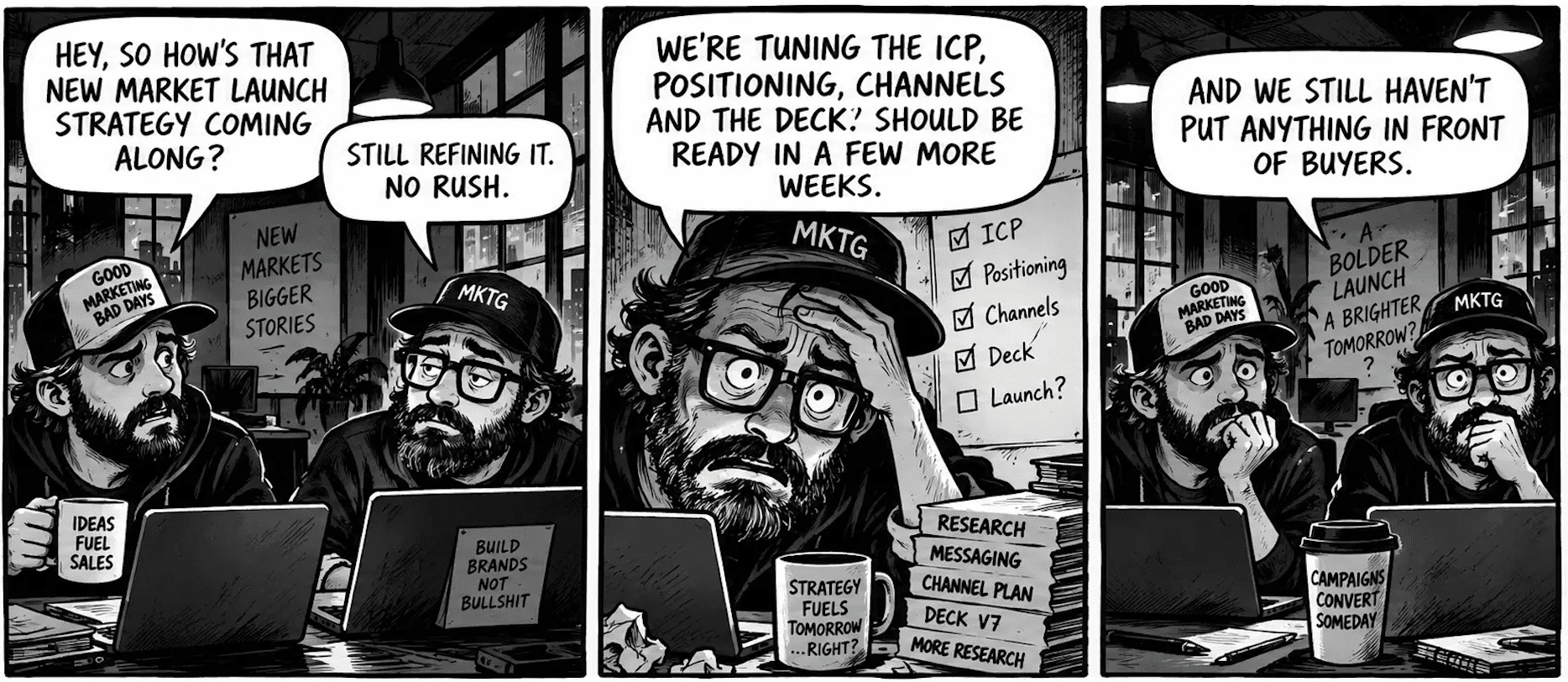
Strategy work has a remarkable ability to expand
There is almost no natural end to strategic research.
The team that is analysing how you can expand into a new market can always find another competitor to look at. Ten customer interviews can become twenty. An ICP can be divided into more segments, mini-segments, micro-segments. A positioning statement can be tested internally against another positioning statement that was already tested against 2 more positioning statements. Someone can request another market-sizing report. Sales can raise a concern that sends the team back into research, while the leadership can ask for three scenarios instead of one.
None of this is obviously wasteful as it happens. In isolation, most of it is perfectly defensible and logical.
But that is exactly what makes strategy design scope of work hyper-expansion difficult to see. Teams rarely spend six months doing nothing, especially in B2B tech, where the rhythm of the work is… let's say fast. They spend six months doing things that can reasonably be described as useful, while the date at which the company interacts with the market keeps being pushed further away.
The organisation can even feel increasingly productive as the pitch deck becomes longer and more detailed. The ICP becomes more detailed, with even more rows in the excel file. The competitor matrix gains another twenty columns and the content distribution framework becomes more sophisticated.
Yet the company is still improving its understanding of the market predominantly through secondary research, internal knowledge and assumptions.
There comes a point when adding more strategy work produces less new information than launching something.
New markets make the problem worse
This becomes especially important when a company enters a market where it has limited direct experience and footprint.
An established business operating in a familiar market usually has data & proof to work with. It has sales calls, at least some form of CRM history, previews campaigns performance, some customer interviews, win-loss information, CAC, LTV, objections they usually encounter, and plenty accumulated organisational knowledge.
International expansion changes the information environment
A company entering another geography, vertical, customer segment or category may have excellent research and still have relatively little first-party evidence about how those specific buyers will react to its proposition. Existing customers can offer some clues, that's true. Competitor research can also show how the market is structured and offer some kind of info about what might work. Search data, industry reports and market databases can expose demand patterns. But there is still a gap between studying a market and participating in it.
Paradoxically, having less direct evidence can encourage companies to spend even longer preparing. Uncertainty creates discomfort, so the organisation tries to reduce that uncertainty before launch. More research feels safer than exposing a strategic assumption to the market.
The problem is that some uncertainty cannot be removed from a desk.
A company can research which job titles appear to be involved in a buying process. It learns something different when one of those roles consistently answers and another consistently ignores the proposition. It can develop messaging from interviews and industry language. It learns something different when buyers repeatedly misunderstand the first sentence of the actual campaign.
Research tells you what is reasonable to believe before entering the market.
Execution starts telling you which of those beliefs survive contact with it.
A strategy can be useful before it is final-final-final v.fin 3.72
The usual sequence implies a clean handover:
research
design the strategy
approve the strategy
execute the strategy
That sequence works neatly on a project plan. It becomes less convincing when the company has limited market data and the strategy depends on assumptions that can only be tested through execution.
The first version should still require serious work. The company needs to understand the commercial objective, available market data, customer problem, competitive environment, likely buying group, initial ICP, positioning options, proposition, channels and measurement framework. Entering a market without this foundation simply replaces excessive planning with random activity.
The difference is that the first version does not need to pretend it has knowledge the company does not yet possess.
Some strategic decisions will be supported by strong proof. Others will be informed hypotheses. The strategy should make that distinction visible and then create a way to test the uncertain parts through execution.
That changes the role of launch. Launch is no longer the ceremony that happens after strategic thinking ends, but becomes one of the inputs required to continue the strategic work.
Put the first strategy into the market
Once the company has enough information to make some informed decisions, execution should begin.
That might mean launching a targeted paid campaign, testing a landing page, running founder-led outreach, activating a small account list, publishing content against a specific problem, working an event, starting a sales sequence or combining several channels around the same strategic hypothesis.
The purpose at this stage is commercial, but it is also informational. The company is creating opportunities to observe the market directly.
Which audience engages?
Which proposition starts conversations?
Which objections appear repeatedly?
Which problems buyers recognise immediately and which ones require too much explanation?
Does the assumed buying group resemble the people who actually become involved?
Which channels produce useful interactions?
Where does interest disappear between first contact and the next commercial step?
This is actually even "more true" in B2B tech, where a single conversion metric rarely tells the whole story, due to super complex buying processes and decision-making unites. Ten qualified conversations can show yoyu a positioning problem long before a pretty dashboard has enough data volume to make that problem statistically obvious.
The feedback from the sales team can show localized objections that were absent from the original research, while a campaign that performs poorly can still show some useful data about the audience, messaging, creatives or buying trigger if the company designed it to learn something specific.
Execution therefore needs to generate two outputs:
commercial return
strategic data
Keep building the strategy while execution is running
This is where the Parkinson’s Law analogy becomes even more interesting.
The solution is not to replace a six-month strategy process with a two-week strategy process. An arbitrary shorter deadline simply creates another arbitrary deadline. Nor is this an argument for “working faster,” reducing research or celebrating action for its own sake.
The useful constraint is that strategy work cannot indefinitely postpone market contact (#WeComeInPeace).
Once a company has enough info to form a coherent first direction, the next phase of strategic development should happen while real campaigns are already running. New information enters the process, assumptions are revised and the strategy becomes progressively stronger. The dream of every strategist.
The relationship between strategy and execution therefore looks less like a relay race and more like a loop:
Research and available evidence → initial strategy → execution → market evidence → strategic refinement → stronger execution → final strategy.
At Milk & Cookies Studio, this is how we tend to approach international expansion & growth when the available data is limited.
We research the market and develop an initial strategic version detailed enough to coordinate execution. Then we put it to work. Over roughly three months, campaigns, content, outreach, sales conversations and conversion behaviour create another layer of evidence. That evidence is incorporated into the strategic work while execution continues, until the company has a much stronger basis for finalising the strategy. The three-month period is an operating model rather than a universal formula; different markets and sales cycles produce useful evidence at different speeds.
The final strategy should contain things the first strategy could not have known
If nothing important changes between the initial strategy and the final strategy, there are two possibilities. The first is that the original assumptions were exceptionally accurate. The second is that the company has not built a good mechanism for allowing market evidence to challenge them.
The final-final version of the strategy hould usually include information that could not have existed in the first version.
Perhaps the expected primary persona turned out to be an influencer rather than the person driving the purchase. Or maybe perhaps the product feature the company considered most important generated little interest, while a secondary use case consistently opened conversations. Perhaps one channel produced traffic while another produced fewer interactions but substantially better commercial conversations. Or why not, the language buyers use to describe the problem differs from the language used internally.
These are all strategic inputs that affect positioning, targeting, content, channel allocation, sales enablement and sometimes the offer itself.
Finishing the strategy is not the end of strategic work
Eventually, the organisation should have enough information to consolidate what it has learned into a more complete strategy.
At that stage, there is value in making clear choices:
what the company will prioritise
what it will stop testing, which segments deserve investment
how the proposition should be expressed
which channels have defined roles and how marketing and sales should coordinate around them
And now the execution should become more systematic and standardized.
Yet the connection between strategy and implementation still has to remain intact. If the people coordinating execution lose sight of the strategic logic, tactics gradually fragment.
A strategy becomes useful through implementation.
Implementation becomes more coherent when the strategic reasoning remains present in the work.
That does not require rebuilding the strategy every month or every Q. It requires a mechanism for discovering when new data is merely tactical and when it is important enough to change a strategic assumption.
A few questions you should ask yourself
CEOs or leadership do not need to decide whether a strategy process has taken “too long” by counting weeks. A better diagnostic is to examine what the company is still trying to learn and whether continued preparation is capable of producing that information.
A few questions expose the difference quickly:
What do we still need to know before launching, and which of those questions can actually be answered without launching?
Which parts of the strategy are supported by direct evidence and which are informed assumptions?
What can we put into the market now without compromising the larger strategic direction?
What specifically do we expect to learn from the first period of execution?
What evidence would cause us to revise the ICP, positioning, proposition or channel mix?
Are we generating new strategic information, or refining information we already have?
When did a real buyer last change one of our assumptions?
Is execution feeding evidence back into strategy, or are strategy and implementation now operating as separate functions?
These questions preserve the value of strategy while putting a boundary around its tendency to expand.
Parkinson’s Law was satire. It was an observation about organisational behaviour, delivered with enough humour to become memorable. Its usefulness to marketing is similarly observational: give strategic preparation unlimited room before execution and it can consume an extraordinary amount of time.
The answer is to think seriously, research properly and build a strong strategic direction. Then put that direction in front of the market while there is still time for the market to improve it.
Strategy is extremely valuable. It becomes far less valuable when the pursuit of a finished strategy keeps postponing the execution required to finish it properly.