Marketing spotlight
/
Marketing Spotlight: Mapping Atlassian's Marketing and Sales Tactics
In this article, we put Atlassian in the “Marketing Spotlight” as we take a closer look at how their sales and marketing strategies are working and what sets them apart, as of September 2026.
TL;DR: Conclusions and Key Takeaways
🎀 This section gives you the main insights without all the details. It’s the stuff you need to remember, whether you’re reading this now or in 6 months. We made this for people who want to get the core message fast.
Atlassian builds the software teams use to plan, track and ship work, from Jira and Confluence to Trello and Loom, and sells it to more than 350k organisations. This article shows how the company markets and sells a platform whose individual products are famous.
Publishing a live per-user price for every self-serve tier puts you in the minority of B2B software vendors, and buyers reward it with a shortlist spot before a salesperson is involved.
A certification ladder with a free entry-level and a paid advanced tier turns product knowledge into a career asset, and people protect career assets by staying with the product.
Giving each ad platform one job beats running the same creative everywhere: ideas on the professional network, products on the social feeds, branded terms on search.
Create batch content and distribute the posts to the right platform.
One post has one intention and one path. Stacking competing calls to action on the same page costs you conversions you already paid to earn.
A talent community converts interest into a warm pipeline before a role opens, which is why proactive hiring outperforms reactive posting at every measured stage.
📝 A quick note before you start reading: The data and analysis in this article are valid as of the time we wrote it. We don’t know when you’ll be reading this, maybe next week, maybe six months from now, and things might have changed since we looked at this company’s marketing and sales approach. Still, the insights and lessons here stay useful, even if the numbers or tactics have evolved a bit.
Most people have used an Atlassian product without ever visiting their site. You get added to a Jira board on your first day at a new job, or someone drops a Confluence link into a chat thread, and the tool is part of your week before anyone asks you to evaluate it. Over twenty years of building work software gives a company a distribution position most B2B brands never reach.
If this is your first Marketing Spotlight article, hi! We are Milk and Cookies Studio, a go-to-market and demand generation agency working with B2B SaaS and deep-tech companies expanding into new markets. We analyze the marketing systems of companies with real traction so you can see the mechanics that drive results.
Atlassian earns a place in this series because it solves a problem almost nobody writes about: how do you market a platform when your individual products are better known than the company behind them? Or at least, for the majority of people.
The answer shows up on every channel we looked at. Jira, Confluence, Trello, and Bitbucket run their own accounts and handle product-level conversion. The Atlassian account carries the brand, the culture, the Formula 1 partnership, and the events. The data and analysis here are valid as of September 2026. Atlassian moves fast, and things change, but the tactics are evergreen for a B2B company.
Understanding Atlassian
Atlassian builds tools that help teams collaborate, build, and create together. They are a recognized leader in the software development, work management, and service management markets, building AI-powered team collaboration tools to help all teams work better together.
Their system of work, with powerful AI capabilities at its core, helps teams push the boundaries of innovation. From medicine and space travel to disaster response and pizza deliveries, our solutions help teams across over 300,000 organizations unleash their full potential.
Mike Cannon-Brookes and Scott Farquhar started Atlassian in Sydney in 2002, fresh out of the University of New South Wales, and funded the first stretch on credit cards. Accel put in $60 million in 2010, the first outside capital the founders took, and the company listed on Nasdaq under the ticker TEAM in December 2015.
Atlassian’s headquarters are in San Francisco, with the largest engineering footprint still in Sydney and offices across Australia, India, Poland, Singapore, the UK and the US. Since 2020, the company has run a distributed model it calls TEAM Anywhere, which is why almost every open role you will see later in this article lists remote as an option.
Brand Promise Analysis

The first brand promise is “Unleash your teams and their agents”, followed by “Everyone. Working on the right things. In Jira, teams and AI agents plan, execute, and deliver outcomes together.” They promise to transform how your team works, with collections-curated apps and AI agents on a secure, compliant and reliable platform. This includes the already-mentioned Jira, Confluence, Loom, and Rovo.
The Atlassian platform is secure, compliant, and reliable by design, used by over 350k unstoppable teams to harness the power of AI. Case studies and “trusted by” banner offer proof of what their platform delivers. The focus seems to be on Jira, which is well known in the corporate world.
With their System of Work, you can have a 75% project success rate, a 35% decrease in interruptions, and a 40% faster time to value. The Atlassian Ecosystem has over 7k apps to extend every workflow, 1.4M installs, and 2.2k partners built in over 20 years of work.
Companies like Mercedes-Benz, Cisco, Domino’s, Delivery Hero, and Breville have great results by using this Ecosystem. 200 countries and territories, and 80% of Fortune 500 companies have use Atlassian’s products.
Service and Product Breakdown

In the footer, the following products are featured: Rovo, Jira, Jira Align, Jira Service Management, Confluence, Loom, Trello, and Bitbucket.
Jira is the AI-powered project management tool that removes the workarounds and keeps teams in sync and on track. With Confluence, you can spend less time hunting things down and more time getting things done. Organize your work, create documents, and discuss everything in one place. Rovo helps every team work smarter and faster with AI-powered Search, Chat, and Agents, or build custom agents, automations, and apps with Studio.
They offer curated Atlassian apps and AI agents to help every team work better together. Teamwork Collection includes Jira, Confluence, and Loom. The Strategy Collection includes Focus, Talent, and Align. The Service Collection include Jira Service Management, Customer Service Management, and Assets.
The Software Collection offers Rovo Dev, DX, Pipelines, and Bitbucket, and the Product Collection includes Jira Product Discovery, Feedback, and Rovo. Their products can be used by developers, product managers, IT professionals, business teams, and leadership.
Most of them are free for up to ten users, with no credit card needed. Some products can be used only after contacting the Sales department, like Jira Align, Talent, Focus, and DX. The only ones from that list that can be downloaded are Bamboo, which offers continuous integration, deployment, and release management, and Source Tree, that harness the full power of Git and Mercurial in a beautifully simple application.

There is also the Enterprise tier that features Atlassian Cloud, designed with goals in mind for Agile & DevOps, IT service management, and work management. The Cloud is secure across every surface, designed to protect privacy, and is committed to compliance in every region.
The pricing for their star product, Jira, has four tiers: the Free one, mentioned earlier, Standard (with $7.91 per user/month), Premium ($14.54 per user/month), and Enterprise with the pricing locked behind a “Contact sales” button. These prices are for monthly billing, for a team size of 300 users. The prices decrease as the team grows.
Atlassian publishes a per-user figure for Jira Standard and Premium and reserves the Contact sales button for Enterprise. A buyer reaches a real number without speaking to anyone, and the number moves with team size. Topickz analysed 816 tools across ten categories between May and June 2026 and found that 26% of B2B SaaS products hide pricing behind a sales call, with developer tools the worst offenders at 42%. Showing a live price on the self-serve tiers puts Atlassian in the smaller group buyers reward with a shortlist spot.
Steal This: Publish a real number for every tier a customer buys without a salesperson, and keep Contact sales for the tier where the price genuinely depends on the deal. A buyer who reaches a figure on their own arrives at your sales team already qualified.
Differentiators and Unique Assets
Pricing Calculator

Atlassian has a pricing calculator on their site. Select the products that you want to use, select the plan and number of users per product, and you can see an estimated monthly cost, billed monthly or annually. If the offer fits your budget, you can contact the Sales department.
Community

The Atlassian Community offers forums, a learning hub, online and offline events, and the Atlassian Champion Program. The forums have a Q&A section, discussion groups, and articles. You can browse the community by product, making it easier to get the answer in this big pool of information.
With Atlassian Learning, you can build skills to work smarter. The catalogue can be browsed by the lesson’s duration, type (lesson, course, learning path, certification, collection, and team training), level (advanced, intermediate, and beginner), and app used. The class calendar shows upcoming paid and free events.
They offer five fundamental certificates for Rovo, Forge, Loom, Jira Service Management with AI, and Atlassian Cloud. These are divided into Associate and Professional. Certificates are free and valid for one year, and certifications are valid for two years. The Atlassian Certified Professional exam fee is $249. The Atlassian Certified Associate exam fee is $100.
Champions are divided into Community and Success, which is in the Beta phase. As a Community Champion, you can host local Atlassian Community Events from virtual meetups to local user-led conferences, share your knowledge by answering questions online, authoring content, moderating online groups, or leading new discussions, and create original thought leadership or learning content on social media as a creator.
As a Success Champion, you can help improve ways of working and productivity in your organization, host Atlassian-focused company user group meetings or knowledge-sharing events, help create Atlassian training content for your users, support admins and users to get their first Atlassian Certification, or work towards one of our specialist designations, and use your Atlassian expertise to contribute to your organization's center of excellence.
Foundation

The Atlassian Foundation brings funding, tools and teamwork expertise to help nonprofits drive greater impact. This is powered by Atlassian's commitment to contribute 1% of profit, equity, tools and employee time to social impact, a model they champion globally as a co-founder of the Pledge 1% movement.
They focus on improving educational opportunities for young people from under-resourced communities, at scale, supporting nonprofits and social enterprises with 50-100% off Atlassian apps and free support, and empowering Atlassian employees to make a difference for causes they care about.
They donated over $99 million, and their employees have volunteered over 339k hours. Over 10k nonprofits and social enterprises are using free or discounted Atlassian apps, and over 20k organisations have joined the Pledge 1% movement they co-founded.
Certification is the part of the community machine doing commercial work. Atlassian ties free courses, paid exams at $100 and $249, and the Champions program into a single ladder, so a curious user becomes a credentialed one and then becomes someone teaching others.
The State of Customer Education 2026, a benchmarking study of 502 organisations run by Absorb Software with Lighthouse Research & Advisory in June 2026, identified five operating habits separating the highest-performing education programs from the rest, and tiered certification is one of them. Atlassian runs the tiers, the public recognition and the re-engagement loop at the same time, and the one-to-two-year expiry brings people back on a schedule rather than by accident.
Steal This: Build a two-tier certification, keep the entry level free, and give the advanced tier a name people will put on a LinkedIn profile. Credentials your users display in public turn product knowledge into a career asset, and people protect career assets by staying with the product.
Leadership Presence Analysis
Mike Cannon-Brookes, CEO and Co-Founder at Atlassian

Atlassian’s CEO has over 113k followers on LinkedIn. If you go to the company’s page, you will see his face quite frequently. He posts a few times per week, with average engagement of 700 reactions, 30 comments and 50 reposts. His posts are, naturally, all about Atlassian. When he doesn’t invite people to register for Atlassian’s events or read a blog article, he shares the company’s big news: awards, partnerships and integrations.
Some of his posts gain over 2.5k reactions and almost 100 comments. Usually, these share a personal story or insight, which is always appreciated by the LinkedIn community.
Scott Farquhar, Co-Founder at Atlassian

The other co-founder of Atlassian has over 51.5k followers. He mostly reposts from the company’s page or Mike’s, along with some thoughts. When he posts original content, he invites people to see or listen to him at different events. Average engagement is around 350 reactions, 15 comments, and 3 reposts. He co-founded multiple companies. Therefore, he posts about these as well, like Pledge 1%.
There doesn’t seem to be a content strategy for either page. Since Mike Cannon-Brookes is constantly mentioned everywhere, he could support some of the biggest ideas of Atlassian and intervene when necessary.
Social Media Strategy

On LinkedIn, Atlassian has 3M followers. They post multiple times a week, at high volume, mostly about company culture, employees, events and product updates. The average engagement is around 200 reactions, 25 comments and 100 reposts. Atlassian is one of the companies that post so much that it’s impossible to check all the posts in the last three months, so for the next chapter, we will analyze only the last month.
Except for Atlassian culture, they constantly share about their partnership with the F1 team, Williams, and the integrated products, like Loom, Jira, and Trello. They repost content from the C-level executives’ pages and UGC from LinkedIn professionals.

On Facebook, Atlassian has 398k followers. They do share some of the posts from LinkedIn as well, but mostly the ones about company culture or their Williams sponsorship. What they do differently, instead, is that they create events for webinars.
They post once per week, and the average engagement is 35 likes and a few comments. They use the channel to keep people updated on their events, online and offline, more than anything else.

On Instagram, Atlassian has 145k followers. The five Highlights are Team ‘25 Europe, Team ‘25, Team ‘24 Europe, Team ‘24, and Events, which suggests that this channel is more about company culture and their team, more than anything else. In the bio, there is a spourt.link, which is a common practice, especially for big B2B brands.
Every post sends you to their website, but to different landing pages. Some are for free resources, some for the products, and some for articles. They post mostly about their team and the Williams sponsorship, almost every single day. The average engagement is around 200 likes and 5 comments. But there are some posts that outperform these numbers by a lot, and we will talk about them in the next chapter.
X (formerly Twitter)

Like we’ve seen already on Trello’s Marketing Spotlight, the Atlassian name appears on each of their products: Jira, Trello, Confluence. On their main page, they have 106.8k followers. This channel is used, as expected, the most for product updates. On this channel, you’ll see more product updates and less of their team or F1 content. This is a great choice, and we’ve seen in other analyses that companies that use the X platform as a status/product update tend to be more successful than the ones that just crosspost everything.
The reach of posts depends on the news. Some of them reach 600 people, while others reach 36k. But you can see which content drags the numbers up in the top-performing content section.
YouTube

On their YouTube channel, Atlassian has 260k subscribers and over 97 million views from 1.1k videos posted. They post both long-format and Shorts, with the last one made specifically for YouTube, by the look of it. They have Lives, Podcasts, Courses, and 83 Playlists. This is a lot of content, but since the channel was made in 20808, you would expect that from a big company.
There is only one course with 9 lessons available, which is “Learn JQL Advanced Search in Jira Software”. They have 2 podcasts: “Teamwork Reinvention with Accenture and Atlassian”, with 32 episodes, and “Teamistry: A Podcast from Atlassian”, with 9 episodes. The last live was streamed more than a year ago, but they still post multiple times per week.
TikTok

Atlassian even has a TikTok account, with no videos posted, a link in bio, or anything that could be traced back to their site or product. Still, they have 3240 followers and 10 reposts. The reposts are from team members, and they even comment on some of them.
Since there is no content to analyze here, we will skip it in both top-performing content and sales funnel from social media. The reason why they’ve probably made this account is that they will post content in the future, made specifically for this platform.
Top-Performing Content
The top-performing content in the last month from Atlassian’s page is:

The post about International Cat Day, where employees send their cats’ pics. This post gained 2072 reactions, 82 comments and 52 reposts.
The post with film photos from their Summer intern class, which has 524 reactions, 10 comments, and 10 reposts
The post about the new Atlassian Rovo and Microsoft 365 integration, which has 491 reactions, 25 comments, and 98 reposts.
The pattern here shows that funny, relaxed-tone posts about company culture beat the product updates. Every post about an event, their internship, or their employees scores higher engagement than regular, corporate posts.
In the last three months, these are the top-performing posts:

A video featuring Carlos Sainz with 284 likes, 18 comments and 21 shares.
A single-image post announcing Claude Agent for Jira, with 104 likes, 7 comments, and 3 shares.
A video featuring Dr. Molly Sand, Head of the Teamwork Lab, about getting the most out of AI, with 95 likes, 20 comments, and 11 shares.
On Facebook, it seems that videos are outperforming single posts or events, but the most important part is that people will react to people more than product announcements. While updates still play an important part on this platform, the content where real people talk about Atlassian gets more attention.
All three top posts from their Instagram page in the last three months are videos in collab with the Williams team page. All of them feature the F1 drivers.
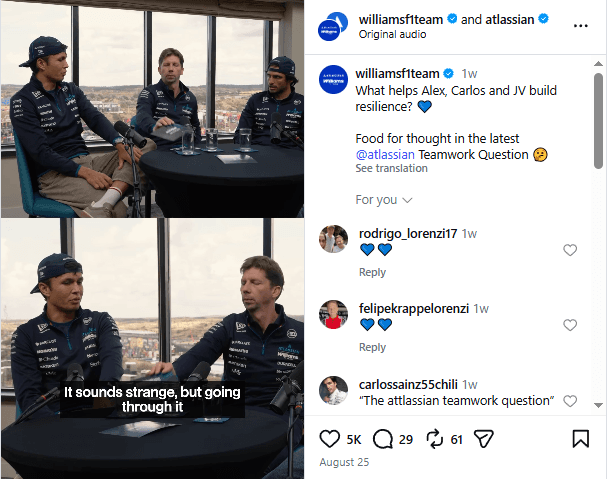
Teamwork Question, with 5k likes, 29 comments, and 61 reposts, and 109k views.
How does an F1 pit crew train for the 2026 season, with 3.4k likes, 13 comments, 31 reposts, and 233k views.
All factors in building a top-performing pit crew, with 3.1k likes, 11 comments, and 20 reposts. This is a carousel with multiple videos, so we can’t see the views.
Collabs are still going strong on Instagram, even if it’s September 2026. Posts like this target both followers, so when powers combine, the engagement and reach are better. Since Formula 1 is one of the most popular sports, it’s obvious that these videos will outperform any team or product update post, especially if the drivers are making a guest appearance.
X (formerly Twitter)
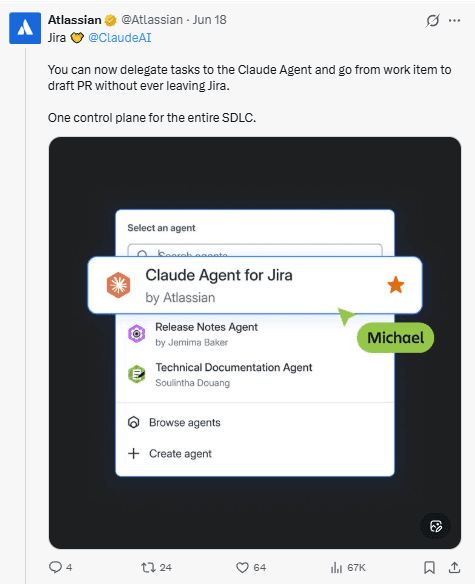
The top post is the video announcing Claude Agent for Jira, that has 67k views, 64 likes, 24 reposts, and 4 comments.
The second one is a video featuring Carlos Sainz, with 18k views, 93 likes, 33 reposts, and 3 comments.
The third is the pinned video, announcing the new system for AI-native software development in Jira, which has 10k views, 40 likes, 14 reposts, and 6 comments.
Videos help reach more people, even on X. The platform, started as Twitter, was used for quick, written updates, sometimes accompanied by an image. All social media platforms require more video content, and Atlassian is doing the work. Maybe a written-only post announcing the same update couldn’t reach this many accounts. Based on the content, people still prefer product updates to others.
YouTube
The Atlassian all time top content on YouTube is:
Long format

“Team '26 Europe is headed to Amsterdam | Atlassian”, with 11M views, 26 likes, and 1 comment
“Teamwork Lab | Atlassian”, with 7.8M views, 261 likes, and 7 comments
“Impossible Alone. Possible Together | Atlassian”, with 7.4M views, 456 likes, and 27 comments.
Although these can be impressive numbers, judging by their follower count and the overall engagement, it’s possible that these videos are, in fact, ads. The difference between likes and views is too big to reach so many people organically.
Shorts

“Impossible Alone #atlassian”, with 2.7M views, 64 likes, and 1 comment.
“Carlos Sainz answers fan questions with Rovo”, with 1.7M views, 949 likes, and no comments.
“💌 Fan Mail for Jira Service Management”, with 460k views, 2.4k likes, and 4 comments.
These three follow the same path as the long-format above. Great views, little engagement. Since many of these are used as product commercials, even if they didn’t promote it, they wouldn’t get that many comments. Shorts are used more and more for educational stuff, and long-form for podcasts and vlogs.
It’s clear that Atlassian tries to adapt their content to each platform, but not going the extra mile. Yes, they are everywhere, but they are not making content unique to each platform’s needs. Plus, that job is for their product channels, to convert people. They are just the “face” of the brands, like that one kid that you will always convince to present the group project in front of the class.
Steal This: Even if you batch create your content, try to choose the right content for the right platform. X is better for product updates, Instagram craves collabs, YouTube needs Shorts to drive people to the main page, and so on. Choose the channel, the intent, and use it accordingly.
Paid Advertising Strategy

On LinkedIn, Atlassian runs over 8.5k ads, mostly single-image or video ads. The recurring themes are: The State of Teams, How F1 teams turn speed into performance, and blog articles. The headlines include: “4 signs your AI strategy isn’t working”, “How F1 teams turn speed into performance” and “The hidden cost of disconnected AI”.
Meta

On Meta, Atlassian is running over 800 ads. All of them are distributed to Facebook and Instagram, but some of them include Messenger and Threads. They are using more carousels and single images than videos, unlike LinkedIn. The focus on these platforms is their products: Jira, Confluence, and Loom. The Sign Up button leads straight to their products pages on their site. The headlines include: “Turn ideas into action with Confluence”, “Get time back from meetings with Jira”, and “The #1 project collaboration tool”.

On Google, Atlassian runs 5k ads on Google Shopping, 20k ads on Google Search, and 20k ads on YouTube. As expected, on Shopping they focus on their product, like Jira and Confluence. They use mostly text ads, with the following headlines: “Jira Official Site”, “Confluence Collaboration Tool”, “Start Projects in Seconds - Connect Plans & Tracking”, and “Team Collaboration Strategies”.
On Google Search, they follow the same strategy as on Shopping, but the big difference is that here, you will find ads in other languages besides English, like Japanese, Portuguese, or French. YouTube follows the same structure, introducing video ads, as we suspected in the Top performing content part. Jira and Confluence seem to be the stars and the focus of Atlassian in this period of time. There are no ads on TikTok, Google Maps, or Google Play.
On LinkedIn, the ads sell ideas. The headlines are built around a problem the reader recognises before any product appears. On Meta, the ads sell products by name, with Sign Up buttons pointing at Jira, Confluence and Loom pages. On Google, the ads defend the brand, with "Jira Official Site" and "Confluence Collaboration Tool" using terms people already type. Awareness, consideration, and capture, each handed to the channel best suited to the task.
The number of ads on channels reflects where the buying committee spends its working attention, and Dreamdata's LinkedIn Benchmarks Report 2026 found LinkedIn the only major platform returning positive ROAS for B2B at 121%, against 67% for Google Search and 51% for Meta. Running 20k. Localised search capture costs little once the landing pages exist, and it protects branded demand in markets where a local competitor would otherwise buy the term.
Steal This: Give each ad platform one job and write separate creative for it. Use the professional network for the idea someone forwards to their boss, the social feeds for the product they sign up for, and search for the branded terms you refuse to lose.
Sales Funnel from Social Media
On LinkedIn, they usually put the link to their site in the comments. From there, multiple sticky “Sign up now” buttons appear on each page, so you can subscribe to their newsletter. At the bottom of the page, you will find a link to download their products, but the interesting fact is that they don’t do it classically and in your face. They just put a hyperlink there, and if you don’t pay attention, you will skip it.
On Facebook, they mostly promote their webinars, so the only links shown are from the Events created to register. Except for their bio, there are no other links directly to their products. On Instagram, you have the sprout.link in the bio that does all that work. Each post is related to a piece of their content or a product, so naturally, the path is simpler for people looking for a specific product or update.
On X, while the product updates get the most engagement, the only links in the comments left by Atlassian are the ones to register for their webinars or events. The forms require name, email, company name and size, job title, and country. There is no other option: download this specific product or sign up for their platform.
On YouTube, they will put a link in their description related to that post. From their site, you have the same path. Mostly to register for one of their events or reach a specific article. Some of the events have tickets with prices between 699 and 1799 euros per pass. If they put all of the CTAs on the same page, people would get completely lost, and they wouldn’t convert. For these events with entry fee pages, it would be too much to ask them to buy tickets, subscribe to their newsletter, and try their products.
Steal This: If you already have a CTA and an intention behind a post (for example, to make people buy tickets to your event) don’t overwhelm the visitor with to many actions that they could take. Make one good, clear path for each intent.
Reviews and Social Proof

Atlassian is more of an aggregator of multiple products, like Jira or Trello. Since this is the mothership, we couldn’t find any reviews of the company, except Glassdoor, where they hold a 3.2-star rating, with 48% would recommend to a friend and 43% approve of CEO Mike Cannon-Brookes from over 3.7k reviews, with an overall of 34% positive business outlook.
The ratings by category are: 4.1 for Compensation and benefits, 3.6 for Diversity & inclusion, 3.2 for Work/Life balance, 3.1 for Career opportunities, 2.9 for Culture & values and 2.4 for Senior management.
The high number of reviews shows a completely different reality than what they present on social media or their site. They promise a lot of benefits and a great community for their employees, and maybe it is like that. But where are the good reviews on Glassdoor? Where are the happy people that we’ve seen on social media?
Well, in March 2026, Mike Cannon-Brookes published a note reducing the team by roughly 1.6k people, close to 10% of headcount, and framed the decision as self-funding for AI and enterprise sales. Glassdoor scores are a rolling average of people writing in the months around an event like this, and sentiment rarely recovers inside a single quarter after a cut of this size. A 3.2 rating six months after a restructuring measures this specific period.
While Atlassian doesn’t have reviews, unlike their product, some signals reveal their success rate. In the Q4 FY26 shareholder letter, Atlassian listed Leader positions across the Gartner Magic Quadrant for IT Service Management Platforms, DevSecOps Platforms, Developer Productivity Insight Platforms, Collaborative Work Management and Marketing Work Management Platforms, alongside Forrester Wave Leader placements in DevOps Platforms, Value Stream Management and Enterprise Service Management.
For a company selling seven-figure contracts into enterprise procurement, an analyst grid outranks a star rating. Named customers do the rest of the work. The same letter quotes engineering and operations leaders at NVIDIA, Cisco, Honeywell, Mercedes-Benz, Kraken, Reddit, Wendy's, Xometry and Synchrony by name and title, each describing a specific deployment.
A Director of Engineering at NVIDIA talking about orchestrating cross-functional workflows is a stronger trust signal for an enterprise buyer than a hundred anonymous four-star reviews, because the buyer recognises the company, the role, and the problem.
Content Marketing and Demand Generation
Atlassian Partners

This directory offers a list of trusted partners, offering proven expertise, specialized services, and tailored solutions. You can browse the list by country or territory, geography, solutions, industry expertise, company size, and service management. If you don’t know what to look for, they offer a matching service, where they will match you with the best Solutions Partners.
Blog

Atlassian’s blog has six categories: AI at work, Leadership, Teamwork, Innovation, Development, and How we build. The blog has a featured category, named “Watch, listen, and learn”, where you can find all the educational content in one place.
From this page, you can download their AI journey report and see what they’ve learned from redesigning how 14,5k people plan, decide, and deliver with AI. At the bottom of the blog page, you will find the newsletter subscription button if you want to read more research and insights on how teams can deliver results with AI.
Investors

This page is made specifically for Atlassian’s present and future investors. They can download quarterly financial results, latest events, and read company highlights. As of September 2026, Atlassian has $6.6B total revenue, 26% YoY growth, and over 350k customers.
Other pages include: a Knowledge Base, where you can search for the topic you want, a Marketplace, where you can discover apps for your team, explore products’ documentation, and read the Atlassian Developer blog and community articles.
Marketing and Sales Funnel Stages
Top of the funnel (TOFU)
The top of the funnel runs on reach the brand already owns. Organic search picks up everyone typing a product name, YouTube long-form and Shorts push brand films to millions of views, the Williams Formula 1 partnership borrows an audience with no interest in project management software, and the blog covers different search topics. Instagram and Facebook carry culture and events.
Middle of the funnel (MOFU)
Consideration is where the free tier does the heavy lifting. Ten users, no credit card, no call. Someone evaluating Jira reaches the product before a salesperson reaches them. Around it sit the pricing calculator, the certification catalogue, the AI journey report at the top of the blog, the newsletter, and the Partners directory with its matching service for buyers who don’t know which implementation partner to pick. Webinar and event registration forms on Facebook and X ask for name, email, company name and size, job title and country, which is the moment an anonymous reader becomes a routable lead.
Bottom of the funnel (BOFU)
Bottom of funnel splits by deal size. Self-serve buyers pick Standard at $7.91 per user per month or Premium at $14.54 and pay by card, with the calculator doing the pre-sale maths for them. Enterprise buyers hit a Contact sales button on Jira Align, Talent, Focus, DX and the Enterprise tier, and enter a human process where the numbers move with commitment length. The paid events, with passes between 699 and 1799 euros, work as a third path, because a company sending four people to Team is one with budget approval already in motion.
Retention
Retention is the strongest part of the machine. The Community forums answer product questions without opening a support ticket. Atlassian Learning keeps skills current, and certificates expire after one year while certifications expire after two, which brings people back on a schedule. The Champions program gives the most engaged users a title and a reason to run local events.
The Marketplace, with over 7k apps and 1.4M installs, raises switching costs every time a team adds one. And the Teamwork Graph, which Atlassian describes as holding more than 200 billion objects and connections across customer graphs, means the longer a company stays, the more accumulated context it would walk away from by leaving.
Future Plans and Growth Indicators

We said in the Trello’s Marketing Spotlight article that any job for their products redirects to Atlassian’s Careers page. They have four main categories to choose from: Engineering, Product and Design, Sales and Support, and Early Careers.
The departments with the most job openings as of September 2026 are: Sales (149), Engineering (38), and Marketing (7). They are recruiting for their offices in Australia, India, Poland, Singapore, the UK, and the US. Most of them offer the possibility of remote work. They also have the Atlassian Talent Community, where if you don’t see an exact role match, you can join the community to stay up to date on company and careers updates.
On 6 August 2026, Atlassian named scaling its enterprise go-to-market engine as one of three FY27 priorities, alongside Rovo and the Teamwork Graph. The same letter reported customers above $3 million in ARR growing more than 50% year over year and customers above $5 million growing more than 70%, which is the kind of movement enterprise sellers get hired to sustain.
Atlassian appointed Ken Exner as Chief Product Officer for Enterprise and Emerging, shipped Agents in Jira, a Jira Coding Agent, Jira Cloud for Slack, and Agent Sessions inside the quarter, and set March 2029 as the end of life for its Data Center offering, which turns every remaining on-premises customer into a scheduled Cloud migration conversation.
Team '26 Europe heads to Amsterdam, and the announcement video is already their most-watched piece of YouTube content. The events calendar, the sales hiring, and the product roadmap all point at the same enterprise buyer.
Metaview's 2026 AI & Hiring Alignment Report, which surveyed 505 recruiting leaders and hiring managers across North America and EMEA, found teams running community upstream of open roles outperform reactive hiring at every measured stage. A Talent Community is exactly that layer, sitting between brand interest and an application.
Steal This: Create a Talent program where you can gather people who are interested in your company and really want to work with you. The extra step taken to enter the community shows you their determination, and it’s a great way, if one position becomes available, to already have prospects.
Inspiration Points
1. Show the price before you ask for the meeting
Buyers discount what they cannot verify. Akerlof's market for lemons describes what happens when one side holds information the other lacks: the uninformed side assumes the worst and prices accordingly.
A hidden price reads as a high price. Atlassian publishes per-user figures for Standard and Premium and reserves Contact sales for the tier where the number genuinely varies. Topickz found 26% of B2B SaaS tools hide pricing behind a sales call, and 42% of developer tools do, so transparency here is a differentiator rather than table stakes.
2. Turn product knowledge into a credential people display
Cialdini's commitment and consistency principle holds that once someone makes a public, effortful commitment, they behave in ways consistent with it. An Atlassian Certified Professional has paid $249, passed an exam, and put the badge on a public profile. Renewal is now identity maintenance rather than a purchase decision.
The State of Customer Education 2026 by Absorb Software and Lighthouse Research & Advisory names tiered certification as one of five habits separating the highest-performing customer education programs from the rest.
3. Split mental availability and physical availability across channels
Ehrenberg-Bass separates mental availability, being thought of when a need arises, from physical availability, being findable when someone acts. Atlassian runs LinkedIn for the first and Google for the second, with Meta bridging the two through named product ads.
Dreamdata's LinkedIn Benchmarks Report 2026 found LinkedIn to be the only major platform delivering positive ROAS for B2B at 121%, against 67% for Google Search and 51% for Meta, which explains why the volume sits where it sits.
4. Create batch content and distribute the posts to the right platform
Uses and gratifications theory says audiences pick a medium for a specific need, so the winning move is matching the subject to the need each platform serves. Atlassian does this deliberately. X carries product updates for people tracking releases. Instagram carries Formula 1 collabs with the Williams team for people who want the brand at its most human. YouTube carries Shorts that feed long-form. LinkedIn and Facebook carry culture and events.
Emplifi's Social Media Benchmarks 2026 concluded that success now requires platform-specific precision rather than broad uniformity, with engagement patterns diverging sharply by channel.
5. One intention, one path
Iyengar and Lepper's choice overload research showed people are less likely to act when offered more options, not fewer. Atlassian keeps event pages on event actions and product pages on product actions rather than stacking newsletter, trial, and ticket CTAs on the same screen. Unbounce's 2026 Conversion Benchmark Report puts single-CTA landing pages at 13.5% conversion against 10.5% for pages carrying five or more competing links.
6. Collect intent before you have a role to fill
Freedman and Fraser's foot-in-the-door work found a small initial commitment raises the odds of a larger one later. The Atlassian Talent Community asks for an email from people with no matching role open, and turns a dead end into a warm list. Metaview's 2026 AI & Hiring Alignment Report, covering 505 recruiting leaders and hiring managers, found teams running community upstream of open roles outperform reactive hiring at every measured stage.
At Milk and Cookies Studio, we build go-to-market, demand generation, and ABM programs for B2B SaaS and deep-tech companies moving into new markets. We work with founders and CEOs who have a product people want and a growth motion still finding its shape. If any of the above sounds like a gap in your own funnel, start a conversation with us.
Frequently Asked Questions
What does Atlassian actually sell?
Atlassian sells team collaboration and work management software, with Jira for project tracking, Confluence for documentation, Loom for video messaging, Trello for lightweight boards, Bitbucket for code, and Rovo for AI search, chat and agents. The products are sold individually and in bundled Collections. More than 350,000 organisations use them, including over 80% of the Fortune 500.
How much does Jira cost per user?
For a 300-user team billed monthly, Jira Standard is $7.91 per user per month and Premium is $14.54 per user per month. The Free tier covers up to ten users with no credit card. Enterprise pricing sits behind a Contact sales button, and the per-user rate drops as team size grows.
Is Atlassian free for small teams?
Yes. Most Atlassian products are free for up to ten users with no credit card required, including Jira, Confluence and Trello. Products aimed at large organisations, such as Jira Align, Talent, Focus and DX, are only available after speaking with sales.
What is the Atlassian Community and is it free to join?
The Atlassian Community is a free forum, learning hub and events network covering Q&A, discussion groups, articles and local meetups. It includes Atlassian Learning courses and a Champions program for members who host events, answer questions or create content. Certificates are free, while the Certified Associate exam costs $100 and the Certified Professional exam costs $249.
Who is the CEO of Atlassian?
Mike Cannon-Brookes is CEO and co-founder. He founded the company with Scott Farquhar in Sydney in 2002, and Farquhar remains involved as co-founder. Cannon-Brookes has over 113k LinkedIn followers and posts several times a week, mostly about company news, events and partnerships.
How does Atlassian use social media?
Atlassian runs LinkedIn at high volume for culture, events and product updates with 3M followers, Facebook for webinar registration with 398k, Instagram for team and Formula 1 content with 145k, X for product updates with 106.8k, and YouTube for brand films, courses and podcasts with 260k subscribers. The TikTok account has followers but no published videos.
What kind of content performs best for Atlassian?
Culture content beats product content on LinkedIn and Facebook, with an International Cat Day post pulling 2072 reactions against 491 for a Rovo and Microsoft 365 integration announcement. On Instagram, Formula 1 collaborations with the Williams team lead by a wide margin. On X, product update videos win.
Where does Atlassian run paid ads?
Atlassian runs over 8.5k ads on LinkedIn, over 800 on Meta across Facebook, Instagram, Messenger and Threads, and roughly 45k on Google across Shopping, Search and YouTube. LinkedIn carries research and thought leadership, Meta carries named product ads, and Google carries branded search capture in multiple languages.
Does Atlassian have good reviews?
Product-level reviews sit on the individual Jira, Confluence and Trello listings rather than on the parent company. On Glassdoor, Atlassian holds a 3.2-star rating from over 3.7k reviews, with 48% recommending the company to a friend. At the company level, credibility comes from Gartner Magic Quadrant and Forrester Wave Leader placements plus named enterprise customers.
How does Atlassian's sales funnel work?
Social posts and search drive awareness, the free ten-user tier handles evaluation, and the pricing calculator and certification catalogue support consideration. Self-serve buyers pay by card at Standard or Premium. Enterprise buyers go through Contact sales. Retention runs through the Community forums, Atlassian Learning, the Champions program and the Marketplace.
What is the Atlassian Teamwork Graph?
The Teamwork Graph is Atlassian's context layer, linking knowledge, work, communications, code, assets and people data into a single map used by both humans and AI agents. Atlassian reports over 200 billion objects and connections across customer graphs, and says agents grounded in the graph return up to 44% more accurate answers while consuming 48% fewer tokens.
What is Atlassian hiring for right now?
As of September 2026, the largest departments hiring are Sales with 149 openings, Engineering with 38 and Marketing with 7, across offices in Australia, India, Poland, Singapore, the UK and the US. The weighting matches the company's stated FY27 priority of scaling its enterprise go-to-market engine.