Marketing spotlight
/
Marketing Spotlight: Mapping Trello's Marketing and Sales Tactics
In this article, we put Trello in the “Marketing Spotlight” as we take a closer look at how their sales and marketing strategies are working and what sets them apart, as of July 2026.
TL;DR: Conclusions and Key Takeaways
🎀 This section gives you the main insights without all the details. It’s the stuff you need to remember, whether you’re reading this now or in 6 months. We made this for people who want to get the core message fast.
Trello is the visual to-do and project board that brought Kanban to millions of people who never worked in a factory or a software team. This article looks at what happened to Trello's marketing after Atlassian bought the company in 2017, and it finds a split most acquisition stories miss: the product-led machinery stayed sharp, while the brand's public voice thinned out.
Key Takeaways
The Trello Guide, Remote Work Guide, Team Playbooks, and webinars are all ungated, a friction-removal bet that lines up with where B2B buyers already are: Gartner puts rep-free purchase preference at 67%.
Pricing stays visible all the way to Enterprise, paired with a calculator instead of a "Contact Sales" wall, exactly the number most B2B software hides.
The Power-Ups marketplace, 200-plus integrations deep, builds a genuine switching-cost moat that costs nothing to market.
Four separate review platforms land between 4.3 and 4.6 with tens of thousands of reviews behind them, trust compounding with nobody actively managing it.
The one coordinated campaign we found, a January blog post paired with a matching YouTube ad, proves the marketing machinery still works the moment someone decides to use it.
📝 A quick note before you start reading: The data and analysis in this article are valid as of the time we wrote it. We don’t know when you’ll be reading this, maybe next week, maybe six months from now, and things might have changed since we looked at this company’s marketing and sales approach. Still, the insights and lessons here stay useful, even if the numbers or tactics have evolved a bit.
Ask ten people how they organize their work and at least three will describe dragging a card from one column to another. That's Trello. It didn't invent the Kanban board, but it's the reason a generation of non-technical teams knows what one looks like.
At Milk and Cookies Studio, we usually pick companies for this series because their marketing is doing something worth stealing right now. Trello is a different kind of case study. It was acquired by Atlassian in 2017, and the easy version of this story is "the acquisition killed the marketing." The more useful version is more specific than that.
The parts of Trello's growth engine that live inside the product itself (the pricing, the integrations, the reviews, the self-serve signup), are still doing their job well. The parts that require someone to actively show up, like the blog, the social accounts, a visible leader, thinned out. That gap between what runs on autopilot and what needs a person behind it is the actual lesson here, and it applies to any company that gets folded into something bigger.
The data and analysis here are valid as of July 2026. Trello moves at Atlassian's pace now, not its own, and that shows up throughout what follows.
Understanding Trello
Trello started life inside Fog Creek Software, the New York development shop co-founded by Joel Spolsky. A prototype called Trellis went into build in January 2011, and the product launched publicly at TechCrunch Disrupt that September. In July 2014, Trello spun out of Fog Creek to become its own company, with fellow Fog Creek co-founder Michael Pryor named CEO. That same month, Trello raised a $10.3 million Series A co-led by Spark Capital and Index Ventures.
Atlassian acquired Trello in January 2017. The reported price, $425 million split between cash and stock, comes from secondary sources rather than an Atlassian press release we fetched directly, so treat that specific figure as widely reported rather than confirmed firsthand. Today Trello operates as a product line inside Atlassian, alongside Jira, Confluence, and Loom. Employee count specific to the Trello product line is not publicly broken out from Atlassian's overall headcount, so we're not treating a company-wide number as a Trello-specific signal.
What's worth noting before getting into the marketing itself: nine years is a long time for any acquired product to keep its own product identity. Trello still ships its own features, still runs its own pricing page, and still has a mascot nobody renamed.
Brand Promise Analysis
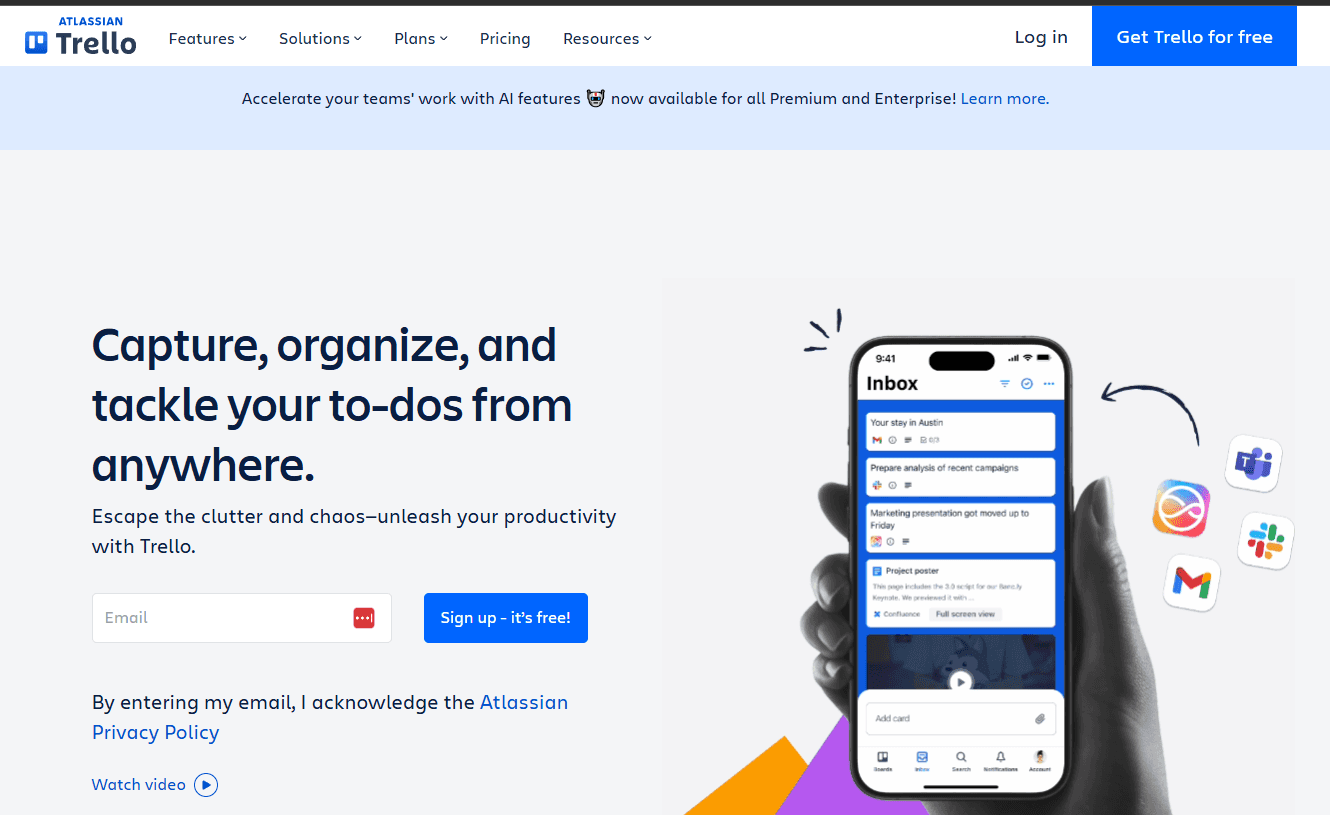
Trello's homepage headline is plain and functional: "Capture, organize, and tackle your to-dos from anywhere." The supporting copy leans on the same register: "Escape the clutter and chaos- unleash your productivity with Trello". They are positioning themselves against the chaos of scattered sticky notes and half-remembered tasks.
Trello keeps you organized with Inbox, Boards, and Planner working together. Turn a message from your favorite apps into a to-do, and keep every discussion and task in one place. Got something to follow up on from Slack or Microsoft Teams? Send it straight to your Trello board. Customize how you organize with integrations, automation, and to-dos that mirror across multiple locations.
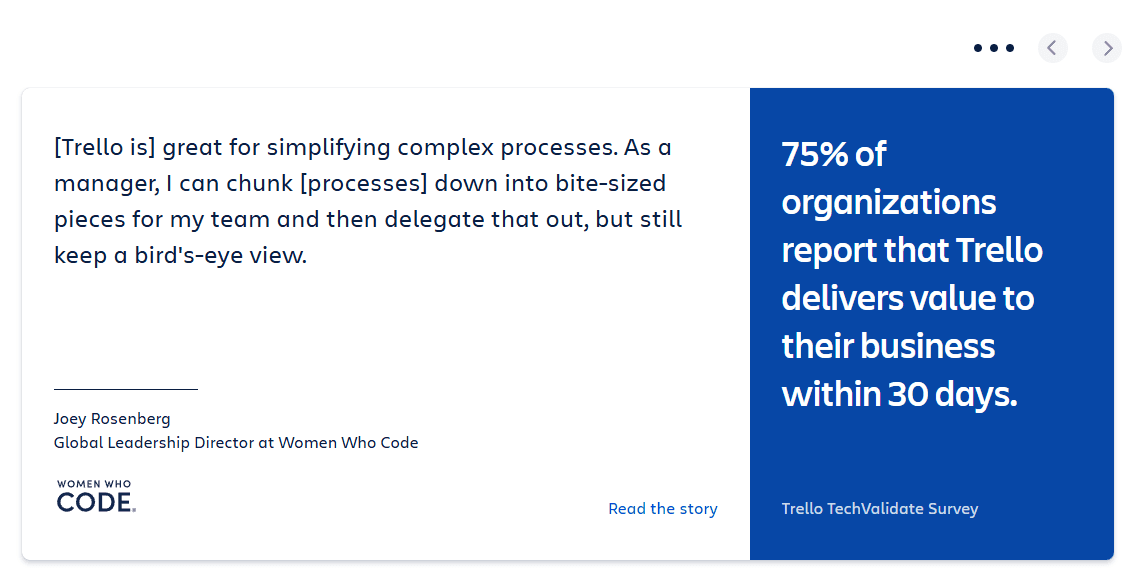
The proof points on the page lean on real numbers like: "75% of organizations report that Trello delivers value to their business within 30 days," "81% of customers chose Trello for its ease of use," and "74% of customers say Trello has improved communication with their co-workers and teams," all attributed to a Trello TechValidate survey. Three named customer testimonials, from Women Who Code, ThoughtWorks, and IKEA/PTC, each link out to a full customer story.
That's a brand promise doing exactly what it needs to do for a self-serve product: state the problem plainly, back it with attributed numbers, and get out of the way of the signup button. Nothing here oversells the product or drifts into "revolutionary" territory. For a tool this well known, restraint is the right instinct.
Service and Product Breakdown
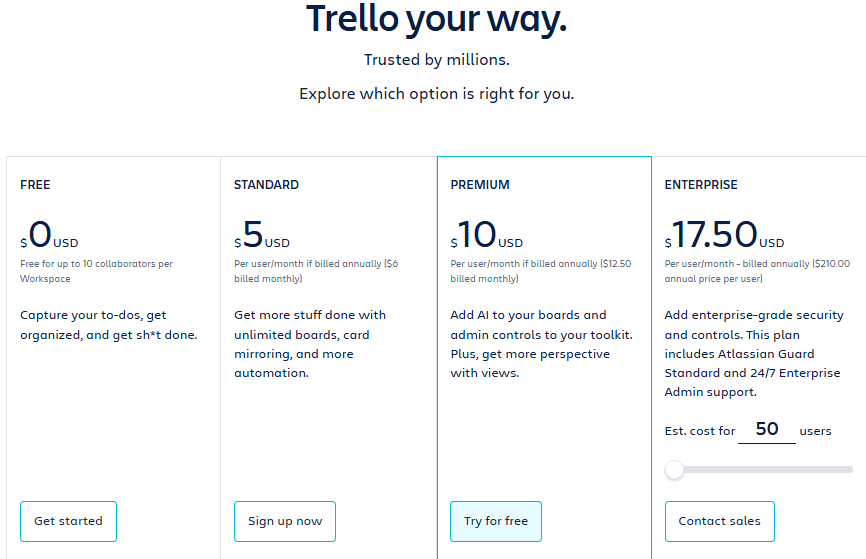
Trello runs four pricing tiers, and every one of them is priced per user with no custom-quote requirement below Enterprise. Free covers up to 10 collaborators per Workspace with unlimited cards and up to 10 boards. Standard runs $5 a user monthly on an annual plan ($6 billed monthly) and adds unlimited boards, AI-powered quick capture, and Planner. Premium is $10 a user annually ($12.50 monthly) and unlocks the Calendar, Timeline, Table, Dashboard, and Map views along with admin controls.
Enterprise starts at $17.50 a user annually, billed annually only, and adds organization-wide permissions and SSO through Atlassian Guard. At this tier, a slider gives a tentative cost estimate based on total user count.
A button below the short description gets you started right away. The Enterprise button leads to a dedicated page with more detail on the offer. A "trusted by" banner features companies like Coinbase, John Deere, Grand Hyatt, Google, Visa and Zoom.
No-code automation is built into every Trello board, aimed at the work that matters, not the busywork around it. Create rules, buttons, and commands to automate almost any action in Trello. They offer free templates for the categories: Business, Design, Education, Marketing, Project Management, and Remote Work.
The integrations list features Slack, Jira, Miro, Clockify, Microsoft Teams, and Mailchimp. It also connects directly to AI tools like ChatGPT, Claude, and GitHub.
Published, per-seat pricing all the way up to Enterprise is not the industry default. A lot of B2B software hides its top tier behind "Contact Sales" specifically to control the conversation with larger buyers. Trello keeps the number visible and adds a calculator instead, which tells a prospect the company trusts its own value enough not to gate the price behind a phone call.
💡 Steal This: Keep your pricing visible all the way to your top tier, and pair it with a simple calculator instead of a "Contact Sales" wall. A buyer who can price out Enterprise themselves arrives at a sales conversation already sold on the number, not negotiating over whether to have the conversation at all.
Differentiators and Unique Assets
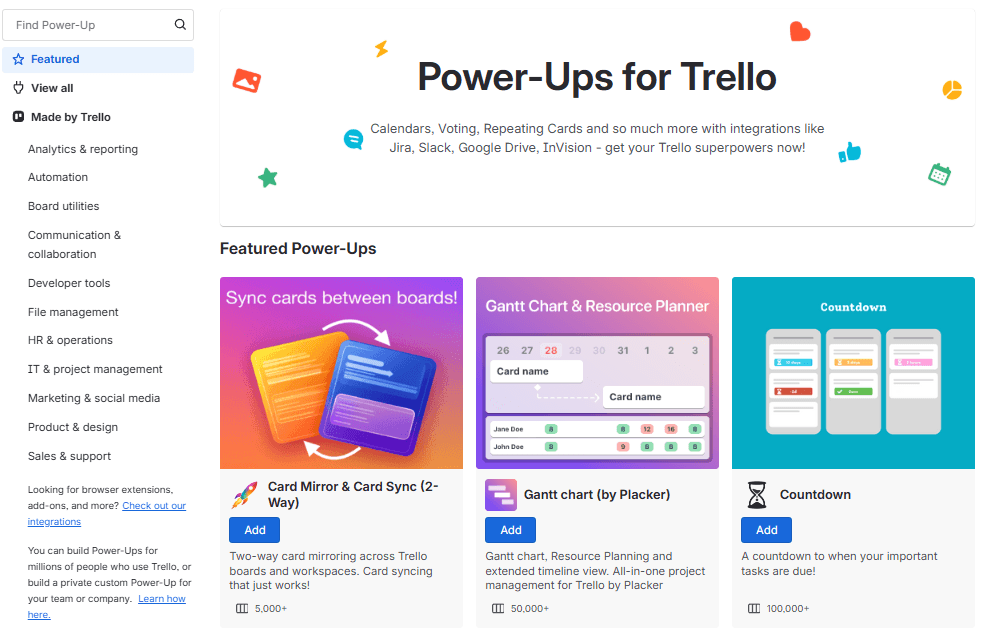
Trello's biggest structural differentiator is the Power-Ups platform, a marketplace of over 200 integrations that let a board pull in Slack messages, Google Drive files, or Salesforce records without leaving Trello. The company also bundles ten Team Playbooks, pre-built combinations of templates, blog posts, and webinars aimed at specific functions like marketing, sales, design, and HR, which is a smart way to package existing content into something that feels like a starter kit rather than a scavenger hunt.
Every resource we found, like the Trello Guide, the Remote Work Guide, the Team Playbooks, and the on-demand webinars, is ungated. There's no whitepaper anywhere in this research that requires an email address. For a company running a pure self-serve motion, that's the right call. Gating content behind a form is a sales-led habit, and Trello's funnel isn't sales-led.
The clearest personality Trello still has left is Taco, the husky mascot that dates back to 2012, when Fog Creek co-founder Joel Spolsky's own dog became the brand's unofficial spokes-animal. Taco still shows up in the illustration on the pricing page. It's a small thing, but it's one of the only pieces of the original Trello identity that survived nine years inside Atlassian intact, alongside the Power-Ups ecosystem itself. Both are worth naming together: one is a technical moat, the other is a purely emotional one, and neither needed a marketing department to keep existing.
💡 Steal This: Map every touchpoint where your product connects to a tool your customers already use daily. Build an integrations layer deep enough that leaving costs more than staying, and let that do quiet retention work no campaign could match.
Leadership Presence Analysis
Trello doesn't have a CEO to point to anymore, which makes this section different from most in this series. The company was originally led by Michael Pryor, the co-founder who stayed on as CEO even after the 2017 acquisition, before stepping back from day-to-day leadership in 2022. His current activity level isn't something we're tracking here, since he's no longer the person shaping Trello's public presence.
Gaurav Kataria, VP of Product, Trello and Loom
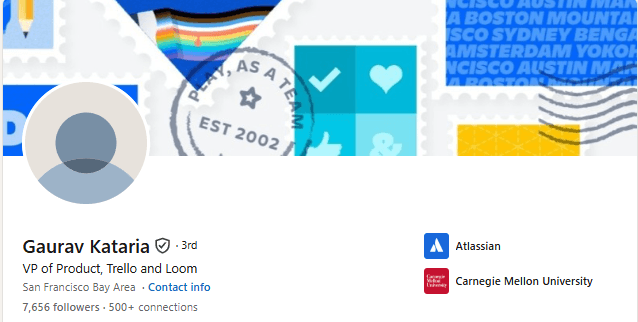
Gaurav Kataria, the VP of Product for Trello, has 7.6k followers on his LinkedIn profile. He mostly reposts, from time to time, announcements about Trello, Atlassian, and Loom. There is an original post from 3 months ago: a video of his interview from The Cube. He wrote in the caption that they are building the agent harness to deliver a 10x increase in productivity by bringing in the right context, while balancing speed, cost, and accuracy. The post received 84 reactions and 3 comments.
He posts original content twice a year, and the reposts have no captions usually. He is posting only about big product updates. He's the person most consistently quoted in press coverage and the one who shows up most often across the company's channels, from feature announcements to posts about the product team.
That's a workable model for a brand living inside a bigger company: you don't need your own CEO to have a trustworthy voice. You need someone who shows up consistently enough to be findable when a reader or a journalist comes looking. Kataria fills that role in substance, even without the title.
Social Media Strategy
On Facebook, Trello has 141,000 followers, but it hasn't posted since June 26, 2024. In the stretch before it went quiet, the page posted roughly twice a month, and the content leaned toward integrations, webinars, and straightforward product promotion, the kind of material a marketing team schedules out. Engagement even during that active period was modest, sitting around 20 likes, 15 comments, and 3 shares per post.
X (formerly Twitter)
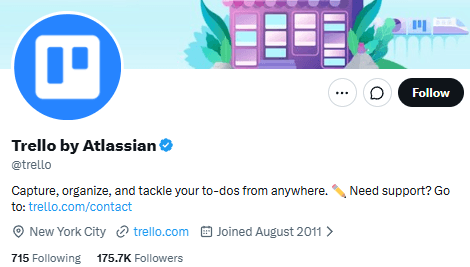
X (formerly Twitter) holds Trello's biggest audience of all four platforms, 175,800 followers, also dormant at the moment of analysis, with no posts since June 2025. In the past, the account mixed feature announcements with a more relaxed, personality-driven style, informal photos of desks, coffee, and pets that had nothing to do with project management directly but gave the account a human tone.
Even in that active period, engagement was light relative to the follower count, typically around 20 likes, 10 comments, and 3 reposts per post, with view counts hovering near 7,000. The difference between the follower size and engagement suggests the account gained a large audience over the years without ever building a habit of interaction with it, and then stopped posting before anyone tried to fix that.
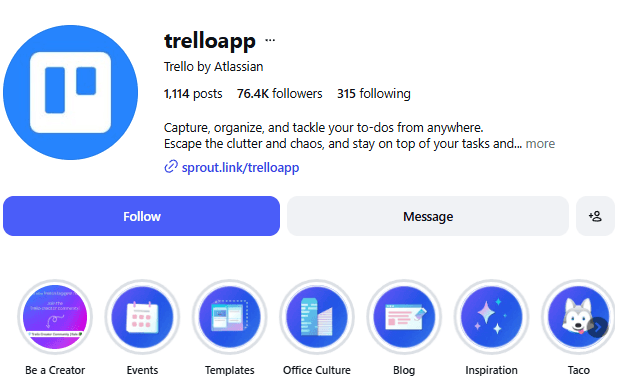
On Instagram, Trello has 76,400 followers. Although they rarely post, the latest post was from July 9, 2026, so we can assume that the channel is active. In the past, the account posts at best once a month, and some months pass with nothing at all.
What content does appear leans heavily on "Trello x Atlassian" branding, reinforcing the parent relationship rather than showing product tips, customer stories, or the kind of playful use-case content that tends to do well for productivity tools on this platform. Engagement runs around 70 likes and 20 comments per post, a reasonable rate for the follower count, but on a posting cadence too thin to build any real habit of checking the account.
YouTube
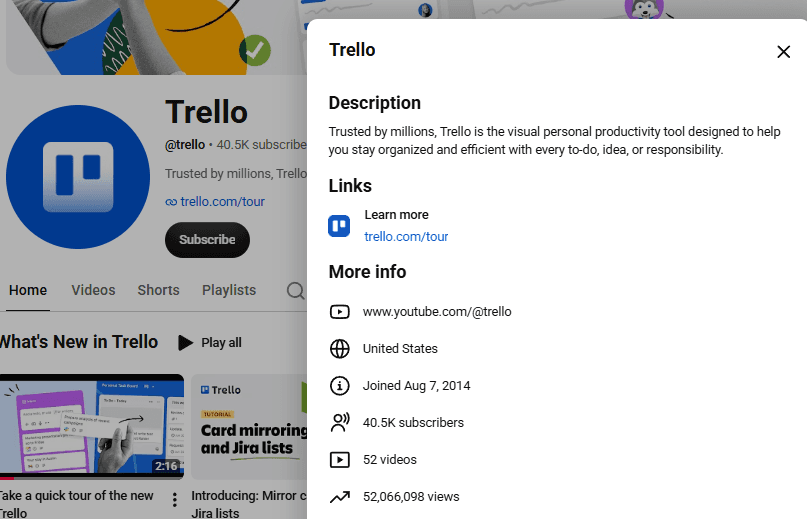
On their YouTube channel, Trello has 40,500 subscribers and a real, if sporadic, publishing habit. The channel is organized into a decent number of playlists, tutorials, tips for advanced users, a "Trello as a productivity hub" series, "what's new in Trello" recaps, AI-powered Trello features, automation and Power-Up walkthroughs, and beginner basics, alongside a small library of standalone Shorts.
The problem is reach on new uploads: several recent videos have disabled comments, and engagement on anything posted in the last few months is thin compared to the channel's older library. They also share Shorts, not only long-format videos, which we’ll discuss in the next chapter.
LinkedIn (Atlassian)
There is no independent Trello Company Page on LinkedIn. There is only a Showcase Page, a sub-page of Atlassian's main Company Page rather than a standalone entity. It’s common to create only a main page for the company, not the products, but you will not find it in the Products tab, but rather by reading the company’s description, where Jira, Confluence, Loom and Trello are mentioned.
The Atlassian page has over 2.5M followers and they post multiple times per day. They mostly post product updates and press-worthy news, including from time to time some posts about Trello, gaining thousands of likes on their posts. But since this is not Trello’s page, we will not analyze it further. It would not be fair to the other similar products from other articles.
Conclusions
We can see here a clear example of how a company’s social presence looks like after it gets absorbed into something bigger. In this case, we have two dormant channels, a third posting once a month, and a fourth that only exists as a Showcase Page under someone else's name.
Acquisitions usually dissolve the ownership. The team that used to post on Trello's behalf gets folded into a bigger team with a bigger mandate, the account that used to matter most becomes one of a dozen the new owner is juggling, and eventually nobody notices the gaps until a reader like this one goes looking.
We'll cover Atlassian itself in a separate Marketing Spotlight, and it will be worth comparing the two side by side: one company running a full, deliberate content operation, and one of its own products showing what happens when that same attention never gets pointed inward.
Content Marketing Institute's newest B2B report found 76% of B2B marketers rate LinkedIn as the most effective channel for building thought leadership, ahead of every other platform tracked. A working, purposeful LinkedIn presence isn't optional for a B2B software brand in 2026, acquired or not.
Ten years ago, Trello was the tool people brought up unprompted. Its current social presence reads like a company still living off that reputation rather than adding to it. A content strategy like this lets a better-marketed competitor close in quietly, one unanswered comparison search at a time, and being owned by a bigger company doesn't buy immunity from that.
Every point here leads to a product-led growth motion with no account-based marketing layer at all. There's no industry-specific content, no persona-targeted messaging, and no evidence of segment-specific campaigns anywhere in the social presence. That gap might have existed before the acquisition too. But it's exactly the kind of gap that's easy to leave unaddressed once a brand's social presence stops being anyone's single responsibility.
Top-Performing Content
This part only covers YouTube, since the other channels have no recent activity. Facebook hasn't posted since June 2024, X hasn't posted since June 2025, so there's no "last 3 months" to draw a top post from. Instagram is the borderline case: it's technically active, but only 2 posts landed in the last 3 months, too thin a sample to call one of them a genuine top performer rather than the more recent one of the two. YouTube is the only channel with enough recent and historical output to identify real standouts, so it's the only one analyzed here.
Long-form videos
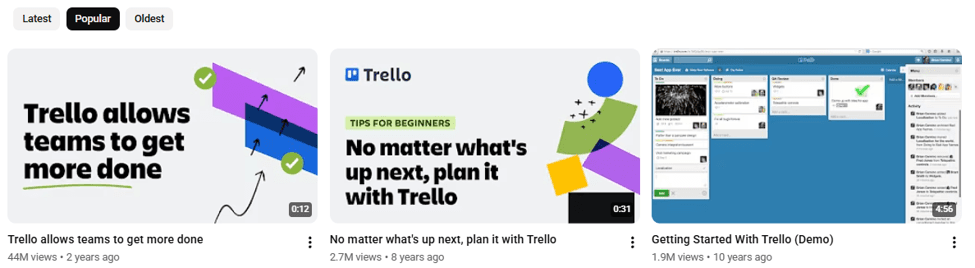
"Trello allows teams to get more done", 12 seconds, 44 million views, 76 likes, 28 comments, posted 2 years ago. A view-to-like ratio this lopsided doesn't happen organically. It reads like a paid ad, run for a long stretch across YouTube's ad network.
"No matter what's up next, plan it with Trello", 30 seconds, 2.7 million views, 215 likes, 12 comments, posted 8 years ago. Same pattern one size down: heavy reach, thin real engagement, most likely another repurposed ad rather than organic content.
"Getting Started With Trello (Demo)", 4 minutes 55 seconds, 1.9 million views, 6,200 likes, 168 comments. A plain screen-recorded walkthrough with a healthy engagement ratio, the one long-form video on the channel that behaves like genuine organic content.
Shorts
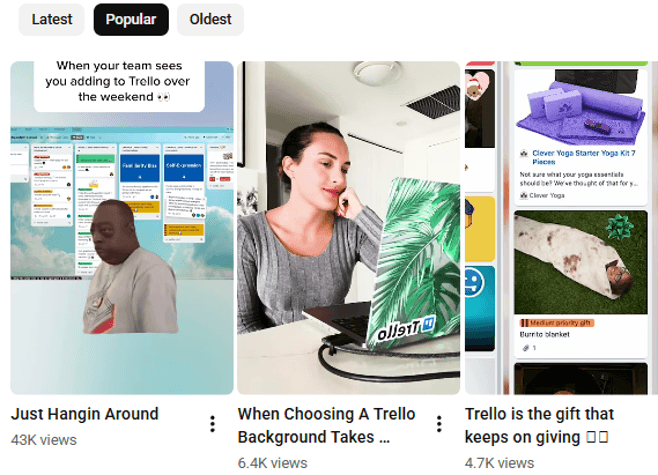
"Just Hangin Around", 43,000 views, 248 likes, 5 comments. A deadpan office-humor Short: a coworker's reaction to seeing weekend Trello activity.
"When Choosing A Trello Background Takes Priority", 6,400 views, 75 likes, 1 comment. Same joke format aimed at procrastination instead of overwork.
"Trello is the gift that keeps on giving", 4,700 views, 60 likes, 1 comment. A softer, personal-use angle, tracking a holiday wishlist inside a board.
None of the three Shorts comes close to the view counts of the two paid-looking long-form videos, and none was built to. What they share instead is something those two videos don't have: they look like something a person made, not something a media buyer placed.
Sprout Social's Q3 2025 Pulse Survey found 55% of social users trust brands more when the content looks human-made, and the Shorts, along with the older "Getting Started" demo, are the only videos on this channel that read that way on sight. It's not a coincidence that they're also the only ones with a real comment-to-view ratio.
Paid Advertising Strategy
Trello is not running Meta ads or LinkedIn ads. Its only paid channel is Google, across Shopping (roughly 200 ads), Search (roughly 1,000 ads), and YouTube (roughly 1,000 ads). Every headline we reviewed pushes straight to signup: "Trello Official Website - Get Started - It's Free," "Organize Work With Trello - Manage Projects Easily," and localized versions in Spanish, Portuguese, and French carrying the same message.
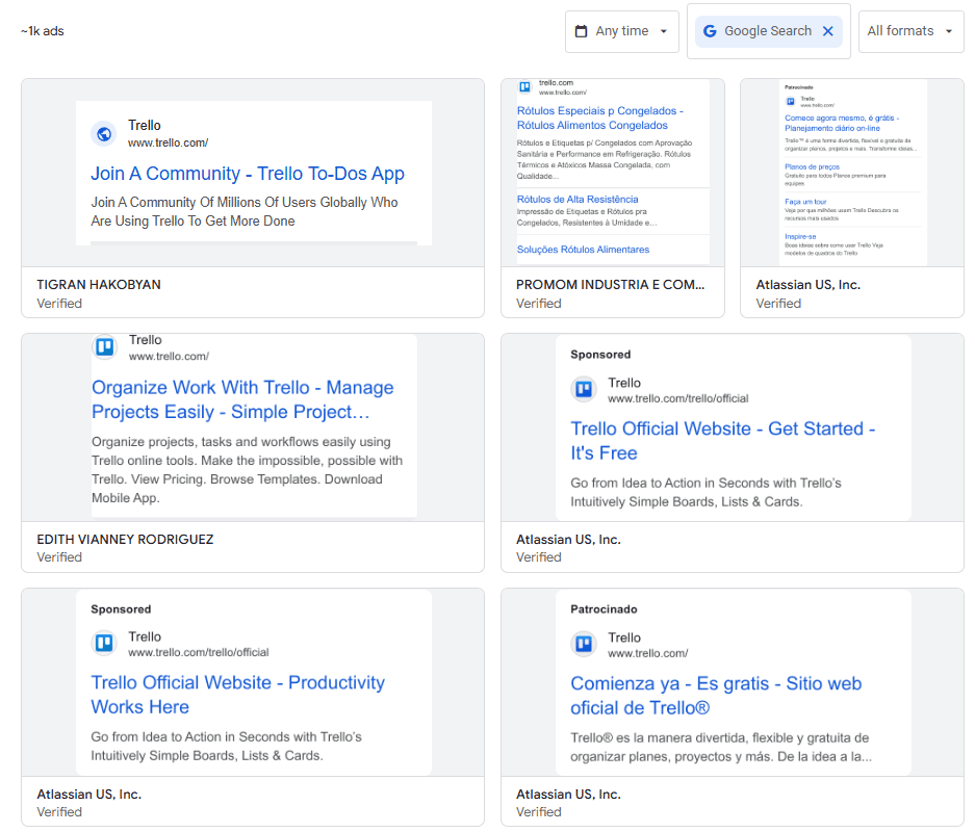
These were made for the bottom of the funnel, aimed at people who are already typing Trello's name or something close to it. The verified advertiser behind most of these is the parent company, Atlassian US.
We also found one piece of evidence of coordinated planning. A January 2026 blog post about a limited-edition "New Year's Resolution Board Builder" feature paired with a matching YouTube video ad, "Turn your New Year's resolution into reality," carrying the same seasonal hook. It's a small campaign, but it's proof the underlying machinery still works when someone decides to point it at a single moment.
The absence of LinkedIn ads is the clearest confirmation that Trello runs zero account-based marketing. LinkedIn is the standard channel for job-title and company-size targeting, and Trello isn't there. Every dollar of paid spend we found is aimed at individual searchers, not accounts, which fits a company whose Enterprise tier is priced and sold without a dedicated outbound motion behind it.
💡 Steal This: When you have a real seasonal moment worth marketing, coordinate every channel around the same message and hook instead of letting each one run its own version. It's a small lift that produces disproportionate cohesion.
Sales Funnel from Social Media
The path from an ad click to a paying customer is short and almost entirely self-serve. Every primary CTA we traced, "Get Trello for free," "Try it free," "Sign up," leads to Atlassian's signup form, where an account gets created immediately, without requesting a demo request, a sales call, or a qualifying form anywhere in that path.
Gartner found in a March 2026 survey of B2B buyers: 67% now prefer a rep-free purchasing experience, and 45% report using AI tools during a recent purchase. A funnel with zero friction between intent and signup is squarely aligned with where buyer preference already sits.
Because most social channels are inactive, what follows describes the paths that still exist today. Instagram's bio link runs through a Sprout Social link page with only three destinations listed. The first leads to a page for connecting Trello to AI tools, gated behind a Log In button, with no direct path to download or buy the product anywhere on it.
The second leads to the download page for Trello's Chrome extension. The third leads to a blog post bylined by Gaurav Kataria, Trello's Head of Product, covering the results of a survey Trello ran with Wakefield Research, asking 7,000 working caregivers across seven countries about their biggest task management headaches, published in November 2025.
Facebook's captions run bit.ly links straight to Atlassian blog articles, where the only next step offered is a newsletter signup, with nothing pointing back to the Trello product itself. Those articles are made for existing customers, covering updates, integrations, and how to get more out of the app. As on YouTube, the only path to an actual download sits in the bio link, not in the posts themselves.
There are effectively two funnels running side by side here. The paid funnel, Google ad to signup form, is tight and does exactly one job. The organic funnel does three different jobs, none of which is that one: it hands a curious visitor an AI integration page they need to already have an account to use, an extension install, or a genuinely well-built piece of research.
The Trello-Wakefield caregiver survey is the sharpest example showing real data, a credible outside research partner, published within the last year, and it's sitting as the third stop on a bio link page behind an Instagram account that posts a handful of times a quarter.
But we couldn’t find any link to the enterprise tier, and that was our biggest surprise. Their competitors are building an entire strategy for each tier, especially for the enterprises. They will push more ads on LinkedIn, where you contact a sales rep, but Trello's strategy doesn’t have that in mind.
Reviews and Social Proof
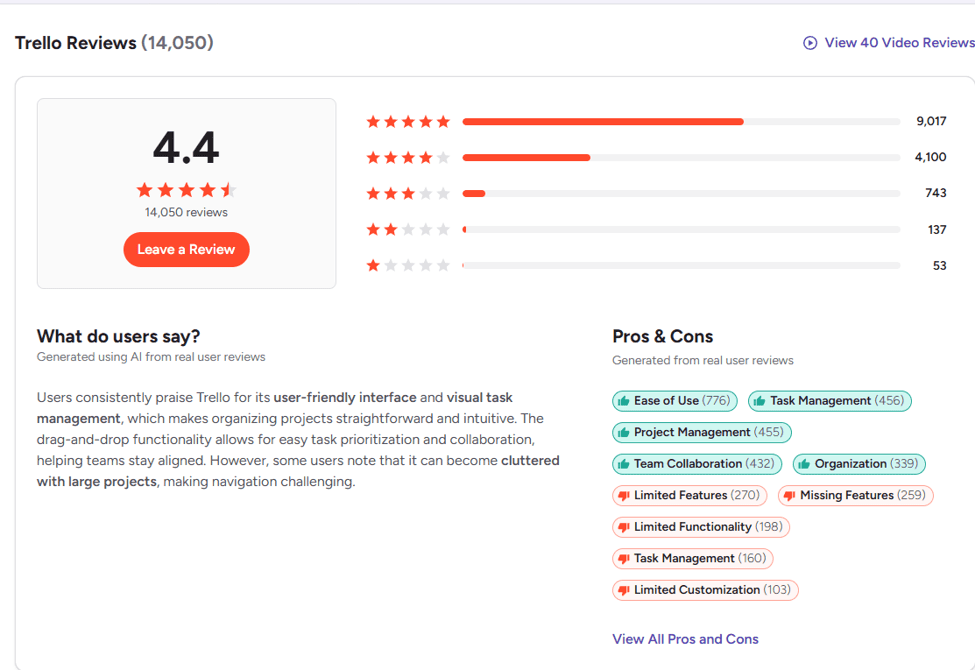
On G2, Trello has a 4.4 rating across 14,050 reviews, with 9,017 five-star reviews against only 53 one-star. Users praise ease of use (776 mentions) and task management (456 mentions), with limited features (270 mentions) as the most common complaint. Capterra shows 4.5 across 23,483 reviews, with Commenting/Notes as the highest-rated individual feature at 4.7. Google Play sits at 4.6 across 122,000 reviews, and the App Store at 4.3 across 6,900. Trustpilot is the outlier: an unclaimed profile with only 219 reviews and a 2.5 rating, low enough in volume that we're not treating it as representative of the broader picture.
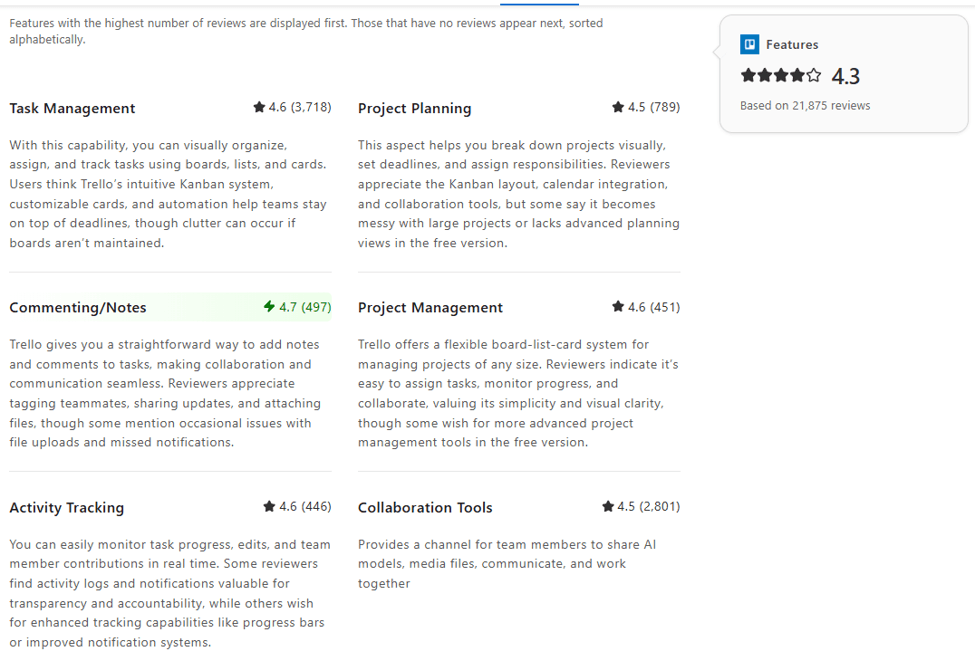
Four platforms, four consistently strong scores, with tens of thousands of reviews behind each of the major ones. That's not a small thing to have working quietly in the background while the social channels went dark. It means the part of the trust equation that actually closes deals for a self-serve product, "does this thing work the way people say it does," has been running fine without anyone needing to actively manage it.
There's a structural story sitting underneath these numbers that's bigger than any single rating. In January 2026, G2 announced it had agreed to acquire Capterra, Software Advice, and GetApp from Gartner, a deal that closed the following month. Two of the three platforms carrying most of Trello's public reputation, G2 and Capterra, now sit under one corporate owner. For a company like Trello with strong ratings on both, that's not a risk today, but it is a concentration of where trust lives that didn't exist a year ago, and it's worth watching.
💡 Steal This: Show up cleanly across every review platform your buyers might check, not just the one you like best. Consistency across platforms compounds into a form of trust no single campaign can buy, and it keeps working in the background whether or not anyone on your team is actively watching it.
Content Marketing and Demand Generation
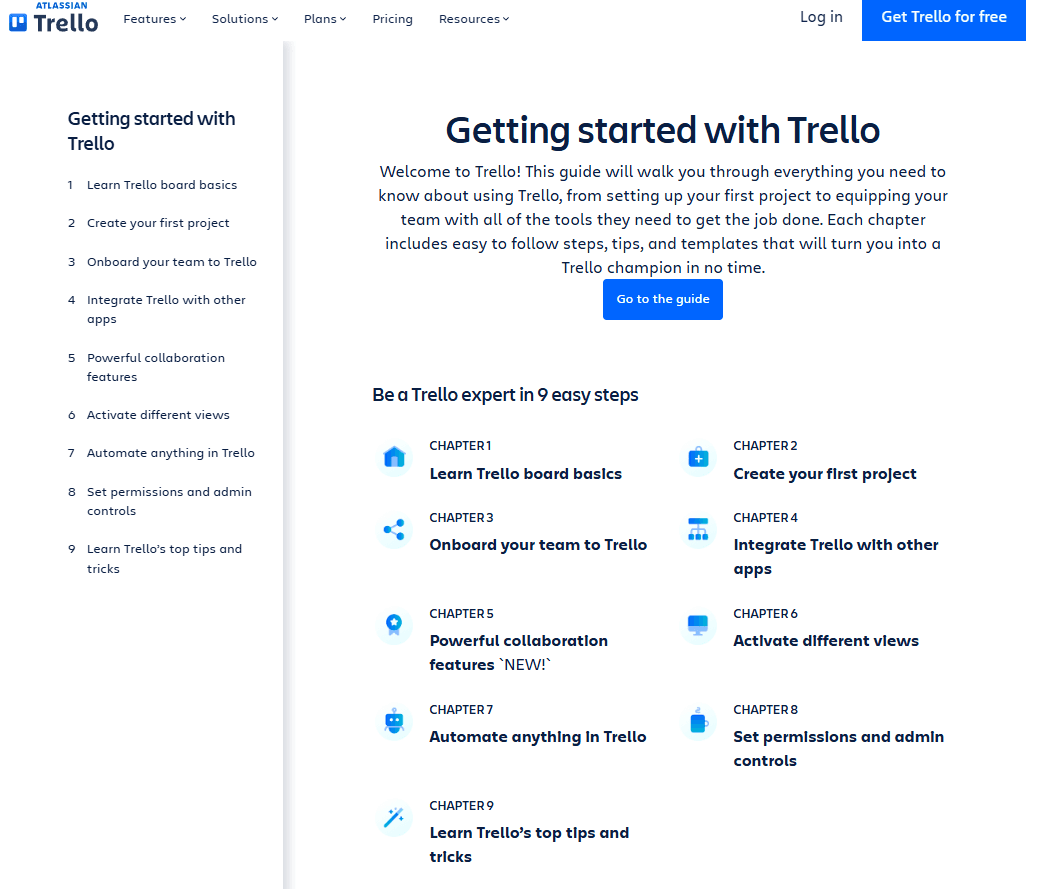
Demand generation here runs on more than the blog. The Trello Guide, the Remote Work Guide, and ten Team Playbooks sit alongside on-demand webinars as the ungated core of the strategy: no email address required to read any of it. That's a deliberate choice for a self-serve product, and it lines up with the named customer stories on the homepage, from Women Who Code, ThoughtWorks, and IKEA/PTC, which do the same job in a different format, proving a prospect can read without a form standing in the way.
None of that material needs the posting rhythm a blog does. A playbook or a webinar gets built once and keeps working, and that gap in required upkeep is a plausible reason the blog specifically lost its cadence while these other formats didn't.
Trello's blog isn't Trello's blog anymore, not independently. In January 2024, the company announced it was folding its dedicated blog into Atlassian's shared "Inside Atlassian" publication.
Since then, posting has dropped to roughly twice a year, clustered around major feature launches and the New Year's productivity window rather than running on any visible content calendar. The gap between a January 2024 post and the next one in January 2025 ran a full twelve months. Every post we sampled carries the byline "Trello," the brand itself, with no named individual author anywhere.
Not everything about the merge is a loss. Folding into a shared publication means Trello's occasional posts sit inside a bigger, better-maintained content operation, with the technical SEO, design, and distribution infrastructure of a much larger team behind it.
The Wakefield Research caregiver survey covered in the previous chapter is proof the underlying research and writing capability didn't disappear. What disappeared is the cadence, not the capability.
A twice-a-year, launch-triggered posting cadence is not a content strategy in the fuller sense. It's a byproduct of a product team that occasionally needs to announce something, and it's a fixable gap, not a structural one, because the pieces that do run, when they run, hold up well.
💡 Steal This: Publish your best practical resources without a form standing in front of them. A guide, a playbook, or a webinar that requires no email address earns more trust in the time it takes to read it than a gated whitepaper earns in a month sitting in someone's downloads folder.
Marketing and Sales Funnel Stages
Top of the funnel (TOFU)
What little top-of-funnel activity exists runs through Google Search and Shopping ads and whatever organic search visibility Trello's name recognition still carries. But those ads, roughly 1,000 on Search and 200 on Shopping, are written for people already typing Trello's name, which makes them a bottom-of-funnel tactic wearing a top-of-funnel job.
The dormant Facebook and X accounts, the once-a-month Instagram posts, and the sporadic YouTube uploads contribute almost nothing to actual awareness among people who don't already know the product. YouTube comes closest to doing real TOFU work. Its playlists of tutorials and "what's new in Trello" recaps are the kind of content someone searching a broader problem could stumble into, but even there, reach on new uploads is thin.
Middle of the funnel (MOFU)
The Team Playbooks, ungated Guide, and on-demand webinars sit at this stage, giving a self-directed evaluator enough material to talk themselves into a signup without ever touching a form. The ten Team Playbooks, split by function (marketing, sales, design, HR), let a prospect find proof relevant to their own role rather than a generic pitch. The named customer stories from Women Who Code, ThoughtWorks, and IKEA/PTC do similar work from the homepage, giving a mid-funnel evaluator social proof they can click into without commitment. None of this requires an email address, which keeps the self-serve motion intact all the way through consideration.
Bottom of the funnel (BOFU)
This stage is the signup button, nothing more. There's no demo, no trial-with-credit-card gate, no sales-assisted step below Enterprise. Every CTA we traced, "Get Trello for free," "Try it free," "Sign up," drops a visitor straight into an active account. The one place this breaks down is the Enterprise tier, where the pricing calculator does the self-serve routing correctly but the actual "Enterprise" link on the product page leads to a dead lead-gen campaign instead of a sales conversation, the single clearest leak in an otherwise tight bottom-of-funnel structure. It converts immediately or it doesn't convert at all.
Retention
Retention signals are the thinnest part of this research. We found no visible onboarding sequence, community, or lifecycle program beyond the product's own in-app features (Power-Ups, templates, automation) doing the retention work rather than through a named program.
What does show up here says something on its own: the product holds up without a formal program behind it. The Power-Ups marketplace and the Taco mascot both give returning users a reason to stay attached to the product itself, and the consistently strong review scores across G2, Capterra, Google Play, and the App Store suggest retention is happening on its own terms, with no one steering it directly.
Future Plans and Growth Indicators
Trello does not maintain a job listings page distinct from Atlassian's general careers site, so hiring-based growth signals aren't available here the way they are for most companies in this series. What is visible is a product direction: the "new Trello," rolled out through 2025 and into 2026, has repositioned the product away from team project management and toward individual productivity, built around an Inbox, a Planner, and AI-assisted capture.
That AI direction shows up in more than one place if you connect the dots across this research. Standard tier now includes AI-powered quick capture, the integrations list connects directly to ChatGPT, Claude, and GitHub, and Gaurav Kataria's most recent original LinkedIn post, covered in the Leadership Presence chapter, describes work on an "agent harness" aimed at a tenfold productivity gain through better context handling. None of that is speculation about where Trello might go.
It's the same AI investment showing up in the pricing page, the integrations list, and the one person who speaks publicly about product direction: three separate signals converging on the same bet.
The January 2026 "New Year's Resolution Board Builder" is the most recent expression of that pivot, a limited-edition AI feature testing whether Trello owns the personal goal-setting moment the way it once owned the team Kanban board moment.
It's also the clearest evidence in this entire research that Trello still moves with intent when it wants to: the feature launched alongside a matching YouTube ad and a blog post timed to the same week, the one coordinated campaign found anywhere in this analysis. That the company's most deliberate piece of marketing in over a year happened to align with its most forward-looking product bet isn't a coincidence worth ignoring.
Inspiration Points
1. Remove every gate between curiosity and useful content, and let the product sell itself.
The Trello Guide, the Remote Work Guide, ten Team Playbooks, and on-demand webinars are all ungated, no email address required anywhere. That's a real bet that self-serve growth compounds faster than lead capture does, and Gartner's March 2026 survey backs the instinct: 67% of B2B buyers now say they prefer a rep-free purchasing experience.
2. Keep your pricing visible all the way to the top tier.
Trello publishes per-seat pricing through Enterprise, $17.50 a month, and pairs it with a calculator instead of a "Contact Sales" wall. Most B2B software hides its top tier specifically to control that conversation. Publishing the number instead tells a buyer the product is confident enough in its own value to skip the negotiation.
3. Build a moat that costs nothing to market.
The Power-Ups marketplace, over 200 integrations deep, lets a board pull in Slack messages, Google Drive files, or Salesforce records without leaving Trello. Switching costs, one of the classic forces behind durable competitive advantage, build themselves here: the deeper a team's setup goes, the harder it becomes to leave, and nobody on the marketing team has to say a word about it.
4. Let consistent proof do the persuading instead of a campaign.
Four separate review platforms, G2, Capterra, Google Play, and the App Store, all land between 4.3 and 4.6, with tens of thousands of reviews behind the major ones. That's trust compounding passively: a buyer researching Trello independently keeps landing on the same answer, with no one actively managing the message.
5. Prove the machinery still works when someone commits to using it.
The January 2026 pairing of a blog post and a matching YouTube ad, both built around the same seasonal hook, is a small, textbook example of integrated marketing communications: one message, timed together, across two channels. It's proof that whatever thinned out elsewhere didn't happen because the capability disappeared. It happened because nobody was pointing it at anything.
Frequently Asked Questions
Who owns Trello?
Trello has been owned by Atlassian since January 2017, when Atlassian acquired the company for a reported $425 million. Trello now operates as one of several product lines inside Atlassian, alongside Jira, Confluence, and Loom.Does Trello have its own CEO?
No. Trello does not currently have a dedicated CEO or CMO. Gaurav Kataria has led Trello's product organization since October 2020 and is the person most often quoted in press coverage, but he holds no chief executive title, and Trello has no standalone leadership team separate from Atlassian's.Is Trello still active on social media?
Partially. Instagram and YouTube post at a low, irregular frequency. Facebook has not posted since June 2024 and X has not posted since June 2025, making both channels dormant.Does Trello have a company page on LinkedIn?
Trello does not have an independent LinkedIn Company Page. What exists is a Showcase Page, which functions as a sub-page under Atlassian's main Company Page rather than a standalone brand presence.Is Trello's Enterprise plan hard to buy?
The pricing is published and self-explanatory, starting at $17.50 per user per month billed annually. The "Enterprise" link on Trello's own product page currently leads to an unrelated, outdated lead-generation campaign instead, rather than a sales contact path.Does Trello run paid advertising?
Yes, but only on Google, across Search, Shopping, and YouTube. Trello does not appear to run any Meta or LinkedIn ads.What is Trello's sales funnel like?
It is almost entirely self-serve. Every plan except Enterprise leads directly to an immediate signup with no demo request or sales-assisted step.How good are Trello's reviews?
Strong and broad. Trello holds a 4.4 rating on G2 across over 14,000 reviews and 4.5 on Capterra across over 23,000 reviews, plus solid scores on Google Play and the App Store.Does Trello still run its own blog?
Not independently. Trello's blog was folded into Atlassian's shared "Inside Atlassian" blog in January 2024, and posting frequency has dropped to roughly twice a year since then.What is the "new Trello"?
A repositioning of the product, rolled out through 2025 and 2026, that shifts Trello's core pitch from team project management toward individual productivity, centered on a new Inbox, Planner, and AI-assisted task capture.