Marketing spotlight
/
Marketing Spotlight: Mapping Linear's Marketing and Sales Tactics
Marketing Spotlight: The marketing and sales tactics behind Linear’s AI-native Jira alternative, 33,000+ customers, and $1.25B valuation.
Key Takeaways
🎀 This section gives you the main insights without all the details. It’s the stuff you need to remember, whether you’re reading this now or in 6 months. We made this for people who want to get the core message fast.
Linear is the product development system for software teams, built to replace legacy issue trackers like Jira with a fast, opinionated, AI-native platform. This article maps the marketing and sales tactics behind their $1.25B valuation and 33,000+ customers.
Speed as a brand promise works when the product delivers it. Linear built its reputation on sub-100ms response times, and every piece of marketing echoes that single claim. No speed, no brand.
Product updates are the content strategy. Linear's highest-engagement social posts are changelog announcements, not thought leadership. Teach less, ship more, announce loudly.
Publishing your methodology builds trust that ads cannot buy. Linear's Method page, quality philosophy, and Now blog form a content ecosystem that positions the product as a belief system, not just a tool.
Using the CEO's LinkedIn as a paid ad channel is underused in B2B SaaS. Linear runs Karri Saarinen's personal posts as promoted LinkedIn ads, turning his organic reach into a conversion engine.
A free tier converts better when it's genuinely useful, not artificially crippled. Linear's free plan includes unlimited members and real AI features. That generosity is a deliberate land-and-expand bet.
The customer story is the sharpest ad format. Linear's top-performing content across every channel follows one pattern: a named company, a specific before state, and a concrete outcome. Ramp, Oscar Health, Cars24, all of them.
Founder-led content with a real point of view outperforms brand content at every level of the funnel. Saarinen's post on anti-hyper-hiring got 911 reactions. His post on design philosophy got 623. Linear's official brand posts average 80.
📝 A quick note before you start reading: The data and analysis in this article are valid as of the time we wrote it. We don’t know when you’ll be reading this, maybe next week, maybe six months from now, and things might have changed since we looked at this company’s marketing and sales approach. Still, the insights and lessons here stay useful, even if the numbers or tactics have evolved a bit.
Many of the project management tools try to be everything to everyone. Linear made the opposite choice. From day one, it said no to enterprise customization bloat, feature sprawl, and no to the kind of process-heavy onboarding that Jira turned into an industry standard. That refusal to please everyone turned out to be the product.
At Milk and Cookies Studio, we spend time mapping how companies grow, so the founders and marketing teams we work with can build strategies that are grounded in evidence rather than guesswork. Linear is one of the more instructive cases we've looked at.
It grew to a $1.25B valuation and 33,000+ teams with what its founders describe as $35k in lifetime marketing spend. Whether that number is exactly right matters less than what it shows: that Linear's growth came from the product, from word of mouth inside developer communities, and from a founder who posts on LinkedIn twice a week and means what he says.
That combination is a deliberate set of decisions about what kind of company to build, and those decisions show up in every piece of their marketing.
The data here is valid as of June 2026. Linear moves fast and things change.
Understanding Linear
Linear is a product development system for software engineering and product teams. The legal entity is Linear Orbit, Inc., headquartered in San Francisco, California. The company was founded in January 2019 by three Finnish engineers who had spent their careers at some of the most respected product companies in Silicon Valley: Karri Saarinen (CEO), previously Principal Designer at Airbnb and Head of Design at Coinbase; Jori Lallo (Co-Founder), previously a Senior Engineer at Coinbase; and Tuomas Artman (CTO), previously a Senior Engineer at Uber.
All three had experienced the same frustration. The tools meant to help software teams coordinate were slower, more complex, and more opinionated about process than the actual work required. Saarinen had built a Chrome extension at Airbnb to simplify Jira just to survive the daily friction. That extension gave the founding team conviction that the demand for something better was real. In 2019, Lallo took a sabbatical from Coinbase and pitched the other two. They started Linear that year, built the first version for small teams, and kept the beta invitation-only for over a year.
This is their funding history: $4.2M seed round in November 2019 led by Sequoia Capital; a $13M Series A in December 2020, also led by Sequoia; a $35M Series B in September 2023 led by Accel; and an $82M Series C in June 2025, again led by Accel, at a $1.25B valuation. Participating investors across the rounds include Sequoia Capital, 01 Advisors, Seven Seven Six, Designer Fund, and Index Ventures. Total disclosed funding stands at $134.2M. Angel investors include Dylan Field (Figma), Patrick Collison (Stripe), and Stewart Butterfield (Slack).
Linear works with more than 33,000 product teams. Notable customers include OpenAI, Ramp, Coinbase, Block, Brex, Vercel, Scale, Sierra, Cars24, Cursor, Mercury, and Oscar Health.
💡 Steal This: When you write your founding story, include the specific moment of frustration that made you start. "I built a Chrome extension just to survive Jira" is a founding story. "We saw an opportunity in the project management space" is not. The specific detail is what makes readers trust you.
Linear's Brand Promise Analysis
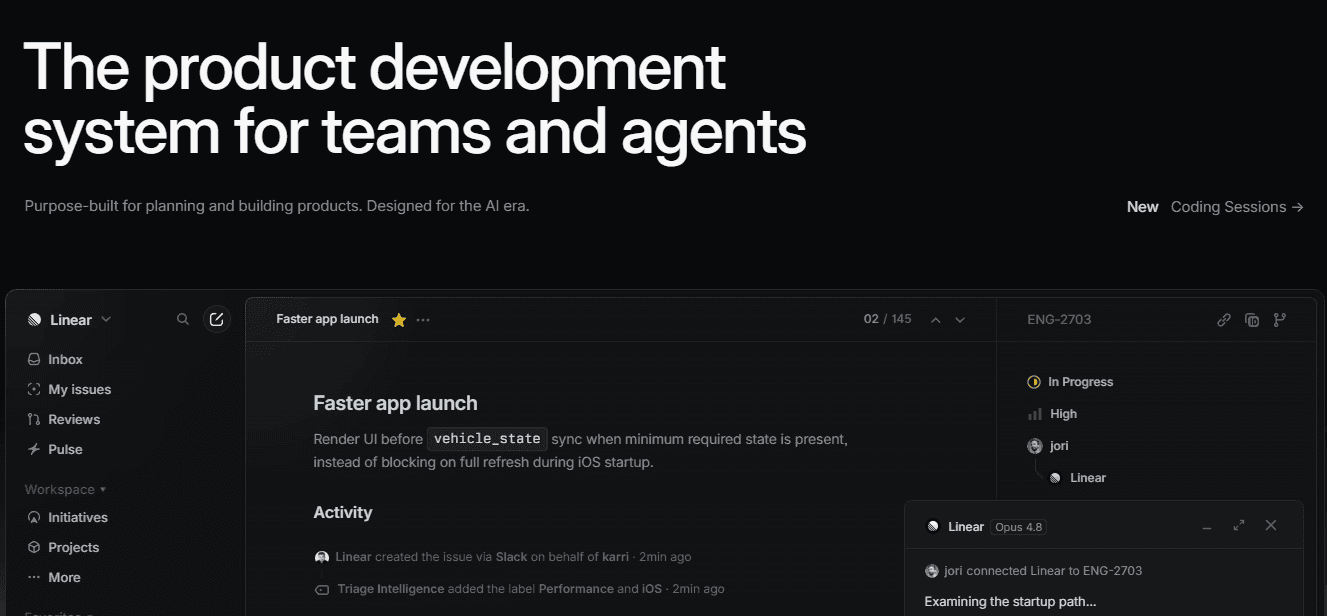
The Linear homepage opens with: "The product development system for teams and agents".
This is an important update from Linear's earlier positioning as an issue tracker. The word "system" does a lot of work here. It shows that Linear is not a point solution or a to-do list, but an infrastructure. The phrase "for teams and agents" is a deliberate AI-era positioning move, placing the product alongside AI coding agents as a first-class participant in the development workflow, not just a tool that humans use to organize their work.
The supporting line is: "Purpose-built for planning and building products. Designed for the AI era." Both phrases are doing the same thing: differentiating from legacy tools (Jira, Asana) that were built for a different era of software development. The implication is that those tools are not purpose-built, and they are not designed for what development teams do today.
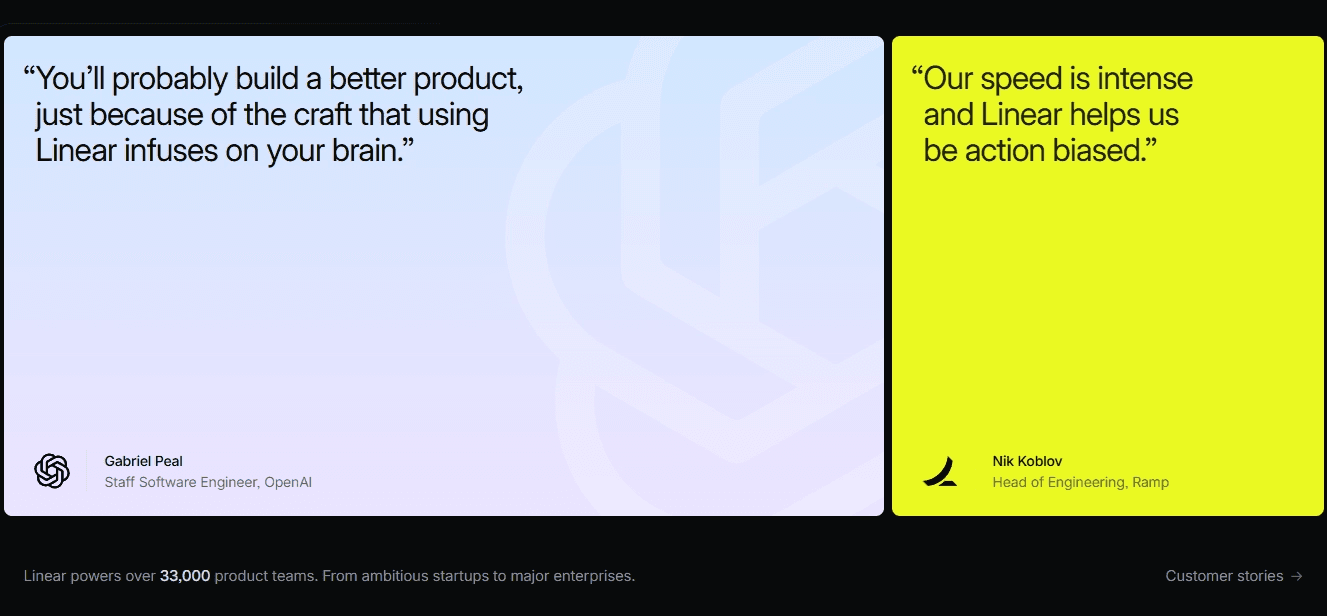
The testimonials visible on the homepage are from senior engineers and product leaders at named companies: Gabriel Peal (OpenAI), Nik Koblov (Ramp), and Kaz Nejatian (Opendoor). None of these quotes describe features. All three describe a feeling: better craft, action bias, and the right opinions for fast teams.
The about page and Method pages expand the brand further. The Linear Method is a published set of product development principles: set the product direction, write issues, not user stories, build in public, generate momentum. It is the company's philosophy made public. This attracts the kind of customers who share that position.
💡 Steal This: If your product is genuinely faster or simpler than the incumbent, make that claim in a way that is verifiable within the first minute of use. "Designed for the AI era" works for Linear because the product demo on the homepage proves it. The claim only earns trust if the product delivers it immediately.
Linear's Service and Product Breakdown
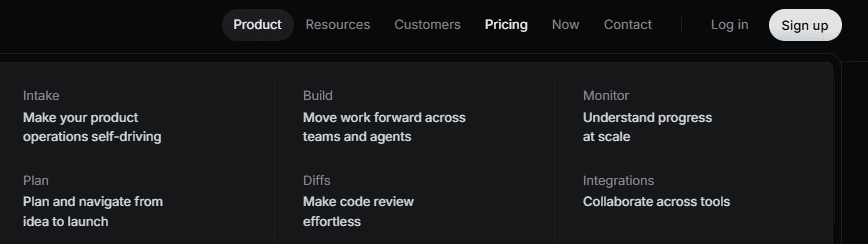
Linear sells one product organized into five core areas:
Intake
Plan
Build
Diffs
Monitor
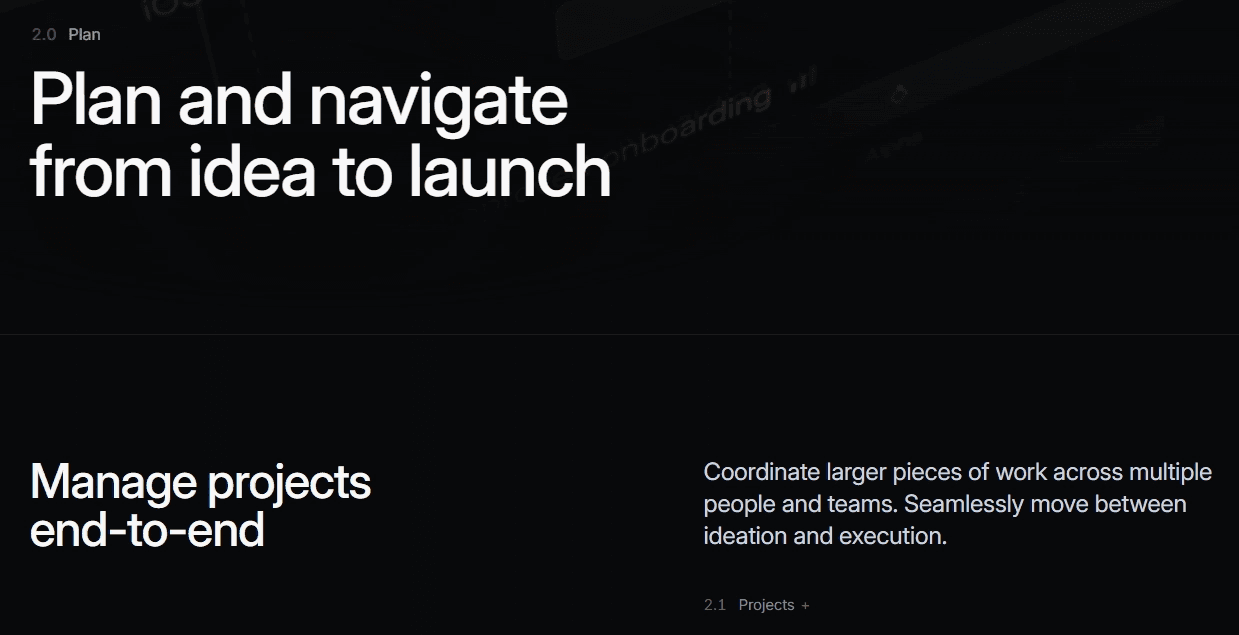
Intake turns incoming requests into structured work. Bug reports from Slack, customer feedback from Intercom or Zendesk, and ad hoc requests from teammates all get converted into Linear issues automatically, instead of getting lost in a channel or an inbox. This is the entry point for Linear Asks, which lets non-Linear users (support agents, sales reps, anyone in Slack) file a request without needing a seat.
Plan covers the roadmap layer: initiatives, projects, and PRDs that connect day-to-day issues to company-wide strategic direction. Teams can scope a project down into cycles, attach documents and specs directly to the project, and track progress automatically as linked issues move through their workflow. This is where Linear positions itself against tools like Notion or Confluence for planning documents by keeping the plan and the execution in the same system.
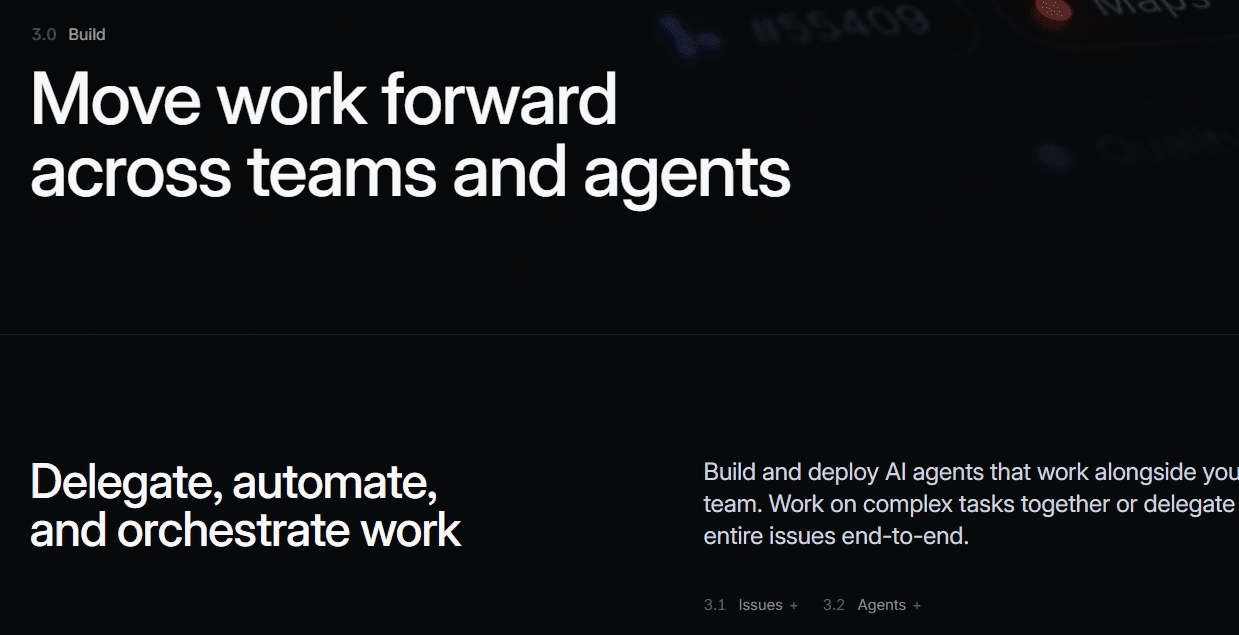
Build is where AI agents enter the workflow as first-class participants. Through the Agent Platform and MCP (Model Context Protocol) access, coding agents like Cursor, Claude Code, and Codex can be assigned issues directly inside Linear, pick up the ticket context automatically, and work the task to completion. Coding Sessions, launched in June 2026, extends this further: Linear Agent can triage a bug, investigate the root cause, write the fix, open a pull request, and bring it back into Linear for human review, with the entire chain of work visible to the team the whole time.
Diffs is Linear's code review product, launched in May 2026. It brings pull request review directly inside Linear, alongside the issue, project, and customer context that produced the change. Diffs include real-time updates, AI-guided reviews (beta), focused notifications, and threaded comments, built specifically for a world where a growing share of code is written by agents and a human still has to be accountable for what merges.
Monitor covers the reporting and visibility layer: Insights (analytics on team velocity and issue flow), Dashboards (custom views for tracking what matters to a specific team or leader), and Linear Releases (tracking deployment environment, version, and status for every issue, giving the team and any agents involved full context on what shipped where).
Beyond these five areas, Linear also ships Triage Intelligence, which automatically routes, labels, and assigns incoming issues without a human triager, and Team Documents, launched in June 2026, which gives every team a dedicated space for context, notes, and references that don't belong inside a specific issue or project.
The ideal customer profile signals are consistent across every product area: this is built for people who write and ship software, not for general business operations. There is no template for marketing campaigns or sales pipelines. Every feature assumes the user is working with issues, code, and product context.
Linear's pricing page lists four tiers.
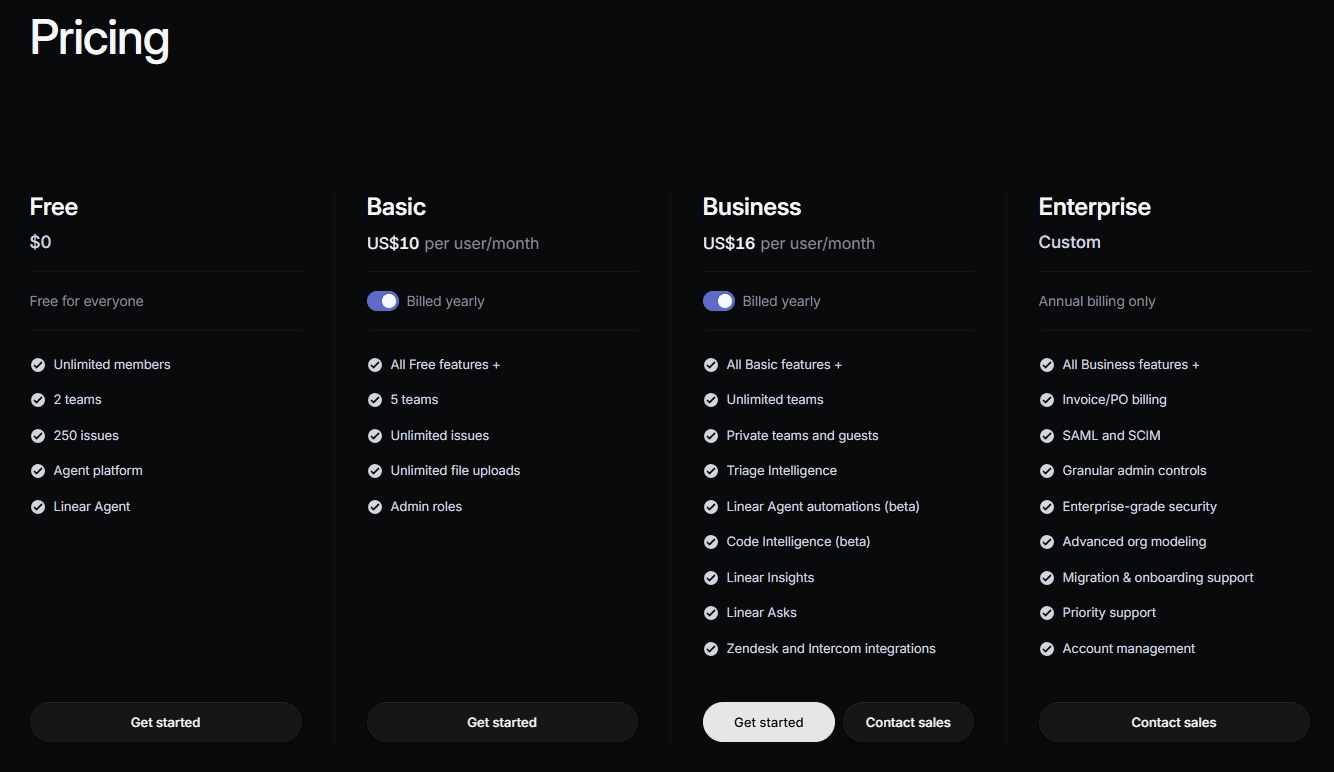
Free at $0, and you get unlimited members, 2 teams, 250 issues, the full agent platform, and Linear Agent access. This is a genuinely useful free tier. A small engineering team can run its entire workflow on it indefinitely.
Then they have Basic, at $10 per user per month, billed yearly. Adds 5 teams, unlimited issues, unlimited file uploads, and admin roles. This is the entry point for growing teams that have hit the limits of the free tier.
Business is priced at $16 per user per month, billed yearly. Adds unlimited teams, private teams, Triage Intelligence, Linear Agent automations (beta), Code Intelligence (beta), Linear Insights, Linear Asks, and Zendesk and Intercom integrations. This is the enterprise-facing tier where the AI features that matter most to larger teams live.
The Enterprise tier requires custom pricing and annual billing only. Adds invoice billing, SAML and SCIM, granular admin controls, enterprise-grade security, advanced org modeling, migration support, priority support, and account management.
The free tier is designed to land in small engineering teams, the Basic plan serves growing startups that need more headroom, the Business plan is for teams that have adopted AI development workflows and need the infrastructure to manage agents alongside humans, and the Enterprise plan is for the Oscar Healths and Cars24s of the world: large organizations with security and compliance requirements.
The Sacra analysis of Linear confirms that the company operates a product-led growth model where teams start using Linear immediately without lengthy sales cycles. The free plan is the acquisition engine. The Mixpanel 2026 State of Digital Analytics report found that leading B2B companies now anchor their growth strategy on in-product signals rather than top-of-funnel campaigns. Linear's free tier is built precisely for this: teams discover the product, invite colleagues, and the seat count grows before anyone talks to a salesperson.
Linear's Startup Program
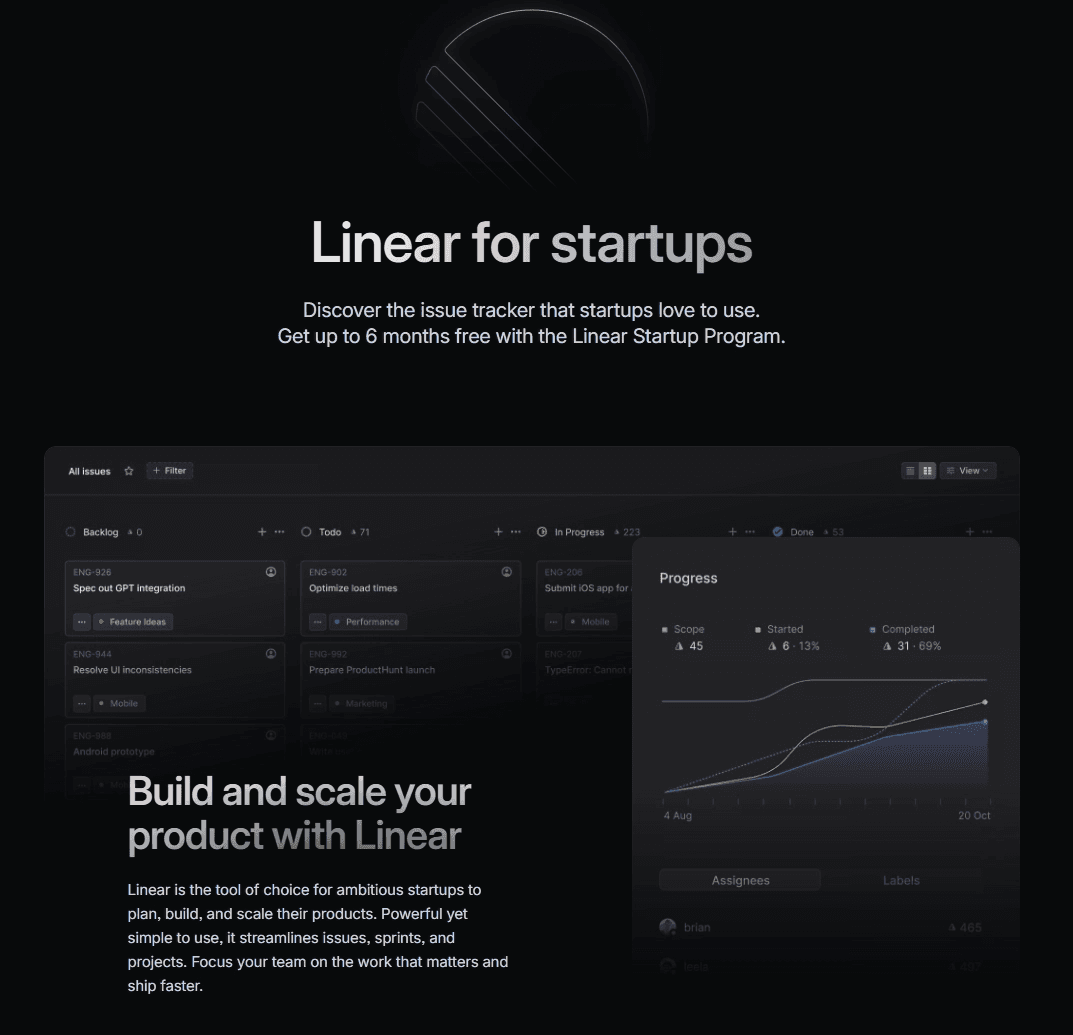
Linear also runs a Startup Program offering up to 6 months free on Basic or Business plans for startups affiliated with investor partners. This is a deliberate network-effects play: get early-stage companies on Linear when they are small, build the habit before they scale, and retain them as they grow into paying accounts.
Linear's pricing structure is a textbook PLG land-and-expand model. The free tier removes the purchase decision entirely for small teams. The upgrade triggers (team limits, AI features, private teams) are placed exactly where growing teams feel them. And the Enterprise tier requires a sales conversation, which is when the sales team gets involved. The Sacra report describes this as "usage expanding through team growth and feature adoption rather than complex customization or professional services."
💡 Steal This: If you are building a developer tool, make your free tier good enough to be embarrassing to competitors. A free tier that teams use is a distribution channel. A free tier that exists only to generate upgrade pressure is a conversion barrier.
Linear's Differentiators and Unique Assets
The Linear Method
Linear publishes its product development philosophy as a set of principles at linear.app/method. The sections cover how to set product direction, write issues rather than user stories, build in public, and generate momentum. This functions as top-of-funnel content for teams whose engineering culture aligns with Linear's values and as a retention mechanism for customers who have internalized the method. It also positions Linear's founders as product thought leaders.
The Now blog
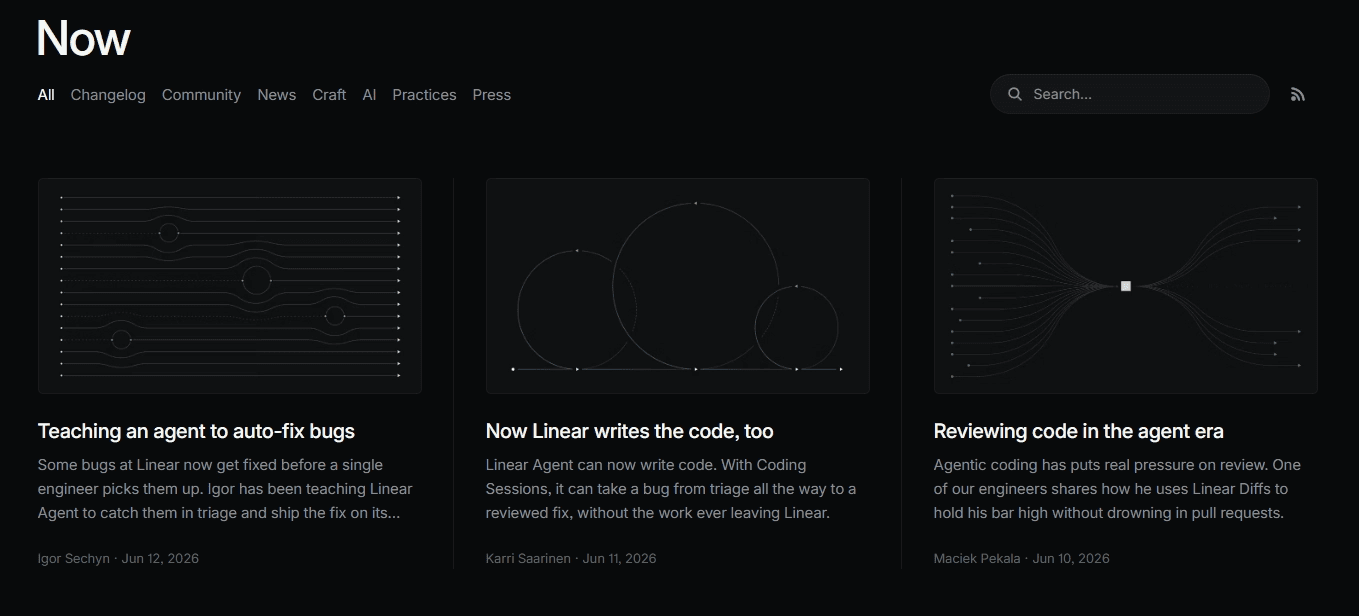
Linear's content hub at Now publishes consistently across several categories: Changelog (product updates), Craft (design and engineering philosophy), AI (agent-era thinking), Practices (team methodologies), and customer stories, which can be found in a separate category.
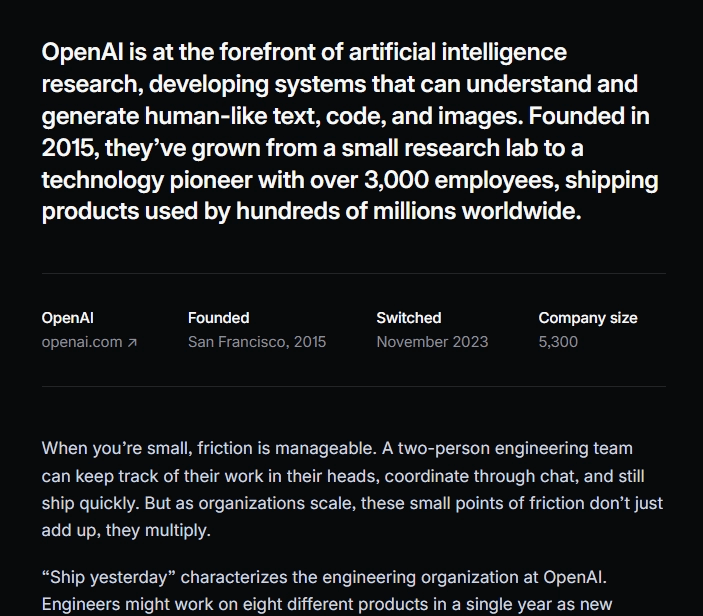
The customer stories are particularly well-executed. Each one follows the same structure: a named company, a specific problem, a concrete outcome. OpenAI scaled to 3,000 users, Ramp's coding agent now handles 60% of merged PRs, and Cars24 walked away from a Jira contract they had just renewed. We all love a good case study with metrics attached, right?
The startup program as a distribution channel
The Linear Startup Program offers up to 6 months free to companies affiliated with investor partners. This is a quiet but effective distribution strategy. It puts Linear in front of every early-stage company backed by participating VCs at exactly the moment those teams are choosing their first real tooling. By the time they are ready for a paid plan, they have built their entire product development process around Linear.
Linear's Leadership Social Media Presence Analysis
Karri Saarinen, CEO and Co-Founder
Karri Saarinen, yhe CEO of Linear has 60.7k followers on LinkedIn. Saarinen posts approximately twice per week and keeps his content tightly focused on three themes: Linear product developments, opinions on product development and design philosophy, and observations about company building. He rarely posts about his personal life, and he rarely promotes Linear in the transactional sense.
The three standout posts from the last three months tell the story clearly.
First, his anti-hyper-hiring post: "We had seen what hyper-hiring does to companies and wanted to avoid it at Linear. Our rule was at most, roughly double the team each year: 3 to 6 to 15 to 30 to 50 to 80 to 120." This post received 911 reactions, 36 comments, and 20 reposts. It has nothing to do with Linear's features. It has everything to do with the kind of company Linear is, and the kind of buyer who trusts it.
Second, his productivity paradox post: "We keep hearing about 10x or 100x productivity gains in engineering and knowledge work. But outside the model labs, I haven't seen the corresponding 10-100x revenue growth across the market or increase in quality. So where is the productivity going?" This received 625 reactions, 102 comments, and 25 reposts. It is a genuine question from someone who thinks carefully about the thing he builds.
Third, his Team Docs beta post: a 7-minute product demo video showing how Linear, Figma, and Slack combine to build features. This received 546 reactions and 172 comments. It was the highest-comment post of the three. When Saarinen shows the actual product in use, the audience engages most.
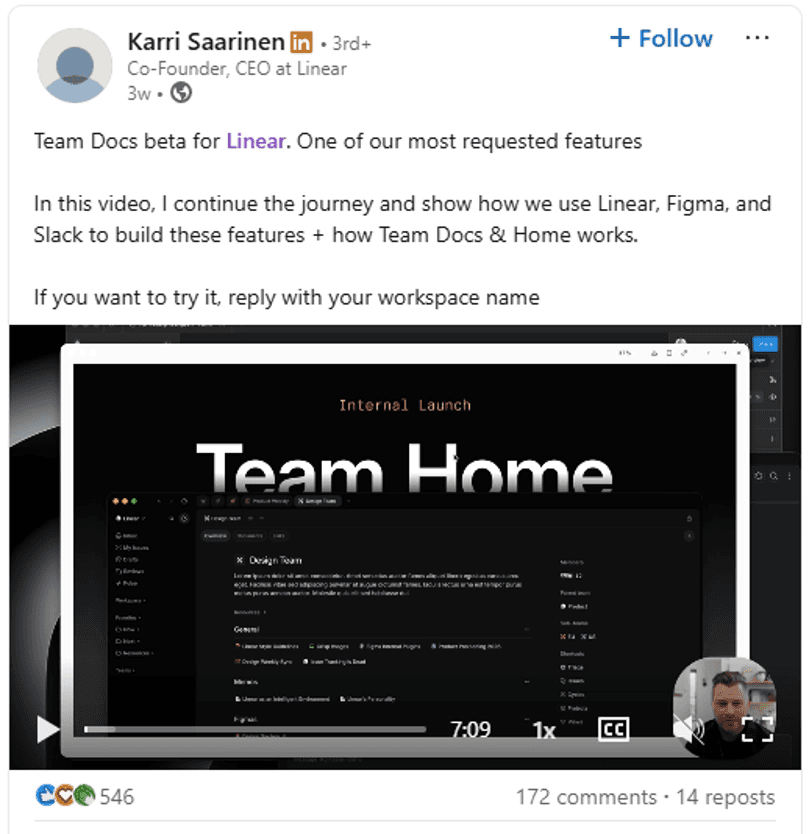
Linear also runs Saarinen's posts as promoted LinkedIn ads. His organic content becomes paid reach. This is an underused tactic: taking a founder's highest-performing personal posts and putting budget behind them directly, rather than creating separate ad creatives.
Cristina Cordova, COO
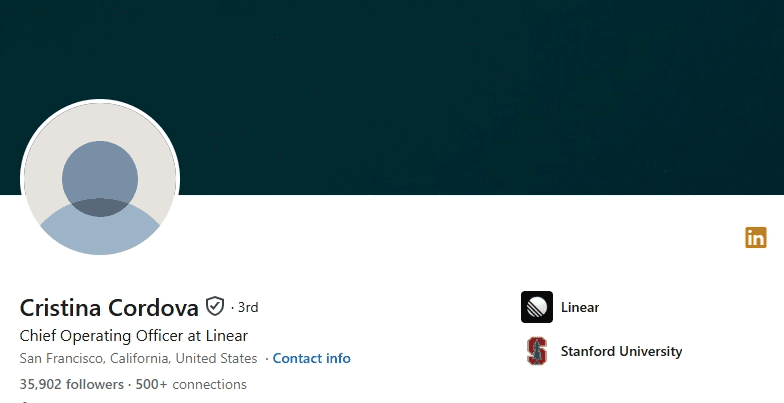
Linear’s COO has 35,8 k followers on LinkedIn. Cristina Cordova posts about Linear, too, but with lower engagement than Saarinen. Her background at Stripe (Business Lead, Head of Corporate Card and Treasury) and her role overseeing Linear's operational scaling make her an important signal for enterprise buyers evaluating Linear's ability to serve larger organizations. She joined in May 2023, when Linear was still primarily serving startups.
💡 Steal This: If a post from your CEO or another C-level exec performs well organically, run it as a paid ad before you write a single line of new ad copy. The engagement has already proved the message works. Promoting it costs less than producing branded creative, and it reaches cold audiences with the same credibility that made it work in the first place.
Linear's Social Media Strategy
X / Twitter
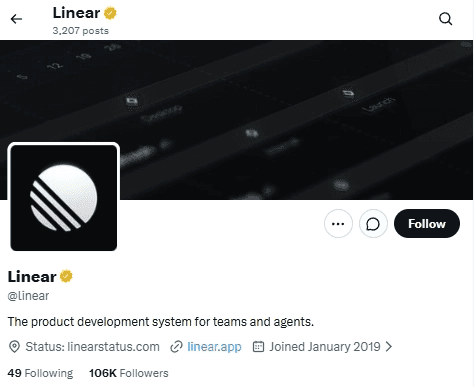
On X, Linear has 105,9 k followers. X is Linear's most active and highest-reach social channel. Posting is daily or near-daily. Average engagement sits around 200 likes per post, with higher spikes on product launch posts.
Three content pillars drive the X account. The first is product announcements: every important feature launch gets a dedicated post with a short product demo video. The second is changelog updates: shorter posts that describe specific improvements or fixes. The third is employee deep dives: posts where individual engineers or designers explain how they built something, with technical depth that the average SaaS company would never publish.
The X account talks to developers as peers. The language is direct, specific, and assumes technical familiarity. There are no motivational quotes, no engagement-bait questions, and no reposted user testimonials without context.
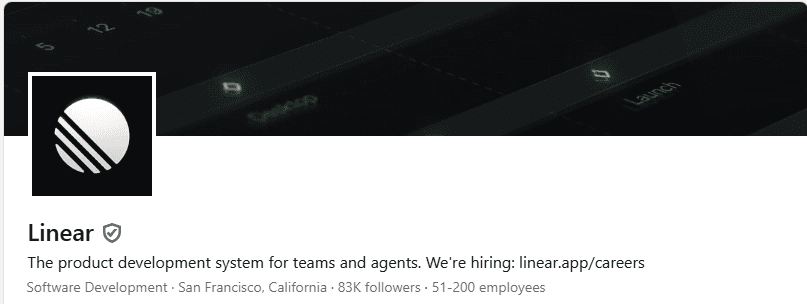
Linear has 83k followers on its LinkedIn page. They post 2-3 times per week with an average engagement of around 80 reactions and a few comments per post. The content mirrors X: product updates and short product demos.
YouTube (13,600 subscribers, youtube.com/@linear)
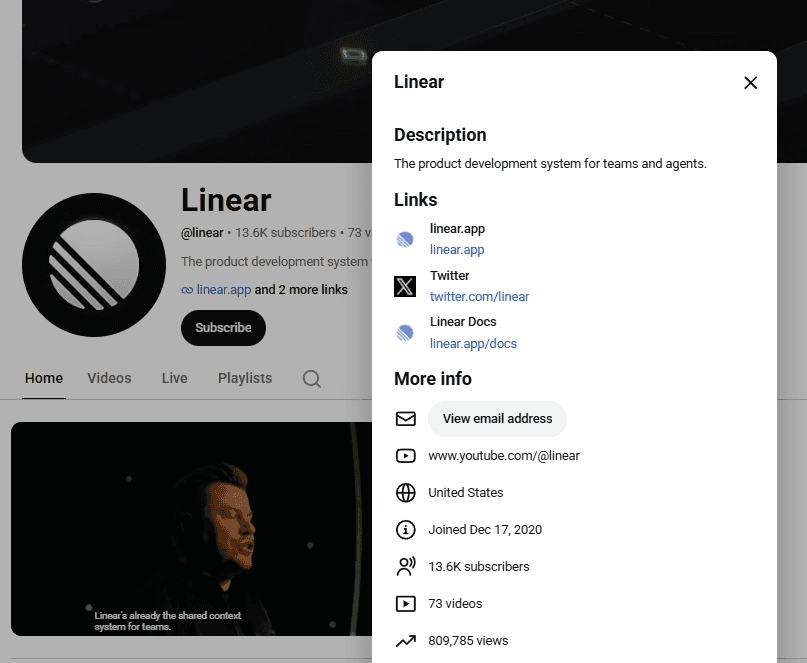
Linear has 13,6k subscribers, 73 videos posted, and 809k views. YouTube is organized into named playlists: Conversations with Customers, AI Workflows, Linear Learn, Changelog, Conversations on Quality, Linear Live, AMA, How We Built It, and Linear Team Talks. This is a structured content library.
On Instagram, they have 374 followers and no posts at the time of research. The channel is dormant for now.
Linear's organic social presence is built for the developer and product manager audience, not for broad awareness. Every active channel talks to the same person: an engineer or PM who evaluates tools on technical merit, reads the changelog because they care, and trusts peers over ads. The absence of Instagram and TikTok is consistent with this: those are not where Linear's buyers go to evaluate software.
💡 Steal This: Publish your changelog on your social channels. Product updates are the highest-credibility content a software company can post. They prove you ship, you listen, and they give your existing users a reason to follow you, which is the audience that refers new users.
Linear's Top-Performing Content
Across all platforms, the content pattern is consistent: named companies, specific outcomes, and product demos that show rather than tell.
X / Twitter
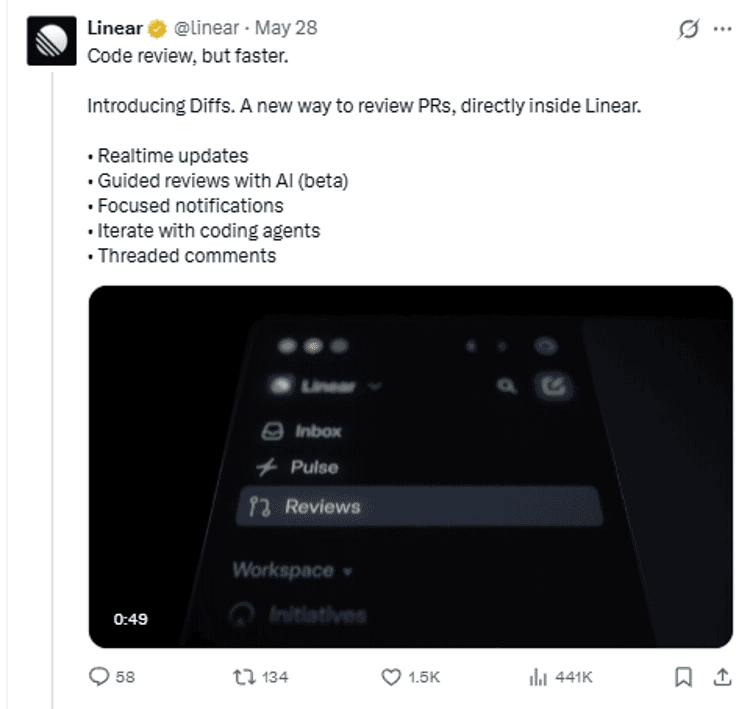
The top post in the last three months was the Diffs launch on May 28: "Code review, but faster. Introducing Diffs. A new way to review PRs, directly inside Linear." This received 1,500 likes, 134 reposts, 58 comments, and 441K views. The post included a 49-second product video. Feature launches with short demos consistently outperform all other content on X.
The second-highest post was the Coding Sessions launch on June 11: "Introducing coding sessions. Linear Agent can now triage issues, investigate the cause, write the fix, open a PR, and bring the code back for review. All shared with your team in Linear." This received 888 likes, 94 reposts, 53 comments, and 282K views.
The third was the Project Slack Channels launch on May 21: "New: Project Slack channels. Linear can now automatically spin up a dedicated Slack channel whenever a new Linear project is created." This received 466 likes, 19 reposts, 20 comments, and 108K views.
Feature announcements for genuine workflow improvements consistently generate more engagement than any other content type. Every top post follows the same three-part shape: name the feature, show what it removes from the user's day, attach a short video of it actually working. None of the three posts uses a hook, a question, or a call to engage. They state a fact about the product and let the fact carry the post. If your audience is technical, this is the format to copy: skip the framing and lead with what changed.
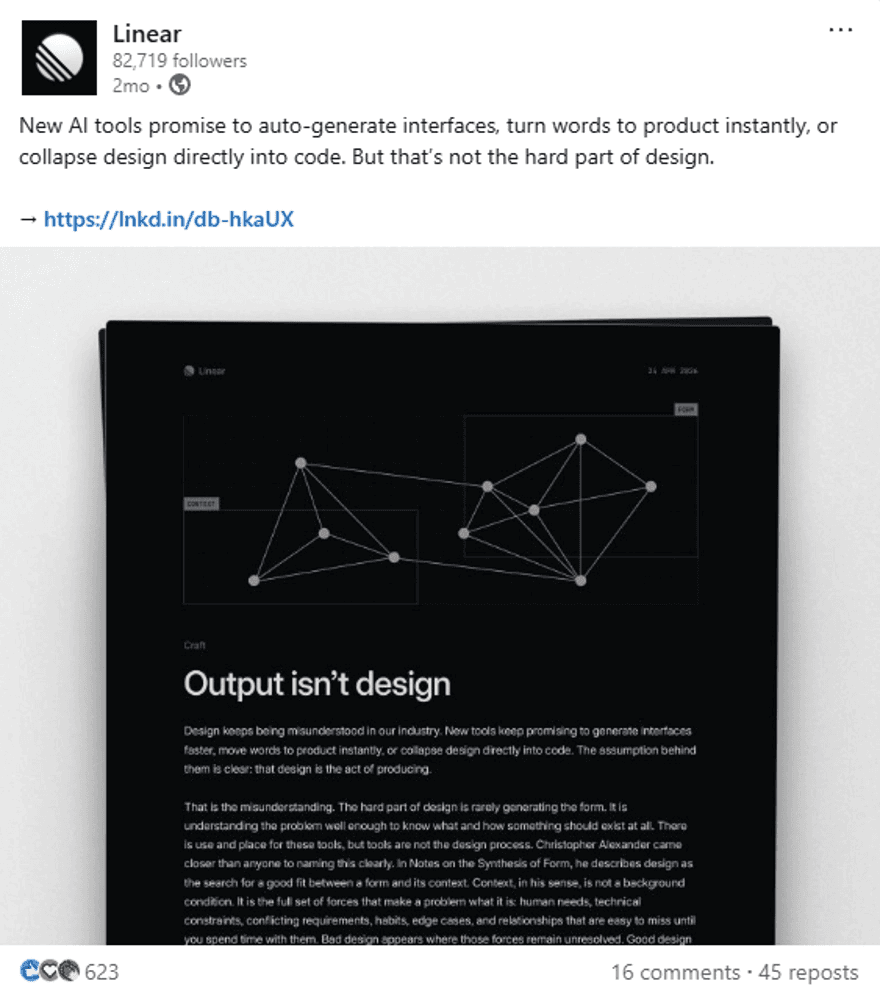
The top post was "Output isn't design" at 623 reactions, 45 reposts, 16 comments. This was a thought leadership piece and it outperformed every product post on the platform during the same period. The reason: it said something specific and contentious that Linear's audience had a strong opinion about.
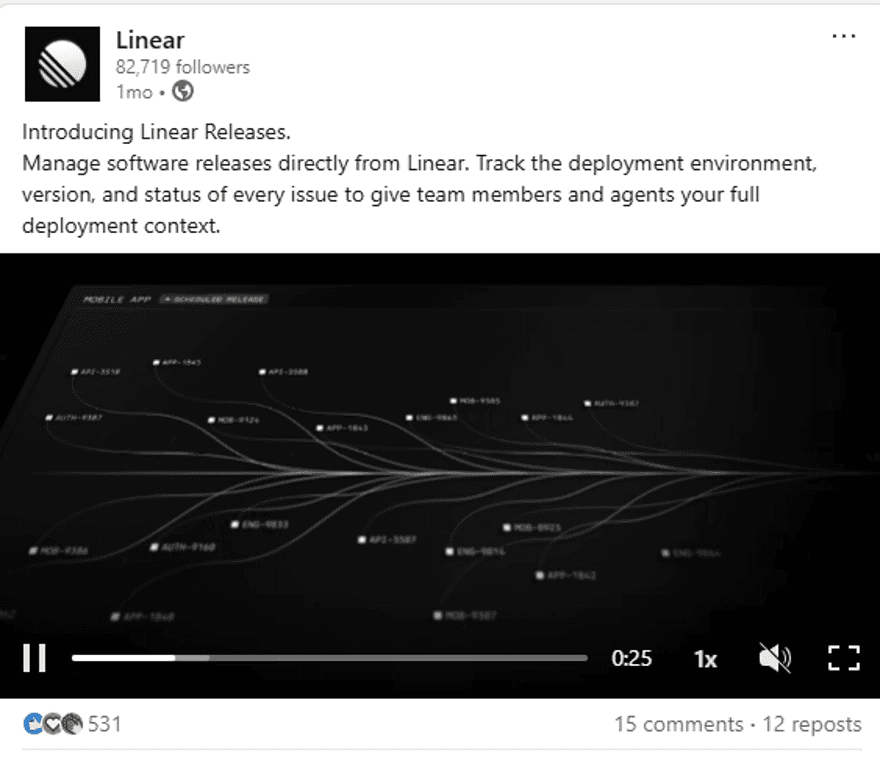
The second was the Linear Releases launch at 531 reactions, 12 reposts, and 15 comments.
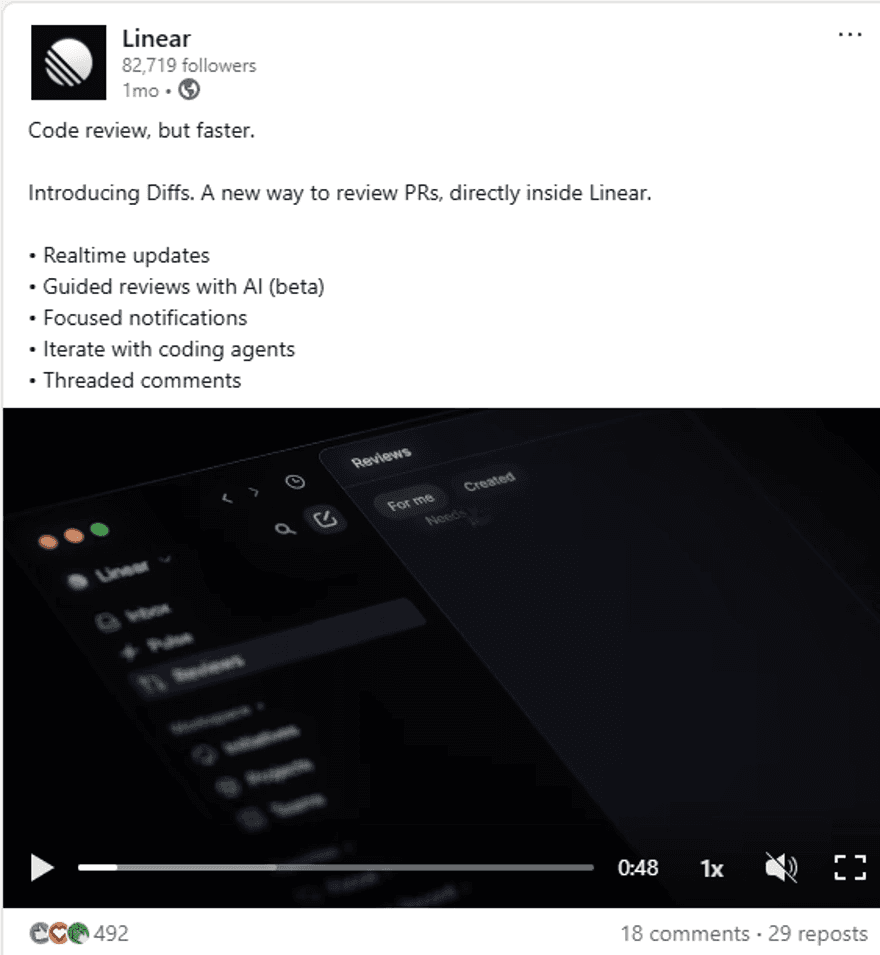
The third was the Diffs launch mirrored from X at 492 reactions, 29 reposts, and 18 comments.
LinkedIn engagement is lower than on X in absolute numbers but higher in quality: comments tend to be substantive, and reposts indicate sharing across professional networks.
The best-performing post on the channel was the one that took a position, not the one that announced a feature. "Output isn't design" worked because it argued against a popular assumption in the industry at the exact moment that assumption was gaining ground. The lesson is not "post opinions instead of updates." LinkedIn audiences reward a point of view more than a product update, while X audiences reward the update itself. That’s why you should match the content type to what the platform's audience actually shows up for.
YouTube
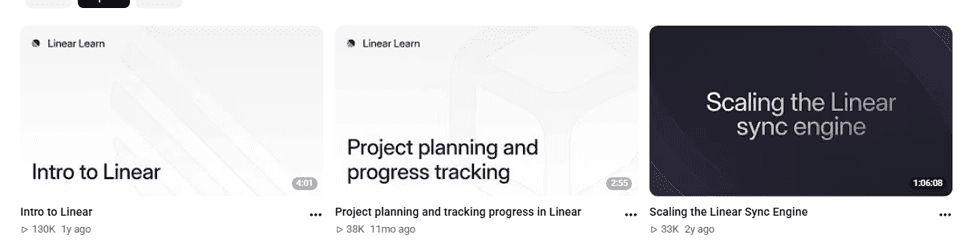
The top-performing video by views is the Intro to Linear tutorial at 130K views, 1,300 likes, and 46 comments. This is an evergreen piece of content that drives discovery from developers evaluating the tool for the first time. The 1% like-to-view ratio is really good for a SaaS tutorial video. It was published a year before the time of research and still has the most views in the channel, which tells you it ranks well in search or gets surfaced consistently to people typing "Linear tutorial" or "how does Linear work."
The second video, Project Planning and Tracking Progress in Linear, has 38K views, 258 likes, and 6 comments. Published 11 months before the time of research, it walks through the full lifecycle of a project: planning phase, project overviews and documents, collaborating in comments, and reporting progress through project updates.
The view count is roughly a third of the Intro video's, and the comment count drops sharply, from 46 down to 6. While the Intro video answers "what is this tool," a question a much larger audience asks, the Project Planning video answers "how do I use this specific feature," which only the people already inside the product, or seriously evaluating it, go looking for. Lower funnel, smaller audience, lower comment volume. That is the expected shape for a deeper product walkthrough, not a problem with the video itself.
The third, Scaling the Linear Sync Engine, has 33K views and 765 likes. This is the most engaged-per-view video in the dataset, with a like ratio more than double that of the other two. This is a technical conference talk about the local-first sync architecture.
The audience watching it is self-selecting for engineers who care specifically about how Linear is built, not how to use it. The fact that a 1-hour-6-minute architecture talk pulls a stronger like ratio than a 4-minute intro tutorial tells you something real about who is actually watching: technically sophisticated viewers who finish long technical content and bother to like it, a much higher-intent signal than a quick view on a short tutorial.
Looking at the three videos together, the trend is consistent with the rest of Linear's content strategy: the channel rewards specificity and depth over polish. The Intro video is the broadest and gets the most reach because it answers the most common question.
The Project Planning video is the weakest of the three by every engagement metric, and the likely reason is format, not topic. It is a feature walkthrough without a strong narrative hook, the kind of content that ranks on search intent rather than earning attention on its own. The Sync Engine talk proves the opposite: a long, technically dense video with no SEO-friendly title outperforms in engagement quality because it speaks directly to the audience that matters most for word-of-mouth among engineers.
The pattern worth flagging: Linear's YouTube output is thin relative to its reach. Three notable videos across a span of one to two years, on a channel with 13,600 subscribers, mean the channel is not being used as an active content engine. It functions more as an archive: a place to park the Intro tutorial and a handful of conference talks, rather than a channel with a regular publishing cadence. Given how well the Sync Engine talk performs, more long-form technical content in that same vein (engineering deep dives, "how we built X" talks) is the clearest opportunity sitting unused on this channel.
While a broad tutorial earns the most reach, a narrow feature walkthrough earns the least engagement, and a long, unpolished technical talk earns the most genuine interest per viewer. If you only have resources for one type of video, the data here says to go deep and technical, not broad and explanatory. Reach and engagement are not the same goal, and chasing the wrong one wastes the resource you have least of: production time.
💡 Steal This: Treat your changelog as a content channel. Every platform reviewed here, X, LinkedIn, and YouTube, shows the same pattern: posts and videos about what shipped and why it matters consistently outperform generic brand content. Post your changelog updates everywhere your audience already is, not just on a changelog page nobody checks.
Linear's Paid Advertising Strategy
Linear is running paid ads on LinkedIn and Google. No Meta ads were found.
LinkedIn (134 ads in library)
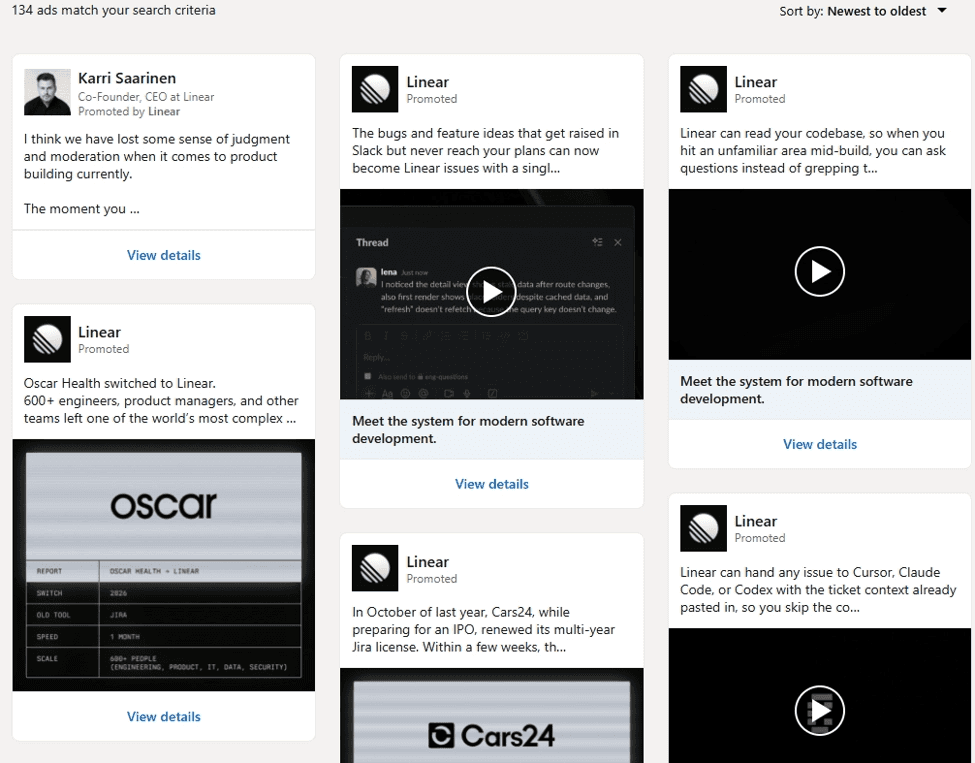
LinkedIn is Linear's primary paid channel. The ads split into four approaches: promoted personal posts from Saarinen, promoted personal posts from Artman, customer migration case studies (Oscar Health's switch from Jira is the clearest example, with switch date, prior tool, migration time, and team size shown directly in the creative), and product capability ads built around a specific workflow pain rather than a general productivity claim. CTA across all of them is consistent: "View details," pointing to linear.app.
The Oscar Health, Cars24, and Ramp case study ads are ABM signals. Each name a specific company and a specific migration scenario, aimed at a buyer in a comparable situation, making this a targeted proof.
Google (19 Search ads, 8 Shopping ads)
The Google strategy is built almost entirely on capturing search intent at the point of comparison, not on building awareness. The two primary search headlines, both anchored on the word "blazingly fast" and the promise of effortless bug tracking, both route to linear.app/issue-tracking.
That single landing page is doing the work of converting two distinct search intents (general task management and bug tracking specifically), which suggests Linear is testing keyword variations against one consolidated page rather than building dedicated pages per intent. This works when the core message (speed, simplicity) is strong enough to answer multiple search queries without dilution, and it avoids the maintenance cost of a large landing page library.

The remaining search ads behave differently. Rather than competing on a broad keyword like "task management," they target product-specific terms, Triage Intelligence, the code diff tool, AI coding agents, and route each one to a feature-specific page.
This is a more mature paid search structure: broad-intent traffic gets the general pitch, feature-intent traffic gets the feature page. It means someone searching "AI coding agent" sees a different argument than someone searching "task management software," even though both searches could plausibly lead to the same product.
The weak point is the Shopping ads. They reuse the identical speed messaging from the Search campaigns with no apparent adaptation for the Shopping format, which is built for product comparison shopping, not for software discovery.
Running unmodified Search copy through Shopping is usually a sign of a smaller team stretching limited creative across formats, not a deliberate strategic choice. For a company spending meaningfully on LinkedIn (134 ads) and building dedicated landing pages for Search, the Shopping presence looks like an afterthought rather than a calculated channel.
💡 Steal This: If your founder posts on LinkedIn and those posts perform well, test running them as promoted ads. You do not need new ad creative. You need to put budget behind what already proves it resonates. The organic engagement data is your A/B test result.
Linear's Sales Funnel from Social Media
Every social channel Linear operates uses a single conversion path: link in bio or profile description, pointing to linear.app. Individual posts contain no links. A developer who sees a post on X, LinkedIn, or YouTube and wants to sign up has one option: go to the profile, click the link, and land on the homepage or a specific landing page.
This is the right funnel for a PLG product. Linear's primary acquisition motion is self-serve. A developer who is ready to try the product does not need a guided path. They go to linear.app, click "Get started," and are in the product within a minute. The content on social is awareness and interest. The conversion happens on the website, not in a social channel.
The funnel works because the product itself is the strongest sales argument. According to the SaasMag 2026 PLG analysis, 58% of B2B SaaS companies now operate a PLG motion. But the ones that compound are the ones where the product delivers value fast enough to justify the self-serve bet. Linear's free plan delivers real value immediately. No feature lock forces a user to upgrade before they have experienced the product. By the time a team upgrades, they have already built their workflow around Linear.
The gap in the funnel is the consideration phase. A developer who is evaluating Linear against Jira or Asana, doing research over several weeks before recommending a switch to their team, has no mid-funnel content to find. There is no comparison guide, ROI calculator, or email nurture sequence.
The assumption is that the product sells itself when teams try it, and the customer stories handle the more skeptical buyer. That assumption has held through a $1.25B valuation and 33,000+ teams. Whether it holds as Linear moves upmarket toward larger enterprises with longer procurement cycles is an open question.
💡 Steal This: If you are running a PLG motion, the mid-funnel is your biggest leak. The prospect who is interested but not yet ready to sign up has nowhere to go after they close your website tab. A newsletter, a comparison page, or a free email course keeps you visible during the consideration period without adding sales friction.
Reviews and Social Proof
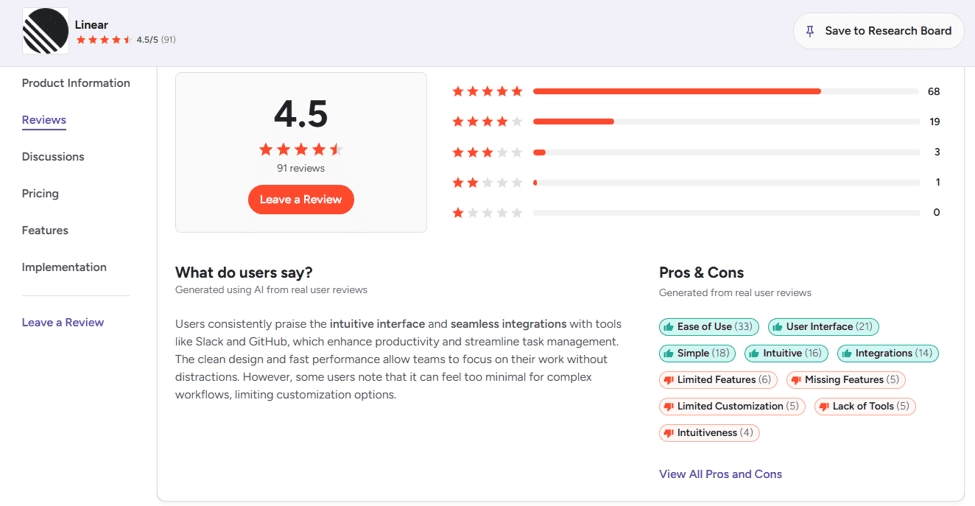
Positive themes show up consistently across reviews: ease of use (mentioned in 33 reviews), user interface (21), simplicity (18), intuitiveness (16), and integrations (14). Reviewers specifically call out speed and responsiveness, the command-k shortcut and keyboard-first navigation, GitHub and Slack integrations that update issue status automatically on PR actions, and the generosity of the free plan relative to its feature depth. Several reviewers describe reaching a "flow state" using the product, which is language that shows up unprompted across multiple independent reviews, a sign the feeling is real rather than coached.
Negative themes cluster around four areas: limited features (6 mentions), missing features (5), limited customization (5), and lack of tools (5). The specific complaints behind those tags are consistent.
Reviewers want more AI-driven "connective tissue" across their work rather than just additional views. Some flag a confusing structure between the "active" view (all open tasks) and the "cycle" view (the current sprint), which defaults to "active" and can cause people to pick up work that is not part of the current cycle. A few mention that navigating back from an issue can lose their place in a list rather than returning them to where they were.
Capterra: 4.3/5.
Feature-level ratings show a clear pattern: Issue Tracking and Gantt/Timeline View both sit at 5.0 (each from a single review), Collaboration Tools and Requirements Management at 4.5, Prioritization at 4.0, and Product Roadmapping at the bottom of the list at 3.5. The lower roadmapping score lines up with the same complaint that surfaces on G2: Linear is built for execution, not for long-range strategic planning, and reviewers feel that gap most when they try to use it for outcome-and-milestone-level roadmap work rather than day-to-day issue tracking.
Capterra's support and deployment profile is sparse by design. Linear offers Email/Help Desk support only, no FAQs/Forum, no knowledge base listed, no phone support, no 24/7 live rep, no chat. Deployment is web-only, no native Android or iPhone/iPad listing on this profile. \
Typical users are tagged as small businesses, with freelancers, mid-size businesses, and enterprises all unchecked. Customer Service itself is rated separately at 4.3 from 3 reviews. None of this is a red flag. It is consistent with a company that has deliberately kept its support surface area small and its product narrowly scoped, the same tradeoff that shows up everywhere else in this article.
Trustpilot: 3.4/5 from 8 reviews. This is a thin dataset and likely not representative. The low score with only 8 reviews suggests unhappy users are more motivated to leave reviews than satisfied ones, which is the typical pattern on Trustpilot for B2B tools.
Although they’ve claimed this profile, they are not answering the comments, not even the negative ones.
The on-site social proof is excellent. The customers page features detailed case studies from OpenAI, Ramp, Cursor, Coinbase, Oscar, Brex, Automattic, Mercury, Opendoor, Scale, Sierra, and others. Each case study has a named outcome: Ramp's agent writes 60% of merged PRs, Brex ran a data-driven pilot to prove Linear's impact, Scale compressed bug resolution time by 52%.
One thing worth noting: the switch page shows aggregate outcome data: 2.0x increase in filed issues, 3.3x faster issue resolution, 28% of issues authored by agents, and a claim that "more than 20,000 teams have already made the switch." This page is built specifically for the enterprise buyer who needs to build an internal business case for migration.
A WiserReview 2026 analysis of online review behavior found that 89% of consumers expect a response to a review and that businesses responding to at least 25% of their reviews earn 35% more revenue than those that do not.
BrightLocal's 2026 Local Consumer Review Survey reaches a similar conclusion: consumers notice when a business ignores feedback, and a templated or absent response damages trust more than a slow one. For an enterprise buyer evaluating Linear against Jira or Asana, an unanswered Trustpilot complaint barely registers, that buyer is reading the customer stories page and talking to an Account Executive.
But for the small business or solo developer who makes up Linear's largest segment by volume, a public, unanswered complaint about being unable to delete an account is exactly the kind of signal that 89% of consumers say they are watching for. The on-site case studies are excellent. The response gap on Trustpilot is the kind of small inconsistency that costs more with the buyer who has the least leverage to escalate past it.
💡 Steal This: Respond to every review you get, especially the negative ones, even on a platform you treat as low priority. Your enterprise case studies convince the buyer with leverage. Your review responses convince the buyer without it, and that buyer is reading more closely than you think.
Linear's Content Marketing and Demand Generation
The blog
Linear's primary content channel is the Now blog, which publishes across eight categories: Changelog, Community, News, Craft, AI, Practices, Customer Stories, and Press.
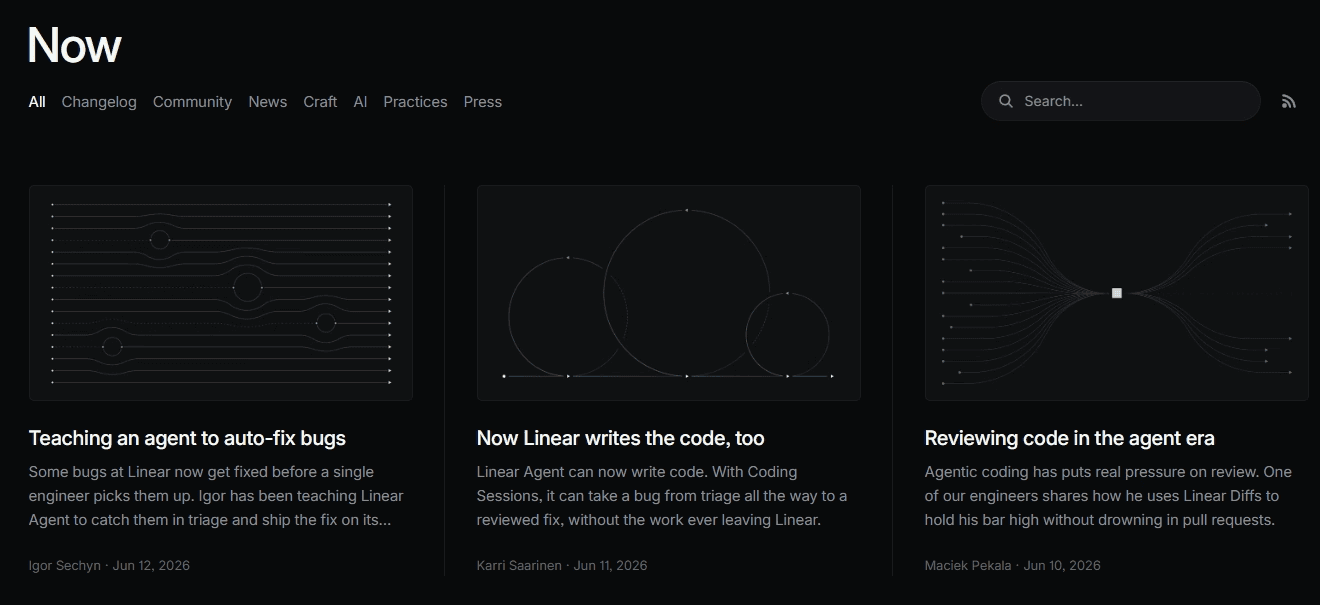
They are posting, on average, around one post per week. The honest description is a publishing rhythm that runs close to weekly with visible bursts around launches (the Diffs and Coding Sessions releases in late May and June both come with two to three supporting posts in the same window) and quieter stretches in between. They publish only when there is something to say.
Content format is consistently long-form text with embedded product screenshots or short demo clips, written in first person by the engineer, designer, or founder responsible for the thing being described. There is no video-first content on the blog itself, no infographics, and no listicle format. Every post reads like an internal engineering update that happened to be made public.
Everything on the blog is ungated. There is no email wall, no "read more" cutoff requiring a form, and no whitepaper-style asset locked behind a download form anywhere on the site. This extends to the Switch page, which is the closest thing Linear has to a traditional demand generation asset: a pitch guide for convincing your team, a pilot guide for running a trial, and a full migration guide, all given away with no form between the visitor and the content.
There is no events page, no upcoming or past webinar listings, and no registration flow exists on the site. The closest equivalent is the Now blog's Press category, which links out to external appearances: a South Park Commons talk with Linear, Raycast, and Anthropic (May 2026), a Sequoia Capital-hosted Startup Grind session (May 2026), and the Grit Podcast interview with Saarinen (April 2026). Linear shows up at other people's events rather than running its own.
Also, there is no email capture on the website outside of the product signup itself.
What the content strategy is optimized for: technical credibility, not lead capture. The blog, the Switch page, and the supporting pages in the Resources menu (Developers covering the GraphQL API, OAuth, and a dedicated Agent Interaction Guidelines section; Security covering SOC 2, GDPR, HIPAA, ISO 27001, SSO, SAML, and encryption at rest) together answer the questions a technical evaluator or a procurement team would otherwise need a sales call to get answered.
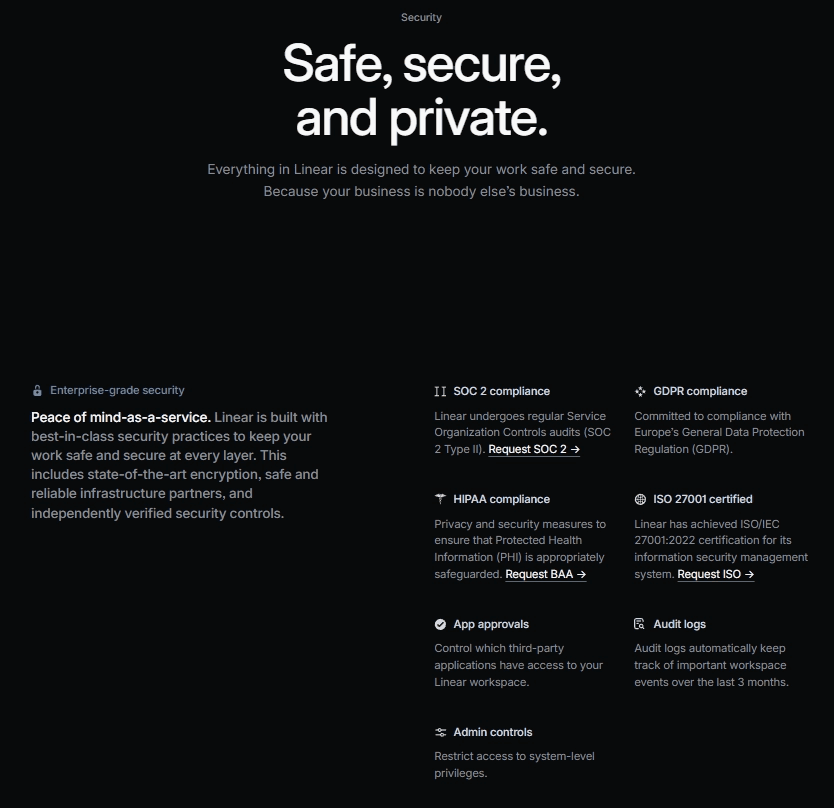
None of them asks for an email address first. The bet is that a buyer who can self-serve the security questionnaire and read the engineer's own account of how a feature was built moves faster through the funnel than one who has to trade contact information for a gated PDF.
💡 Steal This: If your buyer is technical, publish your security and compliance answers in your main navigation instead of gating them behind a sales conversation. A procurement team that can self-serve SOC 2 and HIPAA answers moves your deal forward without waiting on a security questionnaire response from your sales team.
Linear's Marketing and Sales Funnel Stages
TOFU (Top of Funnel)
Linear's top-of-funnel operates across four channels simultaneously. The Now blog generates organic search traffic for developer-oriented queries about product development methodology and tool comparisons. The X account reaches 105,9k followers daily with product updates that spread through developer networks via reposts, the Startup Program places Linear in front of every early-stage company backed by participating VCs, and the LinkedIn paid ad operation (134 ads at the time of research) puts Linear in front of decision-makers at companies that look like the Oscar Health and Cars24 migrations.
The Gartner finding that 40% of enterprise applications will include integrated task-specific AI agents by the end of 2026 is the macro tailwind that makes all of this TOFU work harder. Every developer team is evaluating its tooling for the agent era. Linear's "designed for the AI era" positioning puts it in the consideration set for teams that are not yet using Linear but are actively looking.
MOFU (Middle of Funnel)
Linear's middle-of-funnel is the strongest part of the funnel and the most unusual. The customer stories page is a MOFU asset, not a BOFU one. A buyer who is considering Linear but not yet ready to sign up can read 15+ detailed case studies from companies they recognize, with named outcomes and named stakeholders. The switch page provides ROI context and the Linear Method provides philosophical alignment. A buyer who has spent an hour on these pages has done the equivalent of three sales calls without talking to anyone.
The PLG playbook described in the SaasMag 2026 PLG analysis confirms this pattern: leading B2B companies now anchor growth on in-product signals. Linear's free tier is the activation mechanism. The customer stories and Method are the consideration content that make the activation decision easier.
BOFU (Bottom of Funnel)
The conversion path splits at this stage. For PLG accounts (individuals and small teams), the path is: sign up for free, use the product, hit a limit, upgrade online. No sales conversation required. For enterprise accounts, the path is: see an ad or a customer story, visit their website, request a demo or contact sales, and go through a consultative process with Linear's sales team.
Retention
Linear's retention strategy is the product itself, combined with the community. The Changelog is published weekly and gives users a reason to return. The Linear Method is a philosophy that customers internalize and then advocate for. The community Slack gives power users a channel to help each other and influence the roadmap.
Linear's Future Plans and Growth Indicators
The hiring map at time of research is the most direct signal of where Linear is investing after the Series C.
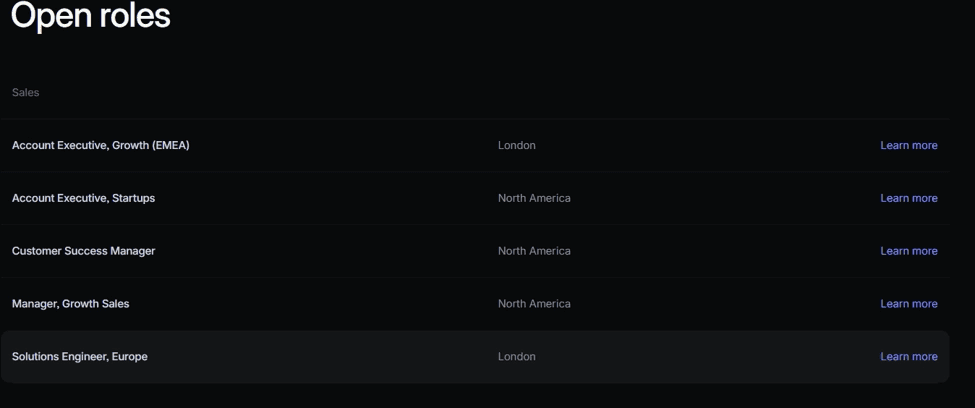
Sales expansion is the primary bet. Account Executive Growth (EMEA/London), Account Executive Startups (North America), Customer Success Manager (North America), Manager of Growth Sales (North America), and Solutions Engineer Europe (London). Saarinen's Series C post described a company that has built its growth on a product-led model. These hires shows that the enterprise sales motion is now being formalized.
EMEA and European roles appear across Sales (London), Engineering (Europe + North America), Product Management (Europe + North America), Design (Europe), and Customer Experience (Europe), showing that there is a need of geographic expansion.
The Senior/Staff Product Engineer AI role (North America) is the most signal-rich hire on the list. They need to build the engineering capacity to make Linear Agent more autonomous, reliable, and capable. The Anthropic 2026 Agentic Coding Trends Report found that autonomous agents now handle 70% of routine maintenance tasks in mature teams. Linear is hiring to be the system that agents operate inside.
The Developer Relations role (Europe and North America), sitting under Marketing, is the clearest sign that Linear's marketing function is maturing. Developer Relations in a PLG company is the bridge between the product and the developer ecosystem: conferences, integrations, open-source contributions, and the kind of technical credibility that makes developers recommend a tool to their peers.
A Senior Counsel (North America) at a 234-person company is not a standard operating hire. It is preparation for more complex enterprise deals, IP management, and the legal infrastructure that comes before a Series D or an IPO conversation.
Put together, these five signals describe a company moving from one growth model to another, not adding to the same one. The sales hires and the Senior Counsel point toward larger, slower, more contractually complex deals. The European roles point toward a second home market, not just opportunistic hiring.
The Product Engineer AI hire points toward Linear Agent becoming more central to the product, not a feature alongside it, and Developer Relations sitting under Marketing is the clearest tell of all: Linear is starting to invest in the kind of category-building work that PLG companies usually delay until the product-led motion alone stops being enough.
None of these hires undoes what got Linear here. They are what a company does when the self-serve motion has proven itself and the next phase of growth requires people that the product alone cannot replace.
Inspiration Points from Linear
1. Build your product so that using it is the proof.
Linear's marketing budget was described publicly as roughly $35k for the first several years of the company. The product grew because engineers who used it told other engineers. This is what happens when a product is so much better than the alternative that users feel compelled to share it.
The PLG principle here is simple: the best acquisition channel is a product that delivers value so clearly and quickly that the user wants their colleagues to have it. The SaasMag 2026 PLG analysis found that 58% of B2B SaaS companies now run a PLG motion, and the ones that compound are the ones where activation is fast and value is obvious. Linear's sub-100ms response time is the value. It is obvious within 30 seconds of using the product.
2. Publish your methodology and let it find its own audience.
The Linear Method is a stated set of principles for how great product teams work. It includes opinions: write issues, build with users, and keep launching. The teams that share that worldview find Linear through the Method content and arrive already convinced.
Cialdini's consistency principle explains the mechanism: buyers who have internalized your framework before they try your product are far more likely to complete activation, upgrade, and advocate for you. The Method is a filter, a sales tool, and a retention mechanism simultaneously.
3. Use customer stories as the conversion argument.
Linear's customer stories on the customers page are structured as business cases. Each one has a named company, a specific migration scenario, and a concrete outcome. Ramp's agent handles 60% of merged PRs. Scale compressed bug resolution time by 52%. Cars24 walked away from a Jira contract they had just renewed.
The Mordor Intelligence project management software market report projects the market to grow from $11.27B to $23.09B by 2031, which means the competitive decision a buyer is making carries significant long-term consequences. Named outcomes from companies the buyer recognizes are the only evidence that overcomes procurement skepticism at this scale.
4. Run your founder's best posts as paid ads.
Saarinen's anti-hyper-hiring post got 911 reactions organically. Linear runs Saarinen's personal posts as promoted LinkedIn ads. The organic engagement data is the A/B test. The post that resonates with Saarinen's 60,7k followers will likely resonate with the engineering leaders and CTOs that LinkedIn's targeting can find for Linear.
Using the founder’s posts as ad creative works because it bypasses the skepticism that branded ad creative generates. The Google DORA 2025 report found 90% of software teams now use AI at work daily. The buyers who are evaluating Linear are sophisticated, ad-aware technical leaders. A post from the CEO with a genuine point of view reaches them in a way that a promotional banner does not.
5. Let the free tier carry the enterprise funnel.
Linear's free plan includes unlimited members, real AI features, and enough functionality to run a small engineering team indefinitely. This is a deliberate bet that free users who build their workflows around Linear become the advocates who drive the enterprise deals.
An engineer who has used Linear at a startup becomes a CTO or VP of Engineering at a larger company and brings Linear with them. The Sacra analysis of Linear confirms that the PLG model works through "team growth and feature adoption rather than complex customization." The free tier is not a demo. It is the acquisition engine.
6. Build content with your engineers, not for them.
Linear's Now blog publishes articles by the people who built the features. The Sync Engine technical talk is by the engineer who built the Sync Engine, the zero-bugs policy post is by the CTO who implemented it, and the Coding Sessions announcement is by Karri Saarinen, who uses the product to build the product.
The JetBrains State of Developer Ecosystem 2025 found that 85% of developers regularly use AI tools, and the ones who evaluate new developer tools do so by reading technical content written by peers. An article by the engineer who built a feature is a peer-to-peer recommendation. A marketing article about the same feature is a sales pitch.
7. Position the product for the era your buyer is entering.
Linear's current homepage says "the product development system for teams and agents." A year ago, it would have said "issue tracker." The Anthropic 2026 Agentic Coding Trends Report documents that autonomous agents now handle 70% of routine maintenance tasks in teams that have adopted them.
Linear is not positioning itself as a better Jira. It is positioning itself as the infrastructure for a development team where some of the team members are AI agents. That is a fundamentally different product category, and claiming it before the market has fully articulated the need is how you own a category.
Frequently Asked Questions
What does Linear do?
Linear is a product development system for software engineering and product teams. It handles issue tracking, project planning, roadmaps, and company-wide initiatives, and it is built to work alongside AI coding agents. The company positions it as the replacement for legacy issue trackers like Jira, with a focus on speed and simplicity over customization.
How much does Linear cost?
Linear offers a free plan with unlimited members, 2 teams, and 250 issues. The Basic plan is $10 per user per month, billed yearly. Business is $16 per user per month, billed yearly. Enterprise pricing is custom and annual only. All plans include the Linear Agent platform.
Who founded Linear?
Linear was founded in January 2019 by Karri Saarinen (CEO, ex-Airbnb Principal Designer and Coinbase Head of Design), Jori Lallo (Co-Founder, ex-Coinbase Senior Engineer), and Tuomas Artman (CTO, ex-Uber Senior Engineer). All three are Finnish and had worked together in the Bay Area startup ecosystem since the early 2010s.
How did Linear grow to 33,000 teams?
Linear grew primarily through product-led growth. The product's speed and quality created organic word-of-mouth inside developer communities. The founders maintained a tight invitation-only beta, which created demand before the public launch in 2020. The startup program placed Linear inside early-stage companies backed by participating VCs. And the low-friction free tier made it easy for teams to start without a purchasing decision.
What is Linear's GTM motion?
Linear runs a hybrid PLG and sales-assisted motion. Small teams discover and adopt the product through the free tier with no sales involvement. Enterprise accounts go through a consultative sales process led by the Account Executive team. The careers page at the time of research shows five active sales hires, including EMEA and startup-focused AE roles, indicating that the enterprise motion is being formalized after the Series C.
Does Linear compete with Jira?
Yes. Linear's switch page explicitly targets teams migrating from Jira, Asana, and GitHub Issues. The LinkedIn ad library includes customer migration stories from Oscar Health (600+ people who left a complex Jira instance) and Cars24 (walked away from a renewed Jira contract). Linear scores higher than Jira on speed and simplicity and lower on customization and enterprise ecosystem breadth.
What are Linear's reviews like?
G2 gives Linear 4.5/5 from 91 reviews, with top positive themes being ease of use, user interface, and integrations. The main negative is that it feels too minimal for teams that need heavy customization. Capterra shows 4.3/5. Trustpilot shows 3.4/5 from 8 reviews, which is a thin dataset and not representative of overall user satisfaction.
What is the Linear Method?
The Linear Method is a set of product development principles published at linear.app/method. It covers how to set product direction, write issues rather than user stories, manage design projects, build with users, and launch consistently. It is Linear's stated philosophy for how great software teams work, and it functions as both content marketing and a filter for the kind of customer Linear wants to serve.
What does Linear's hiring tell us about their roadmap?
The open roles at the time of research include Account Executive Growth (EMEA), Account Executive Startups (North America), Solutions Engineer Europe, Senior/Staff Product Engineer AI, Developer Relations (Europe + North America), and Senior Counsel. This pattern signals European geographic expansion, a formalized enterprise sales motion, continued AI infrastructure investment, a maturing developer relations function, and legal preparation for Series D or larger enterprise contracts.