Blog
/
Best GTM Intelligence Platforms for Your B2B Sales Teams
Find the best GTM intelligence platforms for your B2B sales & revenue team. Leverage AI and real-time insights to drive your go-to-market strategy.
/
Enjoy reading!
A note on timing: the GTM intelligence market moves fast, and every vendor on this list has shipped a product update, a pricing change, or a rebrand in the past six months. The details below are accurate as of July 2026. Confirm current pricing and features directly with each vendor before you sign anything.
It is likely that your sales team already has a CRM. It probably already has a tool to send email sequences, an enrichment tool, and a Slack channel or Whatsapp group full of screenshots pulled from LinkedIn. What (so many times) it does not have is a fast, trustworthy answer to the question every rep asks before a call: why this account, why now.
That gap is what a GTM intelligence platform is built to close. It pulls company data, signal activity, and CRM history into one layer, then uses AI to tell reps and marketers which accounts to work first and what to say once they get there. A genuine AI-powered GTM intelligence platform works in real-time, not on a report you read a week after the signal actually mattered. The category has grown wide enough that the field now runs from a €99-a-month tool built for a single founder to enterprise suites that run six-figure contracts and answer to public shareholders.
This guide covers what GTM intelligence actually means, the pillars a real platform needs, and a close look at eight platforms worth evaluating in 2026: SalesOMMO, Demandbase, HockeyStack, 6sense, HubSpot Breeze Intelligence, ZoomInfo, Apollo.io, and RollWorks (now trading under the AdRoll ABM name). One disclosure before you read further: Milk & Cookies Studio has an investment in SalesOMMO. We have tried to write about it the same way we write about everyone else on this list, with the strengths and the limits both on the page.
What Is GTM Intelligence
GTM intelligence is the layer of data and AI that ranks which accounts to prioritize, surfaces what is happening inside those accounts, and recommends what to do next. It combines firmographic and technographic data, buying signals such as hiring spikes and funding rounds common in b2b sales cycles, engagement history pulled from the CRM, and a scoring or recommendation model that turns all of it into a single, ranked answer for a rep or a marketer.
The term is broader than sales intelligence, which usually means contact data and company lookups, and narrower than a full go-to-market platform, which can include execution tools like sequencers and ad managers. Think of GTM intelligence as the intelligence layer sitting between your data sources and the people who act on that data: it decides what matters before anyone spends a minute working an account.
What GTM Means and Where Go-to-Market Teams Use It
GTM stands for go-to-market, the plan a company follows to bring a product to a defined set of buyers and turn that effort into revenue. A go-to-market motion covers who you sell to, how you reach them, what you charge, and which team (sales-led, product-led, or a mix) drives the acquisition.
In day-to-day use, "GTM" has become shorthand for the whole commercial function: the reps, the marketers, the RevOps analysts, and the tools they share. When a founder says "our GTM is broken," they usually mean the handoff from campaigns to sellers is producing activity without producing pipeline. That is the gap a GTM intelligence platform is designed to close, by giving every function a shared, current view of which accounts are actually worth the effort.
The Core Pillars of a GTM Intelligence Platform
Strip away the marketing language and every credible modern GTM intelligence platform, whatever else already lives in your GTM stack, is built on the same four pillars.
The first is a data foundation: verified company and contact records, technographics, and firmographic detail that everything else gets built on top of. Weak data here undermines every model downstream, no matter how sophisticated the AI layer looks in a demo.
The second is signal capture: market intent, hiring changes, funding events, website visits, and CRM activity, unified into a single account timeline instead of scattered across five different tools.
The third is the AI layer itself: scoring models that weigh hundreds of data points, predictive analytics, and increasingly agents that turn raw signal into a ranked recommendation, a drafted email, or an account brief a rep can read in ninety seconds.
The fourth is activation: the workflows, alerts, and CRM syncs that automate getting the recommendation in front of the right person before the moment passes. A platform that scores accounts brilliantly but never gets that score in front of a seller has built an expensive report, not a working system.
What a GTM Intelligence Platform Does for Your Go-to-Market Strategy
A GTM intelligence platform exists to answer one operational question at scale: out of every account in your total addressable market, which ones should your team work today, and why. Without it, that decision defaults to whoever shouts loudest in a pipeline review, or to a static list built once a quarter and never updated.
For a small team, the platform does the research a founder used to do by hand between calls. For a larger revenue team, it becomes the shared source of truth that keeps sales, marketing, and customer success working the same accounts instead of three separate lists. Either way, the platform matters because it turns account selection from a guess into a decision backed by current data, which is the difference between a plan on a slide and a GTM your team actually runs.
Features to Look for in the Right GTM Intelligence Platform
Every vendor in this category will show you a polished dashboard. The features below are the ones that turn raw data into actionable insights, and separate a platform your team will actually use from one that gets abandoned after the first renewal.
Feature | What it does | Why it matters |
|---|---|---|
Verified company and contact data | Firmographic, technographic, and direct-dial or email accuracy | Everything downstream is only as good as the record it starts from |
Intent and buyer signals | Hiring changes, funding events, third-party research activity, website visits | Tells you when an account moves from cold to worth a call |
AI scoring and prioritization | Ranks accounts and contacts against your ICP automatically | Saves a rep from manually triaging a spreadsheet every morning |
Workflow automation | Routes leads, drafts outreach, updates CRM fields without manual entry | Turns intelligence into action instead of another tab to check |
CRM and tech stack integration | Two-way sync with Salesforce, HubSpot, or your CRM of choice | Keeps the platform inside the tools your team already opens daily |
Reporting and attribution | Ties signal and activity back to pipeline and closed revenue | Gives you the evidence to defend the renewal at budget time |
Two of these deserve extra weight before you sign a contract. Account and contact data quality is the one thing you cannot fix after the fact, so ask for a sample export against real accounts you already know before you buy. And workflow automation matters more than the AI headline feature on the pricing page, because a platform that surfaces the right insight but leaves it sitting in a dashboard nobody opens has not actually changed how your team sells.
How GTM Intelligence Differs From Sales, Revenue, and Conversation Intelligence
These four terms get used almost interchangeably in vendor marketing, and the overlap is real, but the center of gravity is different for each one.
Sales intelligence is the narrowest: company and contact data, usually with some intent layered on top, built to answer "who should I call." The category Gong helped define analyzes calls and meetings to surface what worked, what stalled a deal, and where a rep needs coaching. Deal and forecast intelligence sits a level above both, tying pipeline, revenue projections, and deal activity together so a VP of Sales can see risk before it shows up in a missed quarter.
GTM intelligence is the broadest of the four. It absorbs pieces of all three, contact data, signal activity, and account context, and applies them earlier in the process, before a conversation has even started. A platform can call itself a GTM intelligence platform and still lean heavily toward one of the other three; part of your evaluation is figuring out which center of gravity a given vendor actually has.
The Top GTM Intelligence Platforms on the Market Right Now
The eight platforms below cover the full range of this category, from a lean tool built for a single founder to enterprise suites that require a dedicated RevOps hire to run. The table gives you the shape of each; the write-ups below it go deeper.
Platform | Best for | Standout capability | Starting price (2026) |
|---|---|---|---|
SalesOMMO | Entrepreneurs and small sales teams | Agentic-AI qualification with daily MQLs and Executive Briefs | Free tier, paid from €99.95/month |
Demandbase | Enterprise ABM teams running advertising | Native B2B demand-side platform plus Agentbase AI agents | Custom quote, median around $65,000/year |
HockeyStack | Mid-market and enterprise RevOps | Multi-touch attribution tying every touchpoint to closed revenue | Custom quote, roughly $1,399/month and up |
6sense | Enterprise ABM with dedicated operations staff | Predictive intent scoring built on the dark funnel concept | Free tier, paid custom quote from roughly $50,000/year |
HubSpot Breeze Intelligence | Teams already running HubSpot as system of record | Native enrichment and buyer intent inside the CRM you use daily | From roughly $30/month, credit-based |
ZoomInfo | Teams that need data depth and execution in one platform | GTM Context Graph and agent-native data access via MCP | Custom quote, roughly $14,995/year and up |
Apollo.io | Startups and lean outbound teams | Contact database bundled with built-in sequencing at low entry cost | Free tier, paid from $49/user/month |
RollWorks (AdRoll ABM) | Mid-market teams whose ABM motion leans on advertising | Native display, CTV, and social ad orchestration alongside account scoring | Custom quote, roughly $25,000 to $50,000/year |
SalesOMMO, for Entrepreneurs and Small Sales Teams
SalesOMMO is built for a specific buyer that the rest of this list mostly ignores: the founder or small sales team juggling thirty open opportunities with no time to research any of them properly. It was founded in Bucharest by Mihai Guran, who built Bitdefender's international sales organization from six people to more than two hundred across fifteen countries before turning to angel investing and sales consulting. It is not competing on raw lead generation volume the way Apollo does; it is a qualification and meeting-preparation layer for leads a small team already has or finds elsewhere.
The product sets up an ICP in minutes, then uses Agentic-AI qualification to deliver a handful of marketing-qualified leads every day, complete with an ICP fit score and an Executive Brief on the company and the specific person you are about to contact. The design decision that separates SalesOMMO from most of the platforms further down this list is deliberate restraint: it does not send outreach automatically. A human decides who to contact, when, on which channel, and with what message, while the AI handles the research, the qualification, and the first draft.
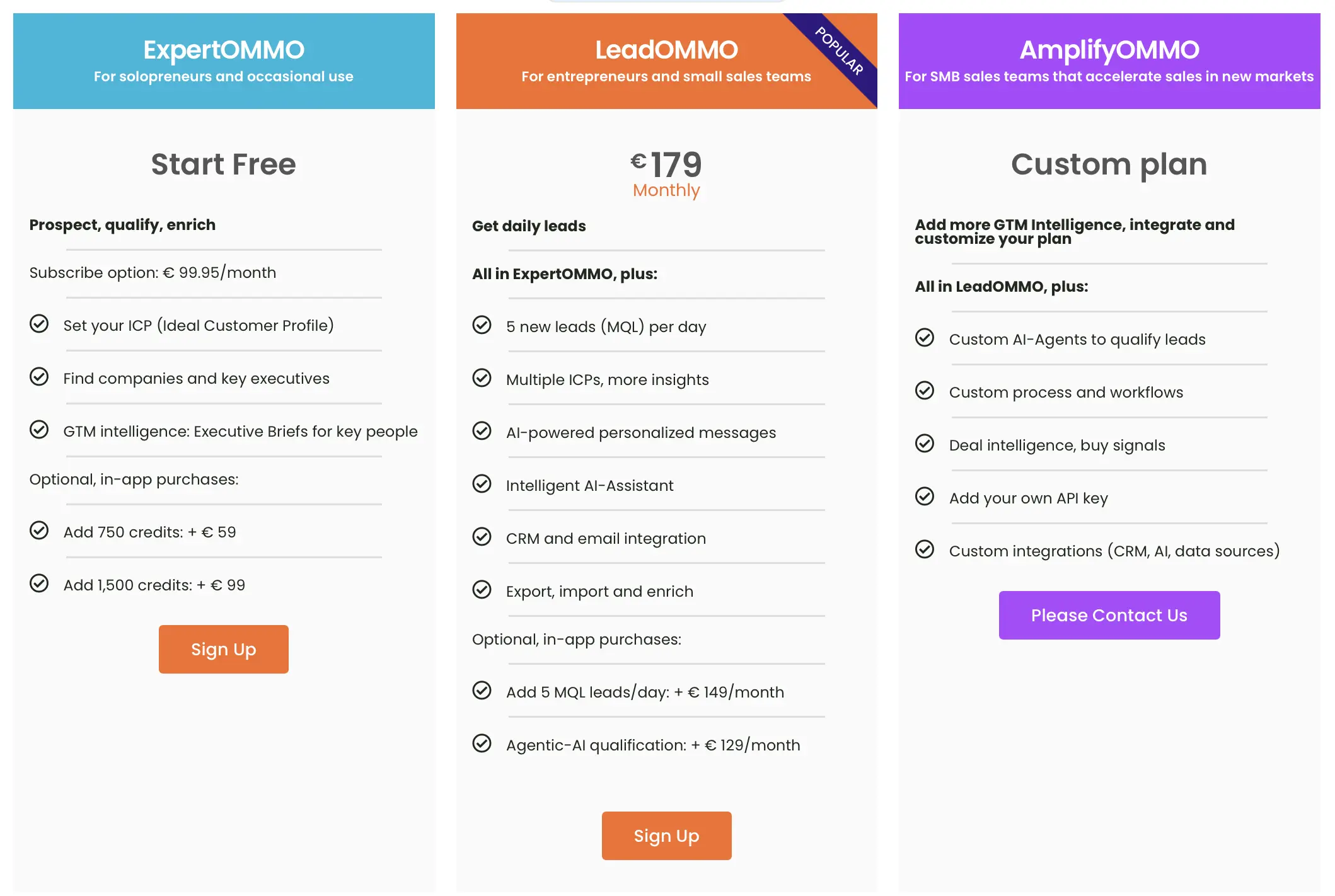
Pricing starts with a free PersonalOMMO tier, then moves to ExpertOMMO at €99.95 a month for ICP setup and Executive Briefs, LeadOMMO at €179 a month for daily MQLs and CRM integration, and custom AmplifyOMMO and TeamOMMO plans for teams that want custom AI agents, deal intelligence, and their own API keys layered on top. For a founder-led team selling anywhere from €2,000 to €50,000 deals that require real personalization, it is the only platform on this list priced and scoped for that exact job. It is not built to replace an enterprise ABM stack, and it will not try to.
Demandbase
Demandbase is the platform to evaluate if your GTM motion runs on coordinated advertising alongside account intelligence. It is the only major ABM vendor with its own business-to-business demand-side platform, meaning display, native, video, and connected TV campaigns run inside the same system as your account scoring instead of through separate ad platforms bolted on after the fact.
In April 2026 the company debuted Demandbase AI at its GO London customer conference, built around a proprietary system called Context Intelligence that analyzes account signals against pipeline goals and now connects to Claude, ChatGPT, Copilot, and Gemini through the Model Context Protocol. Demandbase was named a Leader in both Forrester's Q1 2026 Wave for Marketing and Sales Data Providers and its Wave for Revenue Marketing Platforms, the only vendor to land in both. On G2, it holds a 4.4 rating across roughly 2,000 reviews as of mid-2026, with the most consistent complaint being an opaque, sales-assisted pricing process.
Pricing is never published. Reported contracts run from around $18,000 a year for a basic deployment to more than $300,000 for full enterprise coverage with advertising included, with a median closer to $65,000 to $70,000 according to third-party procurement data. Budget for onboarding costs on top of the platform fee; several reviewers cite setup and account-data cleaning as the roughest part of the first quarter.
HockeyStack
HockeyStack answers a different question than most of this list: not "who should we target" but "what is actually working." Founded in Istanbul in 2020 by Emir Atli and Burak Buyukdemir and backed by a $5 million Series A in 2024, the platform unifies marketing, product, and sales data into a single revenue data model called Atlas, then applies AI on top through an analyst agent named Odin and a sales-facing agent named Nova.
The core strength is multi-touch attribution that connects every touchpoint, ads, content, sales calls, product usage, back to closed revenue, with up to nine attribution models running at once so marketing and finance can stop arguing about which metric is right. Customers including Airbyte, Firstup, and 8x8 use it to consolidate reporting meetings that used to require three separate tools into one.
HockeyStack sells two tiers, GTM Intelligence and GTM Execution, both sold through a demo with no published pricing; third-party sources put the entry tier around $1,399 a month and the execution tier with the full agent suite closer to $2,200. There is no free trial. Reviewers consistently flag a real setup curve: getting attribution right requires someone on your team who understands how the business defines a qualified meeting or a closed deal, not just someone who can click through an onboarding wizard.
6sense
6sense built its reputation on a single idea: most B2B buyers are roughly seventy percent through their decision before they ever talk to a vendor, researching anonymously in what the company calls the dark funnel. Founded in San Francisco in 2013 and backed by more than $426 million in funding from investors including Insight Partners, 6sense uses proprietary intent data and predictive AI, branded Signalverse and 6AI, to identify which accounts are actively in-market before they fill out a form.
The platform has earned Gartner Magic Quadrant Leader status across five consecutive reports and a Forrester Wave Leader placement in Q1 2026, and its RevvyAI layer now lets sellers and marketers ask plain-language questions about account and campaign performance instead of building a report from scratch. G2 reviewers rate it 4.3 out of 5 across roughly 1,300 reviews, with predictive scoring and customer support cited most often as strengths, and a real learning curve cited just as often as the tradeoff.
A free tier exists but is genuinely limited to fifty monthly data credits, useful for testing and not much else. Paid plans start around $50,000 a year and commonly land between $60,000 and $120,000, frequently on a two-year commitment. 6sense is worth the investment for a team with thirty or more reps, a dedicated RevOps or marketing operations owner, and an average deal size that justifies the spend. Smaller teams tend to pay for predictive sophistication they do not have the headcount to operationalize.
HubSpot Breeze Intelligence
For a team already running HubSpot as its system of record, Breeze Intelligence is the lowest-friction way to add GTM intelligence without adding a new platform to log into. Built on HubSpot's Clearbit acquisition, it enriches customer data automatically, flags companies showing buyer intent on your site, and shortens forms by hiding fields you already know the answer to.
Breeze Intelligence sits inside HubSpot's wider Breeze AI suite alongside Breeze Copilot and a set of Breeze Agents. In April 2026, HubSpot moved two of those agents to outcome-based pricing: the Customer Agent now costs $0.50 per resolved conversation, down from a flat rate per conversation, and the Prospecting Agent costs $1 per lead actually recommended for outreach, replacing a flat monthly charge per enrolled contact. Both changes were framed around a simple argument: you should pay when the AI produces a result, not just when it runs.
Breeze Intelligence itself uses a credit system with entry pricing around $30 a month, scaling with enrichment volume. The honest limitation is scope: it works best when HubSpot is genuinely your only system of record. Teams running Salesforce alongside HubSpot, or with data scattered across separate billing, product, and call-recording tools, hit its ceiling fast and end up needing a broader platform anyway.
ZoomInfo
ZoomInfo trades on Nasdaq under the ticker symbol GTM, and the company now describes itself outright as the GTM Intelligence Platform rather than a contact database with intent data bolted on. That positioning is backed by real scale: more than 500 million contacts, 100 million companies, and over 135 million verified phone numbers, making it one of the largest b2b data providers serving more than 35,000 companies worldwide.
The product line has consolidated around two pieces. ZoomInfo Copilot, now folded into GTM Workspace, gives sellers a single view of their book of business with an AI assistant that understands territory context and surfaces up to a thousand daily signals across job changes, funding, hiring, and intent. Separately, GTM AI (gtm.ai) opens ZoomInfo's data to outside AI tools through the Model Context Protocol, so an agent built in Claude or ChatGPT can query the same GTM Context Graph a ZoomInfo seller would use, rather than reasoning from a generic model with no account context.
Pricing is never published and moves fast: Professional plans start around $14,995 a year for three seats, Advanced runs $24,995 to $30,000, and Elite starts near $40,000, though most real-world mid-market deployments with add-ons for buyer signal data and extra seats land between $30,000 and $60,000 or higher. According to ZoomInfo's own 2025 Customer Impact Report, customers grew their addressable market by an average of 40 percent and saw 32 percent pipeline growth, though as with any vendor-reported figure, treat it as a directional data point rather than a guarantee for your specific team.
Apollo.io
Apollo.io remains the most accessible full-stack option on this list, and its roots as a sales engagement platform still show in how much it packs into one login. Its database of more than 275 million contacts and 60 million companies comes bundled with built-in sequencing, dialing, and enrichment, so a five-person team can go from signup to a live outbound campaign in under an hour without stitching together separate tools.
Pricing runs Free, then Basic at $49 a user per month, Professional at $79, and Organization at $119, all billed annually with monthly rates running slightly higher. The catch is a credit system covering email, mobile, and export lookups that resets each cycle and does not roll over, so the advertised price and the real monthly cost can drift apart for high-volume teams. In March 2026, Apollo acquired Pocus, an enterprise revenue intelligence platform, and is folding its signal-based account scoring into Apollo's core product rather than selling it standalone, closing part of the gap with more signal-heavy competitors.
Apollo holds a 4.7 rating on G2 across more than 9,000 reviews, among the strongest volumes in this category, and its AI-assisted email drafting and native integrations with Claude, ChatGPT, and Perplexity via MCP make it a genuinely current pick for a lean team. Where it falls short is depth: signal quality goes only surface-level compared to 6sense or Demandbase, and native CRM integrations beyond the two market leaders are thin.
RollWorks (AdRoll ABM)
RollWorks is the platform to know if display, connected TV, and social advertising are core to how your team runs account-based campaigns, though the name itself changed in the past year. In August 2025, owner NextRoll folded RollWorks back into its original AdRoll brand as AdRoll ABM; existing logins, audiences, and reporting carried over, but any vendor comparison you read before that date will still call it RollWorks.
The platform draws on 2.6 billion digital identities, 92 million contacts, and 18 million B2B companies, with an AI engine called InIQ surfacing early buyer signals and a bidding system called BidIQ making more than 2.5 trillion daily predictions across eighty-plus intent signals per ad impression. It serves more than 110,000 brands, most of them lean mid-market marketers without a dedicated ABM operations hire, and it is genuinely faster to launch than 6sense or Demandbase, typically two to four weeks against several months.
Pricing is unpublished but reported to run from around $12,000 a year for basic account targeting up to $50,000 to $80,000 for a fuller mid-market deployment, generally cheaper than the two enterprise ABM platforms above it. The tradeoff is depth: its intent data comes from a Bombora partnership rather than proprietary modeling, account scoring is less sophisticated than 6sense's predictive engine, and most journey templates assume advertising as the primary channel, a real constraint for a team that wants ABM without running paid media.
Why ZoomInfo Leads the Way in GTM Intelligence
ZoomInfo's claim to the category is unusual because it is written into the company's own stock ticker: three letters, GTM, sitting on Nasdaq. Few vendors put that kind of permanence behind a positioning statement, and it forces a level of commitment that a rebrand or a new landing page does not.
The substance behind the ticker is what actually matters, though. ZoomInfo built its position from the data layer up, more than five hundred million contacts and a hundred million companies, then added the GTM Context Graph and Copilot Workspace on top so that scale becomes usable rather than just large. And by exposing that same graph to Claude, ChatGPT, and other outside assistants through the Model Context Protocol, ZoomInfo made a bet that GTM intelligence in 2026 is not just about owning a dashboard. It is about being the data layer every other agent in a company's stack reasons from, whether that agent lives inside ZoomInfo or inside Claude.
The biggest disadvantage of ZoomInfo is the price, which it can become prohibitive really fast.
How to Choose a GTM Intelligence Platform for Your Revenue Team
Start with your data reality before you look at a single feature list. If your CRM data is clean and your existing tech stack is HubSpot end to end, a native option like Breeze Intelligence removes more friction than a standalone platform ever will. If your CRM is a mess, no GTM intelligence platform will fix that for you; budget for a data audit first.
Next, size the decision to your team rather than to the vendor with the best sales deck. A ten-person team with no dedicated RevOps hire will get more real use out of SalesOMMO or Apollo than out of a 6sense deployment that needs someone running scoring models and audience segments every week. A fifty-person enterprise sales organization with a mature ABM motion is the opposite case, where the depth of Demandbase or 6sense earns its price.
Finally, separate the AI headline features from the actual buying decision. Every platform on this list will show you an AI agent in the demo. What should decide the contract is data accuracy on your own accounts, the honesty of the pricing conversation, and whether the platform's strongest capability, attribution, advertising, predictive scoring, or lean qualification, actually matches the problem in front of your team today.
How GTM Intelligence Platforms Unify GTM Teams
The most underrated benefit of a GTM intelligence platform has nothing to do with AI. It is that sales, marketing, and the team supporting existing accounts start working from the same GTM data instead of three separate spreadsheets built on three separate assumptions about who the best-fit customer actually is.
When a platform unifies go-to-market data across those functions, a marketer running a campaign, a rep prioritizing a call list, and a customer success manager flagging expansion risk are all looking at the same signal, updated in real time rather than refreshed once a quarter. That shared view is what closes the gap between marketing activity and sales pipeline, because nobody has to guess whether the lead marketing just generated is actually worth a rep's time.
Common Use Cases for GTM AI Across Sales and Marketing
The clearest applications for AI across a revenue org cluster around three moments in the funnel. At the top, AI-driven account scoring replaces a manually maintained target list, ranking accounts by fit and buying signal so a rep starts the day with a short list instead of a spreadsheet. In the middle of the funnel, AI drafts a first version of outreach and prepares a meeting brief, cutting the research time a rep spends before every call from twenty minutes down to two.
Deeper in the pipeline, forecasting models flag deals at risk based on engagement patterns pulled from email, calls, and CRM activity, giving a sales leader a warning before a deal quietly stalls rather than after it is already lost. And across the full customer lifecycle, the same signal architecture that identifies a new prospect can flag an existing customer showing expansion intent, which is why customer success teams increasingly sit inside the same GTM intelligence platform as sales and marketing rather than working from a separate tool.
Tying GTM Intelligence to Pipeline and GTM Strategy
None of this matters if it does not show up in pipeline. The honest way to evaluate a GTM intelligence platform is to trace a single account from the moment the platform flags it through to a closed deal, and check whether the platform's fingerprints are visible at every stage: the account got prioritized correctly, the message referenced something real, and the deal moved faster than an account worked the old way.
That evidence should show up first in your weekly pipeline reviews, not just in a quarterly business review deck built to justify the renewal. If a platform cannot point to specific accounts it influenced, the investment is closer to a data subscription than a working part of your revenue engine, and it should be evaluated, and priced, accordingly.
What ROI to Expect From a GTM Intelligence Platform
The return on a GTM intelligence platform shows up in three places: time saved on research and qualification, pipeline generated from accounts that would have gone unworked, and win rate on deals where a rep walked in with real context instead of a cold open. In practice, the payoff appears first wherever AI and automation remove manual research, before it ever shows up in a forecast.
Vendor-reported numbers vary widely and should be read as directional rather than guaranteed. ZoomInfo's own customer research cites an average 40 percent increase in addressable market and 32 percent pipeline growth across its base; Demandbase points to an 83 percent increase in pipeline velocity at Ingram Micro after implementation; Gartner has found that sales reps who use AI effectively are 3.7 times more likely to hit quota than peers who do not.
The realistic timeline matters more than the headline number. Time saved on research shows up within the first month. Pipeline-level results, more qualified opportunities and shorter sales cycles, typically take a full quarter or two to appear, especially on longer sales cycles. Budget for that ramp before you judge whether the platform earned its renewal, and measure it against your own numbers rather than someone else's case study.
AI and the Future of Go-to-Market Intelligence
Every platform in this article is moving toward the same destination even if they are starting from different places. Data-first vendors like ZoomInfo and Apollo are adding agent layers on top of their databases. Attribution-first vendors like HockeyStack are adding agents that can act, not just report. Enterprise ABM platforms like Demandbase and 6sense are opening their intelligence to outside assistants through protocols like MCP rather than keeping it locked inside a proprietary dashboard. For a team running GTM operations across several regions, that openness matters more than any single feature, because it means the intelligence travels to wherever the team actually works.
The practical implication for a buyer in 2026 is that the AI feature on a pricing page matters less than the data layer underneath it. An agent reasoning from stale, unverified company records will confidently produce a wrong answer just as fast as a right one. Whichever platform you choose from this list, spend more of your evaluation time on data accuracy than on how impressive the AI demo looks, because the demo will always look impressive.
Frequently Asked Questions
What is GTM intelligence?
GTM intelligence is the combination of unified data, signal activity, and AI scoring that ranks which accounts to prioritize and what to do next. It sits between raw data sources and the people who act on that data, turning scattered signals into a single, ranked recommendation.
What does GTM mean?
GTM stands for go-to-market, the plan a company uses to bring a product to a defined set of buyers and convert that effort into revenue. It covers who you sell to, how you reach them, and which team drives the acquisition.
What are the core components or pillars of GTM intelligence?
A working GTM intelligence platform rests on four pillars: a verified data layer, unified buying signals, an AI layer that scores and prioritizes accounts, and activation workflows that put the recommendation in front of the right person before the moment passes.
What is a GTM intelligence platform and why is it important for businesses?
A GTM intelligence platform is software that unifies account data, signals, and AI scoring so revenue-facing teams know which accounts to pursue and why. It matters because, without it, account selection defaults to guesswork or a static list that goes stale within weeks.
What features should I look for in a GTM intelligence platform?
Prioritize verified company and contact data, real signal activity, AI-driven account scoring, workflow automation that acts on the score, deep CRM integration, and attribution reporting that ties the platform back to closed revenue rather than activity alone.
What are some top GTM intelligence platforms available in the market?
SalesOMMO, Demandbase, HockeyStack, 6sense, HubSpot Breeze Intelligence, ZoomInfo, Apollo.io, and RollWorks (now AdRoll ABM) each lead in a different segment of the market, from lean founder-led teams to enterprise ABM programs.
How do GTM intelligence platforms benefit sales and marketing teams?
They replace manually maintained target lists with a live, scored view of the account base, cut the research time a rep spends before every call, and give sales, marketing, and the post-sale team a shared source of truth instead of three separate spreadsheets.
What ROI can I expect from investing in a GTM intelligence platform?
Expect time savings on research within the first month and pipeline-level results, more qualified opportunities and shorter sales cycles, within one to two quarters. Treat vendor-reported figures as directional and measure results against your own baseline.
What are the 5 pillars of GTM?
The five classic pillars of GTM are product analysis, product messaging, the sales proposition, the marketing strategy, and the sales strategy. These are distinct from the four pillars of a GTM intelligence platform, which are data, signal, AI, and activation.