Recommendations
/
6 Best ABM Tools for B2B SaaS in 2026
Our top 6 ABM tools for B2B SaaS in 2026: 6sense, Demandbase One, AdRoll, HubSpot Marketing Hub, Bombora, and Clay.
/
Enjoy reading!
Our top 6 ABM tools for B2B SaaS in 2026: 6sense, Demandbase One, AdRoll, HubSpot Marketing Hub, Bombora, and Clay. Pricing, use cases, honest trade-offs, and the one question most teams skip before buying any of them. (as of June 2026)
The ABM tools market has never been more crowded or more confusing. Vendors that started as single-purpose intent data providers now claim to be full platforms. Advertising platforms have acquired orchestration tools. Predictive analytics companies have bolted on email and chat. Every demo looks like the same beautiful dashboard, and the pricing is deliberately opaque.
We evaluated the 2026 field against the criteria that matter to B2B SaaS marketing and sales teams running real account-based programs: intent data depth, CRM integration quality, the honesty of what a tool actually does versus what it markets itself as, and whether the outcomes teams justify the total cost of ownership report.
Six tools came out with genuinely distinct value propositions: 6sense, Demandbase One, AdRoll, HubSpot Marketing Hub, Bombora, and Clay.
Not because each one does everything, but because each one owns a specific use case better than the alternatives at its price point. 6sense leads on predictive AI and buying-stage modeling. Demandbase is the only platform with a native B2B DSP for advertising execution. AdRoll is the most accessible entry point for HubSpot-native teams. HubSpot Marketing Hub covers the ABM basics without adding a new platform to the stack. Bombora is the data layer that powers most of the others. Clay is not an ABM platform, but it is the most flexible way to build one from components.
TL;DR: Which tool fits your situation?
Your situation | Best pick |
|---|---|
Enterprise team needing AI-driven buying-stage prediction | 6sense: predictive AI, $60K-$150K/year, Forrester Wave Leader |
ABM-first advertising execution with native DSP | Demandbase One: strongest programmatic B2B advertising, $50K-$200K+/year |
HubSpot-native team running first ABM program | AdRoll: cleanest HubSpot integration, $13K-$60K/year |
Team already on HubSpot Enterprise wanting ABM without a new platform | HubSpot Marketing Hub: no incremental ABM cost if already on Enterprise |
Enterprise ABM program needing the best standalone intent data | Bombora: Company Surge® powers 6sense and Demandbase; buy direct only at $30K+/year |
RevOps team building a custom ABM stack from components | Clay: workflow platform, not a platform; $167-$800+/month |
Note: Where the pricing wasn’t available on site, we checked with other resources like Vendr, Prospeo.io, and others.
What account-based marketing tools do for B2B tech companies
Account-based marketing tools sit between your target account list and your go-to-market strategies and handle the steps that make account-based campaigns possible at larger scale: identifying which companies are in your addressable market, showing which accounts are currently searching for solutions like yours, running coordinated campaigns across every contact inside those accounts simultaneously, and connecting that activity back to revenue.
The account-based marketing tools category breaks into four layers:
Intent data providers identify accounts showing research behavior that signals buying intent
ABM platforms use that intent data to orchestrate campaigns across advertising, email, and sales engagement
Data enrichment tools build complete account and contact profiles inside your CRM
Orchestration engines coordinate the handoffs between marketing activity and sales action.
The tools in our review span all four layers, #LIKEAPRO.
What account-based marketing tools cannot do?
Now, before we start, some important context around what these tools cannot do.
First of all, they (at least usually) cannot generate your messaging and positioning, identify your ideal customer profile, or make a weak offer that does not convert to… well, convert.
When integrating account-based marketing tools pay off
Account-based marketing strategies and obviously campaigns generate measurable results when three conditions are met:
a defined list of target accounts that are within your ICP
a clear understanding of who the buying committee is inside those accounts
a sales team that knows how to use market signals rather than ignoring them.
For example, one of the most interesting use case could be a B2B tech company with average contract values above €30,000, sales cycles longer than 45 days, and buying committees of three people or more. Anything below this, the platform costs and implementation overhead rarely justify the investment and effort.
Two other signals that account-based marketing is worth the investment: your SDRs spend more time researching accounts than having conversations and your marketing team cannot tell you which accounts engaged with their campaigns before going dark. Both problems are solvable with the right tools.
If you do not yet have a defined ideal customer profile, a target account list, and a sales strategy that can act on intent signals, the tool selection is the wrong first thing to tackle.
At Milk & Cookies Studio, we build the go-to-market architecture that ABM tools run on top of for B2B tech companies entering new markets. The system question comes before the tool question, every time.
When to skip ABM tools entirely
Skip dedicated ABM platforms if any of these apply:
Your target account universe is fewer than 200 companies. At that volume, a well-maintained HubSpot list with manual enrichment from Apollo or LinkedIn Sales Navigator covers 80% of what a platform delivers at a fraction of the cost.
Your average deal size is below €30,000. The cost of platform, implementation, and the RevOps headcount to run it will exceed the pipeline value generated by the incremental account coverage.
You do not have a RevOps function or someone who can own the platform. Every enterprise ABM tool in this review requires ongoing configuration, data management, and CRM hygiene. Without that owner, the platform becomes an expensive dashboard nobody looks at.
You are still defining your ICP or entering a new market for the first time. ABM tools amplify a functioning motion; they do not create one. An intent data platform cannot tell you which accounts matter if your organization has not yet figured out the answer to that question itself.
Now, let's start with the list. Grab some cookies and enjoy!
6sense, best for enterprise ABM teams that need predictive account intelligence
6sense earned its position in the market by doing one thing better than every other tool in this category: predicting which accounts are in an active buying cycle before those accounts ever raise their hand or fill out a form.
The platform's Revenue AI engine processes what 6sense calls buying signals from its proprietary network of B2B publisher sites, combining that data with first-party signals from your website and CRM to assign each target account to a buying stage: Awareness, Consideration, Decision, or Purchase. The model identifies accounts that are researching solutions in your category and predicts how close they are to making a decision, which changes how sales and marketing should engage them.
The outcome, when implemented well, is a shorter gap between the moment an account enters an active buying cycle and the moment your sales team knows about it. For enterprise B2B teams where deals take 90 to 180 days to close and SDR time is the scarce resource, earlier identification of in-market accounts produces disproportionate pipeline value.
6sense earned recognition as a Forrester Wave Leader for Revenue Marketing Platforms in Q1 2026. Its buying-stage model is what separates it from tools that surface intent signals without the predictive layer.
Starting price | $60K-$100K/year for mid-market; $100K-$250K+ for enterprise |
Free tier | Free Sales Intelligence tier with 50 credits/month |
G2 rating | 4.1/5 from 2,387+ reviews |
Best for | Enterprise B2B marketing and sales teams prioritizing in-market account identification |
CRM integration | Salesforce (native, deep); HubSpot (functional) |
Intent data | Proprietary Signalverse network, processing over 1 trillion buying signals daily |
Skip if | Your TAM is under 5,000 accounts, your budget is under $50K/year, or you lack a dedicated RevOps owner |
6SENSE's Key Features
Revenue AI engine with buying-stage prediction (Awareness, Consideration, Decision, Purchase) for every account in your target universe, updated continuously rather than weekly
Signalverse intent data network, aggregating signals across the web, review sites, and B2B publisher content to build predictive models from 1 trillion+ daily data points
Native Salesforce integration with automated account scoring, lead routing, and sales intelligence surfaced inside the CRM workflow
6sense Ads for programmatic advertising to in-market accounts across display, LinkedIn, and connected TV, coordinated with sales engagement
Conversational Email for automated, personalized follow-up sequences triggered by account buying-stage changes
Account identification for anonymous website visitors, with firmographic enrichment and buying-stage context
6SENSE's pros
The predictive buying-stage model is the most capable in the category; no other tool surfaces in-market accounts with the same combination of signal depth and predictive accuracy
Sales teams get actionable intelligence directly inside their CRM workflow, not a separate dashboard they have to learn to check
The free Sales Intelligence tier lets smaller teams test account identification and intent data before committing to a full platform license
Continuous signal refresh rather than weekly batch updates, which matters when your motion is to engage surging accounts within 48 hours
Strong customer success and implementation resources relative to the cost; the platform's complexity makes this non-negotiable
6SENSE's cons
Implementation and learning curve due to the volume of granular data represents the most cited friction by customers, though support is praised for mitigating it
The median 6sense contract runs around $55,000- $59,000/year based on Vendr transaction data, climbing fast with advertising and enterprise modules; budget for the platform plus the RevOps headcount to run it, because one without the other produces nothing
Credits do not roll over on the free tier; a slow prospecting month means evaporated credits
Salesforce is the native integration story; HubSpot users get functional but less deep integration than what AdRoll delivers
For most B2B teams evaluating 6sense, the right answer depends on one or two factors that neither vendor rep will surface: specifically, whether your TAM is large enough and your RevOps capacity mature enough to justify the platform's complexity
6SENSE's pricing
6sense does not publicly communicate their pricing. According to Vendr transaction data, annual contract values typically range from approximately $50,000 for smaller deployments to $300,000+ for enterprise implementations with expanded TAM coverage, multiple modules, and premium data sources. The median buyer pays approximately $55,000-$59,000/year depending on the dataset.
Multi-year contracts are standard. The free Sales Intelligence tier provides 50 data credits per month with company and people search, intent alerts, list building, and a Chrome extension, which is a useful starting point for evaluating signal quality before committing.
Best for: Enterprise B2B marketing and sales teams with large target account universes (5,000+ companies), average deal values above €50,000, and the RevOps function to operationalize buying-stage signals into sales workflows.
If you want to see 6sense’s marketing and sales tactics, read them here.
Demandbase, best for enterprise ABM teams with advertising-led programs
Demandbase took a different architectural path to enterprise ABM than 6sense. Where 6sense is predictive AI first, Demandbase is advertising first. The platform built a native B2B demand-side platform (DSP) that runs programmatic display, LinkedIn, and connected TV advertising directly inside the tool, with daily audience syncing between account intelligence and ad targeting.
The significance of this is real for teams where advertising is central to the ABM motion. When 6sense runs programmatic advertising, it routes through third-party DSP partners. Demandbase keeps that execution inside the platform, which means the feedback loop between account engagement and ad targeting is tighter, audience syncing happens daily rather than at batch intervals, and the reporting connects ad impressions directly to account-level movement through the pipeline.
Following its Engagio acquisition (account-based orchestration) and InsideView acquisition (intent data), Demandbase built the most comprehensive unified ABM platform in the market. For large enterprises running multi-channel ABM programs where programmatic advertising is a primary warm-up mechanism before outbound, that consolidation has genuine value.
The trade-off is the same as every enterprise ABM platform: complexity and cost. Demandbase is not a tool for early-stage teams or for companies where one person handles both marketing and RevOps.
Starting price | $50K-$80K/year for mid-market; $100K-$200K+ for enterprise |
Free trial | No free tier; demos available on request |
G2 rating | 4.4/5 from 1,989+ reviews |
Best for | Large B2B enterprises with advertising-led ABM programs and dedicated ABM operations staff |
CRM integration | Salesforce (bidirectional, deep); HubSpot (functional) |
Intent data | First-party + third-party, including Bombora-powered signals, across 3 million sites and 575,000+ topics |
Skip if | Your budget is under $50K/year, or programmatic advertising is not central to your account engagement strategy |
Demandbase's key features
Native B2B DSP for programmatic advertising to target accounts across display, LinkedIn, connected TV, and digital out-of-home, with daily audience syncing rather than batch updates
Account intelligence combining first-party behavioral data with third-party intent signals from Bombora and proprietary sources across 3 million sites
Engagement Platform for tracking account engagement across every digital touchpoint, with account journey mapping and sales intelligence surfaced inside Salesforce or HubSpot
Website personalization for serving account-specific content and CTAs to target account visitors without manual coding
Sales Intelligence module giving SDRs account research, intent signals, org charts, and engagement history inside their existing CRM workflow
Unified measurement connecting advertising, marketing activity, and revenue outcomes into a single attribution model
Demandbase's pros
The native DSP is a genuine differentiator for advertising-led ABM programs; tighter control over programmatic spend and daily audience syncing is valuable at enterprise scale
Strongest multi-channel account-based experience (ABX) orchestration of any tool in this review, with the ability to coordinate web personalization, advertising, email, and sales outreach from a single platform
Intent data breadth is among the highest in the category, covering 575,000+ topics across 3 million sites
G2 rating across 1,600+ reviews reflects a large, established customer base, which means more documented implementation knowledge than newer entrants
For large enterprises consolidating their ABM stack, Demandbase's acquisition breadth covers use cases that previously required multiple vendors
Demandbase's cons
Complexity is the most cited friction point across G2 reviews; a steep learning curve for smaller teams without dedicated ABM operations staff
According to Vendr transaction data from 166 verified contracts, the median Demandbase contract runs approximately $66,000-$68,000/year; onboarding costs of approximately $29,000 are reported by third-party sources but not confirmed officially by Demandbase
Multi-year contract pressure and auto-renewal clauses require careful contract review; budget conversations with Demandbase tend to be complex
The advertising DSP advantage becomes less relevant if your ABM motion is primarily outbound rather than advertising-led; at that point, you are paying for platform capabilities the team will not use
Like 6sense, it produces its best results only when a dedicated RevOps or ABM operations person owns the platform ongoing basis
Demandbase's pricing
Demandbase does not publish pricing. According to Vendr transaction data from 166 verified contracts, the median annual contract value is approximately $66,000-$68,000, with an observed range from $21,918 to $164,151 depending on modules, team size, and contract terms.
Modules (advertising, sales intelligence, data, orchestration) are priced separately, which means the starting price can be misleading if you need the full platform. Onboarding costs of approximately $29,000 are standard for full implementations.
Best for: Large B2B enterprises with advertising-led ABM programs, dedicated ABM operations teams, and multi-channel programs that benefit from consolidated orchestration across advertising, web personalization, and sales engagement.
AdRoll, best for HubSpot-native teams starting ABM for the first time
AdRoll ABM (formerly RollWorks) rebranded in August 2025 when parent company NextRoll unified its portfolio under the AdRoll brand. The product itself did not change; existing campaigns, audiences, and CRM integrations remained intact. It occupies a specific and useful position in the ABM market: it delivers the core ABM capabilities (account identification, intent data, programmatic advertising, account scoring) at a price point and implementation timeline that do not require an enterprise ABM program to justify.
The reason AdRoll belongs in this review alongside tools that cost three to ten times more is its HubSpot integration. AdRoll has the deepest native integration with HubSpot of any ABM platform. If your CRM is HubSpot, the setup is significantly easier than 6sense or Demandbase, with account lists, engagement data, and campaign results syncing bidirectionally.
That matters because most B2B SaaS companies under €30M ARR run on HubSpot rather than Salesforce. For those teams, 6sense and Demandbase are technically functional but operationally overpowered: they deliver capabilities that HubSpot-native sales processes cannot consume, at prices that require enterprise-scale programs to justify.
AdRoll closes that gap. A single marketer can set up and operate the platform. The first campaign can be live in four to six weeks. The intent data (sourced from Bombora) is the industry standard. The account scoring is rules-based rather than AI-predictive, which is a genuine limitation for teams that need buying-stage modeling, but covers 85 to 90% of the 1:many and 1:few ABM playbook at roughly one-third the cost of the enterprise alternatives.
Starting price | Pricing not published; third-party estimates range $12,000-$50,000/year |
Free trial | No free tier; demos available |
G2 rating | 4.1/5 from 776+ reviews |
Best for | HubSpot-native B2B SaaS companies testing or scaling their first ABM program |
CRM integration | HubSpot (deepest in category); Salesforce (functional) |
Intent data | Bombora Company Surge® (licensed) |
Skip if | You need AI-driven buying-stage prediction, or you run on Salesforce with a complex enterprise sales stack |
AdRoll's key features
Account-based advertising across programmatic display and LinkedIn, targeted to accounts matching your ICP, with audience management synced directly to HubSpot
Account identification using IP resolution and intent signals to identify target accounts visiting your website, matched to HubSpot CRM records
Account scoring using rules-based models combining firmographic fit, engagement activity, and Bombora intent signals to surface accounts ready for sales engagement
HubSpot bidirectional sync for account status, engagement data, ad performance, and campaign results, making account intelligence available inside HubSpot workflows without a separate tool login
Journey evidence reporting connects advertising impressions to account pipeline stages, with the attribution model running inside HubSpot
Target account lists synced from HubSpot directly to AdRoll advertising audiences, so account list management happens in one place
AdRoll's pros
An implementation timeline of four to six weeks is the fastest of any platform-class ABM tool in this review; a single marketer can own the setup
AdRoll is the only major ABM platform that offers monthly contracts alongside annual options, and entry-level pricing under $1,000/month for basic features makes it the only realistic option for companies under $5M ARR or those wanting to test ABM before committing
Transparent pricing published on the website, which is rare in the ABM category and useful for budget conversations that do not require multiple sales calls to resolve
Bombora intent data is the same signal that powers features in 6sense and Demandbase; the coverage difference is in what the platform does with those signals, not in the raw intent quality
A single marketer can operate AdRoll without dedicated RevOps support, which is the practical constraint that eliminates most enterprise platforms for mid-market teams
Forrester named AdRoll ABM (as RollWorks) a Strong Performer in ABM platforms, and Gartner named it a Visionary in the 2024 Magic Quadrant for Account-Based Marketing Platforms
AdRoll's cons
Account scoring is rules-based, not AI-driven; you get a reasonable prioritization of accounts showing intent signals, but not the buying-stage prediction and confidence levels that 6sense's model produces
The display advertising network is smaller than what 6sense or Demandbase can access; for niche B2B audiences with tight firmographic profiles, lower match rates mean some contacts at target accounts will not see ads
Intent data depth is less than 6sense or Demandbase; you get account-level topic surge signals but not the granular predictive modeling that enterprise platforms provide
Not designed for enterprise ABM programs at scale; advanced orchestration, custom attribution models, and multi-touch revenue analytics are limited or unavailable
Salesforce users get functional integration, but miss the HubSpot-specific workflow depth that makes AdRoll worth choosing over enterprise alternatives
AdRoll's pricing
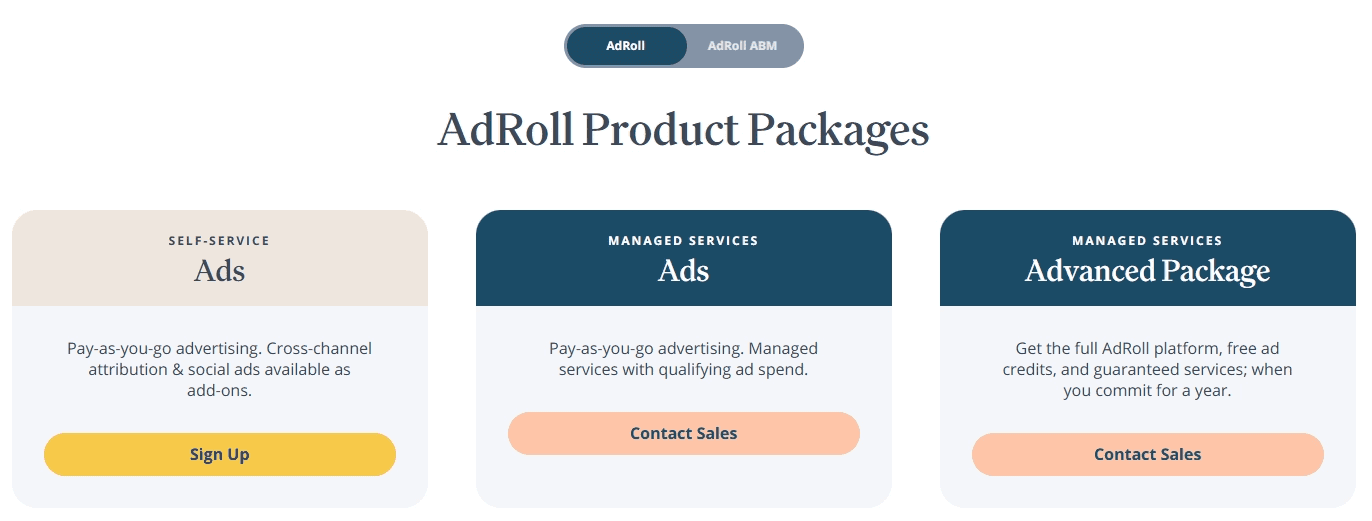
AdRoll ABM does not publish pricing for its ABM tiers. According to the G2 pricing page, "AdRoll ABM has not provided pricing information for this product." Third-party estimates from G2 reviews and procurement sources suggest a range of $12,000-$50,000/year for mid-market teams, but these figures are unverified and should be confirmed directly with AdRoll ABM. Monthly contracts are available, which is a differentiator for teams that want to test the platform before committing annually.
Best for: HubSpot-native B2B SaaS companies with €2M-€30M ARR testing ABM for the first time, or scaling an existing program without the RevOps function required to run 6sense or Demandbase.
HubSpot Marketing Hub, best for teams already on HubSpot Enterprise that want ABM without adding a platform
HubSpot Marketing Hub does not position itself as an ABM platform. It is a marketing automation platform with a set of ABM-specific features built into the Enterprise tier that are good enough for focused programs against 50 to 200 target accounts without adding a standalone ABM tool to the stack.
The argument for HubSpot Marketing Hub in an ABM context is entirely practical: if your team is already on HubSpot CRM and HubSpot Marketing Hub Enterprise, the ABM features cost nothing incremental, require no new integration, and are accessible inside the interface your team already uses every day.
Those features include target account dashboards for tracking engagement across named companies, company scoring built on HubSpot's behavioral and firmographic data, buying role tracking to map contacts to their position in the buying committee, and account-level reporting that connects marketing activity to pipeline movement.
For teams new to ABM, HubSpot is the lowest-friction entry point: you can designate target accounts, set account-level goals, and execute ABM campaigns without adding a separate platform to your stack. The Clearbit acquisition (now Breeze Intelligence) added a data enrichment layer, and Breeze AI agents handle prospecting and content workflows.
What HubSpot does not do: intent data at the depth of Bombora, buying-stage prediction at the sophistication of 6sense, or advertising execution at the reach of Demandbase. For teams that need those capabilities, HubSpot's ABM features are a starting point, not a destination.
Starting price | Bundled into Marketing Hub Enterprise at $3,600/month, including 5 seats and a $7,000 one-time onboarding fee |
Free trial | Free CRM with limited Marketing Hub features |
G2 rating | 4.4/5 from 14,000+ reviews (Marketing Hub) |
Best for | Teams on HubSpot Enterprise that want account-based features without adding a new tool |
CRM integration | Native; HubSpot CRM is the platform |
Intent data | Breeze Intelligence (Clearbit acquisition); more limited than dedicated providers |
Skip if | You need deep intent data, AI-driven account prioritization, or advertising capabilities beyond what HubSpot natively supports |
HubSpot Marketing Hub key features
Target account functionality for designating named companies as ABM targets, with company-level tracking across all HubSpot marketing and sales activity
Company scoring combines firmographic data, behavioral signals, and custom properties to rank target accounts by engagement level and ICP fit
Buying role tracking for mapping contacts to their role in the buying committee (decision-maker, influencer, champion, blocker), visible in the company timeline
Account-level reporting in HubSpot dashboards, connecting email, content, ad, and sales activity to company pipeline stages
Breeze Intelligence enrichment layer adding firmographic and technographic data from Clearbit's database directly to HubSpot company records
Native LinkedIn Ads integration for running account-matched advertising from inside HubSpot without a separate platform
HubSpot Marketing Hub pros
Zero incremental cost for teams already on Marketing Hub Enterprise; the ABM features are included, not add-ons
No new integration, no new tool to learn, and no CRM sync to configure; everything runs inside HubSpot, which is where the team already works
Fastest time-to-first-campaign of any tool in this review; activating ABM features on an existing HubSpot account takes hours, not weeks
Company scoring and buying role tracking are genuinely useful for teams moving from lead-based to account-based thinking without needing to learn a new platform
HubSpot's roadmap has been consistently adding ABM capability since the Clearbit acquisition; the feature set in 2026 is meaningfully stronger than it was in 2023
HubSpot Marketing Hub cons
ABM motion is less rigorous at enterprise scale than purpose-built ABM platforms; Breeze Intelligence's data layer is smaller than dedicated B2B data providers, and there is no native conversation intelligence
Intent data is limited to Breeze Intelligence signals and LinkedIn behavior; Bombora-depth topic surge data is not available without adding a separate provider
No AI-driven buying-stage prediction; account scoring is rules-based and requires manual configuration to produce reliable prioritization
Advertising reach is limited to what HubSpot's native LinkedIn integration covers; programmatic display and connected TV advertising at account-matched audiences require a separate tool
The Enterprise tier requires a $7,000 one-time onboarding fee, which reduces the cost advantage for teams that are not already paying for Marketing Hub Enterprise
HubSpot Marketing Hub pricing
Marketing Hub Enterprise runs $3,600/month billed annually, includes 5 seats, and requires a $7,000 one-time onboarding fee. The ABM features are included at this tier with no incremental cost. For teams not already on Marketing Hub Enterprise, the cost needs to be evaluated against adding a purpose-built ABM platform like AdRoll at a comparable annual cost.
Best for: B2B SaaS teams already on HubSpot CRM and Marketing Hub Enterprise that want to run focused ABM programs (50-200 target accounts) without adding a new platform, integration layer, or RevOps complexity to manage.
Bombora, best for enterprise teams that need the deepest standalone intent data layer
Bombora is the data infrastructure that powers most of the ABM industry. When 6sense surfaces intent signals, it is pulling from Bombora's data alongside its own. When Demandbase shows topic surge data, Bombora is part of the signal. When AdRoll runs account scoring from Bombora Company Surge, the data is Bombora's. Understanding Bombora clearly matters: it is not an ABM platform, and evaluating it as one produces the wrong buying decision.
Bombora operates a consent-based co-operative of more than 5,000 B2B publisher sites that share anonymized content consumption data under direct data agreements. The result is a proprietary signal network that competitors cannot replicate: 86% of Bombora's publisher data is exclusive to the platform. Company Surge®, Bombora's core product, identifies when a company's research activity on a given topic spikes above its historical baseline, signaling active in-market behavior. The platform covers 13,000+ topic categories across industries.
The right question when evaluating Bombora is whether to buy the data directly or access it through a platform that already embeds it. Most ABM teams do not need to buy standalone Bombora because they already have the data through 6sense, ZoomInfo, or AdRoll. Standalone Bombora is the right choice when your team needs granular topic control, direct API access, or the raw signal data to build custom workflows that a pre-packaged platform does not support.
Starting price | $25K-$30K/year; most mid-market companies pay $50K-$100K/year |
Free trial | No free tier, no self-serve trial |
G2 rating | 4.4/5 from ~200 reviews |
Best for | Enterprise ABM teams with mature operations that need raw intent data for custom workflows, or teams not already accessing Bombora through another platform |
CRM integration | Native Salesforce and HubSpot via AppExchange; Marketo, Eloqua |
Intent data | Company Surge® across 13,000+ topics, 5,000+ publisher sites |
Skip if | You already access Bombora data through 6sense, ZoomInfo, or Demandbase; buying it directly means paying twice for the same signal |
Bombora's key features
Company Surge® data tracking content consumption across 5,000+ B2B publisher sites, identifying when a company's research activity on a given topic spikes above historical baseline. This is the dataset powering most of the enterprise ABM industry
13,000+ topic categories covering B2B technology, financial services, healthcare, manufacturing, and other verticals, with granular subtopic specificity that broader platforms do not match
Bombora Insights Suite combines Market Insights (TAM sizing, intent trends, competitive intelligence), Visitor Insights (de-anonymized site traffic enriched with firmographic and intent data), and B2beacon (campaign performance across accounts and buying group personas)
Direct API access to raw surge scores and topic data for teams building custom scoring models, outbound triggers, or integration into proprietary tooling
Native CRM integrations with Salesforce (via AppExchange), HubSpot, Marketo, and Eloqua, routing surge alerts and scores directly into existing workflows
Consent-based data collection through direct publisher agreements, with SOC 2 Type II certification and formal Data Processing Agreements for EU customers requiring GDPR documentation
Bombora's pros
The gold standard for B2B intent data: Company Surge signals are the most widely adopted intent dataset in the market, powering features in dozens of platforms
Topic taxonomy granularity is deeper than any platform-native intent solution; 13,000 topics with narrow specificity ('cloud security for healthcare') versus broad clusters ('cloud security') produce significantly fewer false positives
The cooperative model means the data is genuinely proprietary; competitors cannot replicate the publisher network because the agreements are exclusive
For enterprise teams with a data team or RevOps function, direct API access enables custom scoring models and workflow logic that pre-packaged platforms do not support
CRM integrations are mature; surge data flows directly into Salesforce or HubSpot without middleware
Bombora's cons
Teams already accessing Bombora data through ZoomInfo, 6sense, or other platforms get 80% of the value at a lower total cost through those integrations. Buying a standalone Bombora on top of an existing platform means paying twice for the same signal
Company-level only: Bombora identifies which companies are researching a topic, not which individuals at those companies are doing the research; a separate contact data provider is required to act on the signal
No built-in activation layer; raw surge data needs to flow into a CRM, ABM platform, or sales engagement tool to become actionable; teams without RevOps support will struggle to operationalize the data
Annual contracts only, with no SMB tier and no monthly billing; $30K/year floor plus auto-renewal clauses with 60-90 day cancellation windows are standard
Meaningful pipeline impact generally requires 60-90 days of active use as teams calibrate topic selection and activation workflows; the platform does not produce results the week you connect it
Bombora's pricing
Pricing starts at $25,000-$30,000/year for standalone Bombora, with most mid-market teams paying $50,000-$100,000/year once topic coverage and data volume are sized for a real program. There is no free trial and no self-serve access. According to third-party procurement data, multi-year discounts of 10-22% are achievable: approximately 10-15% for 24-month commitments and 18-22% for 36-month commitments.
Best for: Enterprise B2B marketing teams running mature ABM operations who need the raw intent signal for custom scoring models or activation workflows, and who are not already accessing Bombora data through 6sense, Demandbase, or ZoomInfo.
Clay, best for RevOps teams building a custom ABM stack from components
Clay is not an ABM platform, and understanding this distinction up front saves teams from evaluating it against tools it was not built to compete with. Clay is a workflow orchestration tool that connects to 150+ data providers (Apollo, ZoomInfo, Bombora, LinkedIn Sales Navigator, Lusha, Clearbit, and dozens of niche enrichment sources) and lets teams chain them into custom data workflows via a spreadsheet-like interface.
The ABM use case for Clay emerges from this flexibility. A team that has defined their ICP and built a target account list can use Clay to enrich those accounts with firmographic data from multiple sources simultaneously, pull contact data from whichever provider has the best coverage for their target geography, layer Bombora intent signals from the marketplace, connect the results into HubSpot or Salesforce automatically, and trigger sequences in their outreach tool when accounts meet defined criteria.
Done properly, this replaces the "Bombora + ZoomInfo + contact enrichment + CRM sync" stack at a fraction of the cost, while giving technical RevOps teams more control over the logic than any pre-packaged platform allows.
Clay's March 2026 pricing overhaul cut data marketplace costs by 50 to 90% and moved CRM sync down to the Growth plan, making the platform significantly more accessible for mid-market teams. The trade-off is that Clay requires someone who can build and maintain workflows. This is not a tool for a single marketer who wants to activate ABM without engineering support.
Starting price | $143/month (Starter); $314/month (Explorer); $720/month (Pro, includes CRM sync) |
Free trial | Free plan with limited credits |
G2 rating | 4.6/5 from 220+ reviews |
Best for | RevOps teams and technical marketers building custom enrichment and activation workflows, particularly for new market entry where off-the-shelf targeting models need calibration |
CRM integration | HubSpot and Salesforce (bidirectional, at Growth tier) |
Intent data | Available via marketplace (Bombora, G2 Buyer Intent); separate credit spend |
Skip if | You do not have a RevOps function or someone technical enough to build and maintain workflows |
Clay's key features
150+ data provider integrations accessible from a single platform, with waterfall enrichment logic that queries providers in sequence and fills from the next source when the first misses
AI-powered research using Claude, GPT-4, and Perplexity to research companies and contacts at scale, summarizing LinkedIn activity, funding news, recent company changes, and other signals that structured databases do not capture
Custom workflow builder enabling teams to define enrichment sequences, scoring logic, and CRM sync rules without code, though a RevOps mindset is required to build workflows that do not break
CRM sync available at the Pro tier ($720/month), connecting Clay tables directly to HubSpot or Salesforce with field mapping, deduplication logic, and trigger conditions
Intent data marketplace integrations including Bombora Company Surge and G2 Buyer Intent as purchasable add-ons in the data marketplace
Waterfall enrichment that outperforms single-source contact databases on email coverage; because Clay queries multiple providers in order, the coverage rate on verified emails exceeds what any single database achieves
Clay's pros
The flexibility to combine any data provider in any sequence means Clay adapts to whatever your target market requires, rather than the team adapting to the platform's coverage model
AI research capabilities surface contextual signals (recent news, job posting changes, LinkedIn activity) that structured intent data cannot capture; for teams entering new markets where behavioral intent data is sparse, these qualitative signals are often the best early indicators of in-market activity
Cost structure is genuinely more efficient than enterprise ABM platforms for teams with the technical capacity to build workflows
CRM sync at the Pro plan ($720/month) makes the full workflow accessible to mid-market teams without the $50K+ minimum that most purpose-built enterprise ABM platforms require
4.9/5 G2 rating from practitioners reflects genuine user satisfaction from the teams Clay was built for; high ratings from RevOps professionals are a stronger signal than high ratings from marketers who use the platform for a different purpose
Clay's cons
Not a platform; there is no account scoring dashboard, no buying-stage model, no advertising capability, and no out-of-the-box ABM workflow; what Clay delivers is the data layer that feeds those capabilities in other tools
Requires technical RevOps ownership; a workflow built without enough thought about deduplication logic, CRM field mapping, and data governance will create problems downstream that are harder to fix than starting over
Credits consumed by data marketplace providers are separate spend on top of the platform fee; a team running high-volume enrichment against a large account list can exceed credit allocations faster than expected
No native intent data or predictive modeling; intent signals must be purchased separately through the marketplace and integrated into custom logic
The learning curve is real; Clay requires understanding how provider waterfall logic works, how to structure enrichment sequences, and how to write AI research prompts that produce consistent output
Clay's pricing
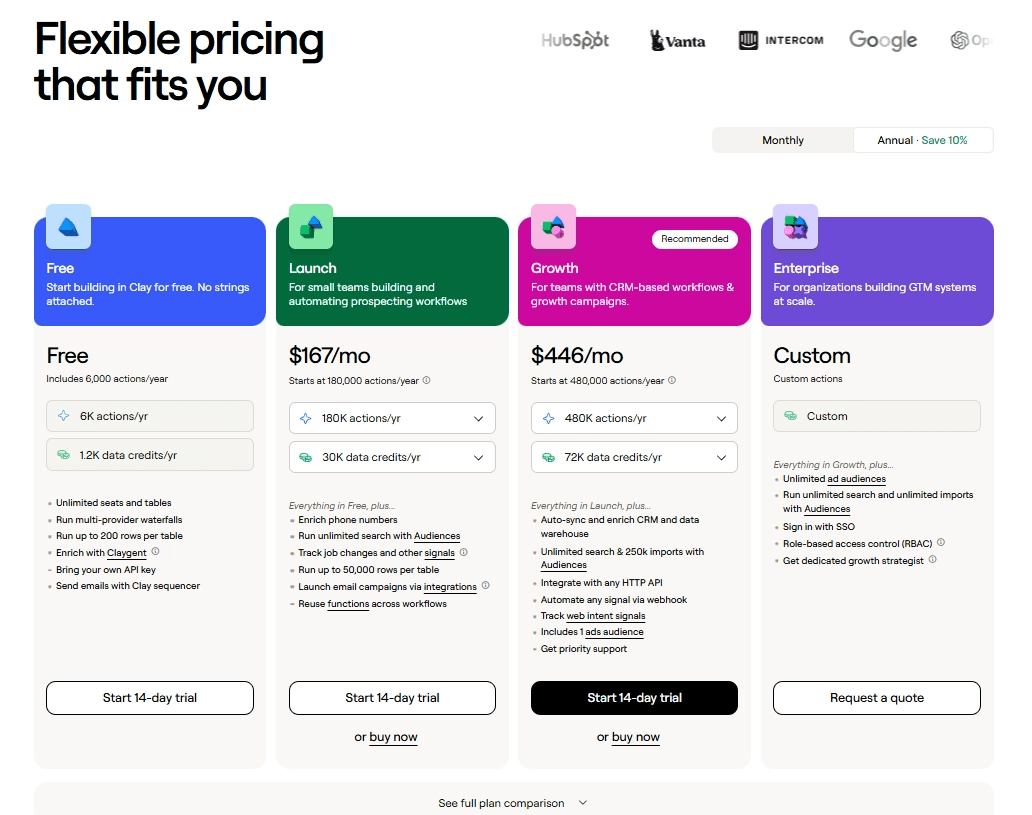
Clay's pricing, as reported on the G2 pricing page, starts at $143/month (Starter) with limited data credits, $314/month (Explorer) with webhooks and API access, and $720/month (Pro) with CRM sync included. Enterprise tier pricing is custom. Verify current pricing at clay.com before contracting, as pricing has changed multiple times in 2025-2026.
Best for: RevOps teams and technical marketers at B2B SaaS companies building custom account enrichment, targeting, and activation workflows. Particularly valuable for teams entering new geographic markets where off-the-shelf intent data and pre-built account scoring models have limited coverage for the specific ICP profile.
If you want to see what Clay’s marketing and sales tactics are, read them here.
How do these 6 account-based marketing tools compare?
Tool | Best for | Pricing | Intent data | Requires RevOps? |
|---|---|---|---|---|
6sense | Predictive buying-stage intelligence | $60K-$250K+/year | Proprietary Signalverse, 1T+ daily signals | Yes, dedicated |
Demandbase One | Advertising-led ABM with native DSP | $50K-$200K+/year | First + third-party, 575K+ topics | Yes, dedicated |
AdRoll | HubSpot-native teams, first ABM programs | $13K-$60K/year | Bombora (licensed) | No |
HubSpot Marketing Hub | Teams already on HubSpot Enterprise | Bundled at ~$3,600/month Enterprise | Breeze Intelligence (Clearbit) | No |
Bombora | Raw intent data for custom workflows | $25K-$100K/year | Proprietary, 13K+ topics, 5K+ publisher sites | Yes |
Clay | Custom enrichment and activation workflows | $167-$800+/month | Marketplace (Bombora, G2); separate cost | Yes (technical) |
The pattern we can see in this comparison tells us an interesting story that so mamy account-based tool for B2B tech evaluations miss.
Budget and team size determine the first cut: HubSpot if you are already on Enterprise and want the lowest friction; AdRoll if you are HubSpot-native and under €30M ARR; 6sense or Demandbase if you have the budget, the RevOps function, and the account volume to justify enterprise platform costs.
Use case determines the second cut: 6sense if your motion depends on identifying in-market accounts before they raise their hand; Demandbase if advertising is central to your account warm-up strategy; Bombora only if you need raw signal data and are not already accessing Bombora through one of the platforms above.
Team capability determines the third cut: Clay only if you have a RevOps function capable of building and maintaining custom workflows. The G2 rating is 4.9 for a reason, and it is not because Clay is easy for everyone.
The question that matters more than which tool you pick
Every ABM vendor will tell you the right time to start ABM is now. The honest answer is more conditional and contextual. Oh, no, what a surprise. :))
ABM tooling generates results when the system underneath it is clear:
you know which accounts you are going after
why those accounts are in your ICP
what problems your product solves for them in the specific market you are entering
how your sales team will act on the signals the tool surfaces
Without that amazing clarity, the tools, free or very expensive, enterprise, engagement, orchestration, and anything in between will only surface signals that nobody ever acts on, while advertising reaches accounts that are not in your ICP, and the reporting shows engagement numbers that never connect to the marketing & sales results. The problem gets reported as "account-based marketing doesn't work for us" and the vendor gets blamed for what was always a go-to-market architecture problem.
Frequently asked questions
What is account-based marketing and how does it differ from demand generation?
Demand generation casts a wide net and captures whoever responds. ABM inverts that: you define a specific list of target companies first, then concentrate every marketing and sales action on moving the buying committees at those accounts toward a decision. Demand gen optimizes for lead volume. ABM optimizes for account penetration. For B2B companies with long sales cycles, high deal values, and buying committees of three or more, ABM produces better unit economics because the effort concentrates on accounts that can actually buy.
What is intent data and do I need it to run ABM?
Intent data is a behavioral signal from across the web showing when a company's employees are actively researching a topic related to your product. Bombora, the largest provider, aggregates this from 5,000+ B2B publisher sites. When research activity on a topic spikes above a company's historical baseline, it signals an active buying cycle.
You can run ABM without it, using firmographic targeting and first-party website data instead. But intent data changes the prioritization: instead of treating every account on your list equally, you concentrate spend on the accounts researching right now. For large target account universes, that distinction determines whether the program pays off.
How much does ABM tooling cost in 2026?
Bombora starts at $25,000-$30,000/year for standalone intent data. AdRoll starts at $13,000/year. 6sense and Demandbase typically start at $50,000-$60,000/year and climb past $200,000 with advertising modules. HubSpot Marketing Hub Enterprise bundles ABM features at approximately $3,600/month. Clay starts at $167/month.
Platform fees are only part of the budget. Enterprise implementations add $25,000-$50,000 in onboarding costs. Advertising spend is separate. And most enterprise platforms require dedicated RevOps headcount to operate, which, at smaller organizations, often exceeds the platform cost.
Is HubSpot enough for ABM, or do I need a dedicated platform?
For programs targeting 50 to 200 accounts where you already know who to target, HubSpot Marketing Hub Enterprise is enough, provided you are already on it and do not want another integration to manage.
Where it falls short is in intent data depth and AI-driven prioritization. If your motion depends on identifying in-market accounts before they raise their hand, HubSpot's Breeze Intelligence does not match Bombora's topic coverage or 6sense's buying-stage prediction. If you already know the list and need coordinated campaign execution, HubSpot covers it.
How long does it take to see results from an ABM program?
Engagement metrics move within six to eight weeks when messaging and targeting are right. Pipeline contribution takes a full quarter minimum, and clean attribution typically requires two quarters. Practitioner data points to first qualified meeting timelines of 27 to 46 days from launch, with account-to-opportunity conversion of 9 to 17% in well-run programs.
The 30-to 60-day signals to watch are account engagement rate, buying committee coverage in your CRM, and intent signal movement on target accounts. If none of those are shifting after eight weeks, the issue is targeting or messaging, not the platform.
Does ABM work for companies entering a new geographic market?
It works but requires recalibration before launch. The targeting model, intent data, and messaging from your home market will not transfer without adjustment.
Intent data is the specific risk. Behavioral signals are built on historical patterns from established markets. A company that is unknown in a new geography has no behavioral history there, so intent-led prioritization is less reliable in the first six to twelve months. Account selection in new markets should lean on firmographic ICP fit and explicit trigger signals (funding rounds, hiring activity, public expansion statements) over intent topic surge scores.
Proof requirements and trust signals also differ between markets. What lands with a buyer who already knows your company will miss with a buyer evaluating you against local alternatives they already trust.
What is the minimum setup required to run ABM?
HubSpot and AdRoll can each be owned by a single marketer. For AdRoll, one person can run the full implementation and ongoing management without RevOps support.
6sense, Demandbase, and Clay each require someone whose job is the platform. For 6sense and Demandbase, that means a dedicated RevOps owner who configures account scoring, maintains CRM data quality, and routes signals to sales. Without that person, the platform produces dashboards that nobody acts on. For Clay, it means someone with technical RevOps capability who can build and maintain custom workflows without creating data problems downstream.
What is the difference between 1:1, 1:few, and 1:many ABM?
1:1 is fully custom treatment for each named account: bespoke content, custom research, coordinated executive outreach. Reserved for 10 to 50 highest-value targets where one deal changes the quarter.
1:few clusters accounts by shared industry or use case and build semi-customized campaigns per cluster. Personalized at the segment level, not the account level, which makes 10 to 100 accounts manageable without custom creative for each.
1:many runs lightly personalized campaigns at hundreds or thousands of accounts using technology, with personalization limited to industry-specific messaging and account-matched advertising. This is where ABM platforms justify their cost: without tooling, 1:many is not executable at volume.
Effective programs in 2026 run all three tiers simultaneously, concentrating the most intensive treatment on the highest-value accounts and using programmatic approaches for the broader list.