Marketing spotlight
/
Marketing Spotlight: Mapping Fresha's Marketing and Sales Tactics
This article looks at how Fresha runs its marketing & sales tactics with the authenticity of a close-knit community brand.
Key Takeaways for Fresha's sales & marketing strategies
🎀 This section gives you the main insights without all the details. It’s the stuff you need to remember, whether you’re reading this now or in 6 months. We made this for people who want to get the core message fast.
Fresha is the booking and business management platform behind more than 130,000 salons, spas, and barbershops worldwide. This article looks at how a company that just raised $80 million from KKR and hit a $1 billion valuation still runs its social channels with the warmth and authenticity of a close-knit community brand.
Its Instagram strategy runs almost entirely on hairstylist and barber creator collaborations rather than brand-produced content, and the creator posts consistently outperform anything Fresha posts alone.
TikTok content is built specifically for that platform, trend formats, comedic bits, street interviews, rather than recycled from Instagram or Facebook, and that's exactly why it works.
Google Search ads are promoting individual salons by name, at massive scale, in multiple languages, generated automatically from the marketplace's own listing data.
YouTube splits cleanly into two jobs. Shorts are built for discovery and the long-form library is built to convert, instead of running one undifferentiated feed.
Instagram's bio link routes every post to its own landing page instead of one shared homepage, turning a single allowed link into as many destinations as there are posts.
📝 A quick note before you start reading: The data and analysis in this article are valid as of the time we wrote it. We don’t know when you’ll be reading this, maybe next week, maybe six months from now, and things might have changed since we looked at this company’s marketing and sales approach. Still, the insights and lessons here stay useful, even if the numbers or tactics have evolved a bit.
Fresha is a booking platform for hair, beauty, and wellness businesses and a consumer app for the people who book with them. For a decade, its entire pitch to salon owners was that the software cost nothing. That pitch is why it grew. It's also, as of 2025, no longer entirely true, and that gap between reputation and reality is the most interesting thing happening in Fresha's marketing right now.
At Milk and Cookies Studio, we spend our time reverse-engineering how B2B and marketplace companies grow, so a platform that quietly changed its core pricing promise while its social content still leans on street-style videos and hairstylist shoutouts is worth a close look.
Fresha just raised $80 million from KKR, crossed a $1 billion valuation, and is hiring aggressively across commercial roles. None of that shows up in the tone of its Instagram or TikTok. That mismatch, and what it teaches about scaling a brand's story alongside its business model, is what this article covers.
Understanding Fresha
Fresha was founded in 2015 by William Zeqiri and Nicholas Miller. It launched under the name Shedul before rebranding to Fresha in February 2020. The company is headquartered in London, UK, with additional offices in Ireland, the USA, Canada, Australia, Singapore, the Kingdom of Saudi Arabia, Hong Kong, and the UAE.
Fresha runs two connected products: a business management platform for salons, spas, and barbershops, and a consumer marketplace where people discover and book appointments. The platform now serves more than 130,000 partner businesses and 500,000 stylists and professionals, with over 1 billion appointments to date, according to its LinkedIn description.
In May 2026, Fresha closed an $80 million growth round led by KKR through its Next Generation Technology Growth strategy, bringing total funding raised to $285 million and valuing the company at over $1 billion. That made Fresha a UK unicorn. The round is Fresha's first institutional capital from a private equity firm rather than a venture fund, and the company says the money will go toward global expansion and AI investment.
William Zeqiri, Founder and CEO, called the milestone "a strong testament to the trust our partners place in Fresha every day."
Fresha's Brand Promise Analysis
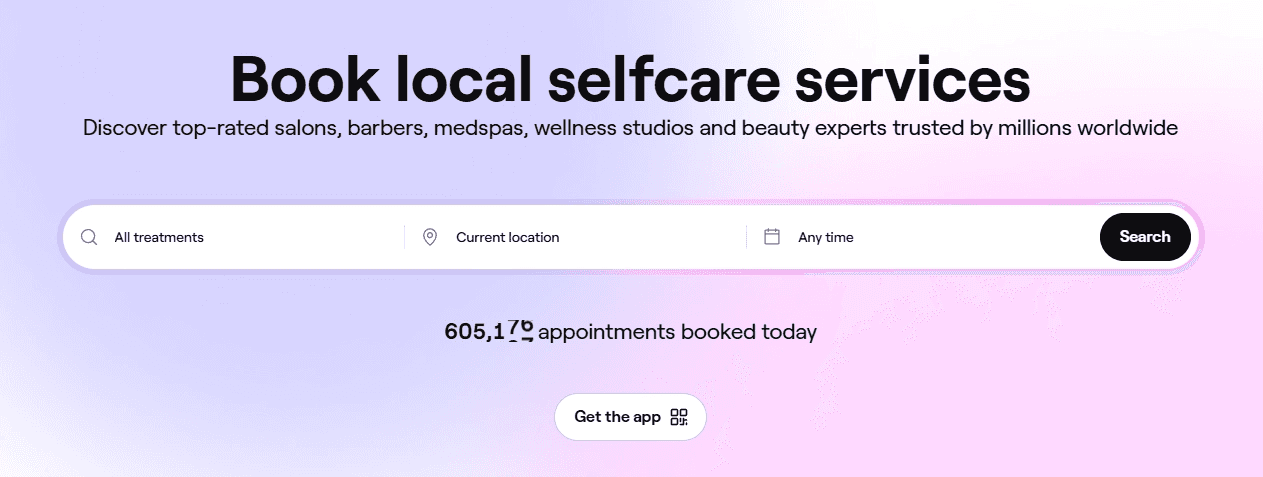
Fresha's homepage leads with "Book local selfcare services," a consumer-facing headline that undersells how much B2B infrastructure sits behind it. The for-business side of the site positions Fresha as "the world's top rated salon and spa software," with claims of being "independently voted no. 1 by industry professionals."
For most of Fresha's public life, its most important differentiator was the pricing: zero monthly subscription fee, ever. Dozens of third-party review sites, comparison articles, and even Fresha's own historical marketing repeated that claim as the platform's defining feature. It's what got Fresha into 130,000 businesses in the first place.
That changed in 2025. Fresha introduced paid subscription tiers, and the people are still not happy about it. Multiple review sites and forums, including threads from Canadian salon owners on Reddit, flagged the 2025 shift as a departure from what they'd signed up for.
A company can survive a pricing change. What's harder to survive is a public reputation that hasn't updated to match it, because every new business that signs up expecting the old free model is a business that will eventually feel misled, whether or not Fresha meant to mislead them.
Forrester's 2026 SaaS Transparency Study found that only 58% of buyers see complete pricing information before making a purchase decision, meaning the remaining 42% commit first and discover the real cost structure afterward. A business that signed up for Fresha expecting the old subscription-free story is exactly the buyer that research describes.
The positioning is broad and horizontal, aimed at any salon, spa, or barbershop regardless of size or vertical. That's consistent with a marketplace-led growth motion, where the goal is volume of partner businesses rather than targeted enterprise accounts. The risk is that a one-size-fits-all price story stops working cleanly once the pricing itself splits into tiers.
And yet, they’re still saying on the Business page that Fresha is the #1 software for Salons and Spas. Can that still be true, even if people moved from them to other platforms? Let’s see how they position right now, after the pricing change and after becoming a unicorn.
Fresha's Service and Product Breakdown
Fresha runs on two connected apps, and they sit on opposite ends of the pricing spectrum.
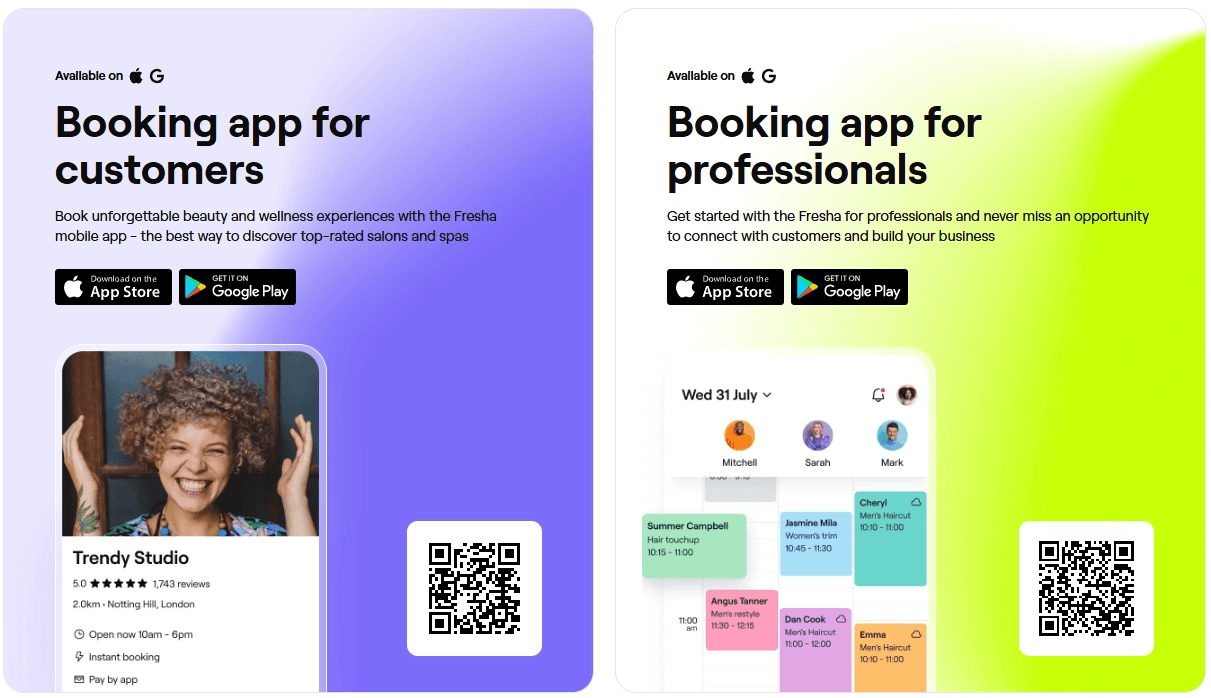
Fresha for Customers is the consumer-facing marketplace app for discovering and booking appointments. It's free to download and free to use. Rated 5.0 with 2.9K App Store ratings (#56 in the Lifestyle chart) and 5.0 across 106K Google Play reviews. Consumers pay the salon or stylist for the service booked, never Fresha directly.
Fresha for Business is the operator-facing management app, rated 5.0 with 144 App Store ratings and 4.8 across 8.5K Google Play reviews. This is the product that includes these pricing tiers:
Independent plan: $19.95/month, built for solo practitioners with one bookable team member
Team plan: $14.95/month per team member, unlocking advanced features like Team Pay, automated commission tracking, and marketing tools
Enterprise: custom-quoted pricing for larger, multi-location businesses
Each plan has extra costs. For online and in-person payments, there is a commission of 1.29% applied + 0.22$ per transaction, 128.68$ per terminal device used, 0.13$ for each marketing text sent, and so on. There are also paid optional add-ons like Client Loyalty, Google Rating Boost, Team Connect, Insights, Xero Accounting and Data Connector.
Fresha states that they’re designed to support businesses of all sizes, from independent professionals to larger teams and enterprise businesses with multiple locations. They offer flexible tools and features to suit your needs, including calendar management, marketing tools and team-specific functionalities.
They serve multiple businesses such as barber shops, hair and nail salons, beauty and cosmetology, and wellness, including spas, fitness, and therapy centers. But the process is not explained in detail, like their competitors do, where they add more migration timeline, data import, onboarding support, client history and records.
Fresha's Differentiators and Unique Assets
Fresha's biggest structural advantage over most SaaS competitors is the marketplace itself. Most salon software sells only to the business. Fresha also owns the consumer discovery layer, which means it can drive new client bookings to a salon directly through its own app, something a standalone POS or calendar tool cannot do.
Fresha's own marketplace page puts numbers behind that claim: businesses using the Fresha Marketplace see an average of 26% more clients and a claimed 392% return on investment, against a marketplace the company says reaches more than 25 million customers actively looking to book.
The commission model is also more specific than "new client fee" suggests: it applies only to a client's first-ever booking with a given business through Fresha, and any time that same client rebooks afterward, there's no commission at all, which makes the fee a one-time acquisition cost rather than an ongoing tax on the relationship.
The mechanism only charges when the platform actually delivers a new customer, so the cost is tied directly to the value received rather than to a flat fee owed regardless of outcome. That's the same logic behind the broader shift toward usage and value-based pricing across SaaS: buyers increasingly expect to pay in proportion to value received rather than a license fee negotiated once a year and owed no matter what happens afterward.
Gartner projects 70% of businesses will prefer usage-based pricing over flat per-seat models by the end of 2026, with usage-based SaaS companies already growing roughly 38% faster than peers on flat pricing. A new-client-only commission is a narrower, single-purpose version of that same principle: it removes the risk of a customer paying for a channel that isn't producing results, which tends to be the easiest part of a pricing model to defend to a buyer or a board.
The marketplace isn't limited to Fresha's own app either. The same booking infrastructure surfaces a business's availability directly inside Google Search results, Facebook business pages, Instagram profiles, and shareable direct booking links, so a client can book without ever opening the Fresha app at all.

Fresha also runs Fresha Academy, a structured, in-product learning hub built into its help center rather than hosted as standalone content on YouTube or elsewhere. It's organized into six modules that map directly onto the customer journey: Launch Your Workspace, Run Your Business, Get Booked Online, Accept Payments, Promote Your Business, and Pay Your Team.
Each module breaks into short video courses, for example, "Getting Started with Fresha" runs 9 lessons across 12 minutes. This functions as a structured onboarding and retention product. It's designed to shorten time-to-value for new signups and reduce support load, not to attract new audiences.
Companies with strong onboarding, meaning customers reach first value in under 7 days, see 50% lower churn than companies without it, across a dataset of 939 B2B SaaS companies. A six-module Academy that gets a new signup live within its first week is doing the single highest-leverage thing a SaaS company can do for retention.
The marketplace's new-client-only commission and its presence inside Google, Facebook, and Instagram results are the clearest GTM signals here. This is marketplace-led growth in a fairly pure form: acquisition is built into the product itself rather than run as a separate demand-generation motion, and the business only pays once the marketplace has already done its job. The model is horizontal by design, aimed at volume across many small accounts rather than targeted enterprise ones.
Fresha's Leadership Presence Analysis
William Zeqiri, Founder and CEO, has 15,600 LinkedIn followers and posts a few times a week. His activity is mostly reshares of Fresha company news with a few lines of personal commentary layered on top, rather than original long-form thought leadership.
When Zeqiri does post something that's actually his, not a repost, the register changes completely. His note marking Fresha's unicorn milestone read, in full effect, like a founder talking to a friend rather than a company issuing a statement. It reads nothing like the reshares sitting on either side of it in his feed.
We won't call the gap between his reshare habit and his rare original posts a missed opportunity, mostly because the data has already made that case better than a cliché could.
LinkedIn's own 2026 engagement data puts personal-profile content at a median engagement rate of roughly 4.7%, against 1 to 2% for company pages, and individual posts convert 2 to 5% of engaged viewers into marketing-qualified leads compared with 0.5 to 1% for company-page posts, a gap the underlying research attributes to LinkedIn's algorithm treating a named person as a more trustworthy signal than a brand account by default.
Fresha's Social Media Strategy

Fresha's LinkedIn
On LinkedIn Fresha has 85,000 followers and posts roughly once a week in a noticeably more corporate register: funding news, event participation, and hiring pushes rather than product storytelling. Posts mix video, single images, carousels, and photo dumps from events, with an average of around 100 reactions, 20 reposts, and a handful of comments per post. This is Fresha's most "serious" platform, the one built to attract businesses rather than users.
A LinkedIn company page with 50,000 or more followers typically converts into an engagement rate of somewhere between 1% and 3%, and most company pages sit under 1% specifically because they over-index on announcements rather than anything a follower would stop scrolling for.
A company-wide benchmarking dataset covering hundreds of B2B pages puts the median at 114 reactions per post, but that median comes from a benchmark group whose typical page has around 4,500 followers, not 85,000.
Fresha is pulling roughly the same raw reaction count as a company nineteen times smaller. It's the same pattern already visible in Zeqiri's own feed: the audience is there, but the page simply isn't asking much of it.
Employee-shared content on LinkedIn generates 5 to 10 times more engagement than the same message posted from the company page, which means the fastest fix here doesn't require a new content strategy so much as routing more of what already gets written through people instead of the logo.
Fresha's Facebook
On Facebook, Fresha has 42,000 followers and posts in irregular spikes, clusters of activity in July 2025, November 2025, April 2026, and June 2026, with quiet stretches in between. Engagement is thin, with low single or double-digit likes and comments per post.
Most of what runs here is repurposed from Instagram and TikTok, and that's a good call. Fresha's actual audience, both the clients booking appointments and the professionals running the businesses, skews toward the platforms where discovery is faster and more visual, so treating Facebook as a secondary feed rather than a primary content lane is the correct read of where attention already sits.
What makes it worth doing at all, rather than dropping entirely, is a stat that cuts against the assumption that Facebook is dead weight for a younger audience: even among Gen Z, the generation least likely to still be there, Facebook ranks as their second most-used platform for product discovery, trailing only TikTok.
A repost costs almost nothing to produce and still sits in front of a channel that, however diminished, hasn't actually gone quiet. The mistake would be spending the original production budget here. Recycling what already exists is the right level of effort for what this channel is still worth.
Fresha's Instagram
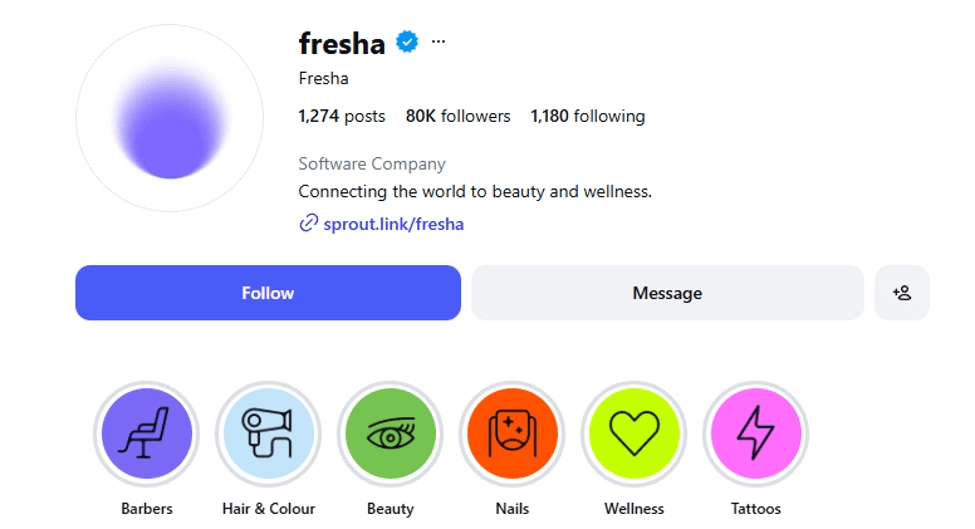
Instagram is the strongest channel by volume and consistency, with 80,000 followers, 1,274 posts, and posting close to daily. Engagement varies enormously, from just over 100 likes on some posts to more than 5,000 on others, and the difference almost entirely comes down to format: creator collaboration posts (co-authored with working stylists and barbers) consistently outperform anything posted from the Fresha handle alone.
They also have 6 highlights: Barbers, Hair & Colour, Beauty, Nails, Wellness and Tattoos. Each one speaks directly to their ideal customer profile on both sides. The link in bio, instead of pointing to the Fresha homepage, the way most comparable businesses set up their one allowed Instagram link, points to a sprout.link page, which rebuilds the Instagram grid as a clickable replica: every image becomes its own link, routable to a different destination depending on what that specific post is about.
Instagram gives every account exactly one clickable link, so a tool that turns one link into as many landing pages as there are posts is an interesting workaround. Optimized link-in-bio setups like this one convert 25 to 40% better than a basic single-link setup, precisely because the destination matches the content someone just finished looking at instead of dumping everyone onto the same generic homepage regardless of what they clicked through from.
Fresha's TikTok account
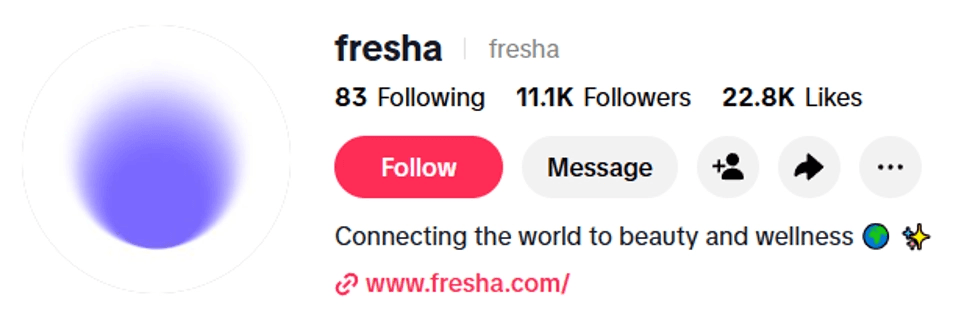
Fresha’s TikTok account has 11,100 followers and posts multiple times a month, built around street-interview and reaction-style UGC, like asking passersby for haircut opinions, hairstylist controversial takes, and client-stylist interview formats. It's the smallest channel by follower count and arguably the most on-brand in tone.
Unlike Facebook, this content is not recycled from elsewhere. Almost every video is produced specifically for TikTok, including trend-driven and comedic formats that don't appear on any other Fresha channel. That distinction shows up in the numbers: native content built for a platform's specific format and culture performs roughly three times better than repurposed content lifted from another channel, because it fits how that platform's audience actually watches rather than reading as an import.
The account is organized into five playlists, each with a distinct job. Hidden Gems tours individual salons. Transformations show before-and-after results mapped to the same categories used in the Instagram Highlights (barbers, nails, colour, and so on). Expert Edits is a recurring interview series with hairstylists and nail technicians sharing advice and trend calls.
Ratings have technicians and stylists reacting to and rating haircuts and trends from their own field. Fresha for Business is the odd one out: a straightforwardly commercial playlist where users talk about the app and its benefits, sitting alongside four playlists that never mention the product by name.
Fresha's YouTube Account
On their YouTube channel, Fresha has 6,000 subscribers, 196 videos, and 1.13 million total views, but its top-performing content by view count is roughly a year old, polished brand-awareness spots with comments disabled. Current uploads are largely covering Fresha Academy training content and partnership recaps, but they draw little engagement, which is to be expected if you turn off the comment section.
The channel splits into two deliberately different jobs. Shorts are built specifically for the platform's own algorithm, in recurring series like Fresha Spaces, Fresha Asks, and Boss Your Business, and they carry real commercial intent, turning viewers directly into customers rather than just building awareness.
This is what Shorts are for on YouTube in 2026: a low-friction discovery layer that reaches people who have never heard of the channel, separate from and algorithmically independent of long-form performance.
Channels that run both formats together grow their subscriber base roughly three times faster than channels running only one, with total watch time increasing 2.5 times in the first year, because Shorts do the discovery work that long-form video, on its own, is too slow and too high-friction to do at scale.
The long-form side is where that discovery traffic is meant to land and convert. Academy content is broken into eleven distinct modules covering the practical mechanics of running the platform: Getting Started, Taking Sales, Explore Payments, Overview: Pay Your Team with Fresha, Reward Loyal Clients, Manage Your Clients, Accept Online Bookings, Master Your Calendar, Schedule Appointments, Create Your Professional Profile, and Create the Ultimate Services List.
Outside the Academy, the channel is further segmented by business vertical:
Massage and Spa
Beauty Salons and Aesthetics
Barbershops
Hair Salons
Meet the Partners
Together, the two structures point to the same goal from opposite ends of the funnel: Shorts pull in someone who has never used Fresha, and the moment they're curious enough to look past a 30-second clip, the long-form library is already organized by exactly the kind of business they run, so the next video they land on speaks to their specific situation instead of a generic pitch.
Line up all six platforms and a pattern emerges that has nothing to do with follower count. LinkedIn, the single largest audience Fresha has anywhere, gets the least ambitious treatment of any channel. Instagram and TikTok, the two platforms with real infrastructure built underneath them (a rebuilt bio link, purpose-made playlists, content nobody else gets), punch furthest above their follower counts.
Facebook is playing a secondary role instead of pretending otherwise, but their choice not to crosspost is worth a discussion. YouTube runs an actual two-stage funnel, discovery on one side, segmented conversion on the other. We couldn’t get our hands on why the X sits locked or the YouTube comment section is turned off.
There are mismatched strategies that, on the surface, don’t connect the dots. The channel with the most people watching is the one being run with the least intention, and the smallest channel by far, TikTok, is the one getting purpose-built content nobody else receives. Probably after the recent funding we will see a change on their social media channels strategy, but as for now, they seem to run with the platform specific content.
💡 Steal This: Don't chase the same content strategy across every platform. Let each channel's native format dictate the content, polished on YouTube, professional on LinkedIn, raw on TikTok, and resist the urge to cross-post the same asset everywhere just because it's efficient.
Top-Performing Content
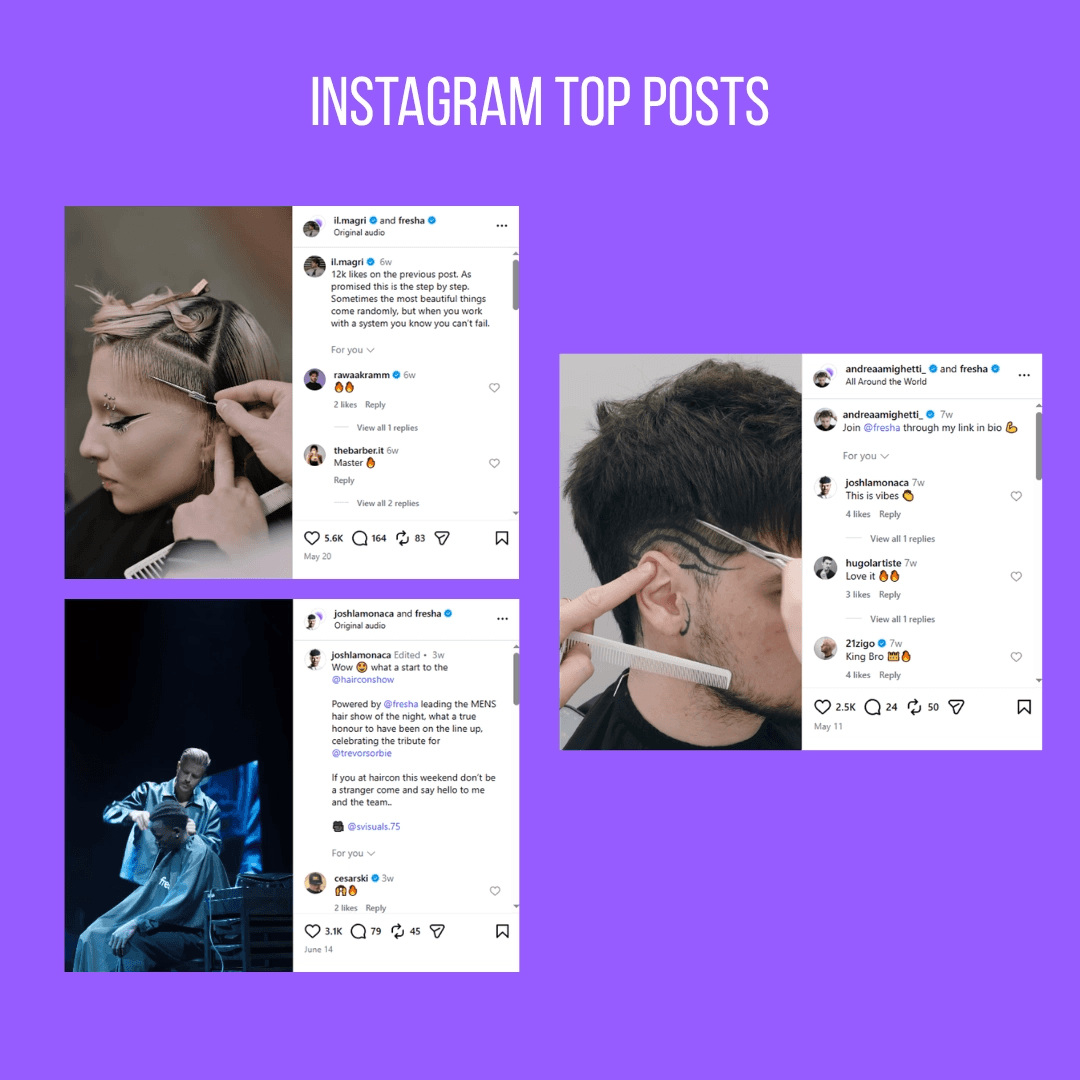
Instagram's clearest winner in the last three months was a step-by-step styling tutorial posted by creator @il.magri in collaboration with Fresha, pulling 5,600 likes, 164 comments, and 83 reposts. Close behind was a HairCon tribute post from stylist @joshlamonaca, at 3,100 likes and 79 comments. A third notable post came from creator @andreaamighetti_, whose caption read simply "Join @Fresha through my link in bio," collecting 2,500 likes on what is effectively an affiliate-style acquisition post with zero product framing.
On TikTok, the top three posts in the same window were all in the street-interview format: a "last thing you expect someone to say" clip (30,600 views, 933 likes), a "corporate mullet era pending" bit (23,600 views, 414 likes), and a "would you say yes to this haircut" clip (26,600 views, 164 likes). None of these mention Fresha's product directly, but you can’t read it between the lines.
The common thread across both platforms: the best-performing content treats Fresha as a backdrop to a person's story, a stylist's craft, a client's reaction, a creator's personality, rather than the subject of the post. Video content in general converts 49% better than static formats, which explains part of why Fresha's short-form video work is carrying so much of the engagement load on its own.
YouTube inverts the pattern seen everywhere else. Its top videos by raw view count, a set of brand-awareness spots from roughly a year ago (169K, 160K, and 147K views respectively), have comments disabled and were never designed to be interacted with, only watched. Due to the commercial tone, they are probably used as visuals for ads.
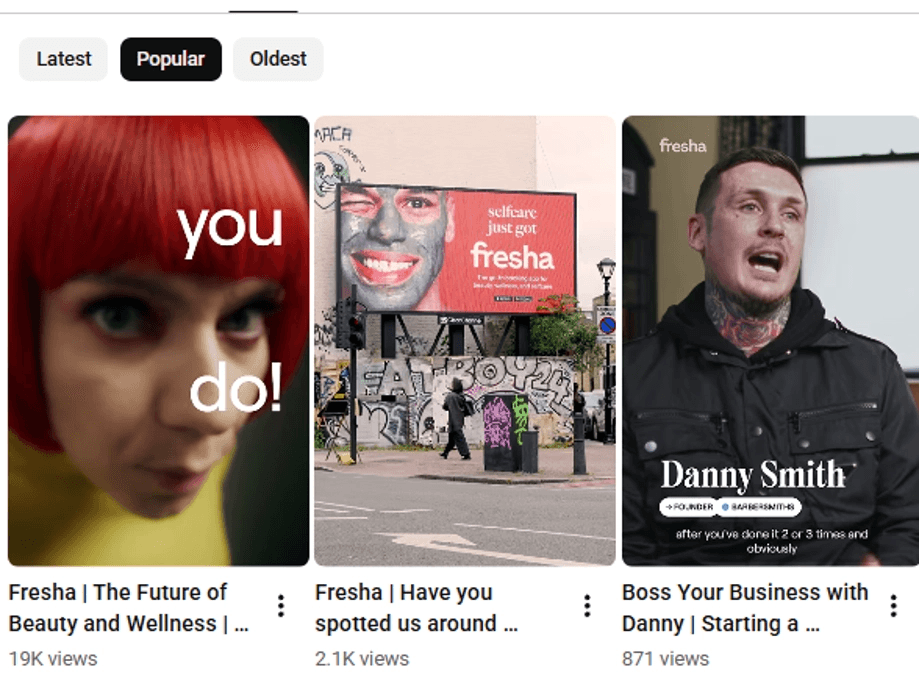
Among the newer Shorts, "The Future of Beauty and Wellness" leads at 19K views, followed by an out-of-home billboard callout ("Have you spotted us around...") at 2,100 views and a founder-story Short with Danny Smith of Barbersmiths at 871 views.
Compared to Instagram and TikTok, where the best content is built with creators and barely mentions the product, YouTube's best-performing material is almost entirely brand-produced and comment-free, a pattern much closer to traditional advertising than to anything else in Fresha's social presence.
LinkedIn's clearest winner by a wide margin was the unicorn announcement itself: the $80 million KKR round and the crossing of a $1 billion valuation, pulling 578 reactions, 20 comments, and 117 reposts.
A "1 million monthly downloads" growth-stats post placed second (169 reactions, 31 reposts), and an internal culture post, "Fresha's Got Talent," a company talent show, placed third (158 reactions, 6 reposts). The pattern holds here too: the post that performed best wasn't a product story. It was the biggest, most human-sounding piece of company news Fresha had all year, dressed as a personal milestone rather than a press release.
The average post that leans on a creator's own voice and audience outperforms a brand-only post by a wide margin, and hybrid influencer-affiliate formats, blending awareness content with a direct action prompt, are emerging as the strongest-performing model across categories in 2026.
Is important to mention that even if the price changed last year, people are still talking about it on social media and review platforms. But on Fresha’s pages, we couldn’t find any content that educates people about the price change. They just rolled with it, not answering to any of the claims online.
That teaches us an important aspect of online communication. If you make a big change around pricing, values, and anything that can be important to the people who are actually buying the product, you should announce it, even if you soft launch. People are using more and more social media as the new Google to find honest reviews. If they could only find people who are not happy with your change, they would be reluctant to buy it, especially if you don’t mention it, address it, or respond to any of the slander that is happening online about your brand.
Businesses that respond to reviews, positive and negative alike, earn up to 18% more revenue than businesses that stay silent, according to research jointly attributed to Google and Wiser Review. A separate industry report from LocalImpact, based on data from over 400 businesses, found that 60% of business owners now reply to both positive and negative reviews as standard practice.
Fresha's Paid Advertising Strategy
Fresha runs no active ads on Meta or TikTok. Its entire paid presence sits on LinkedIn and Google.
On LinkedIn, Fresha runs just six ads. Most are recruitment-focused, "explore jobs at Fresha that match your skills," a push to hire 50 Business Development Executives in London, plus a generic page-follow ad and an event recap for JEC 2026. LinkedIn, for Fresha, is functioning as a recruiting channel with a marketing budget.
Google is where the real weight of Fresha's paid budget is, running across four ad surfaces (Google Play, Shopping, Search, and YouTube) in service of four distinct jobs: app installs, B2B software marketing, generic consumer intent capture, and a per-venue programmatic layer that does something none of the other channels attempt.
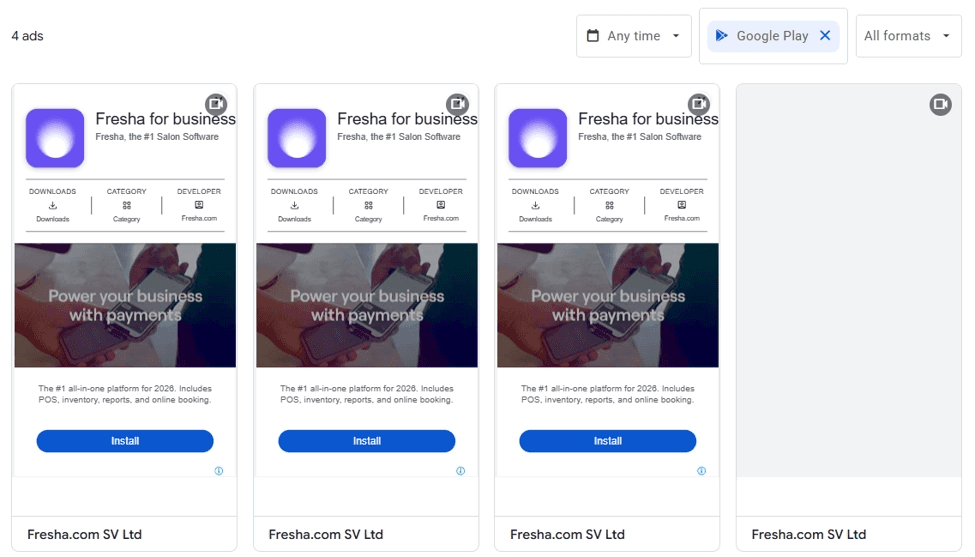
Google Play has four ads for the Fresha for Business app, all built around the same line: "Power your business with payments," paired with "The #1 all-in-one platform for 2026. Includes POS, inventory, reports, and online booking." It's a straightforward install push, no variation tested across the four.
On Google Shopping, they run 300 ads, but on Search and YouTube, they are running approximately 2000 ads per category. Inside that volume, three distinct ad types are running side by side.
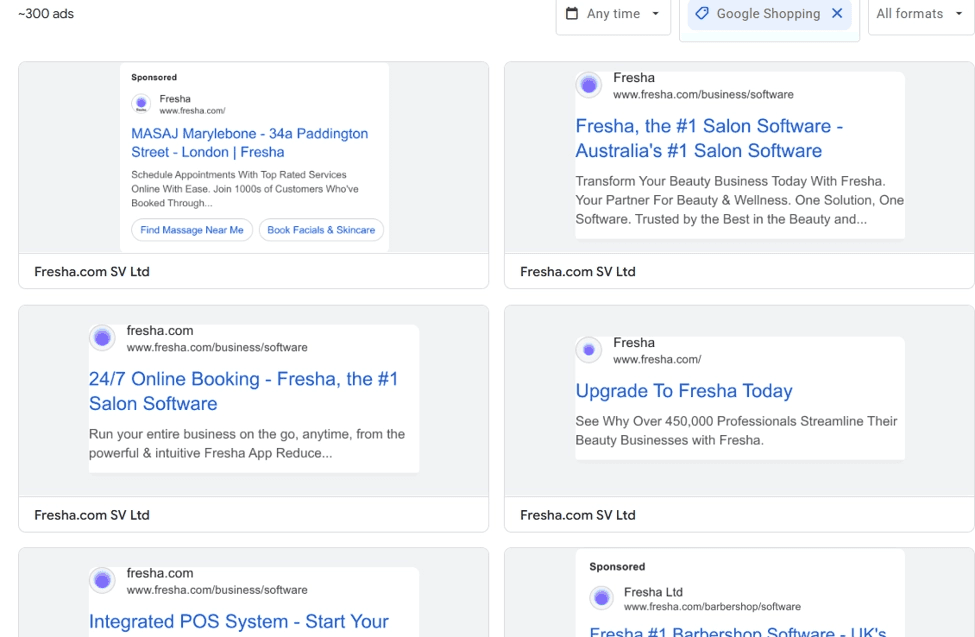
The first is B2B software marketing, aimed at business owners: "Fresha, the #1 Salon Software, Australia's #1 Salon Software," "24/7 Online Booking, Fresha, the #1 Salon Software," and "Upgrade To Fresha Today, See Why Over 450,000 Professionals Streamline Their Beauty Businesses with Fresha." These land on business and software pages and repeat the same social-proof number (450,000 professionals) that shows up elsewhere in Fresha's own marketing.
The second is generic consumer intent capture: a "Book now with Fresha, Book Salons & Spas Nearby" ad running sitelinks for Find Massage Near Me, Find Hair Salons Near Me, Book Salons and Spas, and Find Nail Salons Near Me, effectively bidding on category-level searches rather than the Fresha name itself.
The third one is a per-venue programmatic layer: individual ads generated automatically at the level of a single salon or barbershop, not the Fresha brand. Examples found in the library include MASAJ Marylebone, Artisan Salon Shepley, Bryony Alexandra Ltd in Edinburgh, Hair by Tanya Miller, and Definitions Beauty & Skin Clinic in Hailsham, the last one running its own sitelinks for Eyebrow & Lashes Near You, Hair Removal & Waxing, and Find Tattoo's & Piercings. Each ad is generated from that specific business's own Fresha listing, address included, which means the ad copy is a byproduct of the marketplace data Fresha already holds rather than anything written by a media buyer.
The multi-language spread reinforces that this is infrastructure, not a campaign someone manually localized. The same ad account is running "Zarejestruj się we Fresha" (Polish, "Register with Fresha") and "Fresha: App per barbieri n. 1" (Italian, "App for barbers, no. 1") alongside the English-language versions, all generated from the same underlying template rather than a market-by-market campaign build.
Fresha’s paid strategy is simple and effective. Instead of one broad campaign competing for expensive, generic keywords, Fresha aggregates thousands of small, hyper-specific, low-competition searches (a person's own salon name, their neighborhood) into a paid strategy that scales with the marketplace itself.
💡 Steal This: If you run any kind of marketplace or multi-location model, look at whether your paid strategy could be automated down to the level of your individual partners or locations instead of staying generic. The long tail of very specific, very low-competition searches is often cheaper and more convertible than the obvious keywords everyone else is bidding on.
Sales Funnel from Social Media
Fresha's social-to-customer path is close to the simplest version possible: almost none of its social posts carry an explicit call to action or a trackable link. The primary conversion mechanism is the link in each platform's bio, which points to the main Fresha website, not to a landing page tailored to that platform's audience.
The user-generated content and collabs are the golden ticket here. When a creator posts "Join @Fresha through my link in bio," the CTA lives inside their caption, not Fresha's own content calendar, and the trust transfer happens person to person before the click ever occurs. This means Fresha's real funnel isn't "post, click, convert." It's closer to "creator advocacy, curiosity, direct search or a follow of the creator's link," a genuinely hard path to attribute cleanly but consistent with how creator-led acquisition tends to work across SaaS in 2025 and 2026.
But without platform-specific landing pages or trackable links on brand-owned posts, Fresha has limited visibility into which platform or which specific creator relationship is actually driving signups versus simply building awareness.
Unfortunately, the new changes to the algorithm on social media penalize any use of an external link. But at the same time, you can juggle around that and trick it by leaving the links on stories or in the comments, which we couldn’t see on any of Fresha’s latest content.
Consumers discover salons through Fresha's own marketplace and app, which pulls new client volume toward partner businesses, which in turn gives Fresha's business-side sales motion something concrete to sell: "list with us and get discovered." Social media's job in this loop is its reputation and top-of-funnel warmth that support the marketplace story.
Reviews and Social Proof
If you want to find reviews on Fresha’s apps, you’ll find plenty of platforms that will give more information about this. The ratings themselves sit in a tight band, between 4.2 and 5 out of 5, but the detail behind each score tells a slightly different story.
Capterra puts Fresha at 4.8 out of 5 across 1,447 reviews, with sentiment splitting 96% positive, 2% neutral, and just 3% negative. The pros users cite most are an intuitive, efficient interface and how customizable it is; the cons are occasional technical glitches and lags, plus, notably, an "opaque and increasing fee structure," a direct echo of the pricing shift.
Trustpilot runs slightly behind at 4.7 out of 5, but across a much larger base of 6,279 reviews, on a profile Fresha has claimed and maintained since December 2021. Software Advice puts the overall score at 4.8, backed by a ratings breakdown that skews heavily positive: 1,288 five-star reviews against just 30 one-star, with secondary scores of 4.8 for ease of use, customer support, and value for money, and 4.7 for functionality.
G2 is the outlier, and mostly for a reason that has nothing to do with product quality: its 4.2 out of 5 comes from only 3 reviews, too small a sample to draw any real conclusion from. What that handful of reviews does agree on lines up with the larger platforms anyway. Ease of use, booking management, and scheduling are the most-cited strengths, while payment issues and limited features show up as the only real complaints, the same tension between usability and pricing transparency that shows up at higher volume on Capterra.
On App Store and Google Play, both consumer and business apps sit at 5.0 and 4.8 to 5.0, respectively, with the consumer app carrying real volume (106,000 Google Play reviews, 2.9K App Store ratings).
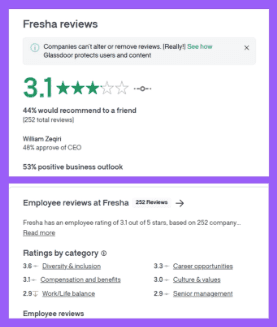
On Glassdoor, there is a totally different story. Fresha has 3.1 out of 5 from 252 employee reviews, with only 44% of employees saying they'd recommend the company to a friend and 48% approving of CEO William Zeqiri's leadership. This sits in stark contrast to how glowing the customer-facing reviews look.
The 252 employees rated Diversity & inclusion with 3.6, Career opportunities with 3.3, Compensation and benefits with 3.1, Culture & values with 3, and Senior management and Work/Life balance with 2.9, the last one decreasing in the last period of time. People here are happy with the team, but not the management and salaries.
Nobody appears to be actively managing the story these platforms tell together. A curated, unified social proof narrative, reviews and testimonials pulled together and presented with intention, can lift B2B conversion rates by as much as 34%, and multi-format social proof (video testimonials alongside written reviews) has been shown to boost conversions by up to 270% in some cases. Right now, Fresha's social proof exists but isn't being assembled into anything close to that.
It’s easy to put big numbers on your site and choose the better testimonials to be featured. It’s easier to collab with creators who are relevant to your ICP, but if you let third-party reviews go unaddressed, it lowers the trust in your brand over time.
On forums, platforms like Reddit, and even on social media, you can find users complaining about stuff that doesn’t end up on the front page of papers. But after their pricing change in 2025, you will find many people complaining about the fees that are charged and the unfairness. People are always looking for an alternative to Fresha, especially because the monthly fee is too expensive for them.
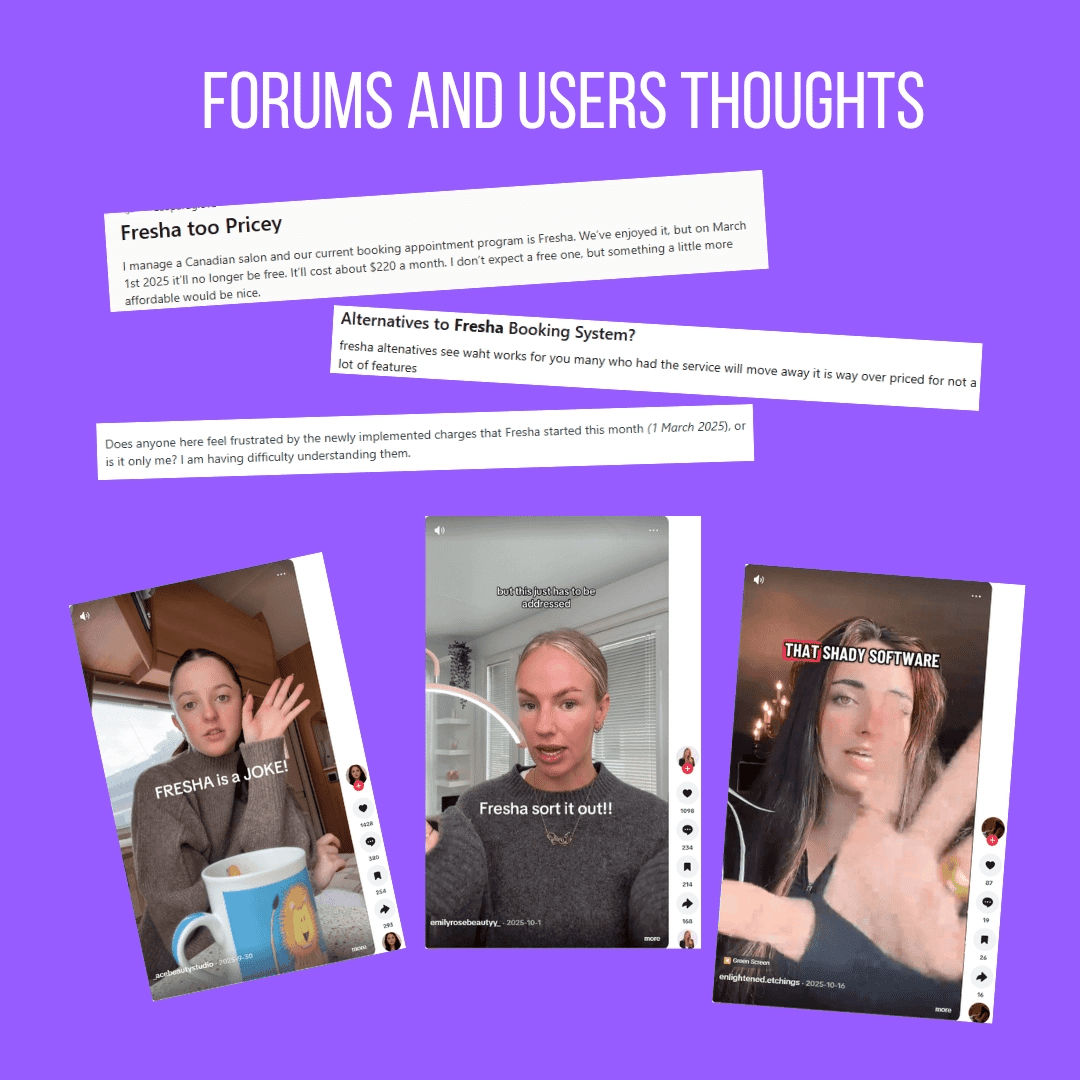
Even after being tagged on social media, they don’t respond in any way to the claims, not even with a standard message explaining why they made this change and how they can help small businesses further, even if the product is now too pricey for them.
The same review-response research cited earlier in this article, businesses that respond earning up to 18% more revenue and 60% of business owners now treating both positive and negative responses as standard practice, applies just as much to social media call-outs as it does to star ratings.
Fresha's Content Marketing and Demand Generation
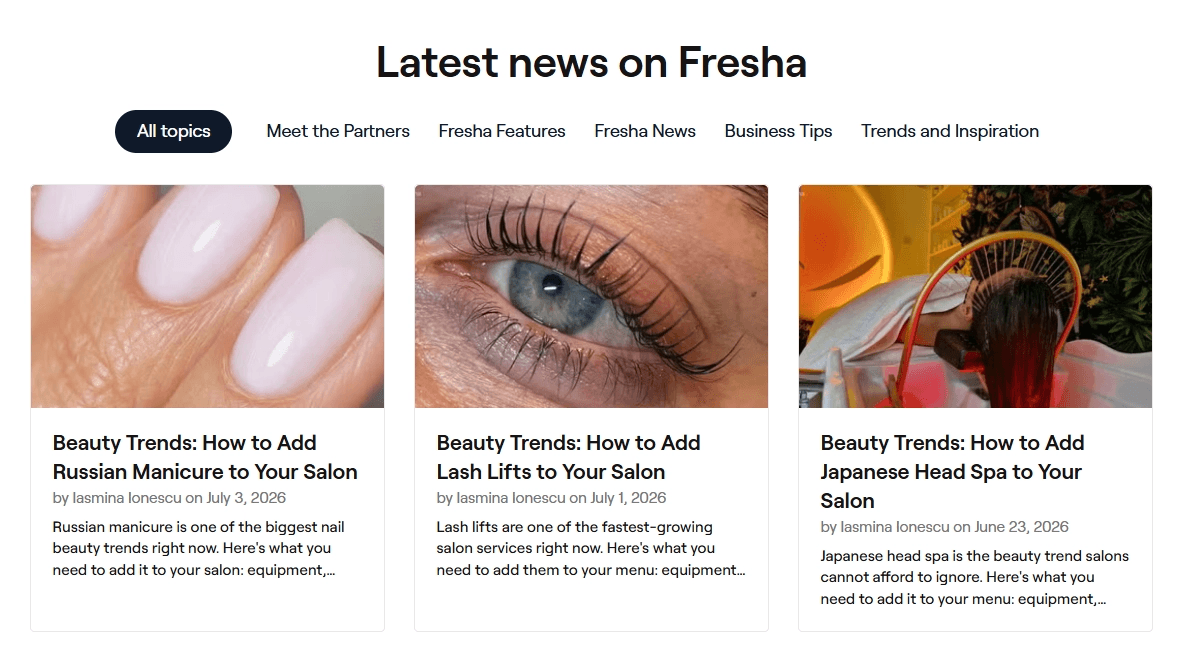
Fresha's blog is active and clearly built for search, not for brand storytelling. Recent posts target specific salon-owner pain points: "how to plan for summer capacity without burning out your team," "how to build a referral scheme," "how to write salon policies," "how to hire and onboard staff." These are the kind of long-tail, problem-first titles built to rank for the exact questions a salon owner types into Google at 11 pm.
They post medium-length articles, with headings, subheadings, and pictures to emphasise the theme. Each article shows the author (by name or team’s profile), publishing date, and last update date, social media sharing buttons, and ends with a Sign Up Today button that redirects you to the for business page.
There's also the Academy, covered earlier in Differentiators and Unique Assets. Between the two, the blog is doing most of the top-of-funnel search work while the Academy handles structured, in-product learning, but neither one is built as a genuine hub. Where competitors are investing in deeper, more comprehensive educational libraries, Fresha is running a single blog plus a modest set of Academy tutorials, one content lane instead of several that reinforce each other.
Sites organized as interconnected content hubs, clusters of pages that comprehensively cover a topic and link back to each other, outperform a single scattered blog by a factor of roughly 4x in organic clicks and see about 40% stronger ranking improvements, because search engines read a hub's link density and topic coverage as a much stronger signal of real expertise than one long article ever can, however well it's written.
For a company already producing Academy videos organized by business vertical, the missing step is linking that structure into the blog itself, rather than running the two as parallel, disconnected content lanes.
Fresha's Marketing and Sales Funnel Stages
At the top of the funnel, Fresha is running two funnels that happen to share a homepage. Instagram and TikTok creator content pulls in consumers curious about a specific stylist or salon, while the blog's SEO-driven guides and organic search pull in business owners searching for a specific operational problem. They’re solving completely different intents at the same stage.
The middle of the funnel is where that split starts to converge. Product pages break features down by use case rather than by feature list, the free trial removes the biggest objection a solo operator would have, and the case-study-style blog content plus creator testimonials do the quiet work of building category trust before anyone's asked to commit to anything.
This is the stage doing the most unglamorous, necessary work in the whole funnel, and it's also the stage that gets the least attention in Fresha's own marketing.
Bottom of the funnel is where the two audiences from the top genuinely split into two different sales motions. A small operator hits the self-serve signup, a 7-day free trial with no credit card required, and converts without ever talking to a human. A larger, multi-location business gets a direct sales conversation instead, which is exactly where the 66 open Commercial roles covered in the next section come in.
Running both motions at once isn't unusual for a marketplace at this scale, but it does mean Fresha's funnel content has to speak to two very different buying processes without contradicting itself, and right now, the marketing still leans almost entirely toward the self-serve, small-operator version of that story.
Retention happens through multiple gates. The built-in loyalty program keeps clients coming back to a given business, the standard mechanism for this category. The marketplace's own commission structure does a second job: since Fresha only charges a business for a client's first booking and nothing on every rebooking after that, the platform itself gives a business a direct financial reason to turn a one-time marketplace booking into a repeat, direct relationship, which keeps that business leaning on Fresha's tools rather than looking elsewhere.
And Fresha Academy shortens how long it takes a new signup to get real value out of the platform, which is its own quiet form of retention: a business that's actually using the product within its first week is far less likely to churn than one still stuck on setup a month in.
Future Plans and Growth Indicators
Fresha's current hiring pattern tells a clear story. Commercial roles dominate with 66 open positions, more than four times the next largest category (Engineering, 15). Marketing has just 4 open roles, including the vacant VP of Marketing (Brand and Communications) position, Head of Performance Marketing, Head of CRM, and a Senior Brand & Marketing Designer.
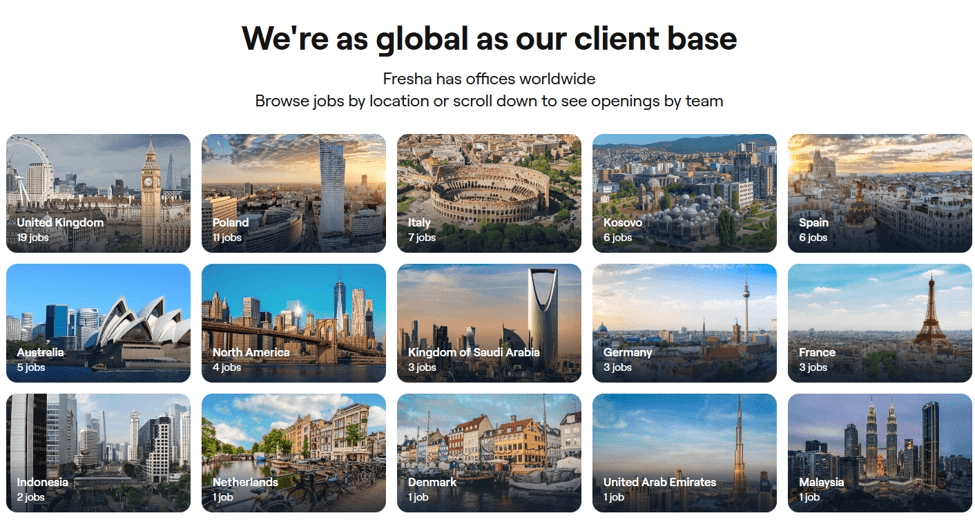
Geographically, the UK leads with 19 open roles, followed by Poland (11) and Italy (7), but the presence of 3 open roles in the Kingdom of Saudi Arabia stands out. Given founder William Zeqiri's background in Dubai and Fresha's stated strength in the Gulf region, active KSA hiring reads as a deliberate expansion signal rather than incidental headcount.
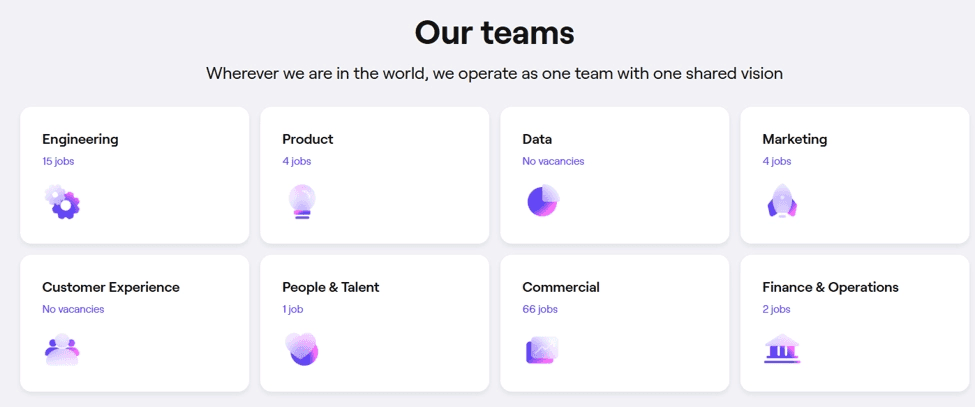
Taken together, the hiring data points to a company scaling its sales and account-management muscle faster than its marketing leadership, while quietly building out Gulf and Southern European presence alongside its established UK, Poland, and Australasia base.
This imbalance is less unusual than it looks. As SaaS companies scale, sales headcount tends to grow roughly ten times over from early stage to maturity, while marketing headcount grows only about four times over the same stretch, and the odds of a company having hired a CMO sit at just 35% at $20 to 50 million in ARR, climbing to 53% only once a company clears $100 million.
What makes Fresha's version worth watching is the timing: a company that just closed an $80 million round at a $1 billion valuation is exactly at the inflection point where marketing leadership typically gets built out to match a scaling Commercial org, not left as an open requisition.
Inspiration Points
1. Creator collaborations succeed on borrowed credibility.
Fresha's top Instagram posts all come from working stylists and barbers, not from the brand's own account. This lines up with source credibility theory: a message's persuasiveness depends on how trustworthy and expert the audience perceives the messenger to be. A hairdresser talking about a booking tool to other hairdressers carries expert credibility that a brand account can never fully replicate.
2. Building content natively for a platform, instead of repurposing it, is what makes TikTok work.
Almost every TikTok video is produced specifically for that platform, including trend-driven and comedic formats that don't appear anywhere else in Fresha's presence, and the street-interview format has no production value to speak of. Native content built for a platform's specific format and culture converts roughly three times better than repurposed content lifted from another channel, because it fits how that platform's audience actually watches instead of reading as an import.
3. The per-venue programmatic search ads turn marketplace data into a growth engine that runs itself.
Naming individual partner salons in paid search ads at a scale of roughly 2,000 to 2,300 placements is a long tail strategy: instead of competing for a handful of expensive, generic keywords, Fresha aggregates thousands of small, specific, low-competition searches that no single salon could afford to run alone, generated automatically from listing data the marketplace already holds.
4. YouTube runs a genuine two-stage funnel instead of one undifferentiated content feed.
Shorts, in recurring series like Fresha Spaces, Fresha Asks, and Boss Your Business, do the discovery work of reaching people who've never heard of the channel. The long-form library, organized into Academy modules and business verticals, is what traffic lands on and converts against. Channels that run both formats together grow their subscriber base roughly three times faster than channels running only one, with total watch time increasing 2.5 times in the first year.
5. The Instagram bio link does the work of many links.
Instagram allows exactly one clickable link per account. Fresha's link routes through a sprout.link page that rebuilds the Instagram grid as a clickable replica, so every post routes to its own destination instead of one shared homepage. Optimized link-in-bio setups like this convert 25 to 40% better than a basic single-link setup, because the destination matches whatever content someone just finished looking at.
Milk and Cookies Studio helps deep-tech and complex B2B companies build go-to-market strategy that holds up under scrutiny, from positioning to demand generation to the kind of research that produced this article. If you're a founder or marketing leader trying to figure out whether your brand story still matches your business model, get in touch.
Frequently Asked Questions
When was Fresha founded and who founded it?
Fresha was founded in 2015 by William Zeqiri and Nicholas Miller under the name Shedul, rebranding to Fresha in February 2020. Fresha is headquartered in London, UK, serves more than 130,000 partner businesses and 500,000 professionals, and raised $80 million from KKR in May 2026 at a $1 billion valuation.
Is Fresha for business actually free, or does it charge subscription fees?
No. Since 2025, it has paid plans starting at $14.95 to $19.95 a month per team member, plus a 20% marketplace commission on new clients. The "100% subscription-free" reputation Fresha built for a decade no longer describes its pricing model.
Who is the CEO of Fresha, and does he post on LinkedIn?
William Zeqiri is Fresha's Founder and CEO, and Nicholas Miller, his co-founder, serves as Chief Product Officer. Zeqiri posts on LinkedIn a few times a week, mostly reshares of company news, but his rare original posts perform far better than his routine reshares.
What social media platforms is Fresha active on?
Fresha runs active accounts on Instagram (80,000 followers), Facebook (42,000), TikTok (11,100), YouTube (6,000 subscribers), and LinkedIn (85,000). Its X/Twitter account is set to private and not publicly viewable.
What kind of content performs best on Fresha's Instagram and TikTok?
Content made in collaboration with individual hairstylists and barbers consistently outperforms anything posted from Fresha's own brand account, sometimes by five to ten times the engagement. On TikTok, street-interview and reaction-style videos built specifically for that platform outperform anything repurposed from Instagram or Facebook.
Does Fresha run paid ads on Facebook, Instagram, or Google?
Fresha runs no paid ads on Meta or TikTok. Its paid budget sits on LinkedIn, mostly recruitment ads, and across Google Search, Shopping, and YouTube, where roughly 2,000 to 2,300 ads run at once, including automated ads promoting individual partner salons by name in multiple languages.
How does Fresha turn social media followers into paying customers?
Mostly through link-in-bio traffic rather than trackable, platform-specific landing pages. On Instagram, that link routes through a sprout.link page that sends each post's clickers to a matching destination instead of one shared homepage. Much of the real conversion work happens through creator trust rather than direct calls to action.
Are Fresha's reviews good, and does it respond to complaints?
Fresha rates 4.8 on Capterra and Software Advice, 4.7 on Trustpilot, and 5.0 on both of its mobile apps, though its G2 score of 4.2 comes from just 3 reviews. There's no visible pattern of Fresha responding to the pricing complaints and negative reviews that have surfaced since its 2025 pricing shift, even though businesses that respond to both positive and negative reviews tend to earn measurably more revenue than those that stay silent.
Does Fresha have a blog, and what does it cover?
Yes. Fresha's blog targets practical salon-owner problems like staff hiring, referral programs, and seasonal capacity planning, built for search rather than brand storytelling. It runs as a single blog rather than a linked content hub, alongside Fresha Academy as a separate, disconnected content lane.
What does Fresha's sales and marketing funnel look like from awareness to booking?
Awareness runs through creator-led social content and SEO-driven blog posts; consideration is supported by use-case-based product pages and a free trial, and conversion splits into a self-serve signup for solo operators and direct sales conversations for larger, multi-location accounts, the segment behind Fresha's 66 open Commercial roles.
Is Fresha hiring, and where is it expanding?
Yes, heavily in Commercial roles, which account for 66 open positions, more than four times the next-largest category. Hiring activity is concentrated in the UK, Poland, and Italy, with a growing presence in the Kingdom of Saudi Arabia signaling continued Gulf region expansion.