Marketing spotlight
/
Marketing Spotlight: Mapping Salesforce's Marketing and Sales Tactics
In this article, we put Salesforce in the “Marketing Spotlight” as we take a closer look at how their sales and marketing strategies are working and what sets them apart, as of August 2026.
TL;DR: Conclusions and Key Takeaways
🎀 This section gives you the main insights without all the details. It’s the stuff you need to remember, whether you’re reading this now or in 6 months. We made this for people who want to get the core message fast.
Salesforce is the CRM company that built the "No Software" pitch in 1999 and now sells itself as the infrastructure for the "Agentic Enterprise." This article breaks down how its pricing, learning platform, hiring, and content actually work together.
Salesforce puts its boldest proof point, 4 million Agentforce conversations, right next to its positioning line instead of three scrolls down, using the first number someone sees as the anchor for every claim after it.
A $25 self-serve tier and a $550-per-seat enterprise bundle aren't two pricing strategies, but one funnel that automatically switches from product-led to sales-led based on which tier a buyer clicks.
Trailhead badges follow the person, which turns a certification program into a career asset competitors can't copy overnight.
A motorsport partnership outperformed nearly every straight product post across three different platforms at once, proof that borrowed relevance beats a direct pitch.
The same LinkedIn ad accounts sell the product and recruit the sales team that sells it, letting one channel do two jobs at once.
Instead of one account trying to speak to everyone, Salesforce runs separate accounts for developers, admins, partners, careers, and individual countries, so each audience only sees content built for them.
Trailhead, the careers page, and four separate blogs all split into narrow, specific topics rather than staying general, which is exactly the structure search engines reward with better rankings.
📝 A quick note before you start reading: The data and analysis in this article are valid as of the time we wrote it. We don’t know when you’ll be reading this, maybe next week, maybe six months from now, and things might have changed since we looked at this company’s marketing and sales approach. Still, the insights and lessons here stay useful, even if the numbers or tactics have evolved a bit.
Salesforce has shipped three different pricing models for its flagship AI product in about eighteen months. Per conversation, then Flex Credits billed per action, then a flat per-user fee. That's a company pricing an entirely new category of software before anyone, including its own customers, had figured out how to buy it.
We build go-to-market systems for B2B SaaS companies at Milk and Cookies Studio, and we chose Salesforce for this Marketing Spotlight because almost no one in B2B software operates at this scale while still visibly experimenting in public.
A company reporting over $41 billion in annual revenue rewriting its own pricing model live, more than once, is rare. It says something about how fast the ground is still moving under "AI CRM" as a category, even for the company that arguably defined the CRM category in the first place.
What's specifically interesting here isn't the AI itself, because every CRM vendor claims AI now. Salesforce packages one horizontal platform behind doors that feel vertical and specific: industry-built solutions, role-based learning paths, and a pricing ladder that separates a two-person free account from a $550-per-seat enterprise bundle without ever feeling like two different products. That packaging discipline, at this size, is the real deal.
The data and analysis here are valid as of August 2026. Salesforce moves fast, particularly on pricing and Agentforce packaging specifically, and both have already changed more than once this year.
Understanding Salesforce
Salesforce was founded on March 8, 1999, by Marc Benioff, a former Oracle executive, together with Parker Harris, Dave Moellenhoff, and Frank Dominguez. The founding pitch, selling software as a subscription accessed through a browser instead of installed on a company's own servers, was unusual enough at the time that Salesforce built its early brand around the slogan "No Software," a direct jab at the on-premises vendors it was trying to displace.
The company is headquartered at Salesforce Tower in San Francisco, California, and went public on the New York Stock Exchange on June 23, 2004, under the ticker CRM, an early and rare example of a SaaS company reaching the public markets that fast. Salesforce reported revenue of roughly $41.5 billion for its 2026 fiscal year.
Employee count sits somewhere between 76,000 and 83,000, a range wide enough on its own to be a finding. Salesforce has spent parts of 2025 and 2026 trimming headcount in some divisions while explicitly framing AI and Agentforce as part of the reason, a rare case of a company naming its own product as a factor in cutting its own workforce.
The core product is still what it started as: customer relationship management software, sales, service, marketing, and commerce tools built to run inside one connected system. What has changed is the framing. In 2026, Salesforce sells itself less as a CRM vendor and more as the infrastructure behind what it calls the "Agentic Enterprise," a platform where AI agents work inside the same systems as human employees rather than sitting on top as a bolted-on chatbot.
Brand Promise Analysis

Salesforce's homepage leads with one line: "Get started with the #1 Agentic CRM." The supporting copy sets up the whole pitch in a sentence: people, agents, apps, and data working inside one trusted platform, embedded in the systems that already run the business.
The message escalates fast. "Welcome to the Agentic Enterprise" sits above five product blocks: Slack, Tableau, Agentforce, Customer 360, and Data 360, each reduced to one line: Slack connects workflows and conversations where work happens, Tableau turns analytics into action, Agentforce builds agentic experiences with purpose, Customer 360 grounds decisions in business context, Data 360 provides one governed data foundation.
The core promise, stated plainly, is that humans and agents work inside the same systems, producing faster decisions and stronger customer relationships. "Headless 360" pushes the idea one step further: every Salesforce capability reachable from any tool or interface, not locked inside Salesforce's own screens.
Trust gets its own message block, separate from the AI pitch. "Salesforce is the platform for the Agentic Enterprise" comes with its own claim: apps, data, agents, and metadata unified on one platform, with security and governance framed as the thing that lets AI scale, not a constraint on it. Trust is positioned as the enabler of the entire agentic pitch.
Vertical packaging shows up directly on the homepage. "Launch faster with 16+ Agentforce solutions, built for your industry" tells a visitor the platform already has an out-of-the-box version for their sector, positioned to save setup time and speed up time to market.
Trust signals show up immediately, before any product detail. Logos and client names like MrBeast, Pandora, Williams-Sonoma, Pacers Sports and Entertainment, Good360, Siemens, SharkNinja, Pearson, sit right under the pitch.

Two numbers carry most of the proof further down the page: over 4 million conversations handled by Agentforce, and a cluster of outcome stats: 66% autonomous case resolution, 15% more marketing pipeline, 1.8x higher lead conversion. The framing is direct: "Everyone talks the AI talk. We're walking the walk." That's a company answering AI skepticism with numbers instead of adjectives.
Pricing enters early too. Starter Suite sits at $25 per user per month, positioned as the low-friction entry point for teams that want AI across sales, service, and marketing without a long setup. The Agentblazer program has three tiers: Champion, Innovator, Legend, turning platform fluency into a status ladder. That's a retention mechanic built directly into the brand promise.
The page closes on a values statement: 1% of equity, technology, and time pledged back, membership in Pledge 1%, before the final CTA: no installation, no credit card, 30 days free.
The "16+ Agentforce solutions, built for your industry" line is the clearest ABM signal on the entire homepage. Salesforce isn't waiting for a prospect to self-identify their sector on a solutions page buried three clicks in; it puts the industry-specific packaging in the first scroll, next to the core product pitch.
That placement tells a visitor from healthcare, financial services, or manufacturing that the platform already speaks their language before they click anything. Pairing that with the case study split by company size, emerging business names in one bucket, enterprise logos like PepsiCo and Williams-Sonoma in another, points to a hybrid motion: broad top-of-funnel messaging for anyone landing on the homepage, with account-based signals layered on top for the visitors Salesforce can already tell are enterprise-sized or industry-specific.
💡 Steal This: Put your strongest proof points right under your positioning line, not three scrolls later. If you're going to claim something bold, show the number in the same breath.
Service and Product Breakdown

Salesforce's core platform sells one idea: every AI agent works better because it already knows your data, your customers, and your business. The company frames this as production-grade AI and builds the entire product suite around four pillars.
Slack is where people ask questions and agents take action, with Slackbot acting as a personal assistant tied to company data and history. Tableau gives agents governed definitions for revenue, churn, and pipeline health, so outputs are described as trustworthy rather than just plausible. Agentforce lets teams build agents with clicks, code, or both, with IT-level security and monitoring to scale across an organization.
Customer 360 connects sales, service, marketing, supply chain, finance, and operations into one system, so agents and humans work from the same context. Data 360, paired with Informatica, unifies fragmented enterprise data without moving it, using Zero Copy integration.
On top of that foundation is a wide product line, each aimed at a specific function. Pricing turns out to be public for most of it, not hidden behind "contact sales" the way the homepage framing suggests.
Agentforce is the flagship agent platform, positioned for 24/7 autonomous support at enterprise scale, extending into web, phone, and app channels. As a standalone add-on, it starts at $125 per user per month on Enterprise or Unlimited edition for Sales, Service, and Field Service, or $150 per user per month for other Industry Clouds.

A lighter Agentforce User License runs $5 per user per month, billed on top of consumption, either $2 per conversation or Flex Credits at $0.10 per action, sold in blocks of $500 per 100,000 credits.
Agentforce Sales (the AI-enabled evolution of Sales Cloud) turns on agents across the deal cycle and claims 30% more revenue with 25 hours a week given back to sellers. It runs on the same five-tier ladder as the base CRM: Starter Suite at $25 per user per month, Pro Suite at $100, Enterprise at $175, Unlimited at $350, and the fully-loaded Agentforce 1 Sales edition at $550 per user per month, which bundles unmetered Agentforce use, Slack Enterprise+, and Tableau Next.
Agentforce Revenue Operations enforces deal rules so invoicing matches what was sold. Pricing is not published. Agentforce Service unifies customer, field, and employee service on one platform, mirroring the Sales Cloud ladder: Starter Suite $25, Pro Suite $100, Enterprise around $175, Unlimited $350, and Agentforce 1 Service at $550 per user per month.
Agentforce Field Service targets uptime and on-site upsell for field teams. It is an add-on on top of Service Cloud rather than a standalone SKU, and its price is not published independently.
Agentforce Marketing positions agents as brand ambassadors that shape experience across the funnel. Unlike the other Agentforce products, it prices per organization, not per user, with a Growth Edition at $1,500 per organization per month and an Advanced Edition at $3,250 per organization per month.
Agentforce Commerce connects ecommerce, POS, and order management under one system, with merchandising support and guided shopping baked in. Pricing is quote-based, structured as a percentage of gross merchandise value rather than a flat seat price.
Headless 360 bundles Agentforce, Data 360, Customer 360, and Slack into one integration layer, the same idea pushed on the homepage: every capability reachable from any tool, not locked behind a Salesforce screen. It’s a packaging concept layered across the other products rather than a separately priced SKU.

Beyond the Agentforce family, Tableau stands alone as an analytics layer for sales, service, and marketing, with a Standard tier around $75 per user per month and additional licenses available from $15 per user per month.
MuleSoft functions as the control plane for APIs and agents, priced by integration volume rather than seats, with its base Anypoint Platform tier typically starting around $15,000 to $20,000 per year for small deployments.
Net Zero Cloud embeds sustainability and compliance data into decision-making, with pricing not publicly listed. Small Business and Starter Suite repackage the same AI capabilities for smaller teams with faster setup, at the same $25 per user per month entry point as the core CRM, with Slack included at no extra cost.
Heroku gives developers a way to extend Agentforce with custom logic and real-time data grounding, priced separately on its own usage-based dyno model, not listed on the main pricing pages.
Partners connects customers to third-party apps and experts for building, launching, and growing on the platform, an ecosystem play that extends what Salesforce itself ships. There is no direct price; access runs through the core platform contract.
Customer Success wraps support into tiered success plans and professional services, paid guidance layered on top of the core product for companies that want implementation help rather than a self-serve setup. Premier and Signature plans are priced as a percentage of license fees, commonly cited around 30%, rather than as flat add-ons.

Case studies are used as proof at both ends of the company size spectrum: Engine, Good360, Precina, and reMarkable represent the emerging business segment, while PepsiCo, Pandora, Williams-Sonoma, and MrBeast anchor the enterprise side.
The company also lists coverage across 18 industries, from Automotive to Travel, Transportation, and Hospitality, which signals a horizontal platform sold with vertical messaging layered on top.
A $25 Starter Suite invites anyone to self-serve, but the moment a buyer needs Enterprise features, AI, or industry-specific packaging, the price jumps to a quote-based conversation, exactly the point where a sales rep gets involved, and the deal becomes account-based.
The emerging-business case studies (Engine, Good360, Precina, reMarkable) stay in the self-serve price range, while the enterprise names (PepsiCo, Pandora, Williams-Sonoma, MrBeast) sit in territory where pricing is never published at all. That split confirms a hybrid motion: product-led at the bottom of the market, sales-led and account-based the moment a logo gets big enough to need a named rep.
💡 Steal This: If your product line has gotten wide, group it around three or four functional pillars instead of listing every SKU flat. It gives a prospect a map instead of a catalog.
Differentiators and Unique Assets
What separates Salesforce from most B2B SaaS competitors is a set of assets built up over two decades that a newer platform cannot replicate by shipping a comparable product. Six of them stand out.
Trailhead

This is the platform's core differentiator. Trailhead is a full learning ecosystem, with guided trails, role-based certifications, and an academic program, built up over years to the point where "knowing Salesforce" is now a portable job qualification independent of any single employer.
A competitor can build a help center or a certification program, but Trailhead's scale and its multi-year head start make platform fluency itself a switching cost. An admin who has invested months earning Trailhead badges has a personal incentive to keep using Salesforce, separate from whatever their employer decides.
Trailblazer Community

The "Trailblazer" identity extends beyond Trailhead into a full community brand, complete with self-organized Dreamin' events and local group meetings that Salesforce doesn't run itself. Letting the community own its own event layer, rather than keeping every gathering corporate-run, gives long-time users a reason to stay engaged that has nothing to do with a renewal date or a sales cycle. Few competitors have a user base with enough tenure or scale to sustain a self-organizing community layer like this.
Agentblazer

Introduced on the homepage itself, the three-tier ladder: Champion, Innovator, Legend, turns platform mastery into a status system. It's a gamification layer sitting on top of Trailhead specifically for Agentforce and AI skills, positioned early enough in a user's journey that platform fluency and personal status become the same thing.
Idea Exchange
Customers submit and vote on product ideas directly in a structured feedback channel that routes to Salesforce's own product managers. This is a differentiator because it's a structural commitment. Continuous voting means the loudest and most persistent customer requests have a visible path to shipping, which few platforms formalize openly.
Customer Success plans
Beyond the core product sits a tiered support layer, Success Plans and Professional Services, priced as a percentage of license fees rather than a flat add-on. For an enterprise buyer, this converts "we hope the vendor helps us" into a paid, contractual guarantee of implementation support, a trust signal that matters more the larger and more complex the deployment gets.
Partners ecosystem
The Partners program connects customers to a network of third-party apps and certified experts built specifically around Salesforce's platform. This extends what Salesforce ships without Salesforce having to build it, and it means a prospect evaluating the platform is also evaluating access to an entire economy of vendors and consultants that grew up around it, something a newer, smaller platform cannot offer on day one regardless of how good its core product is.
Trailhead's role-based and product-based browsing, plus the Agentblazer tiers, function as a self-segmenting acquisition funnel that never looks like marketing. A visitor picks their role or their product interest and Salesforce already knows enough to route them toward relevant content, without a form fill or an ad click. That's ABM logic embedded in a learning platform rather than a landing page, which is a harder tactic for a competitor to copy than any single feature.
💡 Steal This: A certification or community program only becomes a moat once it outlives any single employee's tenure at any single company. If your training content only ever lives inside your product, you're building a feature. If it becomes a credential people put on their own resume, you're building a differentiator.
Leadership Presence Analysis
Marc Benioff (CEO and Co-founder)

The CEO and Co-founder of Salesforce, Marc Benioff has 280,000 followers on LinkedIn and posts about once a week. His average post pulls around 1,800 reactions, 80 comments, and 80 reposts, but the ceiling runs much higher than that baseline.
A post announcing the Fin x Salesforce deal has 6,500 likes, 121 comments, and 334 reposts, and a separate post celebrating Salesforce's #6 ranking on the Wall Street Journal's Best Companies for the Future list performed at a similarly elevated level. Nearly everything he posts is about Salesforce directly, company news, rankings, product moments, not personal reflection loosely tied to the brand.
Patrick Stokes (CMO)

Patrick Stokes, President and CMO at Salesforce has a fraction of that scale: 4,200 followers, and he isn't actively posting. Most of what appears on his profile is reposted content rather than original writing. When he does post something of his own, it tends to include images and tags other people in the caption, more a way of amplifying someone else's moment than building his own.
Average engagement lands around 500 reactions, 15 comments, and 20 reposts, roughly a quarter of Benioff's baseline on his best day and nowhere close to Benioff's biggest posts. Like Benioff, what little original content Stokes produces is about Salesforce, not personal industry commentary.
The Edelman-LinkedIn B2B Thought Leadership Impact research found that more than 40% of B2B deals stall due to misalignment inside the buying group itself, and that consistent executive content reaches what the study calls "hidden buyers," people inside the buying committee who never talk to a salesperson directly but still influence or block the decision.
The same research found that 95% of these hidden buyers say strong thought leadership makes them more receptive to a vendor's sales outreach, and 79% say they're more likely to actively champion a vendor during the RFP process when that vendor's executives have shown up consistently with substantive content.
Benioff's posting, at its best, does exactly this: a product announcement or a third-party ranking read by someone who was never going to take a sales call anyway, but who now has a reason to speak up for Salesforce in a room the sales team isn't in. 0
Stokes's near-silence means that effect is currently concentrated in one executive instead of spread across the leadership team, which is a single point of dependency on a channel research increasingly treats as a compounding trust asset, not a nice-to-have.
Benioff's highest-performing posts, the Fin x Salesforce deal and the WSJ ranking, are both third-party validation moments rather than direct product pitches, which is exactly the kind of content the hidden-buyer research says works on people who are influencing a deal without engaging sales directly.
That's an ABM asset currently running through a single executive account rather than distributed across the people whose titles most directly map to the buying committees Salesforce is trying to reach.
Social Media Strategy

LinkedIn carries Salesforce's largest audience by far, 7 million followers, with posting happening at least once a day. The content mix is broad: trending or viral moments borrowed from other platforms, internal team events, podcast episode promotion, Dreamforce coverage, third-party news and articles, event and conference promotion, and customer case study interviews. Average engagement per post sits around 150 reactions, 10 comments, and 20 reposts.

Salesforce has 813,000 followers on Facebook and posts almost daily, though not every piece of LinkedIn content makes it over. Engagement here drops sharply, with an average of 30 reactions per post, with comments and reposts thin enough to barely register. Multiple additional Facebook pages exist, most likely regional or market-specific, and redirect back to the main brand page rather than running as independent local voices.

On Instagram, Salesforce has 320,000 followers, posting the same content as on Facebook. Average engagement runs around 250 likes and 10 comments per post, noticeably better than Facebook's numbers despite the smaller audience. The link in bio is a sprout.link, which can be found on the TikTok bio as well.
TikTok
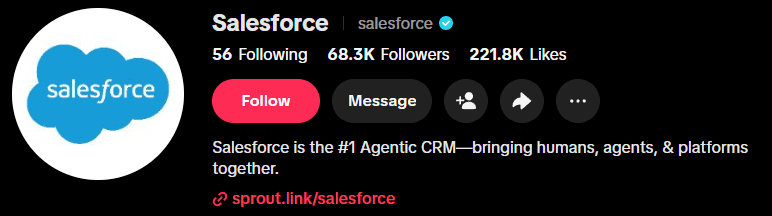
On TikTok, they have 68,300 followers and post largely the same content repurposed from the other platforms, with the same link in the bio pointing back to the same destination used elsewhere. Performance is thin by any measure: 800 to 1,000 views per post, 20 likes, 1 comment, zero saves, and 5 shares. Views sitting under 1,000 against a 68,300-follower base means the platform itself isn't distributing this content beyond a sliver of the existing audience, a sign the format isn't landing with TikTok's own recommendation system.
X (formerly Twitter)

On Salesforce’s X main account, they have 579,300 followers, posting largely the same material seen on LinkedIn. Average performance runs around 20,000 views, 50 likes, 20 reposts, and 10 comments per post.
Beyond the main account, Salesforce runs a wide constellation of dedicated X accounts split by function and region: Salesforce Developers, Salesforce.org, Salesforce Partners, Salesforce Careers, an account for small business, AppExchange, Admins, and separate accounts for Canada, Japan, Customer Success, and News & Insights, among others.
Youtube

On YouTube, Salesforce has 870,000 subscribers, 1,600 videos posted, and 309 million total views. The content spans live streams, Shorts, podcasts, and structured courses, including an eight-lesson Salesforce CPQ Micro Admin Demo, organized into a large number of playlists by topic.
Ordinary update-style posts get modest traction, around 15 likes each, well below what the course and long-form content pulls in aggregate. Beyond the flagship channel, Salesforce runs a network of dedicated channels: Salesforce Product Center, Salesforce Developers, Salesforce Architects, Salesforce Admins, Slack, and Salesforce Support, mirroring the same function-specific splitting strategy visible on X.

Running the numbers against current industry benchmarks makes the pattern across these platforms sharper than the raw figures alone suggest.
Socialinsider's 2026 benchmark report, built from an analysis of over 70 million posts across TikTok, Instagram, Facebook, and X, puts average 2026 engagement rates at 3.70% for TikTok, 0.48% for Instagram, 0.15% for Facebook, and 0.12% for X. Measured against follower count, Salesforce's own numbers land well under those benchmarks on every platform except Instagram, where the gap is smaller.
But a post reaching only 800 to 1,000 views out of 68,300 followers on TikTok isn't underperforming a benchmark so much as signaling that the platform's own algorithm isn't picking the content up for wider distribution in the first place. TikTok's 2026 ranking logic increasingly favors content that gets shared through direct messages over content built for a different platform and dropped in as-is.
Every platform except YouTube is running a version of the same cross-posted content, and every one of those feed-based platforms is underperforming its own 2026 category benchmark, in some cases by an order of magnitude.
YouTube is the one channel not built primarily on a social feed algorithm. It runs on search and long-form watch time instead, and it's also the one channel producing results that dwarf what follower count alone would predict: 309 million views against a subscriber base of 870,000. That's a difference in how each platform decides what to distribute, and Salesforce's current one-piece-of-content-everywhere approach is working against exactly the platforms that reward being built for them specifically.
The splinter account strategy on X and YouTube (Developers, Admins, Partners, Careers, Customer Success, Canada, Japan) mirrors the same segmentation logic seen in the country-specific Meta ad accounts and the "browse by role" structure inside Trailhead. Salesforce is consistently choosing to split audiences by function and geography rather than run one undifferentiated channel, a pattern that shows up in paid media, learning content, and now organic social distribution alike.
💡 Steal This: Before assuming a platform "doesn't work" for your brand, check whether you're posting content built for a different platform and dropping it in unchanged. A feed algorithm and a search algorithm reward completely different things.
Top-Performing Content
Given the volume of content on Salesforce's main accounts, this analysis looks at the most recent period rather than a fixed three-month window, and covers only the flagship accounts on each platform, not the function-specific or regional satellite accounts catalogued earlier.

LinkedIn's three strongest recent posts split across two distinct registers. A post about the Claude Tag x Slack integration pulled 1,761 reactions, 41 comments, and 223 reposts, a post covering onboarding activities for new hires pulled 1,124 likes, 22 comments, and 14 reposts, and a post covering Reese Witherspoon speaking at Dreamforce topped the group at 2,814 reactions, 62 comments, and 200 reposts.
The two posts with the highest repost counts, the Reese Witherspoon appearance and the Claude Tag x Slack integration, both borrow attention from something happening outside Salesforce's own walls: a celebrity appearance and a cross-brand product integration, rather than describing a Salesforce feature on its own.

Facebook's top posts are all modest in absolute terms but consistent in format: a video about the Visa Cash App RB motorsport partnership pulled 59 likes, 1 comment, and 10 shares, a video showcasing the MVP Class of 2026 pulled 54 likes, 1 comment, and 4 shares, and a single image tied to an article on AI agents pulled 47 likes, 2 comments, and 4 shares. Video outperforms the static image post here, and the motorsport partnership content leads even on a platform where every number is small.

Instagram shows the clearest single leader of any platform. A collaboration video with Visa Cash App RB pulled 2,500 likes, 25 comments, and 65 reposts, well ahead of a carousel unveiling the Winter '27 release logo (1,300 likes, 41 comments, 15 reposts) and a Dreamforce collaboration post covering the Reese Witherspoon appearance (1,100 likes, 24 comments, 21 reposts).
The motorsport partnership content is the single best performer on the entire platform, and the carousel format pulls the highest comment count of the three despite fewer likes, a format that invites people to weigh in rather than just react.
TikTok

TikTok's numbers stay small in absolute terms across the board, but the same partnership content still leads relatively: the Visa Cash App RB video pulled 64 likes, 6 comments, 7 saves, 2 shares, and 2,364 views, ahead of the MVP Class of 2026 video (63 likes, 3 comments, 2 saves, 1 share, 3,023 views) and a QR-code product-unboxing video (15 likes, 2 comments, 3 saves, 1,176 views). The unboxing video pulls the fewest views of the three despite being the most obviously "made for TikTok" format on paper, a reminder that novelty alone doesn't guarantee distribution.
X

X's top three all carry view counts in the hundreds of thousands to millions, a "human being, agent doing" video reached 1.1 million views with 81 likes, 26 reposts, and 15 comments, a carousel on AI agents transforming the unboxing experience reached 2.8 million views with 49 likes, 9 reposts, and 4 comments, and a smart customer service agent video reached 1 million views with 138 likes, 11 reposts, and 22 comments.
Every one of these is product-narrative content, AI agents doing visible work, not a borrowed celebrity or partnership moment, a different winning formula than the one dominating Facebook, Instagram, and TikTok. The gap between view count and actual engagement is also the widest of any platform here. The carousel's 2.8 million views produced only 49 likes, a ratio worth noting on its own.
Youtube
YouTube splits cleanly into two tiers. Among Shorts, "What is CDP? Wrong Answers Only" is the standout by an enormous margin, 9.3 million views, 385,000 likes, and 1,796 comments, a like-to-view ratio far above anything else in this entire chapter.

"Invest in innovation and trust, not trends" reached 2.2 million views but only 160 likes and 6 comments, and an F1 Grand Prix giveaway Short tied to Customer 360 reached 438,000 views with 110 likes and 3 comments.
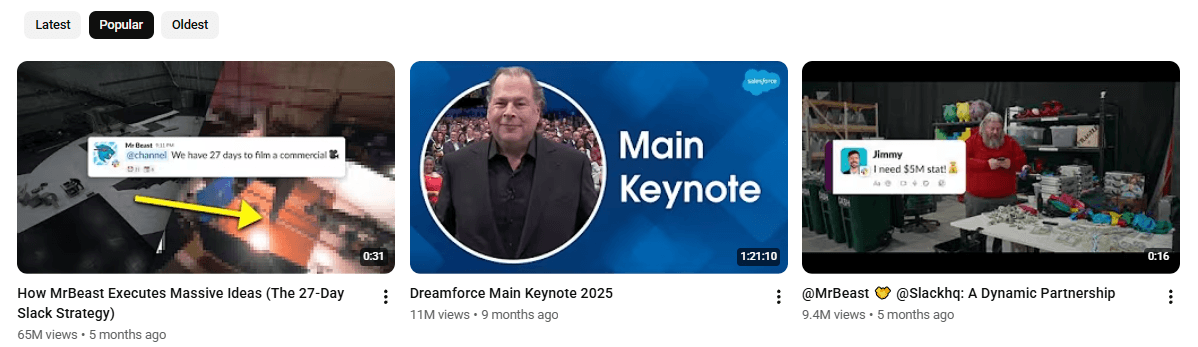
Among long-form videos, "How MrBeast Executes Massive Ideas (The 27-Day Slack Strategy)" leads on raw scale at 65 million views but only 171 likes and 24 comments, the Dreamforce 2025 Main Keynote pulled 11 million views with 730 likes and 103 comments, a far healthier ratio for the format, and a video titled "MrBeast x Slack: A Dynamic Partnership" reached 9.4 million views with just 36 likes and 6 comments.

Viewers have publicly questioned that last result in the comments themselves, pointing to the gap between the view count and the near-absence of likes or comments as a sign the views may not reflect genuine organic reach. That suspicion is worth taking seriously as a finding on its own. A 9.4 million view count with 36 likes is a mismatch large enough to raise the question regardless of what actually drove the number.
What's common across platforms
Two patterns repeat consistently enough to call them a strategy. The first is borrowed cultural relevance: the Visa Cash App RB motorsport partnership is the top or near-top performer on Facebook, Instagram, and TikTok simultaneously, and the Reese Witherspoon Dreamforce appearance performs strongly on both LinkedIn and Instagram. Neither is a hard product pitch. Both borrow attention that already exists somewhere else and point it at Salesforce.
The second is format-native humor. The "Wrong Answers Only" Short is the single best-performing piece of content in this entire chapter by a wide margin, and it's also the only one built entirely around an internet meme format rather than a brand message delivered straight. Everything else with strong numbers still reads as branded content dressed for the platform. That one reads as platform-native content that happens to carry a brand.
That pattern lines up with where B2B marketing itself is heading in 2026. A recent industry analysis on B2B marketing trends for the year, published by The Drum, points to exactly this shift: "lower wattage, higher relevance" celebrity activations, ones that lean on humor and levity and tap into existing fandoms rather than a traditional, expensive endorsement. These are becoming a go-to strategy in crowded B2B markets specifically because they read as more human and less like advertising.
The gap in this chapter makes the point on its own. A joke built entirely around an internet meme format outperformed every polished product video and every borrowed-partnership post by a wide margin, without a media budget or a celebrity name behind it.
Salesforce already has proof of this working. The motorsport partnership and the CDP joke are both in this chapter. The gap is frequency: across the content sampled here, format-native humor shows up once, and borrowed-relevance partnerships show up a handful of times, against a much larger volume of straightforward product and event content that performs at a fraction of the level.
💡 Steal This: If one meme-format post or one borrowed-relevance partnership outperforms your average post by 10 times or more, that's a signal about what your specific audience actually wants more of, and the data to prove it is usually already sitting in your own top-performing content.
Paid Advertising Strategy
Salesforce's paid presence spans seven platforms, and the volume alone tells a story before any copy gets read. Google Maps carries a comparatively small 38 ads, and nearly all of them promote in-person events rather than the product itself, a channel used for local event discovery, not lead generation.

Google Shopping runs roughly 3,000 ads across several languages: Japanese, Portuguese, Spanish, German, alongside English. The English copy leans transactional and benefit-led: "Sell faster with data & AI, try the #1 CRM for free," "Empower your sales team, sales templates for every goal," "Service Cloud Voice, cloud customer support tool," "Data Cloud: activate your data," and "All-in-one CRM solution, AI-powered functionality." These read as bottom-of-funnel, feature-specific hooks aimed at someone already comparing CRM options.
Google Search is the heaviest single channel by raw count, over 20,000 ads, again running in multiple languages alongside English.
The English copy skews toward named use cases and named reports rather than generic brand messaging: "Data analytics for call center & service predictive analytics, get started for free," "State of Service report," "Salesforce for small business," and "AI marketing software, paid media automation tools." That's search-intent matching in a fairly literal sense: someone searching for call center analytics or a small business CRM lands on an ad written for exactly that query.

YouTube has over 5,000 ads across image, text, and video formats, in multiple languages, functioning as the awareness and storytelling layer behind the search and shopping volume rather than a direct-response channel on its own.
Meta runs through ten separate ad accounts split by country and product line: a general Salesforce account, a Cloud Protection for Salesforce account, and country-specific accounts for Japan, Korea, Canada, the UK, Australia, Germany, France, and Belgium.
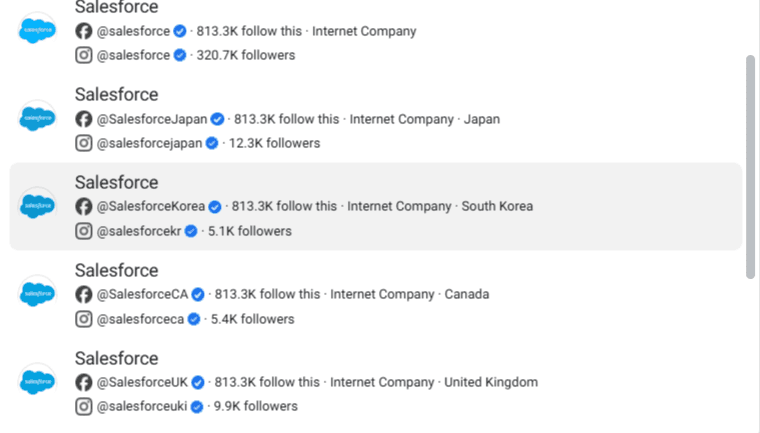
That's a market-by-market localization structure, translated into different languages. The copy leans heavily on event promotion and brand storytelling rather than direct product pitches: Dreamforce sessions, a customer story built around Live Nation using Agentforce's Venue Agent to answer fan questions across 120 venues, and a second Dreamforce ad promoting exclusive interviews and virtual trainings on Salesforce+. Every example uses the same CTA, "Sign up," consistent with a channel built for event and content registration rather than direct sales conversion.
TikTok carries no ads at all, a deliberate absence for a platform that skews consumer and younger, not the enterprise buyer Salesforce is targeting.
LinkedIn is the largest platform by ad count after Google Search, with 9,257 ads, and the copy mix here is the most varied of any channel. Some ads run pure product positioning: "Salesforce is the #1 Agentic CRM, bringing humans, agents, and platforms together to drive customer success," repeated with a support-specific angle in another version aimed at turning FAQ friction into instant guidance.

Others are sales-enablement proof points aimed at practitioners: one ad walks through how Salesforce's own account teams use Agentforce to analyze prospect data and generate account summaries before the first meeting of the day, framed around less time in spreadsheets and more time on relationships and quota.
A third category is pure employer branding, unconnected to any product pitch at all: an ad profiling account executive Teddy Sergesketter's use of Salesforce's Volunteer Time Off benefit, framed around purpose and community impact rather than software. Salesforce is running recruitment marketing and product demand generation through the same ad account, on the same platform, at the same time.
The Dreamdata's 2026 LinkedIn Ads B2B Benchmarks Report, published in March 2026 and built on more than 66 million sessions across 3.5 million B2B customer journeys, found that LinkedIn is the only major paid platform posting a positive median return on ad spend in B2B, 121%, against 67% for Google Search and 51% for Meta, and that LinkedIn now commands 41% of all B2B paid social budgets industry-wide.
LinkedIn's own research adds the recruitment half of the argument: companies with a strong employer brand pay roughly 43% less per hire and see close to 50% more qualified applicants. Put those two findings together and Salesforce's LinkedIn strategy stops looking like a content mix and starts looking like a budget decision: the one channel proven to return more than it costs on the demand side is the same channel proven to lower cost-per-hire on the recruiting side, and Salesforce is running both plays through it at once.
That decision lines up directly with the hiring pattern from the Future Plans chapter: Sales and Customer Success together account for roughly 70% of the company's 1,519 open roles, and a cheaper, higher-quality pipeline into those specific roles is worth real budget.
Where the money goes, in short: Google Search absorbs the largest raw ad count because it captures explicit, already-forming intent across dozens of specific use cases and languages. LinkedIn gets the smallest cost-per-outcome and the most emotionally varied creative because it's the only channel doing double duty, selling the product and staffing the sales team that sells it, in the same budget line.
Meta and YouTube fill the awareness and event-registration layer underneath both. TikTok and app-install advertising get nothing, because neither platform's audience matches who actually signs a Salesforce contract.
The country-specific Meta ad accounts (Japan, Korea, Canada, UK, Australia, Germany, France, Belgium) are a clear ABM signal at the market level rather than the account level. Salesforce is running distinct creative and targeting per country rather than one global English campaign, which only makes sense if regional sales teams are driving distinct pipeline goals in each of those markets.
💡 Steal This: Run ad copy in the languages your buyers actually search in, not just English. It's good to do this because a buyer who has to translate your ad in their head before they understand it is a buyer who's already lost interest by the time they get to your offer.
Sales Funnel from Social Media
The path from a social post to a Salesforce conversion point splits along a clear line: platforms that allow a clickable link directly inside a post get used one way, platforms that don't get used another way entirely.
LinkedIn and Facebook carry native clickable links in the post itself, and Salesforce uses that freedom for links to event and webinar registration pages and to its own articles, the same pattern that shows up everywhere else too: across every platform, most links, whichever way they get delivered, point to an event, online or offline, more than to anything else.
That pairing makes sense given what these two platforms are built for. A LinkedIn or Facebook post has room for context, a paragraph explaining why a webinar matters or what an article covers, so the click a reader makes is already an informed one, closer to a qualified registration than a cold click.
Once that reader lands on an article page, Salesforce stacks the next step several times over rather than leaving it to chance: a sticky top-menu bar carries Contact Us and Try for Free buttons that follow the reader down the page, a newsletter subscription block sits in the right-hand rail beside the article text, and a separate newsletter banner repeats the same offer elsewhere on the page. Wherever a reader stops scrolling, a conversion point is within view.

Instagram and TikTok work under a real technical constraint neither LinkedIn nor Facebook shares: captions on both platforms don't render a clickable link at all, so the bio is the only place a link can actually work. Salesforce's answer is a link-in-bio tool, Sprout Social's SproutLink, given the platform Salesforce already uses for social management, and it routes each visitor to whatever destination is actually relevant to that specific post:
the YouTube channel, a particular webinar or event, or a product page on the main site, rather than sending every click to one fixed, generic URL.
X skips the bio detour entirely and puts direct links straight into the post text, which lines up with what's actually running there: the AI-agent product narratives that dominate X's top-performing content, arguably the platform's most linkable, most literal content type, benefit from sending a viewer straight to the specific page the post is about rather than a general menu of options.
The article page repeats the same offer three different ways: the sticky Contact Us and Try for Free buttons, the newsletter block, and the newsletter banner. Different readers notice different things depending on where they stop on the page, so having the same next step show up in three places means someone almost always sees it.
A link-in-bio tool doesn't need to prove itself through an engagement lift for a brand at Salesforce's scale. Its job here is different. Instagram and TikTok force a single link choice per profile, and Salesforce's content spans YouTube, webinars, events, and product pages in the same week. SproutLink solves a routing problem, not an engagement problem.
For Salesforce, the value of the link-in-bio setup on Instagram and TikTok is less about squeezing extra engagement and more about giving a fragmented, multi-goal audience one workable point of entry on platforms that would otherwise force a choice between YouTube, webinars, events, and products every time a caption gets written.
💡 Steal This: Match your link strategy to what the platform actually allows, not to what's easiest to manage centrally. If a platform blocks clickable captions, a link-in-bio tool earns its place. If it doesn't, sending people straight to the specific page your post is about will usually out-convert routing everyone through a menu first.
Reviews and Social Proof
Salesforce splits its on-site social proof into named Customer Stories sections for Tableau, MuleSoft, Slack, and Heroku, alongside a Salesforce-on-Salesforce section and a set of Trailblazer stories. These are case studies and named-client narratives, not verbatim testimonial quotes, and should be read that way, a case study link is proof of a customer relationship.

G2 is where Salesforce's review presence is strongest and most granular. The company holds a 4.5 average star rating overall and ranks #1 in 209 categories. Broken down by product line, the picture is a long tail rather than a single number, grouped here by rating:
Rating | Products (Number of Reviews) |
|---|---|
5.0 | Agentforce Life Sciences (1) |
4.9 | Qualified (1,500) |
4.8 | Agentforce Energy and Utilities, unclaimed (4) |
4.7 | Trailhead, unclaimed (18) |
4.6 | Salesforce Spiff (3,000), Backup and Recover (415) |
4.5 | Slack (39,000), Headless 360 Platform (3,900), MuleSoft Anypoint Platform (775), Agentforce Communications (27) |
4.4 | Agentforce Sales (25,000), Agentforce Service (7,300), Tableau (3,700), Agentforce Field Service (1,000), Salesforce Customer Success (388), B2B Commerce (301), Partner Cloud (275), MuleSoft Automation (49), Agentforce Net Zero (7) |
4.3 | Agentforce (1,200), B2C Commerce (593), Data 360 (319), Agentforce Financial Services (227), Government Cloud (19) |
4.2 | Agentforce Revenue Management (1,500), Heroku (148), Order Management (121), Agentforce Education (42) |
4.1 | Agentforce Nonprofit (87) |
4.0 | Agentforce Marketing (4,600) |
3.9 | Agentforce Health (37), the lowest rating of any reviewed product |
No rating yet | Bluebirds, Agentforce IT Service |
Agentforce Marketing sits noticeably lower than every other major, high-volume product line. At the thinnest end, several of the "16+ industry solutions" featured on the homepage are the ones with barely any reviews, a sign those verticals are new or lightly adopted relative to the core CRM line.
Capterra tells a much thinner story by comparison. Sales Cloud is the only profile with real volume, 4.4 from 18,000 reviews, while every other Salesforce product on the platform sits under 1,000 reviews, with ratings ranging between 4.1 and 5.0.

Trustpilot is the outlier, and sharply so: 1.4 stars from 639 reviews, on a claimed profile that has not responded to any negative review. Across the reviews evaluated, the dominant complaints were consistent: the platform is expensive, overly complex, rigid, and frustrating to navigate for daily tasks, and customer support was frequently described as effectively non-existent, with long waits and no meaningful resolution.
A smaller share of reviewers pushed back against that picture, reporting that the platform works well for smaller operations, that automated reporting is solid, and that the system becomes genuinely functional once properly configured.

Glassdoor, which measures employee sentiment rather than customer sentiment, shows a healthier picture: 4 stars from 22,000 reviews, 79% would recommend Salesforce to a friend, 78% approve of CEO Marc Benioff, and 68% hold a positive business outlook. Broken down by category, the spread looks like this:
Category | Score |
|---|---|
Compensation and Benefits | 4.3 |
Diversity and Inclusion | 4.2 |
Culture and Values | 3.9 |
Career Opportunities | 3.9 |
Work-Life Balance | 3.9 |
Senior Management | 3.5 |
The qualitative themes match that spread. Employees describe a collaborative, customer-success-driven culture, with some reviews flagging toxic dynamics and internal politics inside specific teams. Management earns credit for training investment but criticism for inconsistent leadership effectiveness.
Career growth opportunities are called out as genuinely strong, tempered by frustration over unclear promotion criteria. Work-life balance is generally rated well, apart from the pressure that comes with sales-specific roles.
App store ratings round out the picture and are mostly strong. The core Salesforce app holds 4.4 from 59,700 reviews on Google Play and 4.8 from 350,000 ratings on the Apple App Store. The rest of the app portfolio breaks down like this:
Product | Platform | Rating | Number of Ratings |
|---|---|---|---|
Salesforce Authenticator | Android | 4.5 | 26,900 |
Salesforce Authenticator | iOS | 4.6 | 4,300 |
Trailhead GO | Android | 4.8 | 16,300 |
Trailhead GO | iOS | 4.9 | 8,800 |
Salesforce Events | iOS | 4.8 | — |
CRM Analytics | iOS | 4.8 | — |
Salesforce Field Service | Android | 2.3 | 5,850 |
Salesforce Field Service | iOS | 4.6 | 20,000 |
Salesforce Field Service is the one clear anomaly in either direction: 2.3 from 5,850 reviews on Android against 4.6 from 20,000 on iOS, a gap wide enough between the same product on two platforms to be worth investigating rather than averaging away.
Taken together, these numbers are several different audiences answering different questions. G2 and Capterra reflect buyers who already chose Salesforce and, in many cases, were prompted to leave a review as part of a vendor-run campaign.
Trustpilot reflects the opposite selection bias: customers motivated enough by frustration to leave an unprompted, uncompensated complaint. Glassdoor reflects employees, a separate audience with separate incentives entirely. Reading any one of these as "the" Salesforce rating misses that each platform is sampling a different population under a different incentive structure.
G2 completed its acquisition of Capterra, Software Advice, and GetApp in February 2026, meaning three of the review sources buyers treat as independent cross-checks now sit under one commercial owner, whose own business model runs on vendors like Salesforce paying for visibility and running disclosed, gift-card-incentivized review campaigns.
That consolidation matters beyond human readers, too. G2's own 2026 research found that 51% of B2B software buyers now start their purchasing research inside an AI chatbot rather than a search engine, and that 69% of those buyers ended up choosing a different vendor than they originally intended based on what the chatbot surfaced.
When the review data feeding those recommendations comes from an increasingly consolidated, partly incentivized pool, a G2 score of 4.5 across 209 categories and a Trustpilot score of 1.4 aren't two conflicting data points to average, they're a reminder that whichever platform an AI assistant happens to cite first is doing a lot of the persuading now, and that platform's independence is worth checking before trusting the number.
Content Marketing and Demand Generation
Salesforce runs its blog as a publishing operation. A direct check of the live blog shows posts landing at a near-daily pace, several in the same week, sometimes the same day. Authorship rotates constantly. Individual posts carry named bylines, but no single writer or handful of writers own the output the way a founder-led blog might. That points to a content engine built for volume and topic coverage, closer to a newsroom feeding SEO and product education than a blog built around one voice a reader gets to know.
Blogs
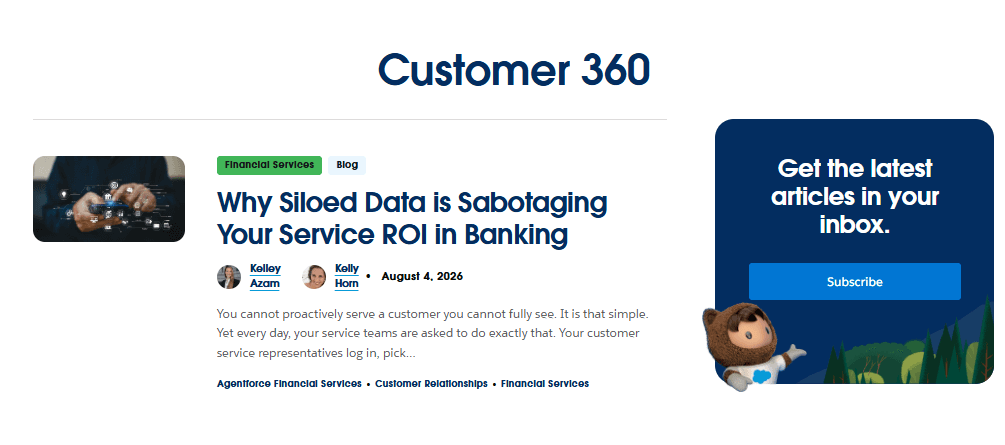
Four named publications sit at the center of that engine. The 360 Blog covers the latest on AI, data, and digital labor. The AI Research Blog tracks findings from Salesforce's own AI research team, positioned to keep readers close to the technical edge of the company's work. The Developer Blog carries tooling news, insights, and inspiration for people building on the platform.
Salesblazer covers sales career content, training, and events, and is framed as part of "the world's leading sales community," a positioning line that turns a blog into a membership pitch. Underneath these four sit narrower category feeds tied to specific product or function teams, pulling different bylines into the same publishing rhythm rather than one editorial voice covering everything.
The articles themselves follow a consistent format: author byline, published date, and estimated reading time up top, H1/H2/H3 structure through the body, internal links throughout, social sharing buttons, and a newsletter CTA, the same conversion infrastructure repeated on every single post regardless of which of the four blogs it came from.
Resources

Four resource types sit apart from the blog as an ungated layer for visitors who want data rather than narrative. Analyst Reports hand over the latest studies and reports from named business analysts, borrowing third-party credibility rather than making the claims itself. Partners points to industry-leading partner apps and experts, functioning as a directory as much as a resource.
Developer Documentation covers guides, tutorials, sample code, and API references, the technical reference layer for anyone actually building on the platform. A Newsletter signup promises tips and insights "tailored to you," the standard top-of-funnel capture mechanism sitting quietly next to the heavier resources.
Learning content as a lead channel

Trailhead, Salesforce's learning ecosystem, also functions as a top-of-funnel content play.. Every trail, certification path, and role-based track (admin, developer, architect, consultant, designer, analyst, cybersecurity, marketing, sales, service) is indexable, searchable content that pulls in visitors who haven't decided to buy anything yet; they're just trying to learn a skill. The full breakdown of Trailhead as a platform asset sits in the Differentiators and Unique Assets section.
Salesforce for Higher Education takes the same content into classrooms through three separate paths. For Students, it offers guided learning paths aimed at building career-ready AI, data, and CRM skills. For Educators, it offers ready-to-teach resources, a way to connect with other educators, and expert support at no cost.

For Institutions, it offers industry-recognized curriculum that a campus can adopt directly, pitched as preparation for high-demand careers. Feeding students and educators into Trailhead early is a long-horizon acquisition play, building platform familiarity years before those students are the ones signing procurement contracts.
Try Salesforce for Free offers two distinct entry points rather than one generic trial. Starter Suite gives access to marketing, sales, service, and commerce tools in a single CRM suite, aimed at a business buyer. Developer Edition is aimed at builders specifically, letting them build enterprise-quality apps and get hands-on with Agentforce and Data Cloud without a business use case attached. Splitting the free trial this way lets Salesforce capture both the buyer persona and the technical evaluator persona with two different doors into the same platform.
New to Salesforce functions as the platform's own onboarding layer for total beginners, three explainer tracks stacked together: what a CRM is and how it improves customer relationships, what Customer 360 does as the category-leading app suite across sales, service, marketing, commerce, and IT, and what an AI agent is, framed through Agentforce as always-on digital labor augmenting every employee and process. This is content marketing aimed at people who haven't decided they need a CRM yet, not at people comparing vendors.
Events

The events calendar runs on two tiers, flagship annual gatherings and a constant background hum of smaller sessions. Dreamforce is the flagship, held in San Francisco and streamed on Salesforce+, built around the Agentic Enterprise narrative. TDX functions as the developer-facing counterpart, with keynotes and sessions available on-demand after the fact. Connections is positioned as "the marketing event of the year," aimed squarely at marketers rather than the broader customer base.
Tableau Conference and Informatica World serve the data and analytics side of the house specifically. Agentforce World Tours take the Dreamforce content on the road, city by city, letting a prospect who can't get to San Francisco still get face time with Salesforce experts. Salesforce+ functions less as an event and more as an always-on streaming channel, live and on-demand content positioned around "professional growth."
A general Webinars track and a dedicated virtual events line, "expert-led workshops, AMAs, and technical sessions for developers, admins, and architects," cover the recurring, lower-commitment end of the calendar.
Community-run events sit apart from the company-run calendar. Trailblazer Community Conferences, known as Dreamin' events, and Trailblazer community group meetings are organized and run by community members rather than by Salesforce. As calendar entries, they add a peer-led, lower-cost layer to the events mix. What that community identity signals as a retention asset is covered in the Differentiators and Unique Assets section.
Support

The support architecture splits into four named categories, each solving a different problem. Help & Documentation covers Known Issues (searchable by category, status, or release), Developer Documentation (release notes, the Models API, Apex and other Salesforce APIs), and an Architecture Center, which currently features guidance on designing headless AI experiences, a composition framework for matching the right AI experience to the right user without leaving the platform's governance boundary.
Communities lets users meet other users, learn skills, find apps and experts, and share feedback, split across six named spaces, Trailblazer, Slack, MuleSoft, Tableau, Partner, and the Idea Exchange (full breakdown in Differentiators and Unique Assets below).
Services & Plans covers Success Plans, tiered support and guidance to grow a business, and Professional Services, hands-on implementation help from Salesforce's own experts. Account Management is the operational layer, a Your Account app for payments and renewals, a Billing Portal for invoices, and a Digital Wallet for tracking consumption in near real time, each requiring a different login, which signals separate backend systems rather than one unified account view.
Company and Investor Relations

The Company section covers the standard corporate footprint, values, impact, careers, news, legal, and links out to Salesforce's other brands. Investor Relations sits alongside it with quarterly results, a reminder that Salesforce's content strategy has to serve public shareholders as an audience alongside prospects, customers, and developers.
Taken as a whole, the content strategy is optimized for two outcomes that reinforce each other: keep existing customers and their employees deepening platform skills through Trailhead and certifications, and keep new visitors, at every level from student to CIO, finding Salesforce through blog posts, events, or a free trial tied to whatever they were already looking for.
The split between Trailhead Academy's "browse by product" and "browse by role" views is a direct ABM signal built into a learning tool. It lets Salesforce serve a tailored path to a visitor the moment it knows either what they're evaluating or what job they hold, without needing an ad campaign or a sales rep to do the segmenting. The three-way split in Salesforce for Higher Education (students, educators, institutions) extends that same logic upstream, targeting the procurement decision-makers of tomorrow years before they hold a budget.
💡 Steal This: If your certification or learning content can be browsed by both what someone is trying to do and who they are, build both filters. Letting a visitor self-segment saves you the ad spend of doing it for them.
Marketing and Sales Funnel Stages
TOFU (Top of Funnel)
Awareness runs through the blog's near-daily publishing cadence, organic social posts across all six platforms, YouTube's Shorts and long-form library, and Trailhead's indexable, searchable learning content, all of it built to catch someone before they've decided to evaluate a CRM at all. The "New to Salesforce" explainer track and the free Starter Suite and Developer Edition trials sit at the permeable edge between awareness and consideration, content aimed at people who don't yet know they need what Salesforce sells.
MOFU (Middle of Funnel)
Webinars, the virtual events calendar, analyst reports, and the newsletter carry the nurture load once someone has shown initial interest. Case studies split by company size, emerging-business names like Engine and Good360 against enterprise names like PepsiCo and Williams-Sonoma, let a prospect find proof that matches their own scale rather than proof aimed at someone else entirely. Trailhead certification paths do double duty here too. Someone working through a trail is deepening product knowledge before a purchase decision even happens, which shortens the sales conversation once one starts.
BOFU (Bottom of Funnel)
The sticky Contact Us and Try for Free buttons on every article page are the most direct conversion points in the entire system, always in view regardless of where a reader stops scrolling. Beyond that, the pricing structure itself does the routing: a self-serve signup on Starter Suite closes the loop without a human ever getting involved, while Enterprise, Unlimited, and Agentforce 1 tiers route to a sales conversation by design. The price simply isn't published past a certain point. That's the moment the funnel switches from product-led to sales-led, and it happens automatically based on which tier a buyer clicks toward.
Retention
Trailhead and its certifications keep customers and their employees engaged with the platform long after the purchase, turning ongoing product usage into a credential worth maintaining. The Trailblazer Community and its self-organized Dreamin' events extend that relationship past anything Salesforce itself has to run or pay for directly. Customer Success plans convert post-sale support into a paid, contractual relationship rather than a goodwill gesture, and the Idea Exchange gives long-tenured customers a visible, structural reason to stay invested in the roadmap rather than just the product they already bought.
Future Plans and Growth Indicators
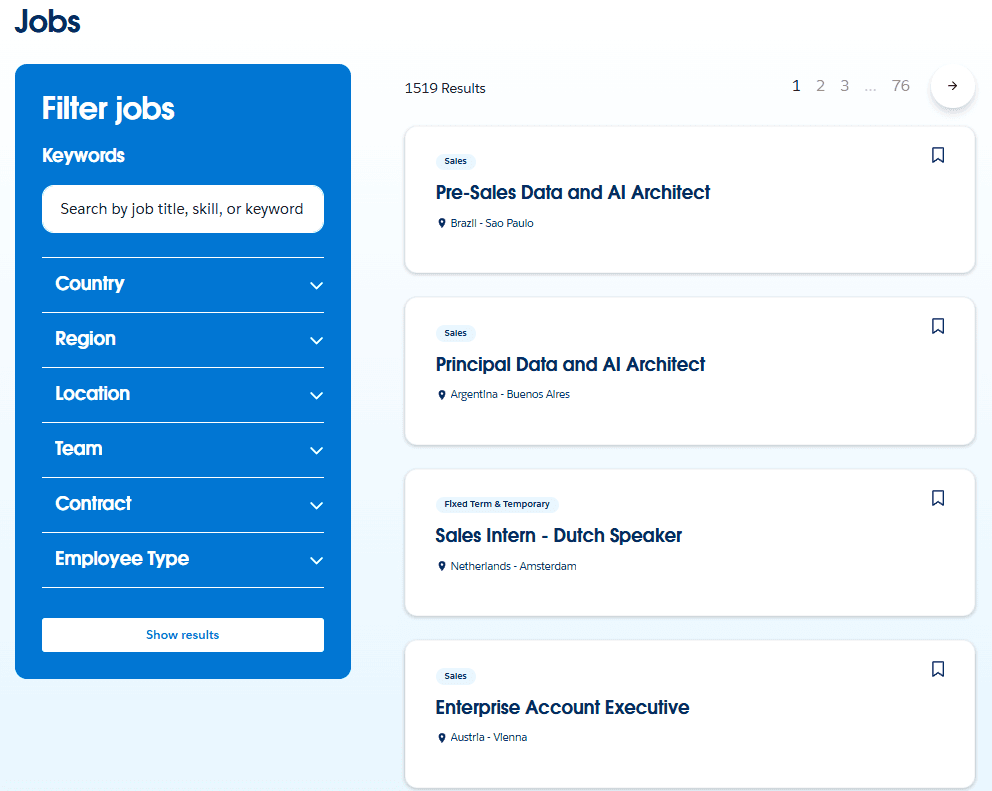
Salesforce's careers page lists 1,519 open roles at the time of this research, searchable by job title, country, region, location, team, contract type, and employee type, a filtering depth that itself signals a company hiring at a scale where a simple list would be unusable.
The department breakdown, provided directly and treated as locked data, tells a clearer story than the total number does on its own: Sales leads by a wide margin at 746 openings, Customer Success follows at 313, and Software Engineering sits a distant third at 173.
Everything else trails further behind, Product at 53, Marketing and Communication at 46, Operations at 33, Employee Success at 29, Finance at 25, Program and Project Management at 22, Fixed Terms and Temporary at 15, Enterprise Technology and Infrastructure and User Experience tied at 14 each, Development and Strategy and Global Affairs tied at 12 each, Data at 7, Real Estate and Facility Management and Corporate Functions tied at 2 each, and Compliance at 1.
Sales and Customer Success together account for roughly 70% of every open role at the company. For a company whose entire current pitch centers on AI agents doing the work that used to require headcount, that split is not what a surface reading of "AI CRM company" would predict. It says Salesforce is hiring humans specifically for the parts of the business that involve relationships and renewals, while keeping technical hiring comparatively lean.
That pattern lines up with a wider labor market shift documented in the Stanford HAI 2026 AI Index, released in April 2026. The report, built on ADP payroll data rather than job-posting estimates, found that employment for software developers aged 22 to 25 fell nearly 20% from its late-2022 peak, while employment for developers over 30 in the same AI-exposed roles grew.
The report's own framing is that AI is not eliminating software engineering as a discipline, but eliminating the entry-level tasks junior developers were historically hired to do: boilerplate code, routine testing, straightforward bug fixes, work a senior engineer with AI tools can now absorb directly.
The same report found that a third of surveyed organizations expect to reduce headcount over the coming year, with the sharpest expected cuts concentrated in service operations, supply chain, and software engineering specifically.
Salesforce's own 173 open engineering roles against 1,346 roles in sales, customer success, and other functions reads as a company acting on exactly that data, or at minimum matching the same underlying shift: AI absorbs routine technical work internally, and the growth budget goes toward the roles where a human relationship still closes the deal or keeps the account renewed.
The hiring pattern sits alongside an unusually aggressive acquisition pace. By February 2026, Salesforce had made ten acquisitions in six months, nearly all of them feeding directly into Agentforce.
Qualified, an inbound buyer engagement platform, was acquired in December 2025 to feed top-of-funnel intelligence into Slack and Agentforce workflows. Momentum, a conversational insights and revenue orchestration platform, followed in February 2026, closing on March 2, giving Agentforce 360 and Slackbot the ability to ingest and analyze unstructured data from Zoom and Google Meet calls and turn it into structured, actionable context.
Cimulate, an AI-powered product discovery platform built for retail, was announced the same week, aimed at improving Agentforce Commerce's search experience. Buying rather than building at this pace signals urgency, Salesforce is closing specific capability gaps in Agentforce faster than its own product teams could ship them from scratch.
Growth signals aren't uniform across the company, and a fair account has to hold both sides. Salesforce's stock traded down roughly 21% year-to-date and nearly 32% over the trailing year as of February 2026, even while the acquisition spree and hiring push continued.
At the same time, Salesforce moved Heroku, one of its longest-standing platform products, out of active sales for new Enterprise contracts and into a maintenance-only "sustaining engineering" phase in February 2026, a clear signal that not every part of the platform is getting the same investment the Agentforce family is getting.
Salesforce has also continued layoffs and leadership restructuring through the same period, explicitly tying some of the headcount reduction to AI efficiency gains, the same theme running through both the hiring data and the acquisition strategy.
Partnership activity extends the same AI-first direction outward. Salesforce has continued deepening its relationship with Google, expanding Agentforce 360 integration, and entered a strategic partnership with OpenAI, both moves aimed at making Agentforce work with AI infrastructure Salesforce doesn't have to build itself, the same buy-or-partner-rather-than-build logic visible in the acquisition pace.
The Sales and Customer Success hiring weight is itself a go-to-market signal. A company scaling its renewal and expansion teams at this ratio relative to engineering is signaling that its growth strategy runs through account-based expansion inside existing customers as much as new-logo acquisition, which fits the enterprise motion visible everywhere else in this research, from the quote-based pricing tiers to the industry-specific Agentforce solutions.
Inspiration Points
1. Put your boldest proof point in the same breath as your positioning line.
Salesforce pairs "the #1 Agentic CRM" with a 4-million-conversation Agentforce figure right in the same screen, not three scrolls later. Advertising research has called this the anchoring effect for decades: the first credible number a prospect sees becomes the reference point for every claim that follows it. Put your strongest evidence where the positioning line already has someone's attention, not buried under a "learn more" click.
2. A free entry point works best when it's paired with a price that disappears.
Starter Suite's $25-a-month self-serve tier and the quote-based Enterprise and Agentforce tiers aren't two separate pricing strategies, they're one funnel. The low end runs on product-led growth, the high end runs on sales-led account expansion, and the switch happens automatically based on which tier a buyer clicks. A hybrid PLG-SLG motion works when the two ends are priced deliberately differently.
3. A certification only becomes a moat once it outlives someone's job.
Trailhead badges follow the person, not the employer, which means Salesforce built platform fluency into an individual's career capital rather than a company's internal training record. That's the difference between a help center, which any competitor can copy, and a credential people list on their own resume, which takes years of accumulated trust to build and can't be shipped as a feature update.
4. Borrowed relevance beats a direct pitch, and 2026's own data backs why.
The Visa Cash App RB motorsport partnership outperformed nearly everything else in Salesforce's content across Facebook, Instagram, and TikTok simultaneously. A recent industry analysis on 2026 B2B marketing trends, published by The Drum, names this directly: "lower wattage, higher relevance" celebrity and partnership content, built around humor and existing fandoms rather than a traditional endorsement, is becoming the default winning move in crowded B2B markets specifically because it reads as human rather than promotional.
5. The same channel can sell your product and staff your sales team, if you let it.
Salesforce runs recruitment marketing and product demand generation through the same LinkedIn ad accounts. Dreamdata's 2026 B2B advertising benchmark research found LinkedIn is the only major paid platform delivering a positive median return on ad spend in B2B, and LinkedIn's own data shows a strong employer brand cuts cost-per-hire substantially. When one channel is proven to outperform on both fronts, splitting that budget across two teams with two separate mandates leaves value on the table.
6. One platform, several accounts, beats one account trying to serve everyone.
Salesforce runs a separate X and YouTube account for developers, admins, partners, careers, customer success, and individual countries instead of funneling every audience through one general handle. That's audience segmentation applied to organic distribution: a developer doesn't want the same feed as someone evaluating a career page, and giving each group its own account means neither has to scroll past content meant for someone else.
The same logic already shows up in the country-specific Meta ad accounts and Trailhead's browse-by-role structure. Segmentation is Salesforce’s strategy.
7. Depth on every single topic beats one page trying to cover everything.
Trailhead runs separate trails by product and by role, the careers page splits into a dozen distinct functions, and four separate blogs each own a different subject instead of one general company blog covering all of it. That's the topic-cluster approach search engines reward directly: a page built around one specific query consistently outranks a broad page that only mentions the same query in passing, and it means someone searching for almost anything Salesforce-related has a real chance of landing on a page built specifically for that exact search.
Frequently Asked Questions
When was Salesforce founded and who founded it? Salesforce was founded on March 8, 1999, by Marc Benioff, a former Oracle executive, along with Parker Harris, Dave Moellenhoff, and Frank Dominguez. The company built its early identity around the slogan "No Software," a direct challenge to the on-premises vendors it aimed to replace.
What does Salesforce mean by the "Agentic Enterprise"? It's Salesforce's framing for a workplace where AI agents work inside the same systems as human employees, sharing the same data and context, rather than sitting on top as a separate chatbot layer. The pitch centers on Agentforce, Salesforce's AI agent platform, working alongside Slack, Tableau, Customer 360, and Data 360 in one connected system.
How much does Salesforce cost per user? Pricing depends heavily on which product and tier. Starter Suite begins at $25 per user per month; the Sales and Service Cloud ladder runs from $25 up to $550 per user per month at the fully-loaded Agentforce 1 tier, and several products, including Agentforce Revenue Operations and Agentforce Commerce, route to a custom quote rather than a published price.
What is Trailhead and is it worth it for a Salesforce admin? Trailhead is Salesforce's learning and certification ecosystem, built around guided trails, role-based paths, and badges that function as a portable professional credential independent of any single employer. For an admin or developer, the certifications carry real career value precisely because they follow the person rather than staying tied to one company's internal training record.
Who is the CEO of Salesforce, and is he active on LinkedIn? Marc Benioff is Salesforce's CEO and co-founder, and he's active on LinkedIn with around 280,000 followers, posting roughly once a week, mostly about company news, product announcements, and third-party recognition.
Does Salesforce post on TikTok? Yes, Salesforce runs an active TikTok account, though its reach is the smallest of any platform it uses, and the same content largely gets repurposed from what runs on Instagram and Facebook rather than built specifically for the platform.
What kind of Salesforce content performs best on social media? Content that borrows attention from something happening outside Salesforce, a motorsport partnership, a celebrity appearance at Dreamforce, or a genuine internet meme format, consistently outperforms straightforward product messaging across nearly every platform Salesforce uses.
Does Salesforce run ads on LinkedIn? Yes, extensively, with thousands of ads running at any given time, split between direct product positioning, sales-enablement proof points, and employer branding content aimed at recruiting for Salesforce's own open roles.
Why does Salesforce use a link in bio instead of linking directly on Instagram and TikTok? Neither platform allows a clickable link inside a post caption, so the bio is the only place a link can live. Salesforce uses a link-in-bio tool to point to a menu of destinations, YouTube, webinars, events, and product pages, rather than one fixed URL.
Is Salesforce good on Trustpilot? No, Salesforce holds a 1.4-star rating on Trustpilot from 639 reviews, sharply lower than its 4.5-star average on G2, largely because the two platforms sample different audiences under different incentives; G2 skews toward prompted buyer reviews, Trustpilot skews toward unprompted complaints.
How often does Salesforce post on their blog? Near daily, sometimes more than once on the same day, across four named blogs and several narrower category feeds, with authorship rotating constantly rather than sitting with one or two named writers.
What does a typical B2B SaaS sales funnel from social media look like? Broadly, awareness content on blogs and social feeds top of funnel, webinars and gated resources in the middle, direct Contact Us or free trial CTAs at the bottom, and certification or community programs handling retention after the sale, a structure Salesforce runs at a large scale but with the same basic stages any B2B SaaS company would use.
Is Salesforce hiring in 2026? Yes, with 1,519 open roles at the time of this research, heavily weighted toward Sales and Customer Success, which together account for roughly 70% of every listed position, well ahead of Software Engineering.