Marketing spotlight
/
Marketing Spotlight: Mapping Intercom's Marketing and Sales Tactics
In this article, we put Intercom in the “Marketing Spotlight” as we take a closer look at how their sales and marketing strategies are working and what sets them apart, as of August 2026.
TL;DR: Conclusions and Key Takeaways
🎀 This section gives you the main insights without all the details. It’s the stuff you need to remember, whether you’re reading this now or in 6 months. We made this for people who want to get the core message fast.
Fin (formerly Intercom) runs an AI-powered helpdesk that resolves over 2 million customer service conversations a week for more than 12,000 businesses. This piece maps how Fin's pricing, content, and customer programs held up through a company rebrand and a $3.6 billion sale to Salesforce, all inside four months.
Key Takeaways
Fin prices its AI agent per resolved conversation, not per seat, turning price into a performance guarantee instead of a guess.
The ROI calculator answers a buyer's cost question before any sales call happens, letting the number do the selling.
Free Academy certifications keep users invested in the product long after their manager stops watching the renewal date.
Blueprint reports ask for only a name and email, trading lead data for a much higher form completion rate.
The startup discount tapers out right as a young company grows into a customer worth featuring later.
Academy, Community, and the Partner Program turn certified users and partners into an unpaid distribution channel.
📝 A quick note before you start reading: The data and analysis in this article are valid as of the time we wrote it. We don’t know when you’ll be reading this, maybe next week, maybe six months from now, and things might have changed since we looked at this company’s marketing and sales approach. Still, the insights and lessons here stay useful, even if the numbers or tactics have evolved a bit.
A company spends fifteen years building a name, then changes it two months before a $3.6 billion acquisition closes. That is the version of events sitting at the center of this piece, and it is a stranger sequence than most rebrand stories get to claim.
We are Milk and Cookies Studio, and we spend our days building go-to-market systems for deep-tech and complex-tech founders. We picked Intercom, now Fin, because its 2026 was not a slow drift. It was a compressed sprint: a name change, a $250M debt raise, and a sale to Salesforce, all inside four months. Marketing had to keep up with a company that was rewriting its own identity in public, in real time, while still running ads under the old name.
What stands out is how much of the old Intercom marketing engine, the pricing model, the academy, the customer stories, kept working through the identity change without a pause. Some parts, like the social accounts, clearly did not.
The data and analysis here are valid as of August 2026. Fin moves fast, and by the time you read this, some of it will have shifted again.
Understanding Intercom
Intercom was founded in San Francisco in 2011 by four Irish designers and engineers: Eoghan McCabe, Des Traynor, Ciaran Lee, and David Barrett. The founders had run a software consultancy called Contrast before Intercom, and the proceeds from selling one of its tools, a bug tracker named Exceptional, became the seed money for the new company.
Intercom grew into one of Ireland's best-known tech exports, crossing a $1 billion valuation in 2018 and building offices in San Francisco, Chicago, Dublin, Sydney, and London. In March 2026, the company raised $250 million in venture debt from Hercules Capital to fund its AI agent build-out.
CEO Eoghan McCabe framed the choice of debt over equity as a way to avoid diluting existing shareholders, a detail worth sitting with, since it says the company still had room to raise equity and chose not to. Two months later, in May 2026, McCabe announced the company would trade the Intercom name for Fin, the name of its AI agent product. One month after that, Salesforce agreed to acquire Fin for $3.6 billion, a deal expected to close in Salesforce's fiscal Q4 2027.
Intercom started as a classic helpdesk, a shared inbox where support teams could talk to customers over chat, email, and phone, all from one place. That core product stayed in place: messaging, ticketing, pre-built reports, a public help center.
What changed the company was Fin, the AI agent launched in 2023, built to resolve support conversations without a human step in between. Fin grew fast enough that it now resolves over 2 million conversations a week for more than 12,000 customers, with an average resolution rate of 76%. The company now runs on its own AI models, Apex 1.0 and Apex Flash, trained directly on customer experience interactions rather than a general model adapted after the fact.
Brand Promise Analysis

Intercom’s homepage opens with the statement “A complete system for humans and AI customer service”. The supporting copy is “Intercom is the only helpdesk with a natively integrated AI Agent, Fin, meaning every customer conversation improves the next one, enabling perfect experiences that were never possible before.”.
The process is simple. You can either view a demo or start the 14-day free trial, with no credit card required. The trust signal shows right below the buttons, claiming over 2000 five-star reviews on G2, a trusted by banner, showcasing monday.com, Perplexity, Shutterstock, Amazon, and other names chosen from the over 30k leading brands that chose Intercom.
Fin + Intercom promise one seamless experience. They are built together, share the same record, knowledge, and inbox, ensuring that every customer receives seamless support. Intercom is a modern, AI-powered helpdesk with tools, workflows, and insights agents that work faster and deliver the highest quality customer service.
Fin AI agent is capable of handling even the most complex customer questions, 24/7, and in 45+ languages. With an omnichannel inbox, AI-powered ticketing, and real-time assistance from Copilot, your human team has everything they need to onboard faster, work more efficiently, and deliver better customer experiences.
They promise that Fin is the highest-performing AI agent that has industry-leading resolution rates, averaging 76% across 12,000+ customers. It’s trusted by many of the most forward-thinking businesses in the world, including Anthropic, Clay, Lightspeed, Rocket Money, Gamma, and many more.
Fin and Intercom support your team and integrate with your tech stack. Get detailed reporting, connect to 450+ applications, and customize with the Intercom API (sync data, trigger workflows, and connect internal systems).
What makes this brand promise work is the order things appear in. Most SaaS homepages open with a claim and back it up later, if at all. Fin opens with the claim, "a complete system for humans and AI customer service," and puts the proof directly underneath it: the trial button, the demo button, and 2,000+ G2 reviews, all in the same first screen a visitor sees.
There is no gap between the promise and the evidence for it. The 76% resolution rate across 12,000+ customers does the same job lower down the page, turning a vague claim like "highest-performing" into a number a buyer can compare against a competitor's own number.
Naming Anthropic, Clay, and Amazon as customers works for the same reason it works everywhere else: a buyer trusts a peer's choice more than a vendor's description of itself, and Fin picked names its actual ICP would recognize rather than the biggest logos available.
💡 Steal This: Put your proof next to your claim, not three scrolls below it. If you can back up a promise with a number or a named customer, place it in the same screen as the promise itself. A buyer who has to scroll to find evidence starts doubting the claim before they get there.
Service and Product Breakdown

The Intercom plans have three tiers. The first one is Essential, where you get customer support for individuals, startups, and small businesses, starting from $0.99 per Fin outcome and $29 per seat/per month. Some of the key features are: Fin for service, sales & ecommerce, messenger, shared inbox and ticketing system, pre-built reports, and public help center.
The Advanced tier is used for powerful automation tools and AI features for growing support teams. The price starts at $99 per seat/ month. With this tier, you’ll get extra: multiple team Inboxes, workflow automation builder, round-robin assignment, private and multilingual Help Center, and 20 free Lite seats.
The Expert is used for collaboration, security, and multibrand features for large support teams, starting at $139 per seat/ month. With this tier, you’ll get extra SSO & identity management, HIPAA support, SLAs, multibrand Messenger and Help Center, and it includes 50 free Lite seats.
If you already have a helpdesk, you can use Fin AI Agent starting at $0.99 per outcome (Resolution, Procedure handoff, Disqualification, and Qualification. Features include: set up in under an hour on your current helpdesk, answers email, live chat, phone, and more, customizable tone & answer length, takes action on external systems, and hands off agents in preferred Inbox.
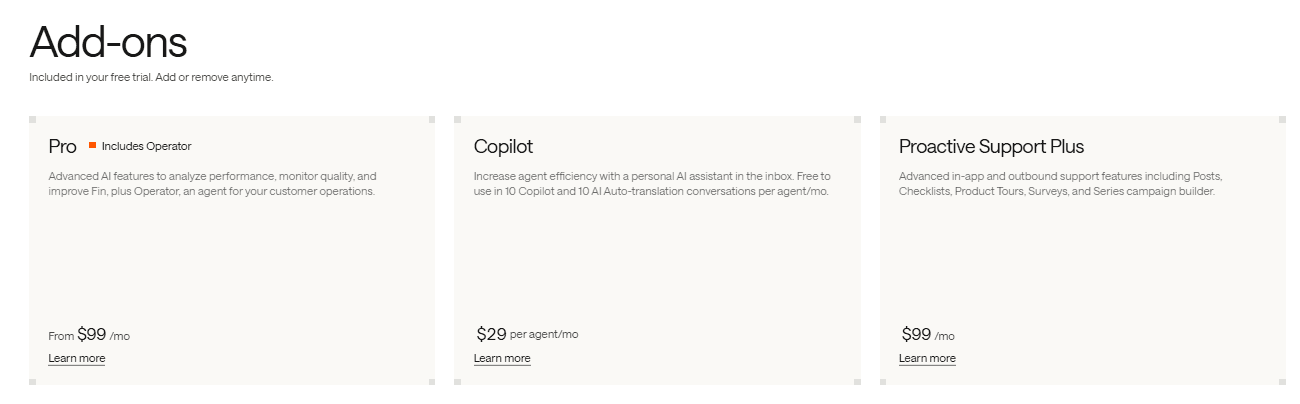
You also have add-on options, like Pro, which includes Operator, from $99/month, Copilot, $29 per agent/month, and Proactive Support Plus, where you’ll get advanced in-app and outbound support features including Posts, Checklists, Product Tours, Surveys, and Series campaign builder for $99/month. Intercom also offers 93% off for startups.
What stands out in this pricing page is the $0.99-per-resolution charge for the Fin AI Agent. Most SaaS companies still sell AI features the same way they sell seats, a flat fee regardless of whether the feature actually does anything for the customer that month. Fin flipped that. You only pay when Fin resolves something.
That single design choice answers the question every AI buyer is quietly asking before they sign: does this actually work, or am I paying for a demo that never scales into real use? Userpilot's 2026 review of SaaS pricing models points to exactly this shift, noting that outcome-based charges tied to AI agents let vendors grow fast because the price tag doubles as a performance guarantee.
Fin was also early to this. The model launched back in 2023, a year or more ahead of most competitors still charging flat AI add-on fees, and it is a large part of why the pricing page reads as confident rather than defensive.
💡 Steal This: If your product can measure its own outcome, whether that is a resolved ticket, a closed deal, or a completed task, price against that outcome instead of a flat fee. It turns your price tag into proof the product works, which is a stronger sales argument than any case study.
Differentiators and Unique Assets
Early Stage Startup program

If you are a startup, you can get 93% off Intercom + 1 year of Fin free. Fin AI Agent delivers seamless, personalized experiences across the entire customer journey, from sales to support. Intercom Early Stage pricing includes 300 free Fin outcomes, 15 free sales qualifications per month, and the Intercom Helpdesk from $33 per month. To apply to this program, you need to fill out a form.
In year 2, you’ll get 50% off, including 150 Fin outcomes and 15 Fin qualifications; phone, SMS, and WhatsApp are charged at list price; and in year 3, 25% off, including 75 Fin outcomes and 15 Fin qualifications. Phone, SMS, and WhatsApp are charged at list price.
The strength of this program is what it filters for. A 93% discount plus a free year of Fin costs Fin very little in absolute revenue at that stage, since an early startup is not spending much regardless. What it buys instead is a bet on which companies become the case studies Fin needs three years from now.
The three-year taper, from 93% off to 50% to 25%, is built so that a startup graduating into real usage pays real price right as its usage numbers become worth featuring on the customer stories page. This is a farming motion disguised as a discount. Fin is trying to own the AI-native support stack before a startup ever considers a competitor, so that by the time the company is large enough to matter, switching costs already exist.
Academy
With Fin Academy, you can develop the skills and strategies to launch and scale Fin to build perfect customer experiences. Here, you can attend webinars, from onboarding to deep dives from product experts and live Q&A, get certified, join the Fin Community, or attend office hours, the live, expert-led sessions where you get answers to your unique questions.
There are two free certifications listed as of August 2026: the Support agent certification and the Support manager one. The tests are in English, and you have 90 minutes to answer the 55 questions.
The Community Meetup Office Hours are held on Mondays by Community Top Experts and Intercom Consultants. These sessions are interactive and solution-driven, with the community at the center. Bring your real challenges and questions and work through them live with experts and peers who use Intercom and Fin every day. To register, you need to fill out a form, where company is mandatory this time.
On their Community page, you’ll find Fin best practices and tips, product wishlist, the Academy, and the Help Center. There are three groups you can join: Connect with Fin users, Ask the Intercom Team about Fin, and Fin Product Feedback Member Group.
From this page, you can also check out the Intercom for Developers page, the Partner Program, and the Hire and Expert one.
On the Developers page, you can see the App Store, build and list an app, create a custom integration, and read the guides (Tickets + GitHub Issues, Reporting and Inbox apps for admins.
On the Partners page, you are promised you will grow with the industry leader, earn commission on clients you refer to Intercom, expand your services with AI, and get guidance from your dedicated partner manager on training, certifications, and integrations. If you want to apply, you are redirected to the chat box available on the bottom right side of the page.

If you want to hire an expert, you can choose from eight people. Their bio offers info about their experience, and you can see from the preview if they are accepting new clients, or you can join the waitlist. You can filter the results by project type, services, budget, and free discovery call.
The budget spans from under $1,000 to over $25,000, and you can choose from: advisory session, project implementation, ongoing support, or training/workshop.
Taken together, Academy, Community, Office Hours, the Developer page, the Partner Program, and Hire an Expert are not five separate assets. They are one funnel for turning a paying customer into an unpaid advocate.
Academy certifications give an individual user a personal credential that outlives their current job. Community groups and Office Hours give that same user a reason to keep showing up even after onboarding ends. The Partner Program and Hire an Expert marketplace extend the same logic outward, turning consultants and freelancers into a distribution channel Fin does not have to pay a media budget for.
The through-line is that Fin built an entire second product around making its own customers and partners do part of its marketing and retention work for it, at a much lower cost than a traditional customer marketing team would run.
💡 Steal This: Build your customer education program to outlast the person's current role. A certification a user can list on their own resume gives them a personal reason to stay fluent in your product long after their manager stops paying attention to renewal.
Leadership Presence Analysis
Eoghan McCabe, CEO

Eoghan McCabe, the CEO of Fin, has 15,800 followers on LinkedIn. He posts Fin updates a few times a month. His average engagement is around 350 reactions, 30 comments, and 40 reposts. There are still some posts that have greater engagement. His latest post from two months ago, about signing the agreement for Salesforce to acquire Fin for ~$3.6B, has gained 7,600 reactions, 517 comments, and 346 reposts.
Eoghan McCabe treats LinkedIn less like a marketing channel and more like a personal ledger of the company's biggest moments, posting only a few times a month but landing over twenty times his usual engagement the one time he had real news to share.
Social Media Strategy

On LinkedIn, Intercom has over 189,700 followers. They post a couple of times a week, mostly promoting their Blueprint Newsletter. The average engagement is around 20 reactions, 5 comments, and a few reposts per post.

The Fin company page has almost 200,000 followers on LinkedIn. They post here multiple times a day, with the average engagement on a post being 30 reactions, 5 comments, and 5 reposts. Here, they talk more about case studies, talent acquisition, and product updates.
We should see, after the full merge with Salesforce, what their feed will look like. At first glance, it seems that they focus more on Fin than Intercom.

On Facebook, Intercom has 39,000 followers. The channel is dormant, with the last post in 2023 and a cover photo change in 2024. The average engagement on a post was 10 likes, 3 comments, and 1 share. Here, they posted more news-like content, promoting different press releases and updates. Since the channel is not active, we will not analyze it in the next section.

On Instagram, Intercom has 1,935 followers and only 1 post shared in May this year. The post was a carousel about Intercom 2, which has 20 likes and 6 comments. There is no link in bio or anything related to their website. We couldn’t find an account linked to Fin, so either this profile is in a rebranding process, or it is a new one. Due to these facts, we will not analyze this channel further either.
X (formerly Twitter)
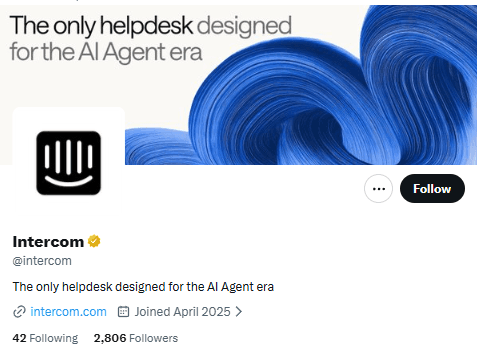
On X, Intercom has only 2806 followers. This is a small following count, considering the fact that the account was made in April 2025. Here, they post mostly about Fin, sharing videos and pictures from events and product updates. The average engagement is almost none, with posts gaining around 200 views.
The last post from 8th May 2026, where they shared a video from their Fix x Anthropic meeting, received 2.4 k views, 6 comments, and 6 likes. There are no other posts to analyze in the last three months, so this platform will be skipped for now.
On the other hand, the Fin account has 45,100 followers on X. They post multiple times a day, almost the same content as on LinkedIn. The pinned post showed the Salesforce acquisition from June. The engagement varies a lot from post to post. Some of them have only 100 views; others have 195,000.
TikTok

On TikTok, Intercom has 389 followers and 2,530 likes in total. The most popular videos are green-screen memes that have a little bit over 1,000 views. They are reusing content from meetups and webinars, but we couldn’t find any other videos made for this platform. The posts receive, on average, 10 likes, with no comments and 1 save. The latest posts are from 2025, which gives us the same result as on the other platform: no more content to analyze.
YouTube

On YouTube, we found only the Fin channel. They have 16,000 subscribers and 2.1M views from 911 videos. Since the info from the channel description shows us that this account was made in 2015, we can only conclude that this is Intercom’s former channel.
They feature four podcasts: / ideas, The Ticket: The Future of Customer Service, with Intercom, Fin AI podcast, and Intercom on Product: Building Software in an AI-first world. On the Courses tab, you can find Optimize Fin, and on Live, Building the helpdesk for the AI era and Fin x Attio: How Modern GTM Teams Sell with AI | London | April 2026.
They also share Shorts that are snippets from conferences, events, and podcasts. We couldn’t find content made specifically for this format. They have multiple playlists, revolving around Intercom and Fin, like Working at Intercom, Intercom Employee Spotlights, and Customer Stories.
Conculsion
Taken as a whole, this is a two-channel company wearing a six-channel presence. LinkedIn and X carry real, current activity, mostly under the Fin name, while Facebook, Instagram, and TikTok all show the same pattern: a channel that either went quiet before the rebrand or never got built out past a handful of posts. The split lines up almost exactly with where a B2B SaaS audience is.
Nobody buying a helpdesk is discovering Fin through a TikTok green-screen meme, so the neglect there costs little. But it also means the rebrand happened faster than the social team could clean house behind it, leaving dormant Intercom-branded accounts sitting next to active Fin ones, a detail any visitor doing due diligence before a purchase would notice.
Top-Performing Content
In the last month on Fin’s page, these are the top posts:

The single-image Fin x Plaid post, which has 106 reactions, 5 comments, and 12 reposts.

A video announcing Chili Piper integration, which has 70 reactions, 6 comments, and 14 reposts.

And a video about Fin Product Updates, regarding Intercom Phone Dialtones, that has 68 reactions, 7 comments, and 2 reposts.
All three top posts are integration or product news, and this is what earns reactions from an audience that scrolls LinkedIn to see what tools are shipping, not to be entertained.
X (formerly Twitter)

The post about Fin joining Salesforce has 195k views, 569 likes, 65 reposts, and 19 comments. Other than this big news, it seems that videos drive more traffic compared to single images or text-only posts. Almost every video has over 1,000 views, while the other barely hit 300. Another post that did well was the Fin x Fyxer meetup, which has 1,3k views, 2 comments, 2 reposts, and 3 likes, and the post about Evals and Releases, with 1,4k views, 1 comment, 2 reposts, and 7 likes.
Video consistently outperforms static images or text-only posts here, and the account's single biggest post rode a real news event, the Salesforce deal, rather than manufactured content, which fits a platform built for speed and live reaction over polish.
YouTube

The top long-form videos are:
Fin, helping your company get its 💩 together since 2023., with 400k views, 19 likes, and 1 (not-so-nice) comment.
Fin AI Copilot by Intercom: an AI assistant for every support agent, with 187k views, and no likes. The comments are turned off for this post.
Hi, Robot: Intercom interviews ChatGPT, with 127k views and 1k likes. The comments are turned off as well.
The views-to-likes ratio suggests that these videos were probably used for ads.
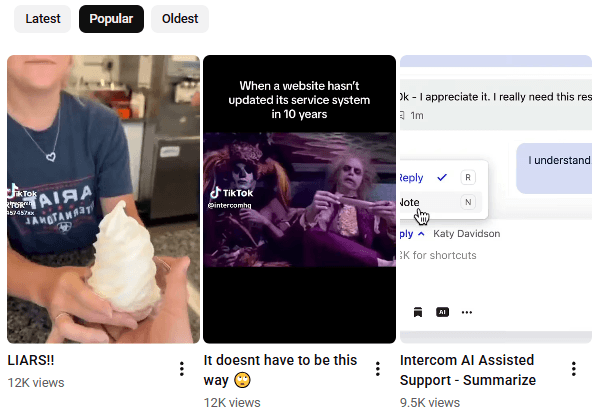
For the Shorts, we have:
LIARS!! With 12.5k views, 223 likes, and 7 comments, a funny video where they took another video and created a meme showing the beef between Customer Service and Sales reps.
It doesnt have to be this way 🙄, with 12.2k views, 626 likes, and 1 comment, featuring a meme from the Beetlejuice movie, showing the pain when a website hasn’t updated its service system in 10 years.
Intercom AI Assisted Support - Summarize, with 9,5k views, 90 likes, and no comments, which features the AI Assisted Support.
The thing we need to mention is that the memes were actually downloaded from TikTok, with the watermark, which we all know is a big no-no. Social media platforms aren’t best friends, but more like frienemies. You need to have your videos clean, with no watermark. Otherwise, you will be penalized by the algorithm gods.
The top long-form videos carry huge view counts next to almost no likes or comments. This pattern reads less like organic interest and more like paid amplification behind the scenes, while the actual organic wins live in the Shorts, where memes and humor pull real engagement numbers a straight product video never gets.
Put together, the common thread across all three channels is that the content native to each platform's culture beats content built for a brand deck. LinkedIn rewards specific, concrete news. X rewards movement and real-time relevance. YouTube's organic audience rewards a joke over a pitch, even while its paid reach quietly rewards the pitch anyway.
Fin's best-performing posts on each channel are the ones that stopped trying to sound like the same company saying the same thing everywhere, and started sounding like whoever lives on that platform.
Paid Advertising Strategy
On LinkedIn, Intercom runs 657 ads. They all use the same image with the copy: Get perfect customer experiences without migrating platforms. The caption says: Trusted by 12,000+ businesses, Fin is now available in Salesforce Service Cloud, bringing industry-leading AI to the platform your team already uses, and the headline is The AI your support team needs.

On Meta, they are running 110 ads, mostly single-image. The one thing that stands out is that most of the ads have a low impression count. The ads run across Facebook and Instagram only. The copy that appears the most is: Fin is the best-performing AI Agent for customer service, powerful enough to resolve even the most complex queries like refunds, account changes, technical troubleshooting, and more.

On Google, Intercom runs 400 ads on Shopping, over 2,000 on Search, and 4 ads on YouTube. Most of them are text-only, and these are some of the copy used for headlines:
Fin. The #1 AI Agent
AI Chatbot for Website
AI-Enhanced Live Chat
AI-Powered Ticketing Software
Customer Engagement with AI
The paid strategy signals a hybrid motion rather than a pure sales-led or product-led approach. The LinkedIn ad volume (657 ads on one static image) and Google Search volume (2,000+ ads) point to broad, always-on demand capture rather than tightly targeted account-based marketing.
There is no visible sign of persona-specific landing pages or industry-segmented ad copy, which would be the clearest ABM signal. What is present instead is scale: the same core message, "perfect customer experiences without migrating platforms," repeated across formats and platforms, aimed at capturing anyone actively searching for a helpdesk or AI agent rather than pursuing named accounts.
Sales Funnel from Social Media
On LinkedIn, they are putting the links in the comments to their resource, but on any other channel, the main source back to their website is the link in bio, which sends you to the main page. From there, you have the Contact Sales and Start Free Trial sticky buttons in the top-right part of the screen. These buttons are repeated constantly throughout the homepage.
If you click on the Free Trial button, you’ll need to fill out the company email, and for Contact Sales, they request the business email and company size. For both, you can opt in to receive their newsletter.
The reasoning behind this structure is straightforward once you separate the platforms by what each one is built to do. LinkedIn is a research and validation channel, so putting resource links in the comments rather than the post body matches how LinkedIn's own algorithm treats external links, which get less reach than a comment-based link.
Every other channel routes back to the same homepage rather than a channel-specific landing page, which keeps the funnel simple to maintain but means Fin is not tailoring the entry experience to what brought someone there, whether that was a founder story on LinkedIn or a product demo on YouTube.
The gap is the disconnect between the CTA structure and the channel content. A viewer who just watched a technical product update video and clicks through lands on the same homepage as someone who saw a general awareness post, with the same two buttons: Contact Sales or Start Free Trial.
There is no middle path offered for someone curious but not ready for either. Recent data on trial design supports the size of that gap. Glimpze's 2026 review of ChartMogul's SaaS Conversion Report found that opt-in, no-credit-card trials like the one Fin runs convert at a median of somewhere between 4 and 15%, depending on trial quality and follow-up. This is wide enough range that the difference often comes down to whether a company nurtures the trial user with a middle step instead of pushing straight to Contact Sales or nothing.
Reviews and Social Proof
On Intercom’s website, you can check the case studies and testimonials for proof. Featured testimonials on the homepage are from Anthropic, Glean, and Neo Financial. The customer stories feature 128 pages. What’s interesting on this page is that you can see what customers are sharing on socials.

On G2, Fin holds a 4.5 rating from over 3,900 reviews. The pros revolve around the ease of use, features, efficiency, and customer support, while people complain about missing features, AI limitations, learning curve, and poor customer support.

On Capterra, Intercom also has a 4.5 rating, but from 1,100 reviews. For ease of use, the product received 4.4, and for customer service, 4.3. On Trustpilot, they have a 2.9-star rating from 524 reviews.
The complaints here noted issues with customer service, pointing out excessively long response times. People frequently experienced frustrating delays and unhelpful interactions when trying to resolve technical problems with the support team. Reviewers mentioned being passed around between different agents without receiving clear answers or effective solutions for their inquiries. They usually reply to 86% of the negative comments and typically reply within 2 weeks.
On Glassdoor, Intercom has a 3.9 rating from a total of 480 reviews, with 76% of people who would recommend the company to a friend, 86% positive business outlook, and 70% of people approve of CEO Eoghan McCabe.
Do not spread review management effort evenly across every platform. Put your energy into the one or two platforms your actual buyer checks before a purchase, and let the others sit. G2's 2026 research on B2B buying found that when an AI chatbot recommendation conflicts with a buyer's expectations, nearly a quarter of them go straight to peer reviews next, which makes the right platform, not every platform, the one that matters.
Content Marketing and Demand Generation

Learn category has six pages: Why choose Intercom?, Small business, ROI calculator, Webinars & Events, Academy, and Blog. For Support, they have five pages: Help center, Developer hub, product updates, Safety & security, and Community. Intercom features four pages: the Early Stage Startup Program, Introducing Intercom2, AI Agent Blueprint, and 2026 Transformation Report.
Some of these are already covered in the Differentiators and Unique Assets part, so in this part we will focus on the remaining ones.
Intercom 2

AI has fundamentally changed customer service. Intercom 2 brings AI and human support together in one helpdesk, with 60+ updates across workforce management, real-time issue detection, and AI and Human QA. This version has over 60 improvements across the helpdesk. You’ll get Workforce management, Real-time issue detection, Monitors, and other product improvements.
Workforce management includes Fin volume and resolutions in your forecasts, so you can plan with a complete view of demand. Forecast, schedule, and track performance in one place. With real-time issue detection, AI analyzes every conversation to detect emerging issues, groups them, and notifies your team, so customers get the right answer even mid-incident.
Monitors give you continuous visibility into every conversation's quality. Review 100% of conversations, define what good looks like, and catch issues before they become patterns. Some of the product improvements are Slack side conversations, Delayed and undo send, and Edit notes.
Blueprint Content Hub

On the Blueprint page, you’ll find everything you need to deploy, scale, and transform CX with AI Agents, from articles and videos to proprietary research and deep-dive manuals. This page also features long-form videos, shorts, and events.
On this page, you’ll find The Service Agent Blueprint, the strategic map for launching and scaling AI in customer service. The Table of contents has an introduction, how to launch it, and how to scale it. The launch part is divided into: AI fundamentals, Deployment approach, Build a business case, Define criteria, Evaluate, Deploy, and Optimize. The Scale section is divided into: Transform your business, Customer experience, Org and system design, and Economics.
To access workbooks, you’ll need to fill out a form that requires your name and email, and company and job title are optional. The form also has a checkbox if you want to get updates about upcoming events, webinars, product announcements, and helpful resources.
The 2026 Customer Service Transformation Report

This report is an exploration of where teams are on the path to mature AI deployment, what’s impacting progress, and what it takes to move beyond adoption to real transformation. Get insights from over 2,400 support professionals worldwide, from NAMER, EMEA, LATAM + APAC, from the Q4 2025 time period, for senior leaders, managers, and associates.
The key findings are:
AI adoption is the norm, depth makes the difference
ROI becomes clearer with deeper integration
The bar has moved from “does it work?” to “is it actually good?”
Important support work now extends beyond the inbox
Support is creating the blueprint for AI deployment across the business
To download the report, they require a name and email, and company and job title are optional, just like on Blueprint workbooks.
The Why choose Intercom page and the Small business pages reduced buyer friction. Both of the pages offer product descriptions, along with testimonials, named brands, and feature descriptions. The pages close with the transparent, outcome-based pricing, like we’ve seen on almost every page on their website.
On the ROI calculator page, you can see the impact Fin could have on your business. You need to complete the number of conversations per month, the number of customer support employees, the annual cost per employee, and the resolution rate. The calculator will show how much money the Fin AI Agent will save you and the ROI percentage.
Webinars

On Fin Webinar Hub, you’ll discover thought-provoking roundtables, in-depth customer support discussions, customer case studies, product demos, and more. You can see the upcoming and on-demand webinars, and you can register for product education and onboarding webinars.
Every webinar has a description and a speaker panel with names, job titles, and their LinkedIn profiles. Other webinars are linked and marked as resources.
Blog

Intercom’s blog has five categories to choose from: Product & design, AI & Automation, Customer Service, News & Updates, and The Ticket. Articles are structured normally with H2, H3, hyperlinks in text, screenshots and tables, author’s byline, and reading time.
The Ticket is their podcast, started in 2025. As of today, they haven’t continued the series. The last post in this category is from September 22, 2025. Some of the topics include: Scaling support through trust, education, and AI innovation, Clay’s rotational program creating future leaders through customer service, and The Secret to Sustaining 75%+ AI Resolution Rates.
What they get right is how little they ask for. Both the Blueprint workbooks and the 2026 Transformation Report require only a name and email, with company and job title left optional. That is a two-field form sitting well below the point where most B2B forms start losing people.
Digital Applied's 2026 form conversion benchmarks, covering field count across thousands of B2B forms, found conversion drops from 23.1% at three fields down to 11.4% at seven, with the steepest part of that decline starting right around five fields.
By keeping the required fields at two, Fin is deliberately trading some lead-qualification data for a much higher number of people who actually get through the gate, betting that volume plus later nurture beats a shorter list of pre-qualified names
Marketing and Sales Funnel Stages
TOFU (Top of Funnel)
Awareness runs through the blog, the YouTube channel, and LinkedIn. The blog's five categories and the four podcasts on YouTube (/ideas, The Ticket, Fin AI podcast, and Intercom on Product) build a steady stream of content aimed at people who are not ready to buy yet, but trying to understand how AI is changing customer service. The 2026 Customer Service Transformation Report also sits here, pulling in readers through the research angle rather than the product angle.
MOFU (Middle of Funnel)
The ROI calculator, the ungated ebooks turned into gated workbooks, and the webinar hub carry the middle of the funnel. A visitor who wants to see the Fin AI Agent's savings potential fills in conversation volume and headcount numbers, which is a soft qualification step disguised as a helpful tool. The Blueprint content hub and its Service Agent Blueprint push the same idea further, giving away a full strategic framework in exchange for a name and email.
BOFU (Bottom of Funnel)
The Contact Sales and Start Free Trial buttons repeat throughout the homepage and stay sticky at the top of the screen. Free Trial only asks for a company email. Contact Sales asks for a business email and company size, the two fields a sales team needs to route a lead correctly without adding friction that would scare off a self-serve buyer. The 93% startup discount sits here too, aimed at converting price-sensitive early-stage teams who would otherwise choose a cheaper competitor.
Retention
The Academy certifications, the Community groups, and the Hire an Expert marketplace all point toward keeping customers inside the ecosystem after the sale closes. A support agent who gets certified through the Academy has a personal reason to keep using the product well after their manager stops paying attention to the tool. The customer stories page, with 128 entries, functions as a retention signal as much as a sales one, since a new hire on an existing account can see how other companies use the product.
💡 Steal This: Do not treat your ROI calculator as a nice-to-have page. Structure it to collect the two or three data points your sales team needs to qualify a lead, and you get a middle-of-funnel tool that does top-of-funnel volume and bottom-of-funnel qualification at once.
Future Plans and Growth Indicators
On Intercom’s Career page, as of August 2026, they have 118 open positions. The locations listed are: Berlin, Chicago, Dublin, London, San Francisco, and Sydney. The teams with the most job openings are: Sales (32), Customer Success & Solutions (17), Engineering (17), AI Group (14), and R&D (13).
The latest product updates from their Changes page are: the new Phone tab on the Inbox Dashboard that puts it all in one place and updates in real time, Fin for Sales directly to your HubSpot account, and you can play in-call hold music.
In June, Salesforce acquired Fin for $3.6B. The transaction is expected to close in the fourth quarter of Salesforce’s fiscal year 2027. The CEO wrote that with the resources of Salesforce, they hope to accelerate their work, and stated: “I’ll still be CEO, Des will still be running R&D, we’ll both still be committed to continuing to lead this category. Thank you very sincerely and deeply for your belief in us.”
Inspiration Points
Charge for the outcome when your product can measure the outcome directly.
Fin's $0.99-per-resolution model works because it removes the buyer's guesswork about ROI before the contract is even signed. Recent research from Userpilot's 2026 review of SaaS pricing models found that outcome-based approaches like Fin's have let AI agent vendors scale from single-digit millions to well over $100M in ARR by tying price directly to a metric the buyer already tracks.
Put a real number in front of a buyer before they talk to sales.
The ROI calculator does the work a discovery call used to do, letting a prospect self-qualify by seeing their own potential savings. This is the Jobs To Be Done principle in practice: buyers are shopping for a number that justifies the switch to their own boss.
A certification program keeps users invested past the sale.
Fin Academy's free certifications give individual users a reason to stay sharp on the product regardless of whether their manager renews the contract. Intellum's research, summarized in TryTami's 2026 customer education report, found that companies with formal customer education programs saw measurable gains in both revenue and retention tied directly to the education layer, not the core product.
Ask for less than you think you need at the gate.
Fin's Blueprint workbooks and its 2026 Transformation Report both require only a name and email, leaving company and job title optional. Digital Applied's 2026 form conversion benchmarks, drawn from thousands of B2B forms, found conversion falls from 23.1% at three fields to 11.4% at seven, with the steepest drop starting around five. A shorter form trades some lead-qualification data for a much larger number of people who make it through the gate.
Time your discount to end right when the customer becomes your proof.
The Early Stage Startup Program tapers from 93% off to 50% to 25% over three years, a curve that lines up with how long it takes a startup to grow into the kind of usage worth featuring on a customer stories page. This is land and expand applied to pricing itself, not just to seats. Fin is not trying to make money on a year-one customer. It is buying the right to claim that customer once they are big enough to matter.
Turn your customers into your distribution channel.
Academy, Community, and the Partner Program are not three separate assets sitting on a website. Together they push certified users and partners to advocate for the product without Fin paying a media budget for it, the same logic behind community-led growth motions that rely on the crowd to do outreach a sales team would otherwise have to fund directly.
Frequently Asked Questions
Why did Intercom rebrand to Fin?
Fin was originally the name of Intercom's AI agent product. As that product grew to represent the bulk of the company's new revenue and its next chapter of growth, leadership renamed the entire company after it in May 2026, ahead of the Salesforce acquisition announcement.
How much did Salesforce pay for Fin?
Salesforce agreed to acquire Fin for $3.6 billion in June 2026. The deal is expected to close in Salesforce's fiscal 2027 fourth quarter.
Does Fin have a free trial?
Yes. Fin offers a 14-day free trial with no credit card required, alongside a live demo option, both promoted through sticky buttons across the homepage.
What does Fin's pricing model look like?
Fin uses a tiered seat-based model for its core Intercom helpdesk (Essential, Advanced, Expert), plus an outcome-based charge of $0.99 per resolution for the Fin AI Agent itself, whether or not the buyer uses Intercom as their underlying helpdesk.
Who is the CEO of Fin?
Eoghan McCabe, a co-founder of the company since 2011, remains CEO through the Salesforce acquisition process.
Does Fin have a Chief Marketing Officer?
Not currently confirmed. The company's last named CMO, Anna Griffin, left in February 2023, and no successor has been publicly announced. President Archana Agrawal, a former CMO herself, appears to carry much of the external growth narrative in the meantime.
Is Fin active on social media?
Unevenly. LinkedIn and X carry active, frequently updated Fin accounts. Facebook, Instagram, and TikTok are dormant or inconsistent, with little to no posting in the last year.
What is Fin Academy?
A free certification program covering Fin support agent and support manager skills, delivered through webinars, office hours, and a community group, aimed at customer teams who want a formal credential in using the product.
Does Fin run paid ads?
Yes, across LinkedIn, Meta, and Google, with a heavy concentration on Google Search (over 2,000 live ads) and a smaller, more visual push on LinkedIn and Meta built around a shared core message about avoiding a platform migration.
What do reviewers say about Fin?
G2 and Capterra reviewers rate Fin around 4.5 stars, citing ease of use and efficiency as strengths and AI limitations and support responsiveness as weak points. Trustpilot reviewers, a different and less software-specific audience, rate the company closer to 2.9 stars, largely over customer service response times.