Marketing spotlight
/
Marketing Spotlight: Mapping Cursor's Marketing and Sales Tactics (2026)
Cursor is the AI-native code editor that hit $3 billion ARR by May 2026, three years after launch. This article maps the marketing and sales machine behind that number.
TL;DR: Conclusions and Key Takeaways
🎀 This section gives you the main insights without all the details. It’s the stuff you need to remember, whether you’re reading this now or in 6 months. We made this for people who want to get the core message fast.
Cursor (built by Anysphere) is the AI-native code editor that hit $3 billion in annual recurring revenue by May 2026, three years after launch. This article maps the marketing and sales machine behind that number.
Let the product ship the marketing. Cursor's fastest-growing channel is the product itself, not paid ads or campaigns.
Build a community before you need it. 700+ events, 300+ ambassadors, and a global meetup program create word-of-mouth at scale.
Use your enterprise page as a closing argument. Cursor leads with named testimonials from Salesforce, PayPal, and Fox before explaining a single feature.
Post product updates like news. On LinkedIn and X, Cursor's highest-engagement posts are product announcements, not thought leadership or branded content.
Let the review gap tell you something. Cursor has a 1.7-star Trustpilot rating and an unclaimed profile. That contradiction between product love and public reviews is worth understanding.
Hire for GTM late, but hard. The careers page in June 2026 lists dozens of sales, solutions, and marketing roles. The hiring surge shows exactly where the growth bet is now placed.
📝 A quick note before you start reading: The data and analysis in this article are valid as of the time we wrote it. We don’t know when you’ll be reading this, maybe next week, maybe six months from now, and things might have changed since we looked at this company’s marketing and sales approach. Still, the insights and lessons here stay useful, even if the numbers or tactics have evolved a bit.
A cursor is just a blinking line that sits there and does nothing until someone starts typing. Cursor, the company, asked: what if the blinking line did the typing for you?
The answer turned out to be worth $29.3 billion.
Here at Milk and Cookies Studio, we spend a lot of time thinking about companies that grow without always being able to explain how. Cursor is one of those. The product grew itself. But the product is not the whole story. This article is about what sits around it: the community infrastructure that generates word-of-mouth at scale, the paid ad operation that most people overlook, the enterprise page design that does real conversion work, and the Trustpilot rating that nobody at Cursor appears to be watching.
We write Marketing Spotlight articles to give B2B SaaS founders and marketing leaders a close look at the decisions companies worth studying are making. Cursor is worth studying.
The data and analysis here are valid as of June 2026. The company moves fast, and things change.
Understanding Cursor
Cursor is an AI-native code editor built by Anysphere, Inc., founded in 2022 by four MIT students: Michael Truell (CEO), Sualeh Asif (CPO), Aman Sanger (COO), and Arvid Lunnemark. Lunnemark left in October 2025 to found Integrous Research, an AI safety lab. The remaining three co-founders continue to run the company.
Cursor has its headquarters in San Francisco, California, and employs approximately 150 to 300 people, as of mid-2026. CNBC reported 300+ employees in November 2025.
The funding history is one of the fastest ramps in software.
October 2023: $8M seed, led by the OpenAI Startup Fund, with Nat Friedman (former GitHub CEO) and Arash Ferdowsi (Dropbox co-founder) as angels.
August 2024: $60M+ Series A at a $400M valuation, led by Andreessen Horowitz and Thrive Capital.
December 2024: $105M Series B at a $2.6B valuation, same lead investors plus Benchmark.
May 2025: $900M Series C at a $9.9B valuation, led by Thrive Capital with Andreessen Horowitz, Accel, and DST Global.
November 2025: $2.3B Series D at a $29.3B valuation, co-led by Accel and Coatue Management, with Nvidia and Google joining the cap table.
By May 2026, ARR had reached $3 billion. The company went from its seed round to a $29.3B valuation in 25 months.
The product is a fork of Visual Studio Code, rebuilt around AI rather than retrofitted with it. That architectural choice is the argument the founders have made publicly since the beginning: build the editor around AI instead of bolting AI onto an existing editor.
Brand Promise Analysis
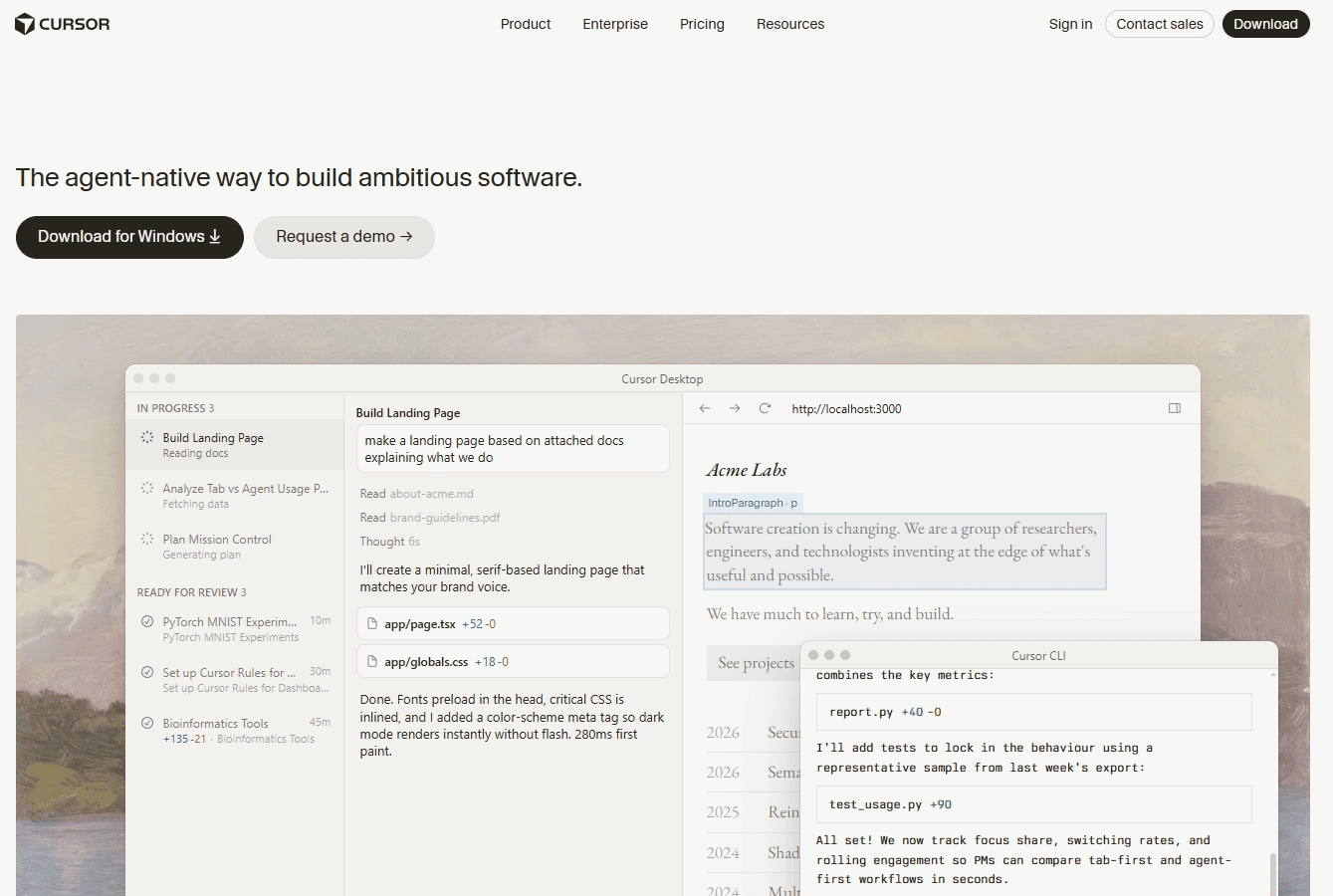
The headline of Cursor's homepage states: "The agent-native way to build ambitious software.”
There are no supporting paragraphs, no feature bullets. Below it is a Download button, a Request a Demo button, and a product screenshot. The homepage is organized around what the product does in each context (agents in the IDE, agents in the terminal, agents in Slack, agents reviewing GitHub PRs) rather than around a traditional value proposition hierarchy.
They make it simple for everybody entering their world. Simple, clean, and not at all as flashy as their competitors. Even the color scheme is simple, using light hues of beige, white, and black.

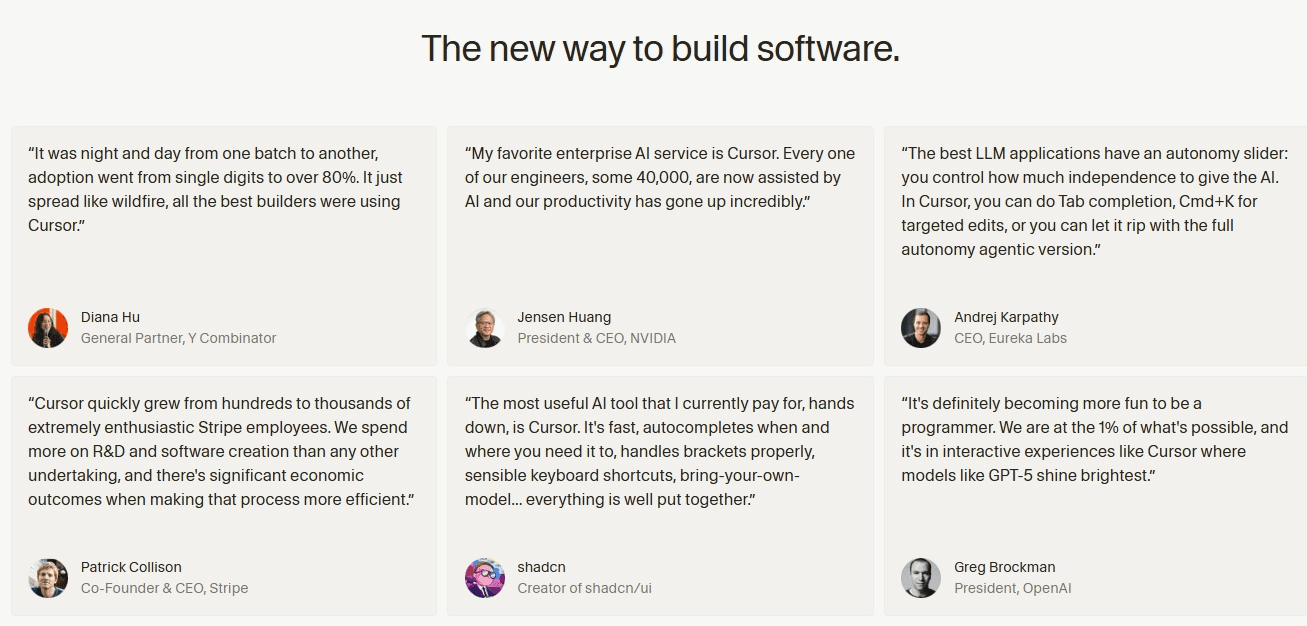
Below the fold, the first social proof element is a logos banner: "Trusted every day by teams that build world-class software" with big names like Stripe, OpenAI, Nvidia, Figma, and Adobe. No quotes, no stats next to the logos. Just the names, placed as if their presence is self-explanatory. Scrolling further, testimonials from CEOs and Presidents of those same companies reinforce the trust signal with named quotes.
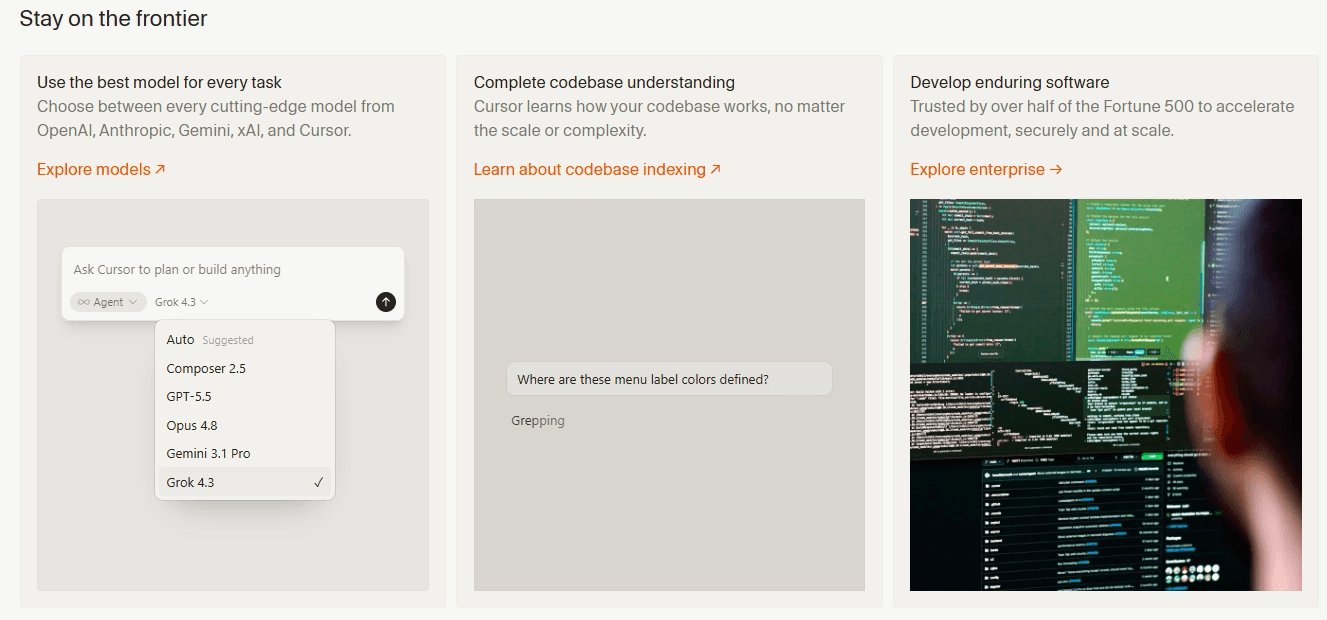
Their agents promise to turn your ideas into code, accelerating development by handing off tasks to Cursor, while you focus on making decisions. They work autonomously, using their own computers to build, test, and demo features end-to-end for you to review.
In every tool, at every step, Cursor runs in your terminal, collaborates in Slack, and reviews PRs in GitHub. Their specialized Tab model predicts your next action with striking speed and precision.
The brand position is confidence delivered without argument. Cursor does not explain why it is the best. It states that it is, shows you who else agreed, and gets out of the way.
This approach works at Cursor's current scale because the product's reputation precedes the homepage. Most visitors arrive already aware of Cursor. The page does not need to convince, but needs to confirm and convert.
A homepage this sparse is a PLG signal. Cursor's acquisition motion it starts when a developer sees a colleague using it, or watches a tutorial video, or reads about it on X. The homepage is optimized for the step after word-of-mouth, not before it. Companies that rely on paid acquisition to drive homepage traffic need more content above the fold, but Cursor does not.
💡 Steal This: If your product has strong organic demand in your category, resist the temptation to over-explain on the homepage. A short, confident headline and immediate access to the product convert better for developer audiences than a feature comparison table. The risk is assuming demand that is not actually there yet.
Service and Product Breakdown
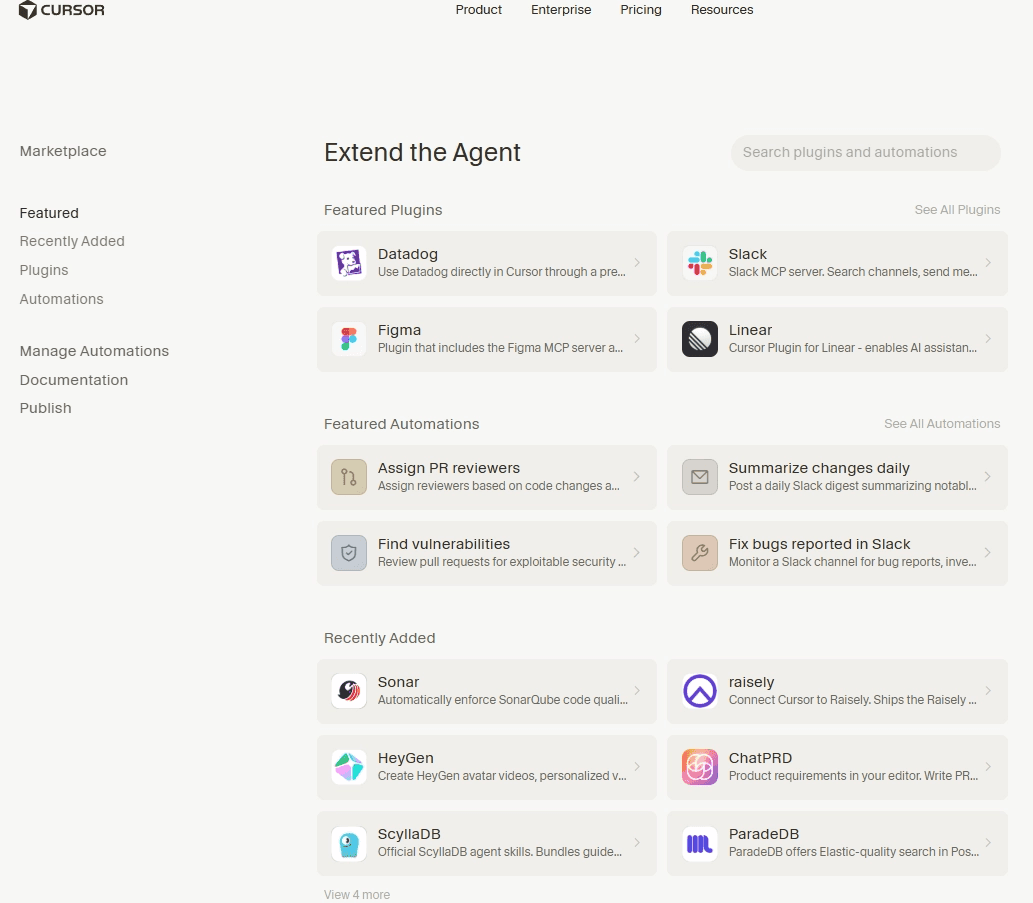
Cursor's product tab is divided into Agents, Cloud, CLI, Review, Tab, and Marketplace.
The Agents page describes how developers delegate implementation to focus on higher-level direction: "everywhere you work, you'll have one agent across every surface." Agents read the codebase before writing a single line, support every phase from planning to writing to reviewing, and can edit files, run terminal commands, search the web, and connect to external tools via plugins, skills, and MCPs.
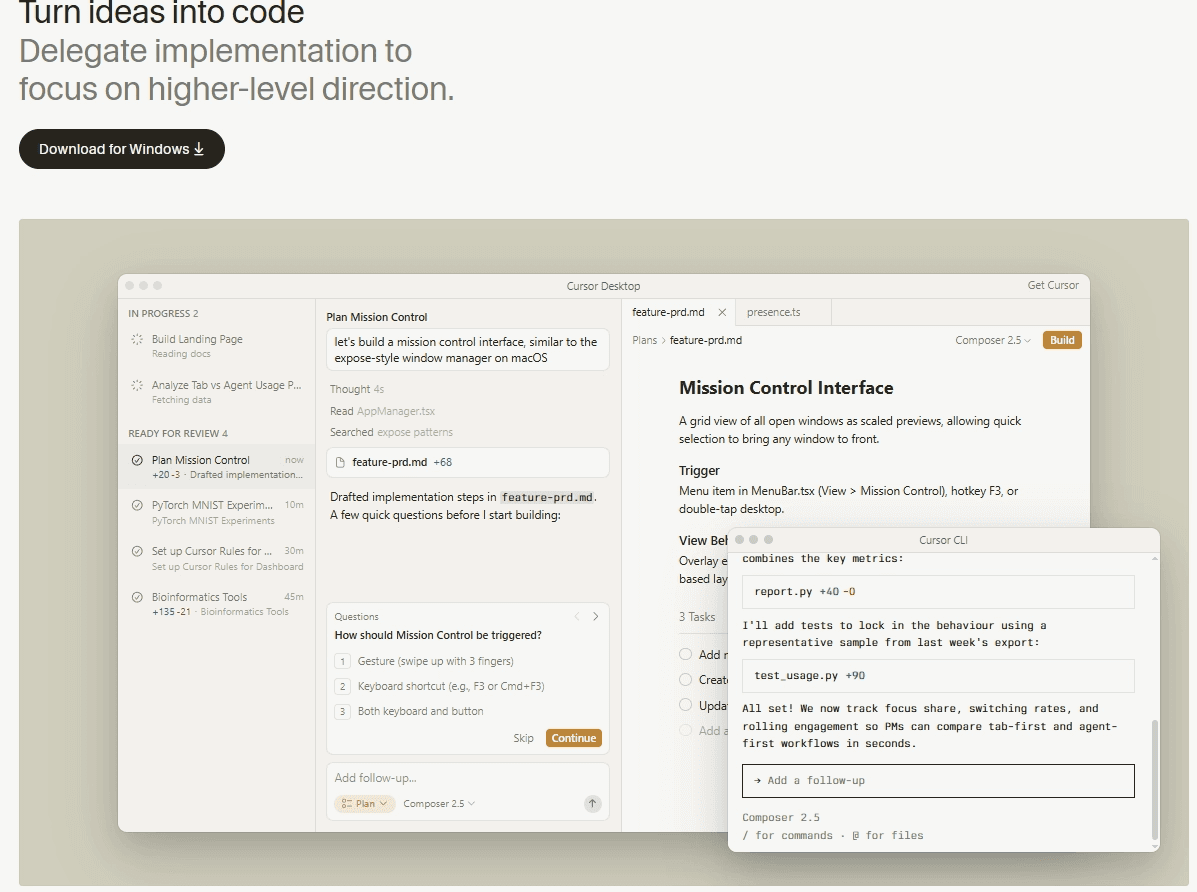
Testimonials from developers at eBay, OpenAI, Sentry, and The Browser Company appear on this page.
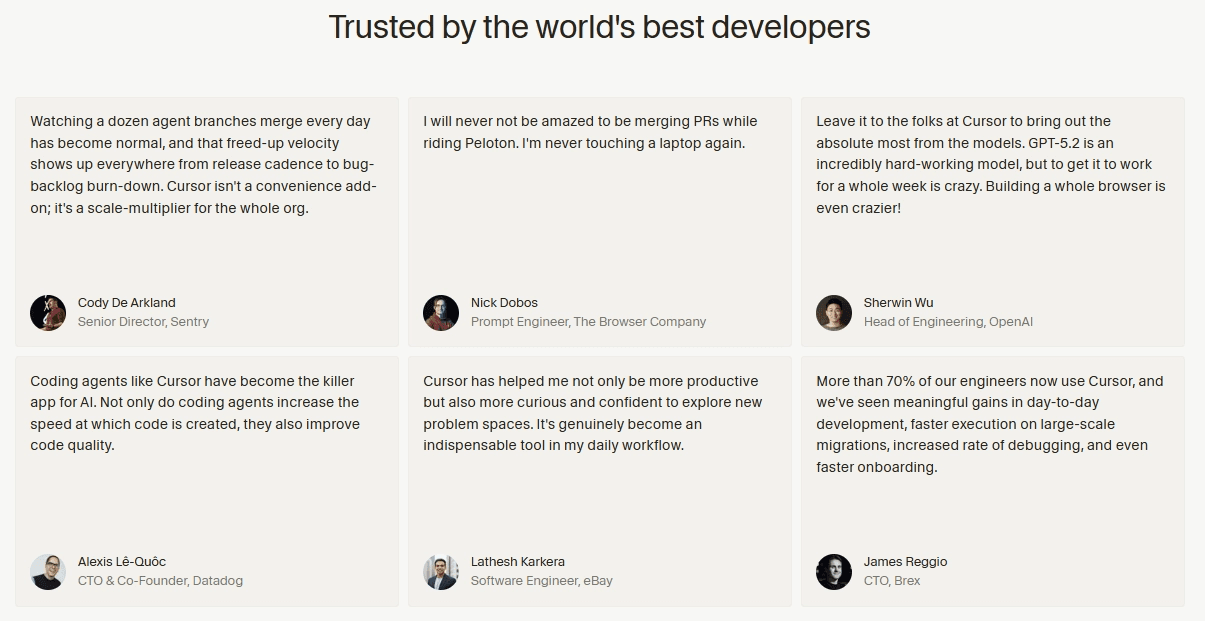
Cloud agents control their own computers to build ambitious software autonomously. Trusted by teams at Figma, Sierra, Clay, and Monday, they allow users to kick off and manage multiple agents in parallel from any surface. Cursor Automations continuously monitor and improve the codebase, test the software they build, and verify their work.
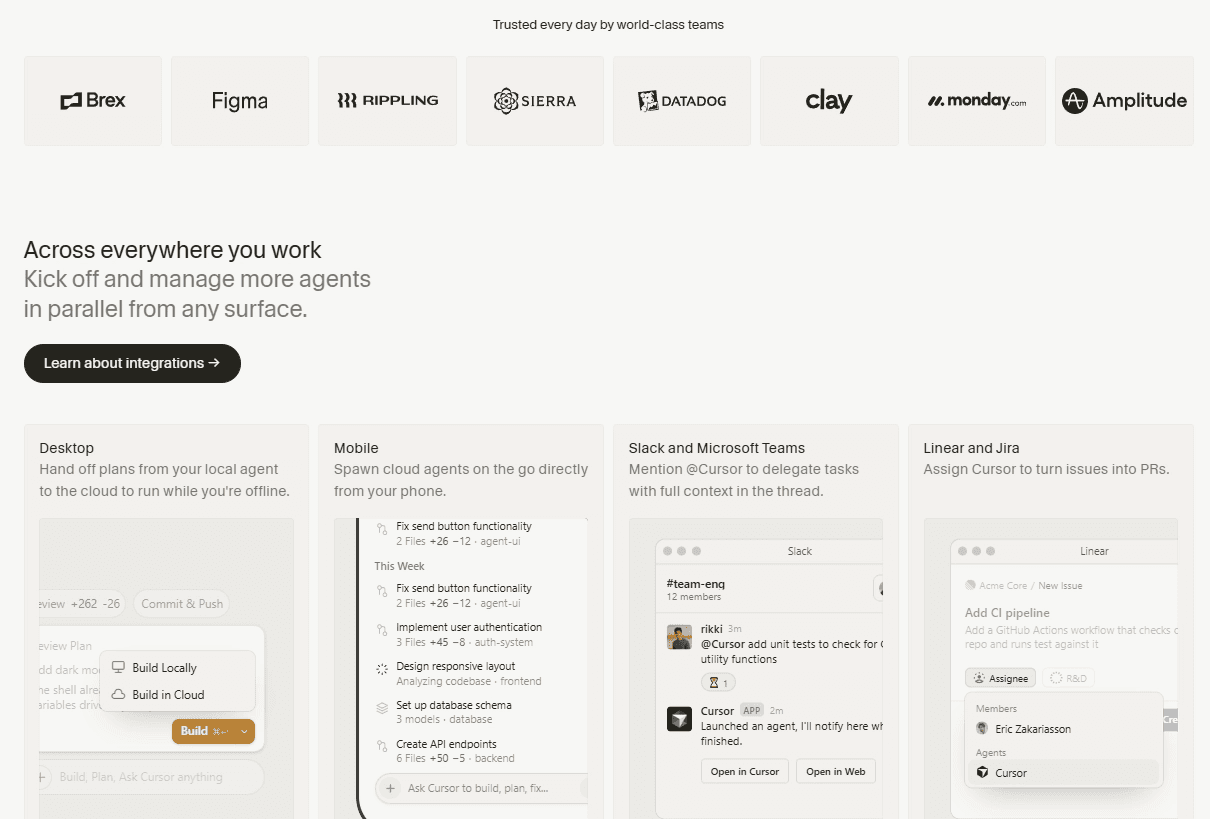
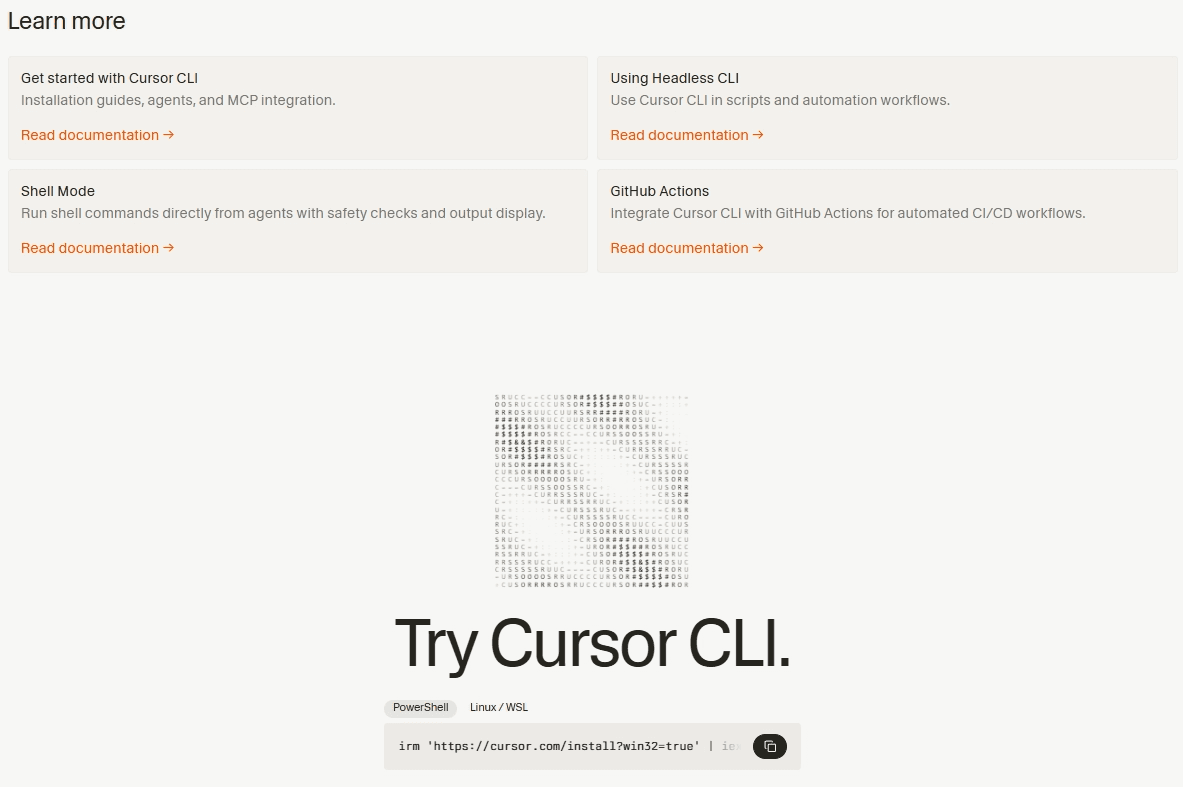
With their CLI, you can ship code with agents directly from the terminal. Access to the latest models, usable in any preferred IDE, with support for writing powerful scripts and automations.
Bugbot is the AI code review that catches hard logic bugs with a low false-positive rate, Tab is a next-action prediction that anticipates where you're headed and suggests changes, and Marketplace is a page of featured plugins, recently added tools, automation, documentation, and a publisher application that requires sign-in.
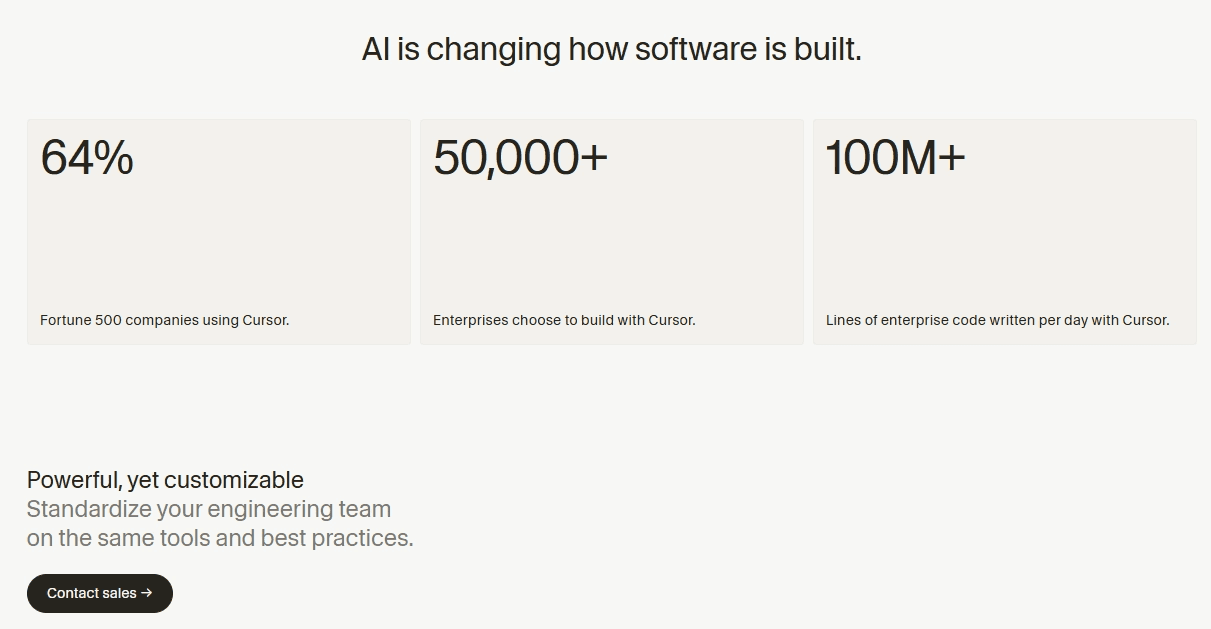
They have a dedicated Enterprise page that prominently showcases customer testimonials and "trusted by" logos to build credibility. To further reinforce adoption at scale, they highlight several key metrics: 64% of Fortune 500 companies use Cursor, more than 50,000 enterprises build with the platform, and over 100 million lines of enterprise code are written with Cursor every day.
Of course, enterprise readiness is also demonstrated through security, compliance, and support offerings. Cursor emphasizes dedicated onboarding and guidance, premium support, zero data retention, identity management features such as SAML-based SSO and SCIM provisioning, centralized security controls, GDPR and CCPA compliance, third-party certifications including SOC 2 Type II, annual penetration testing, AES-256 encryption for data at rest, and TLS 1.2+ encryption for data in transit.
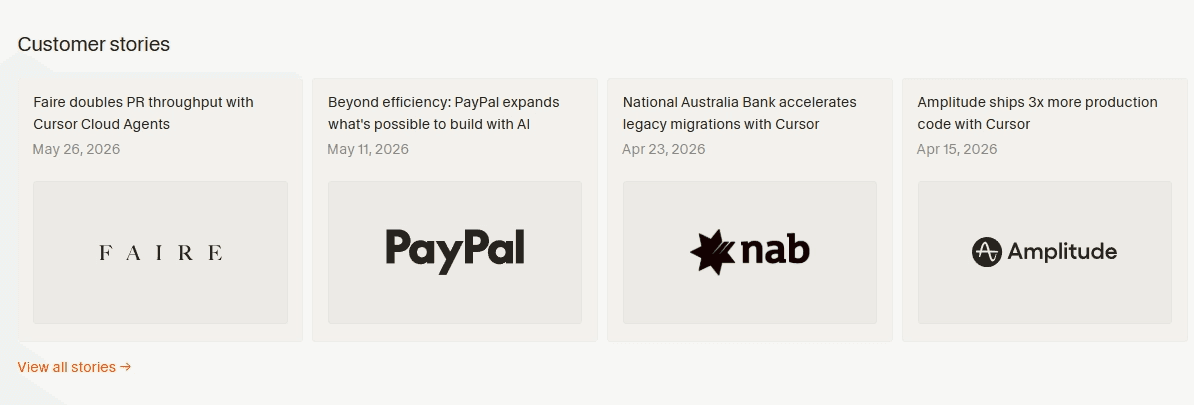
The page also features customer success stories, including case studies that were added as recently as two weeks ago, helping demonstrate continued enterprise adoption and real-world results.
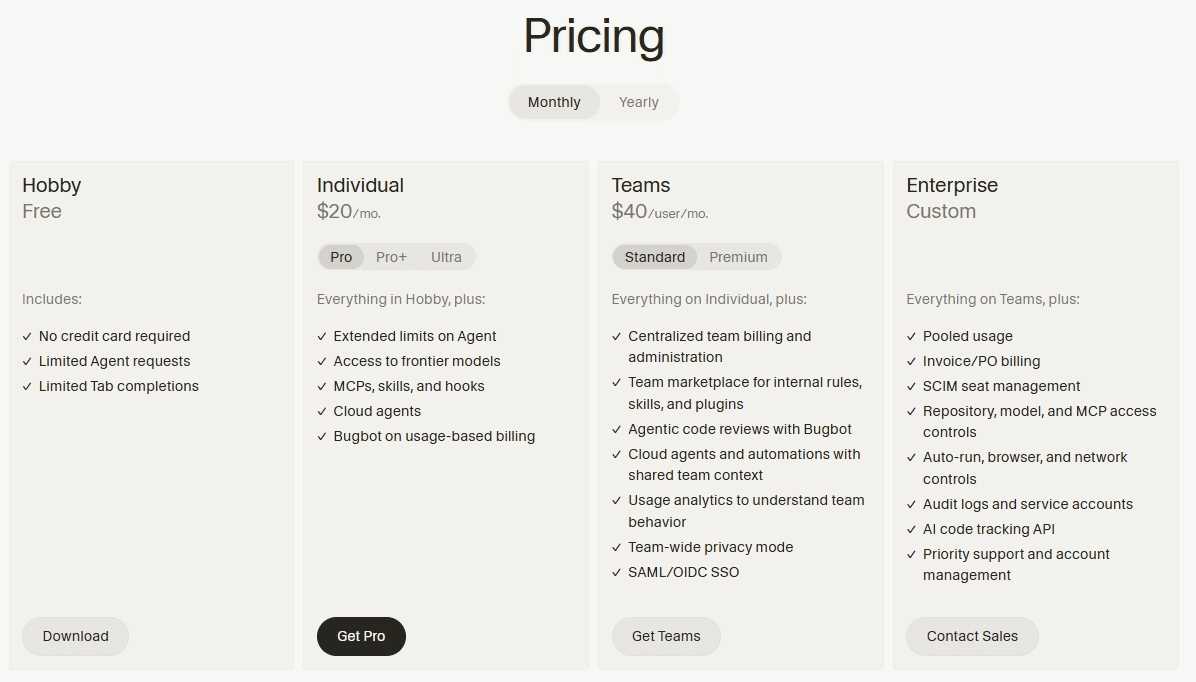
Pricing tiers
With Hobby (Free), you have limited agent requests and tab completions. The free tier exists to get developers inside the product before any commercial conversation happens. No credit card required.
With the Individual plan (starting at $20/month), you have extended agent limits, access to frontier models, MCPs, skills and hooks, cloud agents, and Bugbot on usage-based billing. Within this tier, there are sub-tiers (Pro, Pro+, Ultra), suggesting usage-based upsell mechanics are being tested or refined.
The Teams plan (starting at $40/user/month) adds centralized billing, a team marketplace for internal rules and plugins, agentic code reviews with Bugbot, cloud agents with shared team context, usage analytics, team-wide privacy mode, and SAML/OIDC SSO.
With the Enterprise plan (Custom pricing), you’ll have everything in Teams, plus pooled usage, invoice/PO billing, SCIM seat management, repository and model access controls, auto-run and network controls, audit logs, AI code tracking API, and priority support with a named account team.
The ICP logic across the tiers is clean. Free targets individual developers who self-select in. Individual targets working developers who hit limits. Teams targets engineering leads who need administrative control. Enterprise targets CTOs and procurement teams where compliance and centralized governance are requirements.
The pricing structure is a PLG-to-SLG flywheel. Individual developers enter free, convert to Individual, bring the product to their teams, and the enterprise sales motion closes accounts that the product has already pre-sold at the individual contributor level. The enterprise page is not trying to introduce Cursor to a cold buyer. It is helping a CTO justify a decision their developers have already made.
Differentiators and Unique Assets
Cursor Community
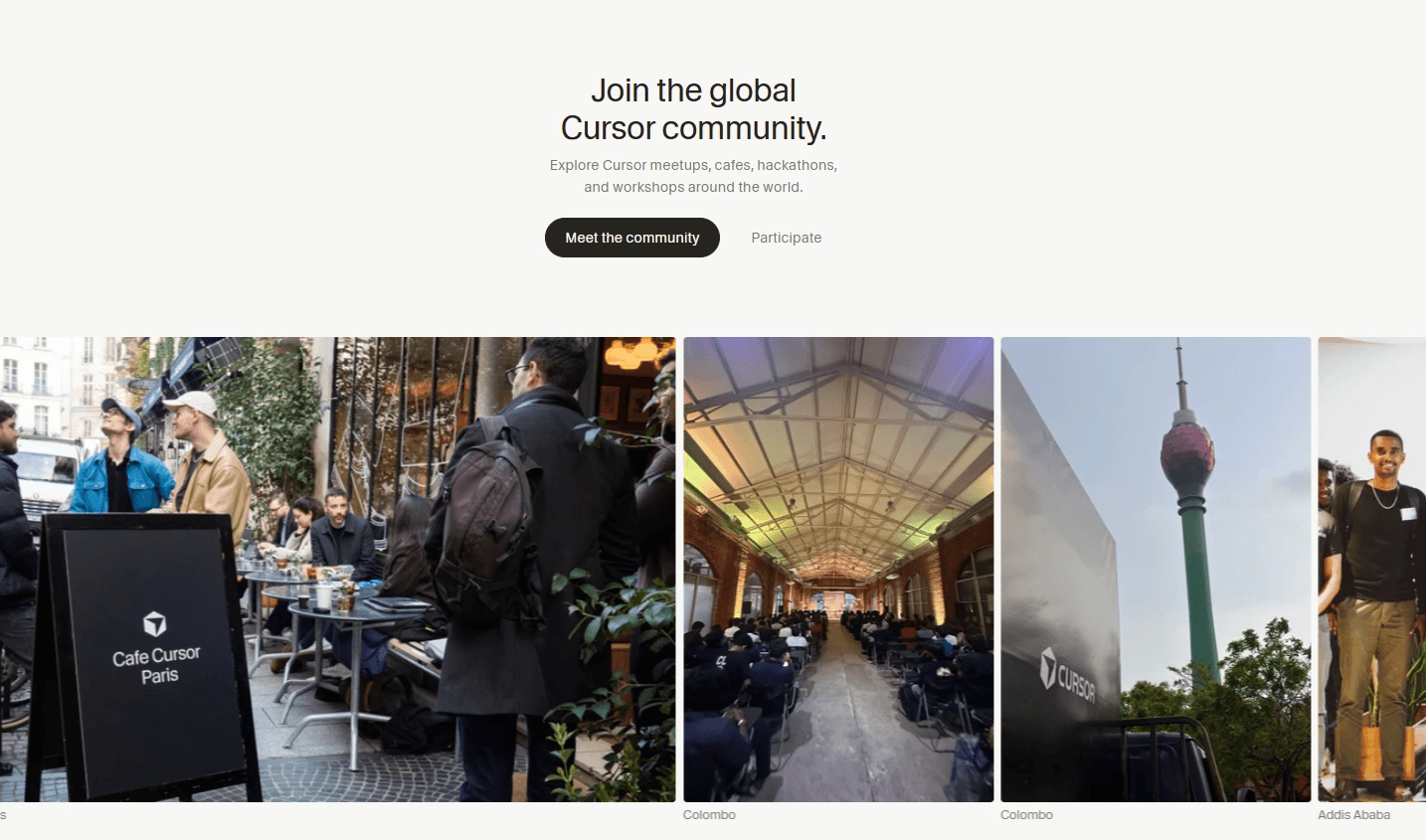
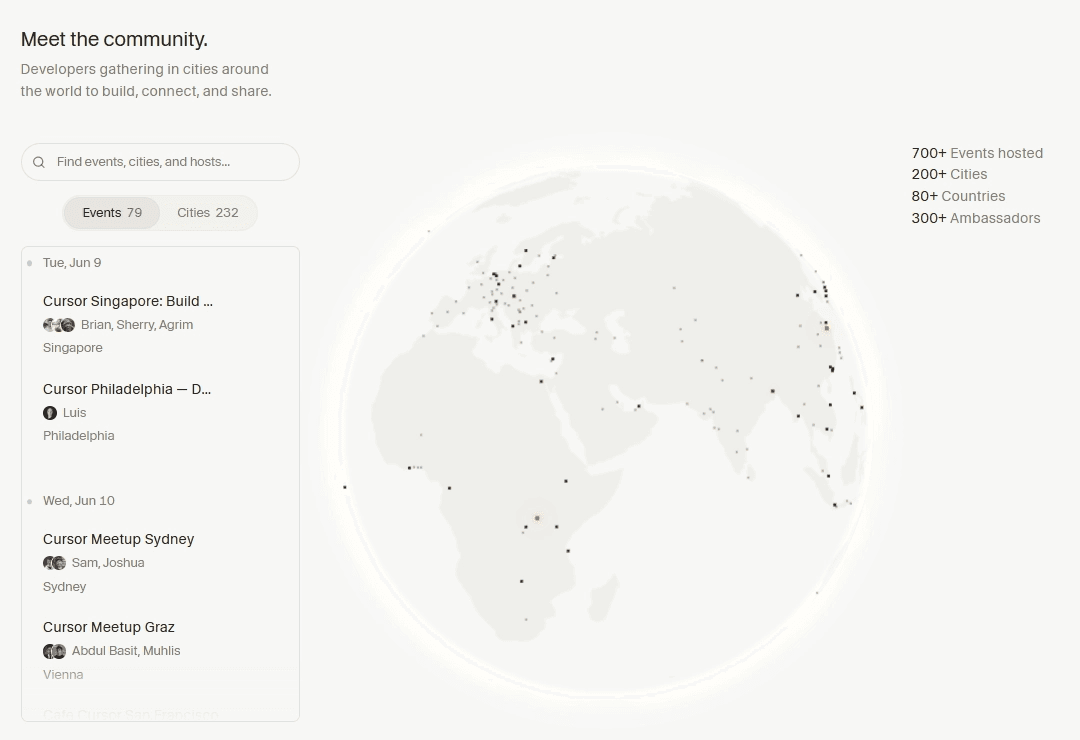
The community program is one of the most unusual marketing assets in developer tooling. As of June 2026, Cursor has hosted 700+ events across 200+ cities in 80+ countries, with 300+ ambassadors running local programs. At the time of research, 79 active or upcoming events were visible on the community globe across 232 cities.
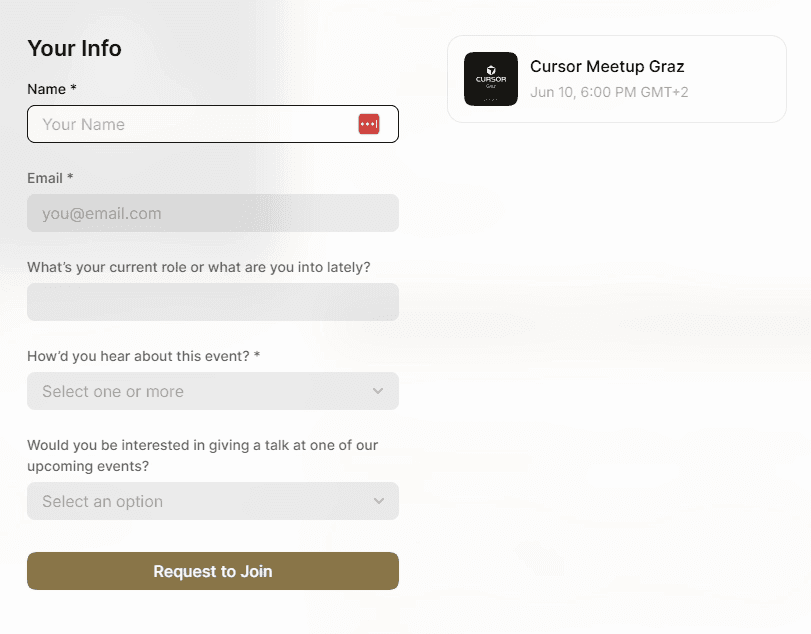
The format covers Cursor Cafes (informal co-working sessions), hackathons, and workshops. Each event has its own page. To register, attendees fill in their name, email, current role, where they heard about the event, and whether they would be interested in speaking at a future event. That last question is a community talent pipeline.
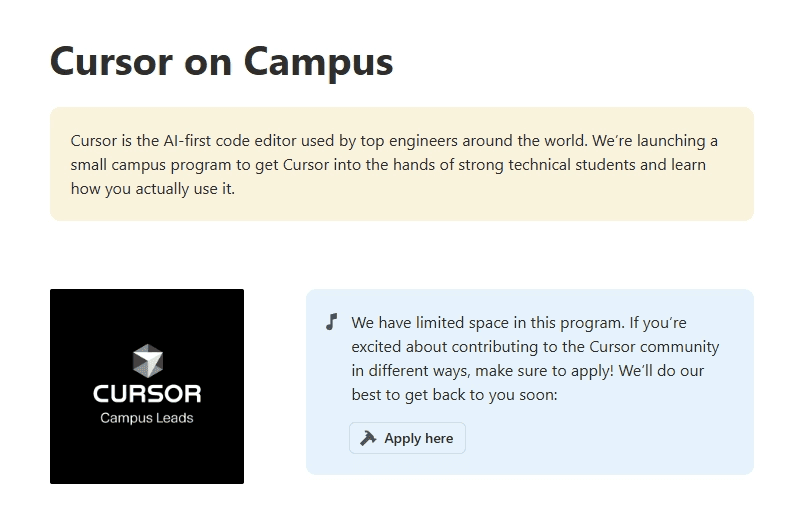
The Ambassador Program gives participants early access to new features, free usage credits, and direct funding for local meetups. The Campus Lead program gives university students access to a student plan and runs workshops at schools. Neither program is structured as a referral scheme, but both are structured around belonging and access.
Multi-channel community infrastructure
Cursor runs an active Discord server, a Reddit community, and an official forum at https://forum.cursor.com, covering announcements, support, events, and ideas. Meeting developers where they already are, rather than asking them to adopt a new platform, reduces friction and keeps community conversations visible.
Workshops
The Workshops section hosts on-demand sessions, live agentic team workshops, role-based content, partner spotlights, and industry-focused material. This functions as a training and enablement layer between the documentation and the enterprise sales conversation. It is useful for buyers who need their teams brought up to speed, and for individual developers who want to go deeper than the docs allow.
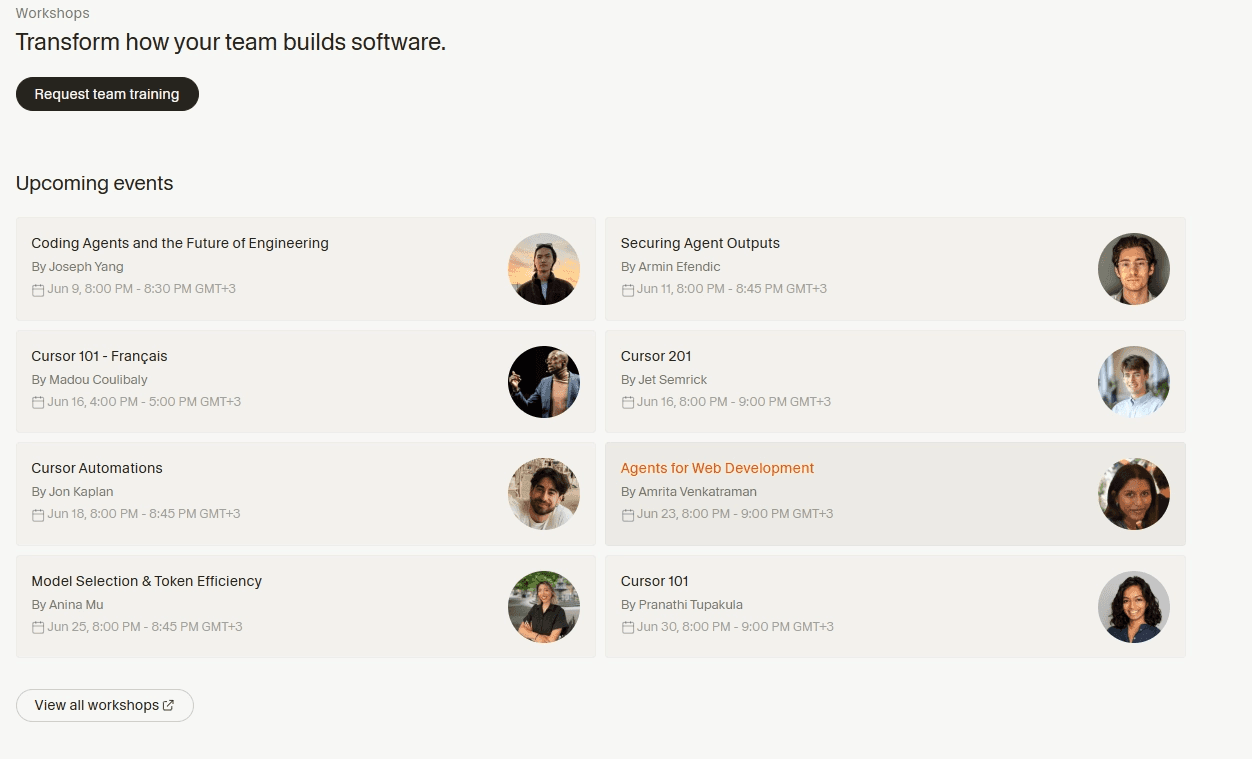
Cursor's Marketplace
The Cursor Marketplace hosts plugins, automation tools, and documentation resources. The publisher application (sign-in required) creates a developer ecosystem loop: third-party builders extend the product, expanding its surface area without Cursor's engineering team having to build every integration. Teams can also run private internal marketplaces with their own plugins.
Proprietary models
Cursor trains its own models. Composer 2 and Composer 2.5 are fine-tuned for software development tasks using reinforcement learning with targeted textual feedback. The training methodology is described openly in technical blog posts. This is a genuine technical differentiator. Competitors using only third-party APIs cannot claim the same level of model control, and enterprise buyers increasingly ask who controls the model.
The community program is a distributed acquisition engine. When 300 ambassadors run local events, Cursor gets word-of-mouth in cities where it has no field marketing team. According to The Smarketers' 2026 B2B community-led growth analysis, companies with active user communities report retention rates up to 26% higher than those relying solely on traditional sales and marketing.
💡 Steal This: Build a structured ambassador program and fund the events directly. The cost per attendee at a local meetup is a fraction of what you spend on LinkedIn ads reaching the same people. The difference is that meetup attendees become advocates. Ad clicks rarely do.
Leadership Presence Analysis
Michael Truell, CEO

Truell's LinkedIn profile has 21,400 followers. He posts roughly once or twice a month, entirely about Cursor: original posts on product releases, engineering decisions, and company milestones, alongside reposts of others' Cursor content with his own commentary. Original posts average approximately 200 reactions, 10 comments, and 5 reposts.
For a CEO with over 21k followers, posting once or twice a month produces a measurable engagement gap. The content is good when it appears. A post about a model training decision or a product launch from the CEO lands differently than the same announcement from the company account.
It adds a human voice and signals that the people building the product are thinking carefully about it. Posting twice a month means most of his audience sees nothing in any given week. Even though Truell is running a $3B ARR company with 200 people, and social media may not be a priority, a 21k followers executive channel posting at this rate is still a missed opportunity.
No CMO appears in any public source for Cursor or Anysphere as of June 2026. Public records, press coverage, and the company's own website list Michael Truell (CEO), Sualeh Asif (CPO), and Aman Sanger (COO). The careers page lists open Marketing roles (Community Operations Manager, Customer Marketing Manager, DX Engineer, Events Manager), but no VP or Director of Marketing. There is no named marketing leader.
The absence of a CMO is not currently a growth problem. The product sells itself, and the community runs word-of-mouth. But enterprise procurement cycles are starting to involve more stakeholders, more security reviews, and more executive-level conversations. A CMO with enterprise B2B credentials accelerates trust at every stage of that process. Cursor will likely need one before the IPO conversation becomes real.
💡 Steal This: If your CEO is underusing LinkedIn, start with product roadmap posts and company milestone updates. Once a week is enough to stay visible. For developer audiences, that content outperforms personal brand content by a wide margin. Save the reflective thought pieces for when you have a larger audience.
Social Media Strategy
X (formerly Twitter)
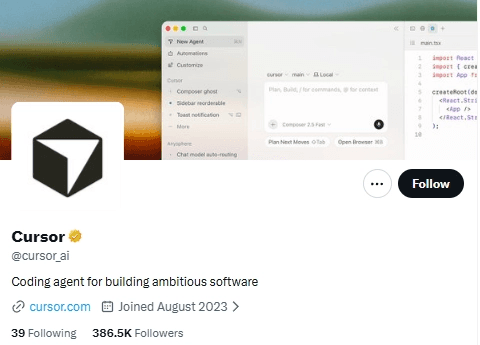
Cursor's X account has 386,500 followers and posts multiple times a day, generating hundreds of comments, thousands of reposts, and views that regularly reach into the millions. The content is almost entirely product updates: new features, model releases, integrations, and changelogs, typically delivered as a short video or screenshot with one line of copy.
X is Cursor's highest-velocity channel. The audience is developers who want to know what shipped, and the content serves that exactly: no brand storytelling, no promotional copy, no thought leadership. It is a product changelog delivered through a social feed, and it performs because Cursor ships constantly enough to fill it.
They are posting multiple times a day, mostly updates.
They have an engaging following with posts receving hunders of comments, reposts, thousands of likes and milions of views.
The LinkedIn page has 328,000 followers and posts nearly every day. Engagement comes fast: hundreds of reactions and comments within hours of each post. The content follows the same dominant pattern as X, with product updates driving the highest engagement across the board.
LinkedIn being this active is unusual for a developer tool company. The typical pattern is to treat LinkedIn as secondary to X or GitHub. Cursor posts at near-X volume, which makes sense: LinkedIn is where the CTOs, VPs of Engineering, and Heads of Platform who need to approve Cursor enterprise contracts actually spend time.
YouTube
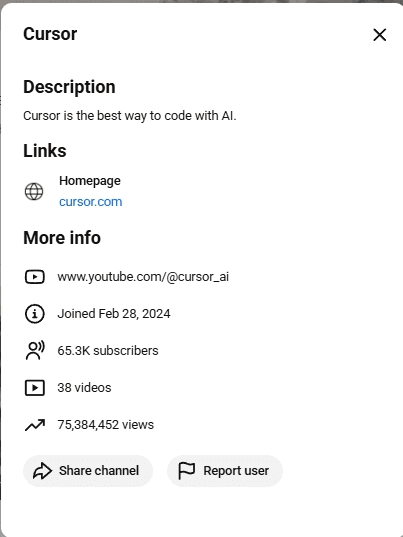
The YouTube channel has 65,300 subscribers, 38 videos, and 75 million total views, with the oldest video dating back approximately one year at time of research. Cursor posts multiple times per month. The content runs primarily as educational deep-dives and product demonstrations, organized into playlists: Cursor Conversations 2026, Customers, AI Foundations, From the Team, Deep Dive, and Shipped.
75 million views with 65,300 subscribers is an extreme ratio. It tells you that YouTube is a discovery channel, not a subscriber-retention channel. Developers who hear about Cursor and want to understand it before committing find these videos before they find the product site. No Shorts are being made, a gap given Shorts' current role in channel growth. The trajectory from the oldest video to 75 million total views shows exactly how fast the product's profile has grown.
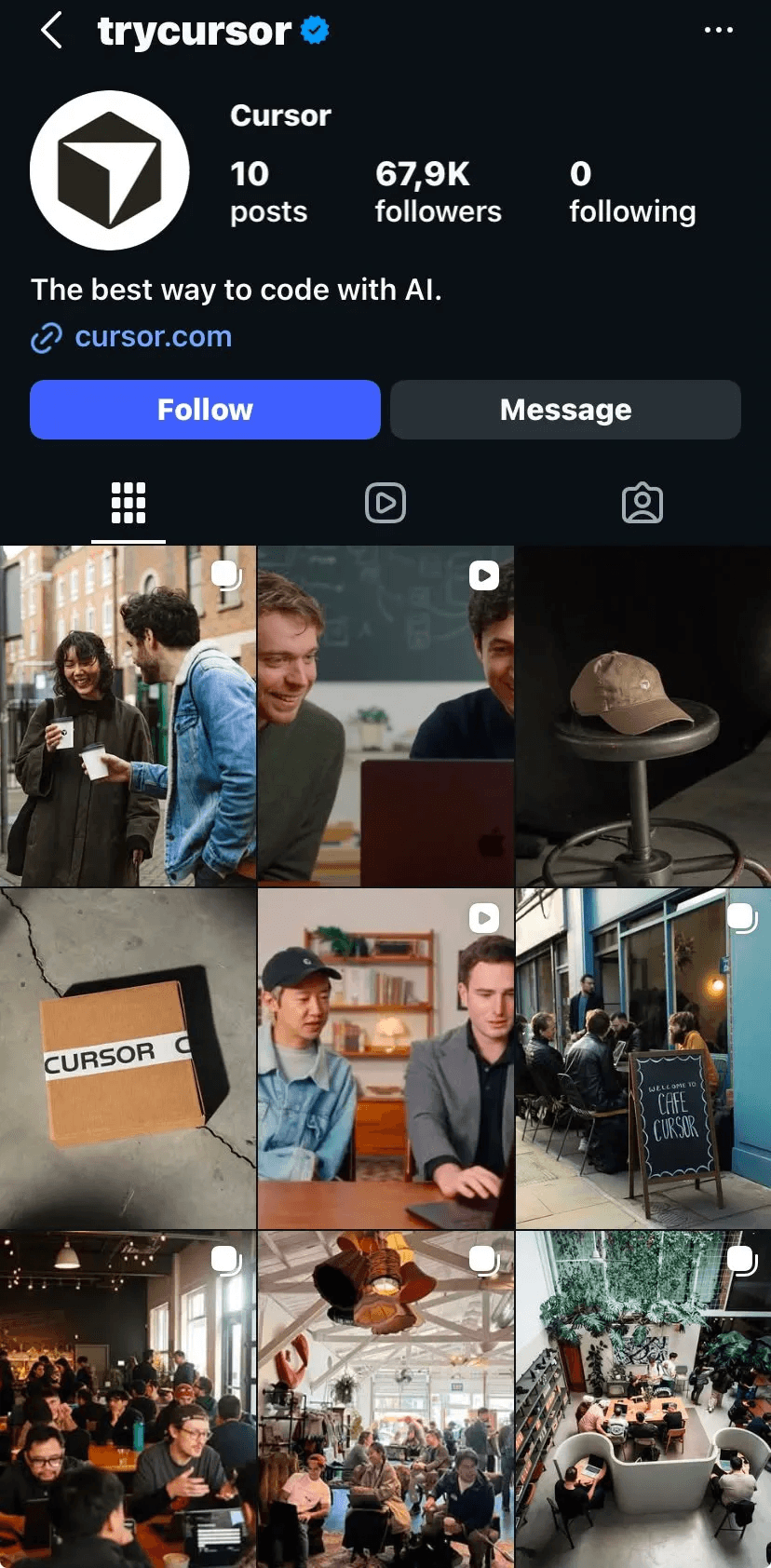
The Instagram account has 67.9k followers and 10 posts in total. The last posts date from March 2026, and likes are turned off. The channel is dormant.
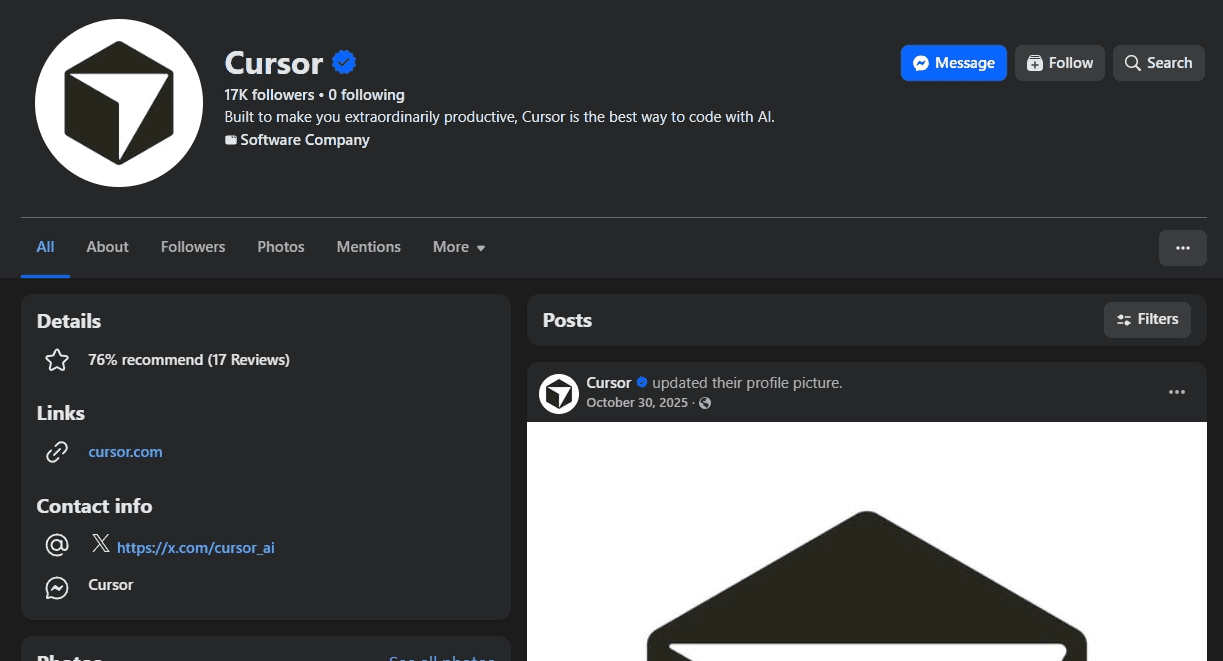
The Facebook page has 17,000 followers, no visible posts, and 17 reviews with a 76% recommendation rate. Some reviews raise billing concerns. The channel is dormant.
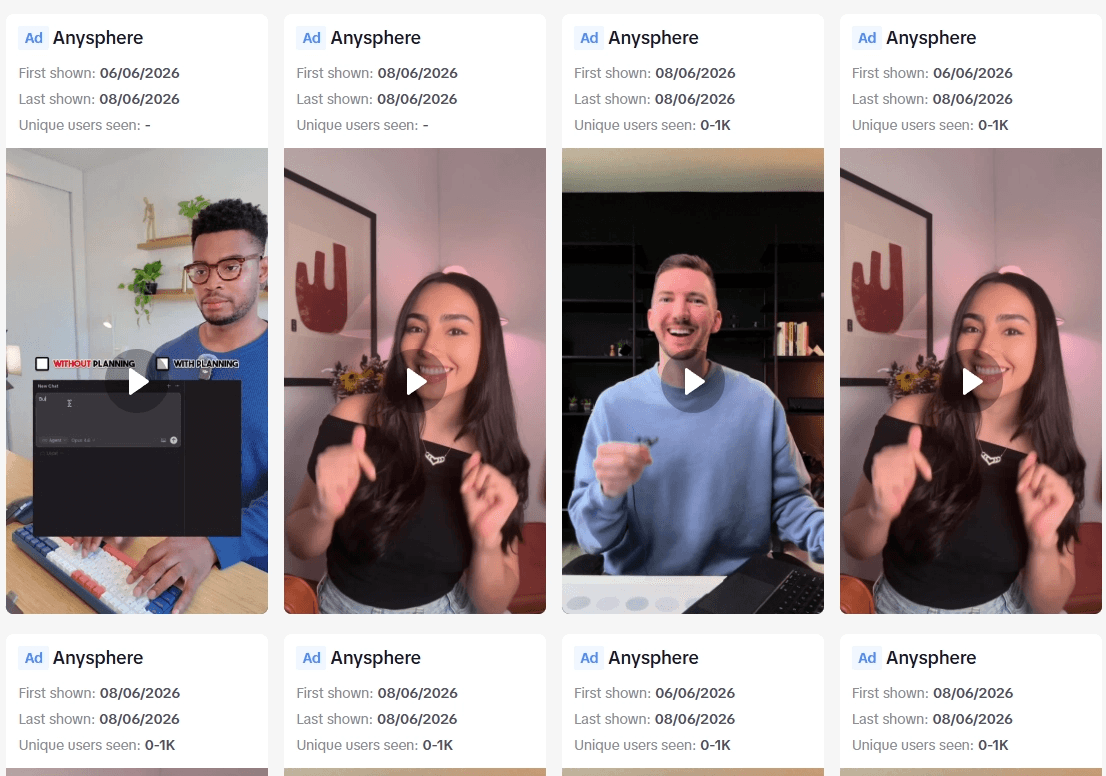
No official Cursor account exists on TikTok. Cursor runs UGC-style paid ads on the platform but does not maintain an organic presence.
The X and LinkedIn content pattern is product-led by design. The marketing calendar is the changelog. Every post is a product announcement. This approach works when the product ships continuously, which Cursor does. Companies that release quarterly updates cannot replicate them because they do not have the raw material.
💡 Steal This: Before building a content plan, map your posting cadence to your product roadmap. For developer audiences, shipping news consistently outperforms almost every other content type. If you cannot post about what you shipped, post about what you're building and why. But if neither is true, you have a product pipeline problem before you have a social media problem.
Top-Performing Content
Across all three active platforms, the content hierarchy is clear: proprietary model launches outperform everything, major version releases come second, and integration announcements come third. What is absent from the top performers is just as telling. No brand content, no thought leadership, no promotional copy appears anywhere near the top of the engagement tables.
Looking at the last month of activity, three posts stand out.
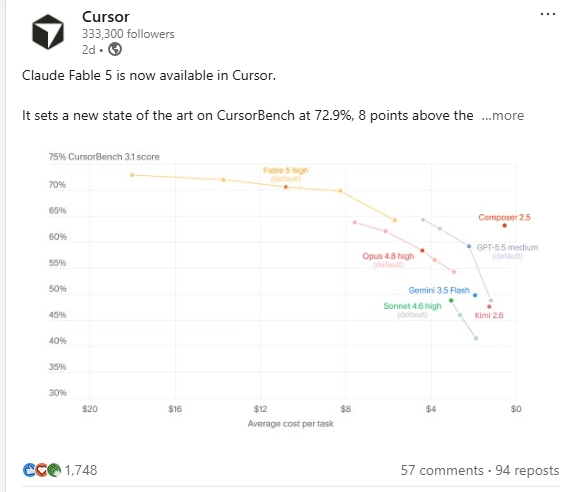
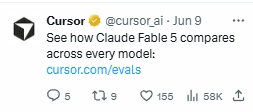
The announcement that Claude Fable 5 was available in Cursor pulled 1,748 reactions, 57 comments, and 94 reposts in the two days after it was published, before we even finished our research. The speed suggests a developer audience that had been waiting for exactly that integration.
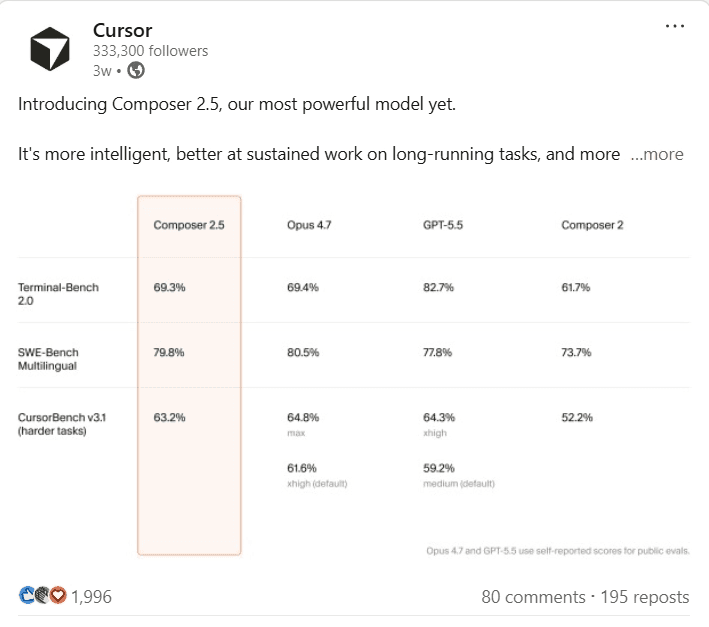
The Composer 2.5 launch did even better, with 1,996 reactions, 80 comments, and 195 reposts, making it the highest-engagement post in the LinkedIn sample. A proprietary model launch signals independent capability in a way that no feature announcement can match.
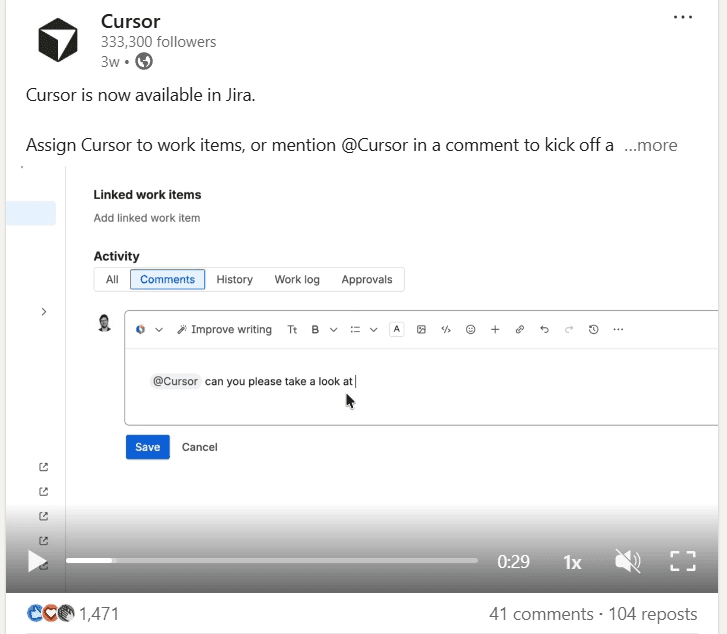
The Jira integration post rounded out the top three with 1,471 reactions, 41 comments, and 104 reposts. Integrations consistently perform well because each one gives developers a new reason to bring Cursor into a workflow they already use every day.
YouTube
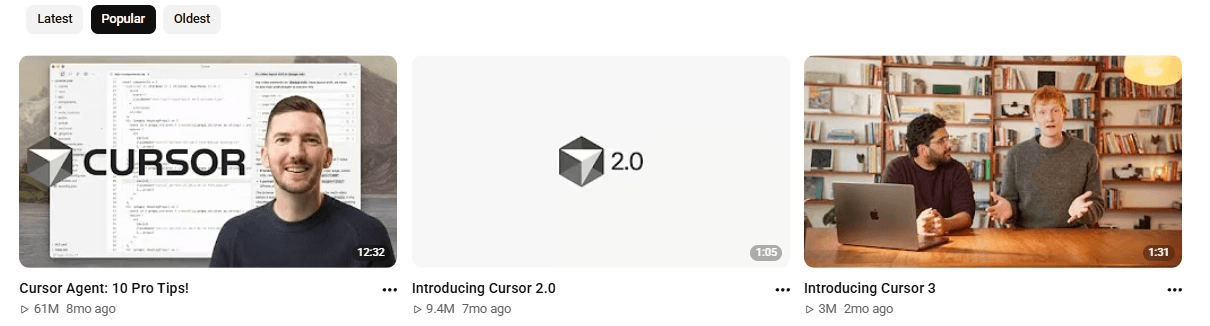
The numbers here are hard to ignore. "Cursor Agent: 10 Pro Tips!" has accumulated 61 million views, 9,900 likes, and 252 comments from a channel with 65,300 subscribers. That ratio (roughly 930 views per subscriber) tells you the video is reaching well beyond the existing subscriber base, through organic search, promoted placements, or both. It is appearing in search results and pulling in developers who have heard about the product and want to understand it before committing.
"Introducing Cursor 2.0" has 9.4 million views, 4,000 likes, and 213 comments, confirming that major version launches reliably drive high traffic. "Introducing Cursor 3" sits at 3 million views, 1,900 likes, and 202 comments and is still accumulating, having been published more recently.
X
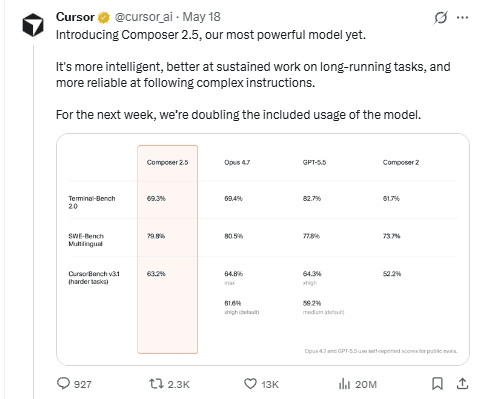
The Composer 2.5 launch post reached 20 million views with 927 comments, 2,300 reposts, and 13,000 likes, making it the highest-performing single piece of content in the entire dataset across any platform.
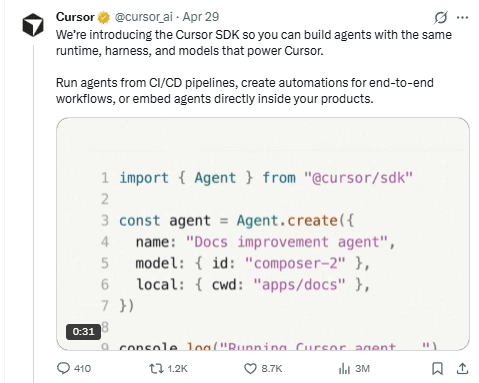
The Cursor SDK announcement reached 3 million views, 8,700 likes, 1,200 reposts, and 410 comments.
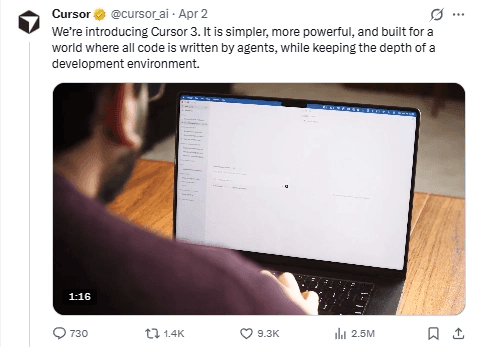
The Cursor 3 launch reached 2.5 million views, 9,300 likes, 1,400 reposts, and 730 comments.
The Composer 2.5 numbers are in a different category entirely. A proprietary model launch shifts the product story in a way that no feature release does, and the audience responded accordingly.
Why this content strategy works
The numbers are not random. There is a specific reason that product update posts consistently outperform every other content type Cursor produces, and it comes down to who the audience is and what they actually care about.
The JetBrains AI Pulse survey from April 2026 found that by January 2026, 90% of developers were regularly using at least one AI coding tool at work. That number means the market is no longer in the awareness stage. Developers are not asking: "Should I use an AI coding tool?" They are asking "which one, and is the one I'm using still the best one?" Every time Cursor announces a new model, a new integration, or a new version, it is answering that second question directly and publicly. The post is not content. It is competitive reassurance.
The SonarSource State of Code Developer Survey 2026 found that 42% of committed code is now AI-generated or AI-assisted. When AI is writing nearly half of everything a developer ships, the quality and capability of that AI model is no longer a curiosity. It is a professional concern. A post about a better model is the equivalent of a surgeon learning that a new instrument they use every day just got significantly upgraded. Of course they engage with it.
Cursor has built a content strategy that treats its audience as professionals, tracking tools that directly affect the quality of their work, not consumers to be entertained. The engagement numbers reflect that respect.
💡 Steal This: On launch day for a significant product update, post simultaneously across every active channel. Developer audiences are multi-platform. Concentrated engagement signals on launch day tell the algorithm this is worth amplifying. Staggering your posts by platform dilutes that signal for no meaningful gain.
Paid Advertising Strategy
Cursor runs substantial paid campaigns across LinkedIn, Meta, and Google. The ad spend is notable for a company that acquires most of its users organically.
3,100+ ads running at time of research. The volume is high for a company with Cursor's level of organic reach, which tells you LinkedIn ads are part of the enterprise conversion motion, not a replacement for organic growth.
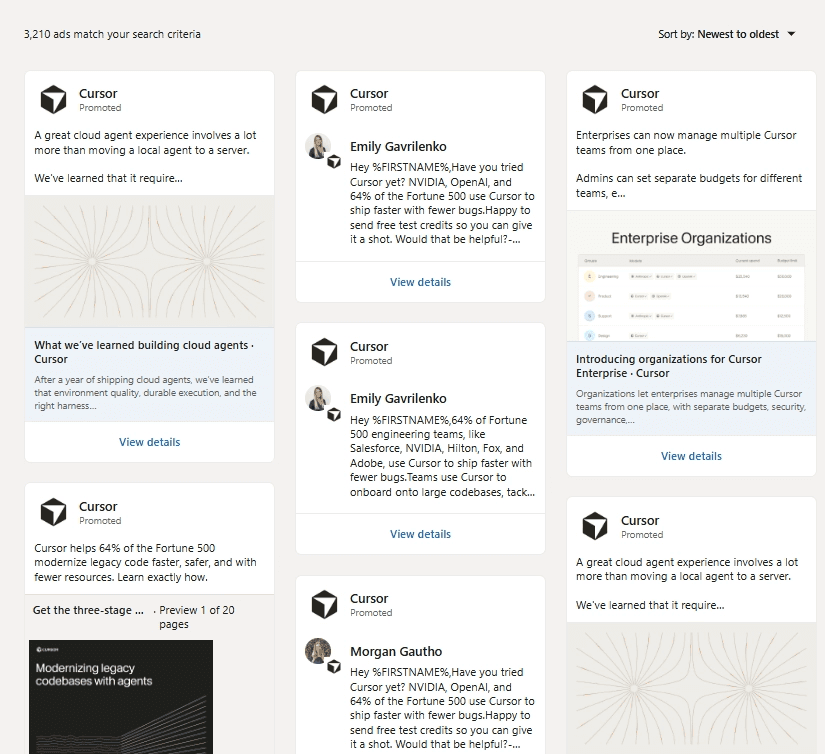
Ad themes observed:
"What we've learned building cloud agents"
"Introducing organizations for Cursor Enterprise"
"Turn Cursor into Team Infrastructure — Claim up to $3,000 Cursor Credits"
"Cursor pstack: the skills behind 9,000 agent runs"
Direct outreach with personalization tokens: "Hey %FIRSTNAME%, Have you tried Cursor yet? NVIDIA, OpenAI, and 64% of the Fortune 500 use Cursor to ship faster with fewer bugs." These ads offer free test credits as the CTA.
The personalization-token ads are an ABM tactic. They target named prospects, use enterprise peer social proof (Nvidia, OpenAI, Fortune 500 percentages), and offer a low-friction entry point as the first conversion step. Each ad appears to reach approximately 50,000 people, with the UK, US, Canada, and Australia as primary locations.
Meta
Approximately 1,100 ads across Facebook, Instagram, Messenger, and Threads. Most appear as UGC-style creative, featuring real developers talking about the product in casual phone-recorded formats rather than polished studio production. Some run exclusively on Instagram.
The UGC format is not accidental. Developers are among the most skeptical audiences for polished brand advertising. A peer talking about their experience with Cursor reads as a recommendation, not a pitch. This mirrors the same dynamic the GoodFirms 2026 review survey identified: online reviews and peer proof now influence purchase decisions for 97% of consumers. The ad creative is simulating peer proof rather than claiming it.
Cursor runs approximately 3,000 ads across Google, split across three formats. Google Shopping carries around 500 ads. Search runs around 2,000 ads, a mix of text and video. YouTube adds another 2,000 ads, predominantly video.
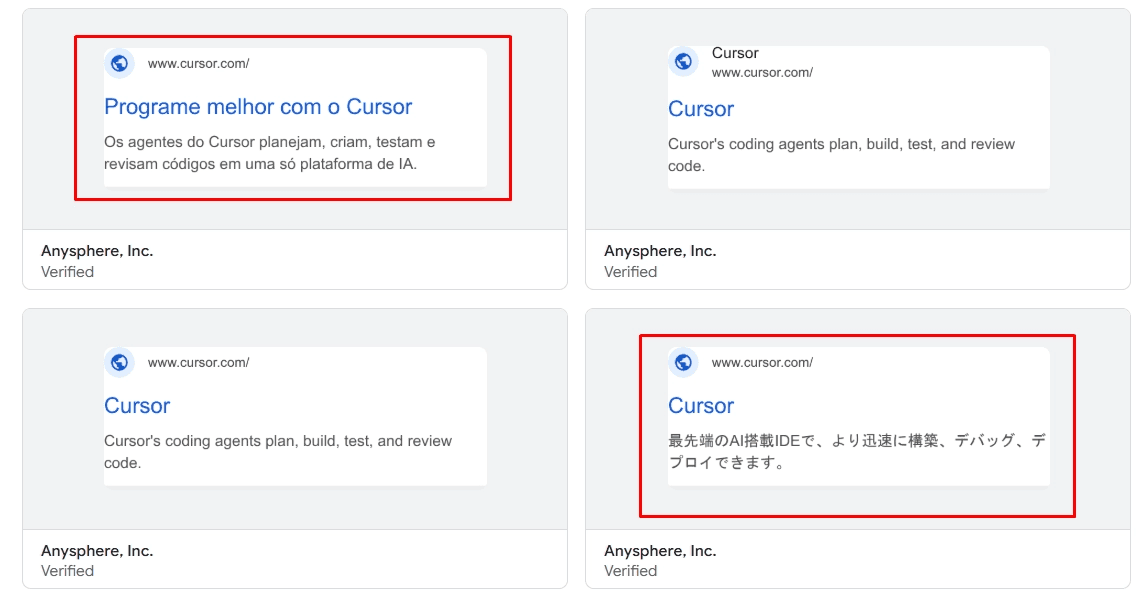
The Shopping ads lead with problem-first copy: "Running into errors? Cursor catches bugs and fixes it, so you can get back to shipping." and "Set up agents that run on schedules or triggers. Automate reviews, tests, and triage."
The Search ads follow the same logic, targeting developers who are actively looking for solutions: "Cursor fixes syntax, type, runtime, build, and CORS errors automatically in seconds," "Cursor Automations: agents that run on events, schedules, or custom webhooks," and "Cursor Bugbot catches real bugs and security issues."
The YouTube ads are mostly video, which makes sense for a product where the workflow is the argument. Watching an agent write, test, and fix code in real time is more convincing than any headline. All three formats also run in languages beyond English, confirming that geographic expansion is active and not limited to English-speaking markets.
The Google strategy is bottom-of-funnel throughout. Every ad format names a specific technical problem and positions Cursor as the answer. There is no brand awareness play here, no category education. Cursor is buying intent at the moment a developer is already searching for exactly what the product does.
The LinkedIn personalization-token ads are a textbook ABM pattern. Rather than building awareness, they are accelerating a decision at specific companies, for a specific buyer type (CTOs, VP Engineering, Head of Developer Platforms), using social proof borrowed from peers they recognize for an enterprise-funnel level acceleration.
💡 Steal This: Your individual developer ads and your enterprise ads need different creative strategies. UGC-style peer content works for individual developers. Named enterprise customer social proof and direct outreach mechanics work for decision-makers. Running the same ad to both audiences wastes budget on the wrong signal.
Sales Funnel from Social Media
Cursor does not have a complicated social-to-sales funnel. It has two buttons and a product that sells itself. But that simplicity is a deliberate design choice for one audience and a gap for another. Here is how each channel actually connects to the conversion path, and where the logic breaks down.
X
X is TOFU: awareness and product launch amplification. Posts link to cursor.com, where the two persistent CTAs are "Download" and "Contact Sales." X drives developers to the homepage, and the homepage presents two paths: self-serve (Download) or enterprise (Contact Sales). There is no intermediate capture mechanism between social discovery and site arrival: no newsletter prompt, no lead magnet, no gated demo. For PLG, that is the right design. Friction kills self-serve conversion.
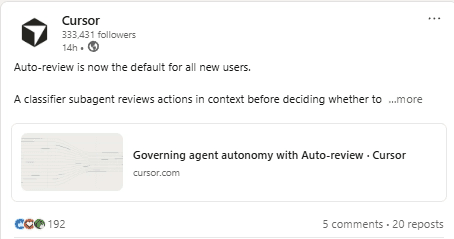
LinkedIn serves TOFU and MOFU for enterprise buyers. LinkedIn posts link to the same homepage as X, presenting the same two CTAs. The problem is that LinkedIn ad targeting can reach CTOs and VPs of Engineering, but those buyers arrive at the same homepage as an individual developer who Googled "AI code editor." The enterprise page already exists and is well-built. Routing enterprise-targeted LinkedIn traffic there rather than to the homepage would improve the conversion logic without requiring new content.
YouTube
YouTube handles TOFU discovery and MOFU education. The 61-million-view top video is the most powerful single acquisition asset Cursor has, and it requires no ad spend. It appears organically when developers search for information about AI coding tools. There are no links in video descriptions, only a link in bio. Viewers who want to try the product after a tutorial video must navigate to the site themselves. A consistent "Download free at cursor.com" in every description is a small fix that would likely capture meaningful intent volume given the view counts involved.
Instagram and Facebook
Both are dormant. No CTAs, no active posts, no funnel connection. Appropriately deprioritized.
The funnel is strong at the top (product reputation, social volume, YouTube) and at the bottom (enterprise sales team, Contact Sales CTA, ABM ads on LinkedIn). The middle is thin. There is no structured nurture path between "I've seen Cursor on social" and "I've downloaded or booked a demo." For individual developers, that is fine. The free product itself is the middle of the funnel. For enterprise accounts that need months of consideration before procurement, the absence of a nurture sequence means some warming buyers fall off before they convert.
💡 Steal This: If you have strong YouTube content driving high view counts, add a clear CTA link in every video description. The viewer who just watched a 10-minute tutorial on your product is in the most motivated state they will be. Give them the next step before they navigate away.
Reviews and Social Proof
Cursor's review profile is one of the more interesting contradictions you will find in B2B SaaS. The product has genuine, enthusiastic advocates. The public review record on some platforms tells a different story.
G2: 4.7 out of 5 from 255 reviews, and a Leader badge. Positive themes: ease of use, coding assistance, performance, problem-solving. Negative themes: pricing and occasional inaccuracy in suggestions.
Capterra: 5 out of 5 from 3 reviews.
Trustpilot: 1.7 out of 5 from 248 reviews. Profile not claimed by Cursor. 77% of reviews are 1-star. Recurring complaints: unexpected charges during or after free trials, billing errors, app crashes. No review has received a company response.
Facebook: 76% recommend from 17 reviews. Specific concerns visible include users reporting they were charged during their free trial period, and others reporting their credit card information was compromised.
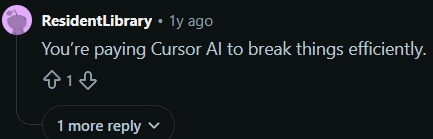
Reddit: Mixed-to-negative sentiment in community threads, particularly around compatibility with existing codebases. A widely circulated comment describes the experience as "paying Cursor AI to break things efficiently."

The gap between G2 (4.7 stars) and Trustpilot (1.7 stars) maps cleanly to audience type. G2 reviewers are professional developers who evaluated the product deliberately and wrote structured assessments. Trustpilot reviewers are more often people who had a frustrating billing experience or hit an error during a trial, which is a different kind of feedback entirely, and the two appear side by side in Google results for anyone searching "Cursor AI reviews."
The unclaimed Trustpilot profile is the part that matters strategically. According to the GoodFirms 2026 survey on review behavior, conducted with 552 business professionals across 25 countries, online reviews now influence purchase decisions for 97% of consumers, and only 5% of businesses respond to reviews despite 89% of consumers expecting a response.
A procurement team evaluating Cursor for a large enterprise rollout will run a background search. The Trustpilot result is on page one. An unclaimed profile with no responses reads as indifference to customer problems, not as product confidence.
The Trustpilot complaints cluster around billing mechanics and trial edge cases, not core product quality. That is fixable with customer operations, the kind of work Cursor is actively hiring for (see: Director of Digital Support, Billing Support Manager on the careers page). Claiming the profile and responding to billing complaints publicly costs almost nothing and removes a real procurement friction point.
💡 Steal This: Claim your review profiles on every platform, including the ones with bad reviews. A thoughtful response to a negative review signals operational maturity to enterprise buyers in a way that silence does not. A perfect score on a low-volume platform does less work than a handled complaint on a high-traffic one.
Content Marketing and Demand Generation
Cursor's content operation doesn’t look like most B2B SaaS content programs. There is no SEO keyword calendar, no gated whitepaper library, no webinar series with guest speakers and registration pages.
What exists instead is a high-frequency technical publishing operation that documents how the product is built, what shipped this week, and what customers have done with it. It is content written for people who are already paying attention, not content designed to attract people who are not. That distinction shapes everything about how it performs.
Blog
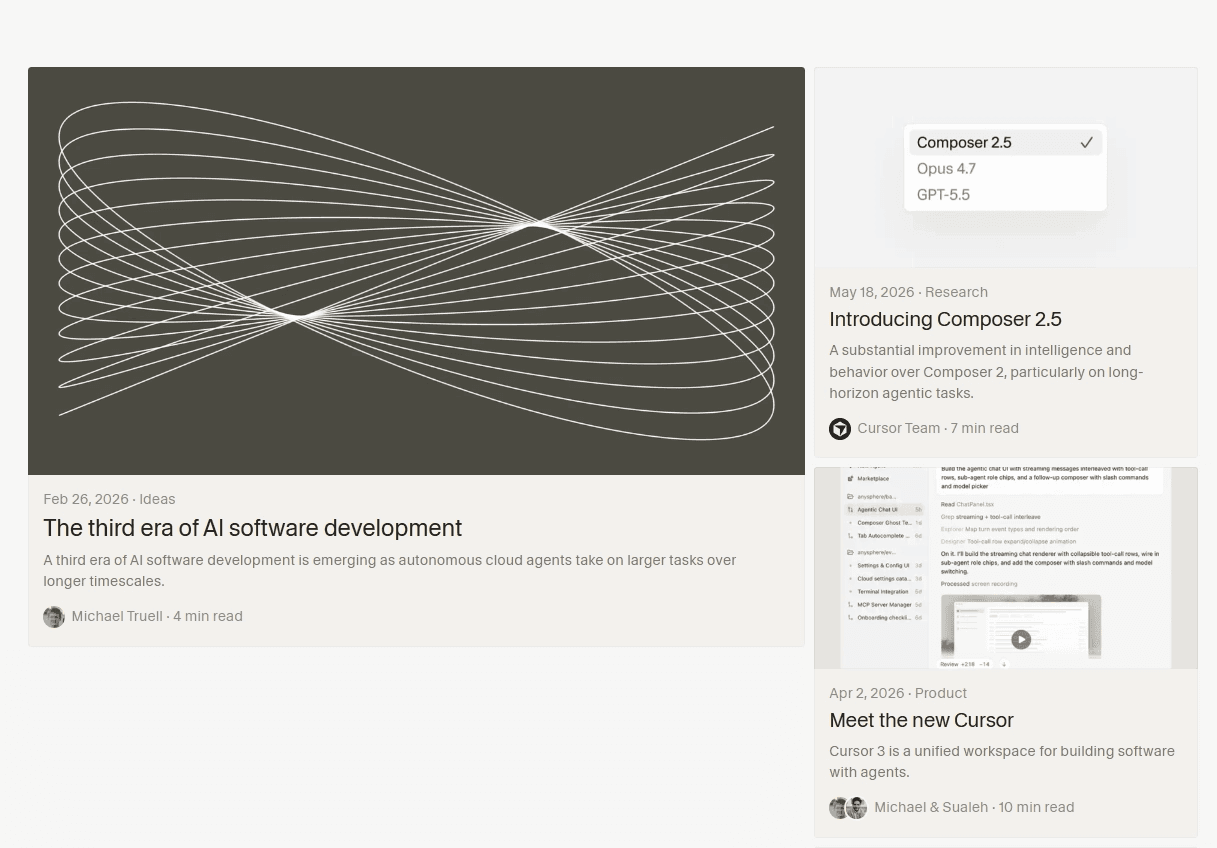
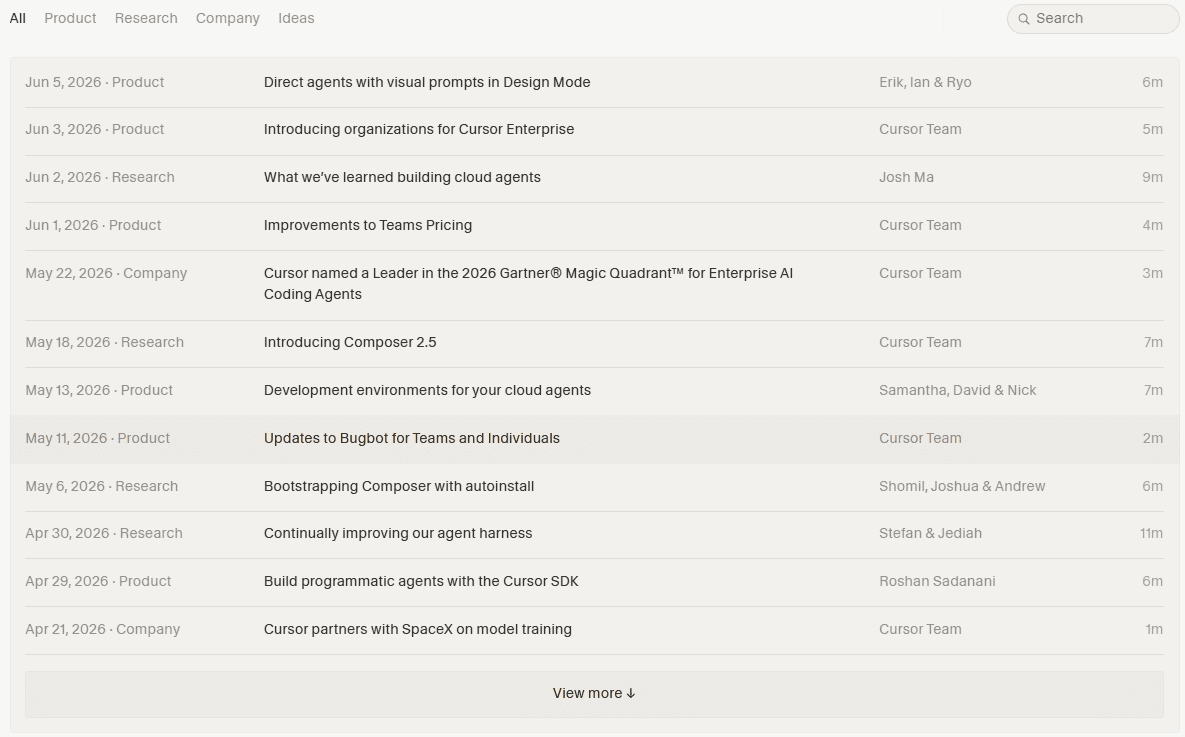
The Cursor blog publishes at high frequency. Recent posts at the time of research, all from June 2026:
"Governing agent autonomy with Auto-review", Jun 11, Research, 8 min
"Bugbot is now over 3x faster, 22% cheaper, and finds 10% more bugs", Jun 10, Product, 4 min
"Direct agents with visual prompts in Design Mode", Jun 5, Product, 6 min
"Introducing organizations for Cursor Enterprise", Jun 3, Product, 5 min
"What we've learned building cloud agents", Jun 2, Research, 9 min
Posts carry author bylines, publish dates, reading time estimates (ranging from 2 to 10 minutes), and tables of contents. Some posts include screenshots, but visual content is otherwise minimal. Categories are Product, Research, Company, and Ideas.
The blog is not optimized for search traffic in the traditional sense. The posts are technical, written for developers who are already engaged with the product or seriously evaluating it. They do not target high-volume generic keywords. What they do instead is document Cursor's engineering and product thinking in enough detail that a technically sophisticated reader can form an accurate opinion of whether the team knows what they are doing. In developer markets, that kind of transparency builds trust that keyword-targeted marketing content cannot.
The blog also runs a Customer Stories section with named case studies from 2026: Faire, PayPal, National Australia Bank, and Amplitude. A Press section links to external coverage. A Videos tab links directly to the YouTube channel. These are MOFU assets for managers and CTOs evaluating enterprise deployment. They describe outcomes at organizations similar to their own, with enough specificity to be useful in an internal approval conversation.
Changelog
The changelog at https://cursor.com/changelog updates at least weekly and acts as a live product update feed. It is surfaced on the blog page as well, giving readers two paths to product news without navigating away.
Press
The blog links to earned coverage from Bloomberg, TechCrunch, CNBC, and The New Stack from early 2026. Cursor did not manufacture this through a PR agency. It is a byproduct of the growth story. But it functions as credibility infrastructure that sits behind every other piece of content.
Forum
The official Cursor forum at https://forum.cursor.com keeps the discussion going beyond the blog. Topics cover Announcements, Events, Discussion, Support, and Ideas. It functions as a public-facing support and community layer, and it gives the team direct visibility into what users are struggling with and what they want built next.
Help
A dedicated Help page is also available, covering the same content as the documentation but organised around a search bar rather than a navigation hierarchy. For users who know what they are looking for, it is faster than the docs.
What Cursor has built here is a content operation that serves three different audiences without trying to be three different things. Developers get the technical depth they need to trust the product. Managers and CTOs get the case studies they need to justify the purchase internally. And the broader market gets the press coverage and changelog that signals a company shipping at speed. The same content infrastructure does all three jobs.
The data gives this context. The JetBrains State of Developer Ecosystem 2025 survey found that 85% of developers now regularly use AI tools in their workflow, and that the question in the market has shifted from "should I use AI?" to "how good is my AI workflow?".
In that environment, content that demonstrates capability beats content that claims it. A blog post showing how Cursor's Bugbot finds logic errors that static analysis misses is not marketing. To the developer reading it, it is a product evaluation. Cursor publishes enough of that content, consistently enough, that the evaluation happens before a sales conversation ever starts.
💡 Steal This: Publish customer case studies as blog posts, not gated PDFs. Ungated case studies get indexed, shared on social, and read by buyers who would never fill out a form. A case study on your blog compounds over time. A gated PDF peaks during the campaign it was made for and then goes quiet.
Marketing and Sales Funnel Stages
TOFU (Top of Funnel)
Cursor's top-of-funnel is the product's own reputation, fed by consistent social content and YouTube discovery. The JetBrains State of Developer Ecosystem 2025 survey (24,534 developers, published October 2025) found that 85% of developers regularly use AI tools for coding and development, and awareness of Cursor within that population is near-universal.
Organic social on X (386,500 followers, multiple daily posts) and LinkedIn (328,000 followers, near-daily posting) sustains that awareness. YouTube (65,300 subscribers, 75 million total views) pulls in developers actively searching for information. Google and LinkedIn paid ads extend reach to enterprise prospects who have not yet acted on awareness.
MOFU (Middle of Funnel)
For individual developers, the free Hobby tier is the middle of the funnel. The product is the evaluation experience, no white papers, no nurture sequences, no lead scoring. For enterprise buyers, MOFU includes the customer stories section on the blog, the Workshops content, and the enterprise page testimonials. There is no gated content library or structured nurture sequence visible.
BOFU (Bottom of Funnel)
Two conversion paths appear on every page: Download (self-serve individual) and Contact Sales (enterprise). The Contact Sales path at https://cursor.com/contact-sales is the enterprise bottom of funnel. The enterprise sales team, visible through multiple Account Executive and Solutions Engineer roles on the careers page, manages the pipeline from there.
Retention
The community program is the primary retention infrastructure. Regular events, Discord, Reddit, and the forum create ongoing engagement that reinforces the product habit. Ambassador and campus lead programs turn retained users into acquisition channels. The Workshops content reduces churn among users who have not yet fully adopted the product. The Changelog is a retention tool that also happens to be a marketing asset: it gives existing users a reason to open Cursor every week.
Future Plans and Growth Indicators
The careers page at https://cursor.com/careers, as of June 2026, lists open roles across Sales, Customer Success, User Ops, Marketing, Engineering, Revenue Operations, Design, Solutions, Operations, Product Management, and People.
The patterns worth noting:
Sales expansion is aggressive.
Multiple Account Executive roles in New York, San Francisco, and Australia. A Country Leader for Japan, a Regional VP role in ANZ (Cursor appointed Pete Short as Regional VP for Australia and New Zealand in May 2026). This is a company building a global enterprise sales motion from the ground up, with geographic expansion accelerating well beyond North America.
Marketing hiring is operational.
Community Operations Manager, Customer Marketing Manager, DX Engineer, Events Manager. None of these are brand, demand generation, or growth leadership roles. The marketing function being built right now is community infrastructure and technical marketing, supporting a motion that is already working rather than creating a new one. No VP or Director of Marketing appears in the open roles, which reinforces the pattern: the CMO seat remains unfilled.
Customer Success signals enterprise scale.
AI Deployment Manager and Director of Product Education Engineering are post-sale enterprise roles. They exist because enterprise accounts need structured onboarding and ongoing enablement to stick, and the enterprise revenue mix has grown enough to warrant them.
Revenue Operations shows maturity.
A Data Scientist for GTM is a hire that enables Cursor to model its funnel quantitatively, probably for the first time. It is the kind of hire that precedes a public market conversation.
The overall signal from the hiring map is that Cursor is building the enterprise sales infrastructure to capture the individual developer adoption that has already happened at an enormous scale. As the SaaS Mag April 2026 analysis notes, citing Cursor directly, corporate buyers grew from roughly 25% of revenue at $400M ARR to approximately 60% at $2B ARR. The hiring surge is the operational response to that shift.
Also worth noting: in May 2026, Cursor was named a Leader in the 2026 Gartner Magic Quadrant for Enterprise AI Coding Agents, with the furthest placement on Completeness of Vision. For CTOs who need analyst-validated justification before signing enterprise contracts, Gartner placement changes the procurement conversation. It is not something you can buy with a marketing budget.
💡 Steal This: Read a company's job postings to understand where their growth bet is placed. Aggressive sales hiring against lean marketing hiring tells you the product is generating demand and sales are being built to capture it. If you are at an equivalent inflection, hire the sales infrastructure before the marketing team.
Inspiration Points
1. Reduce time-to-value to near zero and let the product market itself.
Cursor's free tier requires no credit card, installs in minutes, and is built on VS Code, which means it is immediately familiar to the majority of professional developers. The design is deliberate. PLG theory holds that the fastest path from awareness to conversion is letting users experience value before asking for payment.
According to the JetBrains AI Pulse survey published in April 2026, 90% of developers regularly used at least one AI coding tool at work by January 2026. Cursor built its free tier to capture that adoption wave without a sales conversation in the way.
2. Build community infrastructure before you need it for marketing.
Cursor's 700+ events, 300+ ambassadors, and multi-channel community presence were not built to support a $3B ARR company. They were built when the company was much smaller. According to The Smarketers' 2026 B2B community-led growth analysis, companies with active user communities report retention rates up to 26% higher than those relying solely on traditional sales and marketing. The compounding effect of community investment is why you start at 1,000 users, not 1,000,000.
3. Publish technical content as a trust signal.
Cursor's blog posts on model training, reinforcement learning techniques, and engineering architecture are not written to rank for keywords. They are written to demonstrate that the people building the product understand what they are building.
The JetBrains State of Developer Ecosystem 2025 survey found that 85% of developers now use AI tools regularly, and that the shift toward best-of-breed specialist tools over platform-bundled options is accelerating. In a market where developers are actively choosing between tools on technical merit, a blog post that explains how your model was trained does more trust-building work than a content marketing piece about productivity tips.
4. Treat your enterprise page as a conversion page.
The Cursor enterprise page leads with three named testimonials from Salesforce, Fox, and PayPal before explaining any features. Social proof precedes product explanation. According to the GoodFirms 2026 review survey, online peer proof now influences purchase decisions for 97% of consumers. Enterprise procurement teams go to the enterprise page when they are close to a decision. That is not the moment for feature education. Put your strongest proof where the decision is being made.
5. Run PLG and SLG as a flywheel.
Cursor gave the product away to individual developers, let those developers bring it into their companies, and then built an enterprise sales team to close the accounts the product had pre-sold. Corporate buyers grew from 25% of revenue at $400M ARR to approximately 60% at $2B ARR. The enterprise sales motion does not replace the PLG motion. It harvests the demand the PLG motion created. Design both from the beginning, even if you only activate enterprise sales later.
6. Claim your review profiles before an enterprise deal depends on them.
Cursor has a 1.7-star Trustpilot rating with 248 reviews and an unclaimed profile. A procurement team evaluating Cursor for a 5,000-seat enterprise rollout will search the company name. That Trustpilot result appears on the first page. The SonarSource State of Code Developer Survey 2026 found that 60% of enterprise developers apply automated quality controls to AI-generated code, meaning enterprise buyers are running diligence on AI tools. Responding to billing complaints publicly costs very little and removes a real friction point from the enterprise buying process.
Frequently Asked Questions (FAQ)
What does Cursor actually do?
Cursor is an AI-native code editor, built as a fork of Visual Studio Code, that integrates AI agents directly into the development environment. Instead of adding AI as a plugin on top of an existing editor, Cursor rebuilt the editor around the assumption that AI would write, test, review, and increasingly manage most of the software development process. Developers can delegate tasks to agents, run multiple agents in parallel across a codebase, and review their output before merging.
How is Cursor priced?
Cursor has four tiers: a free Hobby plan with limited usage and no credit card required, an Individual plan at $20/month, a Teams plan at $40 per user per month, and an Enterprise plan at custom pricing. The Individual tier has sub-tiers (Pro, Pro+, Ultra) based on usage volume. Enterprise pricing includes pooled usage, invoice billing, SCIM provisioning, audit logs, and priority support.
What companies use Cursor?
The enterprise page lists Stripe, OpenAI, Nvidia, Figma, and Adobe as customers, with named testimonials from Salesforce, Fox, and PayPal. The enterprise page states 64% of Fortune 500 companies use Cursor. A May 2026 blog post tied to the Gartner Magic Quadrant placement states "over 70% of the Fortune 500 now use Cursor," reflecting continued growth since the enterprise page stat was last updated.
Who founded Cursor and when?
Cursor was founded in 2022 by Michael Truell, Sualeh Asif, Aman Sanger, and Arvid Lunnemark, four MIT students. Truell is CEO, Asif is CPO, Sanger is COO. Lunnemark departed in October 2025 to found Integrous Research, an AI safety lab. The company is legally incorporated as Anysphere, Inc.
Does Cursor have its own AI model?
Yes. Cursor trains its own models, most recently Composer 2 and Composer 2.5, fine-tuned specifically for software development tasks using reinforcement learning with targeted textual feedback. Cursor also integrates third-party frontier models and lets enterprise customers configure which models their teams can access.
What is Cursor's community program?
Cursor runs a global community program covering Cursor Cafes (informal co-working meetups), hackathons, and workshops. As of June 2026: 700+ events hosted, 200+ cities, 80+ countries, 300+ ambassadors. An Ambassador Program gives participants early feature access, free usage credits, and funding for local events. A Campus Lead program runs workshops at universities and gives students access to a student plan.
Is Cursor suitable for enterprise use?
Yes. Cursor holds SOC 2 Type II certification, offers zero data retention, supports SAML-based SSO with Okta, Azure AD, and Google Workspace, and provides SCIM provisioning, audit logs, GDPR/CCPA compliance, AES-256 encryption at rest, and TLS 1.2+ in transit. The enterprise plan includes a named account management team. In May 2026, Cursor was named a Leader in the 2026 Gartner Magic Quadrant for Enterprise AI Coding Agents with the furthest placement on Completeness of Vision.
Why does Cursor have negative reviews on Trustpilot?
Cursor has a 1.7-star rating on Trustpilot from 248 reviews, 77% of which are 1-star. Recurring complaints involve unexpected charges during or after free trials, billing errors, and app errors. The profile is unclaimed and no reviews have received a company response. The negative reviews cluster around billing mechanics and trial edge cases rather than core product quality, which is consistent with the much higher 4.7-star rating on G2, where reviewers are professional developers evaluating the product deliberately for work use.
What is Cursor's funding history?
Cursor has raised across five rounds: $8M seed (Oct 2023, OpenAI Startup Fund), $60M+ Series A (Aug 2024, a16z and Thrive Capital), $105M Series B (Dec 2024), $900M Series C (May 2025, $9.9B valuation, led by Thrive with a16z, Accel, and DST Global), and $2.3B Series D (Nov 2025, $29.3B valuation, co-led by Accel and Coatue with Nvidia and Google). ARR reached $3B by May 2026.