/
CLIENT
RPA Company
/
SERVICES
Lead generation
/
Year
2022
/
The TL;DR
Summary
The client is a European tech automation company, over 500 employees and €5 million in yearly revenue, offering RPA consulting, implementation, and complex software development to clients in finance, insurance, and retail across the US, Asia, the Middle East, and Europe. They came to us with a gap that strong companies often hit: the infrastructure was all there, experienced consultants, a growing sales team, a solid RPA provider partnership, but no process for actually generating leads.
Their marketing team was focused on brand-building through IT events, with no objective tied to delivering leads. The sales team was new, growing, and starving for conversations to convert into contracts worth €20,000 to €100,000 each. The decision was made to let sales focus on closing while we took over demand generation and audience acquisition.
We started by narrowing the focus, the company had been casting too wide a net across industries and spreading itself thin, so we built three customer personas (banking, insurance, retail) and a dedicated landing page for each. Then we ran a combined inbound and outbound system: thought-leadership content and whitepapers, organic and paid social, lead nurturing, alongside LinkedIn cold outreach and email sequences built to respect a senior audience already drowning in sales messages. Everything ran through our four-step process: discovery, short-term strategy, three months of setup and testing, then a long-term strategy built on what the data proved.
This case study walks through how we narrowed the targeting, built the persona-specific funnels, navigated cold-outreach saturation with a nurture-first approach, and delivered a steady flow of 10–15 sales-qualified leads a month for the sales team to close.
/
The context
THE CLIENT
The client is a European based tech automation company, with over 500 employees and over €5 million in yearly revenue. Working in the B2B sector, the company offers automation services (RPA consulting and implementation as well as complex software development services) to clients in the finance, insurance, and retail industy, from all across USA, Asia, Middle East and Europe.
CONTEXT
A company active in the tech automation space (RPA services) needed our help in supporting their sales function. Their sales team had recently been created and was growing at a steady pace, so they needed a constant flow of leads for the team to have conversations with and convert into contracts.
We used inbound and outbound strategies to deliver 10-15 sales qualified leads monthly, leads that booked calls with the sales team.
As our demand and lead generation efforts progressed, the conversations kept flowing and the sales team got more and more potential customers to try and close.
CHALLENGE:
As part of their efforts to expand their customer base, the client wanted to target new customers in the industries they were already experienced in.
They had all the infrastructure in place (experienced consultants, an expanding sales team, a partnership with a strong international RPA provider), but they had no processes in place and they needed more support in the marketing function.
Their current marketing team focused exclusively on building the brand through attending IT events and didn’t have a clear objective for delivering leads.
In order to reach their ambitious sales objectives, it was decided that the sales team should focus their efforts on closing, while an agency would focus on generating demand from the target market and audience acquisition.
OBJECTIVES
The aim was to increase sales, with new contracts ranging from €20,000 to €100,000 in terms life time value (LTV).
Considering the average time frame needed to close a deal (6–12 months in the B2B tech industry, given the customer profile and LTV), the company wanted to achieve the results over a period of 1 year, with a steady increase in leads on a month-to-month basis.
TARGET
The first step in achieving results was the narrowing of focus. The company was working with multiple industries in different countries and usually talked about their vast experience in diverse fields. The net they cast was too wide and their resources were spread very, very thin.
Most potential customers want to make sure you understand their specific problem, which is why 3 main customer personas were developed:
Digitalization executives in the banking industry
Technology and digitalization executives in the insurance industry
Technology officers in the retail industry
Following this, 3 landing pages were developed for each persona, detailing information about what the client can offer and presenting relevant case studies for that specific industry. The landing pages were then promoted in digital ads and organic social media posts, but they were also used in cold outreach campaigns. On these landing pages, potential customers were urged to book calls with the sales team or get in touch with them to see if there’s anything the automation company could help the potential customers with.
/
The project
WORK PROCESS
Step 1: Discovery
We had a comprehensive workshop with the client where we made sure we were on the same page regarding the project, the company, the brand, the objectives for the RPA lead generation campaign we were about to start, the resources involved, the timeframe, the steps and basically everything related to their hopes and dreams and how we could help them get there through demand and lead generation. This step replaces the back and forth of conventional briefing processes and results in actionable items the client can use to work with us or any other agency out there.
Step 2: Short Term Strategy
This is the strategy based on the initial assumptions of both the client and agency. From experience, each niche has its own particularities and without previous campaigns and extensive data available, it is close to impossible to know for sure what will work and what the client’s potential customers will respond best to. This is why we have the short-term strategy stage, where we develop an initial plan to follow and assumptions to test for the first 3 months.
Step 3: 3 Months Of Setup, Testing & Optimising
Like most clients we have worked with, this automation company did not have dedicated domains for outreach and their sales team members did not have their LinkedIn profiles optimized for outreach efforts. This meant that we had to set up and warm up the email addresses, grow and optimize LinkedIn profiles, set up all the tools needed, and so on and so forth.
Within these 3 months, we also develop authority-building content to support our outreach efforts, create demand, and increase interest. All our work in this initial phase is meant to prepare all accounts and platforms as well as educate platform algorithms so that we deliver constant, quality content and interaction.
This period is mandatory to avoid our efforts being labeled as spam by the channels we use to reach out to potential customers.
Step 4: Long-Term Strategy
After we’ve tested out what works and what doesn’t, we develop a long-term demand and lead generation strategy for the client to use for at least one year.
We narrow down on potential customers and niches, we optimize outreach messages, we tweak ads and improve landing pages to make sure we can deliver better and better results linked to the RPA lead generation campaign we were about to launch long term.
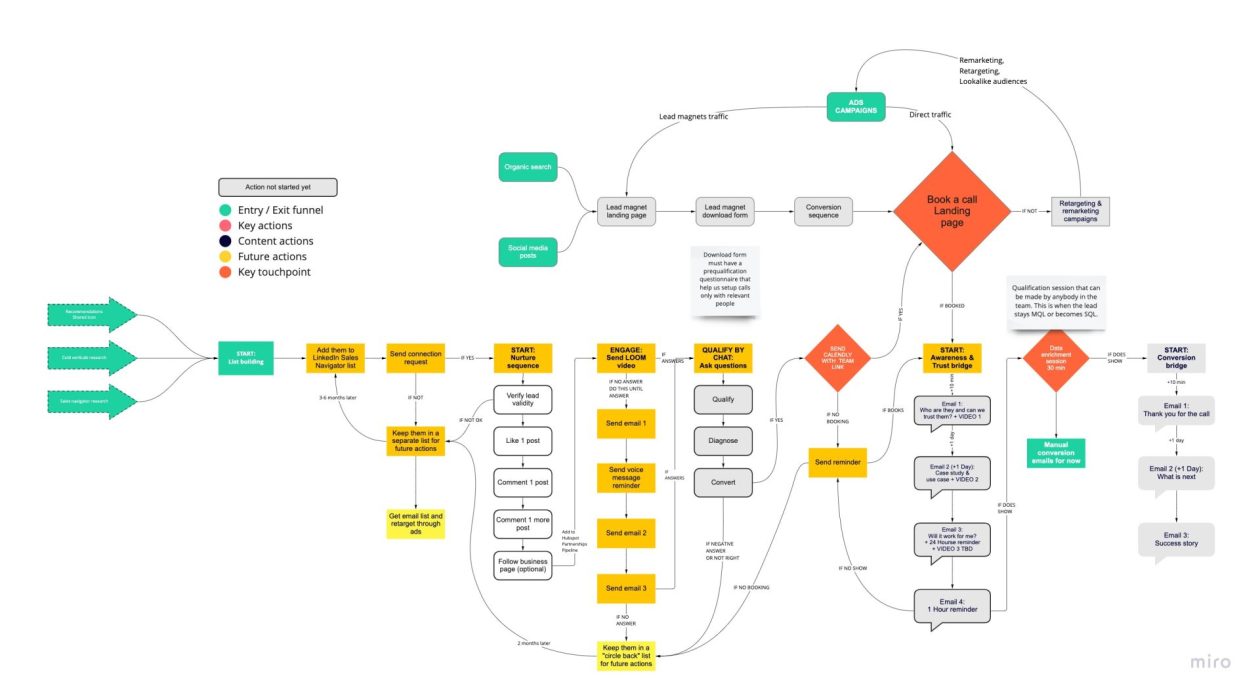
LEAD GENERATION & DEMAND GENERATION SOLUTION FOR RPA LEAD GENERATION
Inbound Marketing
The marketing strategy included activities for inbound marketing (focused more on the long term) and outbound marketing (with a shorter term view). The inbound marketing strategy for demand gen included:
A content marketing plan to showcase thought leadership in each specific targeted industry, with a frequency of 1 long form, value packed article per month;
Videos that presented the team and their process when approaching a new client, to set rapport with the client even before the first conversation;
Using relevant case studies that showed the experience the client had in each particular industry. The articles and case studies were also collated in whitepapers, that generated warm leads;
An organic social media plan, that addressed the needs of customers in all sales life cycle (awareness, consideration, conversion), with specific types of content aimed at each stage, with the sole objective to improve the performance of the RPA lead generation campaign for our client;
A digital ads plan, to promote the content generated and to bring back customers to the site through remarketing, but also to be top of mind for those searching for specific keywords and showing an active interest in automation;
A lead nurturing plan, to ensure that leads generated through all the efforts were kept warm until they were ready to convert, in which constant contact was ensured either through LinkedIn interactions or personalized emails.
Outbound Marketing
The outbound marketing strategy for audience acquisition included:
A LinkedIn cold outreach plan for the RPA lead generation campaign that expanded the network of key sales managers from the team and started conversations with target contacts. It also included nurturing activities for potential customers to help warm them up before starting any type of conversation;
An email outreach sequence to generate meetings for the sales team;
Lead gen ads, targeting the customer personas on LinkedIn.
OVERCOMING CHALLENGES
The project was not devoid of its challenges and overcoming these was possible only with a good working relationship between the client and the agency.
Here are some of the challenges:
Timing:
The main challenge was the client’s desire for immediate results. While the marketing department was well aware of the amount of work necessary to start and set up a whole ecosystem while lacking any type of processes, the sales department was rather impatiet.
Every project has a strategy, a setup and a testing period to begin with, which can last between 1 and 4 months, depending on available information and data, as well as client response time. The account manager ensured that the internal client team offered quick responses, which helped decrease the set-up period. During the testing period we deployed 3 different cold outreach messaging sequences, after which the sequence with the best open and reply rates was used in the following period. The first set of warm leads started coming in during month 3 of the project.
The client understood that it is a long-term game and that peak performance will be obtained after testing, improving and optimizng based on actual data gathered during the first months of our collaboration.
Positioning:
The automation market has become crowded over the past years, with many new actors entering the market and established companies growing stronger. The agency’s task was to find a unique positioning for the client that showcased strengths and helped differentiate them from their competitors.
Following market research, a unique positioning was found, which reflected experience, friendliness, going the extra mile for the client and commitment to delivering the best project for the specific needs of the client instead of focusing on internal targets. These were communicated in landing pages, case studies, articles and emails deployed.
Cold Outreach Saturation:
Given the seniority of the target audience, they were frequently bombarded with messages from sales professionals who wanted to present them with different offerings.
LinkedIn messages would often be ignored and a lot of our client’s potential customers wouldn’t even be active on the social media platform.
In order to counter this, we approached the RPA lead generation outreach in two ways:
With the contacts active on LinkedIn, we started a nurturing phase, where we established a connection through liking and commenting on their posts before engaging with them through private messages.
With the contacts inactive on LinkedIn, we included them in the emailing sequence and tried to understand, from the first email, whether they were the decision makers in their company for RPA services before proceeding with the rest of the emails.
The tone and approach of the communication generated friendly responses, even when they were negative. Which is a big win for our RPA lead generation campaign.
/
The results
RESULTS
MONTHS 1-6
750
average monthly visits on landing pages, from ads mostly
1.07%
average conversion rate in form completion (1–2 forms filled in per month)
56%
average email open rate
13.4%
average response rate from omni-channel cold outreach
1.9%
average percentage of meetings set per month
MONTHS 6-12
1600
average monthly visits on landing pages, from ads mostly
2.58%
average conversion rate in form completion (1–2 forms filled in per month)
69%
average email open rate
18.1%
average response rate from omnichannel cold outreach
3.5%
average percentage of meetings set per month
CONCLUSIONS AND KEY LEARNINGS FOR THE RPA LEAD GENERATION CAMPAIGN
The main learning from this project was that onboarding plays a huge role in setting the right expectations on both client and agency side.
Another big learning was that lead generation efforts can only be successful when client and agency work well together. True collaboration leads to good results. Being open with our clients helped us deliver the best results possible for their industry and services.
The biggest learning on the client side was understanding how connected marketing and sales are and how much of a difference it makes when these two departments start thinking of themselves as one team with different functions.
Having processes implemented, at least some, for key steps and moments, makes a big difference in delivering good results. This is valid for both agency and client. On the agency side, a process in lead generation helps with predictability and it offers a wider playground for testing strategies, tactics and assumptions about the client’s ideal customer profile. On the client side, having processes for both the marketing and sales department helps smooth collaboration and helps save up feedback, approval and implementation time to say the least. Without clear processes, workflows are sluggish, decision making is slow and implementation is inevitably delayed. This in turn expands the timeline, pushes deadlines and leads to delayed results.
Lead and demand generation are long term marketing efforts that contribute to increasing sales metrics and brand awareness. They help build authority and get to the right clients in the right way at the right moment. Basically this is the secret sauce for a successful RPA lead generation omni-channel campaign.
Need help growing your business? Let's talk. We can help you!
/
The outcomes
10+
SQLs per month
+23%
Email open rate
+84%
Positive reply rate
/
The disclaimer
We anonymize most of our case studies, especially the information-dense ones, for obvious reasons. We respect our clients’ confidentiality and the strategic work we create for them. This applies even when clients approve promotional case studies. The strategies, frameworks, and results are real. The competitive advantages stay protected.
/
CASE STUDIES